- Market Value (2025): USD 800.0 Mn
- Estimated Value (2026): USD 900.0 Mn
- Forecast Value (2036): USD 2,000.0 Mn
- CAGR (2026-2036): 8.3%
What is the Color Correcting Glasses Market forecast to be worth by 2036?
USD 900.0 million in 2026 to USD 2,000.0 million by 2036, at 8.3% CAGR.
- The market crossed USD 800.0 million in 2025 as direct sales and accessibility trials widened product exposure.
- Demand is projected to increase from USD 900.0 million in 2026 to USD 2,000.0 million by 2036.
- The market is forecast to record an 8.3% CAGR through 2036 supported by more accurate subtype and prescription matching.
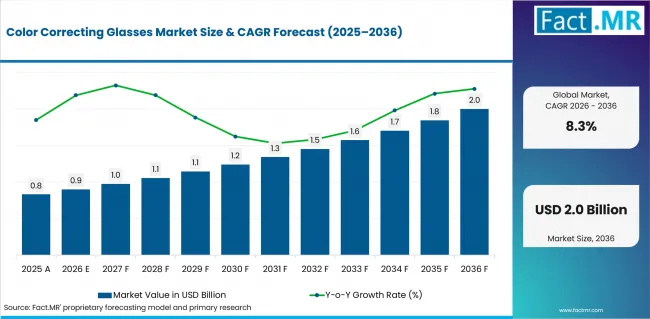
Color Correcting Glasses Market Value Analysis | Source: Fact.MR
What are the defining numbers behind Color Correcting Glasses Market growth?
USD 1,100.0 million absolute opportunity by 2036, led by Red-Green Color Blindness Glasses and Color Vision Deficiency Management alongside Individual Consumers.
- Demand Drivers in the Market
- Consumers require subtype guidance because red-green and blue-yellow deficiencies respond differently to spectral filters during product selection.
- Optometrists need prescription-ready filters that support refractive correction without requiring another everyday frame for regular wear.
- Museums and schools prefer managed trials that demonstrate practical benefits under familiar lighting conditions before purchase decisions.
- Key Segments Analyzed
- By product: Red-green color blindness glasses are expected to hold 48.0% share in 2026, supported by inherited need.
- By application: Color vision deficiency management is projected to account for 52.0% share in 2026, owing to recurring tasks.
- By end user: Individual consumers are anticipated to capture 61.0% share in 2026, due to personal fit decisions.
- By distribution channel: Online retail is estimated to represent 49.0% share in 2026, attributable to direct ordering.
- By lens type: Tinted optical lenses are forecast to garner 45.0% share in 2026, driven by selective filtering.
- Analyst Opinion at Fact.MR
- Shambhu Nath Jha, Sr. Consultant at Fact.MR, opines: “Accurate matching between deficiency type and intended use determines value. Revenue is expected to favor testable benefits and clear limitations while prescription integration and managed trials improve qualified demand.”
- Strategic Implications
- Eyewear brands should separate indoor and outdoor recommendations across different lighting environments for routine use.
- Optical retailers should review subtype and prescription needs before accepting customized orders with limited return flexibility.
- Museums and schools need to define borrowing procedures without implying medical correction or universal outcomes for wearers.
- Corporate safety teams must preserve formal testing for regulated occupational eligibility during product guidance and workplace claims.
In September 2025, EnChroma expanded its program with the Oklahoma City Museum of Art and supported free controlled comparisons that reduce purchase uncertainty across variable wearer responses.
The USA is projected to record a 9.6% CAGR through 2036 as direct access and public trials reduce purchase uncertainty. Japan is forecast to expand at a 9.3% CAGR and Germany is expected to post a 9.0% CAGR owing to dense optical stores and prescription fitting. The United Kingdom is anticipated to grow at an 8.7% CAGR as aviation standards limit occupational claims. Canada is estimated to advance at an 8.4% CAGR, supported by national delivery and regulated eye-care routes.
How does the Color Correcting Glasses Market break down by segment?
Red-green color blindness glasses account for 48.0%, color vision deficiency management represents 52.0%.
Which product dominates the market in 2026?
Red-green color blindness glasses are projected to hold 48.0% share in 2026
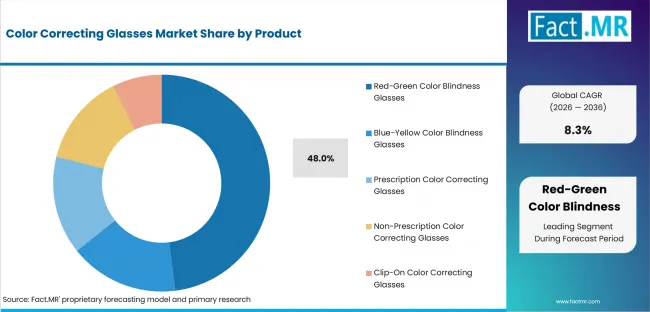
Color Correcting Glasses Market Analysis By Product | Source: Fact.MR
Based on product, red-green color blindness glasses are projected to account for 48.0% share in 2026 due to inherited need. Subtype guidance and lighting-specific trials reduce mismatched customized orders and unnecessary returns for optical retailers.
What leads the application segment?
Color vision deficiency management is anticipated to account for 52.0% share in 2026
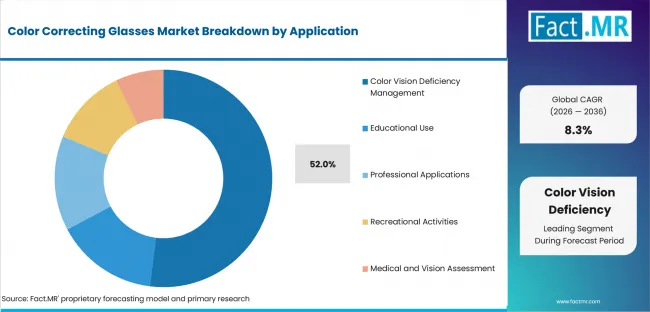
Color Correcting Glasses Market Analysis By Application | Source: Fact.MR
In 2026, color vision deficiency management is expected to lead application with 52.0% share because recurring tasks create broad need. Managed trials strengthen adoption by connecting specific viewing tasks with suitable optical guidance during selection.
How do individual consumers shape the end user segment?
Individual consumers are expected to capture 61.0% share in 2026
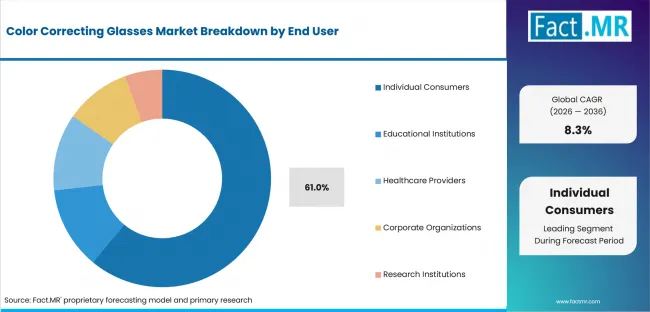
Color Correcting Glasses Market Analysis By End User | Source: Fact.MR
By end user, individual consumers are estimated to hold 61.0% share in 2026 owing to personal fit decisions. Institutional demonstrations lower uncertainty before personal purchases but cannot guarantee consistent outcomes across wearers during repeated use.
What supports online retail within distribution channel?
Online retail is estimated to hold 49.0% share in 2026
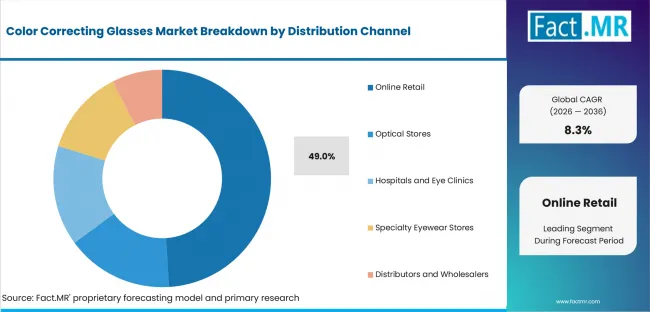
Color Correcting Glasses Market Analysis By Distribution Channel | Source: Fact.MR
By distribution channel, online retail is forecast to represent 49.0% share in 2026 through direct education and ordering. Direct websites reduce discovery friction while optical practices handle prescription fitting for customized customer orders.
What drives tinted optical lenses within lens type?
Tinted optical lenses are forecast to account for 45.0% share in 2026
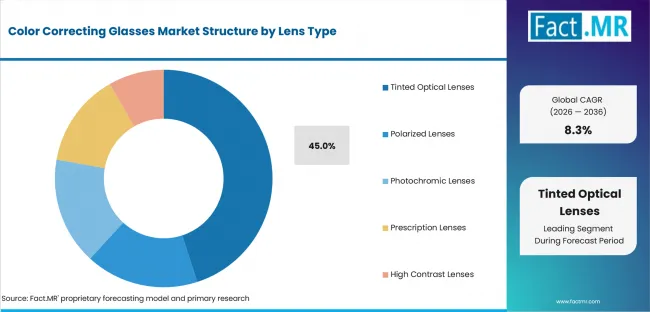
Color Correcting Glasses Market Analysis By Lens Type | Source: Fact.MR
Tinted optical lenses are projected to hold 45.0% share in 2026 owing to selective wavelength control. Alternative wearing formats require separate material development and safety evaluation before routine commercialization within consumer channels.
What is accelerating Color Correcting Glasses Market adoption, and what is holding it back?
Persistent color-dependent tasks drive demand while variable user response and occupational restrictions restrain broader adoption.
Drivers Impact Analysis
| DRIVER | (~) % IMPACT ON CAGR |
GEOGRAPHIC RELEVANCE | IMPACT TIMELINE |
|---|---|---|---|
| Persistent task needs | +0.9% | Global | Medium term (2-4 years) |
| Institutional accessibility trials | +0.7% | North America and Europe | Medium term (2-4 years) |
| Online education and ordering | +0.6% | North America and Asia Pacific | Short term (<= 2 years) |
| Prescription subtype matching | +0.5% | Europe and North America | Medium term (2-4 years) |
| Recreation and cultural trials | +0.4% | Global | Long term (>= 4 years) |
Source: Fact.MR analysis. Updated Jul 31, 2026
- Persistent task needs: Color-coded materials and daily activities create recurring demand for task-specific filtered assistance.
- Institutional trials: Museums and schools lower purchase uncertainty through familiar activities under real lighting before purchase.
- Direct online education: Brand websites reduce mismatched orders through subtype guidance and clear return terms.
- Prescription integration: Prescription-ready filters support refractive correction and color-dependent tasks within one everyday frame during routine use.
Opportunity Impact Analysis
| OPPORTUNITY | (~) % IMPACT ON CAGR |
GEOGRAPHIC RELEVANCE | IMPACT TIMELINE |
|---|---|---|---|
| Guided trials before purchase | +0.6% | North America and Europe | Short term (<= 2 years) |
| Prescription and clip-on integration | +0.5% | Global | Medium term (2-4 years) |
| Personalized optical fitting | +0.4% | Europe and Japan | Medium term (2-4 years) |
| Lighting-specific product ranges | +0.3% | North America and Asia Pacific | Long term (>= 4 years) |
Source: Fact.MR analysis. Updated Jul 31, 2026
- Guided trial programs: Institutional lending lets consumers compare filtered and unfiltered viewing before purchase decisions.
- Prescription and clip-on integration: Both formats reduce the burden of carrying separate eyewear during regular use.
- Personalized optical fitting: Practitioner screening separates deficiency type from refractive needs and task expectations during product selection.
Restraints Impact Analysis
| RESTRAINT | (~) % IMPACT ON CAGR |
GEOGRAPHIC RELEVANCE | IMPACT TIMELINE |
|---|---|---|---|
| Variable wearer response | -0.7% | Global | Short term (<= 2 years) |
| Occupational certification limits | -0.6% | USA, UK and Canada | Short term (<= 2 years) |
| Customized-order return exposure | -0.4% | Global | Medium term (2-4 years) |
| Limited reimbursement and fitting access | -0.3% | Europe and dispersed markets | Long term (>= 4 years) |
Source: Fact.MR analysis. Updated Jul 31, 2026
- Variable response: An April 2026 clinical trial recorded mixed results across participants and reinforced personalized trials before purchase.
- Occupational restrictions: Aviation testing limits filtered eyewear to assistance instead of regulated qualification in safety-sensitive occupations.
- Customization risk: Non-transferable prescription inventory requires realistic trials and clear return limits for customized orders.
Which countries are scaling Color Correcting Glasses Market fastest?
USA 9.6%, Japan 9.3%, Germany 9.0%, United Kingdom 8.7%, Canada 8.4%.
Regional analysis covers North America and Latin America alongside Western and Eastern European markets. Coverage also includes East Asia and South Asia and Pacific with Middle East and Africa.
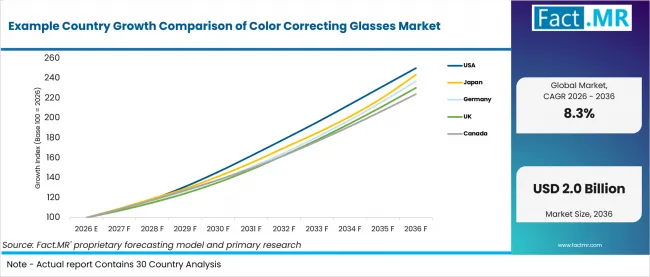
Example Country Growth Comparison Of Color Correcting Glasses Market | Source: Fact.MR
| COUNTRY | CAGR |
|---|---|
| USA | 9.6% |
| Japan | 9.3% |
| Germany | 9.0% |
| United Kingdom | 8.7% |
| Canada | 8.4% |
Source: Fact.MR analysis. Updated Jul 31, 2026
What underpins Color Correcting Glasses adoption in the USA?
9.6% CAGR, supported by direct brand access and managed accessibility trials.
The USA is projected to expand at a 9.6% CAGR through 2036, supported by direct brand access, museum lending, and strong online education. Occupational certification rules keep filtered eyewear positioned as an assistive product rather than a qualification tool, so growth remains tied to consumer trials and prescription-aware selection.
What supports the Japan outlook through 2036?
9.3% CAGR, driven by technical credibility and localized wavelength guidance.
Japan is forecast to grow at a 9.3% CAGR through 2036 as precision optics and wavelength-specific research support careful product evaluation. Localized guidance helps consumers compare color tasks across daily settings, while competition from screen-based wearable vision tools keeps product claims focused on practical optical assistance.
What supports the German market outlook?
9.0% CAGR, owing to dense optical retail coverage and prescription coordination.
Germany is anticipated to post a 9.0% CAGR during the forecast period, supported by broad optical retail coverage and practitioner-led fitting. Prescription coordination supports customized specialty filters and local store access reduces mismatch risk for consumers who need subtype guidance before ordering task-specific color correcting glasses.
What underpins growth in the United Kingdom?
8.7% CAGR, supported by optometry access and strict claim boundaries.
The United Kingdom is estimated to register an 8.7% CAGR by 2036, supported by optometry access, specialty eyewear channels, and structured vision testing. Aviation and workplace claim boundaries restrict positioning in regulated occupations, so demand is expected to remain stronger across education, recreation, and personal daily-use assistance.
How is Canada developing Color Correcting Glasses demand?
8.4% CAGR, reinforced by nationwide delivery and structured color-perception rules.
Canadian consumers combine national delivery with optometry support across remote communities and widely separated population centers. Health Canada reported 17.8 optometrists and 22.7 opticians per 100,000 people which supports an expected 8.4% CAGR through 2036 despite service gaps.
Who leads the Color Correcting Glasses Market?
EnChroma and Pilestone cover broad consumer formats while Colorlite and ChromaGen strengthen practitioner-led prescription fitting.
The competitive landscape divides between direct brands and practitioner-fitted systems, while clinical explanation and prescription fulfillment increase entry costs. EnChroma and Pilestone cover broad consumer formats, while Colorlite and ChromaGen emphasize fitting and other providers address specialty systems.
Which companies are the key providers?
EnChroma, Pilestone, Colorlite, ChromaGen, VINO Optics, ColorMax, and COLORON are the key providers profiled.
- EnChroma
- Pilestone
- Colorlite
- ChromaGen
- VINO Optics
- ColorMax
- COLORON
Bibliography
- ChromaGen Europe. (n.d.). ChromaGen lenses for color blindness and dyslexia.
- Peabody Essex Museum. (2024, October 21). PEM launches partnership with EnChroma.
- Oklahoma City Museum of Art. (2025, September 12). OKCMOA partners with EnChroma.
- Federal Aviation Administration. (2025, August 27). Item 52: Color vision.
- Health Canada. (2026, June 4). National Strategy for Eye Care.
- Hsu, J.-C., et al. (2026, April 29). Effects of notch filters in correcting color vision deficiency. Diagnostics, 16(9), 1347.
- Nagoya Institute of Technology. (2026, July 22). Molecular basis of red-green color vision.
- National Eye Institute. (2025, November 5). Color blindness.
- Northern Ireland Statistics and Research Agency. (2025, June 12). Nearly 460,000 sight tests delivered in 2024-25.
- Zentralverband der Augenoptiker und Optometristen. (2026, April 28). ZVA-Branchenbericht 2025/2026.
This Report Addresses
- The report examines product and application choices that shape consumer selection and institutional accessibility programs.
- Segment analysis covers red-green products and color vision deficiency management alongside individual consumer purchasing patterns.
- Regional outlook compares the USA and Japan with Germany and the United Kingdom alongside Canada commercially.
- Competitive analysis profiles key color-correction eyewear providers across direct and practitioner-led routes within current channels.
- Product assessment covers red-green and blue-yellow eyewear across prescription and clip-on formats for different users.
- Use-case assessment covers daily support and education alongside professional and recreational settings with clinical demonstrations.
What does the Color Correcting Glasses Market cover?
Red-Green Color Blindness Glasses, Blue-Yellow Color Blindness Glasses, Prescription Configurations, and Tinted Optical Lenses used for task-specific color discrimination support.
The market covers spectral-filter eyewear supporting color separation through prescription or non-prescription formats for people with color vision deficiency.
Selective wavelength filtering separates the category from ordinary corrective eyewear because filtered lenses remain task-specific aids without restoring normal color vision.
What is included in the scope?
Spectral-filter eyewear used to support color discrimination across daily activities and selected educational or professional environments.
The scope includes red-green and blue-yellow products across prescription or non-prescription formats with tinted and adaptive lenses.
What is excluded from the scope?
General sunglasses, ordinary corrective eyewear, software-based recoloring tools, and medical treatments for acquired color vision changes are outside the scope.
The scope excludes ordinary sunglasses and standard prescription lenses alongside software recoloring and clinical treatments outside the eyewear boundary.
How was the analysis built?
The analysis draws on 120+ sources, 35+ company portfolios, 25+ countries, and more than 20 industry interviews.
- Primary Research: Primary research includes discussions with manufacturers, service providers, technology developers, distributors, end users, procurement teams, and subject-matter experts. These conversations examine purchasing priorities, product adoption, operational challenges, approval requirements, competitive positioning, and the factors that influence wider market acceptance.
- Desk Research: Desk research covers government statistics, regulatory publications, company filings, trade data, technical studies, industry associations, standards, public policy, and other authoritative sources. Every source used in the analysis is documented in the bibliography.
- Market Sizing and Forecasting: Market estimates combine historical performance, demand indicators, pricing and volume trends, segment shares, company participation, country-level growth, adoption patterns, investment activity, and barriers to market expansion.
- Data Validation and Update Cycle: Findings are validated by comparing primary interviews with public data, company activity, regulatory changes, trade patterns, and industry developments. Regular updates review new product launches, capacity changes, partnerships, approvals, procurement trends, and shifts in commercial adoption.
Segmentation
What is the report’s scope and coverage?
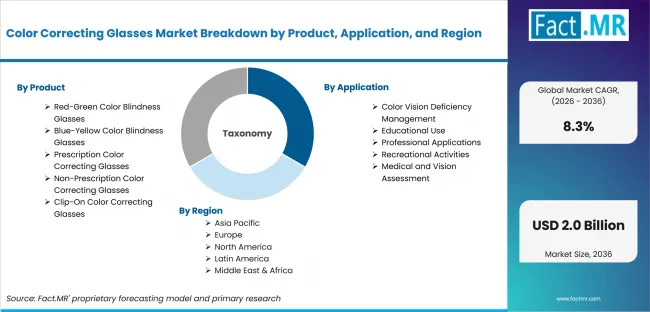
Color Correcting Glasses Market Breakdown By Product, Application, And Region | Source: Fact.MR
| Coverage field | Report scope |
|---|---|
| Quantitative Units | USD million |
| Market Definition | Spectral-filter eyewear supporting color discrimination across daily tasks and selected professional settings |
| Product | Red-Green Color Blindness Glasses, Blue-Yellow Color Blindness Glasses, Prescription Color Correcting Glasses, Non-Prescription Color Correcting Glasses, Clip-On Color Correcting Glasses |
| Application | Color Vision Deficiency Management, Educational Use, Professional Applications, Recreational Activities, Medical and Vision Assessment |
| End User | Individual Consumers, Educational Institutions, Healthcare Providers, Corporate Organizations, Research Institutions |
| Distribution Channel | Online Retail, Optical Stores, Hospitals and Eye Clinics, Specialty Eyewear Stores, Distributors and Wholesalers |
| Lens Type | Tinted Optical Lenses, Polarized Lenses, Photochromic Lenses, Prescription Lenses, High Contrast Lenses |
| Regions Covered | North America, Latin America, Western Europe, Eastern Europe, East Asia, South Asia and Pacific, Middle East and Africa |
| Countries Covered | United States, Canada, Brazil, Mexico, Argentina, Chile, Germany, France, United Kingdom, Italy, Spain, Benelux, Nordics, Poland, Czech Republic, Romania, Hungary, China, Japan, South Korea, India, ASEAN, Australia and New Zealand, GCC Countries, South Africa, Türkiye, Israel |
| Key Companies Profiled | EnChroma, Pilestone, Colorlite, ChromaGen, VINO Optics, ColorMax, COLORON |
| Forecast Period | 2026 to 2036 |
| Approach | Top-down and bottom-up analysis using prevalence, product availability, segment shares, channel access, and regulatory limits |
Source: Fact.MR analysis. Updated Jul 31, 2026
How is the market segmented?
-
By Product:
- Red-Green Color Blindness Glasses
- Indoor Color Correcting Glasses
- Outdoor Color Correcting Glasses
- Blue-Yellow Color Blindness Glasses
- Indoor Blue-Yellow Glasses
- Outdoor Blue-Yellow Glasses
- Prescription Color Correcting Glasses
- Single Vision Prescription Glasses
- Progressive Prescription Glasses
- Non-Prescription Color Correcting Glasses
- Standard Lens Glasses
- Polarized Lens Glasses
- Clip-On Color Correcting Glasses
- Flip-Up Clip-On Glasses
- Magnetic Clip-On Glasses
- Red-Green Color Blindness Glasses
-
By Application:
- Color Vision Deficiency Management
- Deuteranomaly
- Protanomaly
- Educational Use
- Classroom Learning
- STEM Education
- Professional Applications
- Design and Creative Work
- Electrical and Technical Work
- Recreational Activities
- Gaming
- Outdoor Sports
- Medical and Vision Assessment
- Clinical Demonstrations
- Vision Therapy Support
- Color Vision Deficiency Management
-
By End User:
- Individual Consumers
- Adults
- Children
- Educational Institutions
- Schools
- Universities
- Healthcare Providers
- Ophthalmology Clinics
- Optometry Clinics
- Corporate Organizations
- Industrial Employers
- Design and Media Companies
- Research Institutions
- Vision Science Laboratories
- Medical Research Centers
- Individual Consumers
-
By Distribution Channel:
- Online Retail
- Brand-Owned Websites
- E-Commerce Marketplaces
- Optical Stores
- Independent Optical Stores
- Optical Retail Chains
- Hospitals and Eye Clinics
- Hospital Optical Centers
- Specialty Eye Clinics
- Specialty Eyewear Stores
- Color Vision Specialty Stores
- Low Vision Centers
- Distributors and Wholesalers
- National Distributors
- Regional Distributors
- Online Retail
-
By Lens Type:
- Tinted Optical Lenses
- Dichromatic Filter Lenses
- Spectral Filtering Lenses
- Polarized Lenses
- Outdoor Polarized Lenses
- Anti-Glare Polarized Lenses
- Photochromic Lenses
- Indoor-Outdoor Transition Lenses
- UV Adaptive Lenses
- Prescription Lenses
- Single Vision Lenses
- Progressive Lenses
- High Contrast Lenses
- Digital Screen Optimized Lenses
- High Definition Contrast Lenses
- Tinted Optical Lenses
-
By Region:
- North America
- United States
- Canada
- Latin America
- Brazil
- Mexico
- Argentina
- Chile
- Western Europe
- Germany
- France
- United Kingdom
- Italy
- Spain
- Benelux
- Nordics
- Eastern Europe
- Poland
- Czech Republic
- Romania
- Hungary
- East Asia
- China
- Japan
- South Korea
- South Asia and Pacific
- India
- ASEAN
- Australia and New Zealand
- Middle East and Africa
- GCC Countries
- South Africa
- Türkiye
- Israel
- North America
Frequently Asked Questions
Which product is expected to hold the primary share?
How is color vision deficiency management positioned in 2026?
What supports individual consumers within end-user demand?
How much share is online retail estimated to represent?
Which lens type is projected to account for the primary share?
What supports the USA’s projected color correcting glasses expansion?
What is the primary driver in the color correcting glasses market?
What is the main restraint in the color correcting glasses market?
Who worked on this report


Preview the report firsthand - request a free sample
Free SampleGet the brochure for pricing and purchase details
Download PDF