- Market Value (2025): USD 7.19 Bn
- Estimated Value (2026): USD 7.68 Bn
- Forecast Value (2036): USD 14.8 Bn
- CAGR (2026-2036): 6.8%
What is the Colored Polyurethane (PU) Foams Market forecast to be worth by 2036?
USD 7.7 billion in 2026 to USD 14.8 billion by 2036 at a 6.8% CAGR.
- As per Fact.MR analysis, the colored polyurethane (PU) foams market was valued at USD 7.19 billion in 2025.
- Demand will grow from USD 7.68 Billion in 2026 to USD 14.8 billion by 2036.
- The forecast records a 6.8% CAGR from 2026 to 2036, supported by demand for customized cushioning materials across furniture, automotive, packaging, and other industrial applications.
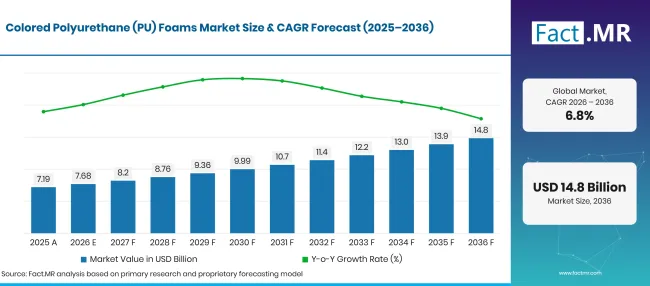
Colored Polyurethane Pu Foams Market Forecast Global | Source: Fact.MR
| Year | Basis | Market Value (USD billion) |
|---|---|---|
| 2025 | Actual | 7.19 |
| 2026 | Estimate | 7.68 |
| 2036 | Forecast | 14.8 |
| CAGR 2026 to 2036 | Forecast period | 6.8% |
Source: Fact.MR analysis. Updated Oct 30, 2026
What are the defining numbers behind Colored Polyurethane (PU) Foams Market growth?
USD 7.1 billion absolute opportunity between 2026 and 2036.
- Demand Drivers in the Market
- Flexible polyurethane foam is widely used in mattresses, pillows, sofas, and upholstered furniture. Its cushioning properties and customizable density support demand for products tailored to different comfort and design requirements.
- Polyurethane foam is used in vehicle seating, headliners, interior trim, and noise and vibration management. Germany produced approximately 4.15 million passenger cars in 2025, illustrating the scale of a major automotive end-use sector.
- Manufacturers can adjust foam density, hardness, dimensions, and coloration to suit different applications. These capabilities allow converters and OEM suppliers to serve varied requirements in furniture, packaging, electronics, and industrial components.
- Key Segments Analyzed
- By Product Type: Flexible PU Foams will account for 42.5% of the market in 2026, reflecting their broad use in cushioning, upholstery, bedding, and transportation.
- By Application: Automotive holds 28.4% of the market in 2026, supported by the use of polyurethane foam in vehicle interiors and seating.
- By End-User: Residential leads with 48.2% of the market in 2026, reflecting demand for mattresses, upholstered furniture, cushions, and other home comfort products.
- Analyst Opinion at Fact.MR
- Shambhu Nath Jha, Principal Consultant at Fact.MR, states, “Colored polyurethane foams can serve manufacturers seeking consistent cushioning performance alongside specific visual or product-identification requirements. Suppliers that maintain color consistency, reliable physical properties, and application-specific quality standards are better positioned to serve furniture, automotive, and industrial customers.”
- Strategic Implications
- Manufacturers should maintain consistent color, density, hardness, and resilience across production batches to meet OEM specifications.
- Furniture and bedding suppliers should prioritize cushioning performance, durability, and product consistency when selecting colored foam grades.
- Automotive component manufacturers should evaluate foam performance against applicable flammability, emissions, durability, and interior-component requirements.
- Packaging converters should select foam grades according to cushioning, shock absorption, dimensions, and the protection requirements of the packaged goods.
Germany is set to record a 7.8% CAGR through 2036. Brazil is projected to post 7.1%, followed by the USA at 6.5%. The UK is estimated to advance at 5.8%, while Japan is forecast to record a 5.1% CAGR.
How does the Colored Polyurethane (PU) Foams Market break down by segment?
Fact.MR finds that Flexible PU Foams leads Product Type at 42.5%; Automotive leads Application at 28.4%; Residential leads End-User at 48.2%.
Which Product Type dominates?
Flexible PU Foams is set to hold a 42.5% share in 2026.
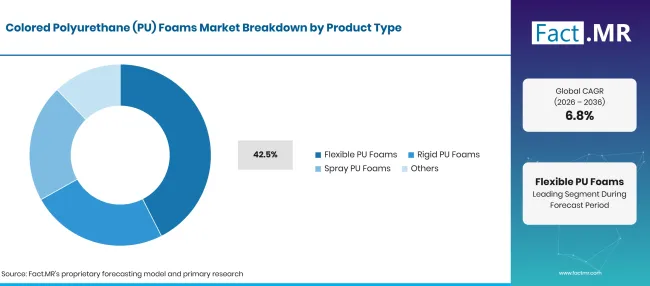
Colored Polyurethane Pu Foams Market Breakdown Product Type | Source: Fact.MR
| Product Type | Share (2026) |
|---|---|
| Flexible PU Foams (Leading segment) | 42.5% |
| Other segments combined | 57.5%* |
| Total | 100.0% |
Source: Fact.MR analysis. Updated Oct 30, 2026
Flexible polyurethane foams provide cushioning and flexibility with adjustable physical properties. These characteristics support their use in sofas, mattresses and vehicle seating as well as protective packaging. Colored grades can help manufacturers distinguish product variants and meet specific visual requirements. Rigid PU foams and spray PU foams serve different insulation, construction and industrial needs.
What leads the Application segment?
Automotive is set to represent a 28.4% share in 2026.
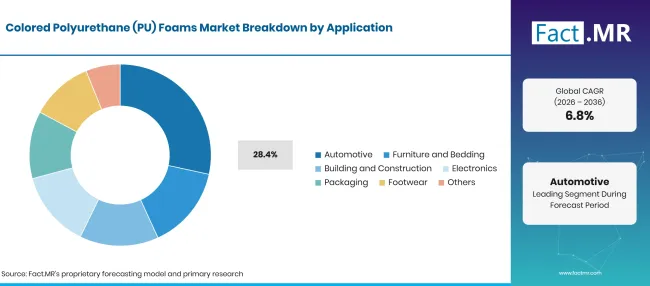
Colored Polyurethane Pu Foams Market Breakdown Application | Source: Fact.MR
| Application | Share (2026) |
|---|---|
| Automotive (Leading segment) | 28.4% |
| Other segments combined | 71.6%* |
| Total | 100.0% |
Source: Fact.MR analysis. Updated Oct 30, 2026
Automotive applications use polyurethane foams in seats, headliners, interior trim, and components that help manage sound and vibration. Foam selection depends on comfort, durability, dimensional requirements, and compliance with relevant vehicle specifications. Furniture and bedding, building and construction, electronics, packaging, and footwear provide additional application opportunities.
How does End-User shape demand?
Residential segment holds a 48.2% share in 2026.
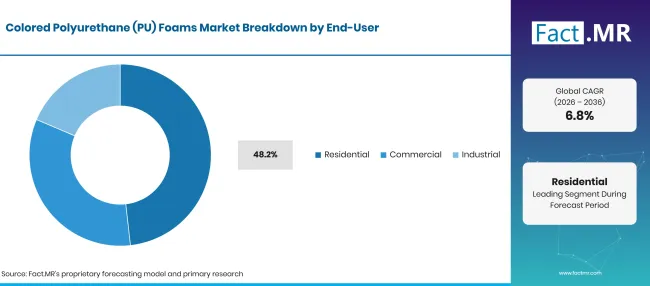
Colored Polyurethane Pu Foams Market Breakdown End User | Source: Fact.MR
| End-User | Share (2026) |
|---|---|
| Residential (Leading segment) | 48.2% |
| Other segments combined | 51.8%* |
| Total | 100.0% |
Source: Fact.MR analysis. Updated Oct 30, 2026
Residential demand is supported by the use of polyurethane foam in mattresses and pillows as well as sofas and upholstered furniture. Manufacturers can choose different densities and hardness levels to meet product design needs and price points. Commercial and industrial customers have distinct requirements, including durability and consistent dimensions along with suitability for specific operating environments.
What is accelerating Colored Polyurethane (PU) Foams Market adoption, and what is holding it back?
Demand for customized cushioning and expanding end-use applications support adoption, while raw-material costs and color consistency as well as performance requirements can constrain growth.
Drivers Impact Analysis
| DRIVER | (~) % IMPACT ON CAGR | Geographic relevance | Impact timeline |
|---|---|---|---|
| Demand for customized furniture and bedding | +1.0% | Global | Medium term (2–4 years) |
| Automotive seating and interior applications | +0.9% | Europe, Asia, Americas | Medium term (2–4 years) |
| Growth in protective and specialty packaging | +0.6% | Global | Short term (≤ 2 years) |
| Customized density, hardness, and coloration | +0.5% | Global | Short term (≤ 2 years) |
| Industrial and consumer-product applications | +0.4% | Global | Long term (≥ 4 years) |
Source: Fact.MR analysis. Updated Oct 30, 2026
Opportunity Impact Analysis
| OPPORTUNITY | (~) % IMPACT ON CAGR |
||
|---|---|---|---|
| Development of application-specific colored foam grades | +0.8% | Global | Medium term (2–4 years) |
| Consistent color matching for OEM production | +0.6% | Europe, Asia | Medium term (2–4 years) |
| Customized foam conversion and die-cutting | +0.5% | Americas, Asia | Short term (≤ 2 years) |
| Recycled and renewable-content foam development | +0.4% | Global | Long term (≥ 4 years) |
Source: Fact.MR analysis. Updated Oct 30, 2026
Restraints Impact Analysis
| RESTRAINT | (~) % IMPACT ON CAGR | Geographic relevance | Impact timeline |
|---|---|---|---|
| Fluctuating raw-material costs | -0.8% | Global | Short term (≤ 2 years) |
| Color variation between production batches | -0.6% | Global | Short term (≤ 2 years) |
| Application-specific safety and performance requirements | -0.5% | Global | Medium term (2–4 years) |
| Price competition in standard foam grades | -0.4% | Global | Medium term (2–4 years) |
Source: Fact.MR analysis. Updated Oct 30, 2026
Which countries are scaling the Colored Polyurethane (PU) Foams Market through 2036?
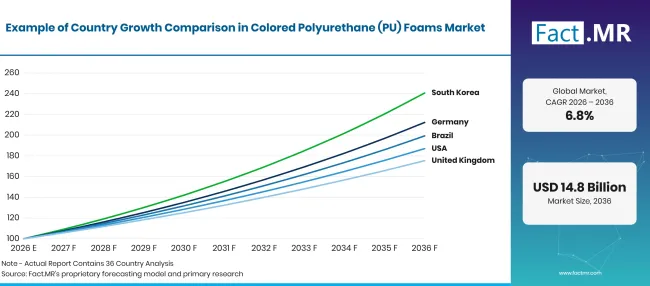
Colored Polyurethane Pu Foams Market Growth Index | Source: Fact.MR
| Country | CAGR (2026–2036) |
|---|---|
| Germany | 7.8% |
| Brazil | 7.1% |
| USA | 6.5% |
| UK | 5.8% |
| Japan | 5.1% |
Source: Fact.MR analysis. Updated Oct 30, 2026
What supports Germany adoption?
7.8% CAGR, supported by established automotive manufacturing and demand for engineered foam components.
Germany's automotive industry provides a substantial market for polyurethane foam used in vehicle seating and interiors. The German Association of the Automotive Industry reported that domestic passenger-car production reached approximately 4.15 million units in 2025, up 2% from the previous year [1]. Foam suppliers can serve automotive customers by maintaining consistent physical properties and meeting application-specific quality requirements.
How is Brazil developing colored PU foam adoption?
7.1% CAGR, shaped by automotive manufacturing and demand for furniture and consumer products.
Brazil produced approximately 2.644 million motor vehicles in 2025, an increase of 3.5% compared with 2024, according to the Brazilian vehicle manufacturers' association Anfavea [2]. This industrial base creates opportunities for suppliers of seating, cushioning, and interior components. Residential furniture and packaging applications provide additional avenues for colored foam manufacturers.
What supports United States adoption?
6.5% CAGR, led by diverse automotive, furniture, packaging, and industrial applications.
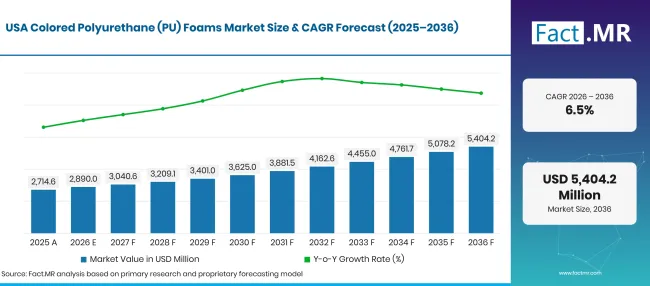
Colored Polyurethane Pu Foams Market Forecast Usa | Source: Fact.MR
The United States has an established market for flexible polyurethane foam in upholstered furniture, bedding, transportation, and protective packaging. The Polyurethane Foam Association identifies these as important applications for flexible foam [3]. Suppliers can differentiate their products through cushioning performance, custom dimensions, and application-specific coloration.
How is the United Kingdom building adoption?
5.8% CAGR, backed by automotive components and industrial applications.
The UK automotive industry manufactured 764,715 cars and commercial vehicles in 2025, according to the Society of Motor Manufacturers and Traders [4]. Although production declined during the year, vehicle interiors remain a relevant application for polyurethane foam. Furniture and bedding manufacturers also provide demand for cushioning materials, while converters can serve specialist packaging and industrial requirements.
What supports Japan adoption?
5.1% CAGR, shaped by automotive manufacturing and established polyurethane foam production capabilities.
Japan produced approximately 8.41 million four-wheeled vehicles in 2025, up 2.1% year over year, according to the Japan Automobile Manufacturers Association [5]. Automotive interiors, seating, furniture, and other cushioning applications provide potential outlets for colored polyurethane foams. Domestic manufacturers can compete through consistent quality, tailored physical properties, and specialized foam formulations.
Who leads the Colored Polyurethane (PU) Foams Market?
Fact.MR profiles INOAC Corporation, Rogers Corporation, Sharp Foam Industries Pvt. Ltd., Ashoka PU Foam (India) Pvt. Ltd., and V. K. Polymer Products based on their relevance to polyurethane foam manufacturing and related product applications.
INOAC Corporation has a particularly direct fit through its COLORFOAM portfolio, which explicitly offers polyurethane foams in different colors and hardness levels [6].
Sharp Foam Industries manufactures flexible polyurethane foams in different densities and colors, including grades intended for furniture and textile applications. Ashoka PU Foam manufactures flexible foams in multiple grades and colors for applications including upholstery and packaging. V. K. Polymer Products lists colored high-density PU foam sheets and other polyurethane foam products.
Rogers Corporation manufactures engineered polyurethane foam materials, including its PORON portfolio. Its documented polyurethane foam portfolio establishes specialty foam manufacturing capability, while specific colored grades require separate product-level confirmation [7]. [7]
Competition in this market depends on color consistency and density control along with cushioning performance. Processing capabilities and the ability to meet customer specifications also influence supplier selection. Buyers should distinguish manufacturers that offer colored foam products directly from suppliers whose polyurethane portfolios focus on other specialty foam applications.
Which companies are the key providers?
Companies assessed across colored and specialty polyurethane foam products include INOAC Corporation, Rogers Corporation, Sharp Foam Industries Pvt. Ltd., Ashoka PU Foam (India) Pvt. Ltd., and V. K. Polymer Products. INOAC documents colored polyurethane foam grades; specific colored-product offerings of other suppliers require individual product verification.
- INOAC Corporation
- Rogers Corporation
- Sharp Foam Industries Pvt. Ltd.
- Ashoka PU Foam (India) Pvt. Ltd.
- V. K. Polymer Products
Bibliography
- [1] German Association of the Automotive Industry. (2026, January 5). Passenger car production in 2025 slightly above previous year's level.
- [2] Associação Nacional dos Fabricantes de Veículos Automotores. (2026, January 15). Produção e venda de autoveículos crescem em 2025 e Anfavea projeta nova alta em 2026.
- [3] Polyurethane Foam Association. (n.d.). Flexible polyurethane foam applications.
- [4] Society of Motor Manufacturers and Traders. (2026, January 29). Tough year for auto but new models and Industrial Strategy can deliver growth.
- [5] Japan Automobile Manufacturers Association. (n.d.). 四輪車 [Four-wheeled vehicles].
- [6] INOAC Corporation. (n.d.). Color Foam®.
- [7] Rogers Corporation. (2026, February 25). Rogers Corporation launches PORON® ReSource30 polyurethane foam.
This Report Answers
- The report describes how colored polyurethane foams serve residential, commercial, automotive, and industrial applications.
- Product-type analysis compares flexible, rigid, spray, and other polyurethane foam categories.
- Application analysis examines automotive, furniture and bedding, construction, electronics, packaging, and footwear demand.
- Country analysis discusses Germany, Brazil, the USA, the UK, and Japan alongside relevant industrial indicators.
- The competitive overview profiles five companies with documented polyurethane foam products or related material capabilities.
What does the Colored Polyurethane (PU) Foams Market cover?
The market covers polyurethane foam products manufactured in colored grades for cushioning, comfort, protective packaging, automotive components, and other applications. It includes flexible and rigid foam products, spray foams, and other specified categories where coloration is a relevant product characteristic.
Market demand depends on the physical properties of the foam, the required color, processing methods, and suitability for the end application. The report distinguishes between product types, applications, and end-user categories to examine their respective contributions to demand.
What is included in the scope?
Included products are polyurethane foams in colored grades for the stated applications. Coverage includes foam products used in residential furniture and mattresses as well as automotive interiors and packaging. It also covers products for construction, electronics, footwear and relevant industrial applications.
What is excluded from the scope?
The analysis excludes non-polyurethane foam materials unless they form part of a separately defined polyurethane product offering. Uncolored polyurethane foams sold without a relevant colored-grade specification are outside the narrowest interpretation of this market. Raw polyurethane chemicals, standalone coloring agents, foam-processing machinery, and unrelated finished products are excluded from the defined foam-product revenue boundary.
How Was the Analysis Built?
The analysis draws on 120+ sources, 35+ company portfolios, 25+ countries, and more than 20 industry interviews.
- Primary Research: Primary research includes discussions with manufacturers, service providers, technology developers, distributors, end users, and subject-matter experts. These conversations examine purchasing priorities, product adoption, operational challenges, approval requirements, competitive positioning, and the factors that influence wider market acceptance.
- Desk Research: Desk research covers government statistics, regulatory publications, company filings, trade data, technical studies, industry associations, standards, public policy, and other authoritative sources. Every source used in the analysis is documented in the bibliography.
- Market Sizing and Forecasting: Market estimates combine historical performance, demand indicators, pricing and volume trends, segment shares, company participation, country-level growth, adoption patterns, investment activity, and barriers to market expansion.
- Data Validation and Update Cycle: Findings are validated by comparing primary interviews with public data, company activity, regulatory changes, trade patterns, and industry developments. Regular updates review new product launches, capacity changes, partnerships, approvals, and shifts in commercial adoption.
Segmentation
What is the report's scope and coverage?
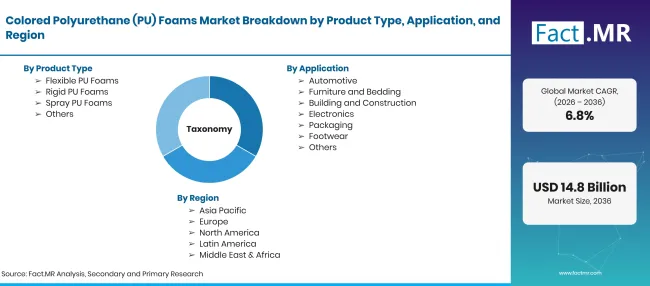
Colored Polyurethane Pu Foams Market Taxonomy | Source: Fact.MR
| Attribute | Details |
|---|---|
| Quantitative Units | USD 7.7 billion in 2026 to USD 14.8 billion by 2036, at a 6.8% CAGR |
| Market Definition | The Colored Polyurethane (PU) Foams Market covers polyurethane foam products manufactured in different colors for cushioning and comfort applications. These foams serve furniture and bedding production as well as automotive interiors and protective packaging. |
| Product Type | Flexible PU Foams; Rigid PU Foams; Spray PU Foams; Others |
| Application | Automotive; Furniture and Bedding; Building and Construction; Electronics; Packaging; Footwear; Others |
| End-User | Residential; Commercial; Industrial; Others |
| Regions Covered | North America; Latin America; Western Europe; Eastern Europe; East Asia; South Asia and Pacific; Middle East and Africa |
| Countries Covered | Germany; Brazil; USA; UK; Japan |
| Companies Profiled | INOAC Corporation; Rogers Corporation; Sharp Foam Industries Pvt. Ltd.; Ashoka PU Foam (India) Pvt. Ltd.; V. K. Polymer Products |
| Forecast Period | 2026 to 2036 |
| Approach | Market segmentation and forecast analysis supported by application-level demand indicators, company product information, and country-level industrial statistics |
Source: Fact.MR analysis. Updated Oct 30, 2026
How is the market segmented?
-
By Product Type
- Flexible PU Foams
- Rigid PU Foams
- Spray PU Foams
- Others
-
By Application
- Automotive
- Furniture and Bedding
- Building and Construction
- Electronics
- Packaging
- Footwear
- Others
-
By End-User
- Residential
- Commercial
- Industrial
- Others
-
By Region
- North America
- Latin America
- Western Europe
- Eastern Europe
- East Asia
- South Asia and Pacific
- Middle East and Africa
Frequently Asked Questions
How big is the Colored Polyurethane (PU) Foams Market in 2026?
What is the CAGR from 2026 to 2036?
Which product type has the largest share?
Which application leads the market?
Which companies are covered?
Who worked on this report


Preview the report firsthand - request a free sample
Free SampleGet the brochure for pricing and purchase details
Download PDF