- Market Value (2025): USD 1.3 Bn
- Estimated Value (2026): USD 1.5 Bn
- Forecast Value (2036): USD 5.5 Bn
- CAGR (2026-2036): 14.1%
What is the Compostable Food Service Coatings Market forecast to be worth by 2036?
USD 1.5 billion in 2026 to USD 5.5 billion by 2036, at a 14.1% CAGR.
- The market is valued at USD 1.3 billion in 2025.
- Demand is projected to increase from USD 1.5 billion in 2026 to USD 5.5 billion by 2036.
- The market is forecast to record a 14.1% CAGR from 2026 to 2036 as food-service packaging shifts toward coated fiber formats that require documented barrier performance and credible end-of-life claims.
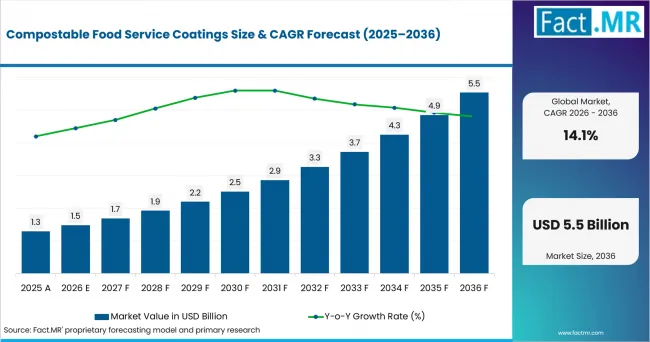
Compostable Food Service Coatings Value Analysis | Source: Fact.MR
What are the defining numbers behind Compostable Food Service Coatings Market growth?
The market is projected to create an absolute dollar opportunity of USD 4.1 billion between 2026 and 2036.
- Demand Drivers in the Market
- Paper cups, trays and molded-fiber formats need coatings that can withstand water and grease during food-service use.
- EU packaging rules are pushing food-contact packaging toward barrier chemistries that can meet tighter PFAS restrictions.
- Coatings used in direct food or beverage contact must also meet migration and safety requirements.
- Compostability depends on more than the coating itself. The finished article must be accepted by the relevant treatment system, so certification and local collection conditions influence material choice.
- Key Segments Analyzed
- By Coating Chemistry: PHA is expected to hold 29% share in 2026, supported by its use in compostability-focused barrier formulations for food-service applications.
- By Substrate: Paper cups are projected to account for 29% share in 2026. Their exposure to hot and cold beverages makes liquid resistance and seal performance important coating requirements.
- By Barrier: Water / beverage barrier is anticipated to capture 31% share in 2026, reflecting the need to limit liquid penetration across cups, trays and molded-fiber containers.
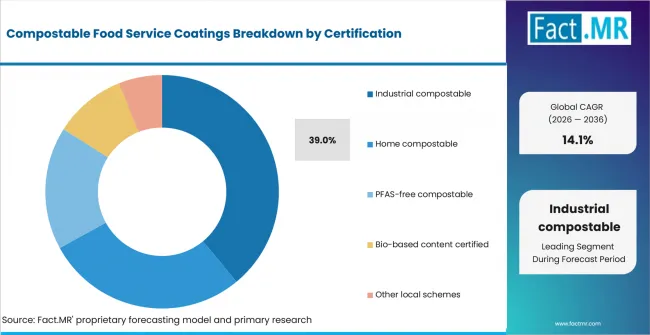
- By Certification: Industrial compostable is estimated to represent 39% share in 2026. Certification under controlled facility conditions gives suppliers a defined route for demonstrating disintegration and composting performance.
- Analyst Opinion at Fact.MR
- Shambhu Nath Jha, Senior Consultant, Fact.MR, notes that growth in compostable food service coatings will depend on how well material performance aligns with real disposal infrastructure. Demand is moving beyond simple plastic replacement toward coatings that can provide reliable liquid and grease barriers while meeting food-contact requirements and supporting credible compostability claims.
- Strategic Implications
- Coating formulators need to test performance on the intended paper or fiber substrate. Surface structure, coat weight and converting conditions can materially change liquid and grease resistance.
- Food-service converters should keep industrial and home compostability claims separate, since the two depend on different treatment conditions and certification routes.
- Packaging buyers need to confirm that the finished article is accepted by the local collection and treatment system before positioning compostability as its primary end-of-life route.
- Suppliers selling into Europe should review food-contact formulations against the PPWR requirements that began applying on 12 August 2026, particularly where PFAS restrictions affect barrier chemistry.
- These changes are also influencing the broader sustainable packaging market, where material selection increasingly depends on how a pack is expected to be recovered after use. The same shift is visible in paper packaging materials, especially for cups, trays and molded-fiber formats that require functional surface protection.
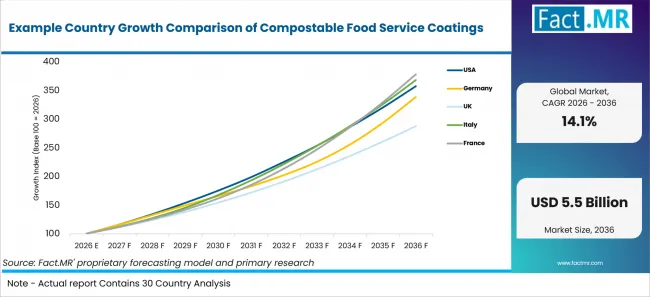
France is projected to record 14.2% CAGR through 2036, followed by Italy at 13.9%. The USA is forecast at 13.6%, Germany at 13.0%, and the UK at 11.2%. The spread reflects different collection systems, packaging rules and evidence requirements around food-contact and compostability claims.
How does the Compostable Food Service Coatings Market break down by segment?
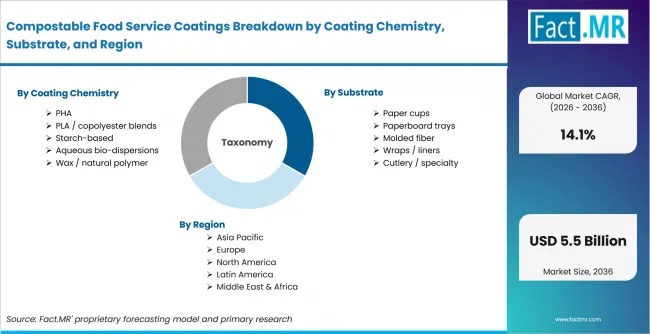
The Compostable Food Service Coatings Market is segmented by coating chemistry into PHA, PLA / copolyester blends, starch-based, aqueous bio-dispersions and wax / natural polymer; by substrate into paper cups, paperboard trays, molded fiber, wraps / liners and cutlery / specialty; by barrier into water / beverage, grease resistance, heat sealability, heat resistance and oxygen / aroma; and by certification into industrial compostable, home compostable, PFAS-free compostable, bio-based content certified and other local schemes.
Which Coating Chemistry dominates?
PHA holds 29% share in 2026.
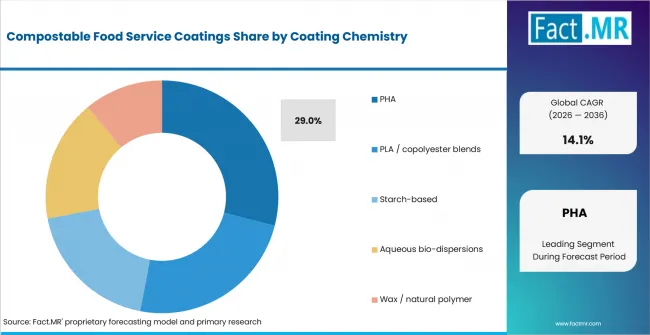
Compostable Food Service Coatings Analysis By Coating Chemistry | Source: Fact.MR
PHA is expected to hold 29% share in 2026, making it the leading coating chemistry in the market. Its position reflects demand for compostability-oriented barrier systems that can support sealing, surface protection and processing requirements across food-service applications. Fraunhofer IVV also highlights the need to assess bio-based coatings for processing behavior, recyclability and protective performance on the intended substrate.
What leads the Substrate segment?
Paper cups account for 29% share in 2026.
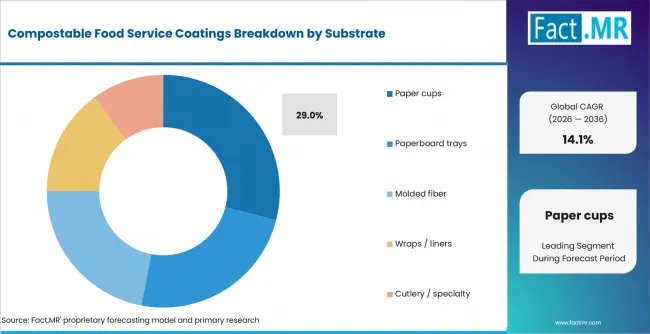
Compostable Food Service Coatings Analysis By Substrate | Source: Fact.MR
Paper cups are projected to hold 29% share in 2026, making them the leading substrate in the market. Their use in beverage service creates a clear need for coatings that improve liquid resistance, sealing performance and surface protection. This shift also connects with the next-generation paper and fiber-based packaging market, where coated paper and molded-fiber formats are being developed as alternatives to conventional plastic-intensive packaging.
How does Barrier shape demand?
Water / beverage barrier accounts for 31% share in 2026.
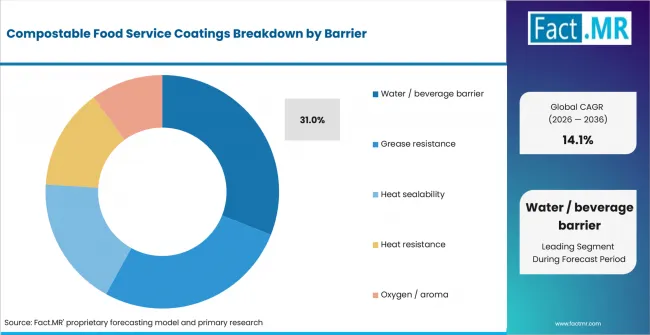
Compostable Food Service Coatings Analysis By Barrier | Source: Fact.MR
Water / beverage barrier is anticipated to hold 31% share in 2026, making it the leading barrier function in the market. Food-service formats such as cups and fiber containers require coatings that can limit liquid penetration while preserving the intended performance of the substrate. Fraunhofer IVV also highlights the role of functional coatings in improving moisture and gas barrier properties, keeping material selection closely tied to the specific application.
What supports Industrial Compostable within Certification?
Industrial compostable holds 39% share in 2026.
Compostable Food Service Coatings Analysis By Certification | Source: Fact.MR
Industrial compostable certification is estimated to represent 39% share in 2026, followed by home compostable at 28%. PFAS-free compostable accounts for 17%, bio-based content certified for 10%, and other local schemes for 6%. DIN identifies EN 13432 for packaging recoverable through composting and biodegradation and also lists home-composting test routes such as EN 17427. The distinction matters because a product designed for industrial treatment should not be presented as suitable for uncontrolled home conditions without separate evidence.
The certification discussion connects with the wider biodegradable packaging material market, where infrastructure availability and material claims affect adoption across packaging formats.
What is accelerating Compostable Food Service Coatings Market adoption, and what is holding it back?
Fiber-based food-service conversion and tighter food-contact rules support adoption; treatment access and certification complexity restrain it.
Drivers Impact Analysis
| DRIVER | (~) % IMPACT ON CAGR | GEOGRAPHIC RELEVANCE | IMPACT TIMELINE |
|---|---|---|---|
| PPWR and PFAS restrictions in food-contact packaging | +2.0% | EU | Short term (<= 2 years) |
| Fiber conversion in cups, trays and molded-fiber serviceware | +1.6% | Global | Short term (<= 2 years) |
| Food-contact safety and migration requirements | +1.0% | EU, USA | Medium term (2-4 years) |
| Certified compostable procurement and organics diversion | +0.8% | USA, Italy | Medium term (2-4 years) |
| Bio-based barrier coating development | +0.6% | Germany, France | Long term (>= 4 years) |
- PPWR and PFAS restrictions: Regulation (EU) 2025/40 began applying on 12 August 2026. The European Commission states that the framework covers packaging design and waste management and restricts PFAS in food-contact packaging above specified limits. Barrier-coating formulators therefore face a clearer compliance test when grease or water resistance has historically depended on fluorinated chemistry.
- Fiber conversion in food service: Paper cups, paperboard trays and molded fiber together represent the majority of the substrate mix. Fraunhofer IVV notes that fiber-based packaging requires suitable barrier and protective coatings because paper alone does not provide the protection needed for many packaged goods.
- Food-contact safety: EFSA states that chemicals can migrate from food-contact materials into food and evaluates possible health risks using migration and toxicological data. Coating selection therefore has to satisfy functional requirements while remaining suitable for the intended food-contact use.
- Certified compostable procurement: U.S. EPA guidance updated in January 2026 says commercially compostable food-service ware should be purchased only where a local commercial composting program accepts the relevant products and collection or hauling services are available. This ties material demand to treatment access.
- Bio-based barrier development: Fraunhofer IVV is developing bio-based functional coatings for paper and film applications and evaluates processing, safety, life-cycle behavior and recyclability alongside barrier performance.
Opportunity Impact Analysis
| OPPORTUNITY | (~) % IMPACT ON CAGR | GEOGRAPHIC RELEVANCE | IMPACT TIMELINE |
|---|---|---|---|
| PFAS-free compostable grease and water barriers | +1.3% | EU, USA | Short term (<= 2 years) |
| Coatings optimized for paper cups and molded fiber | +1.0% | Global | Medium term (2-4 years) |
| Home-compostable systems with stronger claim evidence | +0.7% | UK, Italy, France | Long term (>= 4 years) |
| Aqueous and natural-polymer coating development | +0.5% | Germany, France | Long term (>= 4 years) |
- PFAS-free compostable barriers: The EU restriction on PFAS in food-contact packaging creates a direct formulation opportunity for systems that provide grease or liquid resistance without relying on restricted chemistry. The market already assigns 17% to PFAS-free compostable certification, showing that chemical composition and end-of-life evidence are being evaluated together.
- Paper cup and molded-fiber optimization: Paper cups lead substrate demand at 29%, while molded fiber accounts for 22%. Both formats need coatings that can withstand service conditions without defeating the intended recovery route. Application-specific coat weight, sealability and liquid resistance create room for differentiated formulations.
- Home-compostable systems: Home compostable certification accounts for 28%. DIN distinguishes home-composting test routes from industrial compostability, which creates an opportunity for products that can demonstrate performance under the separate conditions required for household treatment claims.
- Aqueous and natural-polymer systems: Aqueous bio-dispersions hold 17% and wax / natural polymer coatings 11%. Fraunhofer IVV research on proteins, waxes and other bio-based coatings shows an active development path for oxygen, water-vapor and grease protection on fiber substrates.
Restraints Impact Analysis
| RESTRAINT | (~) % IMPACT ON CAGR | GEOGRAPHIC RELEVANCE | IMPACT TIMELINE |
|---|---|---|---|
| Limited acceptance in commercial composting systems | -1.1% | USA, UK | Short term (<= 2 years) |
| Barrier performance versus recovery compatibility | -0.8% | Global | Medium term (2-4 years) |
| Certification and claim fragmentation | -0.6% | Europe, USA | Medium term (2-4 years) |
| Food-contact qualification and migration testing | -0.4% | EU | Long term (>= 4 years) |
- Composting acceptance: EPA states that commercial composting availability is limited and that some facilities do not accept compostable products. A coating can meet a certification route and still fail to deliver its intended end-of-life outcome if the finished serviceware is not collected or accepted locally.
- Barrier versus recovery compatibility: Fraunhofer IVV describes a direct trade-off between the barrier effect of a paper coating and the recyclability of the coated paper. Stronger functional layers can complicate downstream treatment, so coating design has to be assessed as part of the finished structure.
- Certification and claim fragmentation: UBA reported in August 2026 that certification systems for recycled plastics vary significantly in audit scope, depth and transparency. Although that study concerns recycled plastics, it reinforces the broader compliance issue that certification quality and claim credibility cannot be assumed from a label alone.
- Food-contact qualification: EFSA continues to publish food-contact material opinions and recycling-process assessments in 2026. Coatings used on cups, trays or liners must therefore be evaluated for the intended food-contact application, which can extend development and approval work.
Which Countries Are Scaling the Compostable Food Service Coatings Market Through 2036?
- France leads Italy by 0.3 percentage point, supported by pressure to redesign food-service packaging and ongoing research aimed at reducing conventional plastic use.
- Italy remains 0.3 percentage point ahead of the USA, supported by its established framework for municipal waste management and separate collection.
- The USA maintains a 0.6 percentage point lead over Germany as adoption of compostable food-service products develops alongside commercial composting infrastructure and public procurement initiatives.
- Germany remains 1.8 percentage points ahead of the UK, with producer-responsibility requirements and certification scrutiny influencing material selection across food-service applications.
- The UK completes the assessed country range as collection infrastructure continues to develop and local acceptance conditions remain important for compostability claims.
Example Country Growth Comparison Of Compostable Food Service Coatings | Source: Fact.MR
| Country | CAGR |
|---|---|
| France | 14.2% |
| Italy | 13.9% |
| USA | 13.6% |
| Germany | 13.0% |
| UK | 11.2% |
What supports the France outlook?
14.2% CAGR through 2036, supported by food-packaging redesign and stronger scrutiny of plastics in food systems.
France is forecast to record 14.2% CAGR through 2036. INRAE reported in May 2025 that food and beverage packaging accounted for 91% of plastic use within French agriculture and food systems. The same assessment stresses that plastics described as biodegradable may decompose only under specific conditions. This raises the value of coating designs that reduce conventional plastic layers and use clearer end-of-life claims.
How is Italy scaling demand?
13.9% CAGR through 2036, supported by separate-collection and municipal-waste management discipline.
Italy is projected to post 13.9% CAGR through 2036. ISPRA's Municipal Waste Report, edition 2025, provides national data updated to 2024 on waste production, separate collection, management and packaging flows. For compostable food-service formats, that system context matters because certified articles require a collection and treatment route that can manage them without contaminating other streams.
What supports USA adoption?
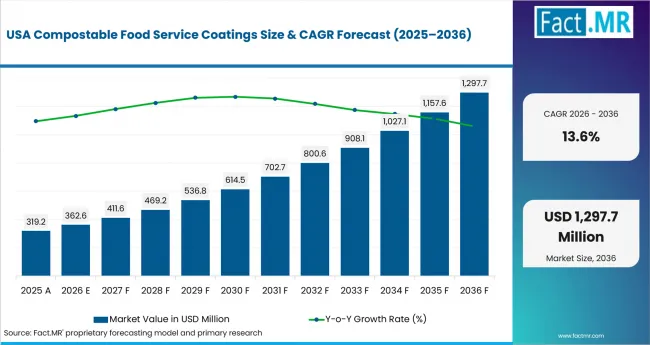
13.6% CAGR through 2036, shaped by commercial composting access and procurement rules for certified serviceware.
Compostable Food Service Coatings Country Value Analysis | Source: Fact.MR
The USA is anticipated to advance at 13.6% CAGR through 2036. EPA guidance updated in January 2026 places certified commercially compostable food-service ware behind reusable formats and recommends it only where a commercial composting program is locally available, accepts the products and has collection or hauling in place. Demand therefore depends on both coating performance and local organics infrastructure.
What underpins Germany’s growth?
13.0% CAGR through 2036, supported by producer-responsibility administration and stronger certification scrutiny.
Germany is estimated to grow at 13.0% CAGR through 2036. The German Environment Agency manages the Single-Use Plastics Fund through DIVID, with affected manufacturers bearing specified collection and cleaning costs. In August 2026, UBA also published an assessment showing substantial differences in the scope, depth and transparency of recycled-plastic certification systems. The broader implication for compostable coatings is a compliance environment that rewards evidence-backed material and claim decisions.
How does the UK perform?
11.2% CAGR through 2036, shaped by collection-system development and the need to align material claims with local recovery routes.
The UK is expected to grow at 11.2% CAGR through 2036. WRAP reports that flexible plastic represents more than 27% of UK consumer plastic packaging while only a small share is recycled, and collection trials have shown materially higher recovery where dedicated systems are introduced. For compostable food-service coatings, the commercial issue is similar: a product claim has more value when collection and treatment pathways are available at scale.
Demand from coated cups, trays and other service formats also overlaps with the broader foodservice packaging market, where material selection is tied to food-contact performance and disposal conditions.
Who leads the Compostable Food Service Coatings Market?
BASF, Novamont and Danimer Scientific are among the leading participants in the Compostable Food Service Coatings Market. The supplier base remains fragmented, with competition centered on coating chemistry, processing compatibility, food-contact suitability and support for compostability certification.
CJ Biomaterials, Mitsubishi Chemical Group and Solenis also compete across biodegradable polymers and functional coating systems. Market positioning depends increasingly on whether suppliers can deliver barrier performance while meeting regulatory and end-of-life requirements.
Which companies are the key providers?
Key companies include BASF, Novamont, Danimer Scientific, CJ Biomaterials, Mitsubishi Chemical Group, and Solenis.
- BASF
- Novamont
- Danimer Scientific
- CJ Biomaterials
- Mitsubishi Chemical Group
- Solenis
Bibliography
- U.S. Environmental Protection Agency. Sustainable Management of Plastics.
- Umweltbundesamt. Waste and Resources.
- WRAP. Flexible Plastic Kerbside Collection Trial.
- ISPRA. Waste, Recycling and Circular Economy Publications.
- INRAE. Bioeconomy, Materials and Eco-design Research.
- European Commission, Directorate-General for Environment. Packaging and Packaging Waste.
- European Food Safety Authority. Food Contact Materials.
- Fraunhofer Institute for Process Engineering and Packaging IVV. Bio-based and Functional Barrier Coatings Research.
- DIN. Circular Economy and Compostability Standards.
This Report Answers
- The report examines demand for compostable coatings used on paper and fiber-based food-service packaging.
- Segment analysis covers coating chemistry, substrate, barrier function and certification while identifying the leading category within each area.
- Country analysis examines growth conditions in the USA, Germany, UK, Italy and France.
- Competitive analysis reviews leading suppliers active in biodegradable polymers and functional coating systems without disclosing company market shares.
- Application analysis considers liquid resistance, grease protection, sealing performance and compostability requirements across food-service formats.
What does the Compostable Food Service Coatings Market cover?
The Compostable Food Service Coatings Market covers functional coating systems applied to food-service packaging to provide liquid, grease, heat, sealing or gas-barrier performance while supporting an intended compostability route. Applications include paper cups, paperboard trays, molded-fiber formats, wraps, liners and selected specialty food-service products.
The market sits within the broader sustainable packaging market, particularly where packaging design is being adjusted around end-of-life requirements. It also overlaps with paper packaging materials when fiber-based formats require a functional surface layer before they can be used for beverage or prepared-food applications.
What is included in the scope?
The scope includes PHA, PLA / copolyester blends, starch-based coatings, aqueous bio-dispersions and wax / natural polymer systems used on food-service substrates. It covers coatings designed for water resistance, grease resistance, sealing, heat performance and oxygen or aroma protection.
The assessment includes coatings used on paper cups, paperboard trays, molded fiber, wraps and liners, together with selected specialty formats. The transition toward coated fiber packaging also connects with the next-generation paper and fiber-based packaging market, where barrier performance is central to replacing conventional plastic-intensive structures.
Certification coverage includes industrial compostable, home compostable, PFAS-free compostable, bio-based content certified and other local schemes. Upstream developments in the biodegradable packaging material market are considered where material properties affect coating performance or qualification.
What is excluded from the scope?
The scope excludes uncoated food-service packaging, conventional barrier layers intended solely for non-compostable disposal routes and reusable food-service products. Packaging applications outside food service are excluded unless coating performance directly overlaps with the stated market boundary.
The market does not include raw polymers sold without a food-service coating application. Separate packaging components such as recyclable food liners fall outside the core definition unless their barrier technology directly competes with compostable coating systems used on comparable food-service substrates.
How Was the Analysis Built?
- Primary Research: Primary research considers purchasing requirements, coating performance, qualification criteria, processing compatibility and adoption barriers across manufacturers, converters and food-service users.
- Desk Research: Desk research covers government publications, regulatory documents, technical research, standards and other authoritative public evidence relevant to food-contact coatings and compostability.
- Market Sizing and Forecasting: Market estimates consider demand patterns across coating chemistry, substrate, barrier function, certification and country-level adoption.
- Data Validation and Update Cycle: Findings are reviewed against regulatory developments, material-performance evidence, supplier activity and changes in packaging or waste-management requirements.
What is the report’s scope and coverage?
Compostable Food Service Coatings Breakdown By Coating Chemistry, Substrate, And Region | Source: Fact.MR
| Attribute | Details |
|---|---|
| Quantitative Units | USD billion |
| Market Definition | Functional coatings used on food-service packaging to provide barrier or sealing performance while supporting an intended compostability route |
| Coating Chemistry | PHA; PLA / copolyester blends; Starch-based; Aqueous bio-dispersions; Wax / natural polymer |
| Substrate | Paper cups; Paperboard trays; Molded fiber; Wraps / liners; Cutlery / specialty |
| Barrier | Water / beverage; Grease resistance; Heat sealability; Heat resistance; Oxygen / aroma |
| Certification | Industrial compostable; Home compostable; PFAS-free compostable; Bio-based content certified; Other local schemes |
| Regions Covered | North America; Latin America; Western Europe; Eastern Europe; East Asia; South Asia & Pacific; Middle East & Africa |
| Countries Covered | USA; Germany; UK; Italy; France |
| Key Companies Profiled | BASF; Novamont; Danimer Scientific; CJ Biomaterials; Mitsubishi Chemical Group; Solenis |
| Forecast Period | 2026 to 2036 |
| Approach | Market assessment across food-service substrate demand, coating functionality, certification requirements, regulatory conditions and country-level adoption |
How is the market segmented?
-
By Coating Chemistry
- PHA
- PLA / copolyester blends
- Starch-based
- Aqueous bio-dispersions
- Wax / natural polymer
-
By Substrate
- Paper cups
- Paperboard trays
- Molded fiber
- Wraps / liners
- Cutlery / specialty
-
By Barrier
- Water / beverage
- Grease resistance
- Heat sealability
- Heat resistance
- Oxygen / aroma
-
By Certification
- Industrial compostable
- Home compostable
- PFAS-free compostable
- Bio-based content certified
- Other local schemes
-
By Region
- North America
- Latin America
- Western Europe
- Eastern Europe
- East Asia
- South Asia & Pacific
- Middle East & Africa