- Market Value (2025): USD 1.1 Bn
- Estimated Value (2026): USD 1.2 Bn
- Forecast Value (2036): USD 2.1 Bn
- CAGR (2026-2036): 5.8%
What is the Recyclable Food Liners Market forecast to be worth by 2036?
USD 1.2 billion in 2026 and USD 2.1 billion by 2036, representing a 5.8% CAGR.
- The recyclable food liners market reached USD 1.1 billion in 2025 as foodservice operators revised barrier specifications.
- Recyclable food liners sales are expected to push valuation from USD 1.2 billion in 2026 to USD 2.1 billion by 2036.
- The market is forecast to record a 5.8% CAGR from 2026 to 2036 as restaurants adopt verified fiber barriers.
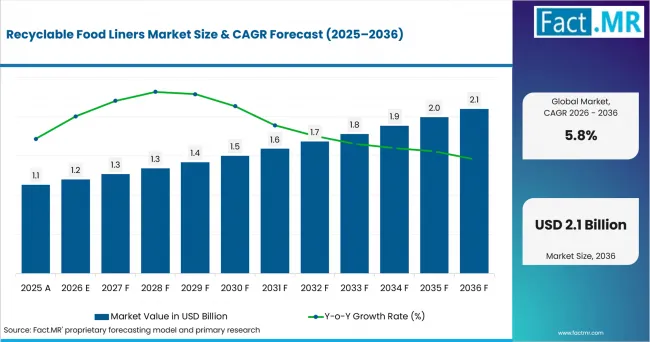
Recyclable Food Liners Market Value Analysis | Source: Fact.MR
What are the defining numbers behind Recyclable Food Liners Market growth?
USD 0.9 billion absolute opportunity by 2036, led by recyclable greaseproof paper and box - carton liners within foodservice.
- Demand Drivers in the Market
- Restaurant chains need grease control that protects food presentation without replacing established cartons or serving baskets.
- Food processors need liners that withstand filling and holding during direct contact with oily or moist foods.
- Converters require stable sheets that retain print quality across cutting, folding and high-speed packing operations.
- Retail teams need documented recovery routes that withstand closer scrutiny of packaging disposal claims during formal account reviews.
- Key Segments Analyzed
- By Material: Recyclable greaseproof paper is expected to account for 40.0% share in 2026, supported by low weight and flexible converting.
- By Product Type: Box - carton liners are projected to garner 34.0% share in 2026, owing to separated barrier and structural functions.
- By Barrier - Treatment: Grease-resistant designs are anticipated to capture 44.0% share in 2026, driven by visible staining and leakage risks.
- By Application: Quick-service restaurants are estimated to represent 38.0% share in 2026, attributable to repeated serving and takeout routines.
- By End Use: Foodservice is forecast to hold 56.0% share in 2026, reinforced by daily preparation and serving consumption.
- By Sales Channel: Direct - OEM programs are expected to record 43.0% share in 2026, shaped by controlled account specifications.
- Analyst Opinion at Fact.MR
- Shambhu Nath Jha, Principal Consultant at Fact.MR states: “Recyclable liner demand depends on proven barrier performance and practical recovery routes. Adoption is expected to favor formats that protect greasy foods without disrupting existing restaurant equipment.”
- Strategic Implications
- Restaurant teams should test liners under actual menu temperatures and holding periods before national approval.
- Food processors should compare barrier weight and migration records before approving grades for high-output lines.
- Converters should document repulpability and print performance across collection systems with different coated-paper rules during qualification reviews.
- Distributors should align case quantities and replenishment routes with regional restaurant volumes before expanding inventory.
Liner converters need grease barriers that run on existing equipment while preserving a credible recovery route. In March 2026, UPM and Paramelt introduced a recyclable food-packaging concept using barrier paper and a bio-based heat-seal coating.
India is projected to record 8.2% CAGR, supported by formal reporting and wider paper packaging materials. China is estimated to post 7.4% CAGR, driven by catering scale and takeout containers. Brazil is anticipated to register 6.3% CAGR by 2036, attributable to duties affecting regional packaging routes. The United Kingdom is forecast to expand at 6.1% CAGR, shaped by recyclability grading. Germany is expected to advance at 5.5% CAGR, reinforced by established paper recovery.
How does the Recyclable Food Liners Market break down by segment?
Recyclable Greaseproof Paper is projected to account for 40.0% share, Box - Carton Liners are estimated to garner 34.0% share.
Which material category dominates?
Recyclable greaseproof paper is forecast to lead the market with a 40.0% share in 2026.
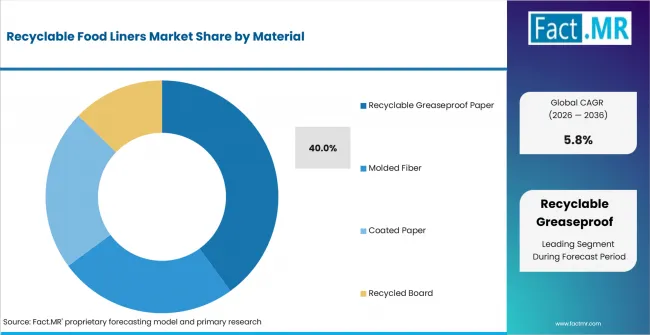
Recyclable Food Liners Market Analysis By Material | Source: Fact.MR
Recyclable greaseproof paper is projected to account for 40.0% share in 2026, supported by flexible grease control. The greaseproof paper used in food-contact converting aligns with the greaseproof paper category, where oil resistance and uniform sheet performance support consistent use across flat foodservice formats.
What leads the Product Type segment?
Box-carton liners are expected to hold a 34.0% share in 2026.
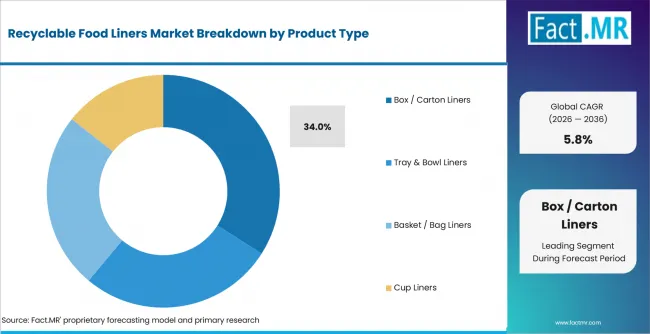
Recyclable Food Liners Market Analysis By Product Type | Source: Fact.MR
Box-carton liners are estimated to garner 34.0% share in 2026, owing to separated package functions. Box and carton liners separate food-contact protection from folding carton formats, limiting redesign across menu changes and packing stations.
How does Barrier-Treatment shape demand?
Grease-resistant designs are predicted to lead with a 44.0% share in 2026.
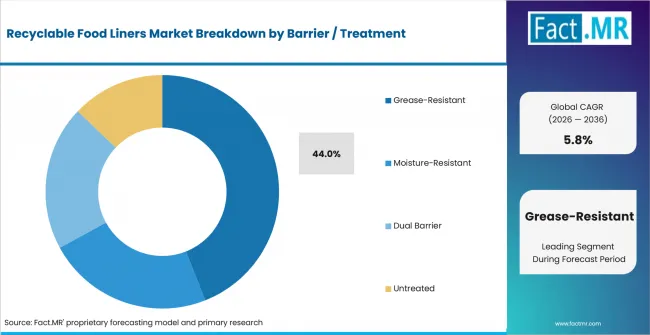
Recyclable Food Liners Market Analysis By Barrier Treatment | Source: Fact.MR
Grease-resistant designs are anticipated to represent 44.0% share in 2026, driven by visible oil failures. Coated liners that combine grease resistance with moisture control are enabled through developments in paper barrier coatings, allowing converted foodservice formats to maintain performance under varied handling conditions. In January 2025, the FDA ended 35 PFAS food-contact notifications affecting paper packaging during the compliance transition.
What supports Quick-Service Restaurants within Application?
Quick-service restaurants are likely to account for a 38.0% share in 2026.
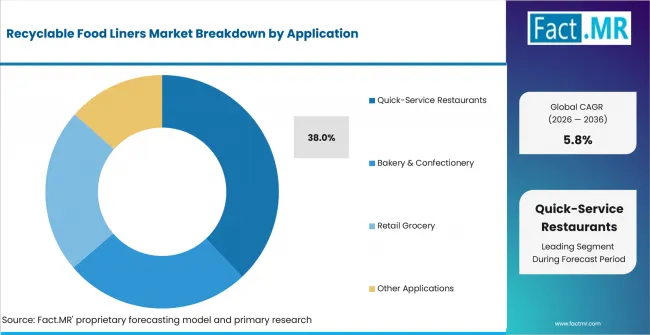
Recyclable Food Liners Market Analysis By Application | Source: Fact.MR
Quick-service restaurants are forecast to hold 38.0% share in 2026, attributable to repeated service routines. Standardized liners used in fast-moving restaurant operations are closely tied to foodservice packaging, where repeated replenishment supports serving and takeout workflows.
Which End Use category carries the primary share?
Foodservice is set to lead the segment with a 56.0% share in 2026.
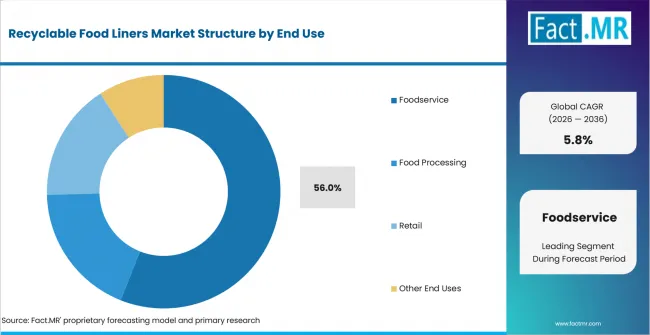
Recyclable Food Liners Market Analysis By End Use | Source: Fact.MR
Foodservice is expected to account for 56.0% share in 2026, reinforced by recurring liner consumption. Processing and distribution environments handling perishable goods extend liner usage into fresh food packaging, where grease separation is required during filling and transport stages.
Why do Direct-OEM programs lead Sales Channel demand?
Direct-OEM programs are poised to hold a 43.0% share in 2026.
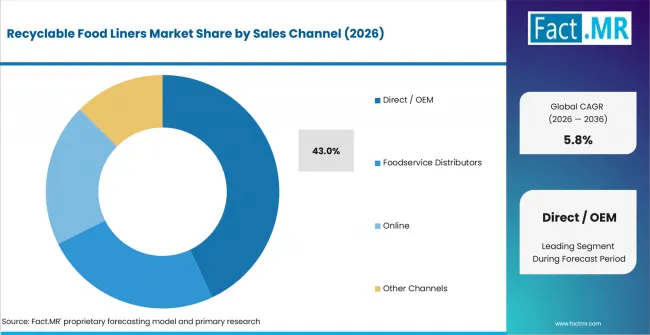
Recyclable Food Liners Market Analysis By Sales Channel | Source: Fact.MR
Direct-OEM programs are projected to capture 43.0% share in 2026, shaped by controlled specifications. Long-term supply agreements with converters and brand owners align with paper packaging materials, where controlled sizing and verified food-contact compliance support large-scale procurement programs.
What is accelerating Recyclable Food Liners Market adoption, and what is holding it back?
PFAS-free barrier reformulation drives adoption across food-contact applications, inconsistent recovery acceptance restrains conversion across fragmented local collection systems.
Drivers Impact Analysis
| DRIVER | (~) % IMPACT ON CAGR | GEOGRAPHIC RELEVANCE | IMPACT TIMELINE |
|---|---|---|---|
| PFAS-free barrier reformulation | +0.8% | North America, Europe | Short term (<= 2 years) |
| Packaging recyclability rules | +0.7% | Europe, United Kingdom | Medium term (2-4 years) |
| QSR and takeout throughput | +0.6% | Asia Pacific, North America | Medium term (2-4 years) |
| Fiber converting investment | +0.5% | Europe, North America | Medium term (2-4 years) |
| Coated-paper mill acceptance | +0.4% | North America, Europe | Long term (>= 4 years) |
Source: Fact.MR analysis. Updated Aug 1, 2026
- PFAS phase-outs: The February 2024 U.S. phase-out changed greaseproof specifications and favored documented chemistry before restaurant trials.
- Packaging recyclability rules: Regulation (EU) 2025-40 favors liner structures that fit recognized paper streams without weakening foodservice performance.
- QSR throughput: Standardized menus create predictable replenishment and reward converters that reproduce dimensions across regional plants.
- Converting investment: Stable barrier grades shorten commercial trials across printing, cutting and folding equipment already installed.
Opportunity Impact Analysis
| OPPORTUNITY | (~) % IMPACT ON CAGR | GEOGRAPHIC RELEVANCE | IMPACT TIMELINE |
|---|---|---|---|
| Low-coating grease barriers | +0.5% | Europe, North America | Medium term (2-4 years) |
| Replaceable box liners | +0.4% | Global foodservice | Medium term (2-4 years) |
| Regional QSR conversion | +0.4% | United States, India, China | Short term (<= 2 years) |
| Documented repulpability | +0.3% | Europe, United Kingdom | Long term (>= 4 years) |
Source: Fact.MR analysis. Updated Aug 1, 2026
- Low-coating barriers: Dense papers and lighter coatings preserve grease performance while reducing non-fiber content during recycling.
- Replaceable box liners: Separate liners preserve outer cartons and let restaurant groups change food-contact performance without package redesign.
- Localized QSR manufacturing: Regional converting shortens sample cycles and supports coordinated restaurant programs with dependable replenishment.
Restraints Impact Analysis
| RESTRAINT | (~) % IMPACT ON CAGR | GEOGRAPHIC RELEVANCE | IMPACT TIMELINE |
|---|---|---|---|
| Local recovery differences | -0.5% | Global municipal systems | Long term (>= 4 years) |
| Qualification cost | -0.4% | Global direct accounts | Medium term (2-4 years) |
| Food and coating residue | -0.3% | North America, Europe | Medium term (2-4 years) |
| Heat and cost trade-offs | -0.2% | Price-sensitive markets | Short term (<= 2 years) |
Source: Fact.MR analysis. Updated Aug 1, 2026
- Local recovery differences: Collection programs treat coated and food-soiled paper differently across restaurant locations and municipal systems.
- Qualification expense: Food-contact review and line trials favor larger accounts whose recurring volumes justify technical support.
- Contamination risk: Grease residue and coating losses reduce recovered-fiber quality across conventional paper recycling operations.
Which countries are scaling Recyclable Food Liners Market fastest?
Brazil 6.3%, United Kingdom 6.1%, Germany 5.5%.
Recyclable Food Liners Market is segmented into North America, Europe, Asia Pacific, Latin America, and Middle East & Africa.
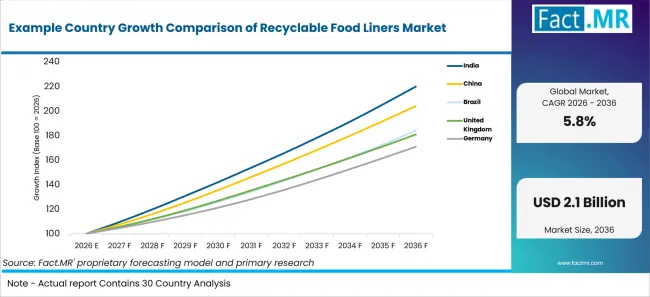
Example Country Growth Comparison Of Recyclable Food Liners Market | Source: Fact.MR
| COUNTRY | CAGR |
|---|---|
| Brazil | 6.3% |
| United Kingdom | 6.1% |
| Germany | 5.5% |
Source: Fact.MR analysis. Updated Aug 1, 2026
What supports the Brazil outlook?
6.3% CAGR, attributable to reverse-logistics obligations and expanding regional foodservice packaging requirements.
Long inland routes require Brazilian restaurant operators to balance liner durability with regional replenishment costs. Recyclable food liner demand is expected to grow at a 6.3% CAGR, supported by reverse-logistics regulations and expanding foodservice packaging use. Collection infrastructure remains uneven across regions, affecting recovery rates and recycling efficiency.
How are United Kingdom requirements shaping demand?
6.1% CAGR, shaped by recyclability grading and producer fee exposure.
Foodservice operators in the United Kingdom require consistent material documentation across restaurant and distribution networks. The industry is forecast to register a 6.1% CAGR, supported by recyclability grading systems and extended producer responsibility frameworks. Regional collection differences continue to influence end-of-life handling and recycling consistency.
Which operating conditions define Germany’s outlook?
5.5% CAGR across the forecast horizon, reinforced by established paper recovery and detailed packaging compliance.
German packaging converters operate within mature paper recovery systems and strict food-contact compliance standards. The market is expected to advance at a 5.5% CAGR, supported by established recycling infrastructure and structured packaging regulations. Coated barrier formats require careful mill acceptance and disposal alignment to ensure effective recyclability.
Who leads the Recyclable Food Liners Market?
Huhtamaki and Detmold Group provide broad direct foodservice conversion coverage, while Mondi Group and Stora Enso strengthen fiber barrier material capabilities.
Competition remains dispersed across integrated converters and specialty paper producers alongside fiber packaging platforms in this market. Entry remains possible through custom inserts, although food-contact records and coating consistency raise qualification costs.
Huhtamaki and Novolex compete with Detmold Group through finished formats and direct restaurant service across national accounts. Mondi Group and Stora Enso join Nordic Paper in supplying barrier paper, Georgia-Pacific supports recovery infrastructure.
Which companies are the key providers?
Some of the key players profiled include Huhtamaki, Novolex, Detmold Group, Mondi Group, Stora Enso, Nordic Paper, and Georgia-Pacific.
- Huhtamaki, Novolex
- Detmold Group
- Mondi Group
- Stora Enso
- Nordic Paper
- Georgia-Pacific.
Bibliography
- UPM. (2026, March 24). UPM and Paramelt introduce bio-based food packaging concept. UPM.
- U.S. Food and Drug Administration. (2025, January 3). FDA Determines Authorization for 35 Food Contact Notifications Related to PFAS Are No Longer Effective. U.S. Food and Drug Administration.
- U.S. Food and Drug Administration. (2024, February 28). FDA Announces PFAS Used in Grease-Proofing Agents for Food Packaging No Longer Being Sold in the U.S. U.S. Food and Drug Administration.
- European Parliament and Council of the European Union. (2025, January 22). Regulation (EU) 2025-40 of the European Parliament and of the Council of 19 December 2024 on packaging and packaging waste, amending Regulation (EU) 2019-1020 and Directive (EU) 2019-904, and repealing Directive 94-62-EC. Official Journal of the European Union.
- Confederation of European Paper Industries. (2025, March 13). Cepi Recyclability Test Method Version 3. Cepi.
- Press Information Bureau, Government of India. (2025, June 4). World Environment Day 2025: Shrink Your Plastic Footprint. Government of India.
- National Bureau of Statistics of China. (2026, January 20). Total Retail Sales of Consumer Goods in December 2025. National Bureau of Statistics of China.
- Agência Nacional de Vigilância Sanitária. (2026, April 17). Embalagens. Anvisa.
- Department for Environment, Food & Rural Affairs, Environment Agency, & Natural Resources Wales. (2024, December 23). Recyclability assessment methodology: how to assess your packaging waste. GOV.UK.
- Federal Statistical Office of Germany. (2026, February 23). Abfallentsorgung 2024. Destatis.
This Report Addresses
- The study contrasts Material options and Product Type formats for the Recyclable Food Liners category.
- Buyer demand is assessed across Barrier - Treatment uses and Application operating conditions.
- India, China, Brazil, United Kingdom, and Germany markets frame the country-level forecast comparison.
- Company assessment considers technical capability and qualification pathways across Recyclable Food Liners.
- End Use routes show where procurement activity concentrates across commercial accounts.
- Forecasts for Recyclable Food Liners integrate historical movement with current adoption evidence.
- Market boundaries exclude formats outside the stated conversion scope.
- Research tests performance claims against regulatory and recovery conditions.
What does the Recyclable Food Liners Market cover?
Greaseproof paper, molded fiber, coated paper, and recycled board liners protect food inside serving and transport packages.
The market covers disposable liners placed inside packages requiring a separate food-contact layer that manages grease or moisture.
Complete containers remain excluded unless a separately specified liner creates the purchased food-contact function.
What is included in the scope?
Recyclable food liners used within foodservice, processing and retail packaging that require a defined food-contact function.
Coverage includes paper and fiber-based liners sold through direct accounts, regional distributors, and online channels.
What is excluded from the scope?
Complete containers and non-recyclable films remain excluded unless a recyclable liner creates the purchased function.
Reusable serviceware and absorbent pads remain excluded when repeated use or fluid capture defines their function.
How Was the Analysis Built?
The analysis draws on 120+ sources, 35+ company portfolios, 25+ countries, and more than 20 industry interviews.
- Primary Research: Primary research includes discussions with manufacturers, service providers, technology developers, distributors, end users, procurement teams, and subject-matter experts. These conversations examine purchasing priorities, product adoption, operational challenges, approval requirements, competitive positioning, and the factors that influence wider market acceptance.
- Desk Research: Desk research covers government statistics, regulatory publications, company filings, trade data, technical studies, industry associations, standards, public policy, and other authoritative sources. Every source used in the analysis is documented in the bibliography.
- Market Sizing and Forecasting: Market estimates combine historical performance, demand indicators, pricing and volume trends, segment shares, company participation, country-level growth, adoption patterns, investment activity, and barriers to market expansion.
- Data Validation and Update Cycle: Findings are validated by comparing primary interviews with public data, company activity, regulatory changes, trade patterns, and industry developments. Regular updates review new product launches, capacity changes, partnerships, approvals, procurement trends, and shifts in commercial adoption.
Segmentation
What is the report’s scope and coverage?
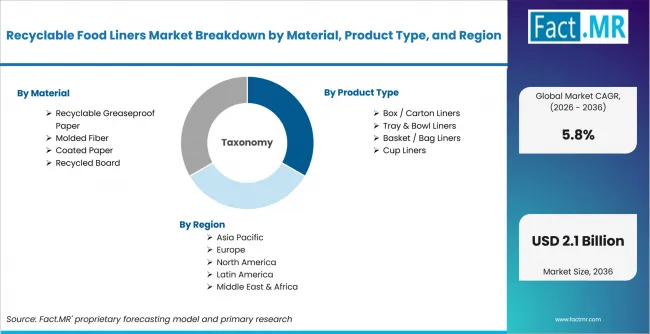
Recyclable Food Liners Market Breakdown By Material, Product Type, And Region | Source: Fact.MR
| Coverage field | Report scope |
|---|---|
| Quantitative Units | USD Billion |
| Market Definition | Disposable paper or fiber liners inside food packaging that control grease or moisture while retaining a recycling route. |
| Material | Recyclable Greaseproof Paper, Molded Fiber, Coated Paper, Recycled Board |
| Product Type | Box - Carton Liners, Tray & Bowl Liners, Basket - Bag Liners, Cup Liners |
| Barrier - Treatment | Grease-Resistant, Moisture-Resistant, Dual Barrier, Untreated |
| Application | Quick-Service Restaurants, Bakery & Confectionery, Retail Grocery, Other Applications |
| End Use | Foodservice, Food Processing, Retail, Other End Uses |
| Sales Channel | Direct - OEM, Foodservice Distributors, Online, Other Channels |
| Regions Covered | North America, Europe, Asia Pacific, Latin America, Middle East & Africa |
| Countries Covered | United States, Canada, Germany, United Kingdom, France, Italy, Spain, Benelux, Nordics, India, China, Japan, South Korea, Australia and New Zealand, ASEAN, Brazil, Mexico, Argentina, Chile, GCC Countries, South Africa, Türkiye, Israel |
| Key Companies Profiled | Huhtamaki, Novolex, Detmold Group, Mondi Group, Stora Enso, Nordic Paper, Georgia-Pacific |
| Forecast Period | 2026 to 2036 |
| Approach | Hybrid analysis using foodservice activity, conversion volumes, attachment rates, barrier mix, replacement cycles, provider checks |
Source: Fact.MR analysis. Updated Aug 1, 2026
How is the market segmented?
-
By Material:
- Recyclable Greaseproof Paper
- Molded Fiber
- Coated Paper
- Recycled Board
-
By Product Type:
- Box - Carton Liners
- Tray & Bowl Liners
- Basket - Bag Liners
- Cup Liners
-
By Barrier - Treatment:
- Grease-Resistant
- Moisture-Resistant
- Dual Barrier
- Untreated
-
By Application:
- Quick-Service Restaurants
- Bakery & Confectionery
- Retail Grocery
- Other Applications
-
By End Use:
- Foodservice
- Food Processing
- Retail
- Other End Uses
-
By Sales Channel:
- Direct - OEM
- Foodservice Distributors
- Online
- Other Channels
-
By Region:
- North America
- United States
- Canada
- Europe
- Germany
- United Kingdom
- France
- Italy
- Spain
- Benelux
- Nordics
- Asia Pacific
- India
- China
- Japan
- South Korea
- Australia and New Zealand
- ASEAN
- Latin America
- Brazil
- Mexico
- Argentina
- Chile
- Middle East & Africa
- GCC Countries
- South Africa
- Türkiye
- Israel
- North America
Frequently Asked Questions
What share does greaseproof paper capture?
How are box - carton liners placed?
Which barrier category carries primary share?
What supports QSR demand?
What share does foodservice hold?
Why do direct - OEM programs carry weight?
How quickly does India expand?
What shapes China’s expansion?
What supports Brazil’s liner demand?
How is the UK outlook developing?
What defines Germany’s outlook?
What drives market conversion?
Who worked on this report


Preview the report firsthand - request a free sample
Free SampleGet the brochure for pricing and purchase details
Download PDF