- Base Value(2026): 635.0 Mn
- Estimated Value(2026): 635.0 Mn
- Forecast Value (2036): 2481.0 Mn
- CAGR (2026 - 2036): 14.6%
Compostable Bubble Film Packaging Materials Market Forecast and Outlook 2026 to 2036
The compostable bubble film packaging materials market records USD 635.0 million in 2026 and advances to USD 2,481.0 million by 2036 at a 14.60% CAGR.
Compostable Bubble Film Packaging Materials Market Key Takeaways
- Compostable Bubble Film Packaging Materials Market Value (2026): USD 635.0 million
- Compostable Bubble Film Packaging Materials Market Forecast Value (2036): USD 2,481.0 million
- Compostable Bubble Film Packaging Materials Market Forecast CAGR 2026 to 2036: 14.6%
- Leading Cushioning Format: Bubble wrap and air pillows
- Key Growth Regions: Asia Pacific, North America, Europe, Latin America, Middle East & Africa
- Top Players: Storopack, Sealed Air, Pregis, Ranpak, Huilong, FP Corporation
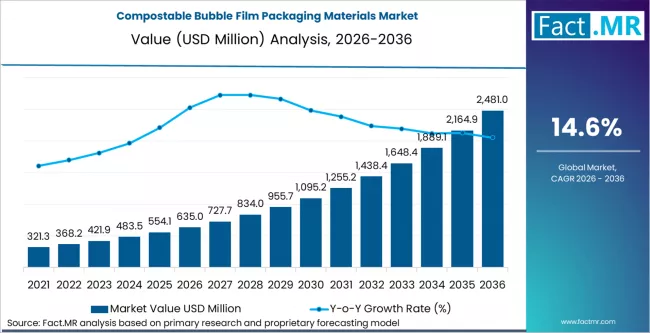
Compostable Bubble Film Packaging Materials Market Market Value Analysis | Source: Fact.MR
The expansion to this scale is visible in earlier stages at USD 321.3 million, USD 421.9 million, USD 554.1 million, USD 727.7 million, and USD 955.7 million, which indicates progressive substitution within protective packaging rather than isolated trials. Adoption is concentrated in e-commerce, consumer electronics, and specialty goods distribution where cushioning performance and pack-out efficiency remain critical.
Logistics operators and converters evaluate these films on drop protection, consistency of bubble structure, and runnability on existing packing lines. Once a film grade is qualified, it becomes part of packing specifications and automated line settings. Replacement occurs infrequently due to validation effort and operational risk. Volume growth follows wider rollout across shipping programs and regional distribution networks rather than frequent changes in material design.
Compostable Bubble Film Packaging Materials Market
| Metric | Value |
|---|---|
| Market Value (2026) | USD 635 million |
| Forecast Value (2036) | USD 2,481.0 million |
| Forecast CAGR 2026 to 2036 | 14.6% |
Source: Fact.MR analysis. Updated Jan 23, 2026
Category
| Category | Segments |
|---|---|
| End-use | E-commerce and fragile goods; E-commerce fulfilment; Mass logistics; Premium logistics; Marketplace shipping; Others |
| Cushioning Format | Bubble wrap and air pillows; Protective mailers; Cushion films; Thin cushioning films; Others |
| Material | PLA or PBAT blends; Compostable blends; PLA or PBAT; Others |
| Foam or Film Technology | Air-cell extrusion and heat sealing; On-demand air systems; High-speed bubble forming; Precision sealing; Others |
| Region | North America; Europe; Asia Pacific; Latin America; Middle East & Africa |
Source: Fact.MR analysis. Updated Jan 23, 2026
Segmental Analysis
Why Has E-Commerce and Fragile Goods Shipping Become the Main Volume Driver for Compostable Bubble Film?
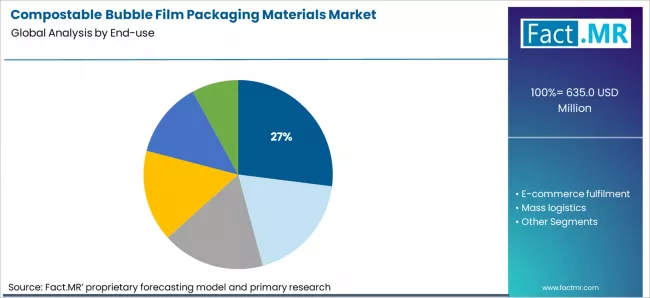
Compostable Bubble Film Packaging Materials Market Analysis By End Use | Source: Fact.MR
End-use patterns in the compostable bubble film packaging materials market show e-commerce and fragile goods shipping at 27% of total demand. This segment handles high shipment counts that involve mixed product sizes and frequent handling steps. Packing stations rely on fast, repeatable protection methods that do not require training or setup changes. Damage prevention targets in this channel focus on surface scuffs, corner impacts, and vibration during transit. Return rates and customer service metrics place steady pressure on packaging performance at this stage. Procurement teams also plan around daily consumption rather than project based orders. Mass logistics, premium shipments, and marketplace flows contribute meaningful volume. The daily rhythm of small parcel shipping keeps this end-use segment at the center of material movement.
Why Do Bubble Wrap and Air Pillow Formats Remain the Most Common Cushioning Choice?
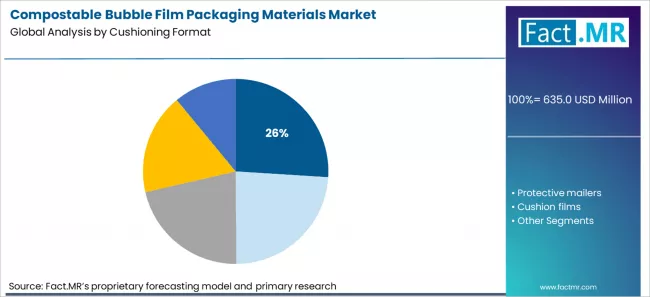
Compostable Bubble Film Packaging Materials Market Analysis By Cushioning Format | Source: Fact.MR
Cushioning format mix in this market places bubble wrap and air pillows at 26% of total usage. These formats support quick packing decisions without measuring, cutting, or forming complex structures. Warehouse staff can match protection level to box size within seconds, which suits high throughput operations. Storage efficiency also plays a role, with rolls and deflated pillows occupying limited space before use. Damage protection performance covers a wide range of weight classes and product shapes. Equipment requirements remain simple, often limited to basic dispensing or inflation units. Protective mailers, cushion films, and thin formats serve defined shipping profiles. Day to day packing activity still centers on bubble and pillow systems as the most flexible cushioning tools.
What are the Drivers, Restraints, and Key Trends of the Compostable Bubble Film Packaging Materials Market?
- Drivers: E-commerce shipping requirements, brand packaging policy changes, and retailer pressure to reduce conventional plastic use are supporting adoption of compostable bubble film as a cushioning and void-fill material in consumer goods and electronics packaging.
- Restraint: Cost gaps versus conventional bubble film, uneven availability of composting facilities, and limitations in tear strength and puncture resistance restrict wider use in heavy-duty applications.
- Trend 1: Product development is focusing on film structures that improve cushioning performance and load resistance while maintaining compostable material profiles.
- Trend 2: More suppliers are offering rolls and formats designed to run on existing automated packing and filling equipment.
Analysis of the Compostable Bubble Film Packaging Materials Market by Key Country
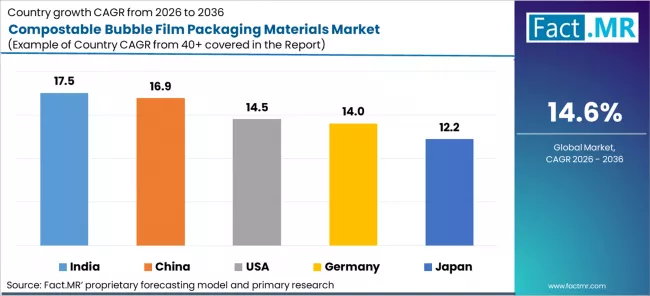
Compostable Bubble Film Packaging Materials Market Cagr Analysis By Country | Source: Fact.MR
| Country | CAGR 2026 to 2036 |
|---|---|
| Germany | 14.0% |
| USA | 14.5% |
| China | 16.9% |
| Japan | 12.2% |
| India | 17.5% |
Source: Fact.MR analysis. Updated Jan 23, 2026
The report covers an in-depth analysis of 40+ countries; top-performing countries are highlighted below.
How Are Transport Packaging Regulations in Germany Shaping Use of Compostable Bubble Films?
Growth in Germany runs at about 14.0% per year through 2036. Demand follows changes in transport packaging rules across electronics, appliances, and mail order retail. Brand owners focus on cushioning performance, thickness control, and drop test results. Purchasing decisions sit with central packaging and logistics teams. Conversions proceed carefully because damage rates and return costs remain sensitive. Distribution stays concentrated among a limited group of material converters. Volume increases track warehouse automation projects and ecommerce shipment growth. Inventory policies remain conservative due to price levels. Market development stays tied to logistics compliance programs rather than marketing led packaging redesign initiatives or consumer visible sustainability claims today.
What Is Driving Faster Adoption of Compostable Bubble Films in USA?
Growth in USA runs at about 14.5% per year through 2036. Demand is shaped by ecommerce shipping volumes and corporate packaging targets. Product teams evaluate puncture resistance, cushioning recovery, and packing speed impact. Purchasing decisions balance cost, availability, and certification coverage. Conversions usually begin with premium shipping programs before broader rollout. Distribution relies on packaging distributors and direct converter relationships. Volume growth follows warehouse network expansion and fulfillment center automation. Inventory planning remains cautious because material pricing fluctuates. Market development stays tied to logistics efficiency programs and brand commitments rather than consumer preference or seasonal packaging campaigns and short term retailer initiatives today.
What Is Supporting Rapid Expansion of Compostable Bubble Films in China?
Growth in China runs at about 16.9% per year through 2036. Demand rises from ecommerce logistics, appliance shipping, and export packaging. Operators prioritize supply continuity, scale, and compliance alignment. Product formats favor rolls and sheets suited to automated packing lines. Purchasing aligns with multi-year logistics material conversion plans. Local production capacity influences supplier choice. Volume increases follow contract wins with major platforms and fulfillment operators. Inventory builds occur around peak shipping seasons. Market development remains tied to industrial scale logistics transitions rather than small merchant adoption or branding driven packaging changes across consumer categories and regional distribution networks today.
How Are Corporate Packaging Standards in Japan Changing Use of Compostable Bubble Films?
Growth in Japan runs at about 12.2% per year through 2036. Demand follows corporate logistics guidelines and retailer compliance frameworks. Product teams focus on uniform cell structure, surface finish, and consistent cushioning behavior. Purchasing decisions emphasize reliability and supplier track record. Conversions proceed cautiously because packing line stability and defect rates receive close attention. Distribution remains concentrated among a limited group of approved converters. Volume increases track scheduled packaging standard updates. Inventory management stays conservative due to storage constraints and cost control. Market development remains tied to structured logistics upgrades rather than rapid experimentation or short term ecommerce packaging trends today.
What Is Accelerating Adoption of Compostable Bubble Films in India?
Growth in India runs at about 17.5% per year through 2036. Demand rises from ecommerce, electronics distribution, and organized retail logistics. Operators focus on cost balance, basic cushioning performance, and availability. Purchasing decisions emphasize supply continuity and regional distribution coverage. Conversions often begin with export oriented or premium shipping programs before wider use. Distribution relies on a mix of local producers and importers. Volume growth follows expansion of fulfillment networks and courier services. Inventory planning remains flexible due to price sensitivity. Market development stays tied to logistics network growth and formalization rather than consumer pressure or regulatory enforcement alone.
How Do Fulfillment Standards and Automation Fit Shape Competition in the Compostable Bubble Film Packaging Materials Market?
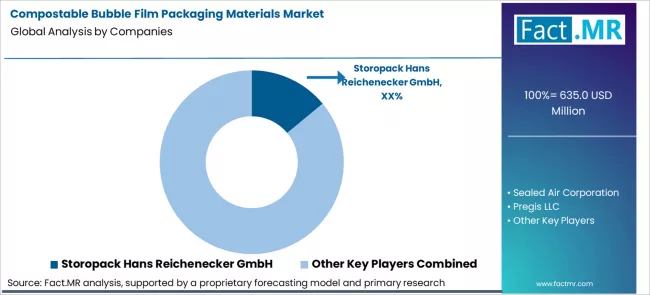
Compostable Bubble Film Packaging Materials Market Analysis By Company | Source: Fact.MR
Distribution centers set cushioning performance, pack speed, and waste handling rules before any material is considered. Those requirements govern access to the compostable bubble film packaging materials market. Storopack, Sealed Air, Pregis, and Ranpak compete by fitting products into automated packing lines and standard workstation layouts. FP Corporation and Huilong address programs where regional supply, format flexibility, or cost ceilings influence selection. Operations teams compare suppliers using drop protection results, unwind behavior, seal reliability, and scrap rates during line trials. Sustainability teams review certification scope and disposal guidance in parallel. Once a film is approved for a fulfillment platform, volumes follow throughput growth and site rollout plans. Supplier changes usually occur after automation upgrades, network consolidation, or packaging standard revisions.
Key Players in Compostable Bubble Film Packaging Materials Market
- Storopack Hans Reichenecker GmbH
- Sealed Air Corporation
- Pregis LLC
- Ranpak Holdings Corp.
- Huilong Packaging
- FP Corporation
References
- International Organization for Standardization. (2023). ISO 17088: Specifications for compostable plastics. ISO.
- European Commission, Joint Research Centre. (2023). Biodegradable and compostable plastics in the circular economy. Publications Office of the European Union.
- European Commission. (2023). A policy framework for bio-based, biodegradable and compostable plastics in the EU. European Commission.
- European Commission. (2024). Proposal for a regulation of the European Parliament and of the Council on packaging and packaging waste and repealing Directive 94/62/EC. European Commission.
- European Commission. (2023). Proposal for a directive of the European Parliament and of the Council on substantiation and communication of explicit environmental claims (Green Claims Directive). European Commission.
Segmentation
Scope of the Report
| Items | Values |
|---|---|
| Quantitative Units (2026) | USD million |
| End-use | E-commerce and fragile goods, e-commerce fulfilment, mass logistics, premium logistics, marketplace shipping, others |
| Cushioning Format | Bubble wrap and air pillows, protective mailers, cushion films, thin cushioning films, others |
| Material | PLA or PBAT blends, compostable blends, PLA or PBAT, others |
| Foam or Film Technology | Air-cell extrusion and heat sealing, on-demand air systems, high-speed bubble forming, precision sealing, others |
| Regions Covered | Asia Pacific, Europe, North America, Latin America, Middle East & Africa |
| Countries Covered | United States, Canada, Mexico, Germany, United Kingdom, France, Italy, Spain, Nordics, BENELUX, China, Japan, South Korea, India, Australia & New Zealand, ASEAN, Brazil, Chile, Saudi Arabia, Turkey, South Africa, and other regional markets |
| Key Companies Profiled | Storopack Hans Reichenecker GmbH, Sealed Air Corporation, Pregis LLC, Ranpak Holdings Corp., Huilong Packaging, FP Corporation |
| Additional Attributes | Dollar sales by end-use, format, material, and technology; pack speed compatibility, drop protection performance, and automation fit; adoption driven by ecommerce growth, fulfillment network rollout, and logistics packaging standardization |
Source: Fact.MR analysis. Updated Jan 23, 2026
Compostable Bubble Film Packaging Materials Market Segmentation
-
End-use :
- E-commerce & fragile goods
- E-commerce fulfilment
- Mass logistics
- Premium logistics
- Marketplace shipping
- Others
-
Cushioning Format :
- Bubble wrap & air pillows
- Protective mailers
- Cushion films
- Thin cushioning films
- Others
-
Material :
- PLA or PBAT blends
- Compostable blends
- PLA or PBAT
- Others
-
Foam or Film Technology :
- Air-cell extrusion & heat sealing
- On-demand air systems
- High-speed bubble forming
- Precision sealing
- Others
-
Region :
- Asia Pacific
- China
- Japan
- South Korea
- India
- Australia & New Zealand
- ASEAN
- Rest of Asia Pacific
- Europe
- Germany
- United Kingdom
- France
- Italy
- Spain
- Nordic
- BENELUX
- Rest of Europe
- North America
- United States
- Canada
- Mexico
- Latin America
- Brazil
- Chile
- Rest of Latin America
- Middle East & Africa
- Kingdom of Saudi Arabia
- Other GCC Countries
- Turkey
- South Africa
- Other African Union
- Rest of Middle East & Africa
- Asia Pacific
Frequently Asked Questions
How big is the compostable bubble film packaging materials market in 2026?
What will be the size of compostable bubble film packaging materials market in 2036?
How much will be the compostable bubble film packaging materials market growth between 2026 and 2036?
What are the key product types in the compostable bubble film packaging materials market?
Which cushioning format segment to contribute significant share in the compostable bubble film packaging materials market in 2026?
Who worked on this report


Preview the report firsthand - request a free sample
Free SampleGet the brochure for pricing and purchase details
Download PDF