- Market Value (2025): USD 875.4 Mn
- Estimated Value (2026): USD 936.9 Mn
- Forecast Value (2036): USD 1848.2 Mn
- CAGR (2026-2036): 7.0%
What is the Conductive Polymer Ink Platforms Market forecast to be worth by 2036?
USD 936.9 million in 2026 to USD 1848.2 million by 2036 at a 7.0% CAGR.
- Fact.MR estimates that the conductive polymer ink platforms market was valued at USD 875.4 million in 2025.
- demand is projected to increase from USD 936.9 million in 2026 to USD 1848.2 million by 2036.
- The forecast indicates a 7.0% CAGR from 2026 to 2036 as manufacturers expand the use of printed and flexible electronic materials.
| Year | Basis | Market Value (USD million) |
|---|---|---|
| 2025 | Actual | 875.4 |
| 2026 | Estimate | 936.9 |
| 2036 | Forecast | 1848.2 |
| CAGR 2026 to 2036 | Forecast period | 7.0% |
Source: Fact.MR analysis. Updated Nov 11, 2026
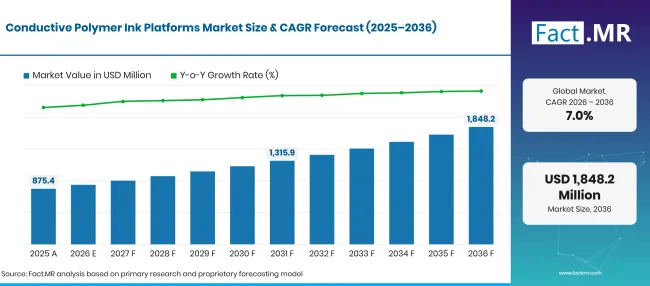
Conductive Polymer Ink Platforms Forecast Global | Source: Fact.MR
What are the defining numbers behind Conductive Polymer Ink Platforms Market growth?
USD 911.3 million in additional market value between 2026 and 2036.
- Demand Drivers in the Market
- Electronics manufacturers require conductive materials that can be deposited on flexible substrates without compromising electrical performance. PEDOT:PSS formulations support transparent electrodes and printed sensor structures. Application-specific PEDOT:PSS dispersions may be formulated for screen printing or inkjet deposition, depending on viscosity, surface tension, substrate compatibility and drying requirements.
- Product developers are seeking alternatives to conventional rigid conductive materials in applications requiring flexibility and thin-film construction. Conductive polymer inks can form lightweight functional layers on plastic films and other substrates. This supports their use in touch interfaces and flexible circuits as well as electronic displays.
- Industrial equipment increasingly incorporates sensors for pressure monitoring and process control. Conductive polymer formulations can support flexible electrodes and sensing layers that conform to different component geometries. Their electrical tunability and compatibility with solution-based processing create opportunities in industrial monitoring and connected equipment.
- Improvements in polymer dispersion stability and conductivity enhancement are helping formulators address application-specific performance requirements. Manufacturers are developing materials with better film formation and substrate compatibility. These improvements can support more consistent printed structures and broaden the range of production processes suitable for conductive polymer inks.
- Expanding electronics production increases the potential customer base for functional coatings and printable conductive materials. India's Ministry of Electronics and Information Technology reported electronics production of approximately ₹13.11 lakh crore in FY 2025–26, an annual increase of 15.8%.
- Key Segments Analyzed
- By Conductive Ink Chemistry: PEDOT:PSS is projected to represent 36.1% of the market in 2026. Its established use in transparent electrodes and conductive coatings supports its leading position.
- By Supply / Product Format: Liquid / Dispersion is projected to hold 28.1% share in 2026, driven by compatibility with solution-based coating and printing methods.
- By Manufacturing / Cure Process: Moisture / Ambient processing is estimated to capture 28.5% share in 2026, reflecting demand for formulations that can be processed without specialized high-energy curing equipment.
- By Industrial End Use: Industrial Equipment is set to lead with a 24.4% share in 2026, supported by applications in antistatic coatings and flexible sensing components.
- Analyst Opinion at Fact.MR
- Shambhu Nath Jha, Principal Consultant at Fact.MR, states, “Conductive polymer ink platforms are gaining relevance as electronics manufacturers seek flexible materials that can deliver reliable electrical performance through scalable printing and coating processes. Suppliers need to demonstrate consistent conductivity and film stability while improving compatibility with different substrates and production requirements.”
- Strategic Implications
- Manufacturers should optimize polymer composition and conductive additive distribution to achieve consistent electrical performance across different substrates. Formulations should maintain dispersion stability during storage and processing while minimizing particle aggregation. Testing should assess conductivity retention and film uniformity to improve coating reliability and reduce defects during large-scale production.
- Ink developers need to control viscosity and surface tension to ensure consistent deposition through screen printing and inkjet systems. Formulations should also demonstrate suitable flow behavior and drying characteristics to prevent nozzle blockage and uneven coating thickness. Process-specific optimization can improve print resolution and support reliable production across different substrates.
- Electronics manufacturers must evaluate sheet resistance and substrate adhesion alongside bending durability when selecting conductive polymer formulations. Repeated flexing tests can identify conductivity losses caused by cracking or delamination. Testing should also consider humidity exposure and temperature variation to establish material reliability in wearable devices and flexible electronic components.
- Suppliers can document solids content and viscosity alongside curing conditions and recommended storage temperatures. Technical specifications should also cover shelf life and substrate compatibility as well as electrical properties such as sheet resistance. Complete documentation helps manufacturers select suitable formulations and maintain consistent processing conditions across production batches.
- Distributors should help customers select conductive polymer formulations based on printing methods and end-use performance requirements. Technical guidance should address coating thickness and substrate preparation alongside curing conditions and electrical testing. Support for sensor fabrication and antistatic coatings can improve material selection and reduce processing difficulties during commercial production.
India is projected to record the highest CAGR of 10.3% through 2036, followed by China at 9.4% and the USA at 7.4%. Germany is estimated to grow at 6.7%, while Japan is forecast to register a 5.5% CAGR.
How does the Conductive Polymer Ink Platforms Market break down by segment?
Fact.MR finds that PEDOT:PSS leads Conductive Ink Chemistry at 36.1%; Liquid / Dispersion leads Supply / Product Format at 28.1%; Moisture / Ambient leads Manufacturing / Cure Process at 28.5%; and Industrial Equipment leads Industrial End Use at 24.4%.
Which Conductive Ink Chemistry dominates?
PEDOT:PSS is set to hold 36.1% share in 2026.
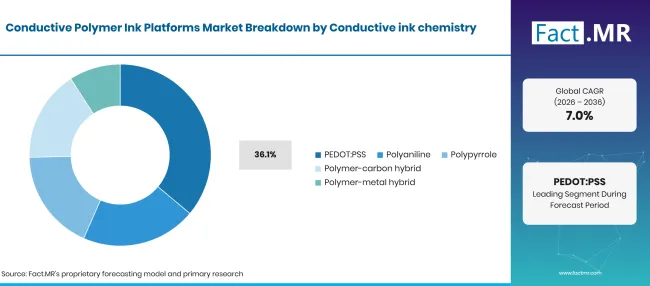
Conductive Polymer Ink Platforms Breakdown Conductive Ink Chemistry | Source: Fact.MR
| Conductive Ink Chemistry | Share (2026) |
|---|---|
| PEDOT:PSS (Leading segment) | 36.1% |
| Other segments combined | 63.9%* |
| Total | 100.0% |
Source: Fact.MR analysis. Updated Nov 11, 2026
PEDOT:PSS is widely used in conductive coatings and printed electronic structures because it can be supplied as a processable polymer dispersion. Its applications include transparent electrodes and antistatic layers as well as flexible sensors. Polyaniline and polypyrrole serve other conductive applications, while polymer-carbon and polymer-metal hybrids provide alternative approaches to electrical performance and formulation design.
What leads the Supply / Product Format segment?
Liquid / Dispersion is set to represent 28.1% share in 2026.
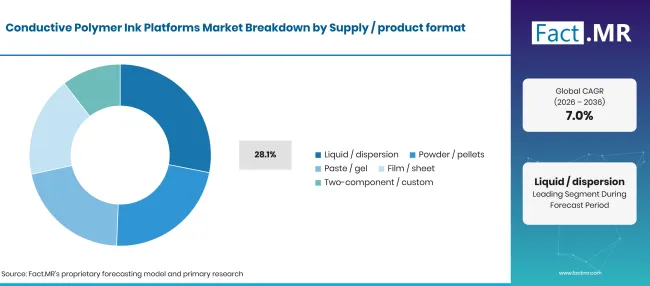
Conductive Polymer Ink Platforms Breakdown Supply Product Format | Source: Fact.MR
| Supply / Product Format | Share (2026) |
|---|---|
| Liquid / Dispersion (Leading segment) | 28.1% |
| Other segments combined | 71.9%* |
| Total | 100.0% |
Source: Fact.MR analysis. Updated Nov 11, 2026
Liquid dispersions offer flexibility in coating and printing processes because manufacturers can adjust formulation viscosity and solids content to suit the deposition method. They can be applied through screen printing and slot-die coating as well as other solution-based techniques. Paste and gel formats support thicker deposits, while films and sheets serve applications requiring preformed conductive layers.
Which Manufacturing / Cure Process leads?
Moisture / Ambient processing is projected to account for 28.5% share in 2026.
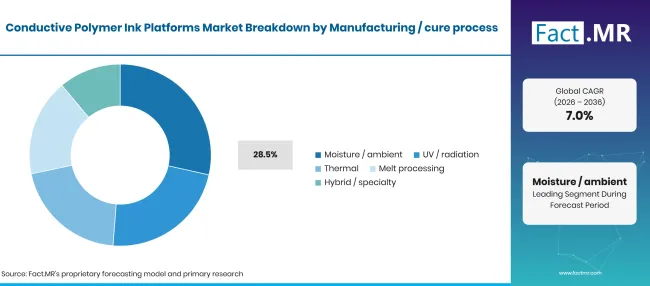
Conductive Polymer Ink Platforms Breakdown Manufacturing Cure Process | Source: Fact.MR
| Manufacturing / Cure Process | Share (2026) |
|---|---|
| Moisture / Ambient (Leading segment) | 28.5% |
| Other segments combined | 71.5%* |
| Total | 100.0% |
Source: Fact.MR analysis. Updated Nov 11, 2026
Ambient processing can support formulations that form functional coatings under relatively mild conditions; moisture-assisted processing and ambient drying need distinct definitions for reliable market segmentation. This can reduce dependence on specialized curing equipment and simplify production workflows. Thermal and UV curing remain relevant where faster film formation or specific material properties are required. Melt processing and hybrid methods address specialized manufacturing requirements.
Which Industrial End Use leads demand?
Industrial Equipment is likely to account for a 24.4% share in 2026.
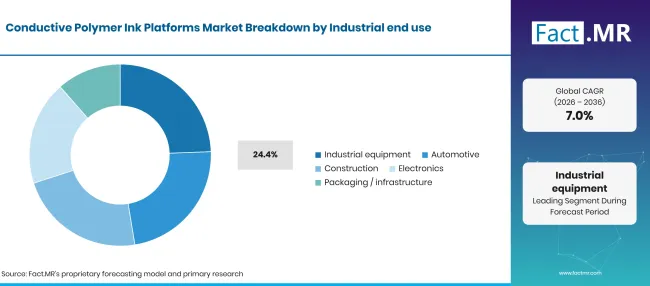
Conductive Polymer Ink Platforms Breakdown Industrial End Use | Source: Fact.MR
| Industrial End Use | Share (2026) |
|---|---|
| Industrial Equipment (Leading segment) | 24.4% |
| Other segments combined | 75.6%* |
| Total | 100.0% |
Source: Fact.MR analysis. Updated Nov 11, 2026
Industrial equipment manufacturers use conductive polymer materials in antistatic coatings and flexible sensing structures. These applications require consistent electrical performance and compatibility with industrial substrates. Automotive and electronics applications also represent substantial demand opportunities. Packaging and infrastructure applications can use conductive coatings for static control and functional surface treatment.
What is accelerating Conductive Polymer Ink Platforms Market growth, and what is holding it back?
Growing printed electronics production and advances in conductive polymer chemistry are creating opportunities, while formulation stability and performance limitations across different substrates can restrict wider commercial use.
Drivers Impact Analysis
| DRIVER | (~) % IMPACT ON CAGR | GEOGRAPHIC RELEVANCE | IMPACT TIMELINE |
|---|---|---|---|
| Expansion of printed and flexible electronics | +1.0% | China, USA, Japan | Medium term (2–4 years) |
| Rising demand for flexible sensing components | +0.8% | Global | Medium term (2–4 years) |
| Advancements in PEDOT:PSS formulations | +0.7% | Europe, USA, Asia | Long term (≥ 4 years) |
| Increasing use of antistatic coatings | +0.6% | Global | Short term (≤ 2 years) |
| Expansion of electronics manufacturing capacity | +0.5% | China, India, USA | Medium term (2–4 years) |
Source: Fact.MR analysis. Updated Nov 11, 2026
Opportunity Impact Analysis
| OPPORTUNITY | (~) % IMPACT ON CAGR | GEOGRAPHIC RELEVANCE | IMPACT TIMELINE |
|---|---|---|---|
| High-conductivity polymer dispersions | +0.8% | USA, Germany, Japan | Medium term (2–4 years) |
| Flexible and wearable sensor integration | +0.7% | China, USA, South Korea | Long term (≥ 4 years) |
| Low-temperature processing formulations | +0.6% | Global | Medium term (2–4 years) |
| Roll-to-roll printing compatibility | +0.5% | Europe, China, Japan | Long term (≥ 4 years) |
| Customized conductive ink formulations | +0.4% | Global | Short term (≤ 2 years) |
Source: Fact.MR analysis. Updated Nov 11, 2026
Restraints Impact Analysis
| RESTRAINT | (~) % IMPACT ON CAGR | GEOGRAPHIC RELEVANCE | IMPACT TIMELINE |
|---|---|---|---|
| Conductivity limitations against metal-based inks | -0.8% | Global | Short term (≤ 2 years) |
| Formulation stability and shelf-life constraints | -0.7% | Global | Medium term (2–4 years) |
| Sensitivity to moisture and environmental exposure | -0.6% | Global | Medium term (2–4 years) |
| Substrate adhesion and process compatibility issues | -0.5% | Global | Short term (≤ 2 years) |
| High formulation development and qualification costs | -0.4% | Global | Long term (≥ 4 years) |
Source: Fact.MR analysis. Updated Nov 11, 2026
Which countries are scaling the Conductive Polymer Ink Platforms Market through 2036?
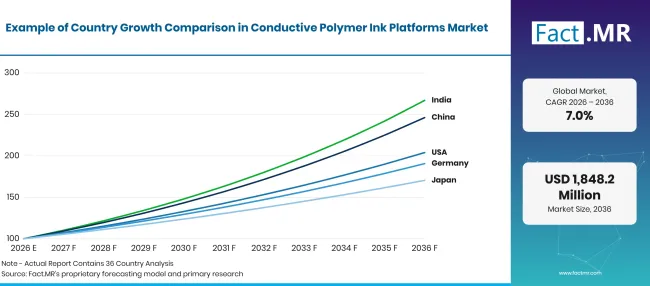
Conductive Polymer Ink Platforms Growth Index | Source: Fact.MR
| Country | CAGR (2026–2036) |
|---|---|
| India | 10.3% |
| China | 9.4% |
| USA | 7.4% |
| Germany | 6.7% |
| Japan | 5.5% |
Source: Fact.MR analysis. Updated Nov 11, 2026
What supports India’s market growth?
10.3% CAGR, supported by expanding electronics manufacturing and domestic component production.
India's market is benefiting from investments in electronics manufacturing and efforts to strengthen domestic component supply chains. The Ministry of Electronics and Information Technology reported that electronics production reached approximately ₹13.11 lakh crore in FY 2025–26, increasing 15.8% year over year. This expanding manufacturing base creates opportunities for functional materials used in sensors and printed electronic components.
How is China developing its market?
9.4% CAGR, driven by large-scale electronics manufacturing and demand for functional materials.
China's market benefits from its extensive electronics manufacturing ecosystem and continued investment in advanced electronic components. The Ministry of Industry and Information Technology reported that the value added of large-scale electronic information manufacturing increased 15.7% year over year during January–August 2026. This production growth can support demand for conductive coatings and printable polymer materials used in electronic components.
What supports United States market growth?
7.4% CAGR, led by semiconductor manufacturing and demand for advanced electronic materials.
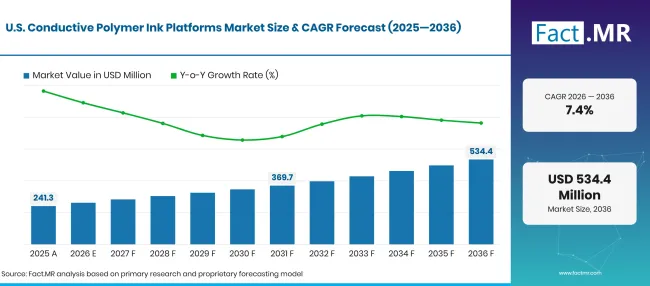
Conductive Polymer Ink Platforms Forecast Usa | Source: Fact.MR
The United States has an established semiconductor and electronic components industry that creates opportunities for specialized conductive materials. The Federal Reserve reported that U.S. industrial production increased 0.7% in September 2026, while manufacturing output rose 0.3% during the month. Continued investment in advanced electronics and flexible sensing technologies can support demand for conductive polymer formulations.
How is Germany building market opportunities?
6.7% CAGR, shaped by advanced industrial manufacturing and demand for functional electronic coatings.
Germany's market is supported by its automotive engineering base and established industrial equipment sector. Conductive polymer formulations can serve antistatic coatings and flexible sensing applications where electrical performance and substrate compatibility are important. Suppliers can target industrial customers by offering materials with consistent conductivity and reliable processing characteristics for specialized manufacturing applications.
What supports Japan's market growth?
5.5% CAGR, backed by established electronics manufacturing and demand for precision materials.
Japan's electronics industry creates opportunities for conductive polymer coatings used in electronic components and functional films. Data published by the Japan Electronics and Information Technology Industries Association, based on Ministry of Economy, Trade and Industry statistics, showed that production of electronic components and devices increased 23.1% year over year in January 2026. This provides a relevant manufacturing indicator for demand in the country's electronics supply chain.
Who leads the Conductive Polymer Ink Platforms Market?
Fact.MR finds that Heraeus, Agfa-Gevaert, Nagase & Co., Merck KGaA and Ossila are included in the competitive landscape for conductive polymer materials and related ink platforms.
Heraeus has a well-established position through its Clevios conductive polymer portfolio, which includes PEDOT:PSS dispersions and formulations for printed electronics and antistatic coatings. Its products support screen printing and other solution-based coating processes.
Nagase participates through its DENATRON conductive coating range. Its PEDOT:PSS-based products are designed for applications such as transparent electrodes and antistatic films as well as electromagnetic interference shielding. The formulations are compatible with wet coating processes and selected printing applications.
Ossila supplies PEDOT:PSS materials and conductive inks for research and printed electronics development. Its portfolio includes screen-printing formulations for applications such as flexible sensors and electrochromic devices.Agfa-Gevaert has documented its Orgacon range of PEDOT:PSS-based conductive polymer screen-printing inks for flexible and rigid substrates. Its published product documentation supports its historical participation in this category.
Which companies are the key providers?
The key company set includes:
- Heraeus
- Agfa-Gevaert
- Nagase & Co.
- Merck KGaA
- Ossila
Bibliography
- Board of Governors of the Federal Reserve System. (2026, October 16). Industrial Production and Capacity Utilization – September 2026.
- Heraeus Epurio. (n.d.). Printed Electronics..
- Ministry of Economy, Trade and Industry, Japan. (2026). Indices of Industrial Production: Electronic Parts and Devices, January 2026..
- Ministry of Industry and Information Technology, China. (2026, September 30). 2026年1—8月份电子信息制造业运行情况 (Operation of the Electronic Information Manufacturing Industry from January to August 2026)..
- NAGASE & Co., Ltd. / Nagase ChemteX Corporation. (n.d.). DENATRON SP-801.
- Ossila Ltd. (n.d.). S V3 PEDOT:PSS..
- Press Information Bureau, Ministry of Electronics and Information Technology, Government of India. (2026, July 29). Production Linked Incentive Schemes Strengthen India's Electronics Manufacturing Ecosystem, Boosting Domestic Production, Exports and Value Addition..
This Report Answers
- The report examines the market for conductive polymer ink platforms across the specified industrial applications.
- Segment analysis compares conductive ink chemistries and product formats alongside manufacturing and curing processes.
- Country analysis evaluates China, India, USA, Germany and Japan.
- The competitive overview profiles the companies for this market.
- Application analysis identifies industrial equipment and electronics as important areas of demand.
What does the Conductive Polymer Ink Platforms Market cover?
The market covers conductive polymer-based formulations supplied for printing and coating electrically functional structures. It includes PEDOT:PSS and other conductive polymer chemistries as well as polymer-carbon and polymer-metal hybrid formulations. Product coverage includes liquid dispersions and pastes as well as films and customized systems intended for industrial and electronic applications.
What is included in the scope?
The analysis includes commercially supplied conductive polymer inks and related formulations intended for conductive coatings and printed electronic structures.
It covers different polymer chemistries and delivery formats alongside manufacturing and curing processes. Applications include industrial equipment and automotive components as well as electronics and selected construction and packaging uses.
What is excluded from the scope?
The analysis excludes conventional metallic conductive inks based solely on silver or copper and carbon-only inks without a conductive polymer component.
It also excludes raw polymer chemicals sold exclusively for unrelated applications and finished electronic devices that incorporate conductive materials. Printing equipment and manufacturing machinery are outside the defined market boundary.
How Was the Analysis Built?
The analysis draws on 120+ sources, 35+ company portfolios, 25+ countries and more than 20 industry interviews.
- Primary Research: Primary research includes discussions with material manufacturers and formulation developers as well as printing technology providers and industrial end users. These conversations examine conductivity requirements and processing compatibility alongside purchasing priorities and technical qualification challenges.
- Desk Research: Desk research covers government statistics and company product portfolios as well as technical publications and industry associations. Product information is reviewed to distinguish conductive polymer formulations from conventional metallic and carbon-based inks.
- Market Sizing and Forecasting: Market estimates combine historical performance and demand indicators with segment shares and country-level growth analysis. Forecasting considers electronics manufacturing activity and industrial application requirements alongside product development and commercialization trends.
- Data Validation and Update Cycle: Findings are reviewed against company product information and manufacturing statistics as well as technical developments and changes in commercial product availability. Regular updates assess formulation improvements and partnerships alongside new applications and competitive positioning.
Segmentation
What is the report's scope and coverage?
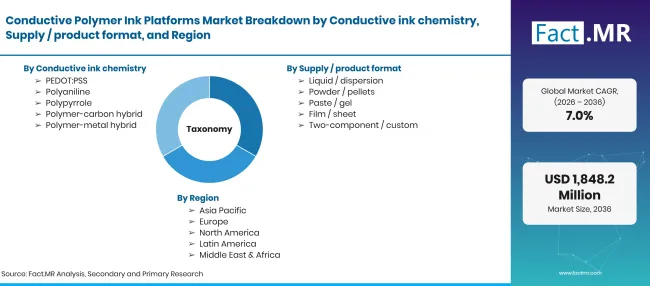
Conductive Polymer Ink Platforms Taxonomy | Source: Fact.MR
| Attribute | Details |
|---|---|
| Quantitative Units | USD million in 2026 to USD million by 2036, at CAGR |
| Market Definition | Conductive polymer ink platforms comprise electrically conductive polymer-based formulations designed for printing or coating functional electronic structures on flexible and rigid substrates. |
| Conductive Ink Chemistry | PEDOT:PSS; Polyaniline; Polypyrrole; Polymer-carbon hybrid; Polymer-metal hybrid |
| Supply / Product Format | Liquid / Dispersion; Powder / Pellets; Paste / Gel; Film / Sheet; Two-component / Custom |
| Manufacturing / Cure Process | Moisture / Ambient; UV / Radiation; Thermal; Melt Processing; Hybrid / Specialty |
| Industrial End Use | Industrial Equipment; Automotive; Construction; Electronics; Packaging / Infrastructure |
| Regions Covered | North America; Latin America; Western Europe; Eastern Europe; East Asia; South Asia & Pacific; Middle East & Africa |
| Countries Covered | China; USA; Germany; Japan; India |
| Companies Profiled | Heraeus; Agfa-Gevaert; Nagase & Co.; Merck KGaA; Ossila |
| Forecast Period | 2026 to 2036 |
| Approach | Market segmentation and scenario-based analysis supported by company portfolio reviews and official electronics manufacturing statistics |
Source: Fact.MR analysis. Updated Nov 11, 2026
How is the market segmented?
-
By Conductive Ink Chemistry
- PEDOT:PSS
- Polyaniline
- Polypyrrole
- Polymer-carbon hybrid
- Polymer-metal hybrid
-
By Supply / Product Format
- Liquid / Dispersion
- Powder / Pellets
- Paste / Gel
- Film / Sheet
- Two-component / Custom
-
By Manufacturing / Cure Process
- Moisture / Ambient
- UV / Radiation
- Thermal
- Melt Processing
- Hybrid / Specialty
-
By Industrial End Use
- Industrial Equipment
- Automotive
- Construction
- Electronics
- Packaging / Infrastructure
-
By Region
- North America
- Latin America
- Western Europe
- Eastern Europe
- East Asia
- South Asia & Pacific
- Middle East & Africa
Frequently Asked Questions
Fact.MR values the market at USD 936.9 million in 2026 and is projected to reach USD 1,848.2 million by 2036.
What is the CAGR from 2026 to 2036?
Which conductive ink chemistry has the largest share?
Which supply format leads the market?
Which manufacturing / cure process leads?
Which industrial end use has the largest share?
Which country is expected to grow fastest?
Which companies are covered?
Who worked on this report


Preview the report firsthand - request a free sample
Free SampleGet the brochure for pricing and purchase details
Download PDF