- Market Value (2025): USD 236.5 Mn
- Estimated Value (2026): USD 219.5 Mn
- Forecast Value (2036): USD 497.5 Mn
- CAGR (2026-2036): 7.7%
How Big Is the Confocal Raman Microscopes Market in 2026?
The global confocal Raman microscopes market is valued at USD 236.5 million in 2026, up from USD 219.5 million in 2025, and is projected by Fact.MR to reach USD 497.5 million by 2036, expanding at a 7.7% CAGR from 2026 to 2036 and generating USD 261.0 million in incremental revenue over the 10-year forecast period.
| Market Metric | Valuation / Share / Forecast Benchmark |
|---|---|
| 2025 Market Size (Historical) | USD 219.5 million |
| 2026 Market Size (Estimated) | USD 236.5 million |
| 2036 Market Size (Projected) | USD 497.5 million |
| CAGR (2026 to 2036) | 7.7% |
| Incremental Dollar Opportunity (2026 to 2036) | USD 261.0 million (2.10x the 2026 base) |
| Dominant Product Type (2026 share) | Desktop confocal Raman microscopes, 62.5% (about USD 147.8 million) |
| Leading Application (2026 share) | Life sciences, 28.3% (about USD 66.9 million) |
| Leading End User (2026 share) | Research institutes, 47.6% (about USD 112.6 million) |
| Largest Country Markets (2026 share) | United States 27.0%, Germany 9.0%, Japan 8.0% |
| Fastest-Growing Countries (CAGR, 2026 to 2036) | Germany 9.0%, Brazil 8.2%, United States 7.4% |
| Leading Tier-1 Companies | Oxford Instruments (WITec), Renishaw, HORIBA, Thermo Fisher Scientific, Bruker |
Source: Fact.MR analysis. Updated Nov 13, 2026
Source: Fact.MR analysis of the confocal Raman microscopes market, 2026.
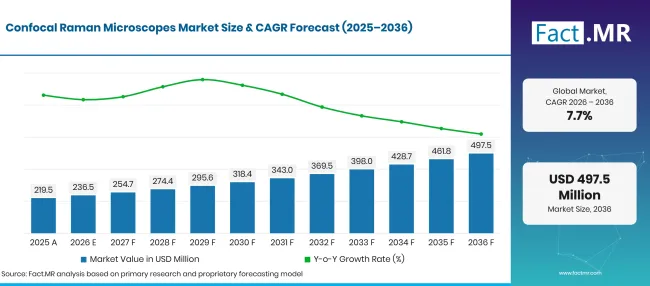
Confocal Raman Microscopes Market Forecast Global | Source: Fact.MR
Executive Market Overview
Demand for confocal Raman microscopes is led by research institutes, the largest buyer group with 47.6% of 2026 revenue, and life sciences is the largest application at 28.3%. University core facilities, government laboratories and industrial R&D teams use these systems to map the chemistry of cells, tissues, wafers, polymers and battery materials without staining or destroying the sample. A single instrument often serves dozens of research groups, so purchases are planned around facility budgets and multi-year grants. The United States (27.0%), Germany (9.0%) and Japan (8.0%) lead the named markets. China, South Korea, Taiwan, India and other countries outside the five named markets hold 49.0% and grow at about 8.0%, slightly ahead of the global rate, as semiconductor and battery research expands across Asia.
Revenue from confocal Raman systems is rising faster than shipments. Faster detectors, automated multi-laser configurations, correlative AFM, SEM and photoluminescence options, and wafer-scale stages for semiconductor work are raising the value of each system sold. Shipments grow more slowly, as many academic buyers wait for grant cycles before committing to a large capital purchase, and some delay replacement by upgrading detectors or software. Germany (9.0% CAGR) and Brazil (8.2%) grow fastest, while the United States (7.4%), United Kingdom (6.7%) and Japan (5.9%) trail the global 7.7%. Fact.MR sizes the market to include new desktop and portable confocal Raman microscope systems with their factory-fitted lasers, spectrometers and software, while excluding standalone Raman spectrometers, handheld Raman analysers, optical microscopes without Raman capability and service contracts.
Analyst Perspective
"Confocal Raman revenue will grow faster than system shipments, because laboratories are paying for automation, fluorescence suppression and wafer-scale or correlative configurations rather than adding basic units. The main risk is tight capital budgets, with Spectroscopy's 2025 industry survey finding that 57% of organisations see upfront instrument cost as their biggest barrier and 43% have no immediate plans for major purchases." Shambhu Nath Jha, Principal Consultant, Fact.MR
Major Market Trends and Insights
- Modular Platforms Replace Fixed Research Systems: Sales of modular confocal Raman platforms are rising because multi-user core facilities need one instrument that can be reconfigured for many projects. Oxford Instruments (September 2025) launched the witec360 microscope with the Hexalight spectrometer as the successor to the alpha300 series, offering standard and inverted beam paths and dedicated and correlative configurations. The company describes Hexalight as keeping the sensitivity of its earlier UHTS spectrometers in a more compact and cost-effective form. Buyers can add lasers, objectives and correlative modules over the life of the system, which spreads spending over several budget years and keeps vendors close to the installed base.
- Fluorescence Suppression Opens Difficult Samples: Adoption of time-resolved detection is widening the range of samples Raman can measure, since fluorescence often hides the Raman signal in pigments, polymers, oils and biological material. Renishaw (December 2025) added time-resolved Raman spectroscopy to its inVia confocal Raman microscope, using a SPAD sensor from Edinburgh spin-out Singular Photonics that records photon arrival times with picosecond precision. Renishaw's software extracts the Raman data automatically, so the technique does not need a specialist operator. Upgrades like this let existing owners extend their systems instead of replacing them, which creates high-margin aftermarket revenue.
- Wafer-Scale Raman Mapping Moves Into Semiconductor Workflows: Use of wafer-scale Raman mapping is growing in semiconductor teams as silicon carbide and gallium nitride move into volume production and need full-wafer stress, doping and defect maps. Covalent (June 2026) announced a collaboration with Oxford Instruments to offer wafer-level Raman and photoluminescence workflows on wafers up to 300 mm, configured with dual 355 nm and other lasers. Oxford Instruments (accessed November 2026) states that the witec360 Semiconductor Edition scans areas up to 300 x 350 mm with active focus stabilisation. These developments link the confocal Raman market more closely to the semiconductor metrology and inspection market.
What Are the Main Drivers, Restraints, and Opportunities?
Confocal Raman demand rests on non-destructive chemical imaging in life sciences, materials and semiconductor research. High capital cost and scarce operator expertise restrain purchases, while automated, workflow-specific systems are the clearest growth opening.
Driver: Non-Destructive Chemical Imaging Across Research and Industry
Interest in non-destructive chemical imaging is spreading across research and industry, because confocal Raman shows where each molecule sits in a sample at sub-micron resolution without labels or sample preparation.
Oxford Instruments (September 2025) positions the witec360 for materials science, life science and semiconductor research, and Covalent (June 2026) now offers wafer-level Raman mapping for defect detection, process monitoring and failure analysis. Pharmaceutical developers use the same capability to check how drugs are distributed in tablets and coatings. Each new application adds a reason for a laboratory to buy its own system rather than share time on someone else's, which broadens the buyer base beyond physics and chemistry departments.
Restraint: High Capital Cost and Scarce Expertise
Capital cost is the biggest hurdle for confocal Raman purchases, because a research-grade system with several lasers and correlative options is a major investment for most laboratories.
Spectroscopy (December 2025) reported in its State of the Industry survey that 57% of organisations named upfront instrument cost as their biggest barrier, 18% cited a lack of internal expertise or staff training, and 43% had no immediate plans for major instrument purchases. Smaller laboratories therefore delay upgrades, share instruments through regional facilities or buy simpler Raman spectrometers instead. Training needs also slow adoption in industrial quality-control laboratories that lack spectroscopy specialists.
Opportunity: Automated, Workflow-Specific Systems
Spending on automated, workflow-specific systems is the clearest growth opening, because packaged hardware, software and methods lower the skill needed to get useful data.
Shimadzu (August 2025) launched a microplastics particle analysis system built on its AIRsight infrared and Raman microscope that calculates particle number, area, volume and mass automatically through its AMsolution software. Renishaw (October 2025) introduced the Strada intelligent Raman microscope for industrial users, controlled by its new Raman Workspace software. Vendors that sell results rather than raw spectra can reach quality-control laboratories and the environmental testing market, where buyers value throughput over flexibility.
How Is the Confocal Raman Microscopes Market Segmented?
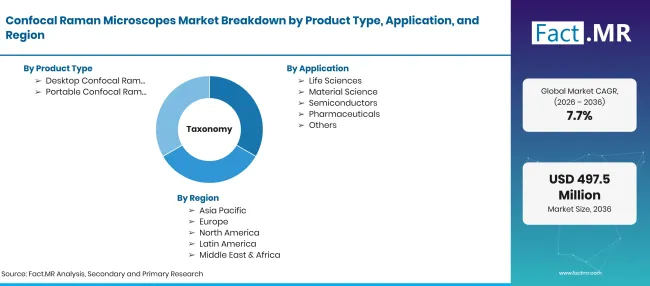
Fact.MR segments confocal Raman microscopes by product type, application, end user and country, valuing every segment in USD million at the point of first sale.
| Segmentation Axis | Sub-Segments Covered | 2026 Leading Segment & Share | Main Growth Benchmark (2026 to 2036) |
|---|---|---|---|
| Product Type | Desktop confocal Raman microscopes, portable confocal Raman microscopes | Desktop, 62.5% (USD 147.8 million) | Global market 7.7% CAGR, USD 236.5 million to USD 497.5 million |
| Application | Life sciences, materials science, semiconductors, pharmaceuticals, others | Life sciences, 28.3% (USD 66.9 million) | USD 261.0 million added across all applications |
| End User | Research institutes, industrial, others | Research institutes, 47.6% (USD 112.6 million) | Global market grows 2.10x by 2036 |
| Region / Country | North America, Latin America, Europe, East Asia, South Asia and Pacific, Middle East and Africa | United States, 27.0% (USD 63.9 million) | Germany fastest at 9.0% CAGR; Japan slowest named country at 5.9% |
Source: Fact.MR analysis. Updated Nov 13, 2026
Source: Fact.MR analysis of the confocal Raman microscopes market, 2026.
Why Does the Desktop Segment Lead by Product Type?
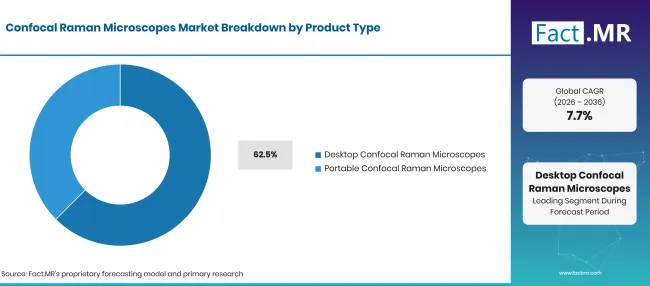
Confocal Raman Microscopes Market Breakdown Product Type | Source: Fact.MR
Desktop confocal Raman systems generate 62.5% of 2026 revenue, about USD 147.8 million. True confocal performance needs a vibration-isolated stage, a high-throughput spectrometer and stable optics, which a laboratory bench provides and a portable unit cannot fully match. Oxford Instruments (September 2025), Renishaw (December 2025) and HORIBA (accessed November 2026), with its LabRAM Odyssey, all build their flagship instruments in this format. Desktop systems also carry the correlative and wafer-scale options that lift average prices. Portable systems serve field, art conservation and on-line inspection uses but remain a smaller share.
Why Does the Life Sciences Segment Lead by Application?
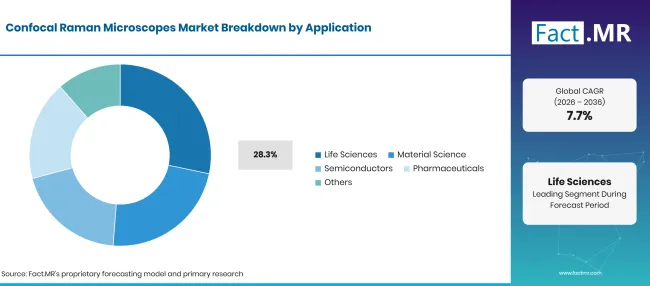
Confocal Raman Microscopes Market Breakdown Application | Source: Fact.MR
Use of confocal Raman in life sciences accounts for 28.3% of 2026 revenue, about USD 66.9 million, the largest application. Cell biologists, pathologists and drug developers use confocal Raman to map lipids, proteins and drugs inside cells and tissue without stains, and to follow changes in living cells over time. Thermo Fisher Scientific (accessed November 2026) lists 0.5 μm spatial resolution and 2 μm confocal depth for its DXR3xi, which suits single-cell work. Inverted microscope configurations from Oxford Instruments (September 2025) make it easier to image cells in culture dishes. Materials science and semiconductors are the next-largest applications and are growing with wafer-scale mapping.
Why Does the Research Institute Segment Lead by End User?
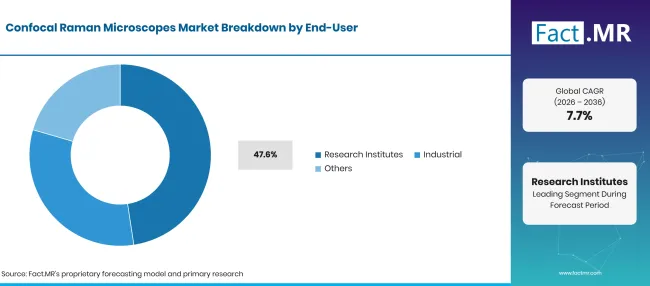
Confocal Raman Microscopes Market Breakdown End User | Source: Fact.MR
Universities and national laboratories, grouped as research institutes, account for 47.6% of 2026 revenue, about USD 112.6 million. These buyers run multi-user facilities that need flexible instruments covering chemistry, physics, biology and earth sciences. Oxford Instruments (September 2025) designed the witec360 for exactly these core facilities, and Oxford Instruments (October 2025) used its Raman Imaging Symposium in Ulm to train academic users. Purchases usually go through public tenders, which reward vendors with strong application support and clear upgrade paths. Industrial buyers are a smaller but faster-moving group, led by semiconductor and battery developers.
Confocal Raman Microscopes Market by Region and Country (2026 to 2036)
Revenue from confocal Raman microscopes is concentrated in the United States, Germany, Japan, the United Kingdom and Brazil, which together account for 51.0% of 2026 revenue (USD 120.6 million), easing to 49.8% by 2036 as East and South Asian demand grows faster. The United States is the largest market, Germany gains the most share, and Japan loses the most as its installed base matures.
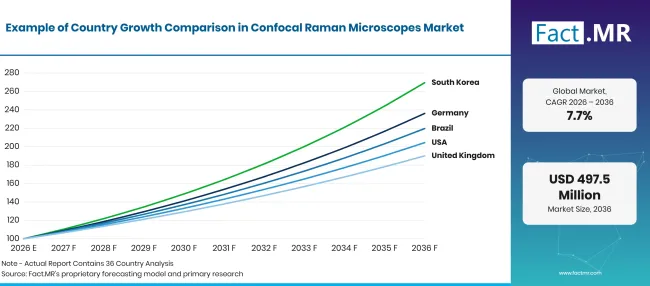
Confocal Raman Microscopes Market Growth Index | Source: Fact.MR
| Country | 2026 Revenue | 2036 Revenue | 10-Year Addition | 2026 to 2036 CAGR | Global Share (2026 → 2036) |
|---|---|---|---|---|---|
| United States | USD 63.9 million | USD 130.4 million | USD 66.5 million | 7.4% | 27.0% → 26.2% |
| Germany | USD 21.3 million | USD 50.4 million | USD 29.1 million | 9.0% | 9.0% → 10.1% |
| Japan | USD 18.9 million | USD 33.6 million | USD 14.7 million | 5.9% | 8.0% → 6.8% |
| United Kingdom | USD 10.6 million | USD 20.2 million | USD 9.6 million | 6.7% | 4.5% → 4.1% |
| Brazil | USD 5.9 million | USD 13.0 million | USD 7.1 million | 8.2% | 2.5% → 2.6% |
| Rest of world | USD 115.9 million | USD 249.9 million | USD 134.0 million | 8.0% | 49.0% → 50.2% |
| Global total | USD 236.5 million | USD 497.5 million | USD 261.0 million | 7.7% | 100.0% → 100.0% |
Source: Fact.MR analysis. Updated Nov 13, 2026
Source: Fact.MR analysis of the confocal Raman microscopes market, 2026.
United States
Sales of confocal Raman microscopes in the United States are projected to rise from USD 63.9 million in 2026 to USD 130.4 million by 2036 at a 7.4% CAGR, adding USD 66.5 million (2.04x), while the US share eases from 27.0% to 26.2%. University core facilities, pharmaceutical R&D and compound semiconductor developers make up most demand. Covalent (June 2026), based in Sunnyvale, added Oxford Instruments witec360 systems to offer full-wafer Raman and photoluminescence mapping as a service, an example of industrial demand growing alongside academic purchases. Federal research budgets remain the main swing factor for academic orders.
Germany
Demand for confocal Raman microscopes in Germany is the fastest among the named markets, expanding from USD 21.3 million in 2026 to USD 50.4 million by 2036 at a 9.0% CAGR. The USD 29.1 million addition (2.37x) lifts its share from 9.0% to 10.1%. Physics, materials and geoscience institutes funded through public research grants are the core buyers, and the WITec team of Oxford Instruments (October 2025) hosted its 21st Raman Imaging Symposium in Ulm, close to its development base. Automotive and battery research centres add industrial demand. A domestic supplier base and strong service coverage keep the installed base active and upgraded.
Japan
Adoption of confocal Raman in Japan grows the slowest of the named countries, from USD 18.9 million in 2026 to USD 33.6 million by 2036 at a 5.9% CAGR. It adds USD 14.7 million (1.78x), while its share falls from 8.0% to 6.8%. Demand comes from electronics, polymer and advanced-materials laboratories, much of it replacement of systems already in place. Local makers such as Shimadzu (August 2025), whose AIRsight combines infrared and Raman microscopy in one instrument, and JASCO (accessed November 2026), with its NRS series, compete closely with Bruker's Nanophoton line. Strong local competition keeps prices firm but limits growth.
United Kingdom
UK revenue from confocal Raman microscopes is projected to grow from USD 10.6 million in 2026 to USD 20.2 million by 2036 at a 6.7% CAGR, adding USD 9.6 million (1.91x), with the UK share slipping from 4.5% to 4.1%. University and industrial laboratories that analyse difficult, fluorescent samples are the main buyers. Renishaw (December 2025), headquartered in the UK, developed its time-resolved Raman module with Singular Photonics, which supports upgrade spending on installed inVia systems as well as new purchases. Pharmaceutical and forensic laboratories add steady demand.
Brazil
Purchases of confocal Raman microscopes in Brazil are the smallest of the named markets but the second-fastest growing, rising from USD 5.9 million in 2026 to USD 13.0 million by 2036 at an 8.2% CAGR. That adds USD 7.1 million (2.20x) and nudges its share from 2.5% to 2.6%. Federal universities and shared laboratories working on energy materials and nanomaterials drive demand. Edinburgh Instruments (November 2025) published an RM5 mapping study of BiVO₄ photoanode crystals made by researchers at the Federal Universities of Uberlândia and Goiás. Purchases remain tied to grant cycles and exchange rates, which makes orders lumpy from year to year.
Rest of World
Outside the named countries, confocal Raman revenue is projected to rise from USD 115.9 million in 2026 to USD 249.9 million by 2036 at an 8.0% CAGR, adding USD 134.0 million (2.16x) and lifting the share from 49.0% to 50.2%. China, South Korea and Taiwan lead this group through semiconductor, display and battery research, while India and Southeast Asia add academic demand. Oxford Instruments (November 2025) extended the witec360 launch across Singapore and South East Asia, reflecting how vendors are building regional application support. Chinese domestic instrument makers are also emerging at the lower end of the market.
Competitive Environment and Notable Companies
The confocal Raman supply base is led by Oxford Instruments (WITec), Renishaw, HORIBA, Thermo Fisher Scientific and Bruker, which form the Tier-1 group with full research-grade portfolios and global service. Tier-2 includes JASCO, Shimadzu, Edinburgh Instruments and S&I Spectroscopy & Imaging, which compete in specific configurations or regional markets. Bruker now sells Nanophoton instruments under its own brand, and many vendors supply Raman modules that integrate with partners' AFM or SEM platforms. Service partners such as Covalent also buy systems to sell measurement time, a growing channel for industrial users.
How Are Companies Positioned in the Confocal Raman Microscopes Market?
Competition among confocal Raman vendors splits by depth of specialisation. Oxford Instruments and Renishaw are Raman specialists that compete on imaging speed, sensitivity and upgrade paths for installed systems. HORIBA, Thermo Fisher Scientific and Bruker sell confocal Raman inside broader spectroscopy and microscopy portfolios, which helps them win bundled facility orders. Shimadzu and JASCO combine Raman with infrared microscopy for contaminant and particle analysis, a strong niche in Japan.
What Matters When a Buyer Selects a Confocal Raman Microscope Supplier?
Buyers of confocal Raman microscopes first match spatial and spectral resolution, laser wavelengths and detector sensitivity to their samples. They then compare mapping speed, depth profiling, fluorescence handling and how easy the analysis software is for occasional users. Installation, training, service response and a clear upgrade path decide between vendors with similar specifications, especially for shared facilities that must serve many users for ten years or more.
Which Capabilities Distinguish Product Offers?
Product offers in confocal Raman are now separated by optical throughput, detector technology and correlative options. Oxford Instruments (September 2025) claims improved light transmission with the Hexalight spectrometer, Renishaw (December 2025) uses SPAD timing for fluorescence rejection, and S&I Spectroscopy & Imaging (accessed November 2026) offers up to four integrated lasers with Raman and AFM options on its MonoVista CRS+. Software that automates analysis is becoming as important as the optics, a pattern also seen in the wider Raman spectroscopy market.
How Does Geographic Reach Affect Competition?
Local application support shapes confocal Raman sales, because systems need on-site installation, alignment and training. Global vendors run demonstration laboratories in North America, Europe and Asia, and Bruker (accessed November 2026) supports the Nanophoton line from Japan. Smaller vendors rely on distributors, which can slow service in fast-growing markets such as Brazil and India. Vendors that host user meetings and training, such as the Ulm symposium, build loyalty that carries into the next purchase.
| Verified Company Evidence (2025 to 2026) | Commercial Effect | Buyer Action |
|---|---|---|
| 8 August 2025: Shimadzu released a particle analysis system for microplastics built on its AIRsight infrared and Raman microscope (Shimadzu, August 2025). | Turns a combined infrared and Raman platform into a packaged workflow for environmental testing. | Compare one combined instrument against separate infrared and Raman systems on throughput and cost. |
| 24 September 2025: Oxford Instruments launched the witec360 Raman microscope with the Hexalight spectrometer as the successor to the alpha300 series (Oxford Instruments, September 2025). | Refreshes the WITec range for core facilities and semiconductor users. | Benchmark witec360 against installed alpha300 systems on speed, sensitivity and upgrade cost. |
| 17 December 2025: Renishaw launched time-resolved Raman spectroscopy for its inVia confocal Raman microscope, developed with Singular Photonics (Renishaw, December 2025). | Opens fluorescent samples such as pigments and polymers to Raman analysis and creates upgrade sales. | Check whether installed inVia systems can take the TRRS module before buying new. |
| June 2026: Covalent announced a collaboration with Oxford Instruments to offer wafer-level Raman and photoluminescence workflows on wafers up to 300 mm (Covalent, June 2026). | Brings confocal Raman into semiconductor process development and failure analysis services. | Use contract mapping services to test value before buying a wafer-scale system. |
Source: Fact.MR analysis. Updated Nov 13, 2026
Source: Verified corporate disclosures and Fact.MR analysis, 2026.
| Company | Core Positioning | Verified Activity & Source Attribution |
|---|---|---|
| Oxford Instruments, WITec (Tier-1) | Modular confocal Raman imaging microscopes | Launched the witec360 with the Hexalight spectrometer (Oxford Instruments, September 2025). |
| Renishaw (Tier-1) | Research-grade inVia and industrial Strada Raman microscopes | Added time-resolved Raman to the inVia and launched the Strada intelligent Raman microscope (Renishaw, December 2025; Renishaw, October 2025). |
| HORIBA (Tier-1) | LabRAM confocal Raman and AFM-Raman systems | Markets the LabRAM Odyssey high-resolution confocal Raman microscope (HORIBA, accessed November 2026). |
| Thermo Fisher Scientific (Tier-1) | DXR3 Raman imaging microscopes | DXR3xi offers 0.5 μm spatial resolution and 2 μm confocal depth (Thermo Fisher Scientific, accessed November 2026). |
| Bruker (Tier-1) | Raman imaging platforms including the Nanophoton line | Sells Nanophoton RAMANtouch and RAMANdrive microscopes (Bruker, accessed November 2026). |
| JASCO (Tier-2) | NRS series confocal Raman microscopes | NRS series available in several optical configurations (JASCO, accessed November 2026). |
| Shimadzu (Tier-2) | Combined infrared and Raman microscopy | Released a microplastics particle analysis system on AIRsight (Shimadzu, August 2025). |
| Edinburgh Instruments (Tier-2) | RM5 Raman microscope and multimodal confocal systems | Published an RM5 mapping study with Brazilian university researchers (Edinburgh Instruments, November 2025). |
| S&I Spectroscopy & Imaging (Tier-2) | High-resolution confocal Raman and photoluminescence systems | MonoVista CRS+ takes up to four integrated lasers (S&I Spectroscopy & Imaging, accessed November 2026). |
Source: Fact.MR analysis. Updated Nov 13, 2026
Confocal Raman Microscopes Market Report Scope and Research Methodology
Fact.MR estimates confocal Raman microscope revenue from system shipments by configuration in each country, multiplied by average selling prices for desktop and portable systems. Shipment assumptions are tested against research funding, public tenders, semiconductor and life sciences R&D activity and vendor product disclosures. Country revenue is counted where the system is installed. The five named countries are modelled individually, and all other countries form the rest-of-world residual.
Confocal Raman Microscopes Market Taxonomy 1 | Source: Fact.MR
| Coverage Field | Report Scope |
|---|---|
| Market definition | New microscope systems that combine confocal optics with Raman spectroscopy for spatially resolved chemical imaging |
| Product types | Desktop confocal Raman microscopes and portable confocal Raman microscopes |
| Variants | Upright and inverted systems; single and multi-laser; correlative AFM, SEM and photoluminescence configurations |
| Ingredients included | Lasers, objectives, spectrometers, detectors, scanning stages and control and analysis software sold with the system |
| Packaging formats | Complete installed systems and factory upgrade kits |
| Distribution channels | Direct vendor sales, authorised distributors and public tenders |
| End users | Research institutes, industrial laboratories and others |
| Exclusions | Standalone Raman spectrometers, handheld Raman analysers, optical microscopes without Raman capability and service contracts |
| Quantitative units | USD million for value; percentage for share and CAGR |
| Volume basis | Units of new confocal Raman systems shipped, counted once at installation |
| Value basis | Vendor selling price in the country of installation, constant 2026 USD |
| Regions covered | North America, Latin America, Europe, East Asia, South Asia and Pacific, Middle East and Africa |
| National coverage | United States, Germany, Japan, United Kingdom, Brazil, with the rest of the world as a residual |
| Companies covered | Oxford Instruments (WITec), Renishaw, HORIBA, Thermo Fisher Scientific, Bruker, JASCO, Shimadzu, Edinburgh Instruments, S&I Spectroscopy & Imaging |
Source: Fact.MR analysis. Updated Nov 13, 2026
Research Sources and Bibliography
- Bruker. (Accessed 2026, November 12). Nanophoton Raman microscopes
- Covalent. (2026, June). Covalent expands wafer-level semiconductor characterization through Oxford Instruments collaboration
- Edinburgh Instruments. (2025, November). Raman uncovers BiVO4 heterogeneity boosting solar fuel efficiency.
- HORIBA. (Accessed 2026, November 12). LabRAM Odyssey confocal Raman microscope.
- JASCO. (Accessed 2026, November 12). NRS series Raman microscopes
- Oxford Instruments. (Accessed 2026, November 12). witec360 Semiconductor Edition brochure.
- Oxford Instruments. (2025, September 24). witec360 Raman microscope with Hexalight spectrometer launched.
- Oxford Instruments. (2025, October 30). 21st Raman Imaging Symposium: A 360-degree view of Raman imaging technology and applications.
- Oxford Instruments. (2025, November 4). Oxford Instruments introduces witec360 Raman microscope with Hexalight spectrometer across South East Asia (reported by BioSpectrum Asia).
- Renishaw. (2025, October). Renishaw unveils the Strada intelligent Raman microscope.
- Renishaw. (2025, December 17). Renishaw launches breakthrough time-resolved Raman spectroscopy (TRRS) integration for its inVia confocal Raman microscopes.
- S&I Spectroscopy & Imaging. (Accessed 2026, November 12). MonoVista CRS+ confocal Raman system. https://www.s-and-i.eu/
- Shimadzu. (2025, August 8). Release of particle analysis system for microplastics.
- Spectroscopy. (2025, December 16). State of the Industry: Spectroscopy at a crossroads
- Thermo Fisher Scientific. (Accessed 2026, November 12). DXR3xi Raman imaging microscope
Frequently Asked Questions
How big is the confocal Raman microscopes market in 2026?
How fast is the confocal Raman microscopes market expected to grow through 2036?
Which product type leads the confocal Raman microscopes market?
Which application leads the confocal Raman microscopes market?
Which end user leads the confocal Raman microscopes market?
Which country is the largest confocal Raman microscopes market?
Which country is expected to grow fastest in the confocal Raman microscopes market?
What limits growth in the confocal Raman microscopes market?
Who worked on this report


Preview the report firsthand - request a free sample
Free SampleGet the brochure for pricing and purchase details
Download PDF