- Base Value(2025): 15 Bn
- Estimated Value(2026): 17 Bn
- Forecast Value (2036): 60.1 Bn
- CAGR (2026 - 2036): 13.5%
Connected TVs Market Forecast and Outlook By Fact.MR
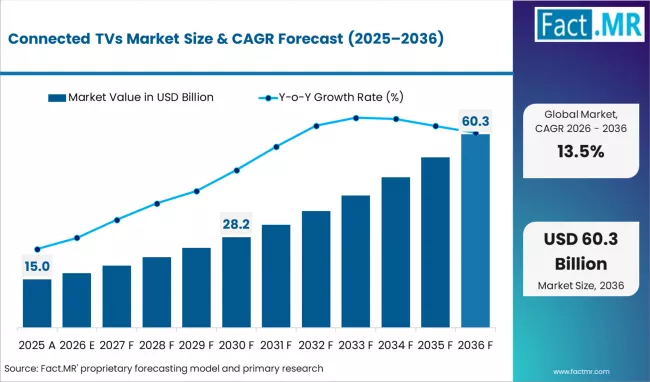
In 2025, the connected TVs market was valued at USD 15 billion. Based on Fact MR analysis, demand for connected TVs is estimated to grow to USD 17 billion in 2026 and USD 60.1 billion by 2036. FMR projects a CAGR of 13.5% during the forecast period.
The absolute dollar growth from 2026 to 2036 is USD 43.1 billion. This scale of expansion reflects a structural shift in home entertainment infrastructure rather than incremental television replacement cycles. Connected televisions integrate internet connectivity, streaming applications, and smart home interfaces within a single display platform. Demand continues to expand as streaming media consumption increases and households transition from traditional broadcast systems to digital content ecosystems. Hardware manufacturers are integrating operating systems and app ecosystems directly into television sets. Growth remains influenced by panel manufacturing costs, semiconductor component supply conditions, and price competition across consumer electronics brands.
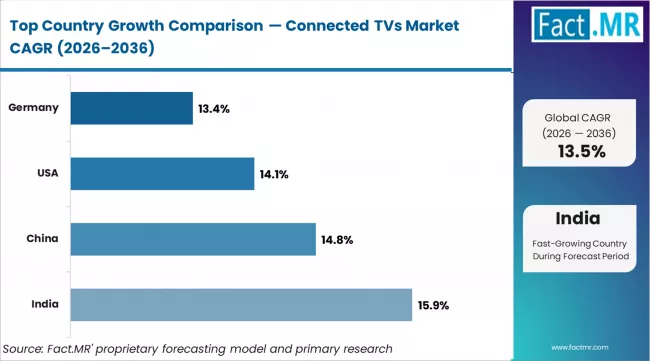
India leads with a projected CAGR of 15.9%, supported by expanding broadband access and rising adoption of streaming entertainment services. China follows with a CAGR of 14.8%, driven by large scale consumer electronics manufacturing and strong demand for internet enabled television platforms. The United States records a CAGR of 14.1%, reflecting widespread streaming platform adoption and continued upgrades to smart home entertainment systems. Germany shows a CAGR of 13.4%, supported by steady replacement demand for internet connected television displays. Mature consumer electronics markets generate a significant share of replacement demand as households upgrade existing televisions. Price competition and rapid product refresh cycles act as structural constraints across established markets.
Connected Tvs Market Market Value Analysis | Source: Fact.MR
Connected TVs Market
| Metric | Details |
|---|---|
| Industry Size (2026E) | USD 17 billion |
| Industry Value (2036F) | USD 60.1 billion |
| CAGR (2026 to 2036) | 13.5% |
Source: Fact.MR analysis. Updated Mar 17, 2026
Connected TVs Market Definition
The Connected TVs Market includes television devices equipped with internet connectivity that allow users to access online content, streaming platforms, and digital applications. These televisions integrate networking capabilities through wired or wireless connections, enabling access to video streaming services, web browsing, and application based media platforms. Connected TVs combine traditional broadcast television functions with internet enabled entertainment features. They are widely used in households and entertainment environments for accessing digital media, online video services, and interactive applications. The primary function of connected TVs is to deliver television programming and internet based content through a single integrated display device.
Market Inclusions
This report covers global and regional market sizes for connected televisions with forecast analysis for the study period. The market is segmented by product type including smart televisions and internet enabled digital televisions. Application segments include household entertainment, streaming media consumption, and interactive television services. End users include residential consumers, hospitality facilities, and commercial entertainment venues. The report also evaluates pricing patterns, shipment volumes, and selected trade flow analysis across major consumer electronics markets.
Market Exclusions
The report excludes conventional televisions that do not support internet connectivity or digital applications. External streaming devices such as media streaming sticks and set top boxes are not included. The scope also excludes computer monitors, digital signage displays, and projection systems used for commercial presentations. Online video streaming platforms and subscription services are outside the defined market scope, as the analysis focuses strictly on internet enabled television hardware devices.
Research Methodology
- Primary Research: Interviews were conducted with television manufacturers, electronics component suppliers, distribution partners, and retail channel managers.
- Desk Research: Public information was collected from consumer electronics industry publications, company reports, government trade statistics, and technology market databases.
- Market-Sizing and Forecasting: A hybrid model combining bottom up shipment analysis with top down demand assessment across global consumer electronics markets was applied.
- Data Validation and Update Cycle: Findings were cross verified using multiple industry data sources and expert reviews, with periodic updates conducted as new market information becomes available.
Summary of the Connected TVs Market
- Market Definition
- The market comprises television devices equipped with integrated internet connectivity that allow users to access streaming services, digital applications, and online media content. Connected televisions combine traditional broadcast capabilities with internet based entertainment platforms, enabling access to video streaming, digital applications, and interactive media services through a single display device.
- Demand Drivers
- Increasing consumption of streaming media and digital video services across household entertainment systems.
- Rising adoption of smart televisions equipped with built in operating systems and application ecosystems.
- Expansion of broadband connectivity and home internet infrastructure supporting digital media consumption.
- Growing integration of connected televisions with gaming systems, smart home devices, and digital entertainment platforms.
- Key Segments Analyzed
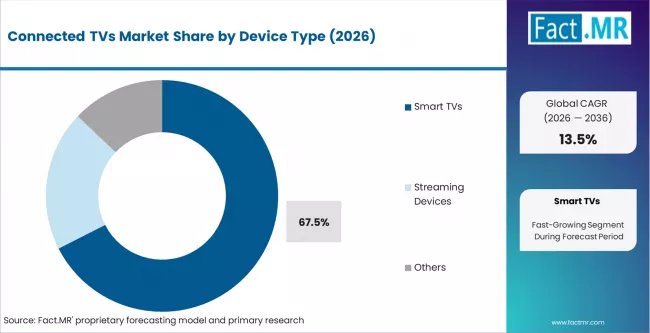
- Device Type: Smart TVs account for about 67.5% share due to widespread adoption of internet enabled television platforms.
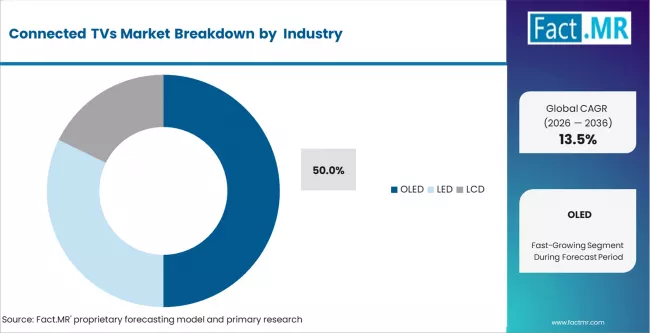
- Technology: OLED technology represents roughly 50% share supported by high image quality and premium television display performance.
- End Use: Residential households represent the dominant end use segment due to increasing demand for connected home entertainment systems.
- Geography: India records the fastest expansion supported by increasing broadband access and rising adoption of streaming services.
- Analyst Opinion at Fact MR
- Shambhu Nath Jha, Principal Consultant, Fact MR, opines, "In this updated edition of the Connected TVs Market report, industry participants will observe that internet enabled televisions have become central devices within household entertainment systems. Connected televisions integrate streaming applications, digital media platforms, and smart home interfaces within a single device. Manufacturers that combine advanced display technologies with integrated software ecosystems will maintain stronger positions in the evolving digital entertainment hardware market."
- Strategic Implications or Executive Takeaways
- Expand development of smart television platforms integrated with application ecosystems and streaming service compatibility.
- Invest in advanced display technologies such as OLED and QLED to improve visual performance in connected television products.
- Strengthen partnerships with digital content providers and streaming platforms to expand media access through connected television systems.
- Maintain competitive pricing strategies and efficient manufacturing operations within the consumer electronics supply chain.
- Methodology
- Primary interviews conducted with television manufacturers, electronics component suppliers, distribution partners, and retail channel managers.
- Desk research based on consumer electronics industry publications, company reports, government trade statistics, and technology market databases.
- Market sizing developed through a hybrid approach combining bottom up shipment analysis and top down demand assessment across consumer electronics markets.
- Findings validated through multiple industry data sources and expert consultations following Fact MR internal modeling standards.
Segmental Analysis
Connected TVs Market Analysis by Device Type
Connected Tvs Market Analysis By Device Type | Source: Fact.MR
- Market Overview: Smart TVs are projected to account for around 67.5% share of the connected TVs market by 2026. Smart TVs integrate internet connectivity and built in operating systems that allow users to access streaming platforms, digital applications, and online content directly through television interfaces. Manufacturers incorporate Wi Fi connectivity, app ecosystems, and voice enabled controls to expand the functionality of television devices beyond traditional broadcasting. The widespread adoption of digital streaming services and internet based media consumption continues to support demand for smart televisions across household entertainment systems.
- Demand Drivers:
- Streaming Platform Integration: Smart TVs provide direct access to video streaming services and digital content platforms without requiring external devices.
- Built In Connectivity Features: Internet connectivity, application stores, and voice enabled controls enhance the functionality of smart television systems.
- Home Entertainment Expansion: Consumers increasingly adopt smart televisions as central entertainment devices for video streaming, gaming, and digital media consumption.
Connected TVs Market Analysis by Technology
Connected Tvs Market Analysis By Technology | Source: Fact.MR
- Market Overview: OLED technology is expected to represent approximately 50% share of the connected TVs market in 2026. OLED displays utilize organic light emitting diodes that produce light independently at the pixel level, allowing improved contrast ratios and deeper black levels compared with traditional display technologies. Television manufacturers deploy OLED panels to deliver high image quality, wider viewing angles, and enhanced color performance in premium television models. OLED based connected televisions are widely adopted within high end home entertainment systems where image clarity and display performance are key product attributes.
- Demand Drivers:
- High Image Quality Performance: OLED displays deliver improved contrast ratios and color accuracy, supporting enhanced viewing experiences for television users.
- Premium Television Adoption: Consumers purchasing high end television models increasingly prefer OLED display technology due to its visual performance characteristics.
- Advancements in Display Manufacturing: Improvements in OLED panel production processes have supported broader availability of OLED based connected television products.
Key Dynamics
Connected TVs Market Drivers, Restraints, and Opportunities
Fact MR analysis indicates that the connected TVs market developed from the transition of conventional television sets into internet-enabled entertainment platforms. Early smart television models integrated basic internet connectivity and streaming applications that allowed viewers to access digital video services without external devices. The current market valuation reflects the integration of operating systems, application ecosystems, and streaming interfaces within television hardware. Demand persists because connected televisions function as primary access points for digital entertainment services within households, supporting video streaming, gaming applications, and internet-based media platforms.
A structural shift is occurring as traditional broadcast television consumption declines while internet-based video streaming becomes the dominant content distribution model. Conventional television hardware continues to serve broadcast channels in many regions where cable and satellite infrastructure remain widespread. Modern connected television platforms integrate streaming services, advertising technology, and personalized content interfaces that generate recurring revenue from digital media ecosystems. These platforms increase the value of connected televisions through software integration and content partnerships even when hardware shipment growth remains moderate. Higher platform monetization contributes to steady market value expansion.
- Streaming Platform Integration: Television manufacturers embed operating systems and streaming application ecosystems that allow direct access to online video platforms without external devices.
- Digital Media Regulation: Content distribution frameworks such as the Federal Communications Commission broadcast regulations and European Audiovisual Media Services Directive (AVMSD) influence digital media accessibility and content compliance.
- Asia Electronics Manufacturing: China, South Korea, and Taiwan host large television manufacturing industries that produce connected televisions for global consumer electronics markets.
Regional Analysis
The market analysis covers key global regions, including South Asia, East Asia, North America, and Europe. It is segmented geographically, with specific market dynamics for each region. The full report provides a detailed market attractiveness analysis.
.webp "Top Country Growth Comparison Connected Tvs Market Cagr (2026 2036)")
Top Country Growth Comparison Connected Tvs Market Cagr (2026 2036) | Source: Fact.MR
| Country | CAGR (2026-2036) |
|---|---|
| India | 15.9% |
| China | 14.8% |
| USA | 14.1% |
| Germany | 13.4% |
Source: Fact.MR analysis. Updated Mar 17, 2026
Source: Fact MR (FMR) analysis, based on proprietary forecasting model and primary research
Connected Tvs Market Cagr Analysis By Country | Source: Fact.MR
South Asia
India represents a major market supported by broadband expansion, digital entertainment platforms, and increasing adoption of smart home devices. Key companies include Samsung Electronics, LG Electronics, and Sony Group Corporation.
- India: Demand for connected TVs in India is projected to rise at 15.9% CAGR through 2036. Growth is supported by digital connectivity initiatives promoted by the Ministry of Electronics and Information Technology (05-2025) and expansion of smart television product lines by Samsung Electronics (09-2025).
East Asia
China represents a key market supported by consumer electronics manufacturing, online streaming adoption, and smart home device integration.
- China: Demand for connected TVs in China is projected to rise at 14.8% CAGR through 2036. Growth is supported by digital entertainment platform expansion (03-2025) and smart television technology development by LG Electronics (08-2025).
North America
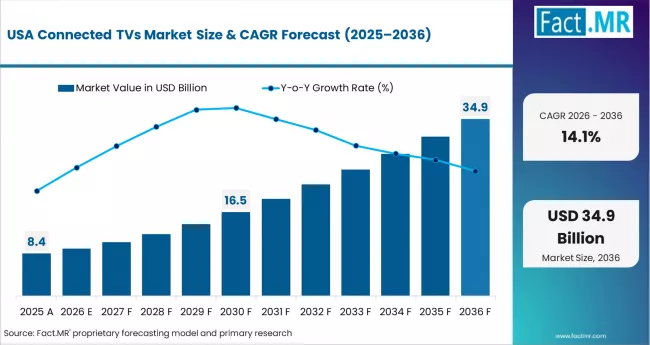
Connected Tvs Market Country Value Analysis | Source: Fact.MR
The USA represents a significant market supported by streaming services, smart home ecosystems, and consumer demand for connected entertainment devices.
- USA: Demand for connected TVs in the U.S. is projected to rise at 14.1% CAGR through 2036. Growth is supported by digital media infrastructure expansion (04-2025) and product ecosystem development by Sony Group Corporation (08-2025).
Europe
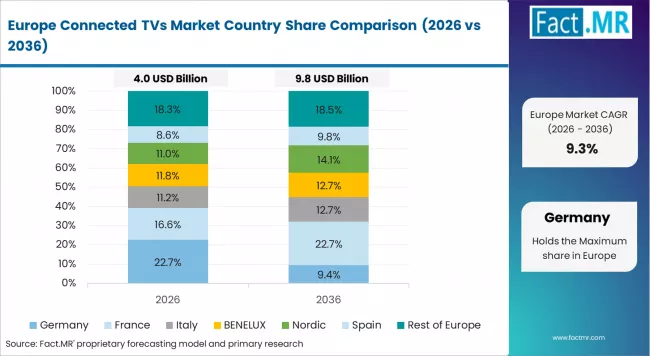
Connected Tvs Market Europe Country Market Share Analysis, 2026 & 2036 | Source: Fact.MR
Germany represents an important market supported by broadband connectivity, digital media consumption, and smart entertainment devices.
- Germany: Demand for connected TVs in Germany is projected to rise at 13.4% CAGR through 2036. Growth is supported by digital infrastructure initiatives promoted by the Federal Ministry for Digital and Transport (03-2025) and smart television product expansion by Samsung Electronics (07-2025).
Fact MR's analysis of the connected TVs market in South Asia, East Asia, North America, and Europe consists of country-wise assessments that include India, China, Germany, and the USA. Readers can find detailed trends, regulatory updates, and company-specific investments shaping market growth in these countries.
Competitive Landscape
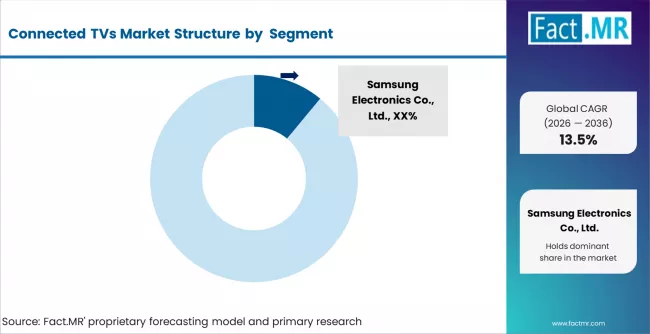
Connected Tvs Market Analysis By Company | Source: Fact.MR
Competitive Structure and Buyer Dynamics in the Connected TVs Market
The competitive structure of the Connected TVs Market is moderately concentrated, with a small group of global electronics manufacturers controlling a large share of global shipments. Samsung Electronics Co., Ltd., LG Electronics Inc., Sony Group Corporation, TCL Technology Group Corporation, and Hisense Group Co., Ltd. maintain strong market positions through extensive television manufacturing capacity and global distribution networks. These companies supply connected television platforms integrated with smart operating systems, streaming applications, and internet connectivity features. Additional participants including VIZIO Holding Corp., Panasonic Holdings Corporation, Sharp Corporation, Apple Inc., and Xiaomi Corporation contribute through smart television hardware, software ecosystems, and connected entertainment platforms. Competition in the market is primarily influenced by display technology quality, operating system capability, application ecosystem compatibility, and price competitiveness across product tiers.
Several companies maintain structural advantages through integrated display manufacturing and established consumer electronics ecosystems. Samsung Electronics Co., Ltd. and LG Electronics Inc. benefit from vertical integration in display panel production and television assembly operations. Sony Group Corporation maintains advantages through strong brand recognition and advanced image processing technologies. Apple Inc. leverages its software ecosystem and streaming services integration to support connected entertainment experiences. Large retail chains and consumer electronics distributors typically offer multiple television brands to reduce supplier dependence and maintain competitive pricing. Procurement decisions in retail channels evaluate product reliability, consumer demand patterns, and brand recognition. This purchasing structure moderates supplier pricing leverage across the market. Manufacturers with advanced display technology, strong brand equity, and established smart platform ecosystems retain stronger negotiating influence in distribution agreements.
Key Players of the Connected TVs Market
- Samsung Electronics Co., Ltd.
- LG Electronics Inc.
- Sony Group Corporation
- TCL Technology Group Corporation
- VIZIO Holding Corp.
- Hisense Group Co., Ltd.
- Panasonic Holdings Corporation
- Sharp Corporation
- Apple Inc.
- Xiaomi Corporation
Report Scope
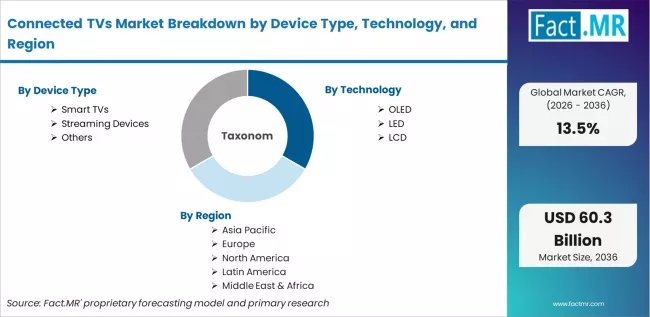
Connected Tvs Market Breakdown By Device Type, Technology, And Region | Source: Fact.MR
| Metric | Value |
|---|---|
| Quantitative Units | USD 17 billion (2026) to USD 60.1 billion (2036), at a CAGR of 13.5% |
| Market Definition | The connected TVs market includes internet-enabled television devices and streaming hardware that provide access to digital content, streaming platforms, and connected home ecosystems across residential and commercial environments. |
| Device Type | Smart TVs, Streaming Devices, Others |
| Technology | LED, LCD, OLED, QLED |
| End Use | Residential, Commercial |
| Key Companies Profiled | Samsung Electronics Co., Ltd., LG Electronics Inc., Sony Group Corporation, TCL Technology Group Corporation, VIZIO Holding Corp., Hisense Group Co., Ltd., Panasonic Holdings Corporation, Sharp Corporation, Apple Inc., Xiaomi Corporation |
| Forecast Period | 2026 to 2036 |
| Approach | Hybrid top-down and bottom-up market modeling validated through interviews with television manufacturers and streaming platform providers, supported by device shipment analysis, smart TV adoption trends, and digital content consumption data. |
Source: Fact.MR analysis. Updated Mar 17, 2026
Bibliographies
- [1] Ministry of Electronics and Information Technology, India. (2025). Digital connectivity initiatives.
- [2] Samsung Electronics Co., Ltd. (2025). Smart television product expansion.
- [3] Federal Ministry for Digital and Transport, Germany. (2025). Digital infrastructure initiatives.
- [4] LG Electronics Inc. (2025). Smart television technology development.
- [5] Sony Group Corporation. (2025). Product ecosystem development.
- [6] Federal Communications Commission. (2025). Broadcast regulations for digital media.
- [7] European Commission. (2023). Audiovisual Media Services Directive (AVMSD).
- [8] National Health Commission, China. (2025). Digital entertainment platform expansion.
- [9] Consumer Electronics Association. (2025). Smart TV adoption trends.
This Report Addresses
- Market size estimation and revenue forecasts for the Connected TVs Market from 2026 to 2036, supported by television shipment benchmarks and digital media consumption indicators.
- Growth opportunity mapping across smart televisions, internet enabled display devices, and connected entertainment platforms integrated with streaming application ecosystems.
- Segment and regional revenue forecasts covering LED, LCD, OLED, and QLED display technologies used across residential and commercial entertainment environments.
- Competition strategy assessment including display panel manufacturing capability, smart operating system integration, and consumer electronics distribution benchmarking among global television manufacturers.
- Regulatory and digital media compliance analysis covering frameworks such as Federal Communications Commission broadcast regulations and the European Audiovisual Media Services Directive governing digital content accessibility and media distribution.
- Market report delivery in PDF, Excel, PPT, and interactive dashboard formats designed for consumer electronics market evaluation, product portfolio planning, and digital entertainment infrastructure analysis.
- Supply chain vulnerability assessments identifying display panel production concentration, semiconductor component dependencies, and regional electronics manufacturing risks affecting connected television production.
Segmentation
Connected TVs Market Key Segments
-
Device Type :
- Smart TVs
- Streaming Devices
- Others
-
Technology :
- LED
- LCD
- OLED
- QLED
-
End Use :
- Residential
- Commercial
-
Region :
- North America
- USA
- Canada
- Mexico
- Europe
- Germany
- UK
- France
- Italy
- Spain
- Nordic Countries
- BENELUX
- Rest of Europe
- Asia Pacific
- China
- Japan
- South Korea
- India
- Australia
- Rest of Asia Pacific
- Latin America
- Brazil
- Argentina
- Rest of Latin America
- Middle East and Africa
- Kingdom of Saudi Arabia
- United Arab Emirates
- South Africa
- Rest of Middle East and Africa
- Other Regions
- Oceania
- Central Asia
- Other Markets
- North America
Frequently Asked Questions
How large is the demand for Connected TVs in the global market in 2026?
What will be the market size of Connected TVs in the global market by 2036?
What is the expected demand growth for Connected TVs in the global market between 2026 and 2036?
Which Device Type Segment is poised to lead global demand by 2026?
Which Company is Identified as a Leading Participant in the Connected TVs Market?
What is Driving Connected TVs Demand in the United States?
What is the United States Growth Outlook in this Report?
Why is China an Important Market for Connected TVs?
What is the China Growth Outlook in this Report?
What Factors Support Connected TVs Demand in India?
What is the India Growth Outlook in this Report?
Why is Germany Considered an Important Market for Connected TVs?
What is the Germany Growth Outlook in this Report?
What are Connected TVs and What are They Mainly Used For?
What does Connected TVs Market Mean in this Report?
What is Included in the Scope of this Connected TVs Market Report?
What is Excluded from the Scope of this Report?
What does Market Forecast Mean on this Page?
How is the Connected TVs Market Forecast Developed in this Report?
Who worked on this report


Preview the report firsthand - request a free sample
Free SampleGet the brochure for pricing and purchase details
Download PDF