Connected Game Console Market (2026 - 2036)

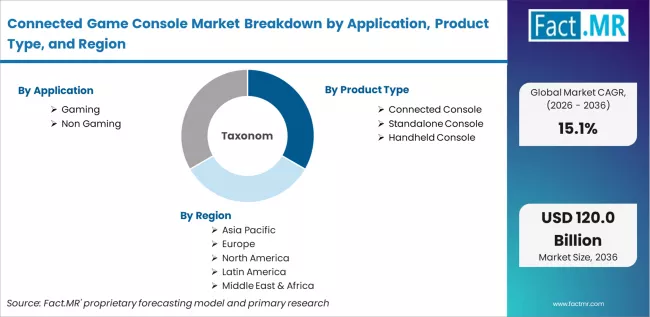
Connected Game Console Market is segmented by Product Type (Connected Console, Standalone Console, and Handheld Console), Services (Prepaid Service and Other Direct Services), Application (Gaming and Non-Gaming), and Region. Forecast for 2026 to 2036.

Core Findings

    Connected Game Console Market Forecast By Fact.MR

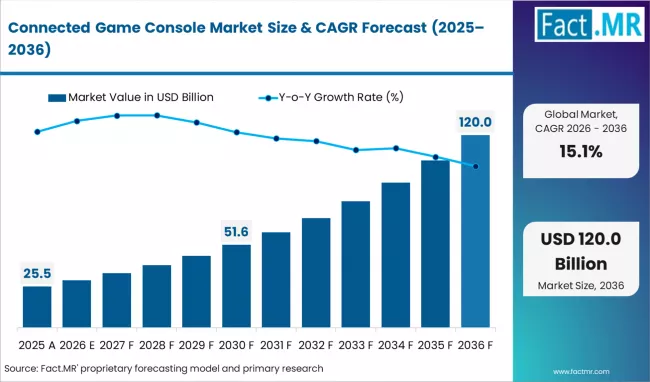
    In 2025, the connected game console market was valued at USD 25.5 billion. Based on Fact MR analysis, demand for connected game consoles is estimated to grow to USD 29.4 billion in 2026 and USD 121.5 billion by 2036. FMR projects a CAGR of 15.1% during the forecast period.

    The absolute dollar growth from 2026 to 2036 is USD 92.1 billion. This scale of expansion signals a structural shift in the gaming hardware ecosystem rather than incremental category growth. Demand is expected to accelerate as connected consoles evolve into integrated entertainment platforms supporting online multiplayer gaming, cloud streaming services, and digital content distribution. Subscription based gaming services and expanded digital storefront ecosystems are strengthening long term platform engagement. Growth remains influenced by structural constraints such as semiconductor component availability, rising hardware manufacturing costs, and substitution pressure from high performance mobile gaming and cloud based gaming platforms.

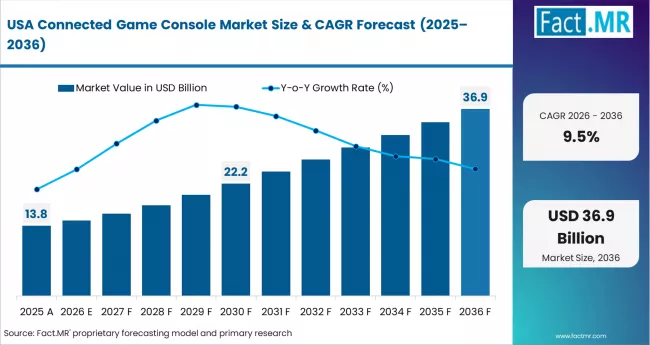
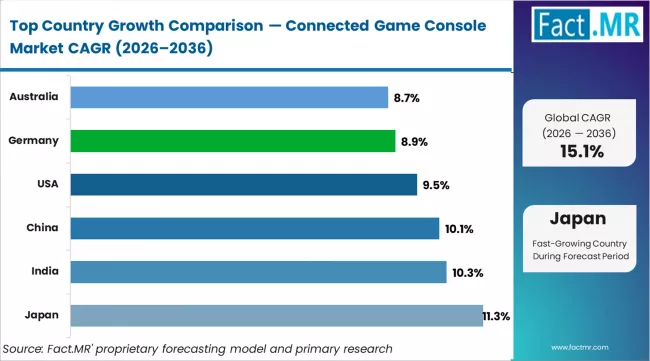
    Japan records strong expansion with a projected CAGR of 11.3%, supported by a large console gaming culture and strong domestic game development ecosystems. India follows with a CAGR of 10.3%, reflecting rising gaming adoption among younger consumers and expanding broadband connectivity. China grows at 10.1%, driven by increasing digital gaming participation and broader distribution of connected entertainment devices. The United States shows a CAGR of 9.5%, supported by strong demand for online multiplayer gaming platforms and subscription based gaming ecosystems. Germany records a CAGR of 8.9% as digital console adoption continues across established gaming communities. Australia shows the slowest growth at 8.7%, reflecting a smaller installed base of console users. Mature markets such as the United States, Germany, and Australia generate a significant share of replacement demand as hardware upgrade cycles replace earlier generation gaming systems. High console prices and competition from mobile gaming platforms act as structural constraints in these established markets.
    Connected Game Console Market Market Value Analysis

    Connected Game Console Market

    Metric Details
    Industry Size (2026E) USD 29.4 billion
    Industry Value (2036F) USD 121.5 billion
    CAGR (2026 to 2036) 15.1%

    Connected Game Console Market Definition

    The Connected Game Console Market refers to video game consoles designed with built in internet connectivity that allows users to access online gaming services, digital game distribution, multiplayer platforms, and streaming features. These consoles connect to home networks through wired or wireless internet to enable software downloads, cloud storage, and online interaction with other players. Connected game consoles serve as integrated entertainment devices used for gaming, media streaming, and digital content access. They are widely used by household consumers and gaming communities for interactive entertainment through online platforms and network based gaming ecosystems.

    Market Inclusions

    This report covers global and regional market sizes for connected game consoles with forecast analysis for the study period. The market is segmented by product type such as home consoles and hybrid consoles with online connectivity. Application segments include household gaming, online multiplayer gaming services, and digital entertainment platforms. End user analysis covers individual consumers and gaming communities. The study also examines pricing trends, hardware shipment patterns, digital game distribution structures, and selected trade flow analysis across major gaming markets.

    Market Exclusions

    The report excludes handheld gaming devices that operate primarily without internet connectivity. Personal computers used for gaming are not included since they belong to a separate gaming hardware category. The scope also excludes mobile gaming devices such as smartphones and tablets. Gaming software, standalone accessories, and cloud gaming services without dedicated console hardware are outside the defined market scope, as the study focuses strictly on internet enabled gaming console devices.

    Research Methodology

    • Primary Research: Interviews were conducted with console manufacturers, game publishers, platform developers, and retail distribution managers.
    • Desk Research: Public information was gathered from gaming industry publications, company financial reports, government statistics, and trade data.
    • Market-Sizing and Forecasting: A hybrid model combining top down demand analysis with bottom up shipment and revenue assessment was applied.
    • Data Validation and Update Cycle: Findings were cross verified using multiple industry sources and expert inputs, with periodic updates conducted as new market data becomes available.

    Summary of the Connected Game Console Market

    • Market Definition
      • The market comprises internet enabled gaming consoles designed to support online gaming services, digital game downloads, multiplayer interaction, and media streaming through integrated network connectivity. These consoles operate as household entertainment platforms used for gaming and digital content access.
    • Demand Drivers
      • Expansion of online multiplayer gaming ecosystems supported by broadband connectivity and platform based gaming networks.
      • Increasing adoption of digital game distribution through platform storefronts that allow direct game downloads.
      • Growth of subscription based gaming services providing access to large digital game libraries.
      • Rising use of gaming consoles as multifunction entertainment devices supporting video streaming and digital media services.
    • Key Segments Analyzed
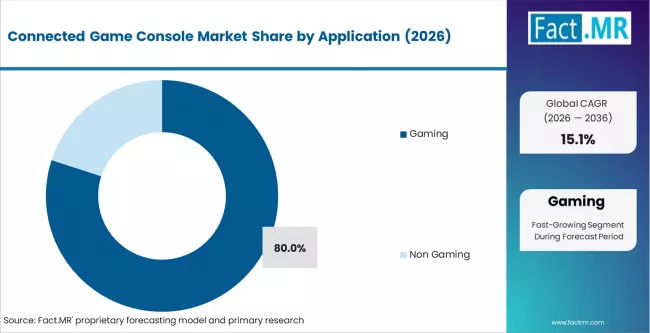
      • Application: Gaming represents around 80% share due to the primary role of consoles as dedicated gaming platforms within digital entertainment ecosystems.
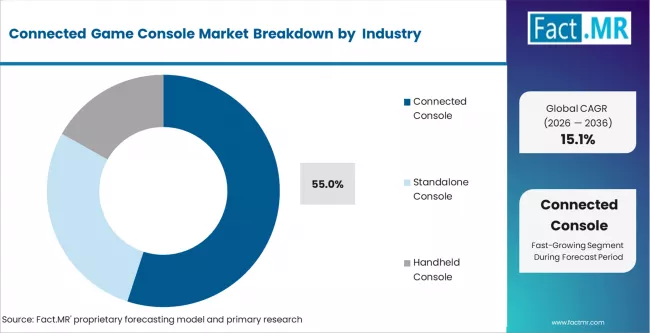
      • Product Type: Connected consoles account for about 55% share supported by integrated internet connectivity and digital platform services.
      • Service Model: Prepaid and subscription gaming services represent an expanding component of platform revenue generation.
      • Geography: Japan records the fastest expansion supported by strong console gaming culture and established game development ecosystems.
    • Analyst Opinion at Fact MR
      • Shambhu Nath Jha, Principal Consultant, Fact MR, opines, "In this updated edition of the Connected Game Console Market report, industry participants will observe that console platforms increasingly function as network connected entertainment ecosystems rather than standalone gaming hardware. Platform operators generate revenue not only from hardware sales but also from digital distribution, subscription services, and online multiplayer engagement. Companies that maintain strong digital storefront infrastructure and exclusive gaming content will retain competitive advantages as platform ecosystems expand."
    • Strategic Implications or Executive Takeaways
      • Strengthen digital distribution platforms that support game downloads, content updates, and subscription gaming services.
      • Expand partnerships with game publishers to secure exclusive content and strengthen platform ecosystems.
      • Invest in hardware performance improvements including graphics processing capability and network connectivity.
      • Develop integrated entertainment platforms that combine gaming, streaming services, and social interaction features.
    • Methodology
      • Primary interviews conducted with console manufacturers, game publishers, platform developers, and retail distribution managers.
      • Desk research based on gaming industry publications, company financial reports, government statistics, and trade data.
      • Market sizing developed using a hybrid approach combining top down demand analysis with bottom up hardware shipment assessment.
      • Findings validated through multiple industry data sources and expert consultation under Fact MR internal modeling standards.

    Segmental Analysis

    Connected Game Console Market Analysis by Application
    Connected Game Console Market Analysis By Application

    • Market Overview: Gaming applications are projected to account for around 80% share of the connected game console market by 2026. The dominance of this segment reflects the primary function of connected consoles as dedicated gaming platforms integrated with online connectivity and digital content ecosystems. Modern gaming consoles support high resolution graphics, cloud based game libraries, and multiplayer interaction through internet enabled platforms. Expansion of digital game distribution and subscription based gaming services has strengthened the role of connected consoles as central entertainment devices in households. The gaming application segment continues to generate consistent demand due to the regular release of new game titles and expansion of online gaming communities.
    • Demand Drivers:
      • Online Multiplayer Ecosystems: Connected consoles support multiplayer gaming through integrated online platforms that enable players to interact, compete, and collaborate in real time environments.
      • Digital Game Distribution: Game publishers increasingly release titles through digital storefronts, allowing console users to download games directly through connected platforms.
      • Subscription Gaming Services: Subscription based gaming services provide access to extensive game libraries, encouraging consumers to remain active within connected console ecosystems.

    Connected Game Console Market Analysis by Product Type
    Connected Game Console Market Analysis By Product Type

    • Market Overview: Connected consoles are expected to represent approximately 55% share of the connected game console market in 2026. These consoles integrate built in internet connectivity, allowing users to access online gaming services, cloud gaming platforms, and digital media streaming applications. Connected consoles serve as multifunction entertainment hubs capable of supporting gaming, video streaming, and digital media consumption. Manufacturers continue to integrate advanced processors, graphics capabilities, and network connectivity features to enhance gaming performance and online interaction.
    • Demand Drivers:
      • Integrated Internet Connectivity: Connected consoles allow users to access online multiplayer gaming, digital content downloads, and cloud gaming platforms directly through internet enabled systems.
      • Entertainment Platform Integration: Modern consoles support streaming services, digital media playback, and online gaming services within a single entertainment device.
      • Hardware Performance Improvements: Advances in graphics processors, storage systems, and network connectivity enable connected consoles to deliver enhanced gaming performance and immersive gaming experiences.

    Connected Game Console Market Drivers, Restraints, and Opportunities
    Connected Game Console Market Opportunity Matrix Growth Vs Value

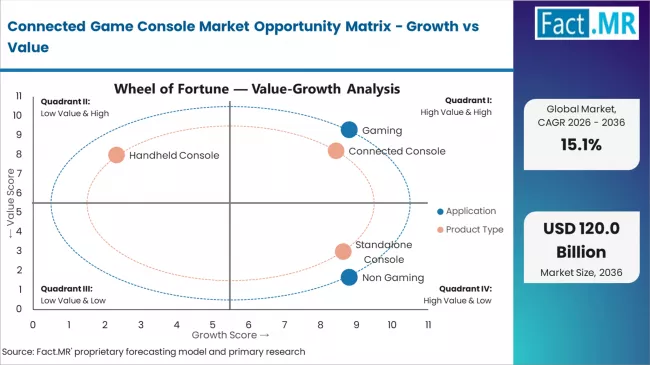
    FMR analysts observe that the connected game console market developed from the transition of standalone gaming hardware toward internet-enabled entertainment platforms. Early console generations functioned primarily as offline gaming devices where software distribution relied on physical media. The current market valuation reflects the shift toward network-connected consoles that support digital game downloads, online multiplayer ecosystems, and integrated media streaming services. Demand persists because console platforms now operate as central entertainment hubs within households, combining gaming, video streaming, and social interaction services.

    A structural shift is occurring as physical game sales decline while digital distribution and subscription-based gaming services expand. Traditional retail-based console software distribution continues in several markets, though digital storefronts and cloud-linked game libraries increasingly dominate platform revenue models. Subscription gaming services and downloadable content command recurring fees that generate higher long-term revenue per user despite slower growth in console hardware shipments. The pricing structure therefore moves from one-time software purchases toward continuous service-based revenue streams linked to connected consoles.

    • Digital Distribution Shift: Game publishers increasingly distribute titles through platform-based digital stores that allow direct downloads and continuous content updates.
    • Platform Content Regulation: Content distribution frameworks such as the Entertainment Software Rating Board (ESRB) classification system and the Pan European Game Information (PEGI) rating standards regulate age-appropriate game distribution.
    • Japan Console Ecosystem: Japan remains a central console development market where major gaming hardware and software companies continue to drive connected console platform innovation.

    Regional Analysis

    The market analysis covers key global regions, including North America, East Asia, South Asia, Europe, and Oceania. It is segmented geographically, with specific market dynamics for each region. The full report provides a detailed market attractiveness analysis.

    Top Country Growth Comparison Connected Game Console Market Cagr (2026 2036)

    Country CAGR (2026-2036)
    USA 9.5%
    China 10.1%
    Germany 8.9%
    Japan 11.3%
    India 10.3%
    Australia 8.7%

    Source: Fact MR (FMR) analysis, based on proprietary forecasting model and primary research
    Connected Game Console Market Cagr Analysis By Country

    North America

    Connected Game Console Market Country Value Analysis

    The USA represents a major market supported by gaming platform adoption, cloud gaming services, and high consumer spending on entertainment devices. Key companies include Microsoft, Sony Group Corporation, and Nintendo Co., Ltd..

    •  USA: Demand for connected game consoles in the U.S. is projected to rise at 9.5% CAGR through 2036. Growth is supported by expansion of cloud gaming infrastructure (05-2025) and product ecosystem upgrades by Microsoft for the Xbox platform (09-2025).

    East Asia

    China and Japan represent major markets supported by gaming culture, esports growth, and digital entertainment consumption.

    • China: Demand for connected game consoles in China is projected to rise at 10.1% CAGR through 2036. Growth is supported by digital gaming initiatives approved by the National Press and Publication Administration (03-2025) and console ecosystem expansion by Sony Group Corporation (08-2025).
    • Japan: Demand for connected game consoles in Japan is projected to rise at 11.3% CAGR through 2036. Growth is supported by continued development of gaming platforms and software distribution networks by Nintendo Co., Ltd. (04-2025).

    South Asia

    India is a rapidly growing market supported by mobile and console gaming adoption, broadband expansion, and digital entertainment consumption.

    •  India: Demand for connected game consoles in India is projected to rise at 10.3% CAGR through 2036. Growth is supported by digital gaming promotion initiatives (06-2025) and regional gaming platform expansion by Sony Group Corporation (09-2025).

    Europe
    Connected Game Console Market Europe Country Market Share Analysis, 2026 & 2036

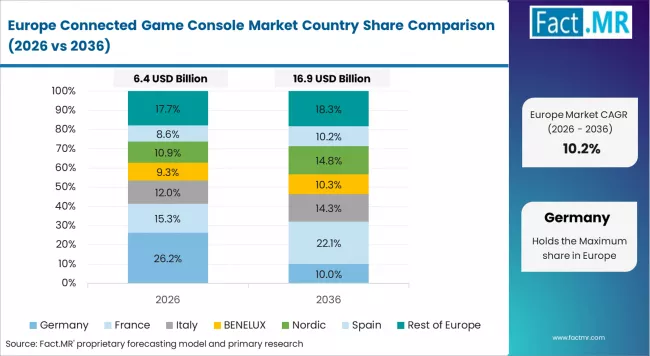
    Germany is a key market supported by gaming hardware adoption, digital distribution platforms, and esports participation.

    •  Germany: Demand for connected game consoles in Germany is projected to rise at 8.9% CAGR through 2036. Growth is supported by expansion of digital gaming marketplaces (03-2025) and console ecosystem investments by Microsoft (07-2025).

    Oceania

    Australia represents an important market supported by broadband connectivity, gaming culture, and adoption of digital entertainment platforms.

    • • Australia: Demand for connected game consoles in Australia is projected to rise at 8.7% CAGR through 2036. Growth is supported by expansion of cloud gaming infrastructure (04-2025) and gaming platform distribution initiatives by Sony Group Corporation (08-2025).

    Fact MR's analysis of the connected game console market in North America, East Asia, South Asia, Europe, and Oceania consists of country-wise assessments that include the USA, China, Germany, Japan, India, and Australia. Readers can find detailed trends, regulatory updates, and company-specific investments shaping market growth in these countries.

    Competitive Structure and Buyer Dynamics in the Connected Game Console Market
    Connected Game Console Market Analysis By Company

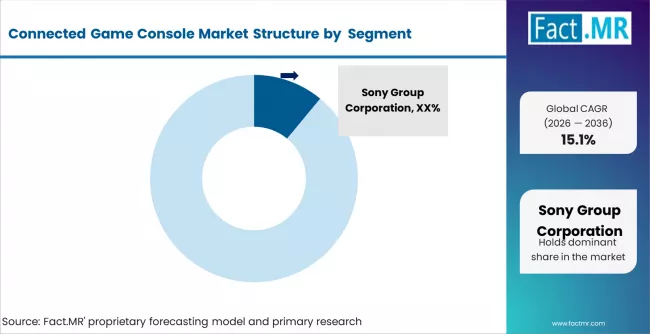
    The competitive structure of the Connected Game Console Market is relatively concentrated, with a small group of platform owners controlling the majority of hardware sales and ecosystem access. Sony Group Corporation, Microsoft Corporation, and Nintendo Co., Ltd. dominate the global console hardware segment through established gaming platforms, proprietary operating systems, and extensive developer networks. These companies collectively account for the majority of installed console systems worldwide. Competition is driven by hardware performance, exclusive game titles, digital ecosystem services, and subscription based gaming platforms. Firms such as Google LLC and NVIDIA Corporation participate through cloud gaming technologies and graphics processing platforms that support connected gaming experiences. Game publishers including Activision Blizzard, Inc., Rockstar Games, Inc., Sega Corporation, Square Enix Holdings Co., Ltd., and Capcom Co., Ltd. contribute to competitive intensity through exclusive content and franchise driven game releases. Valve Corporation also influences the connected gaming ecosystem through digital distribution infrastructure and online gaming services.

    Certain companies hold structural advantages through platform ownership, exclusive intellectual property portfolios, and large installed user bases. Sony Group Corporation, Microsoft Corporation, and Nintendo Co., Ltd. benefit from vertically integrated gaming ecosystems that combine hardware platforms, digital storefronts, and proprietary software titles. These integrated environments create strong network effects and high switching costs for consumers. Large game publishers maintain advantages through globally recognized gaming franchises and long term development partnerships with console manufacturers. Consumer purchasing behavior is influenced by exclusive titles, online services, and compatibility with existing game libraries. Platform operators maintain considerable pricing influence over digital distribution and subscription services, though strong competition between console ecosystems encourages promotional pricing, bundled offerings, and periodic hardware discounts to maintain market share.

    Key Players of the Connected Game Console Market

    • Sony Group Corporation
    • Microsoft Corporation
    • Nintendo Co., Ltd.
    • Google LLC
    • NVIDIA Corporation
    • Tencent Holdings Limited
    • Activision Blizzard, Inc.
    • Valve Corporation
    • Rockstar Games, Inc.
    • Sega Corporation
    • Square Enix Holdings Co., Ltd.
    • Capcom Co., Ltd.

    Report Scope

    Connected Game Console Market Breakdown By Application, Product Type, And Region

    Metric Value
    Quantitative Units USD 29.4 billion (2026) to USD 121.5 billion (2036), at a CAGR of 15.1%
    Market Definition The connected game console market includes production, distribution, and integration of internet-enabled gaming consoles that support online gaming, digital content distribution, multiplayer connectivity, and entertainment applications.
    Product Type Connected Console, Standalone Console, Handheld Console
    Services Prepaid Service, Other Direct Services
    Application Coverage Gaming, Non-Gaming
    Key Companies Profiled Sony Group Corporation, Microsoft Corporation, Nintendo Co., Ltd., Google LLC, NVIDIA Corporation, Tencent Holdings Limited, Activision Blizzard, Inc., Valve Corporation, Rockstar Games, Inc., Sega Corporation, Square Enix Holdings Co., Ltd., Capcom Co., Ltd.
    Forecast Period 2026 to 2036
    Approach Hybrid top-down and bottom-up market modeling validated through interviews with console manufacturers and digital gaming platform operators, supported by hardware shipment analysis, digital service revenue benchmarking, and online gaming adoption trends.

    Connected Game Console Market Key Segments

    • Product Type

      • Connected Console
      • Standalone Console
      • Handheld Console
    • Services

      • Prepaid Service
      • Other Direct Services
    • Application

      • Gaming
      • Non Gaming
    • Region

      • North America
        • USA
        • Canada
        • Mexico
      • Europe
        • Germany
        • UK
        • France
        • Italy
        • Spain
        • Nordic Countries
        • BENELUX
        • Rest of Europe
      • Asia Pacific
        • China
        • Japan
        • South Korea
        • India
        • Australia
        • Rest of Asia Pacific
      • Latin America
        • Brazil
        • Argentina
        • Rest of Latin America
      • Middle East and Africa
        • Kingdom of Saudi Arabia
        • United Arab Emirates
        • South Africa
        • Rest of Middle East and Africa
      • Other Regions
        • Oceania
        • Central Asia
        • Other Markets

    Bibliographies

    • [1] Entertainment Software Rating Board. (2024). ESRB ratings guide and categories for video games.
    • [2] Pan European Game Information. (2023). PEGI-The European content rating system.
    • [3] Video Games Europe. (2025). PEGI-The European content rating system: Responsible gameplay and minor protection.
    • [4] XDA Developers. (2024). What is the deal with cloud gaming in 2024?
    • [5] Croma. (2025). Xbox Cloud Gaming is now available in India.
    • [6] Entertainment Software Rating Board. (2025). E for Everyone was assigned most often in 2024.
    • [7] Entertainment Software Rating Board. (2023). Video game ratings.

    This Report Addresses

    • Market size estimation and revenue forecasts for the Connected Game Console Market from 2026 to 2036, supported by hardware shipment benchmarks and digital gaming platform revenue analysis.
    • Growth opportunity mapping across connected consoles, standalone consoles, and handheld console devices, including expansion of online enabled gaming hardware ecosystems.
    • Segment and regional revenue forecasts covering gaming and non gaming applications, prepaid service platforms, and global console adoption across major gaming regions.
    • Competition strategy assessment including platform ecosystem integration, proprietary gaming content strategies, and digital storefront capability benchmarking among leading console manufacturers.
    • Regulatory and content governance analysis covering digital game distribution frameworks, age rating systems, and online platform compliance standards affecting console ecosystems.
    • Market report delivery in PDF, Excel, PPT, and interactive dashboard formats designed for gaming industry strategy planning, investment analysis, and digital platform evaluation.
    • Supply chain vulnerability assessments identifying semiconductor component sourcing dependencies, graphics processor manufacturing capacity constraints, and global console production risks affecting hardware availability.

    Table of Content

    • Demand to side Trends
    • Supply to side Trends
    • Analysis and Recommendations
    • Market Overview
      • Market Coverage / Taxonomy
      • Market Definition / Scope / Limitations
    • Research Methodology
      • Chapter Orientation
      • Analytical Lens and Working Hypotheses
        • Market Structure, Signals, and Trend Drivers
        • Benchmarking and Cross-market Comparability
        • Market Sizing, Forecasting, and Opportunity Mapping
      • Research Design and Evidence Framework
        • Desk Research Programme (Secondary Evidence)
          • Company Annual and Sustainability Reports
          • Peer-reviewed Journals and Academic Literature
          • Corporate Websites, Product Literature, and Technical Notes
          • Earnings Decks and Investor Briefings
          • Statutory Filings and Regulatory Disclosures
          • Technical White Papers and Standards Notes
          • Expert Input and Fieldwork (Primary Evidence)
            • Primary Modes
              • Qualitative Interviews and Expert Elicitation
              • Quantitative Surveys and Structured Data Capture
              • Blended Approach
            • Why Primary Evidence is Used
            • Field Techniques
              • Interviews
              • Surveys
              • Focus Groups
              • Observational and In-context Research
              • Social and Community Interactions
            • Stakeholder Universe Engaged
              • C-suite Leaders
              • Board Members
              • Presidents and Vice Presidents
              • R&D and Innovation Heads
              • Technical Specialists
              • Domain Subject-matter Experts
              • Scientists
              • Physicians and Other Healthcare Professionals
            • Governance, Ethics, and Data Stewardship
              • Research Ethics
              • Data Integrity and Handling
          • Tooling, Models, and Reference Databases
        • Data Engineering and Model Build
          • Data Acquisition and Ingestion
          • Cleaning, Normalisation, and Verification
          • Synthesis, Triangulation, and Analysis
        • Quality Assurance and Audit Trail
      • Market Background
        • Market Dynamics
          • Drivers
          • Restraints
          • Opportunity
          • Trends
        • Scenario Forecast
          • Demand in Optimistic Scenario
          • Demand in Likely Scenario
          • Demand in Conservative Scenario
        • Opportunity Map Analysis
        • Product Life Cycle Analysis
        • Supply Chain Analysis
        • Investment Feasibility Matrix
        • Value Chain Analysis
        • PESTLE and Porter’s Analysis
        • Regulatory Landscape
        • Regional Parent Market Outlook
        • Production and Consumption Statistics
        • Import and Export Statistics
      • Global Market Analysis 2021 to 2025 and Forecast, 2026 to 2036
        • Historical Market Size Value (USD Million) Analysis, 2021 to 2025
        • Current and Future Market Size Value (USD Million) Projections, 2026 to 2036
          • Y to o to Y Growth Trend Analysis
          • Absolute $ Opportunity Analysis
      • Global Market Pricing Analysis 2021 to 2025 and Forecast 2026 to 2036
      • Global Market Analysis 2021 to 2025 and Forecast 2026 to 2036, By Application
        • Introduction / Key Findings
        • Historical Market Size Value (USD Million) Analysis By Application , 2021 to 2025
        • Current and Future Market Size Value (USD Million) Analysis and Forecast By Application , 2026 to 2036
          • Gaming
          • Non Gaming
        • Y to o to Y Growth Trend Analysis By Application , 2021 to 2025
        • Absolute $ Opportunity Analysis By Application , 2026 to 2036
      • Global Market Analysis 2021 to 2025 and Forecast 2026 to 2036, By Product Type
        • Introduction / Key Findings
        • Historical Market Size Value (USD Million) Analysis By Product Type, 2021 to 2025
        • Current and Future Market Size Value (USD Million) Analysis and Forecast By Product Type, 2026 to 2036
          • Connected Console
          • Standalone Console
          • Handheld Console
        • Y to o to Y Growth Trend Analysis By Product Type, 2021 to 2025
        • Absolute $ Opportunity Analysis By Product Type, 2026 to 2036
      • Global Market Analysis 2021 to 2025 and Forecast 2026 to 2036, By Region
        • Introduction
        • Historical Market Size Value (USD Million) Analysis By Region, 2021 to 2025
        • Current Market Size Value (USD Million) Analysis and Forecast By Region, 2026 to 2036
          • North America
          • Latin America
          • Western Europe
          • Eastern Europe
          • East Asia
          • South Asia and Pacific
          • Middle East & Africa
        • Market Attractiveness Analysis By Region
      • North America Market Analysis 2021 to 2025 and Forecast 2026 to 2036, By Country
        • Historical Market Size Value (USD Million) Trend Analysis By Market Taxonomy, 2021 to 2025
        • Market Size Value (USD Million) Forecast By Market Taxonomy, 2026 to 2036
          • By Country
            • USA
            • Canada
            • Mexico
          • By Application
          • By Product Type
        • Market Attractiveness Analysis
          • By Country
          • By Application
          • By Product Type
        • Key Takeaways
      • Latin America Market Analysis 2021 to 2025 and Forecast 2026 to 2036, By Country
        • Historical Market Size Value (USD Million) Trend Analysis By Market Taxonomy, 2021 to 2025
        • Market Size Value (USD Million) Forecast By Market Taxonomy, 2026 to 2036
          • By Country
            • Brazil
            • Chile
            • Rest of Latin America
          • By Application
          • By Product Type
        • Market Attractiveness Analysis
          • By Country
          • By Application
          • By Product Type
        • Key Takeaways
      • Western Europe Market Analysis 2021 to 2025 and Forecast 2026 to 2036, By Country
        • Historical Market Size Value (USD Million) Trend Analysis By Market Taxonomy, 2021 to 2025
        • Market Size Value (USD Million) Forecast By Market Taxonomy, 2026 to 2036
          • By Country
            • Germany
            • UK
            • Italy
            • Spain
            • France
            • Nordic
            • BENELUX
            • Rest of Western Europe
          • By Application
          • By Product Type
        • Market Attractiveness Analysis
          • By Country
          • By Application
          • By Product Type
        • Key Takeaways
      • Eastern Europe Market Analysis 2021 to 2025 and Forecast 2026 to 2036, By Country
        • Historical Market Size Value (USD Million) Trend Analysis By Market Taxonomy, 2021 to 2025
        • Market Size Value (USD Million) Forecast By Market Taxonomy, 2026 to 2036
          • By Country
            • Russia
            • Poland
            • Hungary
            • Balkan & Baltic
            • Rest of Eastern Europe
          • By Application
          • By Product Type
        • Market Attractiveness Analysis
          • By Country
          • By Application
          • By Product Type
        • Key Takeaways
      • East Asia Market Analysis 2021 to 2025 and Forecast 2026 to 2036, By Country
        • Historical Market Size Value (USD Million) Trend Analysis By Market Taxonomy, 2021 to 2025
        • Market Size Value (USD Million) Forecast By Market Taxonomy, 2026 to 2036
          • By Country
            • China
            • Japan
            • South Korea
          • By Application
          • By Product Type
        • Market Attractiveness Analysis
          • By Country
          • By Application
          • By Product Type
        • Key Takeaways
      • South Asia and Pacific Market Analysis 2021 to 2025 and Forecast 2026 to 2036, By Country
        • Historical Market Size Value (USD Million) Trend Analysis By Market Taxonomy, 2021 to 2025
        • Market Size Value (USD Million) Forecast By Market Taxonomy, 2026 to 2036
          • By Country
            • India
            • ASEAN
            • Australia & New Zealand
            • Rest of South Asia and Pacific
          • By Application
          • By Product Type
        • Market Attractiveness Analysis
          • By Country
          • By Application
          • By Product Type
        • Key Takeaways
      • Middle East & Africa Market Analysis 2021 to 2025 and Forecast 2026 to 2036, By Country
        • Historical Market Size Value (USD Million) Trend Analysis By Market Taxonomy, 2021 to 2025
        • Market Size Value (USD Million) Forecast By Market Taxonomy, 2026 to 2036
          • By Country
            • Kingdom of Saudi Arabia
            • Other GCC Countries
            • Turkiye
            • South Africa
            • Other African Union
            • Rest of Middle East & Africa
          • By Application
          • By Product Type
        • Market Attractiveness Analysis
          • By Country
          • By Application
          • By Product Type
        • Key Takeaways
      • Key Countries Market Analysis
        • USA
          • Pricing Analysis
          • Market Share Analysis, 2025
            • By Application
            • By Product Type
        • Canada
          • Pricing Analysis
          • Market Share Analysis, 2025
            • By Application
            • By Product Type
        • Mexico
          • Pricing Analysis
          • Market Share Analysis, 2025
            • By Application
            • By Product Type
        • Brazil
          • Pricing Analysis
          • Market Share Analysis, 2025
            • By Application
            • By Product Type
        • Chile
          • Pricing Analysis
          • Market Share Analysis, 2025
            • By Application
            • By Product Type
        • Germany
          • Pricing Analysis
          • Market Share Analysis, 2025
            • By Application
            • By Product Type
        • UK
          • Pricing Analysis
          • Market Share Analysis, 2025
            • By Application
            • By Product Type
        • Italy
          • Pricing Analysis
          • Market Share Analysis, 2025
            • By Application
            • By Product Type
        • Spain
          • Pricing Analysis
          • Market Share Analysis, 2025
            • By Application
            • By Product Type
        • France
          • Pricing Analysis
          • Market Share Analysis, 2025
            • By Application
            • By Product Type
        • India
          • Pricing Analysis
          • Market Share Analysis, 2025
            • By Application
            • By Product Type
        • ASEAN
          • Pricing Analysis
          • Market Share Analysis, 2025
            • By Application
            • By Product Type
        • Australia & New Zealand
          • Pricing Analysis
          • Market Share Analysis, 2025
            • By Application
            • By Product Type
        • China
          • Pricing Analysis
          • Market Share Analysis, 2025
            • By Application
            • By Product Type
        • Japan
          • Pricing Analysis
          • Market Share Analysis, 2025
            • By Application
            • By Product Type
        • South Korea
          • Pricing Analysis
          • Market Share Analysis, 2025
            • By Application
            • By Product Type
        • Russia
          • Pricing Analysis
          • Market Share Analysis, 2025
            • By Application
            • By Product Type
        • Poland
          • Pricing Analysis
          • Market Share Analysis, 2025
            • By Application
            • By Product Type
        • Hungary
          • Pricing Analysis
          • Market Share Analysis, 2025
            • By Application
            • By Product Type
        • Kingdom of Saudi Arabia
          • Pricing Analysis
          • Market Share Analysis, 2025
            • By Application
            • By Product Type
        • Turkiye
          • Pricing Analysis
          • Market Share Analysis, 2025
            • By Application
            • By Product Type
        • South Africa
          • Pricing Analysis
          • Market Share Analysis, 2025
            • By Application
            • By Product Type
      • Market Structure Analysis
        • Competition Dashboard
        • Competition Benchmarking
        • Market Share Analysis of Top Players
          • By Regional
          • By Application
          • By Product Type
      • Competition Analysis
        • Competition Deep Dive
          • Sony Group Corporation
            • Overview
            • Product Portfolio
            • Profitability by Market Segments (Product/Age /Sales Channel/Region)
            • Sales Footprint
            • Strategy Overview
              • Marketing Strategy
              • Product Strategy
              • Channel Strategy
          • Microsoft Corporation
          • Nintendo Co., Ltd.
          • Google LLC
          • NVIDIA Corporation
          • Tencent Holdings Limited
          • Activision Blizzard, Inc.
    • Assumptions & Acronyms Used

    List Of Table

    • Table 1: Global Market Value (USD Million) Forecast by Region, 2021 to 2036
    • Table 2: Global Market Value (USD Million) Forecast by Application, 2021 to 2036
    • Table 3: Global Market Value (USD Million) Forecast by Product Type, 2021 to 2036
    • Table 4: North America Market Value (USD Million) Forecast by Country, 2021 to 2036
    • Table 5: North America Market Value (USD Million) Forecast by Application, 2021 to 2036
    • Table 6: North America Market Value (USD Million) Forecast by Product Type, 2021 to 2036
    • Table 7: Latin America Market Value (USD Million) Forecast by Country, 2021 to 2036
    • Table 8: Latin America Market Value (USD Million) Forecast by Application, 2021 to 2036
    • Table 9: Latin America Market Value (USD Million) Forecast by Product Type, 2021 to 2036
    • Table 10: Western Europe Market Value (USD Million) Forecast by Country, 2021 to 2036
    • Table 11: Western Europe Market Value (USD Million) Forecast by Application, 2021 to 2036
    • Table 12: Western Europe Market Value (USD Million) Forecast by Product Type, 2021 to 2036
    • Table 13: Eastern Europe Market Value (USD Million) Forecast by Country, 2021 to 2036
    • Table 14: Eastern Europe Market Value (USD Million) Forecast by Application, 2021 to 2036
    • Table 15: Eastern Europe Market Value (USD Million) Forecast by Product Type, 2021 to 2036
    • Table 16: East Asia Market Value (USD Million) Forecast by Country, 2021 to 2036
    • Table 17: East Asia Market Value (USD Million) Forecast by Application, 2021 to 2036
    • Table 18: East Asia Market Value (USD Million) Forecast by Product Type, 2021 to 2036
    • Table 19: South Asia and Pacific Market Value (USD Million) Forecast by Country, 2021 to 2036
    • Table 20: South Asia and Pacific Market Value (USD Million) Forecast by Application, 2021 to 2036
    • Table 21: South Asia and Pacific Market Value (USD Million) Forecast by Product Type, 2021 to 2036
    • Table 22: Middle East & Africa Market Value (USD Million) Forecast by Country, 2021 to 2036
    • Table 23: Middle East & Africa Market Value (USD Million) Forecast by Application, 2021 to 2036
    • Table 24: Middle East & Africa Market Value (USD Million) Forecast by Product Type, 2021 to 2036

    List Of Figures

    • Figure 1: Global Market Pricing Analysis
    • Figure 2: Global Market Value (USD Million) Forecast 2021-2036
    • Figure 3: Global Market Value Share and BPS Analysis by Application , 2026 and 2036
    • Figure 4: Global Market Y-o-Y Growth Comparison by Application , 2026-2036
    • Figure 5: Global Market Attractiveness Analysis by Application
    • Figure 6: Global Market Value Share and BPS Analysis by Product Type, 2026 and 2036
    • Figure 7: Global Market Y-o-Y Growth Comparison by Product Type, 2026-2036
    • Figure 8: Global Market Attractiveness Analysis by Product Type
    • Figure 9: Global Market Value (USD Million) Share and BPS Analysis by Region, 2026 and 2036
    • Figure 10: Global Market Y-o-Y Growth Comparison by Region, 2026-2036
    • Figure 11: Global Market Attractiveness Analysis by Region
    • Figure 12: North America Market Incremental Dollar Opportunity, 2026-2036
    • Figure 13: Latin America Market Incremental Dollar Opportunity, 2026-2036
    • Figure 14: Western Europe Market Incremental Dollar Opportunity, 2026-2036
    • Figure 15: Eastern Europe Market Incremental Dollar Opportunity, 2026-2036
    • Figure 16: East Asia Market Incremental Dollar Opportunity, 2026-2036
    • Figure 17: South Asia and Pacific Market Incremental Dollar Opportunity, 2026-2036
    • Figure 18: Middle East & Africa Market Incremental Dollar Opportunity, 2026-2036
    • Figure 19: North America Market Value Share and BPS Analysis by Country, 2026 and 2036
    • Figure 20: North America Market Value Share and BPS Analysis by Application , 2026 and 2036
    • Figure 21: North America Market Y-o-Y Growth Comparison by Application , 2026-2036
    • Figure 22: North America Market Attractiveness Analysis by Application
    • Figure 23: North America Market Value Share and BPS Analysis by Product Type, 2026 and 2036
    • Figure 24: North America Market Y-o-Y Growth Comparison by Product Type, 2026-2036
    • Figure 25: North America Market Attractiveness Analysis by Product Type
    • Figure 26: Latin America Market Value Share and BPS Analysis by Country, 2026 and 2036
    • Figure 27: Latin America Market Value Share and BPS Analysis by Application , 2026 and 2036
    • Figure 28: Latin America Market Y-o-Y Growth Comparison by Application , 2026-2036
    • Figure 29: Latin America Market Attractiveness Analysis by Application
    • Figure 30: Latin America Market Value Share and BPS Analysis by Product Type, 2026 and 2036
    • Figure 31: Latin America Market Y-o-Y Growth Comparison by Product Type, 2026-2036
    • Figure 32: Latin America Market Attractiveness Analysis by Product Type
    • Figure 33: Western Europe Market Value Share and BPS Analysis by Country, 2026 and 2036
    • Figure 34: Western Europe Market Value Share and BPS Analysis by Application , 2026 and 2036
    • Figure 35: Western Europe Market Y-o-Y Growth Comparison by Application , 2026-2036
    • Figure 36: Western Europe Market Attractiveness Analysis by Application
    • Figure 37: Western Europe Market Value Share and BPS Analysis by Product Type, 2026 and 2036
    • Figure 38: Western Europe Market Y-o-Y Growth Comparison by Product Type, 2026-2036
    • Figure 39: Western Europe Market Attractiveness Analysis by Product Type
    • Figure 40: Eastern Europe Market Value Share and BPS Analysis by Country, 2026 and 2036
    • Figure 41: Eastern Europe Market Value Share and BPS Analysis by Application , 2026 and 2036
    • Figure 42: Eastern Europe Market Y-o-Y Growth Comparison by Application , 2026-2036
    • Figure 43: Eastern Europe Market Attractiveness Analysis by Application
    • Figure 44: Eastern Europe Market Value Share and BPS Analysis by Product Type, 2026 and 2036
    • Figure 45: Eastern Europe Market Y-o-Y Growth Comparison by Product Type, 2026-2036
    • Figure 46: Eastern Europe Market Attractiveness Analysis by Product Type
    • Figure 47: East Asia Market Value Share and BPS Analysis by Country, 2026 and 2036
    • Figure 48: East Asia Market Value Share and BPS Analysis by Application , 2026 and 2036
    • Figure 49: East Asia Market Y-o-Y Growth Comparison by Application , 2026-2036
    • Figure 50: East Asia Market Attractiveness Analysis by Application
    • Figure 51: East Asia Market Value Share and BPS Analysis by Product Type, 2026 and 2036
    • Figure 52: East Asia Market Y-o-Y Growth Comparison by Product Type, 2026-2036
    • Figure 53: East Asia Market Attractiveness Analysis by Product Type
    • Figure 54: South Asia and Pacific Market Value Share and BPS Analysis by Country, 2026 and 2036
    • Figure 55: South Asia and Pacific Market Value Share and BPS Analysis by Application , 2026 and 2036
    • Figure 56: South Asia and Pacific Market Y-o-Y Growth Comparison by Application , 2026-2036
    • Figure 57: South Asia and Pacific Market Attractiveness Analysis by Application
    • Figure 58: South Asia and Pacific Market Value Share and BPS Analysis by Product Type, 2026 and 2036
    • Figure 59: South Asia and Pacific Market Y-o-Y Growth Comparison by Product Type, 2026-2036
    • Figure 60: South Asia and Pacific Market Attractiveness Analysis by Product Type
    • Figure 61: Middle East & Africa Market Value Share and BPS Analysis by Country, 2026 and 2036
    • Figure 62: Middle East & Africa Market Value Share and BPS Analysis by Application , 2026 and 2036
    • Figure 63: Middle East & Africa Market Y-o-Y Growth Comparison by Application , 2026-2036
    • Figure 64: Middle East & Africa Market Attractiveness Analysis by Application
    • Figure 65: Middle East & Africa Market Value Share and BPS Analysis by Product Type, 2026 and 2036
    • Figure 66: Middle East & Africa Market Y-o-Y Growth Comparison by Product Type, 2026-2036
    • Figure 67: Middle East & Africa Market Attractiveness Analysis by Product Type
    • Figure 68: Global Market - Tier Structure Analysis
    • Figure 69: Global Market - Company Share Analysis

    - FAQs -

    How large is the demand for Connected Game Consoles in the global market in 2026?

    Demand for Connected Game Consoles in the global market is estimated to be valued at USD 29.4 billion in 2026.

    What will be the market size of Connected Game Consoles in the global market by 2036?

    Market size for Connected Game Consoles is projected to reach USD 121.5 billion by 2036.

    What is the expected demand growth for Connected Game Consoles in the global market between 2026 and 2036?

    Demand for Connected Game Consoles in the global market is expected to grow at a CAGR of 15.1% during the forecast period.

    Which Application Segment is poised to lead global demand by 2026?

    Gaming is expected to remain the dominant application segment, accounting for approximately 80% of the global market share in 2026.

    Which Company is Identified as a Leading Participant in the Connected Game Console Market?

    Sony Group Corporation is identified as a leading participant in the connected game console market due to its strong presence in the global gaming hardware industry.

    What is Driving Connected Game Console Demand in the United States?

    Demand growth in the United States is supported by high adoption of online gaming services and strong consumer spending on digital entertainment platforms.

    What is the United States Growth Outlook in this Report?

    The United States connected game console market is projected to expand at a CAGR of 9.5% during the forecast period.

    Why is China an Important Market for Connected Game Consoles?

    China represents a significant market due to the expansion of online gaming platforms and increasing participation in multiplayer gaming ecosystems.

    What is the China Growth Outlook in this Report?

    The China connected game console market is projected to expand at a CAGR of 10.1% during the forecast period.

    Why is Germany Considered a Key Market in Europe for Connected Game Consoles?

    Germany holds a strong position due to the presence of a large gaming community and well-established digital distribution infrastructure.

    What is the Germany Growth Outlook in this Report?

    The Germany connected game console market is projected to expand at a CAGR of 8.9% during the forecast period.

    What Factors Support Connected Game Console Demand in Japan?

    Demand growth in Japan is supported by a long-standing console gaming culture and strong participation in online gaming networks.

    What is the Japan Growth Outlook in this Report?

    The Japan connected game console market is projected to expand at a CAGR of 11.3% during the forecast period.

    What Factors are Driving Connected Game Console Demand in India?

    India demand growth is associated with expanding internet connectivity and increasing adoption of digital gaming platforms.

    What is the India Growth Outlook in this Report?

    The India connected game console market is projected to expand at a CAGR of 10.3% during the forecast period.

    Why is Australia Included in the Connected Game Console Market Outlook?

    Australia is included due to rising demand for home entertainment systems and growing participation in online multiplayer gaming.

    What is the Australia Growth Outlook in this Report?

    The Australia connected game console market is projected to expand at a CAGR of 8.7% during the forecast period.

    What are Connected Game Consoles and What are They Mainly Used For?

    Connected game consoles are gaming devices designed to support internet connectivity, enabling online multiplayer gaming, digital downloads, and cloud-based entertainment services.

    What does Connected Game Console Market Mean in this Report?

    Connected game console market refers to global production, trade, and consumer adoption of internet-enabled gaming consoles used for digital entertainment.

    What is Included in the Scope of this Connected Game Console Market Report?

    The scope includes connected gaming consoles categorized by application and usage across major regional gaming markets.

    What is Excluded from the Scope of this Report?

    Mobile gaming devices, personal computers used for gaming, and unrelated entertainment hardware are excluded from the scope.

    What does Market Forecast Mean on this Page?

    Market forecast represents a projection of future demand based on historical sales trends, gaming industry dynamics, and consumer adoption patterns.

    How is the Connected Game Console Market Forecast Developed in this Report?

    Forecast analysis is developed using gaming industry shipment data, platform adoption trends, and digital entertainment consumption patterns.

    Connected Game Console Market