- Base Value(2025): 0.9 Bn
- Estimated Value(2026): 1.0 Bn
- Forecast Value (2036): 1.9 Bn
- CAGR (2026 - 2036): 7.5%
Continuous Cuff Pressure Monitoring Devices Market Forecast and Outlook By Fact.MR
In 2025, the continuous cuff pressure monitoring devices market was valued at USD 0.9 billion. Based on Fact.MR analysis, demand for continuous cuff pressure monitoring devices is estimated to grow to USD 1.0 billion in 2026 and USD 1.9 billion by 2036. FACT.MR projects a CAGR of 7.5% during the forecast period.
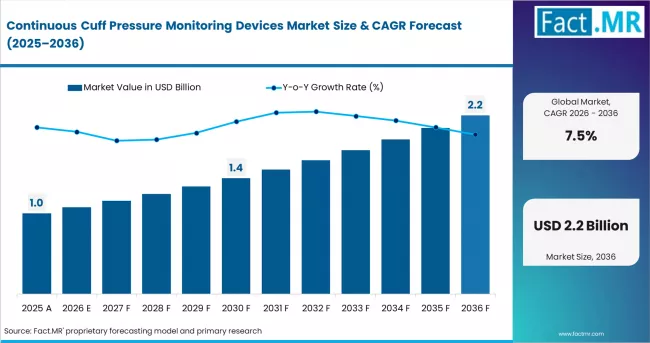
Continuous Cuff Pressure Monitoring Devices Market Value Analysis | Source: Fact.MR
| Metric | Value |
|---|---|
| Estimated Value in 2026 | USD 1.0 billion |
| Forecast Value in 2036 | USD 1.9 billion |
| Forecast CAGR (2026 to 2036) | 7.5% |
Source: Fact.MR analysis. Updated Apr 22, 2026
Summary of Continuous Cuff Pressure Monitoring Devices Market
- Market Definition
- The market includes automated continuous and manual cuff pressure monitoring devices used for endotracheal tube management across ICU, surgical, and emergency care settings.
- Demand Drivers
- U.S. ICU networks require continuous monitoring systems compliant with VAP prevention protocols under CMS quality reporting frameworks.
- China is expanding ICU bed capacity with integrated monitoring systems driving institutional procurement.
- Germany is adopting ICU automation standards, increasing demand for electronic cuff management devices.
- Key Segments Analyzed
- By Product Type: Continuous cuff pressure monitors hold approximately 58% share in 2026 due to VAP prevention requirements.
- By Technology: Electronic automated systems hold approximately 60% share in 2026, driven by ventilator integration.
- By Application: ICU ventilation holds approximately 55% share in 2026, supported by continuous intubation monitoring mandates.
- By Geography: India leads at 8.2% CAGR, supported by critical care infrastructure investment.
- Analyst Opinion at FACT.MR
- Shambhu Nath Jha, Principal Consultant at Fact.MR, opines, 'CXOs will find that automated cuff monitoring systems represent the compliance-driven upgrade path as VAP benchmarks harden across global ICU accreditation frameworks.'
- Strategic Implications
- Invest in automated electronic cuff monitors with documented VAP compliance outputs for ICU procurement programmes.
- Develop cost-optimised continuous monitoring devices for emerging markets in India and China.
- Build partnerships with ventilator OEMs to integrate cuff pressure monitoring within ICU platform ecosystems.
- Methodology
- Market sizing uses device shipment volumes and ASP, validated with 2024 to 2025 procurement data.
- Analysis includes FDA 510(k) clearances, NHS data, CMS quality reporting, and company disclosures.
- Forecasts consider ICU capacity expansion, VAP prevention mandates, and hospital automation investment trends.
The market is expected to generate USD 0.9 billion in incremental revenue over the forecast period. Growth is steady rather than transformational, supported by consistent ICU infrastructure investment and mandatory VAP prevention protocols. Expansion is constrained by high device unit costs and budget limitations in public hospital systems across emerging markets.
Demand is shifting from periodic manual cuff checks toward real-time automated monitoring embedded in ICU ventilation workflows. Hospitals facing VAP audit requirements are accelerating procurement of continuous systems. Regulatory pressure from patient safety bodies is compelling institutions to standardise on automated devices with documented compliance outputs.
India leads with an estimated CAGR of 8.2% through 2036, supported by rapid critical care infrastructure expansion. China follows at 7.8%, driven by growing ICU bed capacity and respiratory disease burden. Germany records 7.2%, supported by high ICU automation adoption. The United Kingdom grows at 7.0%, driven by NHS patient safety programmes. The United States records 6.8%, supported by advanced VAP prevention protocols in established ICU networks.
Segmental Analysis
Continuous Cuff Pressure Monitoring Devices Market Analysis by Product Type
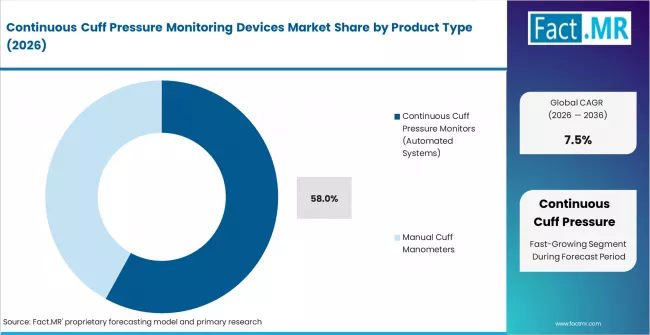
Continuous Cuff Pressure Monitoring Devices Market Analysis By Product Type | Source: Fact.MR
Based on FACT.MR's continuous cuff pressure monitoring devices market report, continuous cuff pressure monitors are estimated to hold approximately 58% share in 2026. They dominate due to mandated VAP prevention workflows in ICU settings. Automated systems eliminate reliance on manual checks and provide documented pressure logs for clinical audit compliance.
- Medtronic Product Expansion: Medtronic expanded its Nellcor portfolio with updated cuff pressure management accessories in 2024. The expansion targeted U.S. and European ICU procurement. Devices were certified under updated EU MDR requirements, strengthening institutional sales. [4]
- Dräger ICU Integration: Dräger launched an updated Evita ventilator series in 2024 with integrated cuff pressure monitoring functionality. The system links cuff management directly to ventilator data streams. This reduces standalone device procurement for Dräger ventilator users. [5]
- Manual Manometer Decline Trend: NHS England procurement data from 2024 shows a shift toward automated continuous monitoring in critical care units. Manual manometer procurement fell as a share of total cuff device spend. NHS Trusts under CQC inspection cited automated monitoring as a patient safety standard. [6]
Continuous Cuff Pressure Monitoring Devices Market Analysis by Technology
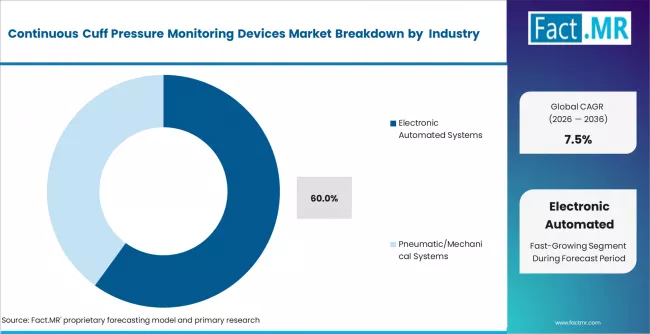
Continuous Cuff Pressure Monitoring Devices Market Analysis By Technology | Source: Fact.MR
Based on FACT.MR's report, electronic automated systems hold approximately 60% share in 2026. Their dominance reflects demand for ventilator-integrated monitoring and real-time alarm capability. Pneumatic systems remain in use in portable and emergency settings where power independence is required.
- Hamilton Medical Integration: Hamilton Medical advanced ventilator-integrated cuff management in its HAMILTON-C6 platform in 2024. The system automates cuff inflation and deflation cycles based on continuous pressure feedback. ICU customers in Germany and Switzerland adopted the platform for clinical workflow integration. [7]
- Vyaire Medical Technology Update: Vyaire Medical updated its AirLife cuff pressure line in 2025 with digital readout capability for operating room use. The update addressed demand from anesthesia departments requiring precise sub-30 cmH2O pressure management. [8]
- Pneumatic System Persistence: Emergency medical services in the United Kingdom continue to use pneumatic cuff manometers for pre-hospital airway management. NHS Ambulance Service procurement data from 2024 confirms ongoing manual device supply contracts. Portability and battery independence sustain demand in this segment. [9]
Drivers, Restraints, and Opportunities
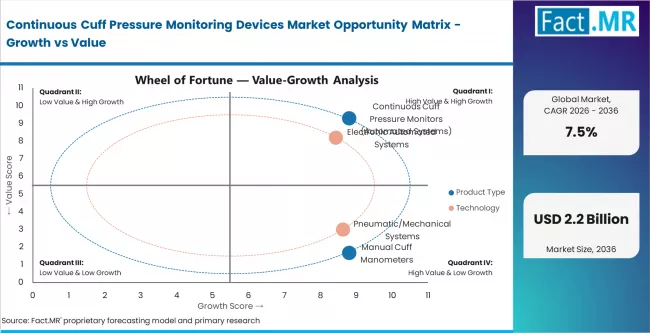
Continuous Cuff Pressure Monitoring Devices Market Opportunity Matrix Growth Vs Value | Source: Fact.MR
FACT.MR analysts observe the market is mature in developed economies and transitioning in Asia Pacific and Latin America. Demand is concentrated in ICU ventilation applications where continuous monitoring is becoming a standard-of-care requirement. Growth is structurally linked to ICU bed expansion, VAP prevention protocol adoption, and hospital accreditation requirements.
Manual manometers remain in use in cost-sensitive and lower-acuity settings but are declining as a share of procurement in high-income markets. Automated continuous systems are growing faster in volume and value. Higher unit cost of electronic devices is partially offset by reduced nursing intervention time and measurable VAP outcome improvement.
- VAP Prevention Mandates: The U.S. Centers for Medicare and Medicaid Services (CMS) includes VAP rates in hospital quality reporting under the Hospital Inpatient Quality Reporting programme. Hospitals with elevated VAP rates face reimbursement adjustments. This creates direct procurement incentive for continuous cuff monitoring devices over manual alternatives. [1]
- ICU Capacity Expansion in Asia: China added over 70,000 ICU beds between 2020 and 2024 under the National Health Commission's critical care capacity programme. India's ICMR guidelines updated in 2024 require cuff pressure monitoring in mechanically ventilated patients. Both expansions are driving volume procurement of cuff management devices. [2]
EU Medical Device Regulation Compliance: The EU MDR framework, enforced from 2021 with transition deadlines in 2024 and 2025, requires updated clinical evidence and post-market surveillance for active monitoring devices. Medtronic and Dräger submitted updated MDR dossiers in 2024, reinforcing their EU market positions while raising barriers for smaller entrants. [3]
Regional Analysis
The continuous cuff pressure monitoring devices market is assessed across Asia Pacific, North America, Europe, Latin America, and Middle East and Africa, covering 40+ countries with demand shaped by ICU infrastructure maturity, VAP prevention protocol adoption, ventilator integration capabilities, and hospital accreditation frameworks. The full report provides market attractiveness analysis by region and country.
.webp "Top Country Growth Comparison Continuous Cuff Pressure Monitoring Devices Market Cagr (2026 2036)")
Top Country Growth Comparison Continuous Cuff Pressure Monitoring Devices Market Cagr (2026 2036) | Source: Fact.MR
| Country | CAGR (2026 to 2036) |
|---|---|
| India | 8.2% |
| China | 7.8% |
| Germany | 7.2% |
| United Kingdom | 7.0% |
| United States | 6.8% |
Source: Fact.MR analysis. Updated Apr 22, 2026
Source: Fact.MR (FACT.MR) analysis, based on proprietary forecasting model and primary research
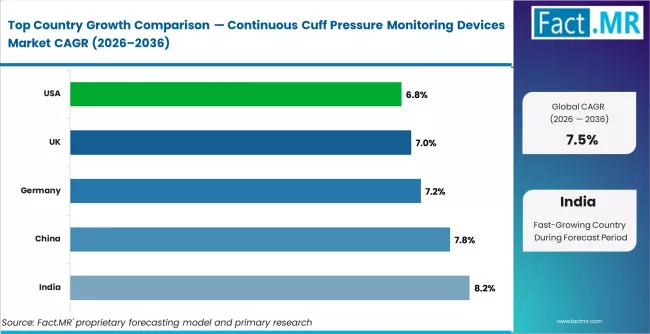
Continuous Cuff Pressure Monitoring Devices Market Cagr Analysis By Country | Source: Fact.MR
Asia Pacific Continuous Cuff Pressure Monitoring Devices Market Analysis
Asia Pacific is the fastest-growing region. Growth is supported by ICU capacity expansion and rising respiratory disease burden. China and India drive volume procurement. South Korea and Japan lead in hospital automation adoption. Domestic and multinational suppliers are scaling supply chains to meet public hospital tenders.
- China: ICU expansion and respiratory disease volume drive demand. Demand is projected at 7.8% CAGR through 2036. The National Health Commission added over 70,000 ICU beds between 2020 and 2024. Central government procurement guidelines from 2024 require cuff pressure management devices in tertiary hospital ICUs. Domestic producers including Mindray are increasing cuff monitoring integration in their ventilator platforms. Import substitution policies are supporting local device procurement while international brands retain premium positioning.
- India: Rapid critical care infrastructure build-out accelerates procurement. Demand is projected at 8.2% CAGR through 2036. ICMR updated mechanical ventilation guidelines in 2024 requiring cuff pressure monitoring in intubated patients. The National Health Mission is funding ICU upgrades in tier 2 and tier 3 hospitals. This creates new institutional buyer segments. Medtronic and local distributors are expanding sales networks across government hospital procurement channels.
North America Continuous Cuff Pressure Monitoring Devices Market Analysis
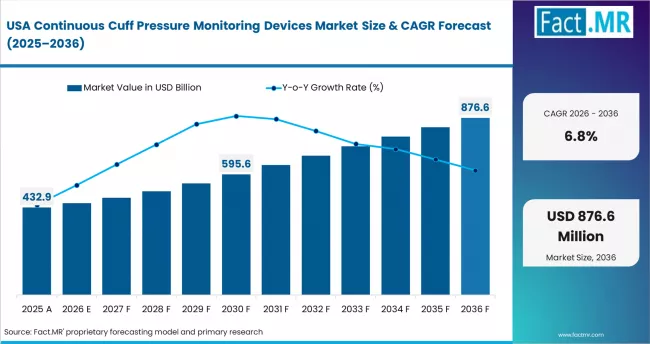
Continuous Cuff Pressure Monitoring Devices Market Country Value Analysis | Source: Fact.MR
North America is the largest revenue market. Demand is driven by mandatory VAP benchmarking and established ICU automation investment. Medtronic, GE Healthcare, and Smiths Medical dominate procurement. Long-term supply contracts and GPO frameworks define buying patterns.
- United States: VAP protocol compliance and advanced ICU infrastructure define market leadership. Demand is projected at 6.8% CAGR through 2036. CMS hospital quality reporting penalises elevated VAP rates under the Hospital-Acquired Condition Reduction Programme. This sustains procurement of automated continuous monitoring devices. GE Healthcare expanded CARESCAPE platform capabilities in Q3 2024 to include cuff pressure alerts. Medtronic's Nellcor product line received updated 510(k) clearances in 2024 for continuous airway management accessories. GPO contract renewals from 2025 are sustaining institutional supply relationships.
Europe Continuous Cuff Pressure Monitoring Devices Market Analysis
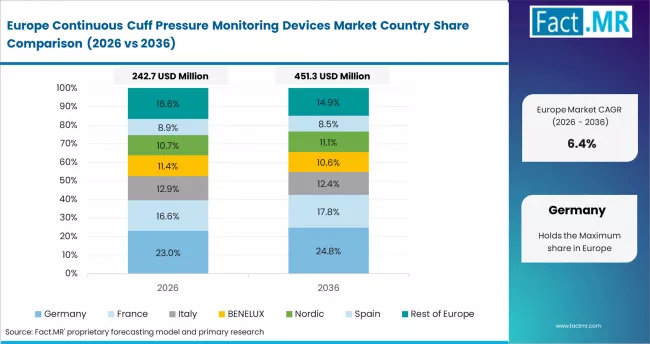
Continuous Cuff Pressure Monitoring Devices Market Europe Country Market Share Analysis, 2026 & 2036 | Source: Fact.MR
Europe is a regulation-driven and clinically structured market. EU MDR compliance frameworks define procurement eligibility. Germany leads in ICU automation. Dräger, Hamilton Medical, and Smiths Medical hold dominant supply positions.
- Germany: ICU automation and ventilator integration leadership drive consistent demand. Demand is projected at 7.2% CAGR through 2036. Dräger's Evita series updated with cuff monitoring integration in 2024 for German hospital systems. Hospital procurement committees under the German Hospital Federation standards require documented cuff management in mechanically ventilated ICU patients. Hamilton Medical's HAMILTON-C6 adoption expanded across Baden-Württemberg hospital networks in 2024. EU MDR compliance requirements strengthened established suppliers while raising barriers for new entrants.
- United Kingdom: NHS patient safety frameworks and CQC inspection criteria shape procurement. Demand is projected at 7.0% CAGR through 2036. NHS England issued updated critical care guidance in 2024 recommending continuous cuff pressure monitoring in ventilated ICU patients. NHS procurement data shows growth in automated cuff device spend relative to manual manometers. Smiths Medical Portex line retained NHS supply contract renewals in 2024. CQC inspections citing VAP prevention compliance are accelerating device standardisation across NHS Trusts.
FACT.MR's analysis of the continuous cuff pressure monitoring devices market in Europe consists of country-wise assessment covering Germany, the United Kingdom, France, Italy, Spain, and Rest of Europe. Readers can find VAP protocol adoption trends, MDR compliance impacts, and hospital procurement forecasts.
Competitive Aligners for Market Players
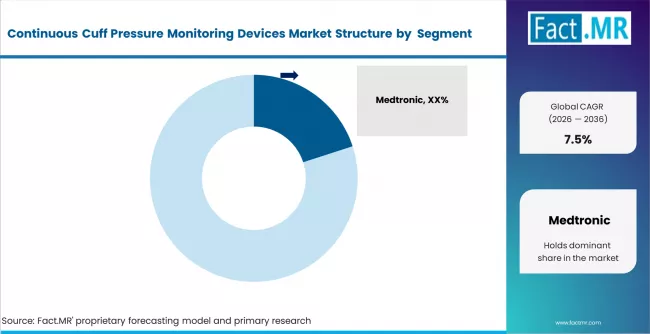
Continuous Cuff Pressure Monitoring Devices Market Analysis By Company | Source: Fact.MR
Competitive intensity in the continuous cuff pressure monitoring devices market is shaped by platform integration, regulatory compliance, and ICU procurement positioning. A small group of established medical device companies’ controls most of the market. A second tier of regional suppliers competes mainly on price in cost-sensitive hospitals. Competitive advantage depends on ventilator integration, VAP prevention documentation, and compliance with EU MDR and FDA 510(k) standards.
Medtronic, Dräger, and Hamilton Medical sit at the center of ICU procurement. Their strength comes from fully integrated ventilator and monitoring systems. Cuff pressure monitoring is embedded into broader critical care workflows. This reduces the need for standalone devices. These companies also benefit from group purchasing organization contracts in North America and long-term supply agreements in Europe. Once installed, switching vendors becomes difficult for hospitals. GE Healthcare and Smiths Medical compete through complementary offerings. GE Healthcare integrates cuff monitoring into its CARESCAPE platform. This supports centralized patient monitoring across ICU environments. Smith’s Medical focuses on anesthesia and procedural care through its Portex product line. It serves operating rooms and perioperative settings.
Hospital buyers are increasingly consolidating vendors. Large health systems prefer fewer suppliers with broader portfolios. This simplifies procurement and improves system compatibility. As a result, integrated platform providers gain pricing power and contract stability. Standalone device manufacturers face growing pressure. Without integration capabilities or strong clinical data, they are often limited to niche or lower-margin segments.
Key Players
- Medtronic
- Smiths Medical
- Vyaire Medical
- Hamilton Medical
- Dräger
- GE Healthcare
Bibliography
- [1] Centers for Medicare and Medicaid Services (CMS). Hospital Inpatient Quality Reporting Programme: ventilator-associated events and HAC reduction programme measures; 2024. Available from: cms.gov/medicare/quality/initiatives/hospital-quality-initiative
- [2] National Health Commission of China. Critical care capacity expansion programme: ICU bed addition targets and procurement requirements for mechanically ventilated patients; 2024. Available from: nhc.gov.cn
- [3] European Commission. EU Medical Device Regulation (MDR) 2017/745 post-market surveillance and clinical evidence requirements for active monitoring devices; 2024. Available from: ec.europa.eu/health/md_sector/new_regulations
- [4] Medtronic. Annual Report and Nellcor product line expansion disclosure: updated cuff pressure management accessories for ICU and EU MDR compliance certification; 2024. Available from: medtronic.com/investor-relations
- [5] Dräger. Product launch announcement: Evita ventilator series update with integrated cuff pressure monitoring functionality for ICU applications; 2024. Available from: draeger.com/en/products/ventilators
- [6] NHS England. Critical care procurement and patient safety reporting: shift from manual to automated cuff pressure monitoring in mechanically ventilated patients; 2024. Available from: england.nhs.uk/critical-care
- [7] Hamilton Medical. HAMILTON-C6 ventilator product update: automated cuff inflation and deflation cycles with continuous pressure feedback for ICU deployment; 2024. Available from: hamilton-medical.com/products
- [8] Vyaire Medical. AirLife product line update: digital readout cuff pressure monitors for operating room and anesthesia applications; 2025. Available from: vyaire.com/products/airlife
- [9] NHS Ambulance Service. National procurement contract data: pneumatic cuff manometer supply for pre-hospital emergency airway management; 2024. Available from: england.nhs.uk/ambulances
This Report Addresses
- Strategic insights on demand across India, China, Germany, the United Kingdom, and the United States. Covers ICU ventilation, surgical anesthesia, and emergency care procurement trends.
- Market forecast from USD 1.0 billion in 2026 to USD 1.9 billion by 2036, at 7.5% CAGR.
- Opportunity mapping across India ICU infrastructure build-out, China hospital expansion, U.S. VAP compliance procurement, and Germany ICU automation demand.
- Segment analysis by product type, technology, and application. Covers continuous monitors, electronic systems, and key clinical use cases.
- Regional outlook covering Asia Pacific capacity-driven growth, North America compliance-led procurement, and Europe regulation-driven standardisation.
- Competitive analysis of Medtronic, Dräger, Hamilton Medical, GE Healthcare, Smiths Medical, and Vyaire Medical.
- Technology tracking on ventilator integration, electronic cuff pressure systems, VAP documentation compliance, and EU MDR certification.
- Report delivery in PDF, Excel, and presentation formats with validated data and industry inputs.
Continuous Cuff Pressure Monitoring Devices Market Definition
The market covers devices used to continuously measure and maintain endotracheal tube cuff pressure within safe clinical ranges.
Continuous Cuff Pressure Monitoring Devices Market Inclusions
Covers global and regional forecasts from 2026 to 2036 by product type and application. Includes electronic automated and pneumatic systems. Covers ICU ventilation, surgical anesthesia, and emergency care use across hospital and CDMO channels.
Continuous Cuff Pressure Monitoring Devices Market Exclusions
Excludes endotracheal tubes and ventilator systems. Omits general airway management accessories and non-cuff pressure monitoring equipment. Excludes standalone bedside monitoring platforms not dedicated to cuff pressure.
Continuous Cuff Pressure Monitoring Devices Market Research Methodology
- Primary Research: Interviews with ICU device procurement managers, respiratory care specialists, and hospital biomedical engineers across key markets.
- Desk Research: Uses NHS procurement data, FDA 510(k) clearances, CMS VAP quality reporting, Medtronic and Dräger public filings, and clinical guidelines from 2024 to 2025.
- Market Sizing and Forecasting: Based on device shipment volumes and ASP by product category. Includes public hospital procurement and private ICU demand benchmarks.
- Data Validation and Update Cycle: Validated using manufacturer revenues and hospital procurement records. Cross-checked with clinical trial and regulatory databases. Updated regularly.
Segmentation
Scope of Report
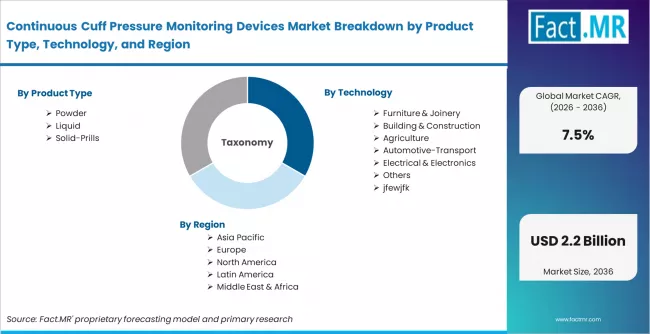
Continuous Cuff Pressure Monitoring Devices Market Breakdown By Product Type, Technology, And Region | Source: Fact.MR
| Attribute | Details |
|---|---|
| Quantitative Units | USD 1.0 billion (2026) to USD 1.9 million (2036), at a CAGR of 7.5% |
| Market Definition | Electronic and mechanical devices that measure and maintain ETT or tracheostomy tube cuff pressure in therapeutic ranges, supplied in automated, semi-automated, and manual formats for ICU, home care, ambulatory, and long-term care applications globally. |
| Product Type Segmentation | Continuous Cuff Pressure Monitors (Automated Systems), Manual Cuff Manometers |
| Technology Segmentation | Electronic Automated Systems, Pneumatic/Mechanical Systems |
| Application Segmentation | ICU Ventilation, Surgical Anesthesia, Emergency Care |
| Application Coverage | ICU VAP prevention protocol compliance, anaesthesia airway management, tracheostomy home care cuff management, ambulatory respiratory care, and long-term ventilation airway safety. |
| Regions Covered | North America, Europe, Asia Pacific, Latin America, Middle East and Africa |
| Countries Covered | USA, Canada, Mexico, Germany, UK, France, Italy, Spain, Nordic, BENELUX, China, Japan, South Korea, India, ASEAN, Australia and New Zealand, Brazil, Argentina, Chile, Saudi Arabia, GCC, Turkey, South Africa, Rest of MEA |
| Key Companies Profiled | Smiths Medical, Nellcor (Medtronic), Tracoe Medical, Endocore Medical, IMD Medical, VBM Medizintechnik, Weinmann Emergency, Intersurgical, Flexicare Medical, Bard Medical (BD) |
| Forecast Period | 2026 to 2036 |
| Approach | Hybrid top-down and bottom-up model using device manufacturer revenues, ICU procurement volumes by product type, average selling prices by automation grade, hospital device purchasing benchmarks, and primary interviews with ICU procurement specialists and critical care clinicians. |
Source: Fact.MR analysis. Updated Apr 22, 2026
Continuous Cuff Pressure Monitoring Devices Market By Segment
-
By Product Type:
- Continuous Cuff Pressure Monitors (Automated Systems)
- Manual Cuff Manometers
-
By Technology:
- Electronic Automated Systems
- Pneumatic/Mechanical Systems
-
By Application:
- ICU Ventilation
- Surgical Anesthesia
- Emergency Care
-
By Region:
- North America
- United States
- Canada
- Mexico
- Latin America
- Brazil
- Argentina
- Rest of Latin America
- Western Europe
- Germany
- United Kingdom
- France
- Italy
- Spain
- Nordic Countries
- BENELUX
- Rest of Western Europe
- Eastern Europe
- Russia
- Poland
- Hungary
- Balkan and Baltic
- Rest of Eastern Europe
- East Asia
- China
- Japan
- South Korea
- South Asia and Pacific
- India
- ASEAN
- Australia and New Zealand
- Rest of South Asia and Pacific
- Middle East and Africa
- Kingdom of Saudi Arabia
- Other GCC Countries
- Turkey
- South Africa
- Rest of Middle East and Africa
- North America
Frequently Asked Questions
How large is the continuous cuff pressure monitoring devices market in 2025?
What will the market size be in 2026?
What is the projected market size by 2036?
What is the expected CAGR of the continuous cuff pressure monitoring devices market?
What is the absolute dollar opportunity in this market?
Which product type segment leads the market?
Which technology segment is poised to lead?
Which application segment holds the largest share?
Which country shows the fastest growth?
What are continuous cuff pressure monitoring devices used for?
What is driving market growth?
Which region leads market growth?
Who are the key market players?
What challenges does the market face?
Who worked on this report


Preview the report firsthand - request a free sample
Free SampleGet the brochure for pricing and purchase details
Download PDF