
- Market Value (2025): USD 1.9 Bn
- Estimated Value (2026): USD 2.00 Bn
- Forecast Value (2036): USD 3.59 Bn
- CAGR (2026-2036): 6.0%
Corrosion-resistant Sewage Pumps Market Forecast and Outlook 2026 to 2036
The global corrosion-resistant sewage pump market was USD 1.89 billion in 2025 and reached USD 2.00 billion in 2026. The market is anticipated to reach USD 3.59 billion by 2036, expanding at a CAGR of 6.0% during the 2026 to 2036 assessment period.
Corrosion-resistant sewage pumps are becoming important as municipal networks and industrial facilities handle wastewater containing abrasive solids and aggressive chemicals. Material selection is gaining attention, with stainless steel, high-chrome alloys and protective epoxy coatings helping equipment withstand harsh operating conditions. In 2025, the City of Salina, Kansas, specified hardened stainless steel or high-chrome impellers for its wastewater pump purchase. Grundfos India also delivered 30 sewage pumps for the Panvel drainage project during 2025, highlighting continued investment in urban wastewater infrastructure.
Key Takeaways from the Corrosion-resistant Sewage Pumps Market
- Sales of corrosion-resistant sewage pumps stood at USD 1.9 billion in 2025
- Corrosion-resistant Sewage Pumps Market Value (2026): USD 2.00 billion
- Corrosion-resistant Sewage Pumps Market Forecast Value (2036): USD 3.59 billion
- Corrosion-resistant Sewage Pumps Market Forecast CAGR (2026-2036): 6.0%
- Leading Material: Stainless steel (34.0%)
- Key Market Participants: Xylem, Grundfos, KSB, Sulzer, Wilo
- Key Growth Countries: India, China, South Korea, United States, United Kingdom
Expansion of sewer networks, upgrades to ageing treatment facilities and stricter wastewater handling requirements are creating fresh opportunities for corrosion-resistant sewage pumps. In 2025, India’s National Mission for Clean Ganga sanctioned 15 projects to create or rehabilitate 329 MLD of sewage treatment capacity, while 11 projects added or restored another 359 MLD. These infrastructure programmes are strengthening the need for durable pumping equipment across municipal and industrial wastewater systems.
Corrosion-resistant Sewage Pumps Market
| Metric | Value |
|---|---|
| Estimated Value (2025) | USD 1.89 billion |
| Estimated Value (2026) | USD 2.00 billion |
| Forecast Value (2036) | USD 3.59 billion |
| Forecast CAGR (2026 to 2036) | 6.0% |
Source: Fact.MR analysis. Updated Nov 26, 2026
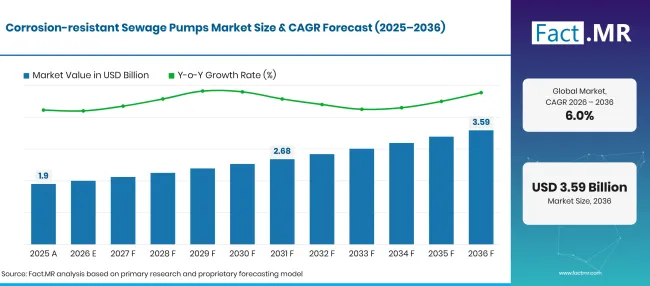
Corrosion Resistant Sewage Pumps Market Forecast Global | Source: Fact.MR
Category
| Category | Segments |
|---|---|
| Material | Stainless steel, Coated and lined cast iron, Engineered polymers, Duplex and super duplex alloys, Bronze and other alloys |
| Pump Type | Submersible, Dry-pit centrifugal, Grinder, Non-clog and vortex, Sewage ejector |
| Application | Municipal wastewater, Industrial effluent, Commercial buildings, Residential, Marine and offshore |
| Power Rating | Up to 3 kW, 3 to 15 kW, 15 to 50 kW, Above 50 kW |
| Region | India; China; South Korea; United States; United Kingdom |
Source: Fact.MR analysis. Updated Nov 26, 2026
Segmental Analysis
What makes stainless steel the leading material segment in the Corrosion-resistant Sewage Pumps Market?
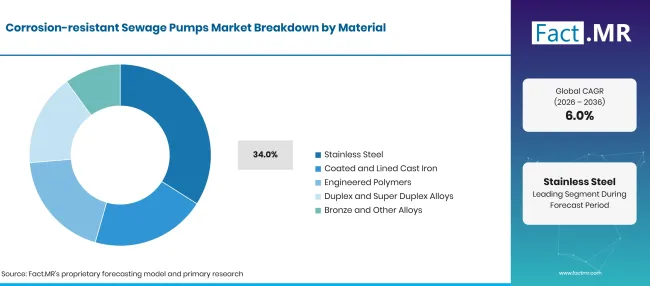
Corrosion Resistant Sewage Pumps Market Breakdown Material | Source: Fact.MR
Stainless steel leads the material segment with a 34.0% revenue share in 2026, or USD 680.0 million. Its resistance to sulfides, chlorides and abrasive solids makes it suitable for sewage duties where ordinary cast iron deteriorates quickly. Buyers also value its longer service interval, which lowers maintenance disruption in continuously operating lift stations. Coated and lined cast iron remains important where budgets are constrained, while engineered polymers and duplex alloys gain ground in aggressive industrial effluent and marine applications. In July 2025, KSB introduced the AmaCan P series, which can be specified with corrosion-resistant and abrasion-resistant materials for wastewater, drainage and pollution-control duties.ksb
Which factors support submersible as the largest pump type segment in the Corrosion-resistant Sewage Pumps Market?
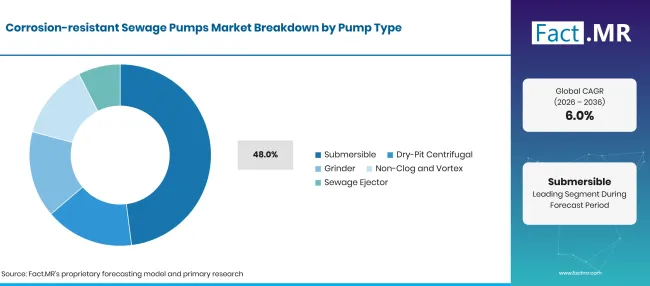
Corrosion Resistant Sewage Pumps Market Breakdown Pump Type | Source: Fact.MR
Submersible pumps lead the pump type segment with a 48.0% revenue share in 2026, or USD 960.0 million. Their installation within wet wells removes the need for separate pump houses, reduces noise and simplifies civil works at lift stations, drainage systems and treatment plants. Utilities also favor submersible designs where flooding, variable flow and solids handling make reliable operation essential. Dry-pit centrifugal pumps continue to serve large treatment works, while grinder and non-clog designs address blockage risks from wipes and fibrous material. KSB’s July 2025 launch of submersible motor pumps with axial propellers for municipal and industrial wastewater reflects continued investment in this configuration.ksb
What makes municipal wastewater the leading application segment in the Corrosion-resistant Sewage Pumps Market?
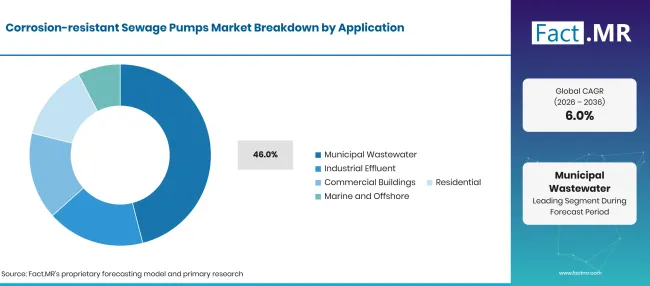
Corrosion Resistant Sewage Pumps Market Breakdown Application | Source: Fact.MR
Municipal wastewater is the leading application segment, with a 46.0% revenue share in 2026, or USD 920.0 million. Sewer networks and treatment plants operate large numbers of pumps around the clock, creating recurring replacement and upgrade needs. Corrosion from hydrogen sulfide, chlorides and abrasive grit makes durable materials especially valuable in these systems. Public investment also strengthens demand: India’s AMRUT programme has allocated INR 32,456 crore, or 42% of its funding, to sewerage and septage projects, with 313 treatment plants and about 18,000 km of sewer network taken up. Industrial effluent, commercial buildings and residential drainage add further demand as operators seek pumps that withstand aggressive and solids-laden flows.pib.gov
Which factors support up to 3 kW as the largest power rating segment in the Corrosion-resistant Sewage Pumps Market?
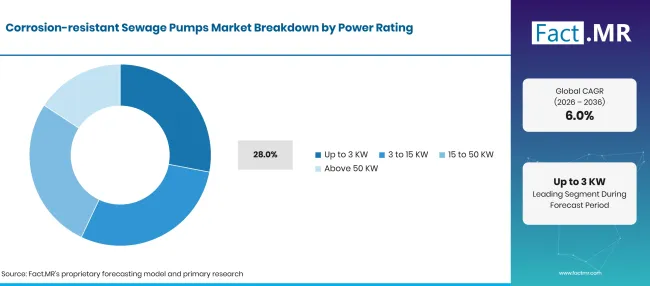
Corrosion Resistant Sewage Pumps Market Breakdown Power Rating | Source: Fact.MR
Pumps with power ratings up to 3 kW lead the power rating segment with a 28.0% revenue share in 2026, or USD 560.0 million. These units serve residential drainage, small commercial premises, local lift stations and decentralized wastewater systems, where compact size and straightforward installation matter more than very high throughput. Their higher unit volumes also support broad distribution through contractors and water-utility supply channels. Larger pumps remain essential for municipal trunk sewers, industrial effluent plants and major treatment facilities, where higher head and flow requirements call for 3 to 15 kW, 15 to 50 kW and above 50 kW equipment. Wilo’s September 2026 launch of the Rexa NORM dry-installed sewage pump range adds options for such broader wastewater duties.
Corrosion-resistant Sewage Pumps Market-Drivers, Restraints & Trends
Driver: Sewer Renewal and Industrial Effluent Management
Cities are renewing ageing sewer assets while industries handle effluent containing acids, chlorides, sulfides and abrasive solids. These conditions shorten the life of conventional pumps and increase interest in stainless steel, lined cast iron and duplex alloy equipment. Municipal programmes are a major source of demand: India’s Namami Gange programme had 206 sewage infrastructure projects underway, with INR 33,003.63 crore sanctioned for sewage infrastructure. Replacement of failed pumps, expansion of treatment capacity and stricter industrial discharge requirements together create a steady need for corrosion-resistant sewage pumps.
Restraint: Higher Material and Ownership Costs
Corrosion-resistant sewage pumps cost more than standard cast iron units because stainless steel, duplex alloys, protective linings and specialized seals add to manufacturing expense. Municipal utilities with limited capital budgets may defer replacement until pumps fail, while smaller industrial users may choose coated cast iron for less aggressive duties. Installation, spare-part availability and compatibility with existing wet wells can also raise total project cost. These factors slow adoption where wastewater conditions are moderate and low-cost pumps remain adequate.
Trend: Energy-Efficient Pumping and Digital Control
Utilities are adopting high-efficiency motors, variable-speed drives and connected controls to reduce energy consumption across wastewater pumping networks. Xylem reported in February 2025 that its work with Yorkshire Water included nearly 1,000 new pumps across 500 sites, including Flygt Concertor units selected for clog resilience and connectivity; the utility achieved a 51% reduction in reactive maintenance visits. This shift creates opportunities for pump makers to combine durable materials with monitoring, adaptive control and lower lifetime energy use.
Trend: Anti-Clogging and Solids-Handling Design
Wipes, fibrous material and dense solids continue to block sewage pumps, prompting manufacturers to refine impellers, cutting systems and free-passage designs. KSB’s ELN-150 Imvubu, introduced in November 2025, was developed for raw, unscreened sewage and offers a 77.3 mm free-pass solids-handling capability, above the 76 mm global benchmark. Improved solids handling reduces unplanned stoppages and maintenance visits, making clog-resistant corrosion-resistant pumps more attractive to municipal and industrial operators.
Corrosion-resistant Sewage Pumps Market Analysis by Key Country
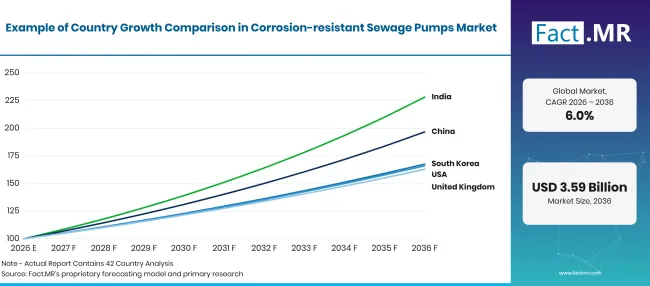
Corrosion Resistant Sewage Pumps Market Growth Index | Source: Fact.MR
| Country | CAGR (2026-2036) |
|---|---|
| India | 8.6% |
| China | 7.0% |
| South Korea | 5.3% |
| United States | 5.2% |
| United Kingdom | 5.0% |
Source: Fact.MR analysis. Updated Nov 26, 2026
Why is India the leading growth market for corrosion-resistant sewage pumps?
India offers the strongest growth outlook at an 8.6% CAGR through 2036 because rapid urbanization is expanding sewer networks and treatment capacity.
Under AMRUT, INR 32,456 crore has been allocated to sewerage and septage projects, while 313 treatment plants with 6,232 MLD capacity have been taken up and around 18,000 km of sewer network laid. This build-out increases demand for submersible and non-clog pumps that resist sulfides, grit and corrosive gases. Industrial effluent treatment, municipal replacement cycles and continued public funding are the main sales drivers.
What is driving corrosion-resistant sewage pumps demand in China?
China is likely to expand at a 7.0% CAGR through 2036, above the global rate of 6.0%. Large-scale wastewater treatment and water-reuse programmes support demand for durable pumping equipment across municipal and industrial systems.
Beijing Drainage Group recycles more than 5 million tons of wastewater daily, and its Xiaohongmen facility can treat up to 600,000 tons per day, illustrating the scale of infrastructure that requires reliable pumping. Upgrades to treatment plants, tighter industrial discharge oversight and replacement of ageing pumping assets are driving sales for local and international pump suppliers.
What is shaping corrosion-resistant sewage pumps demand in South Korea?
South Korea is likely to grow at a 5.3% CAGR through 2036, below the global rate of 6.0%.
Urban wastewater renewal, industrial effluent treatment and flood-drainage upgrades sustain steady equipment demand, while established domestic pump manufacturers strengthen local supply and service capability. Coastal and industrial applications also favor corrosion-resistant materials because chloride exposure can accelerate pump deterioration. Investment in treatment reliability, energy-efficient pumping and replacement of older assets is the principal driver of sales in the country.
How is demand for corrosion-resistant sewage pumps developing in the United States?
The United States is likely to advance at a 5.2% CAGR through 2036, below the global rate of 6.0. Ageing municipal pumping stations, sewer rehabilitation and industrial wastewater compliance create recurring replacement demand.
Xylem’s February 2025 work with Yorkshire Water, although based in the United Kingdom, shows the wider value utilities place on connected, clog-resilient pumping; in the United States, similar priorities support adoption of durable submersible and dry-pit pumps. Capital spending on water infrastructure, stricter effluent management and digital monitoring are the leading sales drivers.
Why is growth slower for corrosion-resistant sewage pumps in the United Kingdom?
The United Kingdom is likely to record the slowest growth among the five countries, at a 5.0% CAGR through 2036.
A mature installed base means much of the demand comes from replacement and upgrading rather than new network construction. Even so, ageing sewer assets and drainage upgrade programmes support demand for pumps that resist corrosion and blockages. Xylem’s 2025 partnership with Yorkshire Water involved nearly 1,000 new pumps across 500 sites, including Flygt Concertor systems, reflecting utility investment in reliable wastewater pumping. Regulatory pressure, asset renewal and digital maintenance are the main drivers of sales.
Competitive Landscape for Corrosion-resistant Sewage Pumps Market
The corrosion-resistant sewage pump market is relatively concentrated, with Xylem, Grundfos, KSB, Sulzer and Wilo together holding about 62% of 2026 revenue, based on Fact.MR estimates. Competition centers on pump efficiency, material durability, clog resistance, service coverage and local stock availability. Global pump groups lead in municipal and industrial projects, while regional manufacturers compete on price in standard sewage pump applications.
Recent activity shows a clear focus on wastewater reliability and serviceable design. In 2025, Xylem supported Yorkshire Water with nearly 1,000 new pumps across 500 sites, including Flygt Concertor systems. KSB introduced its AmaCan P submersible pump series in July 2025, while Sulzer opened a water treatment Center of Excellence in January 2026. Wilo launched its Rexa NORM dry-installed sewage pump range in September 2026.
Recent Developments
- On February 3, 2025, Xylem announced that its partnership with Yorkshire Water included nearly 1,000 new pumps installed across 500 sites, including Flygt Concertor solutions selected for clog resilience, pump-cleaning capability and connectivity.
- In July 2025, KSB launched the AmaCan P series of submersible motor pumps with axial propellers for municipal and industrial water, wastewater, stormwater, drainage and irrigation pumping stations; optional corrosion-resistant and abrasion-resistant materials extend use to pollution control and seawater aquaculture.
- On January 22, 2026, Sulzer announced the creation of a water treatment Center of Excellence, combining wastewater-treatment expertise, engineering capability and technology spanning screening, sedimentation, filtration and flotation.
- On September 30, 2026, Wilo USA introduced the Wilo-Rexa NORM, a new dry-installed sewage pump range.
- No qualifying 2025 or 2026 acquisition, partnership or product launch could be verified for Grundfos from the available official announcements.
Key Players in Corrosion-resistant Sewage Pumps Market
Key companies operating in the market include Xylem, Grundfos, KSB, Sulzer, and Wilo.
- Xylem
- Grundfos
- KSB
- Sulzer
- Wilo
Bibliography
- KSB. (2025, July). New submersible motor pumps with axial propeller.
- Ministry of Housing and Urban Affairs, Government of India. (2026, November 19). Sewage pipelines and treatment plants. Press Information Bureau.
- National Mission for Clean Ganga. (2025, November 20). NMCG powers capacity growth and infrastructure milestones in FY 2025-26. Press Information Bureau.
- Press Information Bureau, Government of India. (2026, November 9). A holistic approach for cleanliness of river Ganga.
- . https://www.sulzer.com/en/-/media/files/news/2026/20260122_water_treatment_coe_media_release_en.pdf
- Wilo USA. (2026, September 30). Wilo USA launches Wilo-Rexa NORM, a new dry-installed sewage pump range.
- Xylem. (2025, February 3). Proactive pump maintenance success: How Xylem supported Yorkshire Water achieve a 51% reduction in reactive visits [Press release].
- Xylem. (2025, September 29). How to tackle water scarcity in a city of 22 million people.
Segmentation
Scope of Report
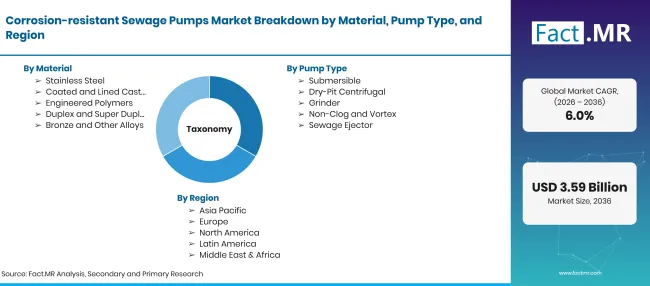
Corrosion Resistant Sewage Pumps Market Taxonomy | Source: Fact.MR
| Items | Values |
|---|---|
| Quantitative Units (2026) | USD 2.00 Billion |
| Material | Stainless steel, Coated and lined cast iron, Engineered polymers, Duplex and super duplex alloys, Bronze and other alloys |
| Pump Type | Submersible, Dry-pit centrifugal, Grinder, Non-clog and vortex, Sewage ejector |
| Application | Municipal wastewater, Industrial effluent, Commercial buildings, Residential, Marine and offshore |
| Regions Covered | North America, Latin America, Europe, Asia Pacific, Middle East & Africa |
| Countries Covered | India, China, South Korea, United States, United Kingdom, and other countries |
| Key Companies Profiled | Xylem, Grundfos, KSB, Sulzer, Wilo |
| Additional Attributes | Dollar revenue in the Corrosion-resistant Sewage Pumps Market is segmented by material, pump type, application and power rating and region. |
Source: Fact.MR analysis. Updated Nov 26, 2026
Corrosion-resistant Sewage Pumps Market by Segments
-
Material
- Stainless steel
- Coated and lined cast iron
- Engineered polymers
- Duplex and super duplex alloys
- Bronze and other alloys
-
Pump Type
- Submersible
- Dry-pit centrifugal
- Grinder
- Non-clog and vortex
- Sewage ejector
-
Application
- Municipal wastewater
- Industrial effluent
- Commercial buildings
- Residential
- Marine and offshore
-
Power Rating
- Up to 3 kW
- 3 to 15 kW
- 15 to 50 kW
- Above 50 kW
- Region:
- North America
- United States
- Canada
- Mexico
- Europe
- Germany
- United Kingdom
- France
- Italy
- Spain
- Rest of Europe
- Asia Pacific
- China
- India
- Japan
- South Korea
- Australia and New Zealand
- Rest of Asia Pacific
- Latin America
- Brazil
- Argentina
- Rest of Latin America
- Middle East & Africa
- GCC Countries
- South Africa
- Rest of Middle East & Africa
- Up to 3 kW
Table of Contents
Key Takeaways
- Market Size and CAGR
- Top Growth Driver
- Fastest Growing Segment
- Leading Region
- Key Companies
- Emerging Opportunities

