
- Market Value (2025): USD 204.1 Mn
- Estimated Value (2026): USD 220.0 Mn
- Forecast Value (2036): USD 466.2 Mn
- CAGR (2026-2036): 7.8%
High-Torque Servo Modules Market Forecast and Outlook 2026 to 2036
As per the Fact.MR analysis, the high-torque servo modules market was valued at USD 204.1 million in 2025 and is projected to grow from USD 220.0 million in 2026 to USD 466.2 million by 2036. Demand for high-torque servo modules is likely to grow at a CAGR of 7.8% over the forecast period.
Demand for high-torque servo modules is rising as machine builders replace hydraulics and mechanical drives with servo motors that deliver large torque with precise control in presses, injection molding machines, extruders and heavy handling. Integrated modules combine motor, drive, gearbox and feedback for compact installation. For example, all-electric injection molding machines, widely used in Japan, rely on high-torque servos instead of hydraulic pumps to cut energy use. Similar electrification is projected to drive sales of high-torque servo modules through 2036.
Key Takeaways from the High-Torque Servo Modules Market
- High-Torque Servo Modules Market Value (2025): USD 204.1 million
- High-Torque Servo Modules Market Value (2026): USD 220.0 million
- High-Torque Servo Modules Market Forecast Value (2036): USD 466.2 million
- High-Torque Servo Modules Market Forecast CAGR (2026-2036): 7.8%
- Leading Servo torque band: Above 100 Nm (28.8%)
- Key Market Participants: Siemens, Bosch Rexroth, Yaskawa, Mitsubishi Electric, Rockwell Automation, Beckhoff
- Key Growth Regions: Japan, Germany, United States, China, Taiwan
Humanoid and heavy-duty robot developers in Asia, the United States and Europe are creating new demand for compact, high-torque joint actuators. Demand for high-torque servo modules is growing as suppliers adapt industrial servo technology to these designs. The key players such as Yaskawa, Mitsubishi Electric, Siemens and Bosch Rexroth are expanding high-torque ranges. Similar robotics investment is projected to drive sales of high-torque servo modules worldwide.
High-Torque Servo Modules Market
| Metric | Value |
|---|---|
| Estimated Value in (2026) | USD 220.0 million |
| Forecast Value in (2036) | USD 466.2 million |
| Forecast CAGR (2026 to 2036) | 7.8% |
Source: Fact.MR analysis.
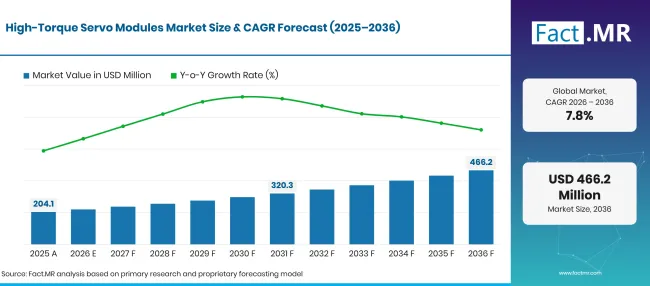
High Torque Servo Modules Forecast Global | Source: Fact.MR
Category
| Category | Segments |
|---|---|
| Servo torque band | Below 5 Nm, 5-20 Nm, 20-50 Nm, 50-100 Nm, Above 100 Nm |
| Installation type | Machine-integrated, Skid / cell, Portable maintenance, Fixed production line, Modular retrofit |
| End use | Food / beverage, Automotive, Chemicals, Pharmaceuticals, General manufacturing |
| Control interface | Standalone, Analog / digital, Fieldbus, Industrial Ethernet, Wireless / cloud |
| Region | Japan; Germany; United States; China; Taiwan |
Source: Fact.MR analysis.
Segmental Analysis
What is driving demand for Above 100 Nm modules in the High-Torque Servo Modules Market?
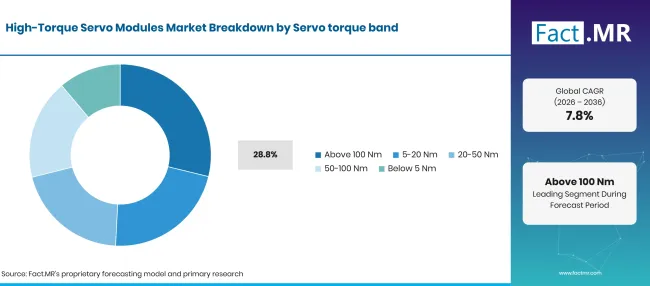
High Torque Servo Modules Breakdown Servo Torque Band | Source: Fact.MR
Modules rated above 100 Nm account for 28.8% of revenue in 2026, about USD 63.4 million, as servo presses, large extruders and heavy positioning axes need very high torque. Below-5 Nm modules follow for light axes. The key players are offering high-torque direct drives. India's Ministry of Statistics and Programme Implementation (MoSPI) reported that capital goods production increased by 16.9% year over year in August 2026, reflecting stronger industrial equipment activity. Manufacturing of electrical equipment also recorded 30.9% growth during the month. These developments support investment in advanced motion-control systems, including high-torque servo modules for machinery requiring precise positioning and sustained mechanical power.
Why do Fixed production line installations lead the High-Torque Servo Modules Market?
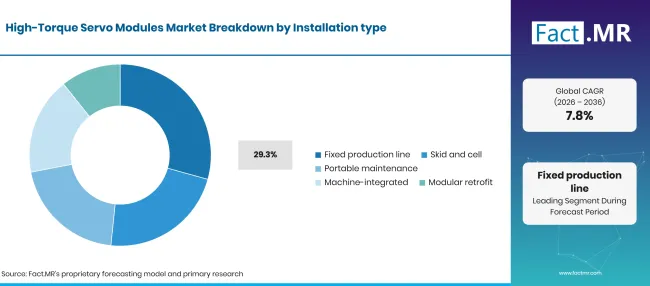
High Torque Servo Modules Breakdown Installation Type | Source: Fact.MR
Fixed production line installations account for 29.3% of revenue in 2026, about USD 64.5 million, as servos are installed on permanent presses, extruders and transfer lines. Modular retrofits follow. MoSPI's Annual Survey of Industries 2024–25, released in September 2026, recorded 10.54% growth in fixed capital investment across registered manufacturing establishments. Industrial output increased by 7.81% during the same period. Expanding machinery installations create opportunities for servo module suppliers serving machine builders and factory engineering teams. Demand is particularly relevant for high-torque systems supporting continuous production, synchronized machine movements and reliable positioning across permanent industrial lines.
How is general manufacturing contributing to high-torque servo module sales?
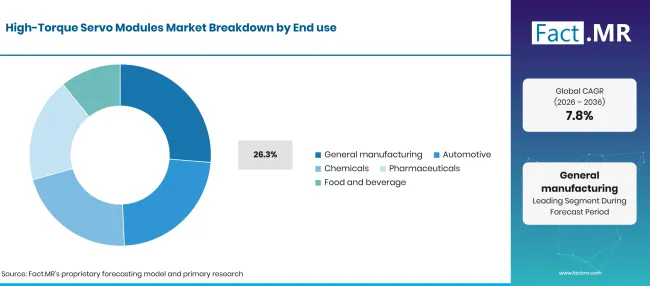
High Torque Servo Modules Breakdown End Use | Source: Fact.MR
General manufacturing applications account for 26.3% of revenue in 2026, about USD 57.9 million, covering metal forming, plastics, packaging and material handling. Food and beverage follows. The manufacturing companies serve diverse OEMs. India's MoSPI reported that manufacturing gross value added expanded by 10.7% in FY 2025–26, according to provisional national accounts estimates published in June 2026. The Annual Survey of Industries also identified basic metals, motor vehicles, chemicals, pharmaceuticals and food products among major contributors to manufacturing value added. These industrial activities require powerful motion-control systems for heavy machinery, positioning equipment and automated production operations, supporting demand for high-torque servo modules.
Why does Fieldbus lead control-interface demand in the High-Torque Servo Modules Market?
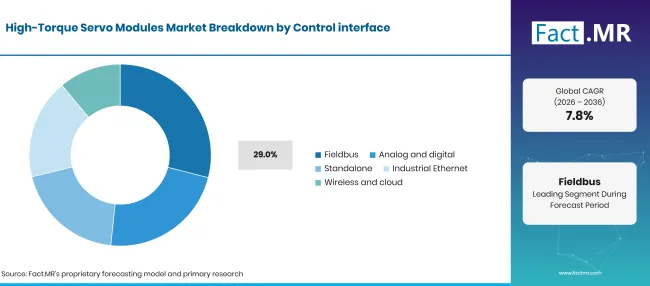
High Torque Servo Modules Breakdown Control Interface | Source: Fact.MR
Fieldbus interfaces account for 29.0% of revenue in 2026, about USD 63.8 million, as many machines use established fieldbus networks such as PROFIBUS and CANopen. Industrial Ethernet and wireless follow. Manufacturers support multiple protocols. India's MoSPI reported that manufacturing production increased by 9.0% year over year in August 2026, while electrical equipment manufacturing expanded by 30.9%. Capital goods production also recorded 16.9% growth during the month. These developments indicate increasing activity across machinery and electrical equipment manufacturing, creating opportunities for compatible motion-control components. Servo suppliers are supporting established industrial communication protocols, including PROFIBUS and CANopen, alongside Industrial Ethernet interfaces to simplify integration with existing factory automation infrastructure.
High-Torque Servo Modules Market-Drivers, Restraints & Trends
Drivers:
Replacement of Hydraulic Systems with Energy-Efficient Servo Technology-: Demand for high-torque servo modules is rising as factories replace hydraulics to cut energy use, leaks and noise. Manufacturers are offering servo-hydraulic and all-electric alternatives. India's Ministry of Statistics and Programme Implementation (MoSPI), in its Annual Survey of Industries 2024–25 released on September 30, 2026, reported that industrial output increased by 7.81%, fixed capital investment grew by 10.54% and gross value added increased by 9.59% compared with the previous year. The survey covered 267,000 registered manufacturing establishments. Rising industrial output and capital investment indicate continued expansion of manufacturing capacity. As factories modernize production equipment, demand for energy-efficient motion-control technologies, including high-torque servo modules, can benefit from investments in automated machinery, electric drives and precision manufacturing systems.
Restraints:
High Investment Costs and Cyclical Machinery Demand -: Sales of high-torque servo modules is limited by high costs of large servos and gearboxes and by cyclical machine-tool and automotive investment. Similar cycles are projected to slow sales in some years. Manufacturers must lower cost per newton-meter. Japan's Ministry of Economy, Trade and Industry (METI), through the U.S. Department of Commerce's 2025 Industrial Machine Tools country guide, reported that Japan's industrial machine-tool market declined from USD 5.675 billion in 2023 to USD 4.771 billion in 2024, a contraction of approximately 15.9%. The 2025 market was estimated at USD 4.169 billion, indicating continued investment pressure. High initial costs associated with large servo motors, precision gearboxes and integrated drive systems may further delay adoption during periods of weaker capital expenditure.
Opportunity: Growing Adoption of Servo-Driven Presses and Industrial Automation-:
Demand for servo-driven presses in metal forming is rising. Manufacturers are offering high-torque press drives. MoSPI's Capital Expenditure Intentions of the Private Corporate Sector report identifies robotics as an emerging area of manufacturing investment. According to the report, 5.83% of manufacturing enterprises reported robotics-related capital expenditure proposals for FY 2025–26, while 4.50% anticipated such investments for FY 2026–27. Across the wider private corporate sector, 2.83% of enterprises reported robotics-related investment proposals for FY 2025–26. These figures indicate continuing investment in automated manufacturing technologies. The expansion of automated metal-forming operations creates opportunities for high-torque servo modules used in servo presses, precision positioning and electrically driven production equipment.
Trend: Integrated High-Torque Actuators for Industrial and Humanoid Robots -:
Demand for compact high-torque joints for humanoids and heavy robots is rising. The key company players are developing integrated actuators. The U.S. government's October 28, 2026 presidential proclamation on robotics and industrial machinery identifies autonomous robots, humanoid robots and quadruped robots as increasingly important technologies for manufacturing and critical infrastructure. The proclamation also reports that U.S. manufacturing shipments reached approximately USD 7.1 trillion in 2024, while equipment production amounted to approximately USD 86 billion. It highlights the role of advanced robotics in automotive, electrical, electronics, metalworking and machinery industries. These developments support the broader technological shift toward automated motion systems and integrated robotic components.
High-Torque Servo Modules Market Analysis by Key Country
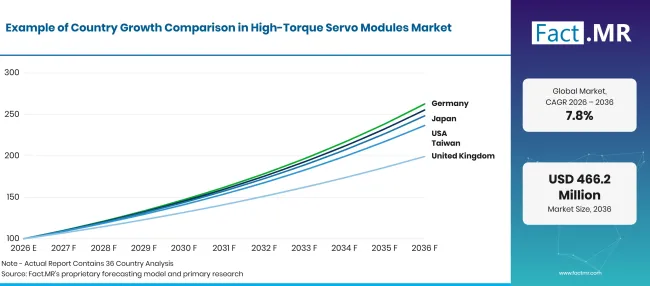
High Torque Servo Modules Growth Index | Source: Fact.MR
| Country | CAGR (2026-2036) |
|---|---|
| Japan | 12.3% |
| Germany | 11.0% |
| United States | 9.7% |
| China | 9.4% |
| Taiwan | 9.0% |
Source: Fact.MR analysis.
Why is Japan the fastest-growing market for high-torque servo modules?
Demand in Japan is projected to grow at a 12.3% CAGR, the fastest among the five key countries, as Yaskawa, Mitsubishi Electric and other makers lead servo technology and supply all-electric machinery.
Japan's high-torque servo modules market is the fastest among the five profiled countries, supported by advanced factory automation and demand for precision-controlled machinery. The Japanese government's e-Stat dashboard reported an industrial production index of 103.9 in September 2026, using 2020 as the base year. Manufacturing automation remains important as equipment producers develop electric presses, industrial robots and high-performance motion-control systems. Yaskawa and Mitsubishi Electric benefit from this manufacturing environment through their established servo technology portfolios. Demand is particularly relevant for applications requiring precise force control, repetitive movement and reliable high-torque operation.
Which industrial investments are strengthening high-torque servo module sales in Germany?
Sales in Germany is estimated to increase at a 11.0% CAGR as machine builders replace hydraulics with electric servo drives.
Siemens, Bosch Rexroth and Beckhoff supply servo modules from German bases. Germany's market is forecast to grow as machinery manufacturers increasingly adopt electric motion-control systems for precision and production efficiency. Destatis reported that industrial production increased 0.7% month-on-month in September 2026, while capital-goods production increased 3.0%. This activity supports demand for advanced drive components used in machine tools, presses and automated production equipment. Siemens, Bosch Rexroth and Beckhoff benefit from Germany's established engineering and automation ecosystem. High-torque servo modules offer machine builders an alternative to hydraulic actuation where accurate positioning, programmable motion and controlled force are important operational requirements.
What is shaping high-torque servo module sales in the United States?
Demand in the United States are anticipated to grow at a 9.7% CAGR as reshored manufacturing and robotics investment grow, supported by CHIPS Act projects.
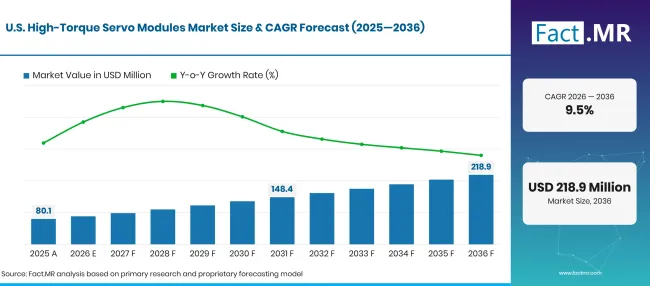
High Torque Servo Modules Forecast Usa | Source: Fact.MR
Rockwell Automation, based in Milwaukee, serves US machine builders. The United States high-torque servo modules market is supported by semiconductor manufacturing investments, industrial automation and reshoring initiatives. The US Department of Commerce announced in July 2026 that TSMC's planned American semiconductor investment had reached USD 265 billion, covering 12 advanced semiconductor manufacturing and packaging facilities. These projects create opportunities for precision automation equipment, robotic handling systems and electrically controlled production machinery. Rockwell Automation benefits from expanding industrial automation requirements, while machine builders seek high-torque drives for presses, material handling and automated production applications.
What is driving high-torque servo module demand in China?
Sales in China are estimated to increase at a 9.4% CAGR as domestic servo makers such as Inovance gain share and factories automate.
China leads global industrial robot installations. Factories in the Yangtze River Delta add servo-driven presses and robots. China's market is expected to grow as domestic automation investments and industrial robot manufacturing strengthen demand for advanced motion-control components. The National Bureau of Statistics reported that industrial robot production reached 96,752 units in September 2026, increasing 18.9% year-on-year. Cumulative production during January to September reached 794,781 units, up 29.1%. This expansion creates opportunities for high-torque servo modules used in robotic joints, automated presses and precision manufacturing equipment. Inovance and other domestic suppliers benefit from manufacturers seeking competitively priced servo solutions for increasingly automated production facilities.
What is accelerating China's adoption of high-torque servo modules?
Demand in Taiwan is projected to record a 9.0% CAGR, the slowest among the five key countries, as local makers such as HIWIN and Delta Electronics serve a mature machine-tool base.
Taiwan's high-torque servo modules market is forecast to expand the slowest among the five profiled countries, reflecting its established electronics, machine-tool and industrial automation supply base. Nevertheless, equipment demand remains supported by manufacturing activity. Taiwan's Ministry of Economic Affairs reported that machinery and equipment manufacturing production increased 26.02% year-on-year in September 2026, while cumulative growth reached 14.39% during January to September. HIWIN and Delta Electronics are established suppliers serving precision machinery and motion-control applications. Replacement purchases, equipment upgrades and specialised automation projects continue to create opportunities despite the comparatively mature industrial ecosystem.
Competitive Landscape for High-Torque Servo Modules Market
Competition in the high-torque servo modules market is led by industrial automation groups. Siemens, Bosch Rexroth, Yaskawa, Mitsubishi Electric, Rockwell Automation and Beckhoff compete on servo motors, drives and control platforms. Buyers select modules on torque density, precision, efficiency and integration.
From 2024 onward, competition shifted toward replacing hydraulics and supplying robot joints. Manufacturers with compact high-torque designs are best placed to grow.
Recent Developments
- On March 23, 2026, Bosch Rexroth introduced the MS2E Ex servo motor for hazardous areas. The series delivers maximum torque up to 360 Nm, with overload capacity reaching four times rated torque.
- On May 19, 2025, Yaskawa announced 400 V input models for its Σ-X AC servo series, including SERVOPACK amplifiers rated 500 W–15 kW and compatible motors for large industrial equipment globally.
- On November 2, 2026, Siemens announced SIMOTICS E-1EE1 servomotors and SINAMICS E210 converters for 24 V and 48 V mobile systems. This expands its extra-low-voltage portfolio.
- On June 24, 2025, Mitsubishi Electric launched MELSERVO-JET servo systems, featuring amplifiers, rotary and linear motors, encoder resolution up to 24 bits, response up to 3.2 kHz, and overload capacity up to 450%.
Key Players in High-Torque Servo Modules Market
Key companies operating in the market include Siemens, Bosch Rexroth, Yaskawa, Mitsubishi Electric, Rockwell Automation, and Beckhoff.
- Siemens
- Bosch Rexroth
- Yaskawa
- Mitsubishi Electric
- Rockwell Automation
- Beckhoff
Bibliography
- Bosch Rexroth. (2026, March 23). Bosch Rexroth simplifies automation in Ex zones with single cable technology.
- Destatis. (2026, November 6). Production in September 2026: +0.7% on the previous month.
- Ministry of Economic Affairs, Taiwan. (2026, October 23). Industrial production statistics for September 2026.
- Ministry of Statistics and Programme Implementation. (2026, August 12). Compounded annual growth rate of manufacturing GVA at constant prices (2022–23 base) as per revised series during 2022–23 to 2025–26 is 10.88%. Press Information Bureau.
- Ministry of Statistics and Programme Implementation. (2026, September 28). Quick estimates of Index of Industrial Production and use-based index for the month of August 2026. Press Information Bureau.
- Ministry of Statistics and Programme Implementation. (2026, September 30). Release of the Annual Survey of Industries (2024–25) results. Press Information Bureau.
- National Bureau of Statistics of China. (2026, October 20). Industrial production operation in September 2026.
- National Institute of Standards and Technology. (2026, July 16). Trump administration secures an additional $100 billion U.S. semiconductor manufacturing investment for a total of $265 billion from TSMC.
- Siemens AG. (2026, November 2). Siemens launches new ELV drive solution for AGVs and mobile robotics.
- The White House. (2026, October 28). Adjusting imports of robotics, industrial machinery, and their parts and components into the United States.
Segmentation
Scope of Report
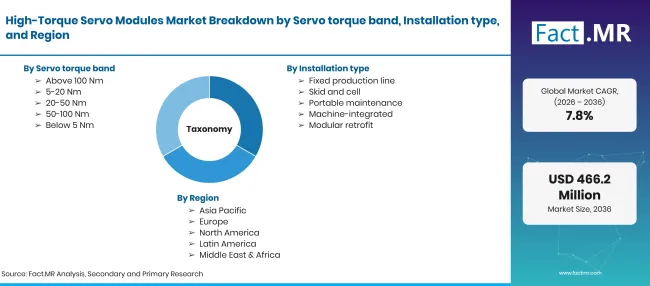
High Torque Servo Modules Taxonomy | Source: Fact.MR
| Items | Values |
|---|---|
| Quantitative Units (2026) | USD 220.0 Million |
| Servo torque band | Below 5 Nm, 5-20 Nm, 20-50 Nm, 50-100 Nm, Above 100 Nm |
| Installation type | Machine-integrated, Skid / cell, Portable maintenance, Fixed production line, Modular retrofit |
| End use | Food / beverage, Automotive, Chemicals, Pharmaceuticals, General manufacturing |
| Control interface | Standalone, Analog / digital, Fieldbus, Industrial Ethernet, Wireless / cloud |
| Regions Covered | North America, Latin America, Europe, East Asia, South Asia and Pacific, Middle East & Africa |
| Countries Covered | Japan, Germany, United States, China, Taiwan, and other countries |
| Key Companies Profiled | Siemens, Bosch Rexroth, Yaskawa, Mitsubishi Electric, Rockwell Automation, Beckhoff |
| Additional Attributes | Dollar revenue in the High-Torque Servo Modules Market is segmented by servo torque band (below 5 N·m, 5–20 N·m, 20–50 N·m, 50–100 N·m, above 100 N·m); installation type (machine-integrated, skid / cell, portable maintenance, fixed production line, modular retrofit); end use (food / beverage, automotive, chemicals, pharmaceuticals, general manufacturing); control interface (standalone, analog / digital, fieldbus, industrial ethernet, wireless / cloud) and region. |
Source: Fact.MR analysis.
High-Torque Servo Modules Market by Segments
-
Servo torque band
- Below 5 Nm
- 5-20 Nm
- 20-50 Nm
- 50-100 Nm
- Above 100 Nm
-
Installation type
- Machine-integrated
- Skid / cell
- Portable maintenance
- Fixed production line
- Modular retrofit
-
End use
- Food / beverage
- Automotive
- Chemicals
- Pharmaceuticals
- General manufacturing
-
Control interface
- Standalone
- Analog / digital
- Fieldbus
- Industrial Ethernet
- Wireless / cloud
-
Region:
- North America
- United States
- Canada
- Mexico
- Europe
- Germany
- United Kingdom
- France
- Italy
- Spain
- Rest of Europe
- Asia Pacific
- China
- India
- Japan
- South Korea
- Australia
- Rest of Asia Pacific
- Latin America
- Brazil
- Argentina
- Rest of Latin America
- Middle East & Africa
- GCC Countries
- South Africa
- Rest of Middle East & Africa
- North America
Table of Contents
Key Takeaways
- Market Size and CAGR
- Top Growth Driver
- Fastest Growing Segment
- Leading Region
- Key Companies
- Emerging Opportunities

