- Market Value (2025): USD 160.7 Mn
- Estimated Value (2026): USD 168.1 Mn
- Forecast Value (2036): USD 262.8 Mn
- CAGR (2026-2036): 4.6%
What is the Couplers Dust Caps Market forecast to be worth by 2036?
USD 168.1 million in 2026 to USD 262.8 million by 2036 at a 4.6% CAGR.
- Couplers dust caps demand came to USD 160.7 million in 2025, with vehicle assembly lines and repair workshops placing the bulk of orders.
- Revenue will grow from USD 168.1 million in 2026 to USD 262.8 million by 2036 as more hydraulic and fluid lines are fitted with quick couplings that need covering when idle.
- A 4.6% CAGR reflects a replacement-led category in which each lost or cracked cap is reordered, so revenue tracks fleet size and service intensity.
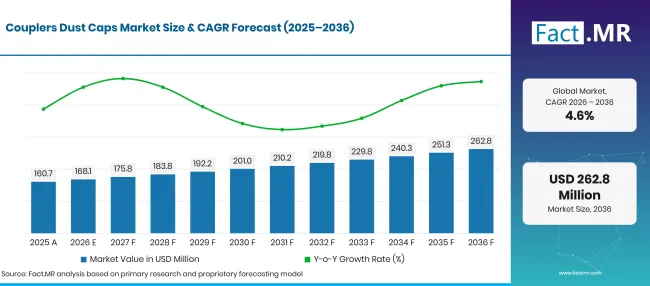
Couplers Dust Caps Market Forecast Global | Source: Fact.MR
| Year | Basis | Market Value (USD million) |
|---|---|---|
| 2025 | Actual | 160.7 |
| 2026 | Estimate | 168.1 |
| 2036 | Forecast | 262.8 |
| CAGR 2026 to 2036 | Forecast period | 4.6% |
Source: Fact.MR analysis. Updated Nov 2, 2026
What are the defining numbers behind Couplers Dust Caps Market growth?
The 2026 to 2036 period will add USD 94.7 million in new value, most of it from aftermarket reorders for vehicles and mobile machinery.
- Demand Drivers in the Market
- Machinery output in Europe picked up late in 2025, and each new machine ships with couplings that need caps. Eurostat reported that euro area production of capital goods in December 2025 stood 5.6% above the same month a year earlier [1].
- Construction keeps excavators, loaders and breakers busy, and attachment changes leave coupling halves open on site. The U.S. Census Bureau put the value of construction put in place in 2025 at USD 2,164.4 billion [2]. Sites with that much activity generate steady demand for replacement caps.
- Brazilian trade in vehicles and machinery widens the pool of equipment carrying quick couplings. Brazil’s exports hit a record US$349 billion in 2025, and shipments of goods-transport vehicles reached a record US$3.1 billion [3].
- Hydraulic cleanliness has become part of routine maintenance checklists. A single particle entering through an uncapped coupler can scar a valve spool, so service teams treat caps as cheap insurance for far costlier components.
- Coupling makers keep adding series and body sizes, and each new design needs a matched cap or plug. This steady stream of designs keeps catalog depth growing and limits substitution with generic covers.
- Key Segments Analyzed
- By Product Type: Plastic Dust Caps will hold 38.5% share in 2026 as they are light, moulded in many sizes and cheap enough to replace without a second thought.
- By Application: Automotive will account for 60.0% of 2026 demand, since vehicle plants and service bays handle thousands of fluid connections every shift.
- By Distribution Channel: Direct Sales will capture 46.0% in 2026 because OEMs and fleet buyers order caps together with the couplings they specify.
- By End-User: Aftermarket will represent 64.2% of 2026 revenue, reflecting the repeat purchases made across the long working life of each coupling.
- Analyst Opinion at Fact.MR
- Shambhu Nath Jha, Principal Consultant at Fact.MR, states, “A dust cap costs a fraction of the pump or valve it protects. That gap is exactly why buyers keep reordering. Suppliers that tie each cap to a named coupling series and keep stock close to the workshop will win the repeat business. Metal and rubber designs will gain ground in mining, forestry and construction, while plastic caps will stay the everyday choice on vehicle lines.”
- Strategic Implications
- Coupling manufacturers should publish cap and plug part numbers on the same drawing as each coupling series so that buyers order the right fit the first time.
- Distributors should stock caps by coupling family and body size and group them with the matching couplers in their catalogs.
- Fleet and plant maintenance managers should add cap checks to disconnection procedures and keep tethered caps on couplings that are swapped often.
- Investors should judge suppliers on the breadth of their coupling installed base, since that base drives the replacement revenue behind this category.
The United Kingdom leads the country set at 5.6%, as a large licensed vehicle fleet and rising construction work keep workshops reordering caps. Germany follows closely at 5.3%, where a dense car parc meets a strong machine-building sector. The United States records 4.6%, a rate tied to its mature vehicle and parts industry and heavy construction volume. Brazil reaches 4.1%, held back by softer capital goods output even as vehicle exports grow. Japan trails at 3.5%, reflecting a well-equipped manufacturing base where most coupling stock is already in place and demand is mainly for replacements.
How does the Couplers Dust Caps Market break down by segment?
Plastic Dust Caps will lead Product Type at 38.5%; Automotive will head Application at 60.0%; Direct Sales will lead Distribution Channel at 46.0%; Aftermarket will hold End-User at 64.2% in 2026.
Which Product Type leads?
Plastic Dust Caps take 38.5% of 2026 sales.
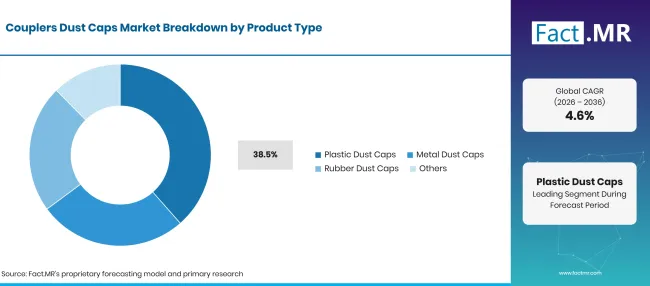
Couplers Dust Caps Market Breakdown Product Type | Source: Fact.MR
| Product Type | Share (2026) |
|---|---|
| Plastic Dust Caps (Leading segment) | 38.5% |
| Other segments combined | 61.5%* |
| Total | 100.0% |
Source: Fact.MR analysis. Updated Nov 2, 2026
Low weight and low cost make plastic caps the default cover on everyday couplings. Moulding allows tight tolerances, colour coding and tethers in one part, and the material does not corrode in wet or salty conditions. Workshop staff can push them on and pull them off by hand. The same material choices seen in plastic caps and closures apply here, with polyethylene and PVC grades chosen for flexibility at low temperatures. Metal caps in steel or aluminium serve high-pressure hydraulic couplings on construction and mining equipment, where impact and heat can crack plastic. Rubber caps fit irregular shapes and seal well against moisture. Others include fabric covers and combined cap and plug sets for specialised equipment.
What supports Automotive within Application?
Automotive accounts for 60.0% of 2026 revenue.
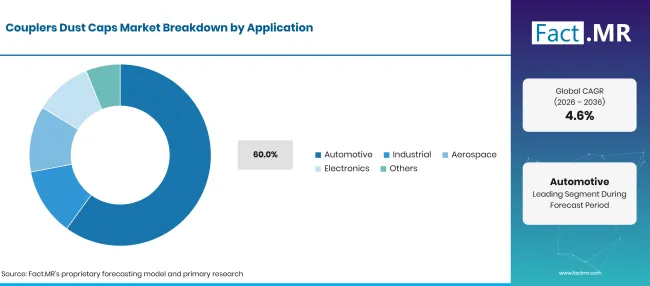
Couplers Dust Caps Market Breakdown Application | Source: Fact.MR
| Application | Share (2026) |
|---|---|
| Automotive (Leading segment) | 60.0% |
| Other segments combined | 40.0%* |
| Total | 100.0% |
Source: Fact.MR analysis. Updated Nov 2, 2026
Vehicle production uses quick couplings for brake fluid, coolant, fuel and air-conditioning fills. Each open line on the assembly track needs a cap. After sale, service bays reconnect the same lines during repairs. The trend mirrors growth in automotive hoses, since every hose end ending in a quick coupling creates a cap requirement. Industrial use covers machine tools, hydraulic presses and plant air networks. Aerospace and electronics buyers order smaller volumes but specify tighter materials and tethered designs. Others include marine, rail and test-bench applications.
How does Distribution Channel shape demand?
Direct Sales takes 46.0% of 2026 value.
| Distribution Channel | Share (2026) |
|---|---|
| Direct Sales (Leading segment) | 46.0% |
| Other segments combined | 54.0%* |
| Total | 100.0% |
Source: Fact.MR analysis. Updated Nov 2, 2026
Large buyers rarely shop for caps on their own. Vehicle makers and equipment OEMs specify caps in the same supply contract as the couplings, so orders flow straight from the coupling maker. Fleet operators with framework agreements follow the same route. The pattern also holds for pneumatic fittings, where direct accounts handle volume and catalogs serve smaller buyers. Online stores make it easy for small workshops to match caps to an existing coupling by series and size. Specialty hydraulic stores serve walk-in repair needs. Supermarkets and hypermarkets stock only basic general-purpose caps, and others include field service vans and industrial vending.
What supports Aftermarket within End-User?
Aftermarket holds 64.2% of 2026 sales.
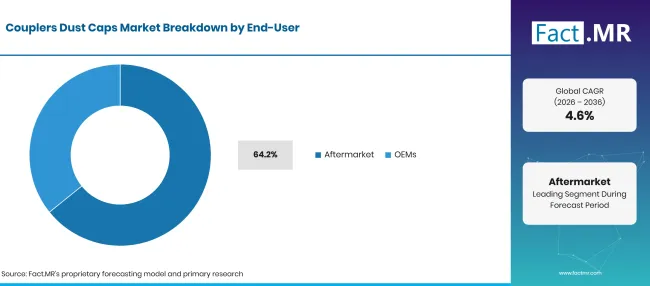
Couplers Dust Caps Market Breakdown End User | Source: Fact.MR
| End-User | Share (2026) |
|---|---|
| Aftermarket (Leading segment) | 64.2% |
| Other segments combined | 35.8%* |
| Total | 100.0% |
Source: Fact.MR analysis. Updated Nov 2, 2026
Caps go missing, split or get left on the ground during attachment changes, so most purchases happen long after the machine leaves the factory. Britain alone had 42.3 million licensed vehicles at the end of 2025 [4]. Each vehicle with fluid service points adds to the base that repair shops support. Owners of tractors and loaders also replace caps on agricultural tractors at each seasonal service. OEM purchases are linked to new equipment builds and the coupling bill of materials. Volumes follow production cycles, which makes OEM demand more uneven than the replacement flow.
What is accelerating Couplers Dust Caps Market adoption, and what is holding it back?
Higher machinery output, steady construction work and the growing number of vehicles in service keep caps in demand, as each disconnection exposes a coupling. Maintenance standards that focus on fluid cleanliness add to this pull. Low unit prices, unbranded copies and the spread of coupling sizes limit revenue per buyer and slow the shift to matched designs.
Drivers Impact Analysis
| DRIVER | (~) % IMPACT ON CAGR | GEOGRAPHIC RELEVANCE | IMPACT TIMELINE |
|---|---|---|---|
| Wider use of quick couplings on vehicles and industrial equipment | +1.5% | Global | Medium term (2-4 years) |
| Recurring replacement of lost and damaged caps in fleets and workshops | +1.1% | Global | Short term (<=2 years) |
| Stricter hydraulic cleanliness practice in maintenance | +0.8% | Western Europe, North America, East Asia | Medium term (2-4 years) |
| Growth of farm and construction machinery fleets | +0.6% | Latin America, North America, South Asia & Pacific | Long term (>=4 years) |
Source: Fact.MR analysis. Updated Nov 2, 2026
Opportunity Impact Analysis
| OPPORTUNITY | (~) % IMPACT ON CAGR | GEOGRAPHIC RELEVANCE | IMPACT TIMELINE |
|---|---|---|---|
| Polymer and rubber caps engineered for harsh duty | +0.6% | Global | Medium term (2-4 years) |
| Online catalogs with series and size matching | +0.4% | North America, Western Europe, East Asia | Short term (<=2 years) |
| Bundled cap and plug kits for aftermarket service | +0.3% | Global | Medium term (2-4 years) |
| New coupling production in emerging economies | +0.2% | Latin America, South Asia & Pacific | Long term (>=4 years) |
Source: Fact.MR analysis. Updated Nov 2, 2026
Restraints Impact Analysis
| RESTRAINT | (~) % IMPACT ON CAGR | GEOGRAPHIC RELEVANCE | IMPACT TIMELINE |
|---|---|---|---|
| Low-cost generic caps and price competition | -0.4% | Global | Short term (<=2 years) |
| Wide variation in coupling dimensions | -0.3% | Global | Medium term (2-4 years) |
| Low unit value and long replacement intervals in some uses | -0.2% | Global | Long term (>=4 years) |
Source: Fact.MR analysis. Updated Nov 2, 2026
Which countries are scaling the Couplers Dust Caps Market through 2036?
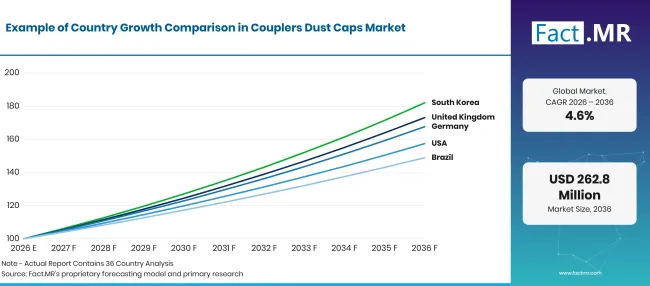
Couplers Dust Caps Market Growth Index | Source: Fact.MR
| Country | CAGR (2026 to 2036) |
|---|---|
| United Kingdom | 5.6% |
| Germany | 5.3% |
| United States | 4.6% |
| Brazil | 4.1% |
| Japan | 3.5% |
Source: Fact.MR analysis. Updated Nov 2, 2026
What supports the United Kingdom’s adoption?
5.6% CAGR, driven by a growing licensed fleet and higher construction output.
The Department for Transport counted 2,617,000 vehicles registered for the first time in 2025 [4]. New vehicles join a fleet that independent garages and dealer workshops service for many years, and each fluid service touches capped connection points. Construction adds a second source of demand. The Office for National Statistics reported that annual construction output rose 1.8% in 2025 compared with 2024 [5]. Plant hire firms change attachments often, which keeps cap replacement frequent.
What supports Germany’s adoption?
5.3% CAGR, backed by a record car fleet and deep machine-building expertise.
Destatis reported about 49.5 million passenger cars in Germany on 1 January 2026, up from 49.3 million a year earlier [6]. Car density reached 593 per 1,000 inhabitants. German workshops expect caps that match the coupling exactly, and buyers favour branded parts with clear fit data. Machine builders that export hydraulic equipment also ship caps on every open coupling, keeping OEM orders steady.
What is supporting United States adoption?
4.6% CAGR, helped by a large vehicle and parts workforce.
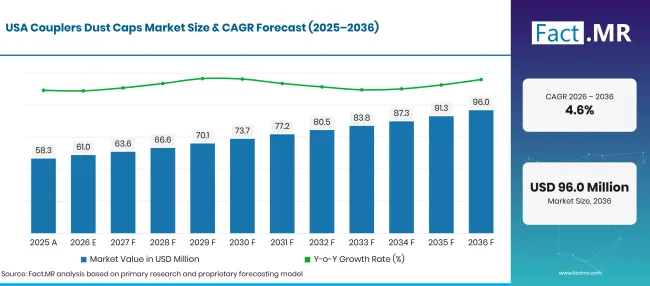
Couplers Dust Caps Market Forecast Usa | Source: Fact.MR
The U.S. Bureau of Labor Statistics recorded 991,300 employees in motor vehicles and parts manufacturing in December 2025 [7]. Plants of this scale run fluid-fill and test stations where caps protect open lines between steps. Hydraulic equipment for farms and building sites draws on the same dealer and distributor networks. Replacement caps for hydraulic hose assemblies are a routine counter item at these outlets.
How is Brazil developing demand?
4.1% CAGR, reflecting strong vehicle trade against softer capital goods output.
Brazilian exports to Argentina rose 31.4% in 2025, pulled up by the automotive sector [3]. That flow supports vehicle and component plants that use capped fluid lines. Industrial output grew 0.6% in 2025, while capital goods production fell 1.5% over the year, according to IBGE data released by the federal government [8]. Slower machinery output tempers OEM orders, so Brazilian demand leans on the aftermarket for farm and road equipment working in dusty conditions.
How does Japan perform?
3.5% CAGR, as a mature plant base shifts buying toward replacements.
METI reported that Japan’s original industrial production index reached 106.8 in December 2025, 2.6% higher than a year earlier [9]. Japanese plants already carry dense coupling networks on presses, robots and hydraulic cylinder circuits. New installations are fewer than in faster-growing economies. Domestic coupling makers sell caps as part of tightly specified accessory ranges, which keeps quality high and volume growth modest.
Who leads the Couplers Dust Caps Market?
Competition splits into two groups. Broad-line fluid connector makers such as Parker Hannifin, Stäubli and Faster sell caps as part of complete coupling families, so their caps follow every coupling they place on OEM equipment.
Stäubli moved production of its data center cooling connectors to Duncan, South Carolina, in April 2025 [10]. Faster launched its MultiQTC multiconnection system for large excavators in March 2026, with a sealed design that resists dust, water and site debris [11]. Specialists compete on depth within particular coupling types, a group that covers CEJN and Dixon along with Walther Präzision, Nitto Kohki and Colder Products Company. CEJN introduced the BLX super-duty hydraulic connector with bayonet locking in May 2025 [12]. Dixon offers rigid aluminium and steel caps for several hydraulic series, while Nitto Kohki lists plastic and dip-moulded caps for its Cupla range. Through 2036, the supplier that offers a matching cap for every coupling it has already sold will keep the aftermarket order.
Which companies are the key providers?
Key companies include Parker Hannifin; Stäubli; Faster; CEJN; Dixon; Walther Präzision; Nitto Kohki; and Colder Products Company.
- Parker Hannifin
- Stäubli
- Faster
- CEJN
- Dixon
- Walther Präzision
- Nitto Kohki
- Colder Products Company
Bibliography
- [1] Eurostat. (2026, March 13). Industrial production down by 1.5% in the euro area and by 1.6% in the EU.
- [2] U.S. Census Bureau. (2026, February 27). Monthly Construction Spending, December 2025.
- [3] Agência Gov, Government of Brazil. (2026, January 6). Exportações brasileiras alcançam US$ 349 bi em 2025 e batem recorde histórico.
- [4] Department for Transport. (2026, April 29). Vehicle licensing statistics, United Kingdom: 2025.
- [5] Office for National Statistics. (2026, February 12). Construction output in Great Britain: December 2025, new orders and Construction Output Price Indices, October to December 2025.
- [6] Statistisches Bundesamt (Destatis). (2026, July 22). Pkw-Dichte 2026 erneut gestiegen.
- [7] U.S. Bureau of Labor Statistics. (2026, January 30). Table B-1b. Employees on nonfarm payrolls by industry sector and selected industry detail, not seasonally adjusted.
- [8] Agência Gov, Government of Brazil. (2026, February 3). IBGE: indústria fecha 2025 com alta de 0,6% e tem terceiro ano seguido de crescimento.
- [9] Ministry of Economy, Trade and Industry. (2026, February 16). Indices of Industrial Production: Revised Report for December 2025.
- [10] Stäubli. (2025, April 8). Stäubli expands manufacturing footprint in North America with IT cooling connectors.
- [11] Faster S.p.A. (2026, March 3). Faster, a Helios Technologies Operating Company, Launches MultiQTC™: High Performance Multiconnection System.
- [12] CEJN. (2025, May 7). CEJN BLX: the next level super-duty quick connector.
This Report Answers
- How much revenue couplers dust caps generate in 2025 and 2026, and what value they reach by 2036.
- Which cap material and application lead, which sales channel and buyer group carry the most revenue, and why.
- How machinery output, construction activity and vehicle fleets shape cap demand in five countries.
- Where generic copies and size variation squeeze supplier margins.
- Which coupling makers and accessory specialists compete for repeat orders.
- What OEMs, distributors and fleet managers can do to cut contamination at disconnected couplings.
What does the Couplers Dust Caps Market cover?
This study values protective caps and plugs built to cover disconnected quick couplings and fluid connectors. These parts stop dust, dirt and water from reaching the sealing faces and valves inside the coupling, and they protect threads from knocks.
Revenue is counted at manufacturer selling price across plastic, metal and rubber designs. It includes sales to OEMs for new equipment and to aftermarket buyers for repair and replacement. These sales move through direct accounts, online stores, specialty stores and other outlets.
What is included in the scope?
New dust caps and plugs designed for hydraulic, pneumatic and liquid-cooling quick couplings.
Caps sold on their own or packed with a coupling, as long as their main job is to protect the disconnected end.
Tethered caps, flip caps and pressure-tight protective plugs made for a named coupling series.
Replacement caps bought during maintenance and repair, including kits that combine caps and plugs for service vans.
What is excluded from the scope?
Complete quick couplings, hoses, valves and fittings whose function goes beyond protective covering.
General-purpose industrial caps and masking plugs not designed for coupling protection.
Covers for electrical connectors and cable ends.
Coupling seal kits, repair kits, installation work and maintenance service contracts.
How Was the Analysis Built?
The analysis draws on 120+ sources, 35+ company portfolios, 25+ countries, and more than 20 industry interviews.
- Primary Research: Primary research includes discussions with manufacturers, service providers, technology developers, distributors, end users, and subject-matter experts. These conversations examine purchasing priorities, product adoption, operational challenges, approval requirements, competitive positioning, and the factors that influence wider market acceptance.
- Desk Research: Desk research covers government statistics, regulatory publications, company filings, trade data, technical studies, industry associations, standards, public policy, and other authoritative sources. Every source used in the analysis is documented in the bibliography.
- Market Sizing and Forecasting: Market estimates combine historical performance, demand indicators, pricing and volume trends, segment shares, company participation, country-level growth, adoption patterns, investment activity, and barriers to market expansion.
- Data Validation and Update Cycle: Findings are validated by comparing primary interviews with public data, company activity, regulatory changes, trade patterns, and industry developments. Regular updates review new product launches, capacity changes, partnerships, approvals, and shifts in commercial adoption.
Segmentation
What is the report’s scope and coverage?
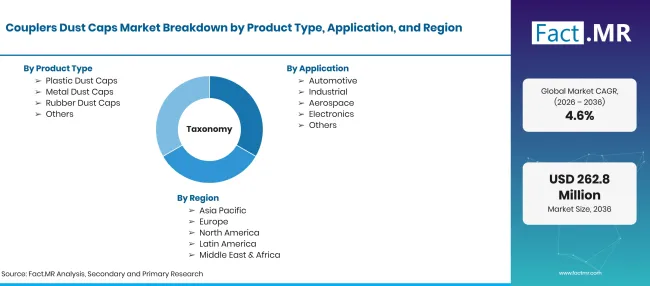
Couplers Dust Caps Market Taxonomy | Source: Fact.MR
| Attribute | Details |
|---|---|
| Quantitative Units | USD million in 2026 to USD million by 2036 at CAGR |
| Market Definition | Protective caps and plugs that cover disconnected quick couplings and fluid connectors to keep out dust, moisture and impact damage. |
| Product Type | Plastic Dust Caps; Metal Dust Caps; Rubber Dust Caps; Others |
| Application | Automotive; Industrial; Aerospace; Electronics; Others |
| Distribution Channel | Direct Sales; Online Stores; Specialty Stores; Supermarkets/Hypermarkets; Others |
| End-User | Aftermarket; OEMs |
| Regions Covered | North America; Latin America; Western Europe; Eastern Europe; East Asia; South Asia & Pacific; Middle East & Africa |
| Countries Covered | United Kingdom; Germany; United States; Brazil; Japan |
| Companies Profiled | Parker Hannifin; Stäubli; Faster; CEJN; Dixon; Walther Präzision; Nitto Kohki; Colder Products Company |
| Forecast Period | 2026 to 2036 |
| Approach | Coupling installed base and replacement rates by application, cross-checked with OEM build volumes, channel interviews and supplier catalogs. |
Source: Fact.MR analysis. Updated Nov 2, 2026
How is the market segmented?
-
By Product Type
- Plastic Dust Caps
- Metal Dust Caps
- Rubber Dust Caps
- Others
-
By Application
- Automotive
- Industrial
- Aerospace
- Electronics
- Others
-
By Distribution Channel
- Direct Sales
- Online Stores
- Specialty Stores
- Supermarkets/Hypermarkets
- Others
-
By End-User
- Aftermarket
- OEMs
-
By Region
- North America
- Latin America
- Western Europe
- Eastern Europe
- East Asia
- South Asia & Pacific
- Middle East & Africa
Frequently Asked Questions
How large is the couplers dust caps market in 2026?
What growth rate will the couplers dust caps market record?
Which product type leads?
Which application leads?
Which distribution channel leads?
Which end-user leads?
Which country will grow quickest?
Who are the main companies?
What holds the market back?
Who worked on this report


Preview the report firsthand - request a free sample
Free SampleGet the brochure for pricing and purchase details
Download PDF