- Market Value (2025): USD 0.9 Bn
- Estimated Value (2026): USD 1.0 Bn
- Forecast Value (2036): USD 5.5 Bn
- CAGR (2026-2036):18.6%
What is the creator storefront tools market forecast to be worth by 2036?
USD 1.0 billion in 2026 to USD 5.5 billion by 2036, at 18.60% CAGR.
- The creator storefront tools market reached a valuation of USD 0.9 billion in 2025.
- Demand is expected to increase from USD 1.0 billion in 2026 to USD 5.5 billion by 2036.
- The market is forecast to record 18.6% CAGR from 2026 to 2036 as creator commerce, social shopping and digital retail continue expanding across global markets.
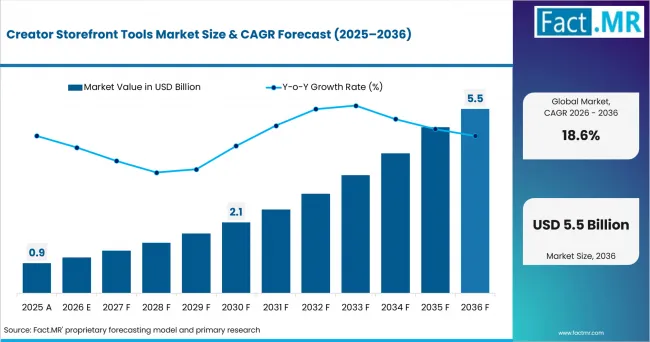
Creator Storefront Tools Market Market Value Analysis | Source: Fact.MR
What are the defining numbers behind creator storefront tools market growth?
USD 4.5 billion absolute opportunity by 2036, led by creator commerce expansion and digital storefront innovation.
- Demand Drivers in the Market
- Creator commerce continues expanding across social media and digital retail platforms.
- Businesses increasingly partner with creators to improve product discovery and customer engagement.
- Platform providers continue introducing AI-powered commerce features.
- Digital retailers increasingly adopt creator storefronts to improve online sales performance.
- Key Segments Analyzed
- By Storefront Model: Creator shops are expected to hold 36.0% share in 2026 because independent creators continue expanding direct selling.
- By User Group: Creators are projected to capture 31.0% share in 2026 because they remain the primary users of storefront platforms.
- By Functional Module: Checkout is likely to account for 27.0% share in 2026 because seamless purchasing remains essential for creator commerce.
- By Deployment: Shopify apps lead because merchants increasingly prefer integrated commerce solutions. The segment is expected to hold 38.0% share in 2026.
- By Geography: The United States is projected to record 19.3% CAGR through 2036 as creator economy platforms continue expanding.
- Analyst Opinion at Fact.MR
- Shambhu Nath Jha, Senior Analyst at Fact.MR, states, "Creator storefront tools are becoming an essential part of digital commerce as creators increasingly build independent retail businesses. Companies that simplify storefront management while improving customer engagement will strengthen their competitive position."
- Strategic Implications
- Platform providers should invest in AI powered storefront management and commerce automation.
- Software developers should simplify deployment across digital commerce platforms.
- Retailers should strengthen creator partnerships through integrated storefront solutions.
- Commerce platforms should combine analytics with checkout tools to improve business performance.
Creator storefront tools form part of the wider commerce technology industry because they connect creators with online selling through customizable digital storefronts. The category differs from conventional e-commerce software because these platforms focus on creator-led product discovery, audience engagement and direct monetization.
Platform providers continue introducing AI powered product recommendations, integrated checkout, affiliate tracking and analytics. These capabilities help creators manage digital stores while improving customer engagement and purchase conversion. Rising investment in creator commerce continues supporting demand for storefront management platforms.
The United States is projected to record 19.3% CAGR through 2036 as creator commerce platforms continue expanding. Germany is expected to post 18.9% CAGR through 2036 as digital retail software adoption increases. Japan is likely to record 18.5% CAGR as social commerce continues gaining traction. China is forecast to advance at 18.1% CAGR as livestream shopping expands. India is set to record 17.8% CAGR as creator led retail continues growing across digital platforms.
How does the creator storefront tools market break down by segment?
Creator shops lead at 36.0%. Checkout leads at 27.0%.
Which storefront model dominates?
Creator shops hold 36.0% share in 2026.
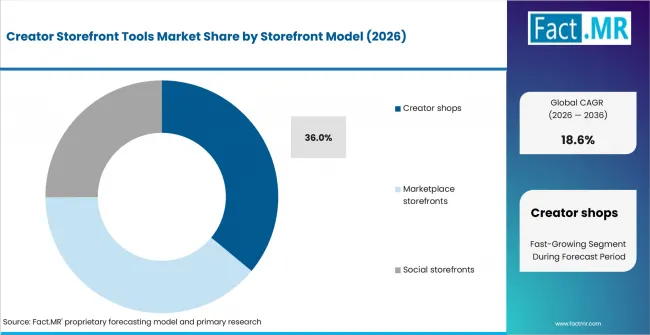
Creator Storefront Tools Market Analysis By Storefront Model | Source: Fact.MR
Creator shops are expected to hold 36.0% share in 2026 because creators increasingly build independent online businesses and strengthen direct customer relationships. Brand-hosted storefronts support collaboration campaigns. Marketplace storefronts improve product visibility. Affiliate storefronts simplify creator monetization. Social storefronts strengthen shopping across social media platforms. ShopMy, a marketing platform enabling creators to build digital storefronts and monetize product recommendations, raised $18.5 million to scale its network of 40,000 creators. The platform equips creators with tools to build digital storefronts, access product catalogs, create commissionable links, and communicate directly with brands. [1]
Which user group dominates?
Creators dominate platform adoption with 31.0% share.
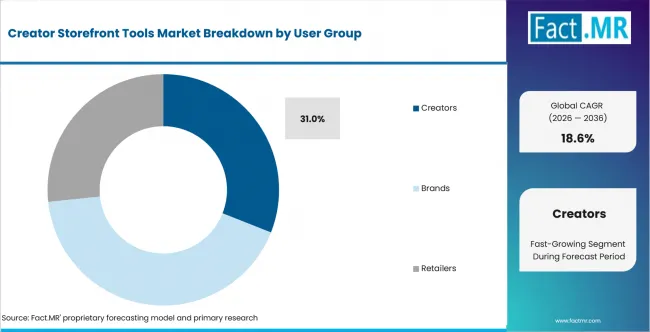
Creator Storefront Tools Market Analysis By User Group | Source: Fact.MR
Creators are projected to capture 31.0% share in 2026 because they remain the primary users of storefront platforms. Brands continue adopting creator commerce to improve customer engagement. Retailers strengthen digital selling through creator partnerships. Marketplaces expand storefront capabilities to improve merchant performance. Passes announced a $40 million Series A funding round led by Bond Capital to accelerate its creator monetization platform and expand new revenue-generating tools for creators. The investment will support growth across engineering, creator support, marketing, and sales while advancing Passes’ mission of helping creators build sustainable businesses through direct fan engagement. [2]
Which functional module dominates?
Checkout holds 27.0% share in 2026.
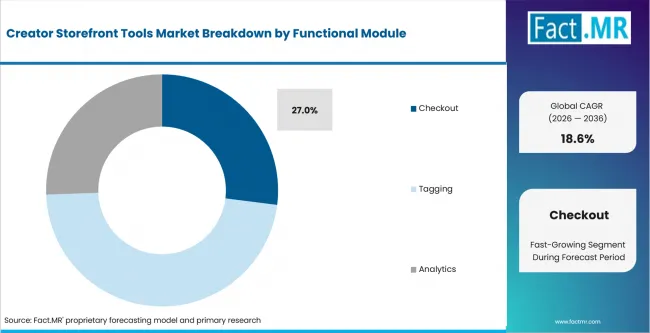
Creator Storefront Tools Market Analysis By Functional Module | Source: Fact.MR
Checkout leads because seamless purchasing is essential for creator commerce. The segment is expected to account for 27.0% share in 2026 as businesses prioritize friction free buying experiences. Tagging improves product discovery. Analytics help measure sales performance. Couponing supports promotional campaigns. Demo hosting improves product education. Affiliate attribution strengthens creator revenue tracking. Linktree, the leading link-in-bio platform, announced it surpassed 50 million users (up from 41 million in December 2023). The company launched the beta of its social commerce program, allowing creators to add storefronts to their link-in-bio pages and earn 12% to 15% commission on sales. [3]
Which deployment dominates?
Shopify apps dominate deployment with 38.0% share.
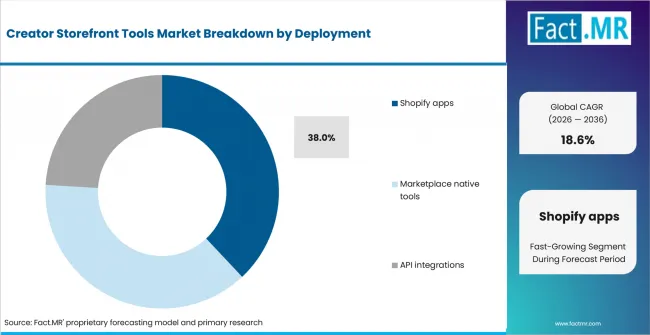
Creator Storefront Tools Market Analysis By Deployment | Source: Fact.MR
Shopify apps are expected to hold 38.0% share in 2026 because merchants increasingly prefer ready to deploy commerce solutions. These applications simplify storefront management without extensive development work. Marketplace native tools strengthen seller adoption. API integrations support enterprise customization. YouTube announced new Shopping features including the addition of Fourthwall, a website builder that helps creators build shops, to its list of integrated platforms. By allowing users to connect their Fourthwall shop, YouTube made it easier for creators to create and manage their content directly in YouTube Studio. [4]
Which revenue model dominates?
SaaS subscription leads market revenue with 43.0% share.
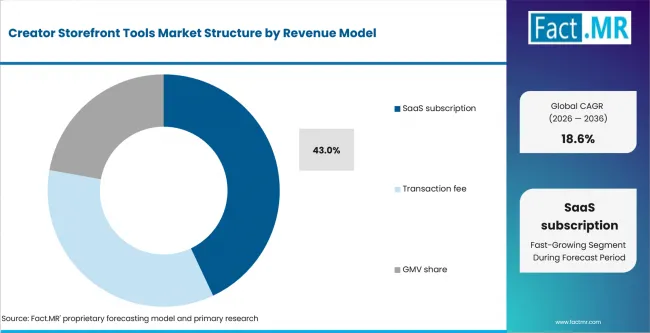
Creator Storefront Tools Market Analysis By Revenue Model | Source: Fact.MR
SaaS subscription is expected to account for 43.0% share in 2026 because recurring software revenue supports continuous platform development and customer support. Transaction fees remain common across creator commerce platforms. GMV share aligns platform earnings with merchant performance. Enterprise licenses support large organizations. Creator tool bundles strengthen adoption among independent creators.
What is accelerating creator storefront tools market adoption, and what is holding it back?
Creator commerce expansion drives growth, while platform integration challenges and strong competition restrain adoption.
Drivers Impact Analysis
| DRIVER | (~) % IMPACT ON CAGR | GEOGRAPHIC RELEVANCE | IMPACT TIMELINE |
|---|---|---|---|
| Expansion of creator commerce | +1.1% | Global | Medium term (2-4 years) |
| Rising demand for direct to consumer selling | +0.9% | North America, Europe, Asia Pacific | Medium term (2-4 years) |
| Growth of social commerce platforms | +0.8% | Global | Short term (≤2 years) |
| Increasing adoption of AI powered commerce tools | +0.7% | North America, China | Medium term (2-4 years) |
| Expansion of enterprise commerce software | +0.5% | Global | Long term (≥4 years) |
Source: Fact.MR analysis. Updated Jul 2, 2026
- Creator commerce expansion
- Creators increasingly sell products through dedicated storefronts instead of relying only on marketplace listings. This trend supports platform demand.
- Direct to consumer selling
- Businesses increasingly partner with creators to strengthen direct customer relationships. Creator storefronts improve product visibility and sales conversion.
- Social commerce growth
- Social media platforms continue integrating shopping features into creator content. Interactive storefronts strengthen digital commerce adoption.
- AI powered commerce tools
- Platform providers continue introducing AI features that improve product recommendations and storefront management. Automation strengthens platform efficiency.
- Enterprise software expansion
- Large businesses continue investing in creator commerce platforms that improve digital sales performance. Enterprise demand supports long term software growth.
Opportunity Impact Analysis
| OPPORTUNITY | (~) % IMPACT ON CAGR | GEOGRAPHIC RELEVANCE | IMPACT TIMELINE |
|---|---|---|---|
| AI driven storefront personalization | +0.8% | North America, Europe | Medium term (2-4 years) |
| Cross platform commerce integration | +0.7% | Global | Medium term (2-4 years) |
| Enterprise creator commerce expansion | +0.6% | United States, Germany, Japan | Long term (≥4 years) |
| Growth of creator monetization tools | +0.5% | Global | Short term (≤2 years) |
Source: Fact.MR analysis. Updated Jul 2, 2026
- AI driven personalization
- Platforms can personalize storefront experiences based on customer preferences. Better personalization improves engagement and purchase conversion.
- Cross platform integration
- Businesses increasingly seek storefront solutions that connect multiple commerce platforms. Unified management improves operational efficiency.
- Enterprise expansion
- Large organizations continue investing in creator commerce strategies. Enterprise demand creates opportunities for premium software providers.
- Creator monetization
- Creators increasingly seek tools that simplify product sales and affiliate revenue. Platform providers continue expanding creator focused capabilities.
Restraints Impact Analysis
| RESTRAINT | (~) % IMPACT ON CAGR | GEOGRAPHIC RELEVANCE | IMPACT TIMELINE |
|---|---|---|---|
| Platform integration complexity | -0.7% | Global | Medium term (2-4 years) |
| Strong software competition | -0.5% | North America, Asia Pacific | Short term (≤2 years) |
| Enterprise implementation costs | -0.4% | Emerging markets | Medium term (2-4 years) |
| Data privacy and compliance requirements | -0.3% | Europe, North America | Long term (≥4 years) |
Source: Fact.MR analysis. Updated Jul 2, 2026
- Platform integration complexity
- Businesses often connect storefront tools with ecommerce systems and payment platforms. This can increase deployment time.
- Software competition
- Many providers compete across creator commerce software. Strong competition increases customer acquisition costs.
- Implementation costs
- Enterprise deployments often require additional customization and technical support. Smaller businesses may postpone investment.
- Data privacy requirements
- Commerce platforms must comply with evolving privacy regulations. Compliance requirements increase software development and operating costs.
Which countries are scaling creator storefront tools fastest?
United States 19.3%; Germany 18.9%; Japan 18.5%; China 18.1%; India 17.8%.
Based on regional analysis, the creator storefront tools market is segmented into North America, Europe, East Asia, South Asia, Latin America and Middle East and Africa.
| Country | CAGR |
|---|---|
| United States | 19.3% |
| Germany | 18.9% |
| Japan | 18.5% |
| China | 18.1% |
| India | 17.8% |
Source: Fact.MR analysis. Updated Jul 2, 2026
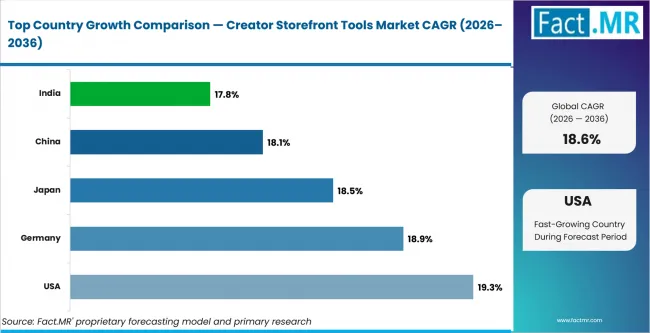
Creator Storefront Tools Market Cagr Analysis By Country | Source: Fact.MR
What is powering the United States lead?
19.3% CAGR, driven by creator economy growth and digital commerce innovation.
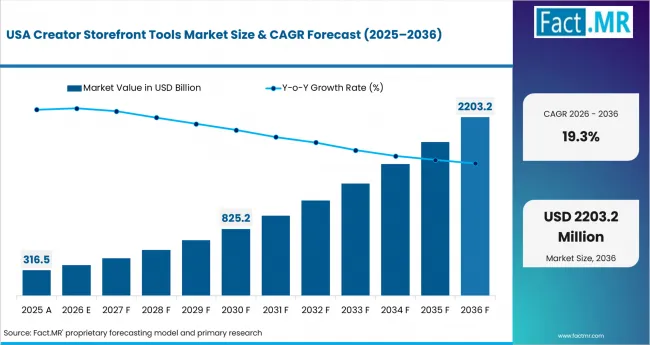
Creator Storefront Tools Market Country Value Analysis | Source: Fact.MR
The United States is projected to record 19.3% CAGR from 2026 to 2036 as creators increasingly build independent online businesses through digital storefront platforms. Brands continue investing in creator partnerships to improve customer engagement and product discovery. AI powered commerce tools simplify storefront management. Companies offering seamless checkout and analytics are expected to strengthen their market position.
How is Germany scaling creator storefront tool demand?
18.9% CAGR, supported by enterprise commerce software and digital retail expansion.
Germany is expected to post 18.9% CAGR as retailers increasingly adopt creator commerce platforms. Enterprise businesses continue investing in storefront software that improves customer engagement and online sales. Demand will favor providers offering flexible integrations and strong analytics capabilities.
What supports Japan's outlook?
18.5% CAGR, driven by social commerce adoption and digital innovation.
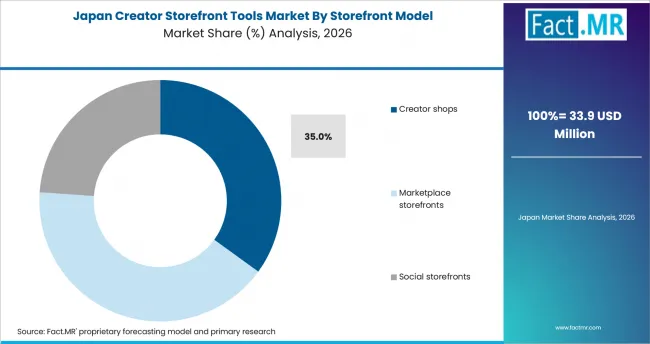
Creator Storefront Tools Market Japan Market Share Analysis By Storefront Model | Source: Fact.MR
Japan is likely to record 18.5% CAGR by 2036 as businesses continue expanding creator led shopping experiences. Retailers increasingly integrate storefront platforms with digital commerce channels. Platform providers continue introducing features that improve customer engagement and creator monetization.
What underpins China's growth?
18.1% CAGR, supported by livestream commerce and creator driven retail.
China is forecast to advance at 18.1% CAGR through 2036 as livestream shopping continues expanding across digital platforms. Retailers increasingly combine creator storefronts with interactive shopping experiences. Local software providers continue introducing advanced commerce solutions for businesses.
How is India scaling creator storefront tool adoption?
17.8% CAGR, driven by creator economy expansion and digital retail growth.
India is set to record 17.8% CAGR by 2036 as creator led commerce continues expanding across digital platforms. Growing online retail adoption supports demand for storefront management software. Companies offering affordable cloud-based solutions are expected to strengthen market growth.
Who leads the creator storefront tools market?
Shopify Collabs and Bambuser lead through creator commerce platforms and digital storefront innovation.
Creator Storefront Tools Market Analysis By Company | Source: Fact.MR
The creator storefront tools market includes commerce software providers and digital storefront technology companies. Shopify Collabs and Bambuser maintain strong market positions through integrated enterprise partnerships and continuous software innovation. Their solutions help creators and brands manage products and customer engagement through one platform.
Firework and LTK strengthen competition through commerce automation and creator focused selling tools. Beacons& Shopping continue driving adoption through creator commerce and social shopping experiences.
Competition through 2036 will depend on AI innovation, platform integration and commerce analytics. Companies continue investing in storefront automation, creator monetization tools and personalized shopping features to improve platform performance.
Which companies are the key providers?
Shopify Collabs,LTK,ShopMy, Stan Store,and Beacons.
- Shopify Collabs
- LTK
- ShopMy
- Beacons
- Stan Store
Bibliography
- ShopMy. (2024). ShopMy secures $18.5 million in funding milestone.
- Passes. (2024, February 28). Passes announces $40m Series A.
- Linktree. (2024, May 24). Celebrating 50 million Linkers on Linktree!
- YouTube. (2024, April 9). Step into spring with new YouTube Shopping features.
- Linktree. (2024). Linktree’s Creator Commerce Report 2024.
This Report Addresses
- Strategic intelligence on creator storefront tools across digital commerce platforms and creator monetization technologies.
- Segment analysis covering Creator Shops and Checkout.
- Regional outlook covering the United States, Germany, Japan, China and India.
- Competitive analysis of Shopify Collabs, LTK, Bambuser, Firework, ShopMy, Beacons.
- Technology assessment covering storefront creation, checkout, analytics, affiliate attribution and commerce automation.
- Use case assessment covering creator commerce, product discovery, digital selling, affiliate marketing, customer engagement and revenue optimization.
- Primary interviews, enterprise software assessments and company portfolio reviews support the market forecast.
What does the creator storefront tools market cover?
Software platforms that help creators build and manage digital storefronts.
The creator storefront tools market covers software platforms that support creator shops, affiliate storefronts, marketplace storefronts, brand hosted storefronts and social storefronts. These platforms enable creators and businesses to manage products, payments and customer engagement.
The market differs from broad ecommerce software because the scope is limited to creator focused storefront solutions that combine commerce with social content and audience engagement.
What is included in the scope?
Creator commerce platforms developed for storefront management and digital selling.
The scope includes Shopify applications, marketplace native tools, API integrations and white label SaaS platforms. It includes storefront creation, checkout, analytics, coupon management, affiliate attribution and product demonstration capabilities.
The scope includes solutions deployed by creators, brands, retailers, marketplaces, agencies and social commerce teams across digital commerce platforms.
What is excluded from the scope?
General ecommerce software without creator storefront functionality is outside the scope.
The scope excludes conventional ecommerce platforms that do not provide creator storefront features. It also excludes social media management software and digital marketing platforms without integrated commerce capabilities.
How was the analysis built?
100+ sources, 45+ company portfolios, 30+ countries, 25+ interviews.
- Primary Research:
- Primary research includes interviews with commerce platform providers, online retailers, creators, digital agencies and software developers. It includes input from enterprise customers, marketplace operators and commerce technology specialists.
- Desk Research:
- Desk research reviews company product portfolios, commerce software publications, platform launches and creator economy trends. It covers storefront technologies, digital retail innovation and software adoption.
- Market Sizing and Forecasting:
- Forecasting uses software adoption, creator economy growth, digital commerce expansion and enterprise technology investment across major markets.
- Data Validation and Update Cycle:
- Forecasts are validated through executive interviews, platform reviews and enterprise adoption assessments. Product launches and software deployment trends help confirm long term market direction.
Segmentation
What is the report's scope and coverage?
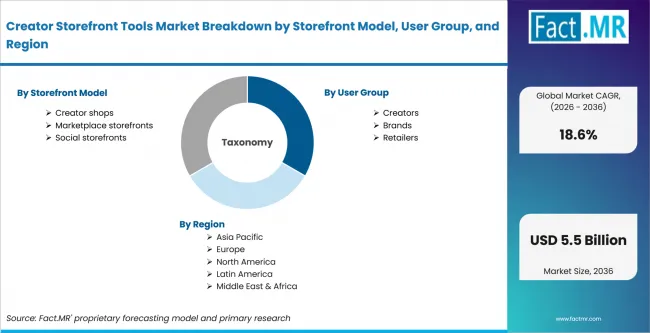
Creator Storefront Tools Market Breakdown By Storefront Model, User Group, And Region | Source: Fact.MR
| Attribute | Details |
|---|---|
| Quantitative Units | USD Billion in 2026 to USD Billion by 2036 at CAGR |
| Market Definition | Software platforms that help creators build, manage and monetize digital storefronts |
| Storefront Model | Creator shops; brand-hosted storefronts; marketplace storefronts; affiliate storefronts; social storefronts |
| User Group | Creators; brands; retailers; marketplaces; agencies; social commerce teams |
| Functional Module | Checkout; tagging; analytics; couponing; demo hosting; affiliate attribution |
| Deployment | Shopify apps; marketplace native tools; API integrations; white-label SaaS |
| Revenue Model | SaaS subscription; transaction fee; GMV share; enterprise license; creator tool bundles |
| Regions Covered | North America; Europe; East Asia; South Asia; Latin America; Middle East and Africa |
| Countries Covered | United States; Germany; Japan; China; India |
| Key Companies Profiled | Shopify Collabs; LTK; ShopMy; Beacons |
| Forecast Period | 2026 to 2036 |
| Approach | Hybrid top-down and bottom-up approach using software adoption, creator economy growth, enterprise spending and expert validation |
Source: Fact.MR analysis. Updated Jul 2, 2026
How is the market segmented?
-
By Storefront Model:
- Creator shops
- Brand-hosted storefronts
- Marketplace storefronts
- Affiliate storefronts
- Social storefronts
-
By User Group:
- Creators
- Brands
- Retailers
- Marketplaces
- Agencies
- Social commerce teams
-
By Functional Module:
- Checkout
- Tagging
- Analytics
- Couponing
- Demo hosting
- Affiliate attribution
-
By Deployment:
- Shopify apps
- Marketplace native tools
- API integrations
- White-label SaaS
-
By Revenue Model:
- SaaS subscription
- Transaction fee
- GMV share
- Enterprise license
- Creator tool bundles
-
Region:
- North America
- United States
- Canada
- Europe
- Germany
- United Kingdom
- France
- Italy
- Spain
- Asia Pacific
- China
- Japan
- South Korea
- India
- Singapore
- Latin America
- Brazil
- Mexico
- Argentina
- Middle East & Africa
- GCC Countries
- South Africa
- Israel
- North America
Frequently Asked Questions
Which storefront model leads the Creator Storefront Tools Market?
Which user group leads the Creator Storefront Tools Market?
Which functional module leads the Creator Storefront Tools Market?
Which deployment leads the Creator Storefront Tools Market?
Which region leads the Creator Storefront Tools Market?
Which country expands fastest in the Creator Storefront Tools Market?
How does Germany perform in the Creator Storefront Tools Market?
Who worked on this report


Preview the report firsthand - request a free sample
Free SampleGet the brochure for pricing and purchase details
Download PDF