- Base Value(2025): 1.4 Bn
- Estimated Value(2026): 1.5 Bn
- Forecast Value (2036): 2.6 Bn
- CAGR (2026 - 2036): 5.5%
Critical Care Diagnostics Analysis and Forecast by Fact.MR
- The Critical Care Diagnostics Market is expected to grow from USD 1.5 billion in 2026 to USD 2.6 billion by 2036, at a 5.5% CAGR.
- driven by migration of critical testing to rapid point-of-care platforms, rising cardiac, sepsis, and respiratory caseloads in intensive care, and integration of AI-enabled decision support with diagnostic workflows, with Point of Care Diagnostic Systems accounting 46.8% share and Intensive Care Unit Diagnostics contributing 71.2% share as providers prioritize earlier detection, treatment-selection accuracy, and resource efficiency across clinical settings.
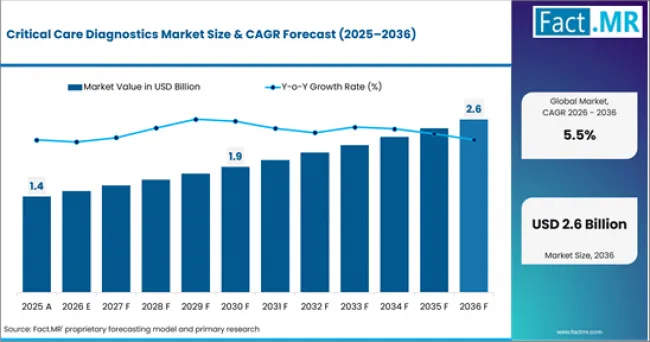
Critical Care Diagnostics Market Value Analysis | Source: Fact.MR
Summary of Critical Care Diagnostics Market
- Market Snapshot
- In 2025, the global Critical Care Diagnostics Market was valued at approximately USD 1.4 billion.
- The market is estimated to reach USD 1.5 billion in 2026 and is projected to attain USD 2.6 billion by 2036.
- The market is likely to expand at a CAGR of 5.5% during the forecast period.
- The market is anticipated to create an absolute dollar opportunity of USD 1.1 billion between 2026 and 2036.
- Point of Care Diagnostic Systems accounts for 46.8% of product share in 2026.
- China (7.4%) and India (6.9%) are the key growth markets during the forecast period.
- Demand and Growth Drivers
- Point-of-care expansion is moving cardiac, coagulation, and infectious-disease testing to the bedside, with new molecular assays cleared for rapid on-site results shortening time to clinical decision in critical settings.
- Rising sepsis, cardiac, and respiratory caseloads in intensive care and emergency departments are increasing demand for rapid multiparameter and biomarker testing.
- AI-enabled decision-support integration with diagnostic workflows is raising the value of connected instrument-integrated systems in critical care.
- Rapid point-of-care molecular assays for respiratory and bloodstream infections expand bedside testing into new indications.
- AI-enabled decision-support software paired with diagnostics creates differentiated, higher-margin connected offerings.
- Product and Segment View
- Point of Care Diagnostic Systems accounts for 46.8% of the product segment in 2026, emerging as the leading category.
- Intensive Care Unit Diagnostics accounts for 71.2% of the application segment in 2026, making it the dominant use setting.
- Key segmentation includes:
- Product: Point of Care Diagnostic Systems, Cardiac Biomarker Testing Systems, Coagulation Testing Systems, Multiparameter Patient Monitors
- Application: Intensive Care Unit Diagnostics, Emergency Department Diagnostics, Surgical Critical Care Diagnostics, Infectious Disease Critical Testing
- End Use: Hospitals, Ambulatory Critical Care Centers, Diagnostic Laboratories, Academic & Research Institutes
- Technology: Immunoassay Based Diagnostics, Molecular Diagnostic Technology, Biosensor Technology, Digital Diagnostic Technology
- Formulation: Rapid Diagnostic Kits, Reagent Based Diagnostic Systems, Instrument Integrated Systems, Digital Diagnostic Platforms
- Distribution Channel: Direct Institutional Sales, Diagnostic Equipment Distributors, Online Healthcare Platforms, Specialty Service Providers
- These systems enable:
- Rapid bedside critical testing
- Cardiac and coagulation biomarker measurement
- Connected decision-support integration
- Geography and Competitive Outlook
- North America demand is supported by high critical-care capacity, established point-of-care adoption, and reimbursement that funds rapid bedside testing.
- Europe demand reflects structured hospital procurement and IVDR compliance shaping platform qualification across critical-care units.
- Asia Pacific posts the fastest expansion as hospital build-out and rising intensive-care caseloads in China and India deepen demand for bedside critical testing.
- China (7.4%) and India (6.9%) lead country growth, with other major markets showing steady demand.
- Key companies include Abbott Laboratories, F. Hoffmann-La Roche Ltd, Siemens Healthineers AG, Danaher Corporation, Becton, Dickinson and Company, bioMerieux SA.
- Analyst Opinion
- Shambhu Nath Jha, Principal Consultant at Fact.MR, says "Critical-care testing is migrating to the bedside, and that migration favors suppliers with connected platforms rather than the broadest catalog alone. New rapid molecular point-of-care assays, some returning results in about 15 minutes, change clinical management in intensive care and emergency settings. Multiyear reagent agreements lock in revenue and slow switching, so installed base matters more than list price. China and India are expanding fastest as hospital and ICU capacity grows. The advantage goes to firms that combine rapid results with decision-support integration and dependable service, since hospitals are standardizing on data-connected systems, not standalone analyzers."
Key Growth Drivers, Constraints, and Opportunities
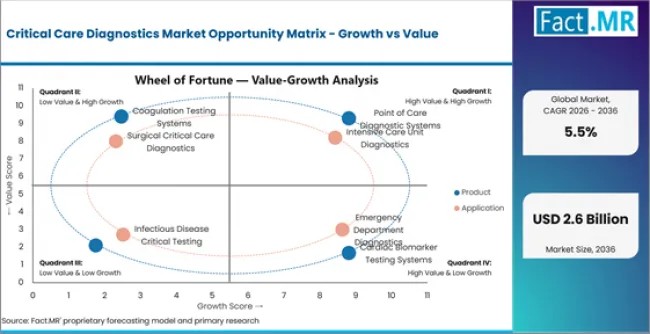
Critical Care Diagnostics Market Opportunity Matrix Growth Vs Value | Source: Fact.MR
Key Factors Driving Growth
- Point-of-care expansion is moving cardiac, coagulation, and infectious-disease testing to the bedside, with new molecular assays cleared for rapid on-site results shortening time to clinical decision in critical settings.
- Rising sepsis, cardiac, and respiratory caseloads in intensive care and emergency departments are increasing demand for rapid multiparameter and biomarker testing.
- AI-enabled decision-support integration with diagnostic workflows is raising the value of connected instrument-integrated systems in critical care.
Key Market Constraints
- Cold-chain and infrastructure limitations constrain molecular cartridge deployment in lower-resource and remote settings.
- Reagent-rental and multiyear contract structures lock hospitals into platforms, slowing competitive switching and new-entrant penetration.
- Laboratory staffing gaps in some regions limit the throughput and adoption pace of more complex critical-care assays.
Key Opportunity Areas
- Rapid point-of-care molecular assays for respiratory and bloodstream infections expand bedside testing into new indications.
- AI-enabled decision-support software paired with diagnostics creates differentiated, higher-margin connected offerings.
- Emerging-market hospital build-out and donor-funded programs open demand for portable rapid diagnostic kits.
Segment-wise Analysis of the Critical Care Diagnostics
- Point of Care Diagnostic Systems holds 46.8% of the product segment in 2026, supported by clinical preference and procurement scale.
- Intensive Care Unit Diagnostics represents 71.2% of the application segment in 2026, anchored by its dominant care setting.
The Critical Care Diagnostics Market is segmented by product, application, end use, technology, formulation, distribution channel. Demand is shaped by clinical pathway choices, reimbursement exposure, and procurement structure, with leading segments anchored in higher-volume care settings while faster-growing categories capture incremental demand as adoption broadens.
Which Product Segment Dominates the Critical Care Diagnostics?
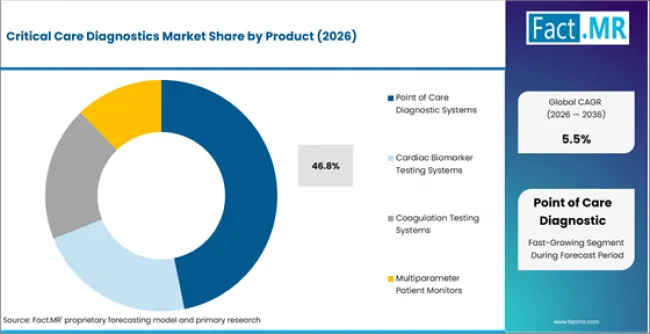
Critical Care Diagnostics Market Analysis By Product | Source: Fact.MR
Point of Care Diagnostic Systems lead the product segment with 46.8% share in 2026, as critical testing migrates from central laboratories to the bedside. Rapid molecular and immunoassay platforms deliver results fast enough to change management in intensive-care and emergency settings.
The segment is expected to retain leadership as new rapid assays extend bedside menus and connectivity links results to decision support. Cardiac biomarker and coagulation systems remain essential within critical workflows, but point-of-care platforms capture the fastest incremental demand.
Which Application Segment Dominates the Critical Care Diagnostics?
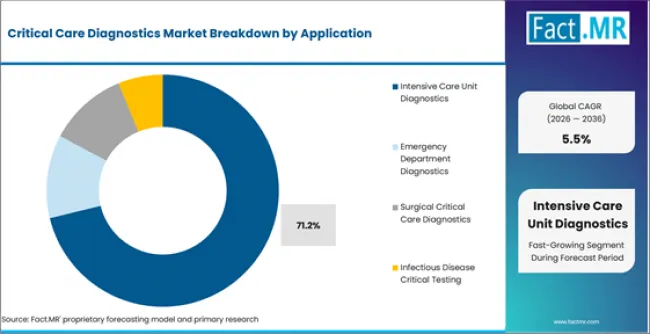
Critical Care Diagnostics Market Analysis By Application | Source: Fact.MR
Intensive Care Unit Diagnostics dominate at 71.2% in 2026, given the concentration of acute cardiac, sepsis, and respiratory testing in critical-care units where rapid results directly affect outcomes. ICU caseloads anchor recurring reagent demand.
The application is likely to hold its share as critical-care capacity expands and testing intensity per bed rises. Emergency-department and surgical critical-care diagnostics grow alongside, but the ICU remains the densest and most reagent-intensive testing environment.
Which Product Trend is Shaping the Next Phase of Growth in the Critical Care Diagnostics?
Point of Care Diagnostic Systems lead the product segment at 46.8%, and the defining shift is migration of critical testing from central laboratories to the bedside. New molecular point-of-care assays, including rapid systems delivering results in roughly 15 minutes, are extending immunoassay and biosensor testing into intensive-care and emergency settings where speed changes clinical management.
Connectivity is reshaping the segment alongside speed. AI-enabled decision-support integrated with diagnostic workflows raises the value of instrument-integrated systems, while multiyear reagent agreements secure recurring revenue. Demand is concentrated in hospitals and ambulatory critical-care centers standardizing on connected platforms that combine rapid results with data integration.
Regional Outlook Across Key Markets
- North America demand is supported by high critical-care capacity, established point-of-care adoption, and reimbursement that funds rapid bedside testing.
- Europe demand reflects structured hospital procurement and IVDR compliance shaping platform qualification across critical-care units.
- Asia Pacific posts the fastest expansion as hospital build-out and rising intensive-care caseloads in China and India deepen demand for bedside critical testing.
- Japan shows steady demand anchored in advanced hospital infrastructure and preference for validated diagnostic platforms.
.webp "Top Country Growth Comparison Critical Care Diagnostics Market Cagr (2026 2036)")
Top Country Growth Comparison Critical Care Diagnostics Market Cagr (2026 2036) | Source: Fact.MR
CAGR Table
| Country | CAGR (%) |
|---|---|
| China | 7.4% |
| India | 6.9% |
| Germany | 6.3% |
| Brazil | 5.8% |
| U.S. | 5.2% |
| UK | 4.7% |
| Japan | 4.1% |
Source: Fact.MR analysis. Updated Jun 12, 2026
Source: Fact.MR analysis, based on proprietary forecasting model and primary research.
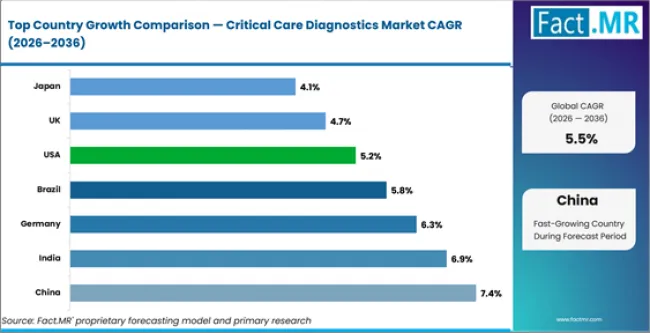
Critical Care Diagnostics Market Cagr Analysis By Country | Source: Fact.MR
Market Outlook for Critical Care Diagnostics in China
The China Critical Care Diagnostics market is projected to grow at a CAGR of 7.4% through 2036. Hospital expansion and intensive-care capacity build-out across provincial centers are widening demand for point-of-care diagnostic systems and cardiac biomarker testing. Domestic manufacturers hold cost advantages in immunoassay-based diagnostics, while centralized procurement steers hospital purchasing toward competitively priced rapid diagnostic kits.
- ICU capacity build-out is lifting demand for point-of-care and cardiac biomarker testing systems.
- Centralized procurement is steering rapid diagnostic kit purchasing toward cost-competitive domestic suppliers.
India Critical Care Diagnostics Demand Trends
The India Critical Care Diagnostics market is projected to grow at a CAGR of 6.9% through 2036. Demand is concentrated in metropolitan tertiary hospitals and expanding private critical-care networks where rising cardiac and sepsis caseloads drive point-of-care testing. Cost-effectiveness favors rapid diagnostic kits and reagent-based systems, while medical device import dependency shapes pricing on molecular diagnostic platforms.
- Private critical-care network expansion is widening adoption of point-of-care diagnostic systems.
- Cost-effectiveness favors rapid diagnostic kits over instrument-heavy molecular platforms in emerging centers.
Critical Care Diagnostics Growth Assessment in Germany
The Germany Critical Care Diagnostics market is projected to grow at a CAGR of 6.3% through 2036. EU IVDR compliance governs how critical-care diagnostic platforms qualify and are validated across German hospitals, raising documentation requirements. The GKV reimbursement framework and lifecycle-cost priorities favor instrument-integrated systems with strong service networks and validated immunoassay and molecular assays.
- EU IVDR validation requirements concentrate procurement among fully documented diagnostic platforms.
- GKV reimbursement and lifecycle-cost priorities favor instrument-integrated systems with certified service.
United States Critical Care Diagnostics Market Opportunity Outlook
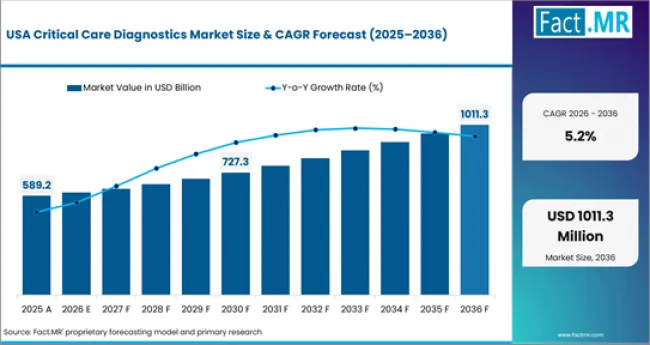
Critical Care Diagnostics Market Country Value Analysis | Source: Fact.MR
The United States Critical Care Diagnostics market is projected to grow at a CAGR of 5.2% through 2036. The critical-care diagnostics installed base is mature, so growth is led by point-of-care expansion and platform upgrade rather than first-time build-out. FDA clearances for rapid molecular assays and the reimbursement landscape shape adoption, while hospital-system consolidation centralizes procurement into multiyear reagent agreements with leading suppliers.
- FDA-cleared rapid molecular point-of-care assays are extending bedside testing into new critical indications.
- Hospital-system consolidation centralizes procurement into multiyear reagent-rental agreements.
Critical Care Diagnostics Demand Analysis in Japan
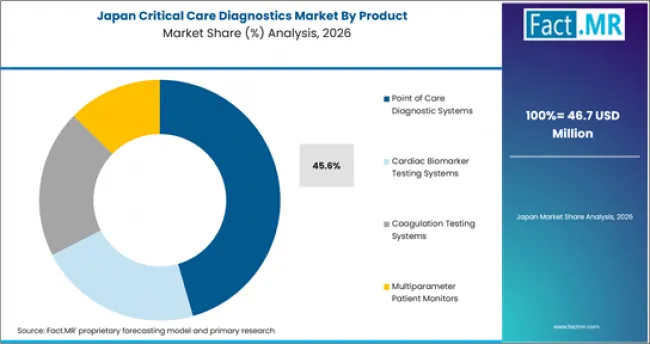
Critical Care Diagnostics Market Japan Market Share Analysis By Product | Source: Fact.MR
The Japan Critical Care Diagnostics market is projected to grow at a CAGR of 4.1% through 2036. Domestic diagnostic manufacturing strength and preference for validated platforms shape critical-care procurement, supporting demand for immunoassay-based and molecular diagnostic systems. PMDA approval pathways and an aging population with high cardiac and critical-care caseloads sustain demand across hospitals and academic centers.
- Preference for validated domestic platforms supports demand for immunoassay-based diagnostic systems.
- Aging-population cardiac caseloads sustain demand for cardiac biomarker testing systems in hospitals.
Competitive Benchmarking and Company Positioning
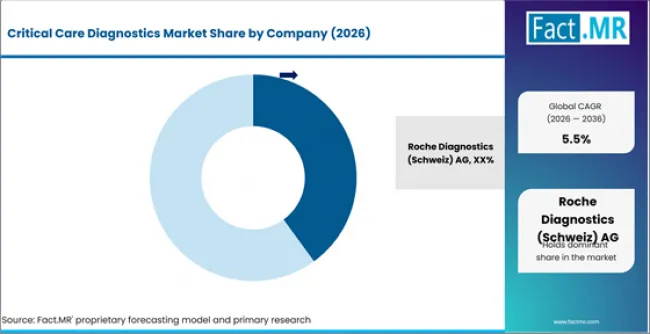
Critical Care Diagnostics Market Analysis By Company | Source: Fact.MR
Critical Care Diagnostics Analysis By Company
- Abbott, Roche, Siemens Healthineers, and Danaher hold leading positions across point-of-care and central critical-care platforms, supported by broad analyzer suites and multiyear reagent agreements that secure recurring revenue.
- Becton Dickinson, bioMerieux, Werfen, and Nova Biomedical compete through cardiac, coagulation, and infectious-disease testing, where rapid results and assay menu breadth shape hospital preference.
- Connectivity and decision-support integration increasingly differentiate competitors as hospitals standardize on platforms combining rapid testing with data integration.
The competitive landscape is moderately concentrated, with leading suppliers controlling a majority of revenue through broad analyzer suites bundled into multiyear reagent agreements. Abbott, Roche, Siemens Healthineers, and Danaher are best positioned to capture point-of-care expansion through portfolio breadth across chemistry, hematology, and molecular testing.
Below the leaders, Becton Dickinson, bioMerieux, Werfen, Nova Biomedical, QuidelOrtho, and Sysmex maintain strong positions in specific critical-care niches such as coagulation, blood gas, and microbiology. Competition turns on assay menu, turnaround time, and service reliability rather than full-line breadth alone.
Strategic activity centers on point-of-care portfolio expansion and connectivity. Recent regulatory clearances for rapid molecular bedside assays and partnerships infusing AI into diagnostic workflows raise the value of connected instrument-integrated systems. Suppliers that combine rapid testing with data integration and dependable service are positioned to deepen account retention.
Key Companies in the Critical Care Diagnostics
- Leading companies in the critical care diagnostics market include Abbott Laboratories, F. Hoffmann-La Roche Ltd, Siemens Healthineers AG, Danaher Corporation, which hold strong positions through portfolio breadth, clinical evidence, and broad distribution.
- Becton, Dickinson and Company, bioMerieux SA, Werfen, Nova Biomedical maintain established positions across specific segments and channels, competing on assay or product performance, service, and regional reach.
- QuidelOrtho Corporation, Sysmex Corporation and other specialists compete through focused offerings and niche strength, reinforcing relevance in a competitive but evolving market.
Recent Industry Developments
- F. Hoffmann-La Roche Ltd - FDA Clearance and CLIA Waiver for cobas Liat Bordetella Assay (December 2025)
- In December 2025, Roche received FDA 510(k) clearance and a CLIA waiver for its first molecular point-of-care assay to identify Bordetella infections, including whooping cough, on the cobas Liat system with results in roughly 15 minutes. The clearance expands rapid on-site molecular testing in US critical and acute settings.
- Baebies - FDA Breakthrough Designation for Point-of-Care Heparin Monitoring (April 2025)
- In April 2025, Baebies received FDA Breakthrough Device designation for a point-of-care heparin monitoring test delivering results in under 15 minutes. The designation supports faster anticoagulation management in critical-care and surgical settings.
Leading Companies Shaping the Critical Care Diagnostics
- Abbott Laboratories
- F. Hoffmann-La Roche Ltd
- Siemens Healthineers AG
- Danaher Corporation
- Becton, Dickinson and Company
- bioMerieux SA
- Werfen
- Nova Biomedical
- QuidelOrtho Corporation
- Sysmex Corporation
Sources and Research References
- F. Hoffmann-La Roche Ltd. (2025). FDA 510(k) clearance and CLIA waiver granted for the cobas Liat Bordetella assay for rapid point-of-care molecular testing. Roche.
- Baebies, Inc. (2025). FDA Breakthrough Device designation granted for point-of-care heparin monitoring test. Baebies, Inc.
This bibliography is provided for reader reference and is not exhaustive. The full report contains the complete reference list and detailed citations.
Key Questions This Report Addresses
- What is the current and future size of the Critical Care Diagnostics Market?
- How fast is the Critical Care Diagnostics Market expected to grow between 2026 and 2036?
- Which product segment is likely to lead the market by 2026?
- Which application segment is expected to account for the highest demand by 2026?
- What factors are driving demand in the critical care diagnostics market globally?
- Which countries are projected to show the fastest growth through 2036?
- What is driving market expansion in China and India?
- Who are the key companies active in the critical care diagnostics market?
- How is point-of-care molecular testing changing critical-care diagnostic pathways?
- What role do multiyear reagent agreements play in supplier competition?
- How does Fact.MR estimate and validate the critical care diagnostics market forecast?
Critical Care Diagnostics Market Definition
The critical care diagnostics market covers point-of-care systems, cardiac biomarker and coagulation testing platforms, and multiparameter patient monitors used in intensive care, emergency, and surgical critical-care settings. It spans immunoassay, molecular, and biosensor technologies delivered through rapid diagnostic kits, reagent-based systems, and instrument-integrated platforms across hospitals and ambulatory critical-care centers.
Critical Care Diagnostics Market Inclusions
- The scope covers global and regional market size and forecasts for 2026 to 2036 across product type, application, end use, technology, formulation, and distribution channel.
- It includes demand tied to intensive-care and emergency-department testing, cardiac and coagulation diagnostics, and rapid infectious-disease testing in critical settings.
- Pricing and procurement analysis spans instruments, reagents, and multiyear reagent-rental agreements common in critical-care testing.
- Coverage includes point-of-care platforms and AI-enabled decision-support software linked to critical diagnostics.
Critical Care Diagnostics Market Exclusions
- The scope excludes routine outpatient laboratory testing not specific to critical-care settings.
- It excludes general imaging systems and therapeutic critical-care devices such as ventilators and infusion pumps.
- Consumer self-testing products outside the critical-care definition are excluded.
- Laboratory information systems sold without diagnostic content are excluded.
Critical Care Diagnostics Market Research Methodology
- The methodology combines secondary research, primary interviews, and demand-side modeling.
- It draws on 120 plus secondary sources and benchmarks 55 plus diagnostic platform portfolios.
- Market sizing covers 30 plus countries through a critical-care bed and test-volume model with top-down validation.
- Key inputs include ICU and emergency-department capacity, cardiac and sepsis testing rates, and point-of-care adoption.
- The model cross-checks test demand with instrument placements, reagent pull-through, and hospital procurement patterns.
- Primary validation includes 20 plus interviews across intensivists, laboratory directors, hospital procurement, and distributors.
- Final estimates pass through cross-segment reconciliation and sensitivity testing.
Segmentation
Scope of Analysis
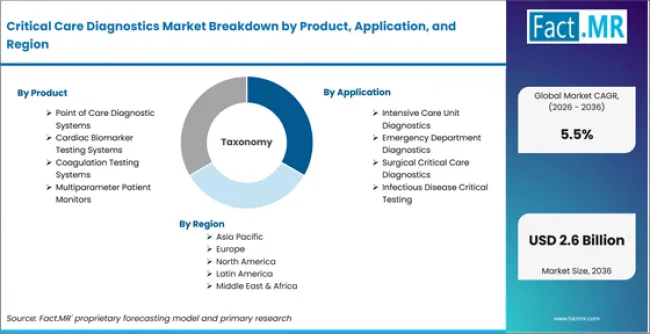
Critical Care Diagnostics Market Breakdown By Product, Application, And Region | Source: Fact.MR
| Parameter | Details |
|---|---|
| Quantitative Units | USD 1.5 billion to USD 2.6 billion, at a CAGR of 5.5% |
| Market Definition | The critical care diagnostics market covers point-of-care and laboratory diagnostic systems used in intensive-care, emergency, and surgical critical-care settings across immunoassay, molecular, and biosensor technologies. |
| Regions Covered | North America, Latin America, Europe, East Asia, South Asia and Pacific, Middle East and Africa |
| Countries Covered | China, India, Germany, Brazil, U.S., UK, Japan, 30 plus countries |
| Key Companies | Abbott Laboratories, F. Hoffmann-La Roche Ltd, Siemens Healthineers AG, Danaher Corporation, Becton, Dickinson and Company, bioMerieux SA, Werfen, Nova Biomedical, QuidelOrtho Corporation, Sysmex Corporation |
| Forecast Period | 2026 to 2036 |
| Approach | Hybrid demand-side and top-down methodology built on country-level demand, product and assay benchmarking, pricing analysis, shipment validation, and primary interviews across providers, laboratories, distributors, and end users |
Source: Fact.MR analysis. Updated Jun 12, 2026
Critical Care Diagnostics Segmentation
-
Critical Care Diagnostics Market Segmented by Product:
- Point of Care Diagnostic Systems
- Blood Gas Analyzers
- Portable Blood Gas Devices
- Bedside Blood Gas Monitors
- Electrolyte Analyzers
- Ion Selective Electrodes Systems
- Multi Parameter Electrolyte Platforms
- Blood Gas Analyzers
- Cardiac Biomarker Testing Systems
- Troponin Testing Systems
- High Sensitivity Troponin Assays
- Rapid Cardiac Marker Kits
- BNP/NT-proBNP Systems
- Heart Failure Diagnostic Kits
- Quantitative Cardiac Panels
- Troponin Testing Systems
- Coagulation Testing Systems
- PT/INR Monitoring Devices
- Portable Coagulation Analyzers
- Bedside Hemostasis Systems
- D-Dimer Testing Platforms
- Thrombosis Detection Kits
- Emergency Clot Analysis Systems
- PT/INR Monitoring Devices
- Multiparameter Patient Monitors
- Critical Care Monitoring Systems
- ICU Integrated Monitoring Platforms
- Real Time Vital Sign Systems
- Wireless Monitoring Devices
- Remote Patient Tracking Systems
- Cloud Connected ICU Monitors
- Critical Care Monitoring Systems
- Point of Care Diagnostic Systems
-
Critical Care Diagnostics Market Segmented by Application:
- Intensive Care Unit Diagnostics
- Adult ICU Monitoring
- Sepsis Detection Diagnostics
- Multi Organ Failure Monitoring
- Neonatal ICU Diagnostics
- Premature Infant Monitoring Systems
- Neonatal Infection Diagnostics
- Adult ICU Monitoring
- Emergency Department Diagnostics
- Trauma Care Diagnostics
- Rapid Injury Assessment Testing
- Internal Bleeding Detection Systems
- Cardiac Emergency Diagnostics
- Acute Myocardial Infarction Testing
- Arrhythmia Diagnostic Support Systems
- Trauma Care Diagnostics
- Surgical Critical Care Diagnostics
- Post Surgical Monitoring
- Post Operative Complication Detection
- Recovery Room Diagnostic Systems
- Anesthesia Monitoring Diagnostics
- Respiratory Function Monitoring
- Hemodynamic Stability Assessment
- Post Surgical Monitoring
- Infectious Disease Critical Testing
- Sepsis Management Diagnostics
- Blood Culture Rapid Testing
- Inflammatory Marker Monitoring
- Hospital Acquired Infection Testing
- ICU Pathogen Detection Systems
- Antibiotic Response Monitoring
- Sepsis Management Diagnostics
- Intensive Care Unit Diagnostics
-
Critical Care Diagnostics Market Segmented by End Use:
- Hospitals
- Public Healthcare Hospitals
- Government Tertiary Hospitals
- Regional Critical Care Centers
- Private Healthcare Hospitals
- Multi Specialty Critical Care Hospitals
- Corporate Hospital Networks
- Public Healthcare Hospitals
- Ambulatory Critical Care Centers
- Emergency Care Clinics
- Urgent Critical Care Units
- Walk In Emergency Centers
- Specialty Diagnostic Clinics
- Cardiac Diagnostic Centers
- Pulmonary Diagnostic Clinics
- Emergency Care Clinics
- Diagnostic Laboratories
- Centralized Diagnostic Labs
- High Throughput Testing Labs
- Reference Diagnostic Laboratories
- Point of Care Labs
- Hospital Embedded Labs
- Rapid Response Testing Units
- Centralized Diagnostic Labs
- Academic & Research Institutes
- Medical Universities
- Clinical Research Hospitals
- Critical Care Research Centers
- Diagnostic Innovation Labs
- Biomarker Development Labs
- Translational Medicine Centers
- Medical Universities
- Hospitals
-
Critical Care Diagnostics Market Segmented by Technology:
- Immunoassay Based Diagnostics
- Chemiluminescence Immunoassays
- High Sensitivity Antigen Detection
- Automated Immunoassay Platforms
- ELISA Based Systems
- Quantitative Protein Detection Systems
- Rapid Immunoassay Kits
- Chemiluminescence Immunoassays
- Molecular Diagnostic Technology
- PCR Based Diagnostics
- Real Time PCR Systems
- Multiplex Pathogen Detection Platforms
- Nucleic Acid Amplification Systems
- Isothermal Amplification Systems
- Gene Expression Analysis Platforms
- PCR Based Diagnostics
- Biosensor Technology
- Electrochemical Biosensors
- Portable Diagnostic Biosensors
- Wearable Biosensor Systems
- Optical Biosensors
- Fluorescence Based Detection Systems
- Lab on Chip Biosensor Platforms
- Electrochemical Biosensors
- Digital Diagnostic Technology
- AI Assisted Diagnostics
- Predictive Critical Care Analytics
- Machine Learning Diagnostic Engines
- Cloud Connected Systems
- Remote ICU Monitoring Platforms
- Real Time Data Integration Systems
- AI Assisted Diagnostics
- Immunoassay Based Diagnostics
-
Critical Care Diagnostics Market Segmented by Formulation:
- Rapid Diagnostic Kits
- Single Use Test Kits
- Disposable Cardiac Test Kits
- Emergency Biomarker Kits
- Multi Parameter Test Kits
- Combined Sepsis Detection Panels
- ICU Diagnostic Panels
- Single Use Test Kits
- Reagent Based Diagnostic Systems
- Liquid Reagent Systems
- Enzyme Based Reaction Kits
- Buffer Solution Diagnostic Kits
- Lyophilized Reagent Systems
- Freeze Dried Diagnostic Kits
- Stable Storage Reagent Kits
- Liquid Reagent Systems
- Instrument Integrated Systems
- Analyzer Integrated Formulations
- Automated Cartridge Based Systems
- Closed System Diagnostic Cartridges
- Modular Reagent Systems
- Replaceable Diagnostic Modules
- Scalable Testing Cartridge Systems
- Analyzer Integrated Formulations
- Digital Diagnostic Platforms
- Software Driven Diagnostics
- AI Algorithm Based Test Systems
- Cloud Analytics Diagnostic Kits
- Integrated Data Systems
- Hospital Network Diagnostic Platforms
- Real Time Reporting Systems
- Software Driven Diagnostics
- Rapid Diagnostic Kits
-
Critical Care Diagnostics Market Segmented by Distribution Channel:
- Direct Institutional Sales
- Hospital Procurement Contracts
- ICU Equipment Procurement Deals
- Government Hospital Supply Agreements
- Healthcare System Contracts
- Multi Hospital Network Deals
- Critical Care Supply Agreements
- Hospital Procurement Contracts
- Diagnostic Equipment Distributors
- National Medical Distributors
- High Value Diagnostic Equipment Suppliers
- Critical Care Device Distributors
- Regional Distributors
- Local Hospital Supply Networks
- Emergency Equipment Distributors
- National Medical Distributors
- Online Healthcare Platforms
- B2B Diagnostic Marketplaces
- Digital Procurement Portals
- Hospital Ordering Platforms
- Manufacturer Direct Channels
- OEM Diagnostic Sales Platforms
- Subscription Based Diagnostic Supply Systems
- B2B Diagnostic Marketplaces
- Specialty Service Providers
- Direct Institutional Sales
-
Critical Care Diagnostics Market by Region:
- North America
- USA
- Canada
- Mexico
- Latin America
- Brazil
- Chile
- Rest of Latin America
- Western Europe
- Germany
- UK
- Italy
- Spain
- France
- Nordic
- BENELUX
- Rest of Western Europe
- Eastern Europe
- Russia
- Poland
- Hungary
- Balkan & Baltic
- Rest of Eastern Europe
- East Asia
- China
- Japan
- South Korea
- South Asia and Pacific
- India
- ASEAN
- Australia & New Zealand
- Rest of South Asia and Pacific
- Middle East & Africa
- Kingdom of Saudi Arabia
- Other GCC Countries
- Turkiye
- South Africa
- Other African Union
- Rest of Middle East & Africa
- North America
Frequently Asked Questions
How big is the critical care diagnostics market in 2026?
What will be the size of the critical care diagnostics market in 2036?
How much will be the critical care diagnostics market growth between 2026 and 2036?
What are the key products in the critical care diagnostics market?
Which application segment is expected to contribute significant share in the critical care diagnostics market in 2026?
Who worked on this report


Preview the report firsthand - request a free sample
Free SampleGet the brochure for pricing and purchase details
Download PDF