- Market Value (2025): USD 2.0 Bn
- Estimated Value (2026): USD 2.1 Bn
- Forecast Value (2036): USD 3.6 Bn
- CAGR (2026-2036): 5.6%
What is the Scrim Reinforced Films Market forecast to be worth by 2036?
USD 2.1 billion in 2026 to USD 3.6 billion by 2036 at a 5.6% CAGR.
- The Scrim Reinforced Films Market reached approximately USD 2.0 billion in 2025.
- Demand is projected to increase from USD 2.1 billion in 2026 to USD 3.6 billion by 2036.
- The market is forecast to record a 5.6% CAGR from 2026 to 2036.
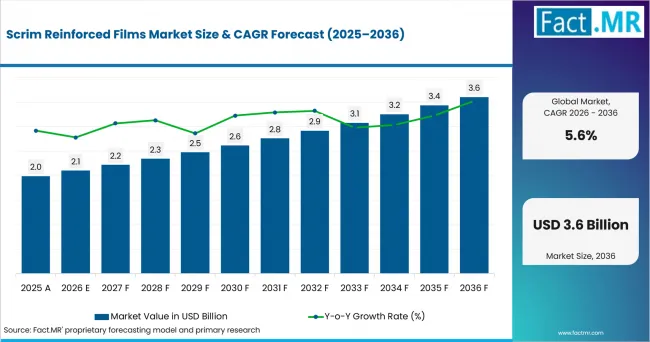
Scrim Reinforced Films Market Value Analysis | Source: Fact.MR
What are the defining numbers behind Scrim Reinforced Films Market growth?
An absolute opportunity of USD 1.5 billion is expected between 2026 and 2036.
- Demand Drivers in the Market
- Building-envelope work creates recurring demand for reinforced films where wall, roof and foundation assemblies need air or moisture control during construction. Germany's Building Energy Act requires the heat-transmitting envelope, including joints, to be permanently airtight. UK Approved Document C also addresses resistance to moisture in floors, walls and roofs. These requirements increase the value of films that can be installed and sealed without tearing around fasteners or transitions.
- Scrim reinforcement addresses a mechanical weakness of unsupported film by adding a load-carrying grid. Saint-Gobain states that polyester scrim in a reinforced transfer system provides dimensional stability during processing, while 3M uses a high-density scrim carrier to improve stability during lamination. The same design logic supports reinforced barrier films that must hold shape during installation and handling.
- Construction activity sustains a broad base of membrane and protective-film consumption. Germany reported a 7.5% real increase in building-construction orders during 2025. In the United States, the Census Bureau continues to track substantial construction put in place across residential and nonresidential work. Higher project throughput translates into more rolls used for weather protection, temporary covering and envelope detailing.
- Protected cultivation creates a separate demand route. USDA NRCS guidance identifies UV-protected polyethylene as the typical roof and sidewall covering for high tunnels and notes that greenhouse-grade material can remain serviceable for more than four years when secured correctly. Reinforced structures are relevant where users want greater resistance to puncture, wind loading and repeated handling.
- Transportation and industrial packaging users need flexible covers that can tolerate handling around irregular loads. Scrim helps limit local damage from spreading across a sheet, while thicker gauges add puncture margin. This supports reinforced pallet covers and cargo protection where buyers want flexible protection without moving to a rigid panel.
- Key Segments Analyzed
- Polyethylene Scrim Reinforced Films account for 41.8% of Product in 2026 because polyethylene combines flexible processing with weather and puncture performance across construction, agricultural and protective-film uses.
- Fiberglass Scrim accounts for 39.4% of Reinforcement Material in 2026 as an open or woven glass grid gives the film dimensional support and helps contain tear propagation around stress points.
- Construction And Building represents 46.7% of Application in 2026 because house wraps, roofing membranes, vapor barriers and insulation facings all require sheet materials that remain intact during installation.
- Construction accounts for 43.5% of End Use Industry in 2026 as reinforced films are purchased for both permanent envelope layers and temporary site protection.
- Multi Layer Reinforced Films represent 38.6% of Film Structure in 2026 because converters can separate reinforcement, barrier and surface functions across a laminated structure.
- Above 100 Microns accounts for 57.1% of Thickness in 2026 as heavier gauges provide added handling and puncture margin in building covers, cargo protection and other exposed uses.
- Analyst Opinion at Fact.MR
- Shambhu Nath Jha, Principal Consultant at Fact.MR, states, "Scrim reinforcement is purchased when a film has to remain usable after fastening or repeated handling. Construction is the central buying environment because a torn barrier can interrupt the wall or roof system before the final covering is installed. Buyers therefore compare polymer choice with scrim bond and gauge against the actual duty cycle. Suppliers that show how the reinforced structure performs at seams and around penetrations are better placed to win repeat specifications as the market moves from USD 2.1 billion in 2026 to USD 3.6 billion by 2036."
- Strategic Implications
- Film converters should document tear resistance after local damage, because buyers need to know whether a puncture remains contained or propagates across the sheet.
- Construction offers should separate permanent envelope uses from temporary protection. The required exposure period and fastening method differ, which changes polymer choice and gauge.
- Agricultural grades should be qualified for UV exposure and field handling. A covering that survives installation but loses integrity under repeated wind movement creates replacement cost for growers.
- Multilayer structures should assign each layer a defined job. The scrim can carry mechanical load while outer layers provide water resistance or surface compatibility.
- Suppliers serving logistics users should specify expected reuse and abrasion exposure before recommending thickness. Higher gauge is commercially useful when replacement avoidance offsets added material consumption.
How does the Scrim Reinforced Films Market break down by segment?
The market is segmented by Product, Reinforcement Material, Application, End Use Industry, Film Structure and Thickness.
Why do Polyethylene Scrim Reinforced Films lead Product?
Polyethylene Scrim Reinforced Films are projected to account for a 41.8% share in 2026.
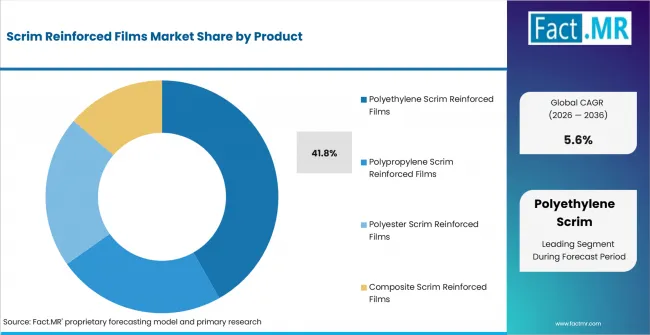
Scrim Reinforced Films Market Analysis By Product | Source: Fact.MR
Polyethylene leads because the resin family covers flexible grades suited to films that need moisture resistance and field toughness. HDPE can add stiffness, while LDPE and LLDPE support flexibility and sealing. Reinforcement lets converters use those film properties while reducing the chance that a local puncture becomes a long tear.
This buying logic also sits within the broader polyfilm market, where PE films serve packaging, agriculture and industrial uses. Dow's agricultural-film portfolio highlights puncture and tear resistance as core polyethylene performance requirements, reinforcing the fit between PE chemistry and demanding cover applications.
Why does Fiberglass Scrim lead Reinforcement Material?
Fiberglass Scrim is projected to account for a 39.4% share in 2026.
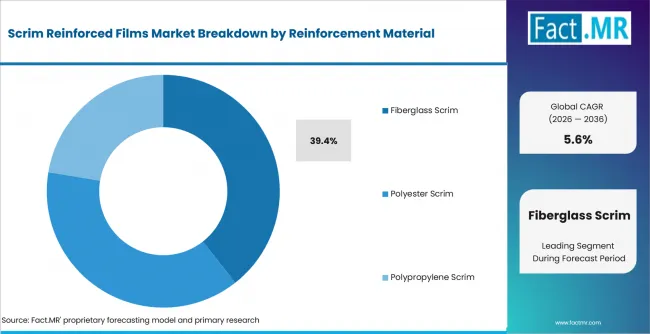
Scrim Reinforced Films Market Analysis By Reinforcement Material | Source: Fact.MR
Fiberglass scrim leads because an open or woven glass grid can stabilize a film without turning the product into a rigid sheet. The grid takes part of the tensile load when the laminate is pulled across a surface, while the film continues to provide the continuous barrier layer.
The benefit becomes visible around edges and fasteners. A local nick in unsupported film can lengthen under tension. A bonded scrim creates repeated load paths across the sheet and can keep damage more localized. Buyers in construction and industrial protection therefore evaluate scrim spacing together with film thickness and lamination quality.
Why does Construction And Building lead Application?
Construction And Building is projected to account for a 46.7% share in 2026.
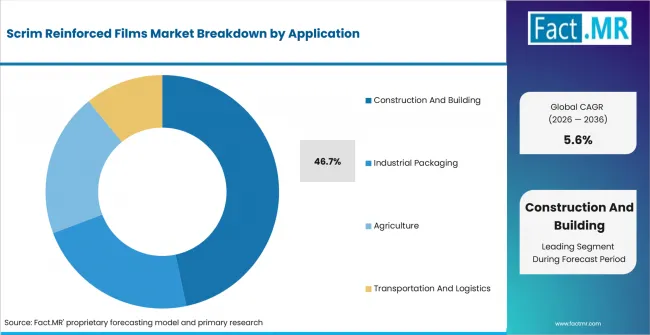
Scrim Reinforced Films Market Analysis By Application | Source: Fact.MR
Construction And Building leads because reinforced films can serve both as envelope components and as protection during the build sequence. House wraps and vapor barriers need continuity after fastening. Insulation facings need dimensional stability, while roof-related films can face wind uplift and foot traffic before the final assembly is closed.
The application overlaps with adjacent waterproofing membranes and roofing membranes where installation quality depends on maintaining barrier continuity. U.S. Department of Energy guidance likewise treats weather-resistive barriers as part of a complete wall system that must integrate with flashing and other control layers.
Why does Construction lead End Use Industry?
Construction is projected to account for a 43.5% share in 2026.
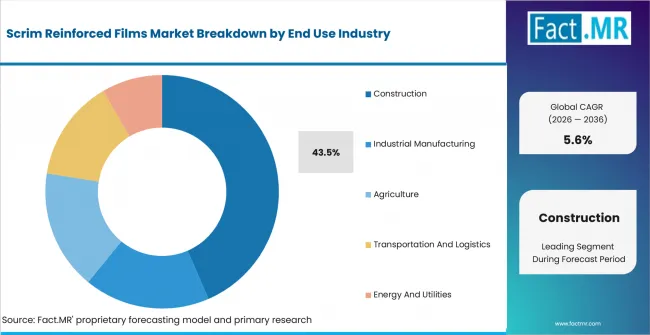
Scrim Reinforced Films Market Analysis By End Use Industry | Source: Fact.MR
Construction leads End Use Industry because rolls are consumed across several stages of a project. Crews can use reinforced film for weather protection and temporary containment before final cladding, while permanent applications include wall and roof barrier layers within the finished assembly.
The purchase decision is practical. A heavier or reinforced roll costs more than commodity film, but failure during installation creates material replacement and additional labor. Where the sheet must remain intact across corners, seams or fastener lines, contractors have a direct reason to specify reinforcement instead of adding a second unsupported layer.
Why do Multi Layer Reinforced Films lead Film Structure?
Multi Layer Reinforced Films are projected to account for a 38.6% share in 2026.
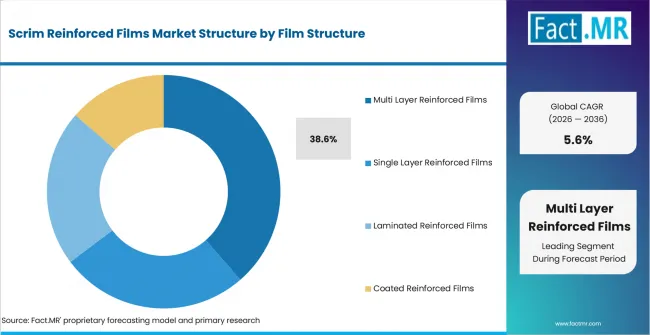
Scrim Reinforced Films Market Analysis By Film Structure | Source: Fact.MR
Multi Layer Reinforced Films lead because the structure lets the converter assign different functions to separate layers. The scrim can provide mechanical support while outer film layers protect it and supply the required surface or barrier behavior. This approach also helps maintain a smooth face for sealing, printing or lamination.
Saint-Gobain's scrim-reinforced lamination products illustrate the value of combining a reinforcement carrier with continuous adhesive layers for construction sealing. In finished reinforced films, buyers apply a similar logic by comparing interlayer bond strength and resistance to delamination after folding or exposure.
Why does Above 100 Microns lead Thickness?
Above 100 Microns is projected to account for a 57.1% share in 2026.
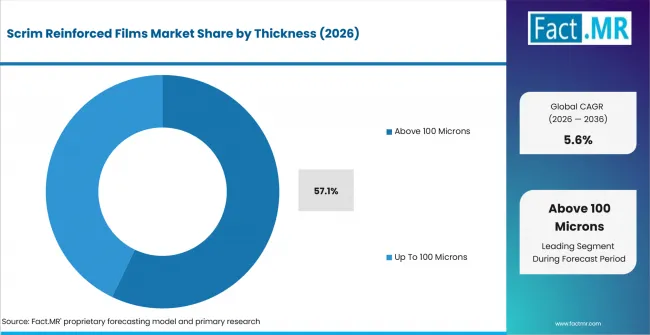
Scrim Reinforced Films Market Analysis By Thickness | Source: Fact.MR
Above 100 Microns leads because added gauge provides more material around puncture points and improves handling margin when a sheet is pulled across rough substrates or irregular loads. This is relevant to construction covers, pallet covers and cargo protection, where local abrasion can occur before the film reaches its final position.
The trade-off is weight and material use. Buyers therefore select within the 100 to 200 Microns and Above 200 Microns subsegments according to exposure time and expected mechanical abuse. Thinner reinforced films remain useful where low weight and easier handling matter more than repeated use.
What is accelerating Scrim Reinforced Films Market adoption, and what is holding it back?
cultivation demand, while reinforcement cost, recycling complexity and competition from simpler materials can constrain adoption.
Drivers Impact Analysis
| Factor | (~) % Impact on CAGR | Geographic Relevance | Impact Timeline |
|---|---|---|---|
| Building-envelope air and moisture specifications | +1.2% | Germany; UK; USA | Short term (<= 2 years) |
| Tear-resistant permanent and temporary protection | +1.0% | Global | Short term (<= 2 years) |
| Protected cultivation cover demand | +0.7% | Brazil; USA; Japan | Medium term (2-4 years) |
| Multilayer conversion for durable film structures | +0.5% | Global | Medium term (2-4 years) |
Source: Fact.MR analysis. Updated Aug 21, 2026
Opportunity Impact Analysis
| Factor | (~) % Impact on CAGR | Geographic Relevance | Impact Timeline |
|---|---|---|---|
| Envelope retrofit and renovation applications | +0.6% | Germany; UK; USA | Medium term (2-4 years) |
| Reinforced greenhouse and silage covers | +0.5% | Brazil; USA; Japan | Medium term (2-4 years) |
| Cargo and industrial protection formats | +0.4% | Global | Medium term (2-4 years) |
Source: Fact.MR analysis. Updated Aug 21, 2026
Restraints Impact Analysis
| Factor | (~) % Impact on CAGR | Geographic Relevance | Impact Timeline |
|---|---|---|---|
| Additional reinforcement and converting cost | -0.8% | Global | Short term (<= 2 years) |
| Mixed-material recycling complexity | -0.6% | Europe | Medium term (2-4 years) |
| Gauge-related weight and handling trade-offs | -0.4% | Global | Short term (<= 2 years) |
| Competition from unsupported films and rigid sheets | -0.5% | Global | Medium term (2-4 years) |
Source: Fact.MR analysis. Updated Aug 21, 2026
Which countries are scaling the Scrim Reinforced Films Market through 2036?
- Germany: Building Energy Act requirements for a permanently airtight envelope support careful specification of films and sealing layers in wall and roof assemblies. Reinforced structures help installers maintain continuity where sheets are tensioned or fixed around joints.
- Brazil: Minha Casa, Minha Vida contracted 2.3 million homes between January 2023 and March 2026. Housing construction creates recurring demand for temporary protection and moisture-control materials, supporting reinforced-film use around building sites and envelope work.
- USA: Department of Energy guidance treats housewrap and other weather-resistive barriers as part of an integrated wall system. This supports durable films that can be fastened and flashed without losing continuity during installation.
- UK: Approved Document C includes resistance to moisture in floors, walls and roofs. Reinforced films are relevant where contractors need moisture-control layers that withstand handling before the assembly is closed.
- Japan: The Ministry of Land, Infrastructure, Transport and Tourism published a design guide for highly insulated homes in April 2025. Greater attention to insulation and airtightness gives envelope films a clearer role in construction detailing.
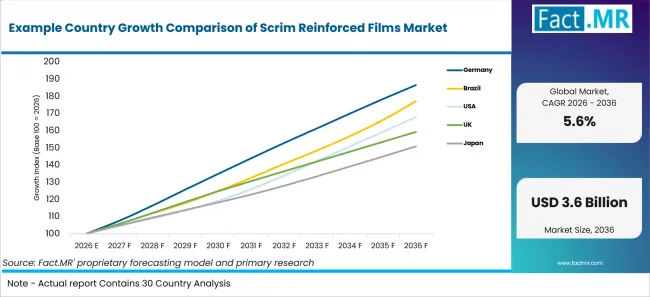
Example Country Growth Comparison Of Scrim Reinforced Films Market | Source: Fact.MR
Country CAGR (2026-2036)
| Country | CAGR (2026-2036) |
|---|---|
| Germany | 6.44% |
| Brazil | 5.88% |
| USA | 5.32% |
| UK | 4.76% |
| Japan | 4.20% |
Source: Fact.MR analysis. Updated Aug 21, 2026
What is driving Germany's growth through 2036?
Germany is forecast to expand at a 6.44% CAGR from 2026 to 2036.
Growth is supported by a combination of envelope requirements and improving construction order flow. Destatis reported that real building-construction orders increased 7.5% in 2025. As projects move into execution, wall, roof and temporary protection work creates recurring purchasing points for reinforced films.
The specification mechanism is clear: a film is useful only while its barrier remains continuous. Scrim reinforcement gives installers more margin around fasteners and during positioning, making reinforced grades relevant for house wraps, vapor barriers and related building layers where rework is costly.
What is driving Brazil's growth through 2036?
Brazil is forecast to expand at a 5.88% CAGR from 2026 to 2036.
Brazilian demand is supported by continuing housing delivery and projects moving into construction. The federal Minha Casa, Minha Vida programme reported more than 100,000 newly contracted FAR homes already under execution, with additional selections launched for further contracting.
For reinforced films, the purchasing route comes through site protection and envelope use rather than housing policy itself. Each active project creates material demand during roof and wall work, while durable covers can reduce replacement when exposed to handling or weather before completion.
What is driving the USA's growth through 2036?
The USA is forecast to expand at a 5.32% CAGR from 2026 to 2036.
U.S. demand is supported by the scale of construction work across both new structures and improvements to existing buildings. The Census Bureau's Construction Spending programme continues to track activity across residential and nonresidential sectors, giving reinforced films a broad project base rather than dependence on one building type.
The buying case is strongest where films are exposed during installation. House wraps and temporary barriers can be pulled around corners or fixed to sheathing, so tear control and dimensional stability can reduce patching and material waste before cladding or finish layers are installed.
What is driving the UK's growth through 2036?
The UK is forecast to expand at a 4.76% CAGR from 2026 to 2036.
Annual construction output in Great Britain increased 1.8% in 2025, according to the Office for National Statistics. The activity base supports demand for reinforced films in new work and repair applications where moisture control or temporary protection is required.
Approved Document C keeps moisture resistance embedded in the building-regulation framework. Film suppliers serving contractors therefore compete on installation robustness alongside barrier performance. Scrim reinforcement can help a sheet remain serviceable while it is fixed, overlapped and sealed on site.
What is driving Japan's growth through 2036?
Japan is forecast to expand at a 4.20% CAGR from 2026 to 2036.
Japan's growth is shaped more by building-envelope specification than by a uniform increase in project volume. MLIT's April 2025 guide for highly insulated homes focuses attention on design choices that support high insulation and energy performance, increasing the importance of continuity at the envelope.
Construction activity can still create near-term volume. MLIT reported that June 2026 housing starts increased 18.6% from a year earlier and that private nonresidential starts also rose overall in the month. Reinforced films can participate where builders need durable barrier or protection sheets during active work.
Outside construction, the addressable use cases connect with agricultural films used for greenhouse and silage applications, while logistics demand overlaps with protective packaging where film integrity under handling affects product protection.
Who Leads the Scrim Reinforced Films Market?
Amcor plc, Dow Inc., 3M, Saint-Gobain, Intertape Polymer Group and Toray Industries are among the companies operating in the Scrim Reinforced Films Market. Amcor completed its combination with Berry Global on April 30, 2025, so Berry Global is no longer a separate current corporate competitor.
Dow participates through polyethylene resin platforms used in films where puncture and tear performance matter. Toray Industries supplies polypropylene and polyester films through Toray Plastics, supporting converters that require film substrates for lamination and industrial applications.
3M, Saint-Gobain and Intertape Polymer Group participate through scrim-reinforced bonding and lamination technologies. Their product documentation shows how polymer or polyester scrim carriers add dimensional stability while bonding films and related substrates, which is relevant to reinforced-film conversion and sealing workflows.
Competition depends on the film-scrim bond and on how the material behaves after local damage. Buyers also compare gauge against expected exposure and assess whether the surface can be sealed or laminated consistently. Suppliers that can support polymer selection and conversion are better placed for repeat specifications.
Which companies are the key providers?
Key companies profiled include Amcor plc; Berry Global Inc. (legacy business now within Amcor); Dow Inc.; 3M; Saint-Gobain; Intertape Polymer Group; and Toray Industries.
- Amcor plc
- Berry Global Inc. (legacy business now within Amcor)
- Dow Inc.
- 3M
- Saint-Gobain
- Intertape Polymer Group
- Toray Industries
Bibliography
- Amcor plc. (2025). Amcor Completes Combination with Berry Global. Amcor.
- Casa Civil, Government of Brazil. (2026). Minha Casa, Minha Vida. Government of Brazil.
- Federal Ministry of Justice, Germany. (2026). Building Energy Act, Section 13: Tightness. Federal Government of Germany.
- Federal Statistical Office of Germany. (2026). Orders Received in Main Construction Industry in 2025. Destatis.
- Intertape Polymer Group. (2026). 41392 Scrim Reinforced Adhesive Transfer Tape Technical Data Sheet. IPG.
- Ministry of Housing, Communities and Local Government. (2013). Approved Document C: Site Preparation and Resistance to Contaminants and Moisture. UK Government.
- Ministry of Land, Infrastructure, Transport and Tourism, Japan. (2025). Design Guide for Highly Insulated Houses. Government of Japan.
- Ministry of Land, Infrastructure, Transport and Tourism, Japan. (2026). Building Starts Statistics: June 2026. Government of Japan.
- Office for National Statistics. (2026). Construction Output in Great Britain: December 2025. UK Statistics Authority.
- Saint-Gobain. (2024). Biolink netlink 5072 Transfer Adhesive Tape. Saint-Gobain Tape Solutions.
- 3M. (2024). Scrim Reinforced Adhesive Transfer Tape L1+RT Technical Information. 3M.
- U.S. Census Bureau. (2026). Construction Spending: Value of Construction Put in Place. U.S. Department of Commerce.
- U.S. Department of Agriculture, Natural Resources Conservation Service. (2024). Title 210 National Engineering Handbook, Subpart T: Urban Agriculture. USDA.
- U.S. Department of Energy. (2000). Technology Fact Sheet: Weather-Resistive Barriers. Building America.
- Dow Inc. (2026). Agricultural Films for Sustainable Crop Production. Dow.
- Toray Plastics (America), Inc. (2026). Films: TORAYFAN Polypropylene Film and Lumirror Polyester Film. Toray Industries.
This Report Answers
- The report examines demand across the six stated segment dimensions and the covered country markets.
- Segment analysis explains how polymer choice and reinforcement type affect film performance in the covered applications.
- Country analysis evaluates the construction and building-envelope conditions shaping demand in Germany, Brazil, the USA, the UK and Japan.
- Competitive analysis reviews the listed companies with current ownership relationships and film or reinforcement capabilities.
- The scope distinguishes finished scrim reinforced films from unsupported film, rigid sheet products and standalone reinforcement components.
What does the Scrim Reinforced Films Market cover?
The market covers flexible polymer films that incorporate a reinforcing scrim or grid so the sheet retains dimensional stability and resists tear propagation during installation, handling or service. Covered reinforcement materials include fiberglass, polyester and polypropylene scrims within the stated Product and Reinforcement Material taxonomy.
Applications include Construction And Building, Industrial Packaging, Agriculture and Transportation And Logistics. The market is further organized by End Use Industry, Film Structure and Thickness, including the supplied gauge bands above and up to 100 microns.
What is included in the scope?
The scope includes polyethylene, polypropylene and polyester scrim reinforced films together with the stated composite film structures. It includes open-mesh and woven fiberglass, polyester scrim and polypropylene scrim when the reinforcement is incorporated into a finished film product.
Application coverage includes house wraps and roofing membranes, vapor barriers, insulation facings, protective packaging, pallet covers, greenhouse and silage covers, cargo protection and protective covers. Demand is counted across the listed end-use industries and thickness categories.
What is excluded from the scope?
Unsupported polymer films without a scrim are outside the market unless they form part of a covered reinforced laminate. Rigid plastic sheets and panels are excluded, as are woven tarpaulins that are not film-based reinforced structures.
Standalone scrim fabrics, resin and adhesive tapes sold without a finished reinforced film are not counted as market revenue. Finished packaging or construction systems are also excluded when the reinforced film cannot be identified as the product being purchased.
How Was the Analysis Built?
The analysis draws on film-conversion demand, reinforcement choices and end-use purchasing across the covered applications and countries.
- Primary Research: Discussions with film converters, polymer suppliers, reinforcement producers, construction-material distributors and end users examine tear requirements, film gauge, lamination quality and purchasing criteria across the covered applications.
- Desk Research: The review covers building-envelope regulation, construction statistics, protected-cultivation guidance and current supplier documentation for polyethylene films, scrim carriers and film lamination systems. Sources used in the article are recorded in the bibliography.
- Market Sizing and Forecasting: Estimates combine product mix with reinforcement-material share and application demand. The model also considers end-use activity, film structure, thickness and country-level construction or agricultural indicators.
- Data Validation and Update Cycle: Findings are reviewed against current company activity, official construction and agricultural indicators and material specifications. Updates account for changes in end-use activity, product design and supplier ownership.
Segmentation
What is the report's scope and coverage?
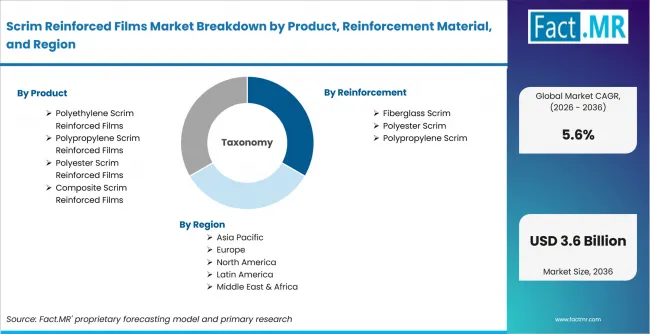
Scrim Reinforced Films Market Breakdown By Product, Reinforcement Material, And Region | Source: Fact.MR
| Attribute | Details |
|---|---|
| Quantitative Units | USD billion |
| Market Definition | Reinforced polymer films incorporating fiberglass, polyester, polypropylene or comparable scrim to add dimensional stability and tear control across the covered applications. |
| Segments Covered | Product; Reinforcement Material; Application; End Use Industry; Film Structure; Thickness |
| Regions Covered | North America; Latin America; Europe; East Asia; South Asia and Pacific; Middle East and Africa |
| Countries Covered | Germany; Brazil; USA; UK; Japan |
| Key Companies Profiled | Amcor plc; Berry Global Inc. (part of Amcor); Dow Inc.; 3M; Saint-Gobain; Intertape Polymer Group; Toray Industries |
| Forecast Period | 2026 to 2036 |
| Base Year | 2025 |
| Market Value, 2026 | USD 2.1 billion |
| Market Value, 2036 | USD 3.6 billion |
| CAGR, 2026-2036 | 5.6% |
| Absolute Opportunity | USD 1.5 billion |
| Approach | Combines product and reinforcement mix with application demand, end-use activity, film structure, thickness, supplier capabilities and country-level construction or agricultural indicators. |
Source: Fact.MR analysis. Updated Aug 21, 2026
How is the market segmented?
-
By Product:
- Polyethylene Scrim Reinforced Films
- HDPE Scrim Reinforced Films
- LDPE Scrim Reinforced Films
- LLDPE Scrim Reinforced Films
- Polypropylene Scrim Reinforced Films
- Biaxially Oriented Polypropylene Films
- Cast Polypropylene Films
- Polyester Scrim Reinforced Films
- Industrial Grade Films
- High Strength Films
- Composite Scrim Reinforced Films
- Multi Layer Composite Films
- Metalized Composite Films
- Polyethylene Scrim Reinforced Films
-
By Reinforcement Material:
- Fiberglass Scrim
- Open Mesh Fiberglass
- Woven Fiberglass
- Polyester Scrim
- Woven Polyester
- Knitted Polyester
- Polypropylene Scrim
- Woven Polypropylene
- Nonwoven Polypropylene
- Fiberglass Scrim
-
By Application:
- Construction And Building
- House Wraps
- Roofing Membranes
- Vapor Barriers
- Insulation Facings
- Industrial Packaging
- Protective Packaging
- Pallet Covers
- Agriculture
- Greenhouse Coverings
- Silage Covers
- Transportation And Logistics
- Cargo Protection
- Protective Covers
- Construction And Building
-
By End Use Industry:
- Construction
- Industrial Manufacturing
- Agriculture
- Transportation And Logistics
- Energy And Utilities
-
By Film Structure:
- Multi Layer Reinforced Films
- Single Layer Reinforced Films
- Laminated Reinforced Films
- Coated Reinforced Films
-
By Thickness:
- Above 100 Microns
- 100 To 200 Microns
- Above 200 Microns
- Up To 100 Microns
- Up To 50 Microns
- 50 To 100 Microns
- Above 100 Microns
-
By Region:
- North America
- Latin America
- Western Europe
- Eastern Europe
- East Asia
- South Asia and Pacific
- Middle East & Africa
Frequently Asked Questions
At what rate will Scrim Reinforced Films market grow from 2021 to 2031?
What is the expected market value for the Scrim Reinforced Films market in 2031?
Which are some leading players in the Scrim Reinforced Films market?
Who worked on this report


Preview the report firsthand - request a free sample
Free SampleGet the brochure for pricing and purchase details
Download PDF