- Market Value (2025): USD 207.6 Mn
- Estimated Value (2026): USD 224 Mn
- Forecast Value (2036): USD 480 Mn
- CAGR (2026-2036): 7.9%
What is the Cryogenic Swivel Joints Market forecast to be worth by 2036?
USD 224 million in 2026 to USD 480 million by 2036, at 7.9% CAGR.
- The market reached approximately USD 207.6 million in 2025 as LNG transfer infrastructure expanded and the installed base of arms and articulated piping entered a heavy swivel service cycle.
- Revenue is projected to grow from USD 224.0 million in 2026 to USD 480.0 million by 2036 on new transfer system construction, swivel replacement and overhaul demand, and emerging cryogenic applications in hydrogen and space.
- A 7.9% CAGR from 2026 to 2036 reflects the compounding of new installations with an installed-base service annuity that grows every time another arm is commissioned.
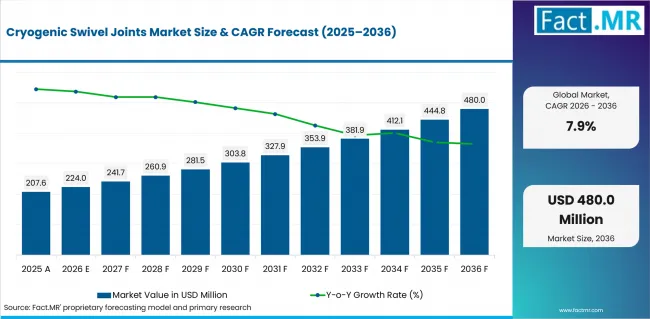
Cryogenic Swivel Joints Market Value Analysis | Source: Fact.MR
What are the defining numbers behind Cryogenic Swivel Joints Market growth?
USD 256 million absolute opportunity by 2036, led by Single-ball-race swivels and Spring-energized PTFE seals within their respective segments.
- Demand Drivers in the Market
- ISO 16904, the international standard for LNG marine transfer arms, defines swivel joint geometry, contact angles and raceway arrangements in detail, embedding engineered swivels in every compliant arm specification.
- GIIGNL counts an LNG carrier fleet of 899 vessels after 8% fleet growth, and each carrier loads and discharges through arms containing six or more cryogenic swivels, all of which wear and seal against boil-off temperatures.
- NASA’s Cryogenic Fluid Management Portfolio Project is funding hydrogen low-leakage valves and cryo-couplers plus reduced-gravity cryogenic transfer demonstrations, pushing swivel and rotating-seal technology requirements beyond anything the energy industry asks for.
- The International Institute of Refrigeration, citing DNV, records 638 LNG-fuelled ships in operation, and bunkering connections for that fleet add smaller swivel counts per connection but far more connection points.
- Industrial gas and LNG terminal expansion across Asia adds articulated transfer lines whose swivel populations enter the overhaul pool within five to ten years of commissioning.
- Key Segments Analyzed
- By Swivel Design: Single-ball-race swivels lead at 36.9% of 2026 demand because the single-race layout gives the best combination of compact envelope, load capacity and seal access for the arm sizes that dominate LNG and industrial gas transfer, and because decades of field history give buyers confidence in race life predictions.
- By Seal Type: Spring-energized PTFE seals hold 37.0% of demand because the spring maintains sealing force as the PTFE jacket wears and as materials contract at cryogenic temperature, a combination that ordinary elastomers cannot survive, making this seal architecture the default for LNG duty.
- By Size Class: Below 8 inch swivels account for 39.0% of demand, reflecting the sheer number of smaller arms, bunkering connections and industrial gas transfer lines, even though the 16 to 24 inch class at 30.0% carries the highest unit values on large marine arms.
- By End User: Loading arm OEMs hold 49.0% of end user demand because most swivels are designed into new arms and articulated systems at the factory, while terminal operators at 27.0% buy swivels and overhaul kits for the installed base.
- Analyst Opinion at Fact.MR
- Shambhu Nath Jha, Sr. Consultant at Fact.MR, states, “A swivel is a small part with an outsized failure consequence. When a seal goes at minus 160 degrees, you do not get a slow leak you can manage, you get an arm out of service and a berth standing still. That is why the conversation with buyers has shifted to documented race life and seal traceability. The overhaul business attached to that conversation is where the durable margin sits.”
- Strategic Implications
- Arm OEMs should qualify at least two swivel sources per size class, since swivel lead times are a recurring bottleneck in arm delivery schedules.
- Terminal operators gain from condition-based swivel overhaul programs, using rotation torque and leak history rather than fixed intervals that replace healthy swivels.
- Swivel suppliers can build service annuities by offering raceway refurbishment and seal kit programs tied to the arm’s duty cycle records.
- Buyers evaluating new transfer systems should request witness-tested swivel performance at full cryogenic temperature, not ambient extrapolations.
Emco Wheaton manufactures cryogenic swivel joints in single and double ball-race designs with spring-energized sealing for LNG and industrial gas service. Its combination of new-equipment supply and seal kit programs illustrates how swivel economics now split between OEM content and installed-base service.
The United States is positioned for 8.6% annual growth from 2026 to 2036 on export terminal construction and aerospace cryogenic programs. Germany is projected to grow at 8.2% on terminal and industrial gas investment. Japan follows at 8.0% on arm overhaul demand, South Korea advances at 7.8% alongside shipbuilding and bunkering.
How does the Cryogenic Swivel Joints Market break down by segment?
The leading shares are Single-ball-race swivels at 36.9% by Swivel Design and Spring-energized PTFE seals at 37.0% by Seal Type.
Why do single-ball-race swivels lead the design mix?
At 36.9% share in 2026, single-ball-race swivels lead because they give adequate load capacity with the simplest structure, the easiest seal access, and the longest field record.
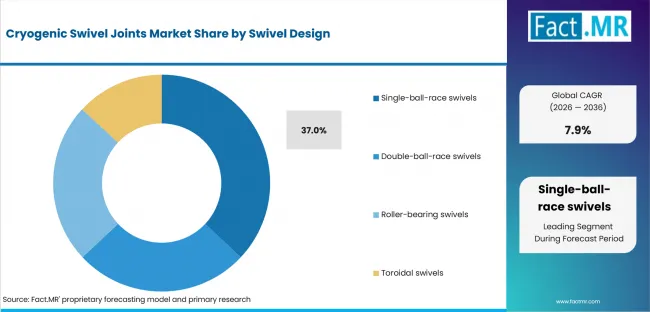
Cryogenic Swivel Joints Market Analysis By Swivel Design | Source: Fact.MR
Single-ball-race swivels account for 37.0% of demand because most transfer arms do not need the moment capacity of double-race designs, and the single-race layout is cheaper to build, easier to seal and faster to overhaul. Double-ball-race swivels suit higher-load arm duties, roller-bearing swivels are selected for their load-handling characteristics, and toroidal designs address specialized geometry and movement requirements.
Why do spring-energized PTFE seals dominate sealing?
A 37.0% share puts spring-energized PTFE seals first in 2026 because the spring maintains sealing force through thermal contraction and jacket wear at cryogenic temperature.
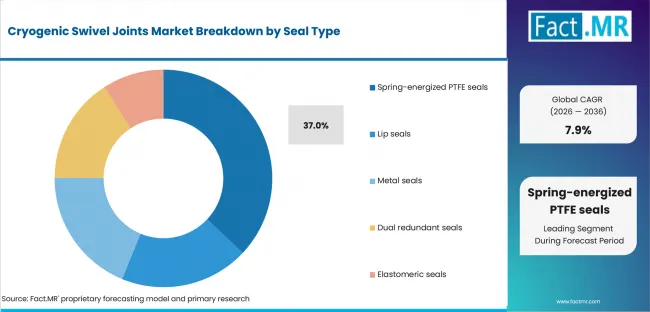
Cryogenic Swivel Joints Market Analysis By Seal Type | Source: Fact.MR
Spring-energized PTFE seals represent 37.0% of demand because LNG and industrial gas duty destroys ordinary elastomers, and the energized PTFE architecture keeps working through thousands of cycles at minus 162 degrees C. Lip seals suit less demanding duties, metal seals address high-temperature or high-pressure boundaries, and dual-redundant seals are selected where additional containment assurance is required.
Why does the below 8 inch class lead by volume?
The 2026 leader is below 8 inch swivels at 39.0% share because industrial gas, bunkering and small transfer systems far outnumber large marine arms.
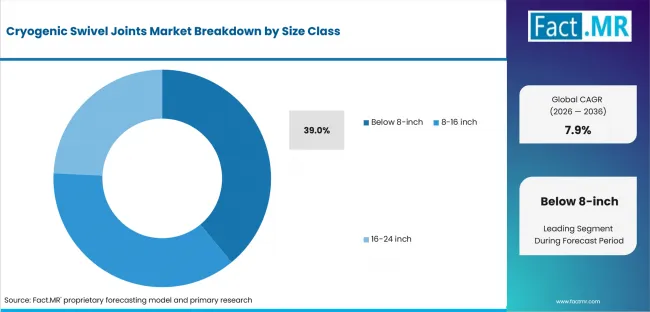
Cryogenic Swivel Joints Market Analysis By Size Class | Source: Fact.MR
Below 8 inch swivels account for 39.0% of demand as the population of small arms, bunkering connections, railcar racks and industrial gas transfer lines is far larger than the population of big LNG berths, and each system still carries several swivels. The 8 to 16 inch class serves mid-size arms and articulated piping, while the 16 to 24 inch class concentrates value in large marine arms where each swivel is a major engineered component.
Why do loading arm OEMs lead the end user group?
The leading 2026 share is 49.0% for loading arm OEMs because most swivels enter service as designed-in content on new arms and articulated systems.
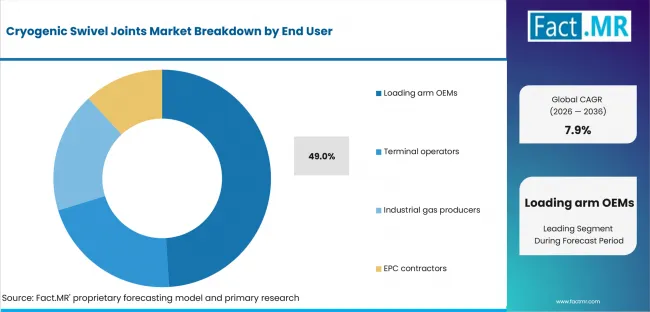
Cryogenic Swivel Joints Market Analysis By End User | Source: Fact.MR
Loading arm OEMs represent 49.0% of demand because the swivel is specified and installed at the arm factory, and arm orders set the primary swivel demand curve. Terminal operators buy swivels and overhaul kits for installed arms, industrial gas producers buy for transfer-system fleets, and EPC contractors procure swivels inside terminal construction packages.
What is accelerating Cryogenic Swivel Joints Market adoption, and what is holding it back?
The principal accelerator is the multiplication of cryogenic transfer points across LNG, industrial gas, bunkering and emerging hydrogen and space applications, each carrying multiple swivels with finite service lives. Adoption is slowed by specialized manufacturing capacity, cryogenic testing cost, and long overhaul intervals that defer replacement revenue.
Drivers Impact Analysis
| DRIVER | (~) % IMPACT ON CAGR | GEOGRAPHIC RELEVANCE | IMPACT TIMELINE |
|---|---|---|---|
| LNG transfer system construction | +1.3% | United States, Asia, Europe | Medium term (2-4 years) |
| Installed-base overhaul cycle | +1.1% | Japan, Europe, mature terminals | Long term (>= 4 years) |
| Bunkering connection growth | +0.9% | Singapore, Northwest Europe | Medium term (2-4 years) |
| Hydrogen and space programs | +0.7% | United States, Europe, Japan | Long term (>= 4 years) |
| Industrial gas expansion | +0.6% | Southeast Asia | Long term (>= 4 years) |
Source: Fact.MR analysis. Updated Jul 24, 2026
- LNG transfer system construction: New export and import berths each install arms with six or more cryogenic swivels, and articulated vapor return and bunker lines add further swivel counts, so berth construction translates mechanically into swivel volume.
- Installed-base overhaul cycle: Swivels commissioned during the LNG buildouts of the past decade are entering their overhaul windows, and seal kits plus raceway refurbishment generate recurring revenue on every installed arm.
- Hydrogen and space programs: NASA’s cryogenic fluid management portfolio is developing hydrogen low-leakage couplers and transfer demonstrations, and liquid hydrogen infrastructure R&D creates demand for swivels and rotating seals qualified to minus 253 degrees C, the hardest service in the industry.
Opportunity Impact Analysis
| OPPORTUNITY | (~) % IMPACT ON CAGR | GEOGRAPHIC RELEVANCE | IMPACT TIMELINE |
|---|---|---|---|
| Seal kit subscription programs | +0.5% | Global installed base | Short term (<= 2 years) |
| Condition-monitored swivels | +0.4% | Advanced terminals | Medium term (2-4 years) |
| Liquid hydrogen duty designs | +0.4% | United States, Japan, Germany | Long term (>= 4 years) |
| Ammonia transfer qualification | +0.3% | Japan, South Korea | Long term (>= 4 years) |
Source: Fact.MR analysis. Updated Jul 24, 2026
- Seal kit subscription programs: Terminals running fleets of identical arms can take seal kits and overhaul services on scheduled agreements, giving suppliers predictable installed-base revenue and giving operators planned maintenance windows.
- Condition-monitored swivels: Rotation torque and temperature sensing on critical swivels lets operators detect race wear before seal failure, and instrumented swivels command a premium where berth downtime is expensive.
- Liquid hydrogen duty designs: Hydrogen liquefaction and transfer projects need swivels that seal the smallest molecule at the coldest industrial temperature. Suppliers qualifying hydrogen-duty designs now will own that niche as infrastructure scales.
Restraints Impact Analysis
| RESTRAINT | (~) % IMPACT ON CAGR | GEOGRAPHIC RELEVANCE | IMPACT TIMELINE |
|---|---|---|---|
| Specialized machining capacity | -0.5% | Global | Short term (<= 2 years) |
| Cryogenic testing cost | -0.4% | New design qualification | Medium term (2-4 years) |
| Long overhaul intervals | -0.3% | Mature terminals | Long term (>= 4 years) |
| Price pressure from machine shops | -0.2% | Commodity sizes | Medium term (2-4 years) |
Source: Fact.MR analysis. Updated Jul 24, 2026
- Specialized machining capacity: Raceway grinding and cryogenic-grade materials require specialized machines and process control. Capacity constraints extend lead times during construction booms.
- Cryogenic testing cost: Witnessed testing at liquid nitrogen or LNG temperature adds cost to every new design variant, discouraging range extension and slowing new entrant qualification.
- Long overhaul intervals: Well-operated swivels can run for many years between overhauls, so service revenue depends on fleet growth as much as on wear rates.
How do the leading cryogenic swivel joint markets compare?
United States 8.6% CAGR. Germany 8.2%. Japan 8.0%. South Korea 7.8%.
Regional analysis addresses North America, Europe, and Asia Pacific through country sections on the United States, Germany, Japan, South Korea, with more than 30 countries treated in the complete report.
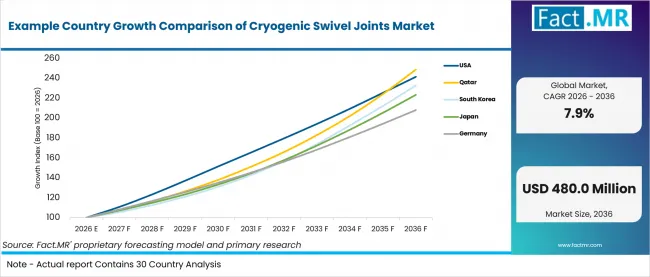
Example Country Growth Comparison Of Cryogenic Swivel Joints Market | Source: Fact.MR
| COUNTRY | CAGR |
|---|---|
| United States | 8.6% |
| Germany | 8.2% |
| Japan | 8.0% |
| South Korea | 7.8% |
Source: Fact.MR analysis. Updated Jul 24, 2026
Why Do Export Terminals and Space Programs Make the US the Deepest Swivel Market?
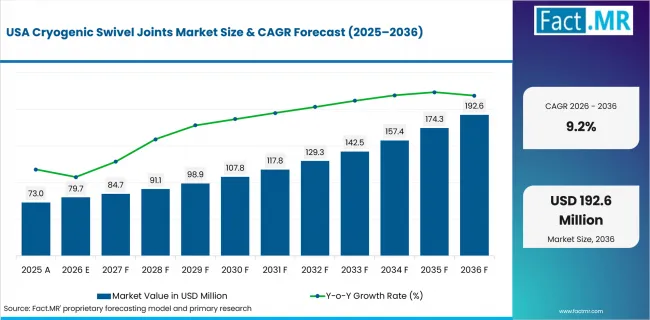
Cryogenic Swivel Joints Market Country Value Analysis | Source: Fact.MR
The United States combines the largest current wave of LNG berth construction with a government-funded cryogenic technology frontier. On the energy side, the EIA tracks U.S. LNG exports at 15.1 Bcf/d in 2025 with capacity rising past 19 Bcf/d during 2026, and every new berth adds swivel populations to the future overhaul pool.
On the research side, NASA’s Cryogenic Fluid Management Portfolio Project, presented at the 2025 Cryogenic Engineering Conference, is funding hydrogen low-leakage valves and cryo-couplers, a 20W/20K cryocooler program, and reduced-gravity cryogenic transfer demonstrations aimed at long-duration storage and propellant transfer. That program work pushes rotating seal technology at temperatures well below LNG duty, and the suppliers involved carry the learning back into commercial designs. The United States carries an 8.6% CAGR from 2026 to 2036.
Why Is Germany’s Swivel Demand Split Between New Terminals and Old Industry?
Germany’s new LNG import terminals, documented by the EIA as part of Europe’s one-third import capacity expansion, install fresh swivel populations at Wilhelmshaven, Brunsbuttel and Stade. At the same time, Germany’s industrial gas sector, serving steel and chemicals, runs one of Europe’s oldest fleets of articulated transfer systems, a deep overhaul market.
German engineering procurement emphasizes documented material traceability and tested seal performance, which raises value per swivel and favors established suppliers. Germany’s demand grows at an 8.2% CAGR from 2026 to 2036.
Why Does Japan Run the Most Disciplined Swivel Overhaul Market?
Japan’s LNG import terminals, many in service for decades, maintain swivel fleets under condition-based programs that generate steady seal kit and refurbishment demand regardless of new construction cycles. Japanese terminals keep detailed rotation and leak histories, making them the most predictable service customers in the industry.
METI’s energy planning keeps LNG central, and Japan’s interest in hydrogen and ammonia import chains points toward future swivel duty in colder and chemically harsher service. Japan’s demand grows at an 8.0% CAGR from 2026 to 2036.
Why Do Korean Yards and Terminals Generate Swivel Volume on Both Sides?
South Korea builds a large share of the LNG carrier fleet that GIIGNL counts at 899 vessels, and its equipment ecosystem around shipbuilding creates swivel demand for shipside and shoreside transfer systems alike. Domestic terminals expanding for bunkering, with 638 LNG-fuelled ships operating globally per DNV data cited by the International Institute of Refrigeration, add further articulated connections.
Korean buyers specify to international standards, keeping the market open to qualified global suppliers. South Korea’s demand advances at a 7.8% CAGR from 2026 to 2036.
Who leads the Cryogenic Swivel Joints Market?
Emco Wheaton (Gardner Denver), Technip Energies Loading Systems, SVT GmbH, Woodfield Systems, Kanon Loading Equipment, and ARTA compete through race engineering, seal technology, and overhaul programs.
Competition depends on race design, cryogenic seal performance, traceable overhaul support, and serviceability. Emco Wheaton’s documented single- and double-ball-race swivels with spring-energized seals and seal kits illustrate the new-equipment and service model; Technip Energies Loading Systems, SVT GmbH, Woodfield Systems, Kanon Loading Equipment, and GTC remain alternatives for OEM and installed-base requirements.
Competitive differentiation centers on condition-monitored swivels, hydrogen-duty designs, and seal-kit service programs.
Which companies are the key providers?
The company set includes Emco Wheaton (Gardner Denver), Technip Energies Loading Systems, SVT GmbH, Woodfield Systems, Kanon Loading Equipment, and ARTA.
- Emco Wheaton (Gardner Denver)
- Technip Energies Loading Systems
- SVT GmbH
- Woodfield Systems
- Kanon Loading Equipment
- ARTA
The six named manufacturers anchor the comparison, and the full report reviews more than 25 swivel and component specialists.
Bibliography
- International Organization for Standardization. (2016). ISO 16904:2016: Design and testing of LNG marine transfer arms (swivel joint definitions and geometry).
- NASA Marshall Space Flight Center. (2025). Cryogenic Fluid Management Portfolio Project Overview, Cryogenic Engineering Conference presentation.
- U.S. Energy Information Administration. (2026). Global liquefied natural gas trade volumes reached record high in 2025 (data source: GIIGNL).
- International Institute of Refrigeration. (2026). LNG-fuelled ships continue to lead (data source: DNV).
- Emco Wheaton (Gardner Denver). (n.d.). Cryogenic Swivel Joints.
This Report Addresses
- The report quantifies the 2025 baseline and forecasts revenue from 2026 through 2036.
- The country analysis tracks U.S. export-terminal construction, German industrial-gas investment, Japanese arm overhauls, South Korean shipbuilding, and Chinese terminal expansion across more than 30 markets.
- It evaluates Emco Wheaton (Gardner Denver), Technip Energies Loading Systems, SVT GmbH, Woodfield Systems, Kanon Loading Equipment, and ARTA.
- It examines swivel design, seal type, size class, and end user choices.
- It separates new equipment and installed-base service demand across marine, industrial gas, and emerging applications.
- It tests the forecast against berth construction, overhaul cycles, bunkering growth, and hydrogen and space programs.
What does the Cryogenic Swivel Joints Market cover?
The study follows swivel joints from arm and system design through cryogenic qualification, field service, and overhaul.
Revenue includes the swivel body, raceways and rolling elements, seal systems, and monitoring options sold with new swivels, plus seal kits, raceway refurbishment and overhaul services billed by the swivel supplier.
Demand is segmented by design, seal type, size class, and end user. Country estimates reflect transfer system construction, installed arm populations, service practices, and research program activity.
What is included in the scope?
Included products are swivel joints qualified for service at cryogenic temperatures in transfer and articulated piping systems.
Single and double ball-race, roller-bearing and toroidal swivels are counted across all covered seal types and size classes when specified for LNG, industrial gas, or other cryogenic duty. New swivels, seal kits, and raceway refurbishment are covered.
What is excluded from the scope?
Complete loading arms, ambient-temperature swivels, and rotary unions for hydraulic service are not included.
The study excludes loading arms and articulated systems as complete assemblies, swivels designed for ambient-temperature fluids, hydraulic rotary unions, and shipboard cargo machinery.
How was the analysis built?
Transfer system counts, overhaul records, supplier interviews, and forecast cross-checks referencing more than 30 countries.
- Primary Research: Primary research targets loading arm OEMs, terminal maintenance managers, swivel manufacturers, seal specialists, and cryogenic test facilities. Interviews test swivel counts per system, seal selection, race life experience, overhaul triggers, and monitoring adoption.
- Desk Research: Desk research reviews ISO standards, government trade and capacity data, space agency program documentation, and manufacturer literature. Named programs are used only when supported by the government or intergovernmental sources listed in the bibliography.
- Market-Sizing and Forecasting: Sizing is developed from swivel counts per system, installation volumes, design and seal mixes, realized pricing, overhaul intervals, and service attach rates. The result is reconciled to USD 224 million in 2026 and USD 480 million in 2036.
- Data Validation and Update Cycle: Validation compares segment shares, supplier positions, and country growth with arm deliveries and terminal schedules. Update signals include berth commissioning, overhaul contract awards, hydrogen project milestones, and standard revisions.
Segmentation
What is the report’s scope and coverage?
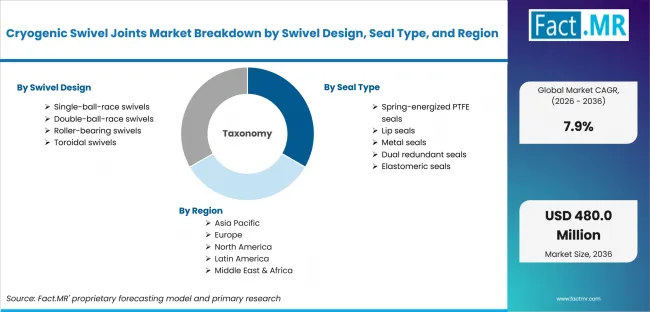
Cryogenic Swivel Joints Market Breakdown By Swivel Design, Seal Type, And Region | Source: Fact.MR
| ATTRIBUTE | DETAILS |
|---|---|
| Quantitative Units | USD 224 million in 2026 to USD 480 million by 2036 at 7.9% CAGR |
| Market Definition | The market covers cryogenic swivel joints providing leak-tight rotational connections in loading arms, transfer systems and articulated cryogenic piping for LNG, industrial gases and emerging hydrogen applications, including new equipment and overhaul kits. |
| Swivel Design | Single-ball-race swivels; Double-ball-race swivels; Roller-bearing swivels; Toroidal swivels |
| Seal Type | Spring-energized PTFE seals; Lip seals; Metal seals; Dual redundant seals; Elastomeric seals |
| Size Class | Below 8-inch; 8-16 inch; 16-24 inch |
| End User | Loading arm OEMs; Terminal operators; Industrial gas producers; EPC contractors |
| Regions Covered | North America; Europe; Asia Pacific |
| Countries Covered | United States; Germany; Japan; South Korea(full report analyzes 30+ countries) |
| Key Companies Profiled | Emco Wheaton (Gardner Denver); Technip Energies Loading Systems; SVT GmbH; Woodfield Systems; Kanon Loading Equipment; ARTA |
| Forecast Period | 2026 to 2036 |
| Approach | Sizing combines swivel counts per transfer system, new installation volumes, design and seal mixes, overhaul cycles, and separately billed seal kits and refurbishment. |
Source: Fact.MR analysis. Updated Jul 24, 2026
How is the market segmented?
-
By Swivel Design:
- Single-ball-race swivels
- Double-ball-race swivels
- Roller-bearing swivels
- Toroidal swivels
-
By Seal Type:
- Spring-energized PTFE seals
- Lip seals
- Metal seals
- Dual redundant seals
- Elastomeric seals
-
By Size Class:
- Below 8-inch
- 8-16 inch
- 16-24 inch
-
By End User:
- Loading arm OEMs
- Terminal operators
- Industrial gas producers
- EPC contractors
-
By Region:
- North America
- Europe
- Asia Pacific
Frequently Asked Questions
What is the cryogenic swivel joints market worth in 2026?
What revenue level is projected for cryogenic swivel joints in 2036?
What CAGR is expected through 2036?
Which swivel design leads demand?
Which seal type is the largest segment?
Which size class has the largest share?
Which end user is most common?
Who worked on this report


Preview the report firsthand - request a free sample
Free SampleGet the brochure for pricing and purchase details
Download PDF