- Market Value (2025): USD 3.11 Bn
- Estimated Value (2026): USD 3.44 Bn
- Forecast Value (2036): USD 9.43 Bn
- CAGR (2026-2036): 10.6%
What is the Cryopreservation Equipment in Stem Cells Market forecast to be worth by 2036?
USD 3.44 billion in 2026 to USD 9.43 billion by 2036 at a 10.6% CAGR.
- The cryopreservation equipment in stem cells market reached a value of USD 3.11 billion in 2025, with liquid nitrogen storage systems at cord blood banks and biobanks forming the installed base.
- Revenue will grow from USD 3.44 billion in 2026 to USD 9.43 billion by 2036, as banks add storage capacity and cell therapy programmes buy freezers built for GMP records.
- A 10.6% CAGR reflects the move from manual dewars to monitored, automated cryogenic stores in facilities that hold stem cells for clinical release.
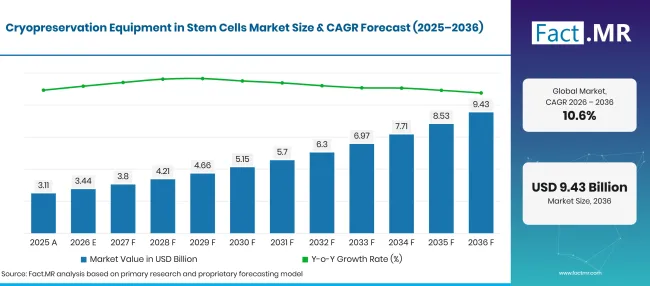
Cryopreservation Equipment In Stem Cells Market Forecast Global | Source: Fact.MR
| Year | Basis | Market Value (USD billion) |
|---|---|---|
| 2025 | Actual | 3.11 |
| 2026 | Estimate | 3.44 |
| 2036 | Forecast | 9.43 |
| CAGR 2026 to 2036 | Forecast period | 10.6% |
Source: Fact.MR analysis. Updated Nov 5, 2026
What are the defining numbers behind Cryopreservation Equipment in Stem Cells Market growth?
The 2026 to 2036 period will add USD 6.0 billion in new equipment value, concentrated in storage systems bought by biobanks for cord blood inventories.
- Demand Drivers in the Market
- Public cord blood inventories keep growing. HRSA reports that the National Cord Blood Inventory has collected more than 129,700 units in total, with more than 3,900 added in FY2025 [1]. Every new unit needs a validated freeze and a permanent place in a cryogenic vessel.
- European regulators continue to clear advanced therapies that depend on frozen cells. EMA’s review of 2025 lists 104 positive opinions for human medicines, four of them for advanced therapy medicinal products [2]. Each approved cell product extends the chain of freezers, storage tanks and thawers that hospitals and manufacturers must run.
- Cord blood derived cell therapy has gained new indications. Gamida Cell announced on 5 December 2025 that the FDA approved Omisirge for severe aplastic anemia, its first cell therapy approval for that disease [3]. Wider clinical use of expanded cord blood products raises the value of each stored unit.
- Biobanks and research institutes are replacing manual dewars with automated stores that log each sample movement. Robotic picking at cryogenic temperatures limits warming events that damage cell viability.
- Key Segments Analyzed
- By Product Type: Storage Systems will hold 36.8% share in 2026, since every banked stem cell unit spends most of its life inside a liquid nitrogen vessel or mechanical cryogenic freezer.
- By Application: Cord Blood Stem Cells will account for 61.2% of 2026 value, given the scale of public and family banks that freeze and store umbilical cord units for transplant.
- By End-User: Biobanks will capture 45.9% of 2026 demand, as they hold the long-term inventories that justify high-capacity and automated storage.
- Analyst Opinion at Fact.MR
- Shambhu Nath Jha, Principal Consultant at Fact.MR, states, “Stem cell banks now judge equipment on the strength of its temperature record, because a single excursion can make a stored unit unusable for transplant. Suppliers that pair liquid nitrogen storage with continuous monitoring, alarm escalation and service contracts will win most of the new tenders. Through 2036, cell therapy manufacturing will add a second buyer group that wants controlled-rate freezing and dry thawing documented to GMP standards.”
- Strategic Implications
- Manufacturers should build dual temperature probes, data logging and remote alarms into standard storage units, since regulators increasingly write these features into facility rules.
- Distributors should offer liquid nitrogen supply and preventive maintenance alongside freezer sales, because running costs shape the purchase decision at smaller banks.
- Biobank and cord blood bank operators should plan storage expansion against inventory growth and choose systems that allow inventory transfer without warming samples.
- Investors should look at service revenue and installed base in cord blood banking, where equipment stays in use for many years once validated.
Germany heads the five-country group at 13.8%, as new public and industry investment in gene and cell therapy production moves into the build phase. The United Kingdom follows a full point behind at 12.8%, supported by a national life sciences plan that targets faster clinical trials. The United States trails by only 0.3 points at 12.5%, with growth resting on an already large public cord blood registry. A wider gap of 1.6 points separates the US from Japan at 10.9%, where regulation of regenerative medicine was revised in 2025. Brazil completes the set at 9.6%, reflecting a transplant system that is expanding but still relies on fewer specialised storage sites.
How does the Cryopreservation Equipment in Stem Cells Market break down by segment?
Storage Systems will lead Product Type at 36.8%; Cord Blood Stem Cells will head Application at 61.2%; Biobanks will hold End-User at 45.9% in 2026.
Which Product Type leads?
Storage Systems take 36.8% of 2026 sales.
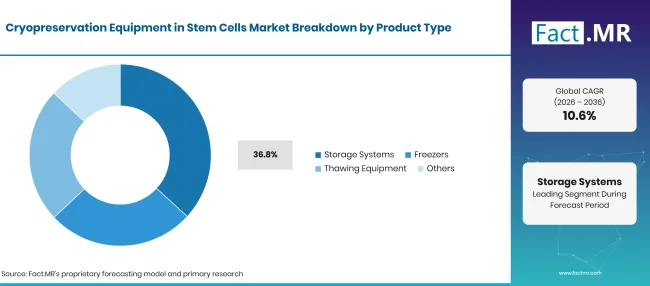
Cryopreservation Equipment In Stem Cells Market Breakdown Product Type | Source: Fact.MR
| Product Type | Share (2026) |
|---|---|
| Storage Systems (Leading segment) | 36.8% |
| Other segments combined | 63.2%* |
| Total | 100.0% |
Source: Fact.MR analysis. Updated Nov 5, 2026
Banked stem cells may wait a decade or longer before release, and for all of that time they depend on a vessel that holds them below the glass transition point of water. Vapour-phase liquid nitrogen tanks, mechanical freezers at minus 150°C and automated stores form this group. Dubai Health Authority standards issued in February 2025 require cryogenic vessels to stay below minus 150°C, with dual temperature probes, continuous data logging and automated SMS or email alerts [4]. Rules of this kind turn monitoring into a basic purchase requirement. Buyers comparing tank formats often start with the wider cryogenic storage tanks category. Freezers cover controlled-rate units that cool cells at a set rate, often around one degree per minute, before transfer to long-term storage. Thawing equipment includes dry, water-free thawers that warm bags and vials at the bedside or in the manufacturing suite. Other products include racks, canisters and inventory readers. Facilities that already run biomedical refrigerators and freezers often add controlled-rate freezing when they start cell work.
What supports Cord Blood Stem Cells within Application?
Cord Blood Stem Cells represent 32.6% of 2026 revenue.
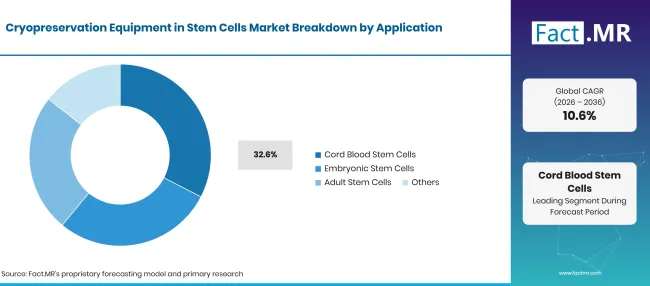
Cryopreservation Equipment In Stem Cells Market Breakdown Application | Source: Fact.MR
| Application | Share (2026) |
|---|---|
| Cord Blood Stem Cells (Leading segment) | 32.6% |
| Other segments combined | 38.8%* |
| Total | 100.0% |
Source: Fact.MR analysis. Updated Nov 5, 2026
Umbilical cord units are collected at birth, processed within hours and frozen for patients who may need a transplant years later. That model creates a steady flow of new units into storage. In Europe, the CAT report of December 2025 lists Zemcelpro, a cord blood derived therapy, among the authorised advanced therapies [5]. The FDA label page for Omisirge, updated in February 2026, covers patients planned for umbilical cord blood transplantation [6]. Adult stem cells, such as bone marrow and peripheral blood progenitors, are frozen for autologous transplant and for cell therapy starting material. Embryonic stem cell lines are stored mainly in research settings, in smaller volumes and under strict ethical rules. Developers in this group also buy tools covered under cell therapy technologies for processing before freezing.
What leads the End-User segment?
Biobanks account for 34.2% of 2026 demand.
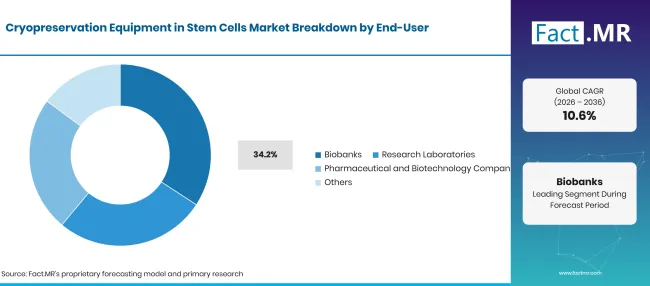
Cryopreservation Equipment In Stem Cells Market Breakdown End User | Source: Fact.MR
| End-User | Share (2026) |
|---|---|
| Biobanks (Leading segment) | 34.2% |
| Other segments combined | 54.1%* |
| Total | 100.0% |
Source: Fact.MR analysis. Updated Nov 5, 2026
Biobanks run inventories that grow every year and rarely shrink, so they keep buying storage capacity and inventory software. Cryoport’s MVE Biological Solutions launched the HE 800 C freezer in March 2025, holding over 22,000 straws at minus 190°C for biorepositories and clinical laboratories [7]. Equipment of this size suits banks that manage cord blood and research collections in one room. Planning for new capacity also draws on biobanking equipment budgets. Pharmaceutical and biotechnology companies hold master cell banks and patient batches for clinical trials, so they focus on traceability and GMP audit records. Research laboratories keep smaller stem cell line collections and often share core freezer facilities. Their purchases track grant cycles and the growth of the wider biobanking sector.
What is accelerating Cryopreservation Equipment in Stem Cells Market adoption, and what is holding it back?
Growing cord blood inventories, new cell therapy approvals and stricter storage standards push banks and laboratories toward monitored cryogenic systems. Adoption slows where buyers face the high price of automated stores, recurring liquid nitrogen bills and the cost of validating equipment before clinical use.
Drivers Impact Analysis
| DRIVER | (~) % IMPACT ON CAGR | GEOGRAPHIC RELEVANCE | IMPACT TIMELINE |
|---|---|---|---|
| Expansion of public and private cord blood banking infrastructure | +3.2% | Global | Medium term (2-4 years) |
| Growing cell and gene therapy research requiring controlled-rate freezing | +2.8% | North America, Western Europe, East Asia | Medium term (2-4 years) |
| Increasing biobank investments and long-term biological sample preservation | +2.4% | Global | Long term (>=4 years) |
| Adoption of automated cryogenic storage and sample monitoring systems | +1.6% | North America, Western Europe, East Asia | Short term (<=2 years) |
| Integrated temperature monitoring, inventory tracking and remote alarm technologies | +0.6% | Global | Medium term (2-4 years) |
Source: Fact.MR analysis. Updated Nov 5, 2026
Opportunity Impact Analysis
| OPPORTUNITY | (~) % IMPACT ON CAGR | GEOGRAPHIC RELEVANCE | IMPACT TIMELINE |
|---|---|---|---|
| Compact and benchtop freezing units for smaller clinics and laboratories | +1.2% | Global | Medium term (2-4 years) |
| New stem cell and cord blood banks opening in emerging markets | +0.9% | Latin America, South Asia & Pacific, Middle East & Africa | Long term (>=4 years) |
| Closed, GMP-ready freezing systems for commercial cell therapy manufacturing | +0.6% | North America, Western Europe, East Asia | Medium term (2-4 years) |
| Storage units that use less liquid nitrogen and cost less to operate | +0.3% | Global | Long term (>=4 years) |
Source: Fact.MR analysis. Updated Nov 5, 2026
Restraints Impact Analysis
| RESTRAINT | (~) % IMPACT ON CAGR | GEOGRAPHIC RELEVANCE | IMPACT TIMELINE |
|---|---|---|---|
| High upfront cost of automated cryogenic storage systems | -1.3% | Global | Short term (<=2 years) |
| Liquid nitrogen supply, servicing and maintenance costs | -0.9% | Global | Medium term (2-4 years) |
| Validation and quality documentation before storage systems enter clinical use | -0.5% | North America, Western Europe | Medium term (2-4 years) |
| Low awareness of stem cell banking in price-sensitive regions | -0.3% | Latin America, South Asia & Pacific, Middle East & Africa | Long term (>=4 years) |
Source: Fact.MR analysis. Updated Nov 5, 2026
Which countries are scaling the Cryopreservation Equipment in Stem Cells Market through 2036?
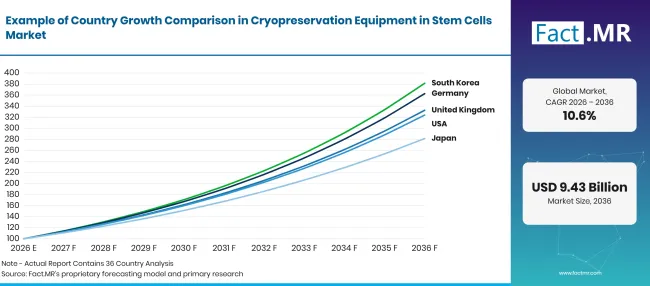
Cryopreservation Equipment In Stem Cells Market Growth Index | Source: Fact.MR
| Country | CAGR (2026 to 2036) |
|---|---|
| Germany | 13.8% |
| United Kingdom | 12.8% |
| United States | 12.5% |
| Japan | 10.9% |
| Brazil | 9.6% |
Source: Fact.MR analysis. Updated Nov 5, 2026
What supports adoption in Germany?
13.8% CAGR, driven by new GMP capacity for gene and cell therapies.
Construction of the Berlin Center for Gene and Cell Therapies started in September 2025, with a building of about 20,000 square metres due to open in 2028 [8]. The federal research ministry will contribute EUR 76.5 million over ten years, and the site will include a GMP facility for clinical-phase cell products. Projects of this type need controlled-rate freezers, cryogenic stores and thawing systems from the first batch. University hospitals and biobanks in Germany also keep upgrading storage to meet audit and traceability demands.
How is the United Kingdom developing demand?
12.8% CAGR, backed by public funding that aims to shorten clinical trial set-up.
The Life Sciences Sector Plan, published in September 2025, commits up to GBP 520 million to the Life Sciences Innovative Manufacturing Fund and sets a target to cut commercial trial set-up to under 150 days [9]. Faster trials bring more cell therapy studies, and each study site needs frozen starting material and a thawing protocol. UK universities, cord blood programmes and contract manufacturers already run large liquid nitrogen stores. That base gives suppliers of monitored storage and gene therapy support equipment a steady customer list.
What is shaping the United States’ adoption?
12.5% CAGR, reflecting a national cord blood registry of more than 247,900 units.
HRSA counts more than 247,900 cord blood units available on the national registry and over 8,400 unrelated blood stem cell transplants in FY2025, including over 6,550 for US patients [1]. Each transplant draws on units that have been held in validated cryogenic storage, often for years. Cell therapy manufacturers add a second line of demand, as they freeze apheresis material and finished doses for shipment to treatment centres.
What supports adoption in Japan?
10.9% CAGR, as revised regenerative medicine rules widen the range of regulated therapies.
The Ministry of Health, Labour and Welfare amended the Act on the Safety of Regenerative Medicine, with the changes taking effect on 31 May 2025 [10]. The revision brought in vivo gene therapy into the law’s scope, extending oversight to more clinics and research groups. Facilities that process and store cells under the Act need documented freezing and storage records. Japan’s mature hospital network and cord blood banks give a steady replacement market for freezers and dewars.
How does Brazil perform?
9.6% CAGR, helped by a record year for transplants in 2025.
Brazil performed about 31,000 transplants in 2025, a national record, including 3,993 bone marrow transplants [11]. Most of this activity runs through the public health system, and stem cell transplant centres need freezers and storage tanks to hold collected cells before infusion. Growth trails the other four countries because storage capacity is concentrated in a small number of large public and private centres.
Who leads the Cryopreservation Equipment in Stem Cells Market?
Competition divides into three roles. Broad laboratory suppliers, led by Thermo Fisher Scientific with its CryoMed controlled-rate freezers and Cytiva with VIA Freeze freezers and VIA Thaw dry thawers, sell into GMP cell therapy suites where buyers want one vendor for the whole freeze and thaw step. Storage specialists compete on capacity and liquid nitrogen efficiency.
Cryoport’s MVE Biological Solutions added the HE 800 C freezer in March 2025 [7] and introduced the Fusion 800 Series in February 2026, a self-sustaining freezer that holds samples at or below minus 150°C without a continuous liquid nitrogen supply [12]. Azenta Life Sciences offers automated cryogenic storage to minus 190°C for biobanks that need robotic picking. Haier Biomedical and PHC Holdings supply liquid nitrogen containers and ultra-low freezers to hospital and research buyers, while Planer serves cord blood and fertility laboratories with Kryo controlled-rate freezers. Service reach and documented temperature control will decide most contracts through 2036.
Which companies are the key providers?
Key companies in the Cryopreservation Equipment in Stem Cells Market include Thermo Fisher Scientific, Cytiva, Cryoport (MVE Biological Solutions), Azenta Life Sciences, Haier Biomedical, PHC Holdings and Planer.
- Thermo Fisher Scientific
- Cytiva
- Cryoport (MVE Biological Solutions)
- Azenta Life Sciences
- Haier Biomedical
- PHC Holdings
- Planer
Bibliography
- [1] Health Resources and Services Administration. (2026, October 22). Donation and Transplantation Statistics.
- [2] European Medicines Agency. (2026). Human Medicines in 2025.
- [3] Gamida Cell. (2025, December 5). FDA approves Omisirge as First Approved Cell Therapy to Treat Severe Aplastic Anemia.
- [4] Dubai Health Authority. (2025, February 20). Standards for Stem Cells and Regenerative Medicine.
- [5] European Medicines Agency. (2025, December 2). CAT quarterly highlights and approved ATMPs.
- [6] U.S. Food and Drug Administration. (2026, February 12). OMISIRGE.
- [7] Cryoport. (2025, March 12). Cryoport’s MVE Biological Solutions Expands High-Efficiency Cryogenic Freezer Series With Answer to Evolving Needs of Fertility Clinics, Biorepositories and Clinical Laboratories.
- [8] Bayer. (2025, September 16). Mehr als ein Spatenstich: Baubeginn für das Berlin Center for Gene and Cell Therapies.
- [9] Department for Science, Innovation and Technology and Office for Life Sciences. (2025, September 12). Life Sciences Sector Plan.
- [10] Ministry of Health, Labour and Welfare. (2026, September 2).
- [11] Agência Brasil. (2026, May 7). Brasil bate recorde de transplantes em 2025.
- [12] Cryoport. (2026, February 11). Cryoport’s MVE Biological Solutions Introduces New Fusion 800 Series.
This Report Answers
- How is revenue split between storage systems, freezers and thawing equipment used for stem cells?
- Why do cord blood stem cells account for most application demand, and what storage conditions do banks require?
- What makes biobanks the main buyer group, and how are they adding automated cryogenic capacity?
- Which technologies, from controlled-rate freezing to remote alarms, are changing how suppliers compete?
- How do Germany, the United Kingdom, the United States, Japan and Brazil differ in growth through 2036?
- Which regulatory standards for stem cell storage shape equipment specifications?
What does the Cryopreservation Equipment in Stem Cells Market cover?
This study tracks equipment that preserves stem cells through controlled freezing, cryogenic storage and thawing. Storage systems, controlled-rate freezers, cryogenic containers and dry thawers form the main product groups.
Revenue is valued at the equipment sale price paid by the end facility, across cord blood, embryonic and adult stem cells. Liquid nitrogen vessels, temperature monitoring modules and automated sample management systems are counted when sold as part of a qualifying unit.
What is included in the scope?
Cryogenic storage systems, liquid nitrogen storage vessels and mechanical cryogenic freezers used for stem cell preservation.
Controlled-rate freezers and passive freezing devices designed for stem cell and cord blood processing.
Dry and water bath thawing equipment used to warm stem cell bags and vials before infusion or culture.
Automated cryogenic stores with temperature monitoring, sample identification and inventory software sold with the hardware.
What is excluded from the scope?
Stem cell collection, transplantation services and cell therapy treatment charges.
Culture media, cryoprotective agents and preservation reagents sold on their own.
General-purpose laboratory instruments and standard refrigerators not designed for cryogenic use.
Sample shipping services and revenue from stem cell banking fees or stored biological material.
How Was the Analysis Built?
The analysis draws on 120+ sources, 35+ company portfolios, 25+ countries, and more than 20 industry interviews.
- Primary Research: Primary research includes discussions with manufacturers, service providers, technology developers, distributors, end users, and subject-matter experts. These conversations examine purchasing priorities, product adoption, operational challenges, approval requirements, competitive positioning, and the factors that influence wider market acceptance.
- Desk Research: Desk research covers government statistics, regulatory publications, company filings, trade data, technical studies, industry associations, standards, public policy, and other authoritative sources. Every source used in the analysis is documented in the bibliography.
- Market Sizing and Forecasting: Market estimates combine historical performance, demand indicators, pricing and volume trends, segment shares, company participation, country-level growth, adoption patterns, investment activity, and barriers to market expansion.
- Data Validation and Update Cycle: Findings are validated by comparing primary interviews with public data, company activity, regulatory changes, trade patterns, and industry developments. Regular updates review new product launches, capacity changes, partnerships, approvals, and shifts in commercial adoption.
Segmentation
What is the report’s scope and coverage?
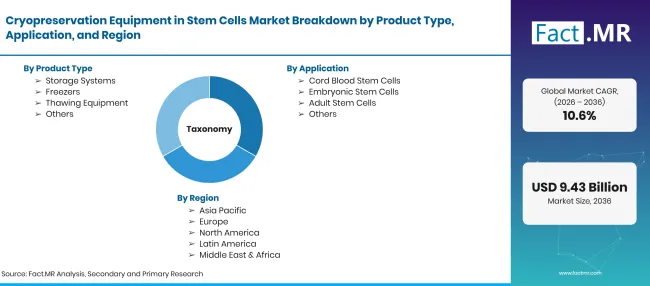
Cryopreservation Equipment In Stem Cells Market Taxonomy | Source: Fact.MR
| Attribute | Details |
|---|---|
| Quantitative Units | USD billion |
| Market Definition | Equipment used to freeze, store and thaw stem cells under controlled low-temperature conditions, covering cryogenic storage systems, controlled-rate freezers and thawing equipment used in banking, research and therapy development. |
| Product Type | Storage Systems; Freezers; Thawing Equipment; Others |
| Application | Cord Blood Stem Cells; Embryonic Stem Cells; Adult Stem Cells; Others |
| End-User | Biobanks; Research Laboratories; Pharmaceutical and Biotechnology Companies; Others |
| Regions Covered | North America; Latin America; Western Europe; Eastern Europe; East Asia; South Asia & Pacific; Middle East & Africa |
| Countries Covered | Germany; United Kingdom; United States; Japan; Brazil |
| Companies Profiled | Thermo Fisher Scientific; Cytiva; Cryoport (MVE Biological Solutions); Azenta Life Sciences; Haier Biomedical; PHC Holdings; Planer |
| Forecast Period | 2026 to 2036 |
| Approach | Hybrid top-down and bottom-up model built on stem cell banking volumes by country, installed cryogenic storage capacity, controlled-rate freezer demand and manufacturer portfolio review. |
Source: Fact.MR analysis. Updated Nov 5, 2026
How is the market segmented?
-
By Product Type
- Storage Systems
- Freezers
- Thawing Equipment
- Others
-
By Application
- Cord Blood Stem Cells
- Embryonic Stem Cells
- Adult Stem Cells
- Others
-
By End-User
- Biobanks
- Research Laboratories
- Pharmaceutical and Biotechnology Companies
- Others
-
By Region
- North America
- Latin America
- Western Europe
- Eastern Europe
- East Asia
- South Asia & Pacific
- Middle East & Africa
Frequently Asked Questions
How large is the cryopreservation equipment in stem cells market in 2026?
What growth rate will the cryopreservation equipment in stem cells market record?
Which product type leads?
Which application leads?
Which end-user leads?
Which country will grow quickest?
Who are the main companies?
What holds the market back?
Who worked on this report


Preview the report firsthand - request a free sample
Free SampleGet the brochure for pricing and purchase details
Download PDF