- Market Value (2025): USD 17.0 Mn
- Estimated Value (2026): USD 18.5 Mn
- Forecast Value (2036): USD 42.2 Mn
- CAGR (2026-2036): 8.6%
What is the Adult Stem Cells Market forecast to be worth by 2036?
USD 18.5 billion in 2026 to USD 42.2 billion by 2036 at 8.6% CAGR.
- The adult stem cells market crossed a valuation of USD 17.0 billion in 2025 as hospitals and specialty clinics continued to fund hematopoietic stem cell use. Demand depends on treatment planning and controlled supply needs.
- Demand is projected to increase from USD 18.5 billion in 2026 to USD 42.2 billion by 2036. Growth remains connected with clinical validation and dependable cell handling.
- The market is forecast to record 8.6% CAGR from 2026 to 2036. Adoption depends on whether providers can prove safe use and repeat clinical value.
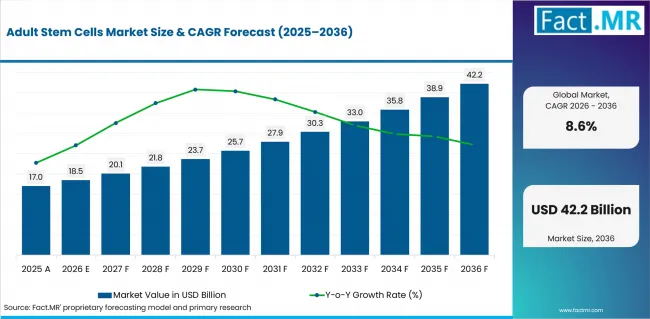
Adult Stem Cells Market Value Analysis | Source: Fact.MR
What are the defining numbers behind Adult Stem Cells Market growth?
USD 23.7 billion absolute growth opportunity by 2036, led by Hematopoietic Stem Cells and Regenerative Medicine alongside Hospitals & Specialty Clinics and Direct Sales.
- Demand Drivers in the Market
- Hematopoietic stem cell demand is likely to remain anchored in transplant workflows. Clinicians already understand collection and matching requirements. Suppliers gain preference when products support repeat handling and clear documentation.
- Regenerative medicine use is anticipated to raise demand for adult stem cell inputs that can pass safety and quality review. Buyers are likely to favor suppliers that explain controls in simple clinical terms.
- Hospital and specialty clinic purchasing is likely to expand where physicians need dependable cell access. Procurement teams are expected to compare validation support before they widen supplier panels.
- Direct sales should remain useful when clinical buyers need guidance before larger orders. Clear onboarding and training are expected to matter more than broad catalog range.
- Key Segments Analyzed
- By Cell Type: Hematopoietic Stem Cells are expected to hold 36.9% share in 2026. The segment leads because transplant programs already understand collection and monitoring during patient care.
- By Application: Regenerative Medicine is projected to hold 31.8% share in 2026. The application gains preference where clinical teams need adult stem cell options for repair and therapy development.
- By End User: Hospitals & Specialty Clinics are anticipated to capture 31.1% share in 2026. These buyers need validated supply and follow-up support before wider clinical use.
- By Distribution Channel: Direct Sales are estimated to represent 30.5% share in 2026. The route leads when suppliers answer technical questions during procurement review.
- By Therapy Type: Autologous Stem Cell Therapy is forecast to hold 36.8% share in 2026. The therapy type benefits when care teams prefer patient-derived cells and controlled collection steps.
- Analyst Opinion at Fact.MR
- Shambhu Nath Jha, Senior Analyst at Fact.MR, states, “In the adult stem cells market the practical test is whether suppliers can defend safety and handling claims without adding a second review burden. Buyers are asking for operating evidence instead of catalog breadth.”
- Strategic Implications
- Hospitals and specialty clinics should connect adult stem cell purchases with validation records before expanding use. Product selection then stays close to patient-care needs and review teams receive clearer evidence.
- Suppliers can improve acceptance by showing how cell type choices fit treatment planning and follow-up needs. Clear documentation and service response are likely to matter during procurement review.
- Investors should separate adult stem cell suppliers with documented clinical support from firms that rely only on product range. Commercial strength is expected to come from repeat supply and buyer trust.
The USA is expected to record a 11.2% CAGR from 2026 to 2036 supported by clinical documentation needs. Japan is projected to record an 10.3% CAGR as regenerative medicine programs favor reliable quality controls. Germany is anticipated to grow at 9.5% through institutional review and hospital demand. The UK is estimated to post an 8.6% CAGR through supplier support and regulatory fit. Canada is forecast at 7.7%. Australia is projected to reach 6.9% and Brazil is forecast to record 6.0% through distributor-led access.
How does the Adult Stem Cells Market break down by segment?
Hematopoietic Stem Cells are expected to lead Cell Type at 36.9% share in 2026. Regenerative Medicine is projected to lead Application at 31.8% share in 2026.
Which cell type dominates?
Hematopoietic Stem Cells are projected to account for 36.9% share in 2026.
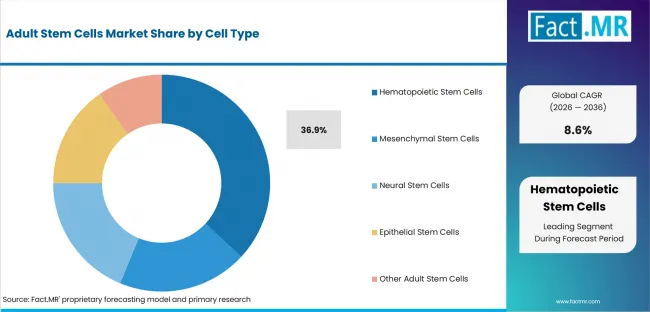
Adult Stem Cells Market Analysis By Cell Type | Source: Fact.MR
Hematopoietic Stem Cells hold the leading position due to their established role in treating blood-related disorders and supporting bone marrow transplantation. Peripheral Blood Stem Cells provide a less invasive collection option, while Bone Marrow Derived HSCs remain important in traditional transplant procedures. Mesenchymal Stem Cells serve a different market need through tissue-repair research, immune modulation studies and emerging regenerative applications.
What leads the Application segment?
Regenerative Medicine is projected to hold 31.8% share in 2026.
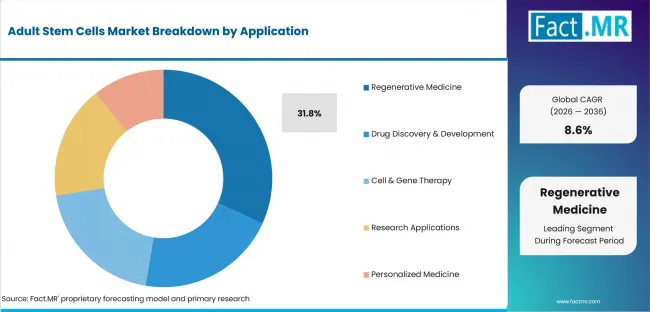
Adult Stem Cells Market Analysis By Application | Source: Fact.MR
Regenerative Medicine gains the largest share as adult stem cells are increasingly studied for restoring damaged tissues and improving recovery after injury or disease. Tissue Regeneration supports wound, cartilage and bone-repair programs, while Organ Repair focuses on conditions affecting the heart, liver and other organs. Drug Discovery & Development creates additional demand by using stem cells in disease models, toxicity testing and treatment screening.
How does End User shape demand?
Hospitals & Specialty Clinics are anticipated to lead with 31.1% share in 2026.
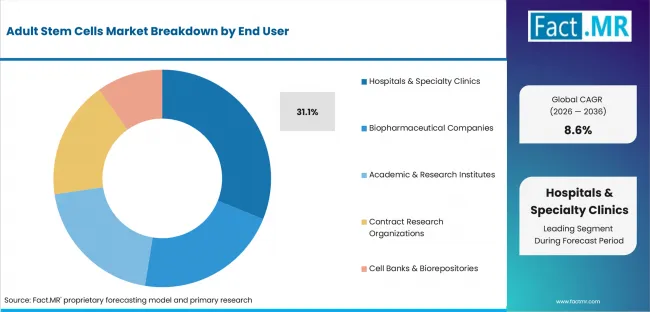
Adult Stem Cells Market Analysis By End User | Source: Fact.MR
Hospitals & Specialty Clinics represent the main end-user group because they manage patient evaluation, cell administration and post-treatment monitoring. Stem Cell Therapy Centers focus on specialized procedures and personalized treatment programs. Transplant Centers generate concentrated demand for hematopoietic cell products, while Biopharmaceutical Companies use adult stem cells for clinical research, therapy development and manufacturing-process validation.
What supports Direct Sales within Distribution Channel?
Direct Sales are estimated to represent 30.5% share in 2026.
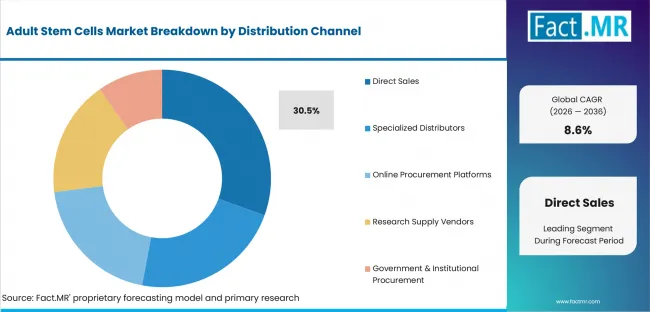
Adult Stem Cells Market Analysis By Distribution Channel | Source: Fact.MR
Direct Sales remain the preferred channel because hospitals, research centers and biotechnology companies often require customized cell specifications, technical guidance and controlled delivery schedules. Manufacturer Sales Teams manage product selection and regulatory documentation, while Institutional Contracts support recurring high-volume purchases. Specialized Distributors mainly serve smaller laboratories and regional customers that need quicker access, local inventory and simplified order handling.
Why does Autologous Stem Cell Therapy lead Therapy Type?
Autologous Stem Cell Therapy is forecast to hold 36.8% share in 2026.
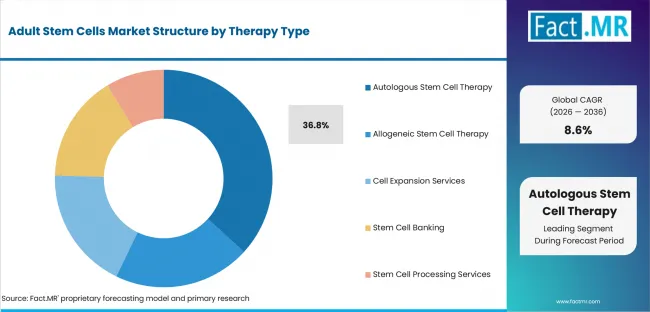
Adult Stem Cells Market Analysis By Therapy Type | Source: Fact.MR
Autologous Stem Cell Therapy leads because it uses a patient’s own cells, lowering the risk of immune rejection and reducing dependence on donor availability. Bone Marrow Transplantation remains widely used for blood cancers and serious hematological conditions. Adipose-Derived Stem Cell Therapy attracts interest in orthopedic and cosmetic applications, while Allogeneic Stem Cell Therapy supports standardized treatments where suitable donor cells are available.
What is accelerating Adult Stem Cells Market adoption, and what is holding it back?
Demand is expected to grow due to established transplant use and hospital purchasing. Growth may be limited by complex validation requirements and inconsistent supplier support.
Drivers Impact Analysis
| DRIVER | QUALITATIVE RELEVANCE | GEOGRAPHIC RELEVANCE | IMPACT TIMELINE |
|---|---|---|---|
| Hematopoietic stem cell workflow use | High | USA | Short term (<= 2 years) |
| Regenerative medicine clinical review | High | Japan | Short term (<= 2 years) |
| Hospital and specialty clinic purchasing | Moderate | Germany | Medium term (2-4 years) |
| Direct supplier support and training | Selective | UK | Medium term (2-4 years) |
Source: Fact.MR analysis. Updated Jul 28, 2026
- Hematopoietic stem cell workflow use: Hospitals already understand the clinical path for collection and follow-up. Suppliers may gain preference when products fit those established steps.
- Regerenative medicine clinical review: Adult stem cell use is likely to depend on evidence that answers safety and quality questions. Providers that explain documentation clearly may shorten buyer review.
- Hospital and specialty clinic purchasing: Clinical buyers are likely to compare service response before adding suppliers. This favors companies that can support routine care and research needs together.
- Direct supplier support and training: Direct sales can help when buyers need guidance on handling and repeat ordering. The channel can reduce approval friction after purchase.
Opportunity Impact Analysis
| OPPORTUNITY | QUALITATIVE RELEVANCE | GEOGRAPHIC RELEVANCE | IMPACT TIMELINE |
|---|---|---|---|
| Regenerative medicine workflow packages | High | USA | Medium term (2-4 years) |
| Provider network expansion | Moderate | Japan | Medium term (2-4 years) |
| Hematopoietic stem cell validation support | Selective | Germany | Medium term (2-4 years) |
Source: Fact.MR analysis. Updated Jul 28, 2026
- Regenerative medicine workflow packages: Suppliers can build demand by pairing cells with handling instructions and service support. The best proposals are likely to solve a named clinical or research workflow problem.
- Provider network expansion: Wider provider access can help markets where clinicians need reliable supply without long ordering delays. Local training and service coverage can make adoption easier for smaller programs.
- Hematopoietic stem cell validation support: Suppliers can create openings by helping hospitals compare products on documentation and repeat-use evidence. This should matter when procurement teams require proof before larger commitments.
Restraints Impact Analysis
| RESTRAINT | QUALITATIVE RELEVANCE | GEOGRAPHIC RELEVANCE | IMPACT TIMELINE |
|---|---|---|---|
| Validation burden and reimbursement pressure | High | USA | Short term (<= 2 years) |
| Price sensitivity around regenerative medicine | Moderate | Japan | Medium term (2-4 years) |
| Slow conversion where supplier support is limited | Selective | Germany | Medium term (2-4 years) |
Source: Fact.MR analysis. Updated Jul 28, 2026
- Validation burden and reimbursement pressure: Buyers may delay adoption when clinical evidence and payment support remain unclear. This restraint is likely to be sharper for newer adult stem cell applications.
- Price sensitivity around regenerative medicine: Programs can slow when higher product costs are not matched by clear clinical-use evidence. Suppliers need to show how the added cost improves the workflow.
- Slow conversion where supplier support is limited: Smaller providers may face pressure when hospitals ask for training and repeat supply. Weak support can extend review time before a purchase is approved.
Which countries are scaling Adult Stem Cells Market fastest?
The country comparison is defined by a narrow spread between the listed markets. The USA and Japan form the upper pair because both markets place weight on clinical documentation and supplier reliability. Germany and the UK create a middle cluster where institutional review and service evidence shape purchasing. Canada and Australia remain close to the global path. Brazil depends more on distributor access and care-network expansion.
- The USA shows the highest listed rate because hospitals and specialty clinics place more weight on documentation and channel accountability.
- Japan remains close to the USA because regenerative medicine programs place more value on quality control and careful supplier qualification.
- Germany holds a measured position where institutional buyers review clinical evidence before changing approved supply routes.
- The UK remains near the middle of the group because buyers balance regulatory fit and supplier support before expanding use.
- Canada stays slightly below the UK because large service geographies make reliable distribution central to adoption.
- Australia follows Canada as distance and service availability make supplier dependability central to clinical and research purchasing.
- Brazil records the lowest listed CAGR because regional access and financing comfort remain central before wider adoption.
Comparable CAGRs can therefore produce different entry conditions across these countries. Deployment timing depends on buyer evidence and service depth. Commercial readiness depends on whether suppliers can support clinical or research workflows after the first purchase.
The full report provides country-level CAGR analysis across North America, Latin America, Europe, East Asia, South Asia and Oceania and the Middle East and Africa.
| Country | CAGR (2026-2036) |
|---|---|
| USA | 11.2% |
| Japan | 10.3% |
| Germany | 9.5% |
| UK | 8.6% |
| Canada | 7.7% |
| Australia | 6.9% |
| Brazil | 6.0% |
Source: Fact.MR analysis. Updated Jul 28, 2026
What supports USA adoption?
11.2% CAGR, supported by established transplant infrastructure and strong clinical research activity.
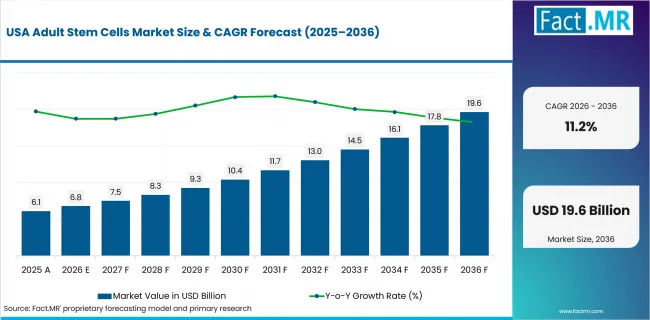
Adult Stem Cells Market Country Value Analysis | Source: Fact.MR
The USA benefits from a large network of transplant centers, biotechnology companies and research hospitals. Demand is expected to rise as these institutions expand cell-based studies and treatment programs. Hematopoietic stem cells remain central to established blood disorder therapies, while private investment and clinical trial activity support broader use across regenerative medicine and drug development.
How is Japan building demand?
10.3% CAGR, driven by regenerative medicine policy support and advanced cell-processing capabilities.
Japan’s market is expanding through national interest in regenerative therapies and structured approval pathways for cell-based treatments. Research institutions and therapy developers are focusing on tissue repair, neurological conditions and age-related diseases. Growth is also supported by strong laboratory standards, skilled clinical teams and demand for highly controlled cell preparation methods.
What shapes Germany’s outlook through 2036?
9.5% CAGR, backed by academic research strength and specialized hospital networks.
Germany’s growth is linked to its strong university hospitals, biomedical research centers and established transplant expertise. Demand is expected to increase through oncology, hematology and cell-therapy research programs. Hospitals place strong emphasis on product quality, traceability and laboratory consistency, which favors suppliers that can meet detailed institutional standards and support long-term clinical projects.
How does the UK perform?
8.6% CAGR, led by clinical trial activity and collaboration between hospitals and biotechnology firms.
The UK market is supported by research partnerships that connect universities, specialist hospitals and therapy developers. Adult stem cells are increasingly used in early-stage studies, disease modeling and treatment evaluation. Growth is also shaped by the country’s strong life-sciences ecosystem, although adoption may vary depending on funding access and approval timelines.
What supports Canada’s growth?
7.7% CAGR, backed by public research funding and demand for advanced treatment options.
Canada’s market is developing through government-supported research programs and specialized centers focused on cancer, blood disorders and regenerative medicine. Academic institutions continue to test adult stem cells in controlled clinical settings. Demand is also supported by interest in autologous therapies, particularly where patients can receive treatment using their own collected cells.
How is Australia developing demand?
6.9% CAGR, supported by transplant services and expanding regenerative medicine research.
Australia’s growth is tied to major urban hospitals, stem cell research institutes and established blood cancer treatment programs. Demand is expected to increase as researchers explore applications in tissue repair, immune-related conditions and neurological disorders. The market also benefits from strong clinical oversight and growing collaboration between universities and healthcare providers.
What supports Brazil’s outlook?
6.0% CAGR, driven by rising healthcare access and a growing network of treatment centers.
Brazil’s market is expanding as more hospitals and private clinics offer advanced procedures for blood disorders and serious chronic conditions. Demand is concentrated in large cities where transplant services and laboratory infrastructure are more developed. Local research activity and wider access to specialized care may gradually support greater use of adult stem cell therapies.
Who leads the Adult Stem Cells Market?
Lonza Group and STEMCELL Technologies show the direct relevance. Thermo Fisher Scientific and PromoCell GmbH strengthen the broader cell culture and research-supply landscape.
Lonza Group supports the market through cell and gene therapy manufacturing and process development capability. STEMCELL Technologies contributes reagents and media used in stem cell research workflows. Thermo Fisher Scientific adds life science tools and production support for cell therapy development. PromoCell GmbH supports cell culture supply for research and clinical preparation settings. Cell Applications Inc. and Takara Bio Inc. broaden the provider field through human cells and research-use products. Discovery Life Sciences and Miltenyi Biotec add further supply and processing capabilities.
From 2026 to 2036, competition is likely to depend on documentation quality and repeat supply. Buyers are likely to compare training support and product traceability before expanding supplier relationships. Providers that connect adult stem cell products with clinical or research workflow evidence may gain wider demand.
Which companies are the key providers?
Key companies include Lonza Group; STEMCELL Technologies; Thermo Fisher Scientific; PromoCell GmbH; Cell Applications Inc.; Takara Bio Inc.; Discovery Life Sciences; Miltenyi Biotec.
- Lonza Group
- STEMCELL Technologies
- Thermo Fisher Scientific
- PromoCell GmbH
- Cell Applications Inc.
- Takara Bio Inc.
- Discovery Life Sciences
- Miltenyi Biotec
Bibliography
- U.S. Food and Drug Administration. (2025, December 8). FDA approves first cellular therapy to treat patients with severe aplastic anemia.
- Therapeutic Goods Administration. (2026, July 16). Guideline on quality, non-clinical and clinical aspects of medicinal products containing genetically modified cells. Australian Government.
- Thermo Fisher Scientific. (2025, May 13). Guide to cell therapy GMP manufacturing for autologous CAR-T and beyond.
- PromoCell GmbH. (2025, April 30). Mesenchymal stem cell origin: Why tissue source matters.
- Takara Bio Inc. (2026, February 6). Waskyra, a gene therapy manufactured using RetroNectin, receives U.S. and EU marketing authorization approvals.
This Report Answers
- The report provides strategic intelligence on the Adult Stem Cells Market across Cell Type and Application choices that shape clinical and research purchasing.
- Segment analysis covers Hematopoietic Stem Cells and Regenerative Medicine as the share leaders within the 2026 market structure.
- Country outlook evaluates the USA and Japan alongside Germany and the UK. Canada and Australia complete the growth comparison with Brazil.
- Competitive analysis profiles Lonza Group and STEMCELL Technologies alongside Thermo Fisher Scientific and PromoCell GmbH. Cell Applications Inc. and Takara Bio Inc. complete the provider set with Discovery Life Sciences and Miltenyi Biotec.
- Channel assessment covers Direct Sales and Institutional Contracts. Specialized Distributors and online procurement routes complete the channel view alongside manufacturer sales teams.
What does the Adult Stem Cells Market cover?
Adult stem cells are used in transplant support and regenerative medicine research where validation evidence shapes buyer approval.
The Adult Stem Cells Market covers commercial activity tied to hematopoietic stem cells and related adult cell types. Coverage extends to hospital use and therapy development. It includes cell processing and research supply when buyers use adult stem cell products for care delivery or testing workflows.
The market differs from general life science tools because value comes from controlled cell sourcing and service support. Spending outside adult stem cell products remains outside the boundary. General laboratory supplies are excluded unless they directly support adult stem cell use and processing.
What is included in the scope?
Hospitals and specialty clinics are included where adult stem cell products support clinical or research use.
The scope includes Cell Type and Application alongside End User, Distribution Channel and Therapy Type. Coverage spans hematopoietic stem cells and regenerative medicine. It includes autologous therapy, stem cell banking and processing services. Regional and country demand is included when suppliers support procurement and repeat use.
Channel sales are included when buyers purchase adult stem cell products or configured supply support for treatment planning. Supplier documentation and training remain part of the scope when they influence adoption.
What is excluded from the scope?
Unrelated infrastructure and adjacent life science categories remain outside the scope of this market.
The scope excludes products that do not involve adult stem cell use or direct support for adult stem cell workflows. General laboratory equipment is excluded unless it supports collection or processing. Company revenue without a clear adult stem cell connection is excluded.
How Was the Analysis Built?
The analysis draws on 120+ sources, 35+ company portfolios, 25+ countries, and more than 20 industry interviews.
- Primary Research: Primary research includes discussions with manufacturers, service providers, technology developers, distributors, end users, procurement teams, and subject-matter experts. These conversations examine purchasing priorities, product adoption, operational challenges, approval requirements, competitive positioning, and the factors that influence wider market acceptance.
- Desk Research: Desk research covers government statistics, regulatory publications, company filings, trade data, technical studies, industry associations, standards, public policy, and other authoritative sources. Every source used in the analysis is documented in the bibliography.
- Market Sizing and Forecasting: Market estimates combine historical performance, demand indicators, pricing and volume trends, segment shares, company participation, country-level growth, adoption patterns, investment activity, and barriers to market expansion.
- Data Validation and Update Cycle: Findings are validated by comparing primary interviews with public data, company activity, regulatory changes, trade patterns, and industry developments. Regular updates review new product launches, capacity changes, partnerships, approvals, procurement trends, and shifts in commercial adoption.
Segmentation
What is the report’s scope and coverage?
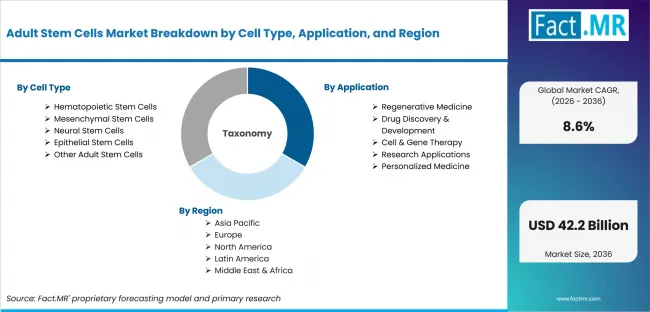
Adult Stem Cells Market Breakdown By Cell Type, Application, And Region | Source: Fact.MR
| Attribute | Details |
|---|---|
| Quantitative Units | USD billion in 2026 to USD billion by 2036 at CAGR |
| Market Definition | Commercial buying and use of adult stem cell products and services for treatment planning, transplantation support, regenerative medicine research and controlled clinical workflows |
| Cell Type | Hematopoietic Stem Cells; Bone Marrow Derived HSCs; Peripheral Blood Stem Cells; Mesenchymal Stem Cells; Bone Marrow MSCs; Adipose Tissue MSCs; Neural Stem Cells; Fetal Neural Stem Cells; Adult Neural Stem Cells; Epithelial Stem Cells; Skin Stem Cells; Corneal Stem Cells; Other Adult Stem Cells; Intestinal Stem Cells; Hepatic Stem Cells |
| Application | Regenerative Medicine; Tissue Regeneration; Organ Repair; Drug Discovery & Development; Preclinical Drug Screening; Toxicology Studies; Cell & Gene Therapy; Cell-Based Therapy; Gene-Modified Cell Therapy; Research Applications; Stem Cell Biology Research; Disease Modeling; Personalized Medicine; Precision Therapeutics; Biomarker Discovery |
| End User | Hospitals & Specialty Clinics; Stem Cell Therapy Centers; Transplant Centers; Biopharmaceutical Companies; Cell Therapy Developers; Biotechnology Companies; Academic & Research Institutes; Universities; Research Laboratories; Contract Research Organizations; Preclinical CROs; Clinical Research Organizations; Cell Banks & Biorepositories; Public Cell Banks; Private Cell Banks |
| Distribution Channel | Direct Sales; Manufacturer Sales Teams; Institutional Contracts; Specialized Distributors; Life Science Distributors; Biomedical Suppliers; Online Procurement Platforms; Manufacturer Websites; B2B E-Commerce Platforms; Research Supply Vendors; Laboratory Supply Companies; Scientific Equipment Suppliers; Government & Institutional Procurement; Public Healthcare Tenders; Research Grant Procurement |
| Therapy Type | Autologous Stem Cell Therapy; Bone Marrow Transplantation; Adipose-Derived Stem Cell Therapy; Allogeneic Stem Cell Therapy; Matched Donor Transplantation; Umbilical Cord Blood Supported Therapy; Cell Expansion Services; In Vitro Cell Expansion; GMP Cell Processing; Stem Cell Banking; Cryopreservation Services; Long-Term Cell Storage; Stem Cell Processing Services; Cell Isolation; Cell Characterization |
| Regions Covered | North America; Latin America; Europe; East Asia; South Asia and Oceania; Middle East and Africa |
| Countries Covered | USA; Japan; Germany; UK; Canada; Australia; Brazil |
| Key Companies Profiled | Lonza Group; STEMCELL Technologies; Thermo Fisher Scientific; PromoCell GmbH; Cell Applications Inc.; Takara Bio Inc.; Discovery Life Sciences; Miltenyi Biotec |
| Forecast Period | 2026 to 2036 |
| Approach | Hybrid top-down and bottom-up approach using treatment demand; research activity; supplier portfolios; hospital purchasing patterns; clinical workflow needs; country adoption patterns and company participation review |
Source: Fact.MR analysis. Updated Jul 28, 2026
How is the market segmented?
-
By Cell Type:
- Hematopoietic Stem Cells
- Bone Marrow Derived HSCs
- Peripheral Blood Stem Cells
- Mesenchymal Stem Cells
- Bone Marrow MSCs
- Adipose Tissue MSCs
- Neural Stem Cells
- Fetal Neural Stem Cells
- Adult Neural Stem Cells
- Epithelial Stem Cells
- Skin Stem Cells
- Corneal Stem Cells
- Other Adult Stem Cells
- Intestinal Stem Cells
- Hepatic Stem Cells
-
By Application:
- Regenerative Medicine
- Tissue Regeneration
- Organ Repair
- Drug Discovery & Development
- Preclinical Drug Screening
- Toxicology Studies
- Cell & Gene Therapy
- Cell-Based Therapy
- Gene-Modified Cell Therapy
- Research Applications
- Stem Cell Biology Research
- Disease Modeling
- Personalized Medicine
- Precision Therapeutics
- Biomarker Discovery
-
By End User:
- Hospitals & Specialty Clinics
- Stem Cell Therapy Centers
- Transplant Centers
- Biopharmaceutical Companies
- Cell Therapy Developers
- Biotechnology Companies
- Academic & Research Institutes
- Universities
- Research Laboratories
- Contract Research Organizations
- Preclinical CROs
- Clinical Research Organizations
- Cell Banks & Biorepositories
- Public Cell Banks
- Private Cell Banks
-
By Distribution Channel:
- Direct Sales
- Manufacturer Sales Teams
- Institutional Contracts
- Specialized Distributors
- Life Science Distributors
- Biomedical Suppliers
- Online Procurement Platforms
- Manufacturer Websites
- B2B E-Commerce Platforms
- Research Supply Vendors
- Laboratory Supply Companies
- Scientific Equipment Suppliers
- Government & Institutional Procurement
- Public Healthcare Tenders
- Research Grant Procurement
-
By Therapy Type:
- Autologous Stem Cell Therapy
- Bone Marrow Transplantation
- Adipose-Derived Stem Cell Therapy
- Allogeneic Stem Cell Therapy
- Matched Donor Transplantation
- Umbilical Cord Blood Supported Therapy
- Cell Expansion Services
- In Vitro Cell Expansion
- GMP Cell Processing
- Stem Cell Banking
- Cryopreservation Services
- Long-Term Cell Storage
- Stem Cell Processing Services
- Cell Isolation
- Cell Characterization
-
By Region:
- North America
- Latin America
- Europe
- East Asia
- South Asia and Oceania
- Middle East and Africa
Frequently Asked Questions
Which Cell Type leads the market?
Which Application leads the market?
Which End User category leads the market?
Which Distribution Channel leads the market?
Which Therapy Type leads the market?
Which country records the highest listed CAGR?
What is the primary driver in this market?
What is the main restraint?
Why do hospitals and specialty clinics lead demand?
Who worked on this report


Preview the report firsthand - request a free sample
Free SampleGet the brochure for pricing and purchase details
Download PDF