Wearable Healthcare Devices Market (2026 - 2036)

Wearable Healthcare Devices Market is segmented by Product (Trackers, Smartwatches, Patches, Smart Clothing), Device (Diagnostic & Monitoring Devices, Therapeutic Devices), Grade (Consumer-Grade Wearable Healthcare Devices, Clinical-Grade Wearable Healthcare Devices), Application (General Health and Fitness, Remote Patient Monitoring, Home Healthcare), Distribution Channel (Pharmacies, Online Channel, Hypermarkets), and Region. Forecast for 2026 to 2036.

Core Findings

    Wearable Healthcare Devices Market Forecast 2026 to 2036

    In 2025, the wearable healthcare devices market was valued at USD 20.8 billion. Based on Fact MR’s analysis, demand for wearable healthcare devices is estimated to grow to USD 22.6 billion in 2026 and USD 51 billion by 2036. FMr projects a CAGR of 8.5% during the forecast period.

    The absolute dollar growth from 2026 to 2036 is USD 28.4 billion. This growth is driven by increasing consumer demand for personal health monitoring, especially for chronic disease management, fitness tracking, and early detection of health conditions. The rise in healthcare awareness, technological advancements in wearable sensors, and the growing emphasis on preventive healthcare contribute to the market expansion. However, challenges such as high device costs and privacy concerns about health data could affect the rate of adoption in some regions.

    As Cliff Pemble, President and Chief Executive Officer of Garmin Ltd., noted regarding demand for the company’s products including wearable healthcare devices, “Garmin achieved another quarter of outstanding financial results, driven by strong, broad-based demand for our products.”

    India leads with a CAGR of 9.7%, driven by increasing adoption of wearable healthcare devices, a growing focus on health management, and rising disposable income. China follows with an 8.6% CAGR, supported by its large population and growing healthcare needs. South Korea grows at 6.8%, reflecting advancements in wearable health tech and increased healthcare awareness. Spain shows growth at 5.0%, driven by the rising popularity of fitness tracking and preventative health measures. Canada grows at 4.7%, supported by growing consumer interest in health management solutions. France shows growth at 4.4%, with steady demand for wearable devices in health monitoring. The USA experiences slower growth at 2.7%, reflecting a mature market but continued innovation in wearable healthcare technology.
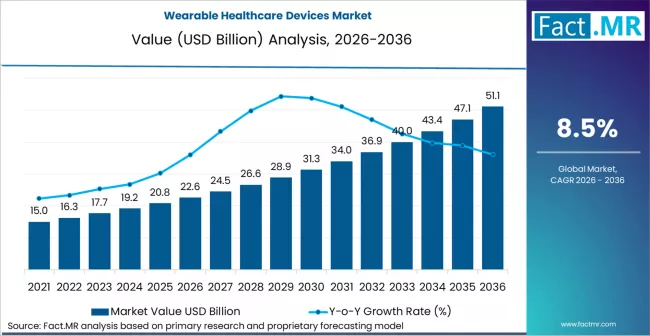
    Wearable Healthcare Devices Market Market Value Analysis

    Wearable Healthcare Devices Market

    Metric Value
    Estimated Value in (2026E) USD 22.6 billion
    Forecast Value in (2036F) USD 51 billion
    Forecast CAGR (2026 to 2036) 8.5%

    Wearable Healthcare Devices Market Definition

    The Wearable Healthcare Devices Market involves the production and sale of electronic devices worn on the body that monitor health metrics (such as heart rate, activity level, glucose, and vital signs) to support wellness management, preventive care, and chronic disease tracking.

    Market Inclusions

    This report covers global and regional market sizes for wearable healthcare devices across a defined forecast period, including device types (fitness trackers, smartwatches, medical wearables), application areas (cardiovascular, diabetes, respiratory), and sales channels (online, retail, clinical procurement).

    Market Exclusions

    The scope excludes standalone medical equipment not worn on the body (such as stationary monitors or imaging systems), general consumer electronics without health monitoring functions, and unrelated accessories not integral to device performance.

    Research Methodology

    • Primary Research: Interviews were conducted with device manufacturers, clinicians, and healthcare technology integrators.
    • Desk Research: Data was sourced from industry reports, regulatory filings, and market intelligence publications.
    • Market‑Sizing and Forecasting: A hybrid model combining top‑down healthcare technology adoption forecasts with bottom‑up shipment and revenue data was used.
    • Data Validation and Update Cycle: Findings were validated through expert review and aligned with recent production, adoption, and usage statistics.

    Summary of the Wearable Healthcare Devices Market

    • Market Definition
      • The Wearable Healthcare Devices Market involves the development and sale of electronic devices worn on the body that monitor health metrics (such as heart rate, activity levels, glucose, and vital signs) to support wellness management, preventive care, and chronic disease tracking.
    • Demand Drivers
      • Chronic Disease Management: The increasing prevalence of chronic conditions such as diabetes and cardiovascular diseases is driving demand for devices that enable continuous monitoring and early intervention.
      • Consumer Health Awareness: Growing awareness of health issues and preventive care is fueling the demand for wearable healthcare devices for personal health tracking, fitness, and wellness management.
      • Technological Advancements: Innovations in wearable sensors, real-time connectivity, and diagnostic capabilities are enhancing the functionality of wearable healthcare devices, attracting both clinical and consumer-grade markets.
    • Key Segments Analyzed
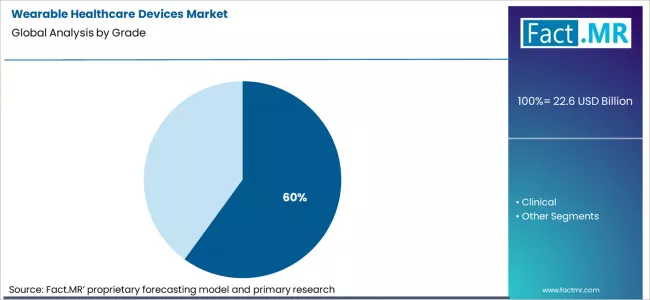
      • Grade: Consumer-grade wearable healthcare devices are expected to capture 60% of the market by 2026, primarily used for personal health monitoring, fitness tracking, and wellness purposes.
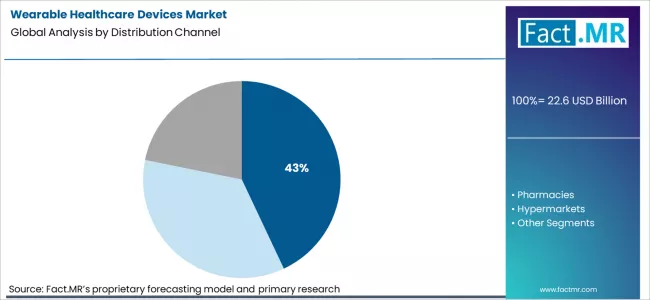
      • Distribution Channel: Online channels are projected to account for 43% of the distribution channel market share by 2026, driven by the convenience of e-commerce platforms and the ability to easily compare and purchase devices online.
    • Analyst Opinion at FactMR
      • “The wearable healthcare devices market is expected to experience significant growth, fueled by increasing consumer demand for health management solutions, chronic disease tracking, and the integration of wearable technology into preventive healthcare practices. The ongoing development of medical-grade devices with advanced biosensors and real-time connectivity will be key in expanding this market.” - Shambhu Nath Jha, Principal Consultant at FactMR.
    • Strategic Implications/Executive Takeaways
      • Focus on Product Innovation: Companies should prioritize innovation in device functionality, focusing on health monitoring features such as blood glucose, heart rate, and oxygen levels.
      • Enhance Online Sales Channels: Expanding the availability of wearable healthcare devices on online platforms will allow companies to reach a wider customer base and offer convenience to consumers.
      • Target Aging Populations: With the rising aging population, wearable healthcare devices for chronic disease management and remote monitoring will become increasingly critical. Companies should focus on offering products suited to the needs of elderly consumers.
    • Methodology
      • Primary Research: Interviews with device manufacturers, clinicians, and healthcare technology integrators.
      • Desk Research: Data was sourced from industry reports, regulatory filings, and market intelligence publications.

    Segmental Analysis

    Wearable Healthcare Devices Market Analysis by Grade
    Wearable Healthcare Devices Market Analysis By Grade

    • Market Overview: Consumer-grade wearable healthcare devices are expected to capture 60% of the market share by 2026. These devices are primarily used by individuals for personal health monitoring, fitness tracking, and wellness purposes. Consumer-grade wearables include smartwatches, fitness trackers, and other health-related devices that allow users to track vital metrics such as heart rate, sleep patterns, and physical activity.
    • Demand Drivers:
      • Increasing Health Awareness: As consumers become more health-conscious, the demand for consumer-grade wearable healthcare devices has grown. These devices provide real-time health data, empowering individuals to take control of their wellness and make informed lifestyle decisions.
      • Growing Popularity of Fitness Tracking: The rise of fitness-conscious consumers is a significant factor driving demand for wearables. Devices that track physical activity, monitor heart rate, and offer personalized health insights are increasingly popular in the consumer market.
      • Convenience and Accessibility: Consumer-grade wearables are affordable, accessible, and easy to use, making them a convenient option for everyday health tracking. Their ability to sync with smartphones and other devices has further fueled their widespread adoption.

    Wearable Healthcare Devices Market Analysis by Distribution Channel
    Wearable Healthcare Devices Market Analysis By Distribution Channel

    • Market Overview: Online channels are projected to hold 43% of the market share by 2026. The shift toward e-commerce and the growing preference for online shopping are driving this segment. Consumers increasingly purchase wearable healthcare devices through online platforms, where they can easily compare options, read reviews, and have devices delivered directly to their homes.
    • Demand Drivers:
      • Convenience and Accessibility: Online shopping offers convenience and easy access to a wide range of wearable healthcare devices, allowing consumers to explore various brands and features from the comfort of their homes. This is a key factor in the growth of the online distribution channel.
      • Expansion of E-Commerce Platforms: The continued growth of e-commerce platforms and their ability to deliver products quickly have made online shopping the preferred method for purchasing wearable healthcare devices. These platforms also offer promotional deals and discounts, further driving consumer interest.
      • Broader Market Reach: Online channels enable wearable healthcare devices to reach a global customer base. E-commerce platforms also provide detailed product information, which helps consumers make more informed purchasing decisions.

    Wearable Healthcare Devices Market Drivers, Restraints, and Opportunities

    FMR analysts observe that the wearable healthcare devices market is a growth‑aligned, health‑technology segment driven by rising chronic disease prevalence and increasing demand for continuous health monitoring and remote care solutions. Devices that track vitals, glucose, oxygen levels, and other physiological data enable preventive and personalized care, expanding use beyond fitness into clinical health management. This structural demand is pushing market expansion as healthcare systems integrate wearables into patient engagement and telehealth frameworks.

    While traditional fitness trackers remain widespread, adoption of medical‑grade wearable devices with advanced biosensors and real‑time connectivity is gaining share. These higher‑value devices carry premium pricing, contributing to net market value growth even as overall unit volumes grow in line with broader digital health adoption. The market exists because healthcare providers and patients increasingly seek tools that support early detection, chronic disease management, and reduced clinical visit dependency.

    • Chronic Condition Monitoring: Rising prevalence of diabetes, cardiovascular disorders, and aging populations drives demand for devices that support ongoing health tracking and early intervention.
    • Clinical & Telehealth Integration: Remote patient monitoring and telemedicine adoption encourage use of connected wearables that feed data into healthcare systems and virtual care workflows.
    • Regional Healthcare Priorities: North America leads due to advanced healthcare infrastructure and reimbursement support for digital health, while Asia‑Pacific shows rapid uptake as access and awareness expand.

    Regional Analysis

    The market analysis covers key global regions, including South Asia, East Asia, North America, Western Europe, and India. It is segmented geographically, with specific market dynamics for each region. The full report provides a detailed market attractiveness analysis.
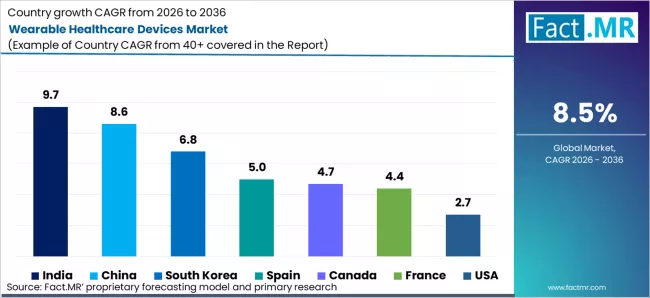
    Wearable Healthcare Devices Market Cagr Analysis By Country

    Country CAGR (%)
    India 9.7%
    China 8.6%
    South Korea 6.8%
    Spain 5.0%
    Canada 4.7%
    France 4.4%
    USA 2.7%

    Source: Fact MR (FMR) analysis, based on proprietary forecasting model and primary research.

    South Asia:

    In South Asia, India leads the demand for wearable healthcare devices, driven by increasing healthcare access, a growing tech-savvy population, and rising awareness about health monitoring.

    • India: Demand for wearable healthcare devices in India is projected to rise at 9.7% CAGR through 2036. India’s increasing healthcare needs, growing fitness trends, and rising awareness of health monitoring technologies continue to drive significant market growth.

    East Asia:

    In East Asia, China and South Korea are prominent markets for wearable healthcare devices, supported by the increasing adoption of health-focused technology and expanding digital health initiatives.

    • China: Demand for wearable healthcare devices in China is projected to rise at 8.6% CAGR through 2036. China’s large and rapidly urbanizing population and focus on health and fitness continue to push growth in the wearable healthcare devices market.
    • South Korea: Demand for wearable healthcare devices in South Korea is projected to rise at 6.8% CAGR through 2036. South Korea’s technological advancements and increased focus on health and wellness contribute to steady market growth.

    Western Europe:

    In Western Europe, Spain and France are seeing steady demand for wearable healthcare devices, driven by the region’s focus on preventative healthcare and rising demand for personal health monitoring technologies.

    • Spain: Demand for wearable healthcare devices in Spain is projected to rise at 5.0% CAGR through 2036. Spain’s growing emphasis on preventative care and health-focused consumer products contribute to the market’s expansion.
    • France: Demand for wearable healthcare devices in France is projected to rise at 4.4% CAGR through 2036. France’s healthcare reforms and focus on aging population care support steady growth in the market for wearable healthcare technologies.

    North America:
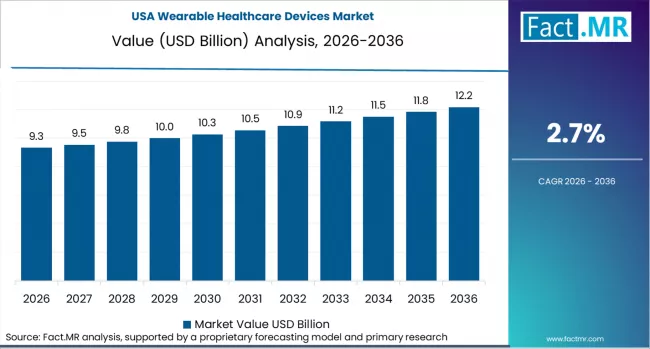
    Wearable Healthcare Devices Market Country Value Analysis

    In North America, the USA and Canada are key markets for wearable healthcare devices, supported by the growing consumer focus on personal health management and technological innovation in health devices.

    • USA: Demand for wearable healthcare devices in the U.S. is projected to rise at 2.7% CAGR through 2036. The USA’s tech-driven healthcare sector and increasing interest in fitness monitoring continue to contribute to steady market growth.
    • Canada: Demand for wearable healthcare devices in Canada is projected to rise at 4.7% CAGR through 2036. Canada’s growing awareness of fitness and health management and increased adoption of wearable technologies drive the market forward.

    Fact MR's analysis of the Wearable Healthcare Devices Market in South Asia, East Asia, North America, Western Europe, and India consists of country-wise assessments that include India, China, South Korea, Spain, Canada, France, and the USA. Readers can find detailed trends, regulatory updates, and company-specific investments shaping the market’s growth in these countries.

    How Are Key Players Competing in the Wearable Healthcare Devices Market?
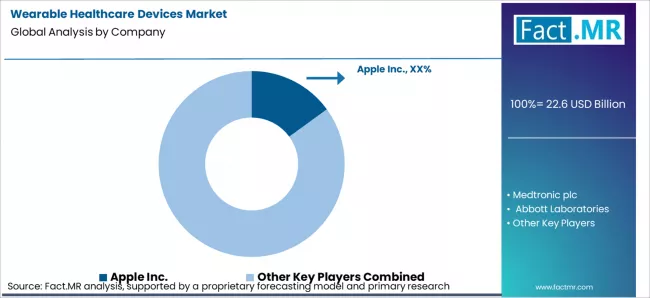
    Wearable Healthcare Devices Market Analysis By Company

    In the wearable healthcare devices market, Apple Inc. and Fitbit (brand of Google LLC) dominate with their fitness trackers and health-monitoring devices, integrating advanced sensors and AI to offer personalized health insights. Medtronic plc and Abbott Laboratories are leveraging their medical expertise to provide advanced wearable solutions for chronic disease management and remote patient monitoring. GE HealthCare Technologies Inc. and Koninklijke Philips N.V. are tapping into the market with innovative medical-grade wearables designed for healthcare professionals. OMRON Corporation offers clinically validated devices for blood pressure monitoring, while Samsung Electronics Co., Ltd. focuses on smartwatches that blend fitness with health-tracking features. Movano Health, Inc. and Corsano Health B.V. are emerging players, providing niche health-focused wearables targeting specific health metrics like glucose monitoring and heart rate variability.

    Recent Industry Developments

    • FDA Final Rule on Clinical Electronic Thermometers (Regulatory): On June 18, 2025, the FDA issued a final order exempting certain clinical electronic thermometers (including non-contact infrared sensors used in wearables) from 510(k) premarket notification, provided they do not feature continuous measurement or telethermographic functions.
    • Samsung Acquisition of Xealth for Clinical Integration (Corporate): In July 2025, Samsung Electronics acquired the U.S. digital health platform Xealth to bridge the gap between everyday wearable data and hospital medical records.
    • Oura Ring 4 Launch with "Smart Sensing" (Corporate): On October 3, 2024, Oura unveiled the Oura Ring 4, featuring a new "Smart Sensing" platform that increased signal pathways from 8 to 18 to account for different finger shapes and movement during sleep.

    Key Players of the Wearable Healthcare Devices Market

    • Apple Inc.
    • Medtronic plc
    • Abbott Laboratories
    • GE HealthCare Technologies Inc.
    • Koninklijke Philips N.V.
    • Fitbit (brand of Google LLC)
    • OMRON Corporation
    • Samsung Electronics Co., Ltd.
    • Movano Health, Inc.
    • Corsano Health B.V.

    Report Scope

    Metric Value
    Quantitative Units USD 22.6 billion (2026) to USD 51 billion (2036), at a CAGR of 8.5%
    Market Definition The Wearable Healthcare Devices Market includes wearable devices designed for health and fitness tracking, monitoring chronic conditions, and improving patient care through diagnostic and therapeutic functions.
    By Product Trackers, Smartwatches, Patches, Smart Clothing
    By Device Diagnostic & Monitoring Devices, Therapeutic Devices
    By Grade Consumer-Grade Wearable Healthcare Devices, Clinical-Grade Wearable Healthcare Devices
    By Application General Health and Fitness, Remote Patient Monitoring, Home Healthcare
    By Distribution Channel Pharmacies, Online Channel, Hypermarkets
    Regions Covered North America, Latin America, Europe, East Asia, South Asia, Oceania, Middle East and Africa
    Countries Covered United States, Canada, Mexico, Brazil, Argentina, Germany, France, United Kingdom, Italy, Spain, China, India, Japan, South Korea, Indonesia, Australia, and 40+ countries
    Key Companies Profiled Apple Inc., Medtronic plc, Abbott Laboratories, GE HealthCare Technologies Inc., Koninklijke Philips N.V., Fitbit (brand of Google LLC), OMRON Corporation, Samsung Electronics Co., Ltd., Movano Health, Inc., Corsano Health B.V.
    Forecast Period 2026 to 2036
    Approach Hybrid top-down and bottom-up market modeling validated through primary interviews with manufacturers and supported by trade data benchmarking and market research.

    Wearable Healthcare Devices Market Key Segments

    • Product :

      • Trackers
      • Smartwatches
      • Patches
      • Smart Clothing
    • Device :

      • Diagnostic & Monitoring Devices
        • Vital Sign Monitoring Devices
        • Glucose Monitoring Devices
        • Sleep Monitoring Devices
        • Fetal Monitoring & Obstetric Devices
        • Neuromonitoring Devices
      • Therapeutic Devices
        • Pain Management Devices
        • Insulin Pumps
        • Rehabilitation Devices
        • Respiratory Therapy Devices
    • Grade :

      • Consumer-Grade Wearable Healthcare Devices
      • Clinical-Grade Wearable Healthcare Devices
    • Application :

      • General Health and Fitness
      • Remote Patient Monitoring
      • Home Healthcare
    • Distribution Channel :

      • Pharmacies
      • Online Channel
      • Hypermarkets
    • Region :

      • North America
        • USA
        • Canada
        • Mexico
      • Europe
        • Germany
        • UK
        • France
        • Italy
        • Spain
        • Nordic Countries
        • BENELUX
        • Rest of Europe
      • Asia Pacific
        • China
        • Japan
        • South Korea
        • India
        • Australia
        • Rest of Asia Pacific
      • Latin America
        • Brazil
        • Argentina
        • Rest of Latin America
      • Middle East and Africa
        • Kingdom of Saudi Arabia
        • United Arab Emirates
        • South Africa
        • Rest of Middle East and Africa
      • Other Regions
        • Oceania
        • Central Asia
        • Other Markets

    Bibliographies

    • Abbott Laboratories. (2024). Wearable continuous glucose monitoring and digital health solutions. Abbott Laboratories.
    • Apple Inc. (2024). Apple Watch and health monitoring technologies. Apple Inc.
    • Fitbit LLC (a subsidiary of Google LLC). (2024). Wearable fitness and health tracking devices. Fitbit LLC.
    • Medtronic plc. (2024). Wearable and connected technologies for chronic disease management. Medtronic plc.
    • Samsung Electronics Co., Ltd. (2024). Smartwatch and wearable health monitoring technologies. Samsung Electronics Co., Ltd.
    • ŌURA Health Oy. (2024, October 3). ŌURA introduces Ring 4 with Smart Sensing platform for advanced sleep and health tracking [Press release]. ŌURA Health Oy.
    • Samsung Electronics Co., Ltd. (2025, July). Samsung Electronics acquires Xealth to strengthen integration of wearable data into clinical workflows [Press release]. Samsung Electronics Co., Ltd.
    • U.S. Food and Drug Administration. (2025, June 18). Final order exempting certain class II clinical electronic thermometers from premarket notification requirements [Federal Register notice]. U.S. Food and Drug Administration.
    • European Commission. (2023). Regulation (EU) 2017/745 on medical devices (MDR): Implementation updates relevant to wearable medical devices. Official Journal of the European Union.

    This report addresses:

    • Market Intelligence enabling comprehensive assessment of leading countries and service segments across the Wearable Healthcare Devices Market globally.
    • Market Volume (Sales Units) estimates and 10-year revenue forecasts from 2026 to 2036, validated through manufacturer shipment data, channel partner surveys, and country-level demand modeling.
    • Growth Opportunity Mapping across product types (Trackers, Smartwatches, Patches, Smart Clothing), device categories (Diagnostic & Monitoring Devices, Therapeutic Devices), grade classifications (Consumer-Grade Wearable Healthcare Devices, Clinical-Grade Wearable Healthcare Devices), and regions.
    • Segment and Regional Revenue Forecasts by product, device, grade, and geography across 40+ countries.
    • Competition Strategy Analysis covering dealer network structure, recent developments, product portfolio, USPs, and market share analysis.
    • Product and Regulatory Compliance Tracking aligned with healthcare regulations and standards for wearable devices.
    • Regulatory Impact Analysis addressing global healthcare compliance, market access regulations, and evolving standards for wearable healthcare devices.
    • Report Delivery in PDF, Excel, PowerPoint, and interactive dashboard formats for executive, procurement, and operational planning use.

    Table of Content

    1. Executive Summary
      • Global Market Outlook
      • Demand to side Trends
      • Supply to side Trends
      • Technology Roadmap Analysis
      • Analysis and Recommendations
    2. Market Overview
      • Market Coverage / Taxonomy
      • Market Definition / Scope / Limitations
    3. Research Methodology
      • Chapter Orientation
      • Analytical Lens and Working Hypotheses
        • Market Structure, Signals, and Trend Drivers
        • Benchmarking and Cross-market Comparability
        • Market Sizing, Forecasting, and Opportunity Mapping
      • Research Design and Evidence Framework
        • Desk Research Programme (Secondary Evidence)
          • Company Annual and Sustainability Reports
          • Peer-reviewed Journals and Academic Literature
          • Corporate Websites, Product Literature, and Technical Notes
          • Earnings Decks and Investor Briefings
          • Statutory Filings and Regulatory Disclosures
          • Technical White Papers and Standards Notes
          • Trade Journals, Industry Magazines, and Analyst Briefs
          • Conference Proceedings, Webinars, and Seminar Materials
          • Government Statistics Portals and Public Data Releases
          • Press Releases and Reputable Media Coverage
          • Specialist Newsletters and Curated Briefings
          • Sector Databases and Reference Repositories
          • FMR Internal Proprietary Databases and Historical Market Datasets
          • Subscription Datasets and Paid Sources
          • Social Channels, Communities, and Digital Listening Inputs
          • Additional Desk Sources
        • Expert Input and Fieldwork (Primary Evidence)
          • Primary Modes
            • Qualitative Interviews and Expert Elicitation
            • Quantitative Surveys and Structured Data Capture
            • Blended Approach
          • Why Primary Evidence is Used
          • Field Techniques
            • Interviews
            • Surveys
            • Focus Groups
            • Observational and In-context Research
            • Social and Community Interactions
          • Stakeholder Universe Engaged
            • C-suite Leaders
            • Board Members
            • Presidents and Vice Presidents
            • R&D and Innovation Heads
            • Technical Specialists
            • Domain Subject-matter Experts
            • Scientists
            • Physicians and Other Healthcare Professionals
          • Governance, Ethics, and Data Stewardship
            • Research Ethics
            • Data Integrity and Handling
        • Tooling, Models, and Reference Databases
      • Data Engineering and Model Build
        • Data Acquisition and Ingestion
        • Cleaning, Normalisation, and Verification
        • Synthesis, Triangulation, and Analysis
      • Quality Assurance and Audit Trail
    4. Market Background
      • Market Dynamics
        • Drivers
        • Restraints
        • Opportunity
        • Trends
      • Scenario Forecast
        • Demand in Optimistic Scenario
        • Demand in Likely Scenario
        • Demand in Conservative Scenario
      • Opportunity Map Analysis
      • Product Life Cycle Analysis
      • Supply Chain Analysis
      • Investment Feasibility Matrix
      • Value Chain Analysis
      • PESTLE and Porter’s Analysis
      • Regulatory Landscape
      • Regional Parent Market Outlook
      • Production and Consumption Statistics
      • Import and Export Statistics
    5. Global Market Analysis 2021 to 2025 and Forecast, 2026 to 2036
      • Historical Market Size Value (USD Million) Analysis, 2021 to 2025
      • Current and Future Market Size Value (USD Million) Projections, 2026 to 2036
        • Y to o to Y Growth Trend Analysis
        • Absolute $ Opportunity Analysis
    6. Global Market Pricing Analysis 2021 to 2025 and Forecast 2026 to 2036
    7. Global Market Analysis 2021 to 2025 and Forecast 2026 to 2036, By Grade
      • Introduction / Key Findings
      • Historical Market Size Value (USD Million) Analysis By Grade , 2021 to 2025
      • Current and Future Market Size Value (USD Million) Analysis and Forecast By Grade , 2026 to 2036
        • Consumer
        • Clinical
      • Y to o to Y Growth Trend Analysis By Grade , 2021 to 2025
      • Absolute $ Opportunity Analysis By Grade , 2026 to 2036
    8. Global Market Analysis 2021 to 2025 and Forecast 2026 to 2036, By Distribution Channel
      • Introduction / Key Findings
      • Historical Market Size Value (USD Million) Analysis By Distribution Channel, 2021 to 2025
      • Current and Future Market Size Value (USD Million) Analysis and Forecast By Distribution Channel, 2026 to 2036
        • Online Channels
        • Pharmacies
        • Hypermarkets
      • Y to o to Y Growth Trend Analysis By Distribution Channel, 2021 to 2025
      • Absolute $ Opportunity Analysis By Distribution Channel, 2026 to 2036
    9. Global Market Analysis 2021 to 2025 and Forecast 2026 to 2036, By Region
      • Introduction
      • Historical Market Size Value (USD Million) Analysis By Region, 2021 to 2025
      • Current Market Size Value (USD Million) Analysis and Forecast By Region, 2026 to 2036
        • North America
        • Latin America
        • Western Europe
        • Eastern Europe
        • East Asia
        • South Asia and Pacific
        • Middle East & Africa
      • Market Attractiveness Analysis By Region
    10. North America Market Analysis 2021 to 2025 and Forecast 2026 to 2036, By Country
      • Historical Market Size Value (USD Million) Trend Analysis By Market Taxonomy, 2021 to 2025
      • Market Size Value (USD Million) Forecast By Market Taxonomy, 2026 to 2036
        • By Country
          • USA
          • Canada
          • Mexico
        • By Grade
        • By Distribution Channel
      • Market Attractiveness Analysis
        • By Country
        • By Grade
        • By Distribution Channel
      • Key Takeaways
    11. Latin America Market Analysis 2021 to 2025 and Forecast 2026 to 2036, By Country
      • Historical Market Size Value (USD Million) Trend Analysis By Market Taxonomy, 2021 to 2025
      • Market Size Value (USD Million) Forecast By Market Taxonomy, 2026 to 2036
        • By Country
          • Brazil
          • Chile
          • Rest of Latin America
        • By Grade
        • By Distribution Channel
      • Market Attractiveness Analysis
        • By Country
        • By Grade
        • By Distribution Channel
      • Key Takeaways
    12. Western Europe Market Analysis 2021 to 2025 and Forecast 2026 to 2036, By Country
      • Historical Market Size Value (USD Million) Trend Analysis By Market Taxonomy, 2021 to 2025
      • Market Size Value (USD Million) Forecast By Market Taxonomy, 2026 to 2036
        • By Country
          • Germany
          • UK
          • Italy
          • Spain
          • France
          • Nordic
          • BENELUX
          • Rest of Western Europe
        • By Grade
        • By Distribution Channel
      • Market Attractiveness Analysis
        • By Country
        • By Grade
        • By Distribution Channel
      • Key Takeaways
    13. Eastern Europe Market Analysis 2021 to 2025 and Forecast 2026 to 2036, By Country
      • Historical Market Size Value (USD Million) Trend Analysis By Market Taxonomy, 2021 to 2025
      • Market Size Value (USD Million) Forecast By Market Taxonomy, 2026 to 2036
        • By Country
          • Russia
          • Poland
          • Hungary
          • Balkan & Baltic
          • Rest of Eastern Europe
        • By Grade
        • By Distribution Channel
      • Market Attractiveness Analysis
        • By Country
        • By Grade
        • By Distribution Channel
      • Key Takeaways
    14. East Asia Market Analysis 2021 to 2025 and Forecast 2026 to 2036, By Country
      • Historical Market Size Value (USD Million) Trend Analysis By Market Taxonomy, 2021 to 2025
      • Market Size Value (USD Million) Forecast By Market Taxonomy, 2026 to 2036
        • By Country
          • China
          • Japan
          • South Korea
        • By Grade
        • By Distribution Channel
      • Market Attractiveness Analysis
        • By Country
        • By Grade
        • By Distribution Channel
      • Key Takeaways
    15. South Asia and Pacific Market Analysis 2021 to 2025 and Forecast 2026 to 2036, By Country
      • Historical Market Size Value (USD Million) Trend Analysis By Market Taxonomy, 2021 to 2025
      • Market Size Value (USD Million) Forecast By Market Taxonomy, 2026 to 2036
        • By Country
          • India
          • ASEAN
          • Australia & New Zealand
          • Rest of South Asia and Pacific
        • By Grade
        • By Distribution Channel
      • Market Attractiveness Analysis
        • By Country
        • By Grade
        • By Distribution Channel
      • Key Takeaways
    16. Middle East & Africa Market Analysis 2021 to 2025 and Forecast 2026 to 2036, By Country
      • Historical Market Size Value (USD Million) Trend Analysis By Market Taxonomy, 2021 to 2025
      • Market Size Value (USD Million) Forecast By Market Taxonomy, 2026 to 2036
        • By Country
          • Kingdom of Saudi Arabia
          • Other GCC Countries
          • Turkiye
          • South Africa
          • Other African Union
          • Rest of Middle East & Africa
        • By Grade
        • By Distribution Channel
      • Market Attractiveness Analysis
        • By Country
        • By Grade
        • By Distribution Channel
      • Key Takeaways
    17. Key Countries Market Analysis
      • USA
        • Pricing Analysis
        • Market Share Analysis, 2025
          • By Grade
          • By Distribution Channel
      • Canada
        • Pricing Analysis
        • Market Share Analysis, 2025
          • By Grade
          • By Distribution Channel
      • Mexico
        • Pricing Analysis
        • Market Share Analysis, 2025
          • By Grade
          • By Distribution Channel
      • Brazil
        • Pricing Analysis
        • Market Share Analysis, 2025
          • By Grade
          • By Distribution Channel
      • Chile
        • Pricing Analysis
        • Market Share Analysis, 2025
          • By Grade
          • By Distribution Channel
      • Germany
        • Pricing Analysis
        • Market Share Analysis, 2025
          • By Grade
          • By Distribution Channel
      • UK
        • Pricing Analysis
        • Market Share Analysis, 2025
          • By Grade
          • By Distribution Channel
      • Italy
        • Pricing Analysis
        • Market Share Analysis, 2025
          • By Grade
          • By Distribution Channel
      • Spain
        • Pricing Analysis
        • Market Share Analysis, 2025
          • By Grade
          • By Distribution Channel
      • France
        • Pricing Analysis
        • Market Share Analysis, 2025
          • By Grade
          • By Distribution Channel
      • India
        • Pricing Analysis
        • Market Share Analysis, 2025
          • By Grade
          • By Distribution Channel
      • ASEAN
        • Pricing Analysis
        • Market Share Analysis, 2025
          • By Grade
          • By Distribution Channel
      • Australia & New Zealand
        • Pricing Analysis
        • Market Share Analysis, 2025
          • By Grade
          • By Distribution Channel
      • China
        • Pricing Analysis
        • Market Share Analysis, 2025
          • By Grade
          • By Distribution Channel
      • Japan
        • Pricing Analysis
        • Market Share Analysis, 2025
          • By Grade
          • By Distribution Channel
      • South Korea
        • Pricing Analysis
        • Market Share Analysis, 2025
          • By Grade
          • By Distribution Channel
      • Russia
        • Pricing Analysis
        • Market Share Analysis, 2025
          • By Grade
          • By Distribution Channel
      • Poland
        • Pricing Analysis
        • Market Share Analysis, 2025
          • By Grade
          • By Distribution Channel
      • Hungary
        • Pricing Analysis
        • Market Share Analysis, 2025
          • By Grade
          • By Distribution Channel
      • Kingdom of Saudi Arabia
        • Pricing Analysis
        • Market Share Analysis, 2025
          • By Grade
          • By Distribution Channel
      • Turkiye
        • Pricing Analysis
        • Market Share Analysis, 2025
          • By Grade
          • By Distribution Channel
      • South Africa
        • Pricing Analysis
        • Market Share Analysis, 2025
          • By Grade
          • By Distribution Channel
    18. Market Structure Analysis
      • Competition Dashboard
      • Competition Benchmarking
      • Market Share Analysis of Top Players
        • By Regional
        • By Grade
        • By Distribution Channel
    19. Competition Analysis
      • Competition Deep Dive
        • Apple Inc.
          • Overview
          • Product Portfolio
          • Profitability by Market Segments (Product/Age /Sales Channel/Region)
          • Sales Footprint
          • Strategy Overview
            • Marketing Strategy
            • Product Strategy
            • Channel Strategy
        • Medtronic plc
        • Abbott Laboratories
        • GE HealthCare Technologies Inc.
        • Koninklijke Philips N.V.
        • Fitbit (brand of Google LLC)
        • OMRON Corporation
        • Samsung Electronics Co., Ltd.
    20. Assumptions & Acronyms Used

    List Of Table

    • Table 1: Global Market Value (USD Million) Forecast by Region, 2021 to 2036
    • Table 2: Global Market Value (USD Million) Forecast by Grade , 2021 to 2036
    • Table 3: Global Market Value (USD Million) Forecast by Distribution Channel, 2021 to 2036
    • Table 4: North America Market Value (USD Million) Forecast by Country, 2021 to 2036
    • Table 5: North America Market Value (USD Million) Forecast by Grade , 2021 to 2036
    • Table 6: North America Market Value (USD Million) Forecast by Distribution Channel, 2021 to 2036
    • Table 7: Latin America Market Value (USD Million) Forecast by Country, 2021 to 2036
    • Table 8: Latin America Market Value (USD Million) Forecast by Grade , 2021 to 2036
    • Table 9: Latin America Market Value (USD Million) Forecast by Distribution Channel, 2021 to 2036
    • Table 10: Western Europe Market Value (USD Million) Forecast by Country, 2021 to 2036
    • Table 11: Western Europe Market Value (USD Million) Forecast by Grade , 2021 to 2036
    • Table 12: Western Europe Market Value (USD Million) Forecast by Distribution Channel, 2021 to 2036
    • Table 13: Eastern Europe Market Value (USD Million) Forecast by Country, 2021 to 2036
    • Table 14: Eastern Europe Market Value (USD Million) Forecast by Grade , 2021 to 2036
    • Table 15: Eastern Europe Market Value (USD Million) Forecast by Distribution Channel, 2021 to 2036
    • Table 16: East Asia Market Value (USD Million) Forecast by Country, 2021 to 2036
    • Table 17: East Asia Market Value (USD Million) Forecast by Grade , 2021 to 2036
    • Table 18: East Asia Market Value (USD Million) Forecast by Distribution Channel, 2021 to 2036
    • Table 19: South Asia and Pacific Market Value (USD Million) Forecast by Country, 2021 to 2036
    • Table 20: South Asia and Pacific Market Value (USD Million) Forecast by Grade , 2021 to 2036
    • Table 21: South Asia and Pacific Market Value (USD Million) Forecast by Distribution Channel, 2021 to 2036
    • Table 22: Middle East & Africa Market Value (USD Million) Forecast by Country, 2021 to 2036
    • Table 23: Middle East & Africa Market Value (USD Million) Forecast by Grade , 2021 to 2036
    • Table 24: Middle East & Africa Market Value (USD Million) Forecast by Distribution Channel, 2021 to 2036

    List Of Figures

    • Figure 1: Global Market Pricing Analysis
    • Figure 2: Global Market Value (USD Million) Forecast 2021 to 2036
    • Figure 3: Global Market Value Share and BPS Analysis by Grade , 2026 and 2036
    • Figure 4: Global Market Y to o to Y Growth Comparison by Grade , 2026 to 2036
    • Figure 5: Global Market Attractiveness Analysis by Grade
    • Figure 6: Global Market Value Share and BPS Analysis by Distribution Channel, 2026 and 2036
    • Figure 7: Global Market Y to o to Y Growth Comparison by Distribution Channel, 2026 to 2036
    • Figure 8: Global Market Attractiveness Analysis by Distribution Channel
    • Figure 9: Global Market Value (USD Million) Share and BPS Analysis by Region, 2026 and 2036
    • Figure 10: Global Market Y to o to Y Growth Comparison by Region, 2026 to 2036
    • Figure 11: Global Market Attractiveness Analysis by Region
    • Figure 12: North America Market Incremental Dollar Opportunity, 2026 to 2036
    • Figure 13: Latin America Market Incremental Dollar Opportunity, 2026 to 2036
    • Figure 14: Western Europe Market Incremental Dollar Opportunity, 2026 to 2036
    • Figure 15: Eastern Europe Market Incremental Dollar Opportunity, 2026 to 2036
    • Figure 16: East Asia Market Incremental Dollar Opportunity, 2026 to 2036
    • Figure 17: South Asia and Pacific Market Incremental Dollar Opportunity, 2026 to 2036
    • Figure 18: Middle East & Africa Market Incremental Dollar Opportunity, 2026 to 2036
    • Figure 19: North America Market Value Share and BPS Analysis by Country, 2026 and 2036
    • Figure 20: North America Market Value Share and BPS Analysis by Grade , 2026 and 2036
    • Figure 21: North America Market Y to o to Y Growth Comparison by Grade , 2026 to 2036
    • Figure 22: North America Market Attractiveness Analysis by Grade
    • Figure 23: North America Market Value Share and BPS Analysis by Distribution Channel, 2026 and 2036
    • Figure 24: North America Market Y to o to Y Growth Comparison by Distribution Channel, 2026 to 2036
    • Figure 25: North America Market Attractiveness Analysis by Distribution Channel
    • Figure 26: Latin America Market Value Share and BPS Analysis by Country, 2026 and 2036
    • Figure 27: Latin America Market Value Share and BPS Analysis by Grade , 2026 and 2036
    • Figure 28: Latin America Market Y to o to Y Growth Comparison by Grade , 2026 to 2036
    • Figure 29: Latin America Market Attractiveness Analysis by Grade
    • Figure 30: Latin America Market Value Share and BPS Analysis by Distribution Channel, 2026 and 2036
    • Figure 31: Latin America Market Y to o to Y Growth Comparison by Distribution Channel, 2026 to 2036
    • Figure 32: Latin America Market Attractiveness Analysis by Distribution Channel
    • Figure 33: Western Europe Market Value Share and BPS Analysis by Country, 2026 and 2036
    • Figure 34: Western Europe Market Value Share and BPS Analysis by Grade , 2026 and 2036
    • Figure 35: Western Europe Market Y to o to Y Growth Comparison by Grade , 2026 to 2036
    • Figure 36: Western Europe Market Attractiveness Analysis by Grade
    • Figure 37: Western Europe Market Value Share and BPS Analysis by Distribution Channel, 2026 and 2036
    • Figure 38: Western Europe Market Y to o to Y Growth Comparison by Distribution Channel, 2026 to 2036
    • Figure 39: Western Europe Market Attractiveness Analysis by Distribution Channel
    • Figure 40: Eastern Europe Market Value Share and BPS Analysis by Country, 2026 and 2036
    • Figure 41: Eastern Europe Market Value Share and BPS Analysis by Grade , 2026 and 2036
    • Figure 42: Eastern Europe Market Y to o to Y Growth Comparison by Grade , 2026 to 2036
    • Figure 43: Eastern Europe Market Attractiveness Analysis by Grade
    • Figure 44: Eastern Europe Market Value Share and BPS Analysis by Distribution Channel, 2026 and 2036
    • Figure 45: Eastern Europe Market Y to o to Y Growth Comparison by Distribution Channel, 2026 to 2036
    • Figure 46: Eastern Europe Market Attractiveness Analysis by Distribution Channel
    • Figure 47: East Asia Market Value Share and BPS Analysis by Country, 2026 and 2036
    • Figure 48: East Asia Market Value Share and BPS Analysis by Grade , 2026 and 2036
    • Figure 49: East Asia Market Y to o to Y Growth Comparison by Grade , 2026 to 2036
    • Figure 50: East Asia Market Attractiveness Analysis by Grade
    • Figure 51: East Asia Market Value Share and BPS Analysis by Distribution Channel, 2026 and 2036
    • Figure 52: East Asia Market Y to o to Y Growth Comparison by Distribution Channel, 2026 to 2036
    • Figure 53: East Asia Market Attractiveness Analysis by Distribution Channel
    • Figure 54: South Asia and Pacific Market Value Share and BPS Analysis by Country, 2026 and 2036
    • Figure 55: South Asia and Pacific Market Value Share and BPS Analysis by Grade , 2026 and 2036
    • Figure 56: South Asia and Pacific Market Y to o to Y Growth Comparison by Grade , 2026 to 2036
    • Figure 57: South Asia and Pacific Market Attractiveness Analysis by Grade
    • Figure 58: South Asia and Pacific Market Value Share and BPS Analysis by Distribution Channel, 2026 and 2036
    • Figure 59: South Asia and Pacific Market Y to o to Y Growth Comparison by Distribution Channel, 2026 to 2036
    • Figure 60: South Asia and Pacific Market Attractiveness Analysis by Distribution Channel
    • Figure 61: Middle East & Africa Market Value Share and BPS Analysis by Country, 2026 and 2036
    • Figure 62: Middle East & Africa Market Value Share and BPS Analysis by Grade , 2026 and 2036
    • Figure 63: Middle East & Africa Market Y to o to Y Growth Comparison by Grade , 2026 to 2036
    • Figure 64: Middle East & Africa Market Attractiveness Analysis by Grade
    • Figure 65: Middle East & Africa Market Value Share and BPS Analysis by Distribution Channel, 2026 and 2036
    • Figure 66: Middle East & Africa Market Y to o to Y Growth Comparison by Distribution Channel, 2026 to 2036
    • Figure 67: Middle East & Africa Market Attractiveness Analysis by Distribution Channel
    • Figure 68: Global Market - Tier Structure Analysis
    • Figure 69: Global Market - Company Share Analysis

    - FAQs -

    How large is the demand for Wearable Healthcare Devices in the global market in 2026?

    Demand for Wearable Healthcare Devices in the global market is estimated to be valued at USD 22.6 billion in 2026.

    What will be the market size of Wearable Healthcare Devices in the global market by 2036?

    The market size for Wearable Healthcare Devices is projected to reach USD 51 billion by 2036.

    What is the expected demand growth for Wearable Healthcare Devices in the global market between 2026 and 2036?

    Demand for Wearable Healthcare Devices in the global market is expected to grow at a CAGR of 8.5% between 2026 and 2036.

    Which grade of wearable healthcare devices is expected to dominate the market?

    Consumer-Grade Wearable Healthcare Devices are expected to dominate the market, accounting for 60% of the market share in 2026, as they are widely used for personal health monitoring, fitness tracking, and wellness purposes.

    Which region is expected to show the highest growth rate for Wearable Healthcare Devices?

    India is projected to show the highest regional CAGR at 9.7% during the forecast period, driven by the growing adoption of wearable health devices for fitness tracking and chronic disease management in the country.

    How significant is the growth outlook for China in this market?

    China is expected to grow at a CAGR of 8.6%, reflecting increasing healthcare awareness, a large consumer base, and the growing demand for wearable devices to monitor chronic conditions and enhance personal health management.

    What is the growth outlook for South Korea in the Wearable Healthcare Devices market?

    South Korea is expected to grow at a CAGR of 6.8%, supported by increasing healthcare technology adoption, high-tech innovations, and consumer demand for wearable health tracking devices.

    What is the growth forecast for Spain in the Wearable Healthcare Devices market?

    Spain is expected to grow at a CAGR of 5.0%, driven by growing awareness of health and wellness among consumers and increasing interest in wearable devices for health monitoring and fitness tracking.

    What is the growth forecast for Canada in the Wearable Healthcare Devices market?

    Canada is expected to grow at a CAGR of 4.7%, supported by a strong healthcare system, rising health awareness, and an increasing number of consumers using wearable healthcare devices for fitness and medical purposes.

    What is the growth forecast for France in the Wearable Healthcare Devices market?

    France is expected to grow at a CAGR of 4.4%, with demand driven by a growing consumer interest in personal health management, fitness, and chronic disease monitoring.

    What is the growth forecast for the United States in the Wearable Healthcare Devices market?

    The United States is projected to grow at a CAGR of 2.7% from 2026 to 2036, supported by the widespread adoption of wearable healthcare technologies, particularly for fitness and wellness tracking, as well as for chronic disease management.

    Which company is identified as a leading player in the Wearable Healthcare Devices market?

    Apple Inc. is recognized as a leading player in this market, offering a range of consumer-grade wearable healthcare devices, including smartwatches with health-monitoring features such as heart rate tracking, ECG, and fitness tracking.

    What are Wearable Healthcare Devices used for?

    Wearable Healthcare Devices are used for tracking various health parameters, such as heart rate, blood oxygen levels, activity levels, and sleep patterns. They are also used for monitoring chronic conditions and supporting fitness and wellness goals.

    What does the Wearable Healthcare Devices market include in this report?

    The market scope includes wearable devices designed for health monitoring and fitness tracking, particularly consumer-grade devices, which are accessible to individuals for personal use in managing their health and wellness.

    How is the market forecast developed in this report?

    The forecast is developed using historical data on wearable healthcare device adoption, trends in personal health management, and insights from key industry players involved in the design and production of wearable health monitoring devices.

    What is meant by the Wearable Healthcare Devices market in this report?

    The market refers to the global production, trade, and consumption of wearable devices used for health and fitness monitoring, particularly consumer-grade devices used by individuals for personal health management and chronic disease monitoring.

    Wearable Healthcare Devices Market