- Market Value (2025): USD 508.2 Mn
- Estimated Value (2026): USD 620.0 Mn
- Forecast Value (2036): USD 4529.0 Mn
- CAGR (2026-2036): 22.0%
What is the Cultivated Media Grades Market forecast to be worth by 2036?
USD 620.0 million in 2026 to USD 4529.0 million by 2036 at a 22.0% CAGR.
- The cultivated media grades market reached USD 508.2 million in 2025.
- Demand is projected to increase from USD 620.0 million in 2026 to USD 4529.0 million by 2036.
- The market is forecast to record 22.0% CAGR from 2026 to 2036 as producers, research institutes and CDMOs move toward defined media choices for cultivated meat and bioprocess development.
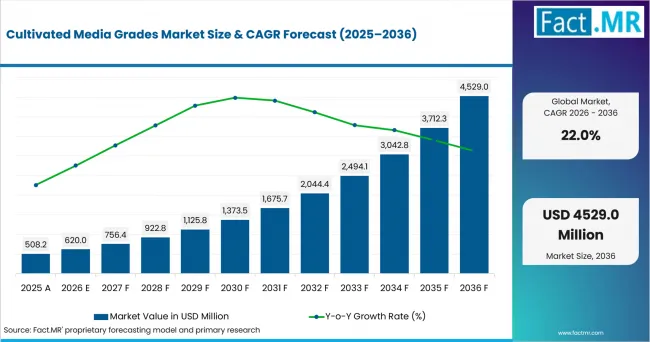
Cultivated Media Grades Market Value Analysis | Source: Fact.MR
What are the defining numbers behind Cultivated Media Grades Market growth?
An absolute opportunity of USD 3909.0 million is expected between 2026 and 2036.
- Demand Drivers in the Market
- Cultivated meat producers need food-grade and serum-free media as regulators review cell banks, growth stages and production inputs before cell-based foods enter sale channels.
- Research institutes need reproducible media grades for early cell-line work because formulation changes alter attachment and differentiation behavior during screening.
- CDMOs need liquid and concentrated formats that reduce preparation steps while keeping quality records clear for customer transfer packages.
- Cell therapy researchers need defined formulations and component traceability as product developers tighten material-control files for regenerative medicine programs.
- The FDA issued final CMC flexibility guidance in May 2026 for developing human cellular and gene therapy products for a biologics license application.
- Key Segments Analyzed
- By Grade: Research grade is expected to hold 34.0% share in 2026 because laboratories screen cell lines before switching to food-grade or defined production formats.
- By Format: Liquid is projected to account for 43.0% share in 2026 as ready-to-use media reduces preparation time in research and pilot facilities.
- By Function: Cell growth is anticipated to capture 37.0% share in 2026 owing to its direct effect on viable cell yield and passage consistency.
- By Application: Cultivated meat is estimated to represent 39.0% share in 2026 due to producer interest in food-grade inputs for muscle and fat cell expansion.
- By Customer: Producers are forecast to hold 41.0% share in 2026 because pilot-scale teams buy media repeatedly during formulation and validation work.
- Analyst Opinion at Fact.MR
- Shambhu Nath Jha, Principal Consultant at Fact.MR, states, “Media qualification is becoming the commercial bottleneck in cultivated cell production. Producers are expected to compare media grades by growth rate, input origin and documentation quality before committing to scale-up. Suppliers that combine animal-component-free formulations, clean regulatory files and repeatable performance data have a clearer route into long-term supply programs.”
- Strategic Implications
- Media developers should document input origin and batch comparability so producers can move from bench testing to pilot runs with fewer requalification steps.
- Cultivated meat producers should separate discovery media from food-grade media early so formulation changes appear before regulatory or cost reviews.
- CDMOs should maintain media-change records and performance curves because customers need clear transfer packages for bioprocess development and cell therapy research.
- Ingredient suppliers should track recombinant growth-factor and amino-acid supply plans so producers can compare cost exposure before scale-up decisions.
The USA is forecast to record 24.2% CAGR through 2036, supported by formal cultured-animal-cell food review and cell therapy material-control needs. Germany is anticipated to post 23.1% CAGR as gene and cell therapy registry work improves evidence pathways for media-qualified cell production. Japan is projected to advance at 21.6% CAGR due to iPS cell research depth and AMED-backed regenerative medicine programs. France is estimated to hold 20.7% CAGR as biotherapies and bioproduction funding strengthens demand for GMP-aligned cell culture materials. Brazil is forecast to reach 19.8% CAGR as Embrapa-backed cultivated meat research creates a foundation for local cell-line and media testing.
How does the Cultivated Media Grades Market break down by segment?
Liquid leads Format at 43.0% share in 2026; while Producers lead Customer at 41.0% share.
Which Grade dominates?
Research grade is expected to hold 34.0% share in 2026.
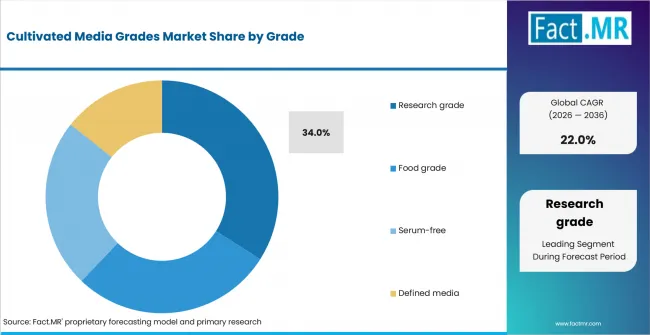
Cultivated Media Grades Market Analysis By Grade | Source: Fact.MR
Research grade media leads because cultivated-cell programs test cell lines before switching to food-grade or defined media. These projects need flexible formulations for muscle and fat cell screening without locking the process too early.
Food grade and serum-free options gain value once developers approach regulatory review. Producers need traceable formulations before larger runs because media inputs influence cell quality and review readiness.
What leads the Format segment?
Liquid is projected to account for 43.0% share in 2026.
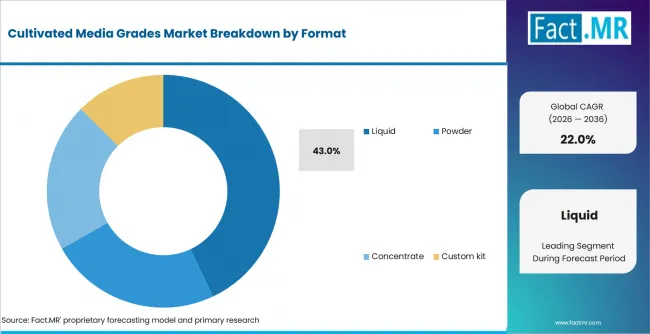
Cultivated Media Grades Market Analysis By Format | Source: Fact.MR
Liquid formats lead because producers and research institutes use them directly in routine culture work. The format shortens preparation time and reduces weighing errors in small laboratories where screening changes frequently.
Powder, concentrate and custom kit formats remain relevant when customers need lower shipping volume or site-specific formulation control. These formats gain interest where media cost becomes part of pilot-scale economics.
How does Function shape demand?
Cell growth is anticipated to lead with 37.0% share in 2026.
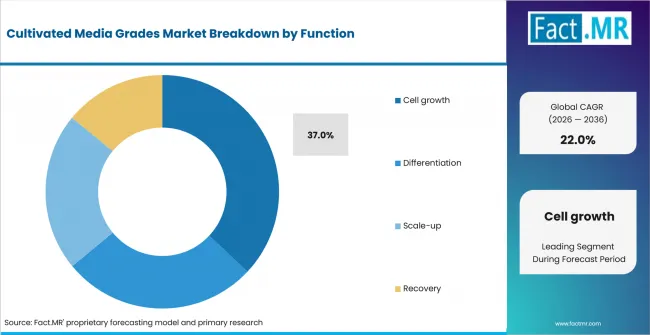
Cultivated Media Grades Market Analysis By Function | Source: Fact.MR
Cell growth leads because viable yield is the first practical test of any cultivated media grade. Producers compare doubling time and passage stability before they evaluate differentiation or recovery behavior.
Multus reported in July 2025 that Proliferum B maintained 15–25 hour doubling times in bovine fibroblasts, comparable with serum controls, while also demonstrating consistent performance across bovine fibroblast and satellite-cell lines. The results provide developers with a concrete benchmark when comparing animal-component-free media with serum-containing controls.
What supports Cultivated meat within Application?
Cultivated meat is estimated to represent 39.0% share in 2026.
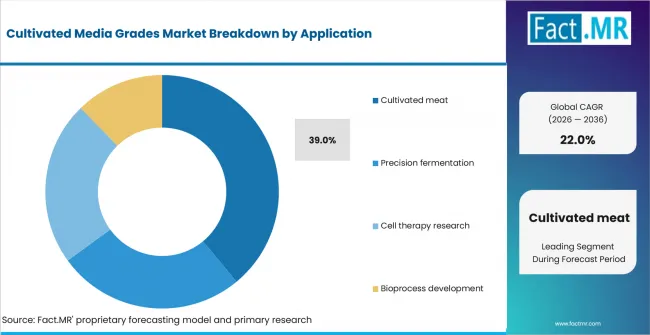
Cultivated Media Grades Market Analysis By Application | Source: Fact.MR
Cultivated meat leads because animal cell production requires repeated media use across banking, expansion and differentiation. Producers therefore evaluate media as a cost input and as a documentation input.
Structured cultivated meat programs need media that performs consistently during expansion and scaffold contact. Food-grade formulations therefore remain close to process economics and regulatory readiness.
What supports Producers within Customer?
Producers are forecast to hold 41.0% share in 2026.
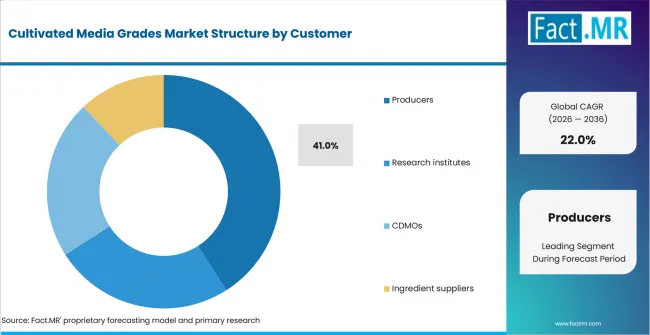
Cultivated Media Grades Market Analysis By Customer | Source: Fact.MR
Producers lead because they purchase media repeatedly during recipe selection, cell-bank preparation and pilot-scale process runs. Their buying decisions depend on growth data, cost exposure and supplier documentation.
Research institutes, CDMOs and ingredient suppliers remain necessary customer groups. Their demand is tied to early formulation work, transfer packages and specialty inputs used before producers commit to larger media purchases.
What is accelerating Cultivated Media Grades Market adoption, and what is holding it back?
Demand is expected to rise through food-grade media qualification and scale-up needs. Growth is constrained by input cost, regulatory documentation and batch comparability.
Drivers Impact Analysis
| DRIVER | (~) % IMPACT ON CAGR | GEOGRAPHIC RELEVANCE | IMPACT TIMELINE |
|---|---|---|---|
| Food-grade media qualification for cultivated meat | +2.4% | USA, Europe, Japan | Short term (<= 2 years) |
| Serum-free and animal-component-free transition | +2.0% | Global | Medium term (2-4 years) |
| Scale-up from research vessels to pilot bioreactors | +1.6% | North America, Western Europe, East Asia | Medium term (2-4 years) |
| Cell therapy and bioprocess documentation needs | +1.2% | USA, Germany, France, Japan | Long term (>= 4 years) |
- Food-grade media qualification for cultivated meat: Producers need documented inputs as cell-based foods move from laboratory development toward formal consultation and inspection pathways.
- Serum-free and animal-component-free transition: Defined inputs reduce biological variability and support safety files where producers need repeatable cell expansion without serum dependence.
- Scale-up from research vessels to pilot bioreactors: Larger runs expose media cost and growth-factor stability, making grade selection a process-economics decision.
- Cell therapy and bioprocess documentation needs: Product developers need clear manufacturing and control information when media changes affect quality records during development.
Opportunity Impact Analysis
| OPPORTUNITY | (~) % IMPACT ON CAGR | GEOGRAPHIC RELEVANCE | IMPACT TIMELINE |
|---|---|---|---|
| Standardized food-grade basal media for producers | +1.5% | USA, Europe, Brazil | Medium term (2-4 years) |
| Custom media kits for species-specific cell lines | +1.2% | Global | Short term (<= 2 years) |
| Liquid-to-powder conversion for logistics and storage | +0.8% | Global | Long term (>= 4 years) |
- Standardized food-grade basal media for producers: Suppliers can gain repeat orders by offering clean base formulations that customers adapt with fewer high-cost additives.
- Custom media kits for species-specific cell lines: Muscle and adipogenic systems need different nutrient balances, creating demand for application-specific kit formats.
- Liquid-to-powder conversion for logistics and storage: Powder and concentrate formats create savings where cold-chain handling or site storage limits raise liquid-media cost.
Restraints Impact Analysis
| RESTRAINT | (~) % IMPACT ON CAGR | GEOGRAPHIC RELEVANCE | IMPACT TIMELINE |
|---|---|---|---|
| Growth-factor and recombinant input cost | -0.8% | Global | Short term (<= 2 years) |
| Regulatory review of media components | -0.6% | USA, Europe | Medium term (2-4 years) |
| Batch comparability during scale-up | -0.5% | Global | Long term (>= 4 years) |
- Growth-factor and recombinant input cost: Expensive components raise the cost per kilogram of cultivated biomass and delay broader use of high-performance formulations.
- Regulatory review of media components: Producers must document inputs clearly, so weak supplier files slow consultation work and facility-readiness reviews.
- Batch comparability during scale-up: Media that works in research vessels can behave differently in larger systems, forcing additional runs before process lock.
Which countries are scaling the Cultivated Media Grades Market through 2036?
- The country comparison spans 4.4 percentage points and forms three practical growth bands across the forecast period.
- The USA remains 1.1 percentage points above Germany as formal food consultation activity raises media-grade documentation intensity.
- Germany remains 1.5 percentage points above Japan as gene and cell therapy registry work supports evidence building.
- Japan remains 0.9 percentage point above France as iPS cell commercialization moves media qualification closer to production use.
- France remains 0.9 percentage point above Brazil as biotherapy and bioproduction funding supports GMP-linked input demand.
- Brazil closes the displayed range as cultivated meat research develops local cell-line and scaffold work.
Comparable CAGRs create different entry conditions because media qualification depends on food regulation, therapy infrastructure, bioproduction depth and local research continuity. Full report coverage includes North America, Latin America, Western Europe, Eastern Europe, East Asia, South Asia and Pacific, Middle East and Africa.
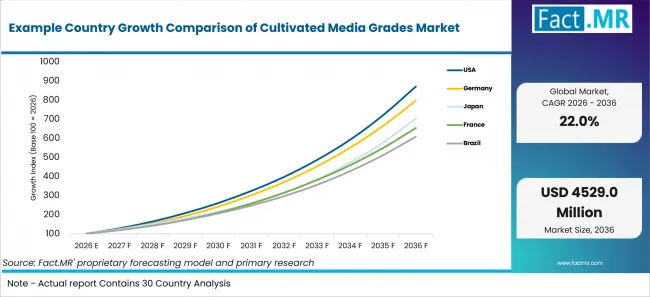
Example Country Growth Comparison Of Cultivated Media Grades Market | Source: Fact.MR
| Country | CAGR (2026-2036) |
|---|---|
| United States | 24.2% |
| Germany | 23.1% |
| Japan | 21.6% |
| France | 20.7% |
| Brazil | 19.8% |
What supports USA adoption?
24.2% CAGR, supported by cultivated-food consultation activity and cell therapy material-control needs.
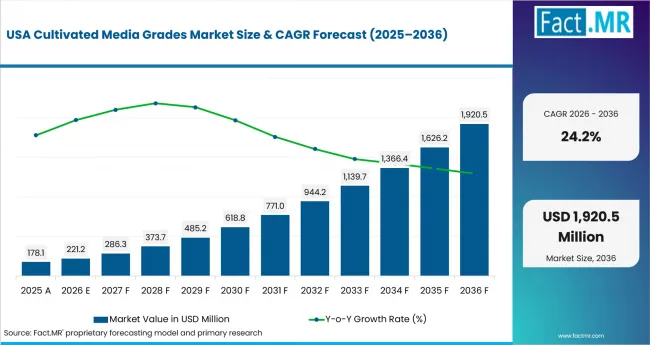
Cultivated Media Grades Market Country Value Analysis | Source: Fact.MR
The USA has the clearest regulatory reference point among the profiled markets. FDA listed Wildtype cultured salmon cell material under CCC No. 005, with an FDA response dated May 28, 2025. The consultation illustrates the importance of documented cell-bank establishment, production inputs, manufacturing controls and process information for cultured-cell food development.
What supports Germany’s adoption?
23.1% CAGR, backed by coordinated gene and cell therapy infrastructure.
Germany is building a stronger evidence pathway for advanced therapies. The National Registry for Gene and Cell Therapies Germany e.V. was founded in June 2025 and officially entered in the Register of Associations in December 2025. The registry is intended to strengthen the evidence base and framework for quality-assured application of gene and cell therapies in Germany.
How does Japan perform?
21.6% CAGR, led by iPS cell research and regenerative medicine programs.
Japan’s iPS cell base gives media developers a high-control application environment. AMED reported that MHLW granted conditional and time-limited approvals on March 6, 2026 for two iPS cell-based regenerative medicine products. The approvals reinforce the relevance of culture-media formulations and manufacturing controls that support consistent cell proliferation, differentiation and quality.
What supports France’s growth?
20.7% CAGR, supported by biotherapies and bioproduction investment.
France links media demand to biotherapy and bioproduction funding. Bpifrance reported €535 million in innovation financing for biotherapies and bioproduction in 2025. This funding environment supports continued expansion of biotherapy research and manufacturing, creating opportunities for suppliers of defined and well-documented cell-culture media used by therapy developers, research organizations and bioproduction facilities.
How is Brazil developing demand?
19.8% CAGR, driven by cultivated meat research and local cell-culture capability.
Brazil is developing demand from research-led cultivated meat programs. Embrapa published 2025 research on chicken muscle and adipogenic cell cultures for cultivated meat production, including evaluation of cell proliferation and differentiation. The work provides a local research base for developing culture-media formulations and other research-grade inputs needed to improve repeatability as poultry cell-culture processes advance toward larger-scale testing.
Who leads the Cultivated Media Grades Market?
Thermo Fisher Scientific is active through Gibco cell culture media, cultivated meat research products and media customization services. Its position is tied to broad formulation coverage, application support and quality documentation for research and production users.
Merck KGaA participates through cell-culture media and process-development support under its Life Science business. Sartorius AG is active in adjacent cell and gene therapy inputs, and its September 2025 Illkirch expansion increased the site to more than 8,000 square meters of production, laboratory and office space, including more than 3,000 square meters of new GMP-grade production capacity for transfection reagents.
Ajinomoto is active in cultivated-meat media R&D through its April 2026 hinokitiol-based serum-free media technology, while Multus Biotechnology provides animal-component-free media for cellular agriculture.
Which companies are the key providers?
Key companies include Thermo Fisher Scientific; Merck KGaA; Sartorius AG; Ajinomoto; and Multus Biotechnology.
- Thermo Fisher Scientific
- Merck KGaA
- Sartorius AG
- Ajinomoto
- Multus Biotechnology
Bibliography
- U.S. Food and Drug Administration. (2025, May 28). Cell Culture Consultation CCC 000005: Cultured Oncorhynchus kisutch cell material [Scientific memorandum].
- U.S. Food and Drug Administration. (2026, May). Chemistry, manufacturing, and controls flexibilities for developing human cellular and gene therapy products for a biologics license application: Guidance for industry.
- Ajinomoto Co., Inc. (2026, April 16). Ajinomoto Co. develops new technology to reduce culture media costs for cultivated meat production utilizing plant-derived components.
- Multus Biotechnology. (2025, July 14). Proliferum B enables multi-species cell line development with streamlined media outsourcing.
- Berlin Institute of Health at Charité. (2026, June). Progress in implementing the objectives (Progress Monitoring). National Strategy for Gene- and Cell-Based Therapies.
- Japan Agency for Medical Research and Development. (2026, March 23). Japan’s R&D and application practices toward the realization of induced pluripotent stem cell (iPS cell) therapy.
- Bpifrance. (2026, April 8). Bpifrance dresse le bilan 2025 de son action dans la santé & réaffirme son ambition de déployer 10 milliards d'euros d'ici fin 2030 pour faire émerger les leaders de demain.
- Sartorius Stedim Biotech S.A. (2025, September 18). Sartorius Stedim Biotech expands production of key components for cell and gene therapies in France.
This Report Addresses
- The report explains where cultivated media grades are used across grade, format, function, application and customer groups.
- Segment analysis identifies leading subsegments and explains media performance, documentation and scale-up needs.
- Country analysis examines listed markets and the mechanisms supporting cultivated media adoption.
- Competitive analysis reviews providers across cell culture media, defined media and animal-component-free formulations.
- Application analysis assesses how cell growth, differentiation and media input control influence producer and research institute decisions.
What does the Cultivated Media Grades Market cover?
The Cultivated Media Grades Market covers media used to support cells outside the body for cultivated food, research, regenerative medicine and bioprocess development.
The assessment covers liquid, powder, concentrate and custom-kit formats. Demand is assessed across cultivated meat, precision fermentation, cell therapy research and bioprocess development.
What is included in the scope?
The scope includes commercial media grades and custom formulations used for cell growth, differentiation, scale-up and recovery. It also includes animal-component-free and food-grade formulations.
It includes media purchases by producers, research institutes, CDMOs and ingredient suppliers. The scope also covers supplier activity in base media and defined formulations. Related end-use areas include fermented egg proteins and fermented heme flavors where food biotech teams evaluate cell or fermentation inputs.
What is excluded from the scope?
The scope excludes finished cultivated meat products, general laboratory plastics, bioreactor hardware, cell lines sold without media, scaffolds sold alone and microbial fermentation media without animal-cell culture use.
It also excludes diagnostic assay kits, general reagents without a media function and contract manufacturing revenue when the media component is bundled without separate commercial visibility.
How Was the Analysis Built?
The analysis draws on 120+ sources, 35+ company portfolios, 25+ countries, and more than 20 industry interviews.
- Primary Research: Interviews cover media suppliers, cultivated meat developers, bioprocess teams, CDMOs and research users. These discussions examine formulation choice, documentation needs and scale-up barriers.
- Desk Research: Desk research covers government data, regulatory publications, company releases, product pages, technical studies and public policy.
- Market Sizing and Forecasting: Estimates combine historical performance, segment shares, country growth, adoption patterns, investment activity and expansion barriers.
- Data Validation and Update Cycle: Findings are checked against public data, company activity and regulatory changes. Updates review launches, capacity shifts and commercial adoption.
What is the report’s scope and coverage?
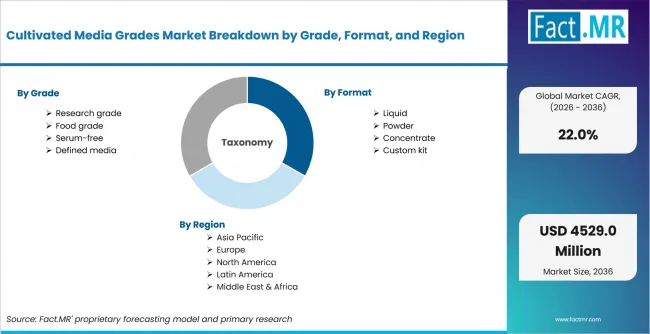
Cultivated Media Grades Market Breakdown By Grade, Format, And Region | Source: Fact.MR
| Attribute | Details |
|---|---|
| Quantitative Units | USD million |
| Market Definition | Media grades used to grow, maintain, differentiate or recover animal and human cells for food, research and bioprocess applications. |
| Grade | Research grade; Food grade; Serum-free; Defined media |
| Format | Liquid; Powder; Concentrate; Custom kit |
| Function | Cell growth; Differentiation; Scale-up; Recovery |
| Application | Cultivated meat; Precision fermentation; Cell therapy research; Bioprocess development |
| Customer | Producers; Research institutes; CDMOs; Ingredient suppliers |
| Regions Covered | North America; Latin America; Western Europe; Eastern Europe; East Asia; South Asia and Pacific; Middle East and Africa |
| Countries Covered | United States; Germany; Japan; France; Brazil |
| Key Companies Profiled | Thermo Fisher Scientific; Merck KGaA; Sartorius AG; Ajinomoto; Multus Biotechnology |
| Forecast Period | 2026 to 2036 |
| Approach | Hybrid top-down and bottom-up approach using media-grade adoption, cultivated meat pipelines, bioprocess demand, country activity and provider portfolio review. |
How is the market segmented?
-
By Grade:
- Research grade
- Food grade
- Serum-free
- Defined media
-
By Format:
- Liquid
- Powder
- Concentrate
- Custom kit
-
By Function:
- Cell growth
- Differentiation
- Scale-up
- Recovery
-
By Application:
- Cultivated meat
- Precision fermentation
- Cell therapy research
- Bioprocess development
-
By Customer:
- Producers
- Research institutes
- CDMOs
- Ingredient suppliers
-
By Region:
- North America
- Latin America
- Western Europe
- Eastern Europe
- East Asia
- South Asia and Pacific
- Middle East and Africa