- Market Value (2025): USD 203.1 Mn
- Estimated Value (2026): USD 260 Mn
- Forecast Value (2036): USD 3070 Mn
- CAGR (2026-2036): 28.0%
What is the Fermented Egg Proteins Market forecast to be worth by 2036?
USD 260 million in 2026 to USD 3070 million by 2036 at a 28.0% CAGR.
- The fermented egg proteins market reached USD 203.1 million in 2025.
- Demand is projected to increase from USD 260 million in 2026 to USD 3070 million by 2036.
- The market is forecast to record 28.0% CAGR from 2026 to 2036 as food manufacturers qualify egg-identical protein functions for large recipes.
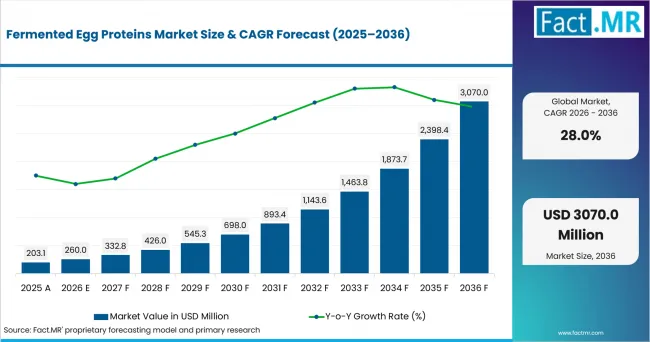
Fermented Egg Proteins Market Value Analysis | Source: Fact.MR
What are the defining numbers behind Fermented Egg Proteins Market growth?
An absolute opportunity of USD 2,810 million is expected between 2026 and 2036.
- Demand Drivers in the Market
- Production bakers need dependable foaming when egg supply moves suddenly. Large plants are expected to test fermented ovalbumin where production planning depends on stable egg-white performance.
- Procurement teams are expected to test fermentation-made proteins where egg cost volatility affects tender planning. USDA ERS reported in July 2026 that farm-level egg prices increased 31.6% in 2025 due mainly to HPAI and lower egg production.
- Ingredient blenders value ovalbumin powders because they can support protein enrichment without changing every process line. The value case is strongest where the same blend must work across bakery, confectionery and prepared food customers.
- Alternative egg brands need egg-like behavior in heat and aeration. Fermented proteins are suited to those recipes because the target protein is familiar even when the production route is new.
- Key Segments Analyzed
- By Protein: Ovalbumin is expected to hold 31.0% share in 2026 because it is the most direct egg-white protein for foaming and structure.
- By Function: Foaming is projected to account for 46.0% share in 2026 as aerated bakery and confectionery formats need repeatable volume.
- By Application: Bakery is anticipated to capture 33.0% share in 2026 since cake, mix and dessert plants already measure egg-white performance closely.
- By Customer: Food manufacturers are forecast to represent 47.0% share in 2026 owing to larger qualification budgets and repeat plant-level purchasing.
- Analyst Opinion at Fact.MR
- Shambhu Nath Jha, Principal Consultant at Fact.MR, states, "Fermented egg proteins are drawing attention because buyers now connect egg functionality with supply risk. The market is expected to scale as suppliers prove that fermentation-made ovalbumin performs under real bakery and prepared-food conditions. Winning portfolios should combine strain control, downstream consistency and application evidence that food plants can use during qualification."
- Strategic Implications
- Ingredient suppliers should compare foaming, binding and gelation against liquid and dried egg benchmarks before approaching large accounts.
- Food manufacturers should start qualification in recipes where egg variation creates measurable waste or quality rework.
- Fermentation partners should secure food-grade downstream capacity before commercial contracts move from sample orders to repeat programs.
- Regulatory teams should plan allergen, GRAS and novel food files early. FDA reported in August 2026 that its proposed GRAS rule had estimated 10-year present-value costs of USD 89.6 million at a 3% discount rate.
Germany is estimated to record 36.4% CAGR through 2036 due to industrial bakery trials and EU-grade documentation needs. The USA is projected to post 32.6% CAGR as egg volatility keeps procurement teams focused on resilient inputs. Japan is anticipated to advance at 31.5% CAGR through premium bakery and prepared-food qualification. The UK is forecast to reach 30.8% CAGR as precision fermentation guidance improves filing clarity. South Korea is expected to record 24.3% CAGR as processors manage local egg-supply risk.
How does the Fermented Egg Proteins Market break down by segment?
Food manufacturers lead Customer at 47.0% share in 2026; Foaming leads Function at 46.0% share.
Which Protein dominates?
Ovalbumin is expected to hold 31.0% share in 2026.
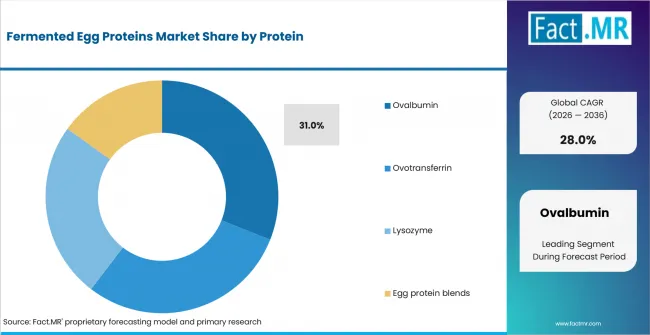
Fermented Egg Proteins Market Analysis By Protein | Source: Fact.MR
Ovalbumin leads because it is the egg-white protein most closely linked with foaming, binding and baked structure. Food manufacturers can compare it against known egg-white benchmarks. That makes qualification easier than for a less familiar protein.
FDA’s GRAS inventory shows that GRN 001249 for Onego Bio Ltd.’s ovalbumin produced using Trichoderma reesei was closed on September 16, 2025 with an FDA “no questions” letter.
What leads the Function segment?
Foaming is projected to account for 46.0% share in 2026.
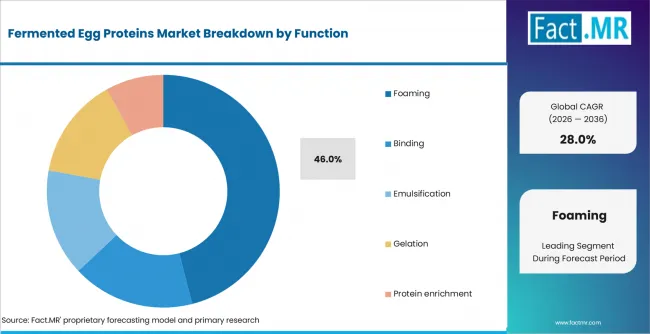
Fermented Egg Proteins Market Analysis By Function | Source: Fact.MR
Foaming leads because aeration is difficult to replace without changing product volume. Bakeries and confectionery plants can measure the result immediately in sponge cakes, whipped fillings and meringue-style systems. That makes the function central to early adoption.
How does Application shape demand?
Bakery is anticipated to capture 33.0% share in 2026.
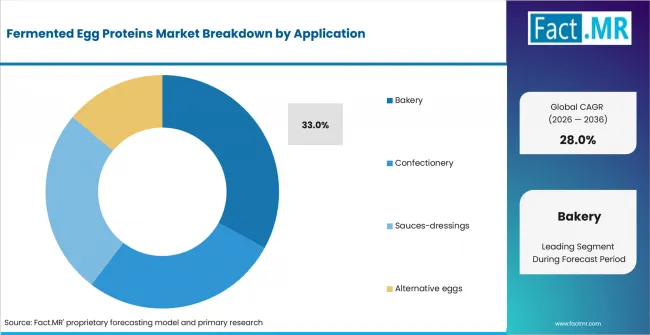
Fermented Egg Proteins Market Analysis By Application | Source: Fact.MR
Bakery leads application demand because cakes, mixes and prepared desserts already use egg proteins as process tools. The UK Department for Environment, Food and Rural Affairs reported in July 2026 that egg production for human consumption increased 5.2% to 1.1 billion dozen in 2025.
Fermented proteins are expected to enter premium bakery and prepared dessert recipes first. These products give developers a clear test for volume, crumb and shelf-life behavior before broader use.
What supports Customer demand?
Food manufacturers are forecast to represent 47.0% share in 2026.
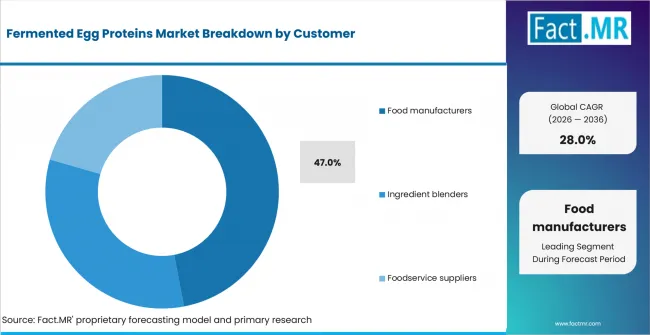
Fermented Egg Proteins Market Analysis By Customer | Source: Fact.MR
Food manufacturers lead customer demand because one approval can support multiple recipes and plants. Ingredient blenders and foodservice suppliers remain relevant, but they often wait for proof from larger food groups before expanding their own portfolios.
What is accelerating Fermented Egg Proteins Market adoption, and what is holding it back?
Egg supply volatility and functional parity drive adoption, while regulatory review and cost gaps restrain it.
Drivers Impact Analysis
| Driver | (~) % Impact on CAGR | Geographic Relevance | Impact Timeline |
|---|---|---|---|
| Egg supply volatility in bakery and prepared foods | +3.2% | North America, Europe, East Asia | Short term (<= 2 years) |
| Foaming and binding parity in commercial recipes | +2.6% | Global | Short term (<= 2 years) |
| Shelf-stable protein powders for plant operations | +1.8% | USA, UK, Germany | Medium term (2-4 years) |
| Food-grade fermentation capacity expansion | +1.4% | USA, Europe | Medium term (2-4 years) |
Source: Fact.MR analysis. Updated Aug 24, 2026
- Egg supply volatility in bakery and prepared foods: U.S. egg production fell in 2025, and farm-level egg prices rose during the same year. These two signals are expected to keep large bakeries interested in functional alternatives that reduce single-source exposure.
- Foaming and binding parity in commercial recipes: Food manufacturers need proof that fermented proteins behave like egg whites during mixing, heating and storage. Plant trials carry more weight than claims about production technology.
- Shelf-stable protein powders for plant operations: Powdered ovalbumin can simplify inventory where liquid egg creates cold-chain or shelf-life limits. This is expected to support adoption by multi-site manufacturers.
- Food-grade fermentation capacity expansion: Commercial use depends on reliable protein volume and downstream processing. EVERY’s June 2026 expansion with Huvepharma demonstrates the importance of large-scale manufacturing partners in supporting steady-state, regular commercial supply.
Opportunity Impact Analysis
| Opportunity | (~) % Impact on CAGR | Geographic Relevance | Impact Timeline |
|---|---|---|---|
| Bakery validation programs with large food groups | +1.8% | USA, UK, Japan | Short term (<= 2 years) |
| CDMO and strategic fermentation partnerships | +1.5% | USA, Europe | Medium term (2-4 years) |
| Ingredient blending for foaming systems | +1.1% | Global | Medium term (2-4 years) |
Source: Fact.MR analysis. Updated Aug 24, 2026
- Bakery validation programs with large food groups: Bakery remains the clearest entry point because results are visible in volume, crumb and shelf life. Suppliers that support plant trials are expected to reach purchase approval sooner.
- CDMO and strategic fermentation partnerships: Many specialists have strong strains but limited commercial tanks. Outsourced precision fermentation CDMO services are projected to shorten the path from pilot runs to repeat food-grade supply.
- Ingredient blending for foaming systems: Blenders can pair fermented ovalbumin with starches or hydrocolloids to create simpler recipes. That route helps brands avoid full process redesign.
Restraints Impact Analysis
| Restraint | (~) % Impact on CAGR | Geographic Relevance | Impact Timeline |
|---|---|---|---|
| GRAS and novel food review requirements | -1.1% | USA, UK, EU | Short term (<= 2 years) |
| Cost gap against conventional egg ingredients | -0.9% | Global | Medium term (2-4 years) |
| Allergen labeling for egg-identical proteins | -0.5% | Global | Short term (<= 2 years) |
Source: Fact.MR analysis. Updated Aug 24, 2026
- GRAS and novel food review requirements: Regulatory review adds time before broad food use. FDA and UK guidance show that identity, safety and process evidence remain a core cost of market entry.
- Cost gap against conventional egg ingredients: Fermented proteins compete with a mature processing chain. Adoption is expected to begin where supply risk or functionality justifies premium pricing.
- Allergen labeling for egg-identical proteins: In the United States, FDA identifies egg as a major food allergen, and applicable packaged foods containing egg-derived protein must disclose the source unless an exemption applies. Onego Bio Ltd. also states that its precision-fermented ovalbumin should be treated as an egg allergen.
Which countries are scaling the Fermented Egg Proteins Market through 2036?
- The country comparison spans 12.1 percentage points and forms two practical growth bands across the forecast period.
- Germany remains 3.8 percentage points above the USA through industrial bakery demand and EU dossier discipline.
- The USA remains 1.1 percentage points above Japan as egg supply volatility keeps procurement teams focused on resilience.
- Japan remains 0.7 percentage point above the UK through premium food manufacturing and application-led qualification.
- The UK remains 6.5 percentage points above South Korea as precision fermentation guidance improves regulatory planning.
- South Korea closes the displayed range through processed-food demand and egg-supply risk management.
Comparable CAGRs can create different entry conditions due to egg ingredient availability, regulatory filing routes, fermentation capacity and food manufacturer readiness. Full report coverage includes North America, Latin America, Western Europe, Eastern Europe, East Asia, South Asia and Pacific, and Middle East and Africa.
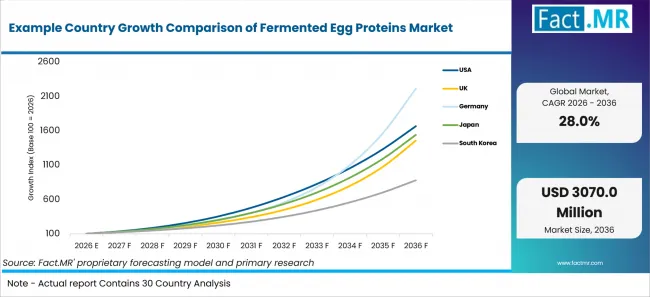
Example Country Growth Comparison Of Fermented Egg Proteins Market | Source: Fact.MR
| Country | CAGR |
|---|---|
| Germany | 36.4% |
| USA | 32.6% |
| Japan | 31.5% |
| UK | 30.8% |
| South Korea | 24.3% |
Source: Fact.MR analysis. Updated Aug 24, 2026
What supports Germany adoption?
36.4% CAGR, supported by bakery reformulation and EU-grade dossier planning.
Germany has a large egg-processing base for bakery and confectionery comparison. Destatis reported in March 2026 that Germany produced around 13.7 billion eggs in 2025 in establishments with at least 3,000 hen-housing places, up 0.5% from 2024. The country is expected to record 36.4% CAGR through 2036 as manufacturers test fermentation-made proteins against known egg-white performance.
How is the USA scaling demand?
32.6% CAGR, backed by egg-supply volatility and commercial fermentation capacity.
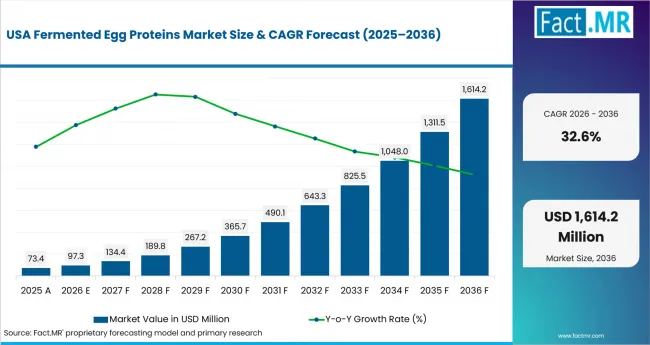
Fermented Egg Proteins Market Country Value Analysis | Source: Fact.MR
U.S. food manufacturers are already dealing with visible egg price and production swings. The USA is projected to post 32.6% CAGR through 2036 as large bakery and prepared-food plants seek stable functionality. ADM and EVERY announced in July 2026 that commercial-scale OvoPro production would be based at ADM's Clinton, Iowa facility.
What supports Japan growth?
31.5% CAGR, led by premium bakery and prepared-food qualification.
Japan offers a strong route through premium baked goods and prepared foods where texture standards are tightly managed. Japan is anticipated to advance at 31.5% CAGR through application trials that prove foaming and binding without recipe disruption. Suppliers should focus on customer trials that show stable performance in familiar bakery formats.
What supports the UK outlook?
30.8% CAGR, supported by precision fermentation guidance and bakery channel trials.
The Food Standards Agency and Food Standards Scotland published precision-fermentation safety guidance on February 18, 2026. For Regulation (EC) 853/2004 hygiene purposes, the guidance says precision-fermentation products involving animal-derived cells, tissue or material at any stage are treated as products of animal origin.
How is South Korea developing demand?
24.3% CAGR, driven by processed-food demand and egg-supply risk management.
South Korea's processed-food manufacturers to consider fermented egg proteins where consistent functionality may reduce exposure to egg-supply uncertainty. On April 22, 2026, South Korea’s Ministry of Agriculture, Food and Rural Affairs reported daily egg production of 45.96 million eggs in April 2026, down 5.6% from 48.66 million a year earlier following HPAI-related culling.
Who leads the Fermented Egg Proteins Market?
The EVERY Company and Onego Bio Ltd. as directly evidenced fermented egg-protein participants. ADM and Huvepharma are precision-fermented dairy-protein companies.
The EVERY Company is expanding through OvoPro™ across retail, e-commerce, and foodservice channels. In June 2026, the company said its Huvepharma agreement quadrupled EVERY’s production capacity, with the expanded production primarily focused on OvoPro, following annual orders secured in the first four months of 2026 worth 550% of its total 2025 order volume. Onego Bio Ltd. is active through Bioalbumen®, its precision-fermented ovalbumin, for which FDA closed GRN 1249 on September 16, 2025 with a ‘no questions’ response.
Which companies are the key providers?
Key companies include The EVERY Company; Onego Bio Ltd.; ADM; and Huvepharma.
- The EVERY Company
- Onego Bio Ltd.
- ADM
- Huvepharma
Bibliography
- ADM. (2026, July 14). ADM, EVERY Company partner to deliver US-based commercial scale production of OvoPro™ egg white protein.
- Statistisches Bundesamt. (2026, March 13). Eierproduktion 2025 leicht gestiegen.
- Food Standards Agency. (2026, February 18). UK safety guidance on precision fermentation products. GOV.UK.
- The EVERY Company. (2026, June 15). EVERY and Huvepharma announce 4x production capacity expansion.
- Department for Environment, Food & Rural Affairs. (2026, July 29). Chapter 8: Livestock. In Agriculture in the United Kingdom 2025. GOV.UK.
- U.S. Department of Agriculture, Economic Research Service. (2026, July 24). Food Price Outlook - summary findings.
- U.S. Food and Drug Administration. (2025, September 16). GRN No. 1249: Ovalbumin produced by Trichoderma reesei ATCC 13631.
- U.S. Food and Drug Administration. (2026, August 11). Substances generally recognized as safe (proposed rule).
This Report Answers
- The report explains where fermented egg proteins fit across protein, function, application and customer categories. It also compares them with egg products used in food processing.
- Segment analysis identifies ovalbumin, foaming, bakery and food manufacturers as the leading subsegments.
- Country analysis examines Germany, USA, Japan, UK and South Korea through egg supply, regulation and food manufacturing conditions.
- Competitive analysis reviews direct egg-protein developers and precision-fermented protein companies that shape application proof and scale-up options.
- Application analysis assesses foaming, binding and bakery use cases beside vegan baking ingredients where egg function also drives formulation choices.
What does the Fermented Egg Proteins Market cover?
The Fermented Egg Proteins Market covers precision-fermented proteins designed to deliver egg-like functions in food manufacturing. It includes ovalbumin, ovotransferrin, lysozyme and egg protein blends used for foaming, binding, emulsification, gelation and protein enrichment.
The assessment includes commercial food applications across bakery, confectionery, sauces-dressings and alternative eggs. It also reviews ingredient qualification routes connected to plant-based egg replacers because many food plants compare these options during reformulation.
What is included in the scope?
The scope includes proteins made by microbial precision fermentation when the intended commercial role is replacing or improving egg protein performance. It includes ingredient powders, blends and customer support tied to food manufacturing qualification, including precision fermentation dairy alternatives only where they illustrate shared fermentation scale-up needs.
It includes direct use by food manufacturers and technical selling through blenders or foodservice suppliers. Scope links also cover aquafaba functional ingredients where foaming and binding are compared against egg-white performance.
What is excluded from the scope?
The scope excludes fresh shell eggs, conventional liquid egg, dried egg and frozen egg products when sold without fermentation-derived protein. It also excludes animal-free dairy proteins unless they are discussed as precision fermentation capability.
Finished consumer foods are excluded unless the ingredient function is visible in the supply chain. Conventional dried egg products are treated as benchmarks rather than part of the fermented egg protein revenue base.
How Was the Analysis Built?
The analysis draws on 120+ sources, 35+ company portfolios, 25+ countries, and more than 20 industry interviews.
- Primary Research: Primary research includes discussions with manufacturers, service providers, technology developers, distributors, end users, procurement teams, and subject-matter experts. These conversations examine purchasing priorities, product adoption, operational challenges, approval requirements, competitive positioning, and the factors that influence wider market acceptance.
- Desk Research: Desk research covers government statistics, regulatory publications, company filings, trade data, technical studies, industry associations, standards, public policy, and other authoritative sources. Every source used in the analysis is documented in the bibliography.
- Market Sizing and Forecasting: Market estimates combine historical performance, demand indicators, pricing and volume trends, segment shares, company participation, country-level growth, adoption patterns, investment activity, and barriers to market expansion.
- Data Validation and Update Cycle: Findings are validated by comparing primary interviews with public data, company activity, regulatory changes, trade patterns, and industry developments. Regular updates review new product launches, capacity changes, partnerships, approvals, procurement trends, and shifts in commercial adoption.
Segmentation
What is the report’s scope and coverage?
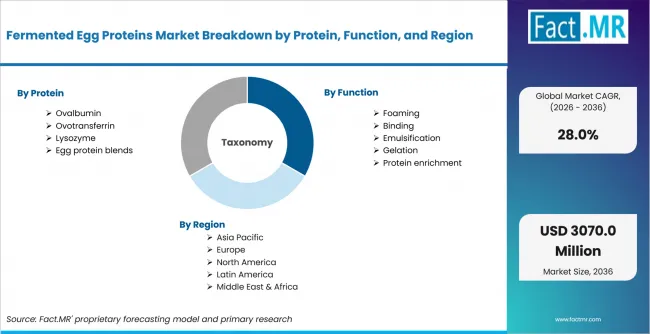
Fermented Egg Proteins Market Breakdown By Protein, Function, And Region | Source: Fact.MR
| Attribute | Details |
|---|---|
| Quantitative Units | USD million |
| Market Definition | Proteins produced through precision fermentation to match egg protein functions such as foaming, binding, emulsification, gelation and protein enrichment for food applications. |
| Protein | Ovalbumin; Ovotransferrin; Lysozyme; Egg protein blends |
| Function | Foaming; Binding; Emulsification; Gelation; Protein enrichment |
| Application | Bakery; Confectionery; Sauces-dressings; Alternative eggs |
| Customer | Food manufacturers; Ingredient blenders; Foodservice suppliers |
| Regions Covered | North America; Latin America; Western Europe; Eastern Europe; East Asia; South Asia and Pacific; Middle East and Africa |
| Countries Covered | USA; UK; Germany; Japan; South Korea |
| Key Companies Profiled | The EVERY Company; Onego Bio Ltd.; ADM; Huvepharma |
| Forecast Period | 2026 to 2036 |
| Approach | Hybrid top-down and bottom-up approach using egg ingredient demand, fermentation capacity, application trials, country adoption and provider portfolio review. |
Source: Fact.MR analysis. Updated Aug 24, 2026
How is the market segmented?
-
By Protein:
- Ovalbumin
- Ovotransferrin
- Lysozyme
- Egg protein blends
-
By Function:
- Foaming
- Binding
- Emulsification
- Gelation
- Protein enrichment
-
By Application:
- Bakery
- Confectionery
- Sauces-dressings
- Alternative eggs
-
By Customer:
- Food manufacturers
- Ingredient blenders
- Foodservice suppliers
-
By Region:
- North America
- Latin America
- Western Europe
- Eastern Europe
- East Asia
- South Asia and Pacific
- Middle East and Africa
Frequently Asked Questions
How big is the fermented egg proteins market in 2026?
What is the CAGR of the fermented egg proteins market from 2026 to 2036?
Which protein leads the fermented egg proteins market?
Which function leads the fermented egg proteins market?
Who are the leading companies in the fermented egg proteins market?
Who worked on this report


Preview the report firsthand - request a free sample
Free SampleGet the brochure for pricing and purchase details
Download PDF