- Market Value (2025): USD 140.6 Mn
- Estimated Value (2026): USD 180.0 Mn
- Forecast Value (2036): USD 2,125.0 Mn
- CAGR (2026-2036): 28.0%
What is the Fermented Heme Flavors Market forecast to be worth by 2036?
USD 180.0 million in 2026 to USD 2,125.0 million by 2036 at a 28.0% CAGR.
- The fermented heme flavors market reached USD 140.6 million in 2025.
- Demand is projected to increase from USD 180.0 million in 2026 to USD 2,125.0 million by 2036.
- The market is forecast to record 28.0% CAGR from 2026 to 2036 as brands pursue meatier flavor systems.
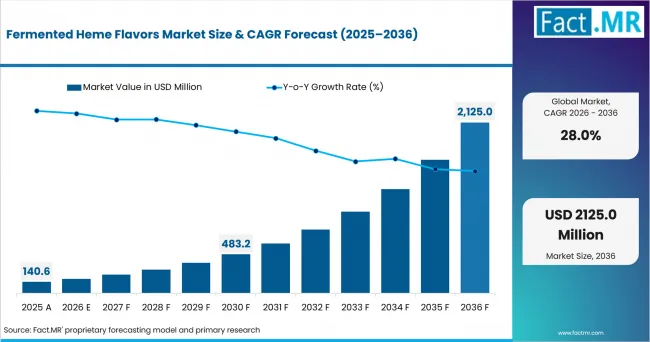
Fermented Heme Flavors Market Value Analysis | Source: Fact.MR
What are the defining numbers behind Fermented Heme Flavors Market growth?
USD 1,945.0 million absolute opportunity is expected between 2026 and 2036.
- Demand Drivers in the Market
- Plant-based brands need cooked-meat aroma in plant-based meat formulations where heat exposes beany notes and weak browning.
- Hybrid meat developers need low-dose savory systems that improve aroma while keeping animal-protein reduction claims clear.
- Flavor houses need fermentation routes that provide consistent heme expression and cleaner supply documentation.
- Foodservice teams need liquid concentrates that dose into patties and sauces without changing line speed.
- Key Segments Analyzed
- By Heme Platform: Pichia-expressed heme is expected to hold 44.0% share in 2026 due to established yeast expression know-how and scalable purification routes.
- By Function: Meaty aroma is projected to account for 30.0% share in 2026 as brands try to close the cooked-meat gap in plant-based products.
- By Application: Plant-based burgers are anticipated to capture 43.0% share in 2026 owing to direct consumer exposure to grilled aroma and browned color.
- By Form: Liquid concentrates are estimated to represent 44.0% share in 2026 since they fit wet blending and fat-phase flavor dosing in meat alternatives.
- Analyst Opinion at Fact.MR
- Shambhu Nath Jha, Principal Consultant at Fact.MR, states, “Fermented heme flavors target the sensory gap that limits repeat purchases of meat alternatives. Adoption is expected to favor platforms that prove aroma release and provide clear regulatory documentation. Suppliers with strain control and application labs should be better placed than firms selling a single molecule.”
- Strategic Implications
- Ingredient suppliers should document heme concentration, thermal aroma release and off-note control by finished food format.
- Flavor developers should pair heme notes with protein flavor masking only where those systems improve sensory clarity.
- Co-manufacturers should validate dosing equipment and cleaning steps before adding liquid heme concentrates to shared production lines.
- Brand teams should use official safety dossiers and application data before moving heme flavors from pilot kitchens to retail recipes.
Japan is projected to post 32.1% CAGR through 2036, led by meat consumption and precision fermentation. Germany is forecast to record 24.8% CAGR as meat-substitute output supports trials. The USA is anticipated to advance at 24.4% CAGR as food spending sets a reference point. The UK is estimated to hold 21.6% CAGR due to alternative-protein research funding. South Korea is expected to reach 19.8% CAGR as K-Food exports widen test channels.
How does the Fermented Heme Flavors Market break down by segment?
Pichia-expressed heme leads Heme Platform at 44.0%; Liquid concentrates lead Form at 44.0%.
Which Heme Platform dominates?
Pichia-expressed heme is expected to hold 44.0% share in 2026.
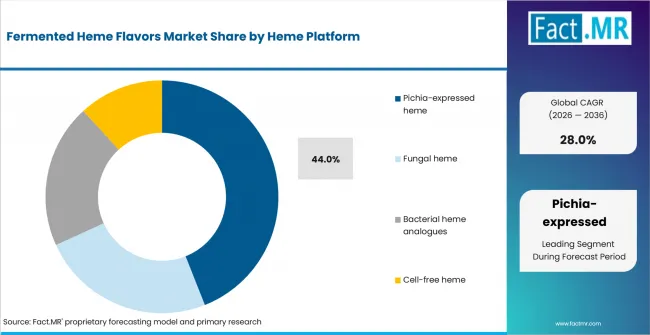
Fermented Heme Flavors Market Analysis By Heme Platform | Source: Fact.MR
FDA GRN 737 documents soy leghemoglobin prepared from a strain of Pichia pastoris for use in cooked ground-beef analogue products to optimize flavor. This verifies the existence and food-use relevance of a Pichia-expressed heme platform.
FDA’s GRAS evidence supports soy leghemoglobin as a flavor-related ingredient in meat analogues; broader myoglobin-like behavior or animal-free sourcing claims should be supported separately when used.
What leads the Function segment?
Meaty aroma is projected to account for 30.0% share in 2026.
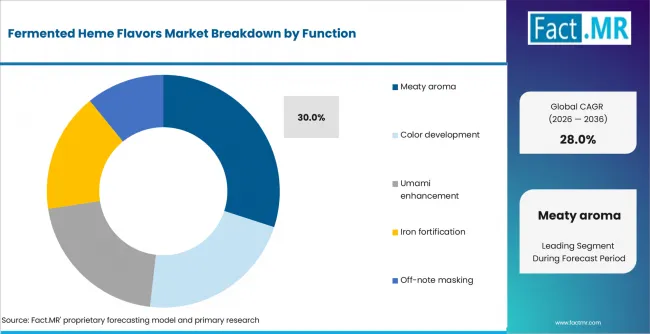
Fermented Heme Flavors Market Analysis By Function | Source: Fact.MR
Meaty aroma leads because heme chemistry becomes visible when plant proteins are heated. Brand teams use meat flavors to close the gap between seasoning and cooked character.
Color development and umami enhancement remain relevant, yet aroma is where brands face the sharpest comparison against beef and pork.
How does Application shape demand?
Plant-based burgers are anticipated to capture 43.0% share in 2026.
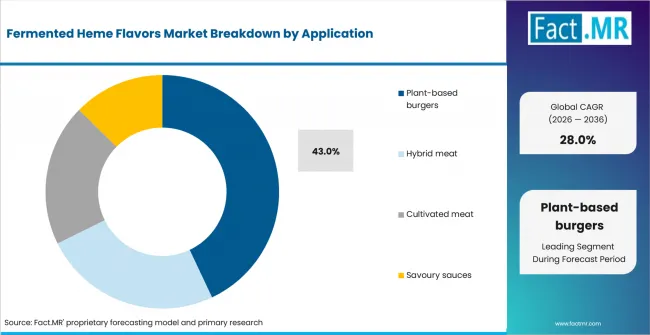
Fermented Heme Flavors Market Analysis By Application | Source: Fact.MR
Plant-based burgers lead because the format puts heme flavor under direct sensory pressure. Consumers notice grill aroma and color in burger-style meat substitutes faster than in sauced meal components.
Hybrid meat and cultivated meat are expected to create new formulation work, but burgers remain the main validation ground.
What supports Liquid concentrates within Form?
Liquid concentrates are estimated to represent 44.0% share in 2026.
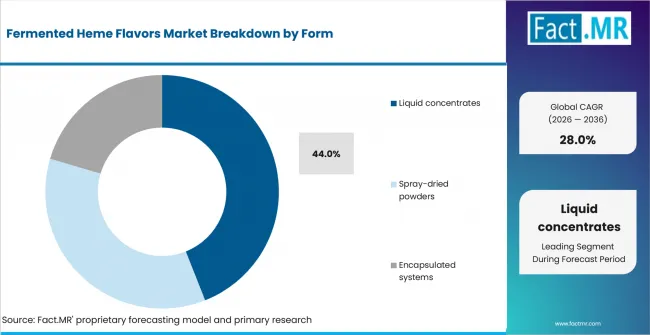
Fermented Heme Flavors Market Analysis By Form | Source: Fact.MR
Liquid concentrates lead because they blend into hydrated protein matrices and fat systems without powder handling. This makes them practical where dosing accuracy has to remain simple.
Spray-dried powders and encapsulated systems are useful where shelf life carries more weight.
What is accelerating Fermented Heme Flavors Market adoption, and what is holding it back?
Demand is expected to rise through meat-alternative sensory gaps and fermentation scale-up. Growth is constrained by cost, labeling review and off-note risk.
Drivers Impact Analysis
| DRIVER | (~) % IMPACT ON CAGR | GEOGRAPHIC RELEVANCE | IMPACT TIMELINE |
|---|---|---|---|
| Need for cooked-meat aroma in plant-based burgers | +3.1% | North America, Europe, East Asia | Short term (<= 2 years) |
| Animal-free heme fermentation routes | +2.4% | Global | Medium term (2-4 years) |
| Hybrid meat reformulation by food processors | +1.6% | USA, Germany, UK | Medium term (2-4 years) |
| Foodservice liquid dosing formats | +1.1% | USA, Japan, South Korea | Long term (>= 4 years) |
Source: Fact.MR analysis. Updated Aug 22, 2026
- Need for cooked-meat aroma in plant-based burgers: Burgers expose aroma gaps during cooking, giving heme flavor suppliers a clear sensory use case.
- Animal-free heme fermentation routes: Precision fermentation gives ingredient teams a route to heme-like flavor compounds without animal extraction.
- Hybrid meat reformulation by food processors: Processors are expected to use heme flavors to retain meat cues when reducing animal protein in blended products.
- Foodservice liquid dosing formats: Foodservice kitchens and central commissaries favor flavor systems that integrate into existing wet mixes with limited handling change.
Opportunity Impact Analysis
| OPPORTUNITY | (~) % IMPACT ON CAGR | GEOGRAPHIC RELEVANCE | IMPACT TIMELINE |
|---|---|---|---|
| Burger and sausage application labs | +1.7% | USA, Germany, Japan | Short term (<= 2 years) |
| Encapsulated delayed-release systems | +1.2% | Global | Medium term (2-4 years) |
| Cultivated meat and hybrid flavor modules | +1.0% | East Asia, Europe | Long term (>= 4 years) |
Source: Fact.MR analysis. Updated Aug 22, 2026
- Burger and sausage application labs: Suppliers are expected to win trials by showing cooked sensory results in the brand’s selected format.
- Encapsulated delayed-release systems: Encapsulation is expected to protect flavor during processing and release aroma during cooking.
- Cultivated meat and hybrid flavor modules: Heme flavors are anticipated to support blended and cell-based products where base material does not deliver enough cooked-meat aroma alone.
Restraints Impact Analysis
| RESTRAINT | (~) % IMPACT ON CAGR | GEOGRAPHIC RELEVANCE | IMPACT TIMELINE |
|---|---|---|---|
| Fermentation and purification cost | -0.9% | Global | Short term (<= 2 years) |
| Regulatory and labeling review | -0.7% | USA, UK, Europe, Japan | Medium term (2-4 years) |
| Off-note and color instability | -0.5% | Global | Medium term (2-4 years) |
Source: Fact.MR analysis. Updated Aug 22, 2026
- Fermentation and purification cost: Heme flavors need low inclusion rates and clear sensory lift in price-sensitive meat alternatives.
- Regulatory and labeling review: Product teams need food-safety documentation before adding new heme proteins or analogues to retail recipes.
- Off-note and color instability: Heme flavor work often needs plant protein off-note masking when metallic notes appear after processing.
Which countries are scaling the Fermented Heme Flavors Market through 2036?
- The comparison spans 12.3 percentage points.
- Japan remains 7.3 percentage points above Germany as meat consumption supports higher trial intensity.
- Germany remains 0.4 percentage point above the USA through meat-substitute manufacturing.
- The USA remains 2.8 percentage points above the UK as food spending and red-meat processing keep the sensory benchmark visible.
- The UK remains 1.8 percentage points above South Korea through alternative-protein research programs and food export activity.
- South Korea closes the displayed range while food-tech policy and export channels keep demand selective and evidence-led.
Comparable CAGRs create different entry conditions due to food spending, meat-reference culture, label scrutiny and ingredient cost. Full coverage includes North America, Latin America, Western Europe, Eastern Europe, East Asia, South Asia & Pacific, Middle East & Africa.
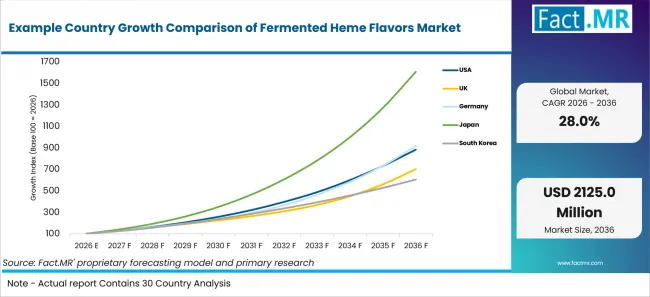
Example Country Growth Comparison Of Fermented Heme Flavors Market | Source: Fact.MR
| Country | CAGR (2026-2036) |
|---|---|
| Japan | 32.1% |
| Germany | 24.8% |
| USA | 24.4% |
| UK | 21.6% |
| South Korea | 19.8% |
Source: Fact.MR analysis. Updated Aug 22, 2026
How does Japan perform?
32.1% CAGR through 2036, supported by meat consumption and fermentation-linked food innovation.
Japan’s growth is supported by established meat demand, food innovation and precision formulation capabilities. MAFF reported 34.3 kilograms per person per year of meat supply in FY2024, while Japan’s calorie-based food self-sufficiency ratio was 38% in FY2024. Food brands are expected to test liquid and encapsulated heme systems in prepared meals and meat fillings where grilled aroma and color performance matter.
What supports Germany adoption?
24.8% CAGR through 2036, reinforced by meat-substitute production and ready-meal manufacturing.
Germany’s growth reflects a sizeable meat-alternative market and expanding prepared-meal production. Destatis reported production of 124,900 tonnes of meat substitutes in 2025, while prepared-meal output reached 1.7 million tonnes in 2024, up 25.6% from 2019. Processors are expected to use fermented-heme systems to strengthen meat-like aroma and flavor in pea, soy and wheat formulations.
What supports USA adoption?
24.4% CAGR through 2036, backed by food spending and red-meat processing scale.
The USA’s growth is supported by a large food market and substantial meat-processing activity. USDA ERS reported total food spending of USD 2.51 trillion in 2025, while USDA NASS reported 53.8 billion pounds of red meat production in 2025. Plant-based brands and foodservice operators are expected to use heme flavors in burgers, sauces and reheated products where browning and cooked aroma are important.
How is the United Kingdom scaling demand?
21.6% CAGR through 2036, supported by alternative-protein research and agri-food export depth.
The United Kingdom’s growth is supported by alternative-protein research and established agri-food channels. Defra reported provisional UK food, feed and drink exports of GBP 25.7 billion in 2025, while UKRI’s Gateway to Research lists a GBP 16.0 million funded award for the National Alternative Protein Innovation Centre running from August 2024 to August 2029. Plant-based brands are expected to test heme flavor systems in burgers and ready meals where cooked-aroma gaps are measurable.
How is South Korea developing demand?
19.8% CAGR through 2036, driven by food-tech policy and K-Food export channels.
South Korea’s growth is supported by food-tech investment and expanding export activity. MAFRA reported that K-Food Plus exports reached USD 13.6 billion in 2025, up 5.1%, while smart-factory participation is being expanded from 30 facilities in 2024 to 187 by 2026. Sauce, dumpling and ready-meal producers are expected to test heme flavor systems that retain meat-like notes after freezing or retort processing.
Who leads the Fermented Heme Flavors Market?
Impossible Foods is a verified commercial reference for fermentation-derived heme. FDA’s GRAS inventory records Impossible Foods as the notifier for soy leghemoglobin preparations produced using Pichia pastoris and Komagataella phaffii for flavor use in plant-based meat analogues. Impossible Steak Bites should not be used as heme evidence because the product’s current published ingredient list does not list soy leghemoglobin.
Ginkgo Bioworks has verified strain-engineering and fermentation capabilities for food and flavor molecules, but no current official source reviewed here identifies a commercial heme-flavor product. dsm-firmenich have verified plant-based taste and biosolutions capabilities.
Givaudan has verified alternative-protein flavor and sensory capabilities, including vegan flavor systems. These companies should be classified as adjacent or enabling participants unless direct fermented-heme products are independently documented.
Which companies are the key providers?
Key companies include Impossible Foods Inc., Ginkgo Bioworks, dsm-firmenich, Givaudan SA.
- Impossible Foods Inc.
- Ginkgo Bioworks
- dsm-firmenich
- Givaudan SA
Bibliography
- U.S. Bureau of Labor Statistics. (2026, July 14). Consumer Price Index—June 2026.
- Department for Environment, Food & Rural Affairs. (2026, July 29). Food statistics in your pocket.
- dsm-firmenich. (2025, October 2). dsm-firmenich opens global food innovation center in Delft, the Netherlands to accelerate diet transformation.
- Ginkgo Bioworks Holdings, Inc. (2026, February 26). Ginkgo Bioworks Q4 and Full Year 2025 Update & Business Review.
- U.S. Food and Drug Administration. (2025, March 7). GRN No. 1202: Soy leghemoglobin preparation from a strain of Komagataella phaffii.
- Ministry of Agriculture, Food and Rural Affairs. (2026a, January 20). Exports of K-Food Plus reached USD 13.6 billion in 2025, up 5.1% year-over-year.
- Ministry of Data and Statistics. (2026, May 6). Consumer Price Index in April 2026.
- Office for National Statistics. (2026, July 22). Consumer price inflation, UK: June 2026.
- Statistics Bureau of Japan. (2026, January 23). Japan 2025.
- Statistisches Bundesamt. (2026a, January 14). Produktion von Fertiggerichten binnen fünf Jahren mengenmäßig um 25,6 % gestiegen.
- UK Research and Innovation. (2024, August 28). National alternative protein innovation centre launches.
- U.S. Department of Agriculture, National Agricultural Statistics Service. (2026, April 22). Livestock Slaughter 2025 Summary.
This Report Addresses
- The report explains where fermented heme flavors are used across heme platform, function, application and form.
- Segment analysis identifies subsegments with clear commercial fit and explains the sensory reasons behind their position.
- Country analysis reviews Japan, Germany, USA, UK and South Korea with local drivers and restraints.
- Competitive analysis reviews a verified commercial heme reference alongside adjacent fermentation platforms, biosolutions and alternative-protein flavor companies.
- Application analysis assesses how cooked aroma, color behavior and off-note control shape buyer decisions in meat alternatives.
What does the Fermented Heme Flavors Market cover?
The Fermented Heme Flavors Market covers heme proteins, heme analogues and heme-led flavor systems made through microbial or cell-free routes. It covers adjacent sensory additives when the heme component defines the meat-like sensory claim.
The assessment covers commercial flavor systems that contribute meaty aroma, color development, umami support or off-note masking. It includes formulation work linked to bitter blockers only when the finished food uses heme-led savory positioning.
What is included in the scope?
The scope includes Pichia-expressed heme, fungal heme, bacterial heme analogues and cell-free heme systems used as food flavor inputs. It covers liquid concentrates, spray-dried powders and encapsulated systems.
Included applications are plant-based burgers, hybrid meat, cultivated meat and savoury sauces. The scope includes ingredient systems tied to meat-alternative taste.
What is excluded from the scope?
The scope excludes base fermentation equipment, contract fermentation services and general fermented plant protein products when they are not sold as heme flavor systems.
Conventional smoke flavors, yeast extracts and ordinary seasonings are excluded unless a heme component defines the claim.
How Was the Analysis Built?
The analysis draws on 120+ sources, 35+ company portfolios, 25+ countries, and more than 20 industry interviews.
- Primary Research: Primary research includes discussions with manufacturers, service providers, technology developers, distributors, end users, procurement teams, and subject-matter experts. These conversations examine purchasing priorities, product adoption, operational challenges, approval requirements, competitive positioning, and the factors that influence wider market acceptance.
- Desk Research: Desk research covers government statistics, regulatory publications, company filings, trade data, technical studies, industry associations, standards, public policy, and other authoritative sources. Every source used in the analysis is documented in the bibliography.
- Market Sizing and Forecasting: Market estimates combine historical performance, demand indicators, pricing and volume trends, segment shares, company participation, country-level growth, adoption patterns, investment activity, and barriers to market expansion.
- Data Validation and Update Cycle: Findings are validated by comparing primary interviews with public data, company activity, regulatory changes, trade patterns, and industry developments. Regular updates review new product launches, capacity changes, partnerships, approvals, procurement trends, and shifts in commercial adoption.
Segmentation
What is the report’s scope and coverage?
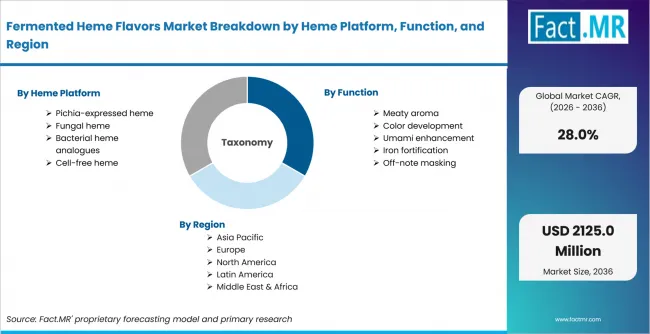
Fermented Heme Flavors Market Breakdown By Heme Platform, Function, And Region | Source: Fact.MR
| Attribute | Details |
|---|---|
| Quantitative Units | USD million |
| Market Definition | Fermentation-derived heme proteins, heme analogues and flavor preparations used to create meaty aroma, umami, color development or off-note masking in plant-based, hybrid and cultivated meat applications. |
| Heme Platform | Pichia-expressed heme; Fungal heme; Bacterial heme analogues; Cell-free heme |
| Function | Meaty aroma; Color development; Umami enhancement; Iron fortification; Off-note masking |
| Application | Plant-based burgers; Hybrid meat; Cultivated meat; Savoury sauces |
| Form | Liquid concentrates; Spray-dried powders; Encapsulated systems |
| Regions Covered | North America; Latin America; Western Europe; Eastern Europe; East Asia; South Asia & Pacific; Middle East & Africa |
| Countries Covered | USA; UK; Germany; Japan; South Korea |
| Companies Profiled | Impossible Foods Inc.; Ginkgo Bioworks; dsm-firmenich; Givaudan SA |
| Forecast Period | 2026 to 2036 |
| Approach | Hybrid top-down and bottom-up approach using product launches, food-tech programs, meat-alternative production, ingredient portfolios and country adoption. |
Source: Fact.MR analysis. Updated Aug 22, 2026
How is the market segmented?
-
By Heme Platform
- Pichia-expressed heme
- Fungal heme
- Bacterial heme analogues
- Cell-free heme
-
By Function
- Meaty aroma
- Color development
- Umami enhancement
- Iron fortification
- Off-note masking
-
By Application
- Plant-based burgers
- Hybrid meat
- Cultivated meat
- Savoury sauces
-
By Form
- Liquid concentrates
- Spray-dried powders
- Encapsulated systems
-
By Region
- North America
- Latin America
- Western Europe
- Eastern Europe
- East Asia
- South Asia & Pacific
- Middle East & Africa
Frequently Asked Questions
How big is the fermented heme flavors market in 2026?
What is the CAGR of the fermented heme flavors market from 2026 to 2036?
Which heme platform leads the fermented heme flavors market?
Which function leads the fermented heme flavors market?
Who are the leading companies in the fermented heme flavors market?
Who worked on this report


Preview the report firsthand - request a free sample
Free SampleGet the brochure for pricing and purchase details
Download PDF