- Market Value (2025): USD 202.3 Mn
- Estimated Value (2026): USD 265.0 Mn
- Forecast Value (2036): USD 3944.0 Mn
- CAGR (2026-2036): 31.0%
What is the Cultivated Fat Ingredients Market forecast to be worth by 2036?
USD 265.0 million in 2026 to USD 3,944.0 million by 2036 at a 31.0% CAGR.
- The Cultivated Fat Ingredients Market reached USD 202.3 million in 2025.
- Demand is projected to increase from USD 265.0 million in 2026 to USD 3,944.0 million by 2036.
- The market is forecast to record 31.0% CAGR from 2026 to 2036 as meat-alternative brands and food manufacturers test cultivated fat for taste and juiciness.
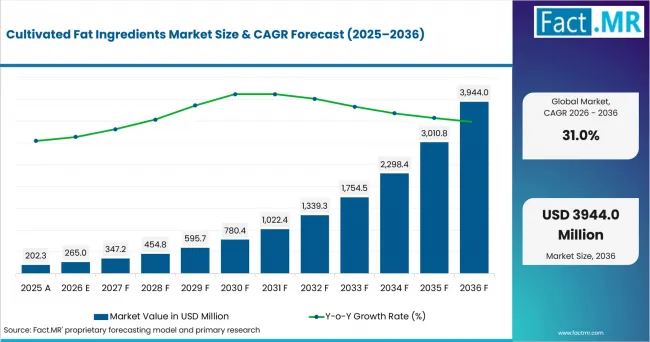
Cultivated Fat Ingredients Market Value Analysis | Source: Fact.MR
What are the defining numbers behind Cultivated Fat Ingredients Market growth?
An absolute opportunity of USD 3,679.0 million is expected between 2026 and 2036.
- Demand Drivers in the Market
- Meat-alternative formulators need animal-fat cues in plant-protein formats. Cultivated fat targets sizzle, aroma release and bite where commodity plant oils often perform differently.
- Regulatory teams need clear food-safety pathways before moving from trial batches into launch planning.
- Ingredient developers need route flexibility across cultured cells and fermentation. They also need data packages that connect the route with taste, yield and safety review.
- UK applicants need structured regulatory feedback before investing in commercial dossiers.
- Key Segments Analyzed
- By Ingredient Type: Isolates are expected to hold 39.0% share in 2026 because they give formulators a focused fat input for flavor release and melt control.
- By Production Route: Precision fermentation is projected to account for 37.0% share in 2026 as controlled bioprocess routes support reproducible lipid and ingredient batches.
- By Function: Nutrition is anticipated to represent 28.0% share in 2026 since cultivated fat lets brands review lipid profiles alongside taste performance.
- By Application: Meat alternatives are forecast to capture 35.0% share in 2026 owing to the need for juicier plant-protein foods.
- Analyst Opinion at Fact.MR
- Shambhu Nath Jha, Principal Consultant at Fact.MR, states, “Cultivated fat is drawing attention because it solves a formulation problem before full cultivated meat reaches scale. The category is expected to move first where small fat doses improve flavor and mouthfeel in hybrid products. Suppliers need regulatory evidence, batch control and application data that product teams can compare against oils already used in recipes.”
- Strategic Implications
- Food brands should test cultivated fat against plant oils in the same recipe so sensory gains are measured before launch decisions.
- Ingredient developers should document cell-bank stability, media inputs and final composition before approaching retail or foodservice accounts.
- Regulatory teams should prepare country-specific dossiers early. The FSA reported that the average time to issue the first Request for Further Information fell from 195 days across four pre-sandbox applications to 90 days across three applications after the sandbox launched in March 2025.
- Manufacturing partners should track bioreactor yield and downstream recovery as primary scale measures because ingredient cost is tied to usable fat output.
The USA leads at 37.9% CAGR due to early regulatory clearance and foodservice scale. Japan follows at 31.9% as food-security planning and Asian partnerships shape ingredient review. Germany records 30.7% through high meat consumption and reformulation activity. South Korea posts 24.4% backed by food-tech policy support. The UK reaches 22.5% through sandbox regulation and a large food-manufacturing base.
How does the Cultivated Fat Ingredients Market break down by segment?
Isolates are projected to lead Ingredient Type at 39.0% share in 2026; Precision fermentation leads Production Route at 37.0% share.
Which Ingredient Type dominates?
Isolates are expected to hold 39.0% share in 2026.
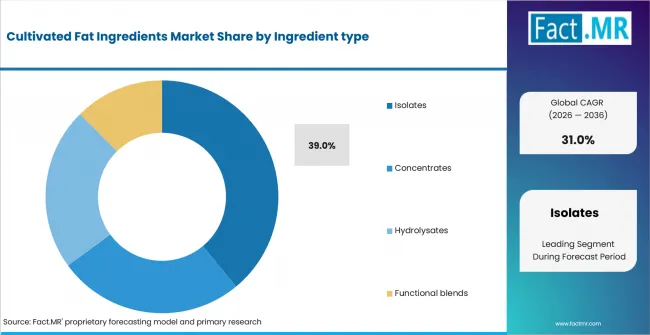
Cultivated Fat Ingredients Market Analysis By Ingredient Type | Source: Fact.MR
Isolates lead because they give formulators a concentrated fat input for flavor release and melt behavior. Product teams can test them in controlled amounts, which lowers recipe risk when a brand wants to improve a burger, sausage or bacon-style format.
Mission Barns states that its current meatballs, bacon and related products combine cultivated pork fat with plant protein. Its product information identifies Mission Fat as the cultivated pork component, supporting concentrated fat inputs where formulators seek flavor and juiciness in hybrid products.
What leads the Production Route segment?
Precision fermentation is projected to account for 37.0% share in 2026.
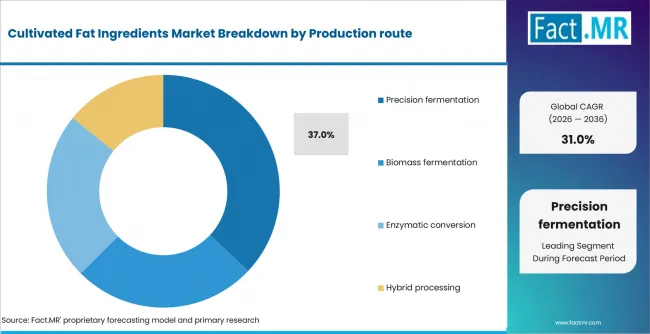
Cultivated Fat Ingredients Market Analysis By Production Route | Source: Fact.MR
Precision fermentation leads because controlled bioprocessing gives developers a repeatable route for targeted fat molecules and supporting ingredients. It also helps process teams manage yield, contamination control and batch quality data around a production method that can be reviewed by commercial partners.
Mitsui Chemicals announced an investment in Hoxton Farms in June 2025 to advance next-generation biomanufacturing and accelerate the scale-up and commercialization of cultivated fats. The company said cultured fat gives meat alternatives meat-like flavor and juicy mouthfeel, linking the route directly to formulation use.
How does Function shape demand?
Nutrition is anticipated to represent 28.0% share in 2026.
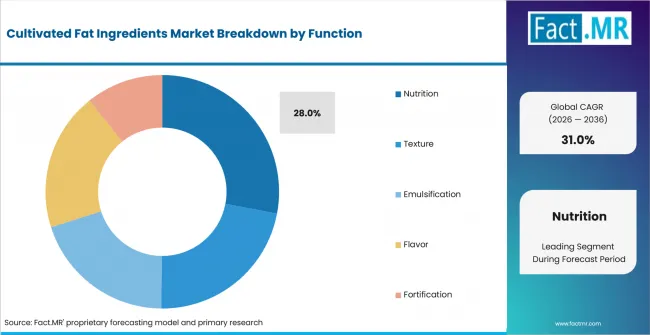
Cultivated Fat Ingredients Market Analysis By Function | Source: Fact.MR
Nutrition leads within Function because cultivated fat allows developers to review lipid composition more directly than conventional animal fat. Brands can design formulas that keep animal-fat cues while adjusting the ingredient profile for target applications.
Mosa Meat announced in January 2025 that it had submitted its first Novel Foods application to the European Commission for cultivated beef fat. The company said the submission would proceed to EFSA review after completion of the European Commission’s validity check.
What supports Meat alternatives within Application?
Meat alternatives are forecast to capture 35.0% share in 2026.
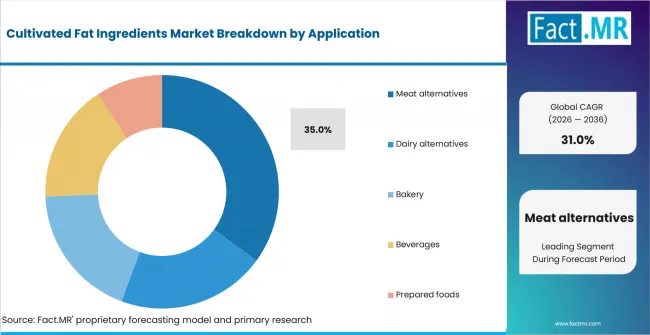
Cultivated Fat Ingredients Market Analysis By Application | Source: Fact.MR
Meat alternatives lead Application because cultivated fat addresses sensory gaps that plant proteins alone struggle to close. A small inclusion can influence aroma, cooking behavior and bite, which makes the ingredient commercially relevant before full cultivated meat reaches broad scale.
USDA ERS reported food-away-from-home spending of USD 1.41 trillion in 2025 in its June 2026 food expenditure update. The figure establishes the scale of the U.S. food-away-from-home channel for product testing and commercialization planning.
What is accelerating Cultivated Fat Ingredients Market adoption, and what is holding it back?
Demand is expected to rise through flavor replacement and regulatory progress. Scale-up cost and dossier depth remain the main limits.
Drivers Impact Analysis
| DRIVER | (~) % IMPACT ON CAGR | GEOGRAPHIC RELEVANCE | IMPACT TIMELINE |
|---|---|---|---|
| Sensory gap in meat alternatives | +3.4% | Global | Short term (<= 2 years) |
| Regulatory clearances for cell-cultured ingredients | +2.8% | USA, UK, Europe | Medium term (2-4 years) |
| Food-tech public investment and pilot capacity | +2.1% | South Korea, Japan, UK | Medium term (2-4 years) |
| Hybrid processing between plant protein and cultivated fat | +1.6% | Global | Long term (>= 4 years) |
Source: Fact.MR analysis. Updated Aug 27, 2026
- Sensory gap in meat alternatives: Cultivated fat adds aroma and juiciness that many plant oils supply unevenly. The driver is strongest where brands sell burgers, bacon-style strips and prepared foods.
- Regulatory clearances for cell-cultured ingredients: FDA consultation activity and USDA oversight create a visible U.S. pathway for cultivated animal-cell ingredients used in hybrid foods.
- Food-tech public investment and pilot capacity: South Korea’s MAFRA planned KRW 108.8 billion in 2025 R&D investment across smart farming, green biotechnology and food-tech.
Opportunity Impact Analysis
| OPPORTUNITY | (~) % IMPACT ON CAGR | GEOGRAPHIC RELEVANCE | IMPACT TIMELINE |
|---|---|---|---|
| Hybrid meat-alternative formulations | +1.9% | Global | Medium term (2-4 years) |
| Asia-Pacific ingredient partnerships | +1.4% | Japan, South Korea | Medium term (2-4 years) |
| Nutrition-focused animal-fat profiles | +1.1% | USA, Europe | Long term (>= 4 years) |
Source: Fact.MR analysis. Updated Aug 27, 2026
- Hybrid meat-alternative formulations: Brands can use cultivated fat with plant protein to improve taste before full cultivated cuts reach scale.
- Asia-Pacific ingredient partnerships: Japan and South Korea offer food-tech ecosystems where cultivated fat can be tested with local brands and export-focused manufacturers.
- Nutrition-focused animal-fat profiles: Developers gain room to position cultivated fat around controlled lipid composition when safety evidence and consumer communication are clear.
Restraints Impact Analysis
| RESTRAINT | (~) % IMPACT ON CAGR | GEOGRAPHIC RELEVANCE | IMPACT TIMELINE |
|---|---|---|---|
| Safety dossier and validation burden | -1.0% | Global | Short term (<= 2 years) |
| Scale-up cost and bioreactor utilization | -0.8% | Global | Medium term (2-4 years) |
| Country-specific approval timing | -0.6% | USA, Europe, Asia | Medium term (2-4 years) |
Source: Fact.MR analysis. Updated Aug 27, 2026
- Safety dossier and validation burden: Companies need data on cells, media, process controls and final composition before regulators assess market authorization.
- Scale-up cost and bioreactor utilization: Ingredient cost remains tied to yield, media efficiency, recovery and plant utilization, which can slow price parity.
- Country-specific approval timing: A company clearing one jurisdiction still needs separate label, import and food-safety review in other launch markets.
Which countries are scaling the Cultivated Fat Ingredients Market through 2036?
- The country comparison spans 15.4 percentage points and forms three practical growth bands across the forecast period.
- The USA remains 6.0 percentage points above Japan through early federal clearance and foodservice test channels.
- Japan remains 1.2 percentage points above Germany as food-security policy and Asia-Pacific partnerships shape ingredient review.
- Germany remains 6.3 percentage points above South Korea through meat-processing scale and texture-led reformulation needs.
- South Korea remains 1.9 percentage points above the UK as food-tech funding supports pilot manufacturing and export readiness.
- The UK closes the displayed range through a two-year sandbox and a sizeable food-manufacturing base.
Comparable CAGRs can create different entry conditions due to regulatory timing, hybrid product fit, pilot manufacturing access and consumer familiarity. Full report coverage includes North America, Latin America, Western Europe, Eastern Europe, East Asia, South Asia & Pacific, Middle East & Africa.
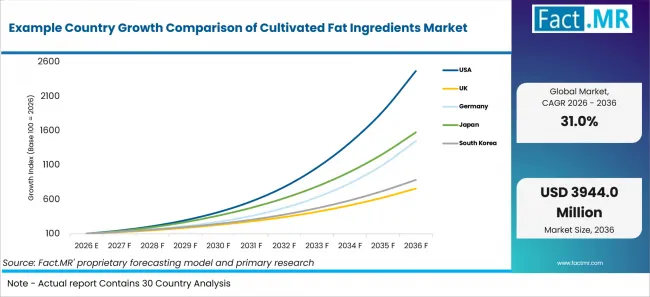
Example Country Growth Comparison Of Cultivated Fat Ingredients Market | Source: Fact.MR
| Country | CAGR (2026-2036) |
|---|---|
| USA | 37.9% |
| Japan | 31.9% |
| Germany | 30.7% |
| South Korea | 24.4% |
| UK | 22.5% |
Source: Fact.MR analysis. Updated Aug 27, 2026
What supports USA adoption?
37.9% CAGR, supported by regulatory clearance and hybrid product commercialization.
The U.S. path is shaped by foodservice exposure and animal-protein familiarity. USDA ERS reported that food-away-from-home spending accounted for 56.3% of total U.S. food expenditures in 2025. The agency also projected per-capita availability of beef, pork, broilers and turkey at 228.8 pounds in 2026.
How is Japan developing demand?
31.9% CAGR, led by food-security pressure and Asia-Pacific partnerships.
Japan’s adoption case begins with food-security pressure and local market access. MAFF reported in August 2026 that Japan’s preliminary FY2025 calorie-basis food self-sufficiency ratio was 37%. Hoxton Farms and Sumitomo Corporation announced a March 2025 collaboration to bring cultivated pork fat to Japan and wider Asia-Pacific.
What supports Germany adoption?
30.7% CAGR, supported by meat consumption and alternative-protein reformulation.
Germany’s opportunity is tied to a large meat-processing base and familiar fat-led taste profiles. BMEL-Statistik reported, based on preliminary BZL calculations, that meat consumption for human consumption in Germany reached 54.9 kilograms per person in 2025. Total human meat consumption amounted to 4.6 million tonnes. Formulators are expected to compare cultivated fat with vegetable oils in hybrid meat alternatives.
How is South Korea scaling demand?
24.4% CAGR, backed by food-tech policy and export manufacturing.
South Korea links cultivated fat demand to broader food-tech manufacturing policy. MAFRA stated in its 2025 policy plan that KRW 121.2 billion would be invested in expanding R&D and production infrastructure for emerging industries linked to food-tech and green biotechnology. The investment provides broader food-tech infrastructure context for biotechnology production, pilot manufacturing and commercialization activity.
What supports the United Kingdom’s growth?
22.5% CAGR, supported by sandbox regulation and food manufacturing capacity.
The UK has a defined regulatory learning route for cell-cultivated products. The FSA and Food Standards Scotland sandbox started in March 2025 and is scheduled to run until February 2027. ONS reported in July 2026 that food manufacturing represented 22.9% of total UK manufacturers’ product sales in 2025.
Who leads the Cultivated Fat Ingredients Market?
Mission Barns, Hoxton Farms and Mosa Meat have direct cultivated-fat activity, while Vow is reviewed as adjacent or historical participants in the broader cultivated-food and functional-fat landscape.
Mission Barns holds direct cultivated-fat commercialization relevance through products that combine cultivated pork fat with plant protein. That focus links the company to hybrid meat formats where fat performance changes aroma, bite and cooking behavior.
Hoxton Farms is developing cultivated pork fat under the Hoxton Fat name and is building Asian routes through corporate partnerships. Mosa Meat is relevant through cultivated beef fat and formal European review activity.
Australia’s Department of Industry reported in July 2026 that demand for Vow’s cultivated-meat products had risen by 200% each month since their May 2025 launch, demonstrating commercial activity in the cultivated-meat category.
Which companies are reviewed in the competitive landscape?
Key companies include Mission Barns, Hoxton Farms, Mosa Meat, Vow.
- Mission Barns
- Hoxton Farms
- Mosa Meat
- Vow
Bibliography
- U.S. Food and Drug Administration. (2025, March 7). FDA completes pre-market consultation for human food made with cultured pork fat cells.
- Mission Barns. (2025, July 24). Mission Barns secures USDA approval for cultivated fat, unlocking strategic partners with next-gen flavor solutions.
- Hoxton Farms. (2025, March 27). Hoxton Farms and Sumitomo Corporation announce strategic partnership.
- Mitsui Chemicals, Inc. (2025, June 19). Mitsui Chemicals invests in Hoxton Farms Ltd, a company using cell culture to produce animal fats.
- Food Standards Agency. (2026, June 25). Regulatory sandbox for cell-cultivated products (CCPs). GOV.UK.
- Office for National Statistics. (2026, July 24). UK manufacturers' sales by product: 2025.
- Ministry of Agriculture, Food and Rural Affairs. (2025, February 14). The 2025 work plan for the Ministry of Agriculture, Food and Rural Affairs.
- Department of Industry, Science and Resources. (2025, December 5). Getting lab-grown meat to market.
This Report Answers
- The report explains where cultivated fat ingredients are used across ingredient type and production route. It also covers function and application.
- Segment analysis identifies the leading subsegments and the formulation reasons behind selection.
- Country analysis examines the listed markets and the regulatory or manufacturing mechanisms supporting adoption.
- Competitive analysis reviews providers across cultivated fat, hybrid formulation and fat systems.
- Application analysis assesses how aroma, melt and juiciness influence ingredient decisions.
What does the Cultivated Fat Ingredients Market cover?
The Cultivated Fat Ingredients Market covers food inputs designed to deliver animal-fat functionality through cultivated-cell or controlled bioprocess routes. It connects with cultured food and fermented ingredients where manufacturers evaluate biological production methods for flavor and texture.
The assessment covers isolates, concentrates, hydrolysates and functional blends across precision fermentation, biomass fermentation, enzymatic conversion and hybrid processing. Adjacent formulation areas include plant-based meat and meat substitutes where fat performance influences acceptance.
What is included in the scope?
The scope includes cultivated pork fat, cultivated beef fat and fat-rich ingredient systems used as B2B inputs in meat alternatives, dairy alternatives, bakery, beverages and prepared foods. It includes production services linked to precision fermentation CDMO services when the work supports a cultivated-fat ingredient program.
Ingredient development linked to precision fermentation dairy alternatives, fermented egg proteins and single cell protein extracts is included when the fat component is part of the product boundary. Formulation work around food cultures and enzymatic protein texturizers is covered where it supports fat stability, flavor or functional delivery.
What is excluded from the scope?
The scope excludes finished cultivated meat cuts sold as consumer products, conventional animal fat, commodity vegetable oils and generic flavor systems sold separately from cultivated-fat functionality. It also excludes bioreactor hardware, media suppliers and contract production services when they are sold outside a cultivated-fat ingredient program.
Plant protein bases, finished frozen meals and restaurant menu items are outside the scope unless cultivated fat is sold as a defined ingredient input. General cellular agriculture research is treated as contextual only when it supports ingredient safety, production scale or application fit.
How Was the Analysis Built?
The analysis draws on 120+ sources, 35+ company portfolios, 25+ countries, and more than 20 industry interviews.
- Primary Research: Primary research includes discussions with ingredient developers, food manufacturers, service providers, product teams and procurement teams. These conversations examine formulation needs, approval requirements and purchasing priorities.
- Desk Research: Desk research covers government statistics, regulator publications, company announcements, technical documentation and policy programs. Every source used in the analysis is documented in the bibliography.
- Market Sizing and Forecasting: Market estimates combine historical performance, demand indicators, segment shares, country growth, adoption patterns and barriers to market expansion.
- Data Validation and Update Cycle: Findings are validated by comparing interviews with public data, company activity, regulation and commercial launch signals. Updates review approvals, partnerships and formulation adoption.
Segmentation
What is the report’s scope and coverage?
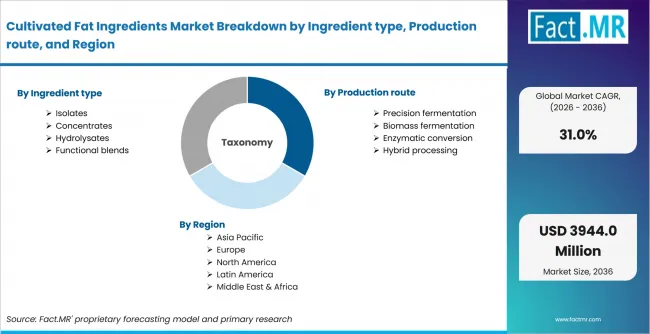
Cultivated Fat Ingredients Market Breakdown By Ingredient Type, Production Route, And Region | Source: Fact.MR
| Attribute | Details |
|---|---|
| Quantitative Units | USD million |
| Market Definition | Cultivated fat ingredients are fat-rich food inputs produced from cultivated animal cells or related controlled bioprocess routes. They are used to improve flavor, juiciness, melt and nutritional control in formulated foods. |
| Ingredient Type | Isolates; Concentrates; Hydrolysates; Functional blends |
| Production Route | Precision fermentation; Biomass fermentation; Enzymatic conversion; Hybrid processing |
| Function | Nutrition; Texture; Emulsification; Flavor; Fortification |
| Application | Meat alternatives; Dairy alternatives; Bakery; Beverages; Prepared foods |
| Regions Covered | North America; Latin America; Western Europe; Eastern Europe; East Asia; South Asia & Pacific; Middle East & Africa |
| Countries Covered | United States; United Kingdom; Germany; Japan; South Korea |
| Key Companies Profiled | Mission Barns; Hoxton Farms; Mosa Meat; Vow |
| Forecast Period | 2026 to 2036 |
| Approach | Hybrid top-down and bottom-up approach using food-tech policy signals, cultivated-cell regulatory progress, ingredient application fit, country adoption and provider portfolio review. |
Source: Fact.MR analysis. Updated Aug 27, 2026
How is the market segmented?
-
By Ingredient Type:
- Isolates
- Concentrates
- Hydrolysates
- Functional blends
-
By Production Route:
- Precision fermentation
- Biomass fermentation
- Enzymatic conversion
- Hybrid processing
-
By Function:
- Nutrition
- Texture
- Emulsification
- Flavor
- Fortification
-
By Application:
- Meat alternatives
- Dairy alternatives
- Bakery
- Beverages
- Prepared foods
-
By Region:
- North America
- Latin America
- Western Europe
- Eastern Europe
- East Asia
- South Asia & Pacific
- Middle East & Africa
Frequently Asked Questions
How big is the cultivated fat ingredients market in 2026?
What is the CAGR of the cultivated fat ingredients market from 2026 to 2036?
Which ingredient type leads the cultivated fat ingredients market?
Which production route leads the cultivated fat ingredients market?
Who are the leading companies in the cultivated fat ingredients market?
Who worked on this report


Preview the report firsthand - request a free sample
Free SampleGet the brochure for pricing and purchase details
Download PDF