- Market Value (2025): USD 2.9 Bn
- Estimated Value (2026): USD 3.2 Bn
- Forecast Value (2036): USD 6.6 Bn
- CAGR (2026-2036): 7.5%
What is the Cellulose Whitening Alternatives Market forecast to be worth by 2036?
USD 3.2 billion in 2026 to USD 6.6 billion by 2036 at a 7.6% CAGR.
- As per Fact.MR analysis, the Cultured Dairy Preservation Agents Market crossed a valuation of USD 2.9 billion in 2025.
- Demand is projected to increase from USD 3.2 billion in 2026 to USD 6.6 billion by 2036.
- The market is forecast to record a 7.6% CAGR from 2026 to 2036.
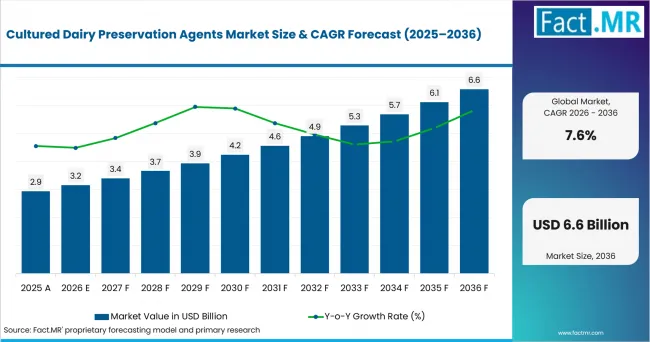
Cultured Dairy Preservation Agents Market Value Analysis | Source: Fact.MR
What are the defining numbers behind Cultured Dairy Preservation Agents Market growth?
USD 3.4180 billion absolute opportunity by 2036, led by cultured dextrose, mold control, and cheese applications.
- Demand Drivers in the Market
- Cheese makers need products that control mold and spoilage without affecting the cultures used to make cheese.
- Yogurt makers need to control yeast and extra acid because they can change taste and texture during storage and shipping.
- High dairy production increases the need for longer shelf life. In September 2026, the Department for Environment, Food & Rural Affairs reported that the UK produced 15.8 billion litres of milk for human consumption in 2025 [2]. This supports the use of shelf-life products in cultured dairy foods.
- Dairy products need to stay fresh during transport and storage. Protective cultures help maintain quality when temperatures change.
- Key Segments Analyzed
- By Culture-Derived Agent: Cultured dextrose is expected to hold a 39.0% share in 2026 because it works well in many dairy products and is a familiar fermented ingredient.
- By Preservation Target: Mold is projected to account 38.0% share in 2026 because cheese and other cultured dairy products can develop mold during storage.
- By Dairy Use: Cheese is anticipated to capture 34.0% share in 2026 because it can be stored and shipped for longer periods, and spoilage can lead to product waste or lower quality.
- By Delivery Format: Liquid fermentate is estimated to represent 31.0% share in 2026 because dairy plants can easily add it during existing mixing and production steps.
- Analyst Opinion at Fact.MR
- Shambhu Nath Jha, Principal Consultant at Fact.MR, states, “Dairy plants need ingredients that slow spoilage without affecting production, starter cultures, or taste. Suppliers that show clear results in the final dairy product are expected to see higher demand.”
- Strategic Implications
- Culture suppliers should test their products for mold, yeast, and bacteria in different dairy products because each can respond differently.
- Cheese culture suppliers should provide clear production test results. In June 2025, IFF launched a culture for semi-hard cheese production designed to improve energy and water use. Similar test results can help dairy plants compare different cultures.
- Dairy companies should choose shelf-life products based on storage time and temperature. This helps them compare results across cheese, yogurt, and dairy desserts.
- Preservation suppliers should support spoilage and shelf-life testing. Dairy plants need clear and consistent results in the final product before choosing a system.
The UK is expected to grow at 9.5% CAGR through 2036 as cultured dairy production increases the need for longer shelf life. The USA follows at 8.3% as cheese and yogurt plants use more shelf-life products. Germany is expected to grow at 8.0% due to its large cultured dairy industry, while France reaches 7.7% as cheese makers need longer shelf life. Japan records 6.2% as dairy plants focus on keeping chilled products fresh and stable.
How does the Cultured Dairy Preservation Agents Market break down by segment?
Cultured dextrose leads at 39.0%; mold control leads at 38.0%.
Which Culture-Derived Agent dominates?
Cultured dextrose is expected to hold 39.0% share in 2026.
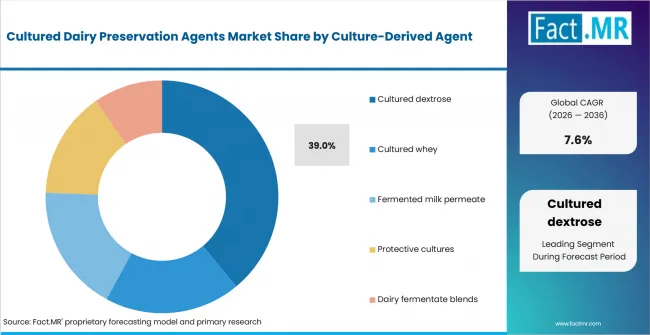
Cultured Dairy Preservation Agents Market Analysis By Culture Derived Agent | Source: Fact.MR
Cultured dextrose contains acids and other compounds made during fermentation and can be used in many dairy products. It works in both liquid and dry products and helps extend shelf life with little change to the final product. Cultured whey is used when a dairy-based ingredient is preferred. Fermented milk permeate works well in milk-based products, while protective cultures use live cultures to help products stay fresh for longer.
What leads the Preservation Target segment?
Mold is projected to account for 38.0% share in 2026.
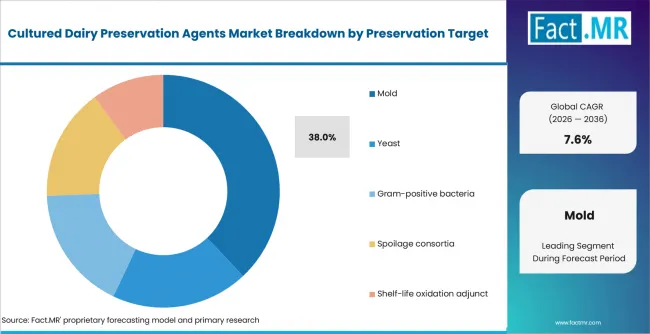
Cultured Dairy Preservation Agents Market Analysis By Preservation Target | Source: Fact.MR
Mold control is expected to hold a 38.0% share because visible mold can make cheese and dairy desserts unsuitable for sale before their planned sale date. Yeast control is important for sweetened yogurt and cultured drinks, while bacterial control depends on the dairy product and production method. Some products need protection from several types of spoilage at the same time.
How does Dairy Application shape demand?
Cheese is anticipated to capture 34.0% share in 2026.
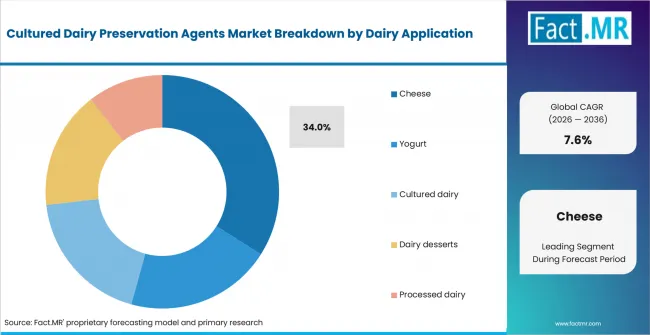
Cultured Dairy Preservation Agents Market Analysis By Dairy Application | Source: Fact.MR
Cheese demand remains strong because longer storage and ripening periods can increase spoilage risk. Producers therefore need preservation methods that help maintain product quality, freshness, and safety throughout storage while supporting consistent cheese production requirements.
What supports Liquid Fermentate within Delivery Format?
Liquid fermentate is estimated to represent 31.0% share in 2026.
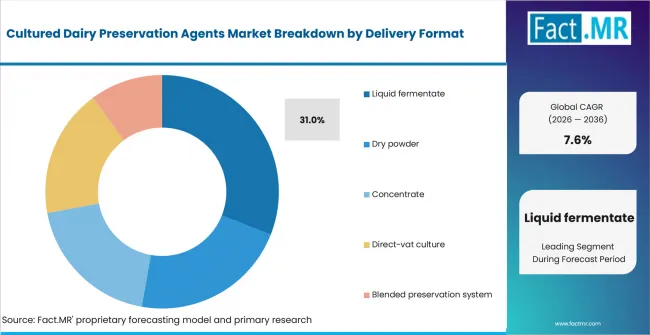
Cultured Dairy Preservation Agents Market Analysis By Delivery Format | Source: Fact.MR
Liquid fermentates work well in dairy plants that already add liquid ingredients during mixing. Dry powders are easier to store and use in dry mixes. Concentrates are useful when there is limited space in the recipe, while direct-vat cultures are added during the culture stage. Blended systems combine more than one shelf-life function in a single product.
What is accelerating Cultured Dairy Preservation Agents Market adoption, and what is holding it back?
Longer shelf life increases demand, while testing for each dairy product can slow wider use.
Drivers Impact Analysis
| DRIVER | (~) % IMPACT ON CAGR | GEOGRAPHIC RELEVANCE | IMPACT TIMELINE |
|---|---|---|---|
| Clean-label preservation in cultured dairy | +1.4% | North America, Europe | Medium term (2-4 years) |
| Cheese and yogurt production scale | +1.1% | North America, Europe, East Asia | Short term (<= 2 years) |
| Cold-chain shelf-life extension | +0.8% | Global | Medium term (2-4 years) |
| Protective-culture functionality | +0.6% | Europe, North America | Long term (>= 4 years) |
Source: Fact.MR analysis. Updated Oct 6, 2026
Opportunity Impact Analysis
| OPPORTUNITY | (~) % IMPACT ON CAGR | GEOGRAPHIC RELEVANCE | IMPACT TIMELINE |
|---|---|---|---|
| Protective cultures for cheese spoilage control | +1.0% | Europe, North America | Medium term (2-4 years) |
| Fermentate blends for yogurt and desserts | +0.7% | Global | Short term (<= 2 years) |
| Liquid dosing systems for large dairy plants | +0.5% | North America, Europe | Medium term (2-4 years) |
| Phage-resilient culture systems | +0.4% | Europe | Long term (>= 4 years) |
Source: Fact.MR analysis. Updated Oct 6, 2026
Restraints Impact Analysis
| RESTRAINT | (~) % IMPACT ON CAGR | GEOGRAPHIC RELEVANCE | IMPACT TIMELINE |
|---|---|---|---|
| Matrix-specific efficacy requirements | -0.7% | Global | Short term (<= 2 years) |
| Sensory and starter-culture interaction | -0.5% | Global | Medium term (2-4 years) |
| Validation and challenge-test cost | -0.4% | North America, Europe | Medium term (2-4 years) |
| Cold-chain limits on shelf life | -0.3% | Global | Long term (>= 4 years) |
Source: Fact.MR analysis. Updated Oct 6, 2026
Which countries are scaling the Cultured Dairy Preservation Agents Market through 2036?
- The country comparison spans 3.3 percentage points and forms three clear growth bands across the forecast period.
- The UK remains 1.2 percentage points above the USA as cultured-dairy plants expand shelf-life work across cheese and fresh dairy.
- The USA remains 0.3 percentage point above Germany as large cheese and yogurt output supports wider use of shelf-life systems.
- Germany remains 0.3 percentage point above France as acidified dairy and cheese processing keep culture-based preservation in regular plant use.
- France remains 1.5 percentage points above Japan as cheese output and fresh cultured dairy maintain broad shelf-life needs.
- Japan closes the displayed range as plants focus on stable chilled quality and careful changes to dairy recipes.
Comparable CAGRs can create different entry conditions due to dairy output and product mix, and plant scale and shelf-life needs also shape the route to market. Full coverage includes North America, Latin America, Western Europe, Eastern Europe, East Asia, South Asia & Pacific, and Middle East & Africa.
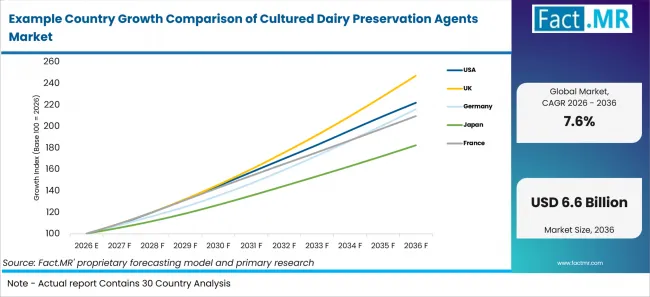
Example Country Growth Comparison Of Cultured Dairy Preservation Agents Market | Source: Fact.MR
| Country | CAGR (2026-2036) |
|---|---|
| United Kingdom | 9.5% |
| United States | 8.3% |
| Germany | 8.0% |
| France | 7.7% |
| Japan | 6.2% |
Source: Fact.MR analysis. Updated Oct 6, 2026
What supports United Kingdom adoption?
9.5% CAGR, supported by a large milk-processing base and cultured-dairy production.
The UK has a large dairy industry with many cheese and cultured dairy products. Dairy plants prefer shelf-life products that work with their existing cultures and production methods. The UK is expected to grow at 9.5% CAGR, the highest among the five countries.
How is the United States scaling demand?
8.3% CAGR, driven by large cheese output and a wide cultured-dairy base.
The United States has many cheese and cultured dairy plants. In April 2026, the USDA National Agricultural Statistics Service reported that U.S. frozen yogurt production reached 34.1 million gallons in 2025 [1]. The market is expected to grow at 8.3% CAGR, supporting the use of simple liquid and dry shelf-life products in large dairy plants.
What supports Germany’s growth?
8.0% CAGR, backed by acidified dairy and cheese processing at scale.
Germany has a large cheese and cultured dairy industry, supporting steady demand for preservation products. Large-scale yogurt and cultured dairy production increases the need for solutions that help maintain freshness, product quality, and shelf life during processing and storage.
How does France perform?
7.7% CAGR, shaped by cheese output and steady cow-milk collection.
France has a large cheese industry and steady demand for cultured dairy products. In November 2025, Eurostat reported that France produced 17.8% of the EU’s cheese in 2024 [3]. The market is expected to grow at 7.7% CAGR, supporting shelf-life testing in cheese and fresh cultured dairy products.
What supports Japan’s outlook?
6.2% CAGR, led by mature dairy processing and a focus on stable refrigerated quality.
Japan has a well-established dairy industry where plants focus on keeping chilled products fresh and consistent. In May 2026, the Ministry of Agriculture, Forestry and Fisheries listed 3.25 million tonnes as the eligible raw milk quantity for fiscal 2025 [4]. The market is expected to grow at 6.2% CAGR, supporting shelf-life products that cause little change to the final product and fit existing production methods.
Who leads the Cultured Dairy Preservation Agents Market?
Corbion supplies fermented ingredients that help dairy products last longer. Kerry Group offers DuraFresh™ fermented ingredients for food preservation. IFF and Lallemand supply protective cultures for dairy and cheese. dsm-firmenich offers Dairy Safe™ cultures for cheese, while Kemin Industries provides food safety and shelf-life products.
IFF offers HOLDBAC® cultures for cheese and fresh dairy products. Lallemand supplies LALCULT® Protect cultures to control spoilage and extend shelf life. dsm-firmenich provides Dairy Safe™ cultures for semi-hard, hard, and continental-style cheeses. These cultures protect cheese, help with acid development, and provide protection against phages.
In October 2025, dsm-firmenich announced research with APC Microbiome Ireland and INRAE on how bacteria protect against phages during dairy fermentation. Kemin Industries provides products that control microbes and extend food shelf life. Buyers can compare spoilage control, shelf life, ease of use, and supplier support when choosing products.
Which companies are the key providers?
Corbion and Kerry Group are profiled with IFF, Lallemand, Kemin Industries, and dsm-firmenich.
- Corbion
- Kerry Group
- Kemin Industries
- IFF
- Lallemand
- dsm-firmenich
Bibliography
- [1] U.S. Department of Agriculture, National Agricultural Statistics Service. (2026, April 24). Dairy Products 2025 Summary.
- [2] Department for Environment, Food & Rural Affairs. (2026, September 3). Agriculture in the United Kingdom 2025: Chapter 8: Livestock.
- [3] Eurostat. (2025, November 20). Milk production reached 161.8 million tonnes in 2024.
- [4] Ministry of Agriculture, Forestry and Fisheries of Japan. (2026, May 7).[Eligible quantities for each operator in fiscal 2025].
- [5] Agreste. (2025, December 16). Bilan conjoncturel 2025.
- [6] dsm-firmenich. (2025, September 4). dsm-firmenich launches next generation of Dairy Safe™ all-in-one cultures for semi-hard, hard, and continental-style cheese varieties.
- [7] IFF. (2025, June 26). IFF launches transformational culture to drive energy and water efficiency in semi-hard cheese production.
- [8] dsm-firmenich. (2025, October 8). dsm-firmenich and APC Microbiome Ireland discover new bacterial defense systems for enhanced phage control in dairy fermentation.
This Report Answers
- The report explains culture-based shelf-life control by agent type and preservation target, and it also covers dairy application and delivery format across the same market structure.
- Country analysis covers the United Kingdom and United States, and it also covers Germany, France, and Japan using the stated CAGR outlook through 2036.
- Competitive analysis reviews Corbion and Kerry Group, and it also covers Kemin Industries, IFF, Lallemand, and dsm-firmenich across culture and shelf-life capabilities.
- Technology assessment covers cultured dextrose and cultured whey, and it also covers fermented milk permeate, protective cultures, and dairy fermentate blends used for shelf-life control.
- Application analysis covers cheese and yogurt, and it also covers cultured dairy, dairy desserts, and processed dairy products with different spoilage and shelf-life needs.
- The evidence base uses recent official dairy data and first-party company updates, and each item is tied to production scale, culture technology, or shelf-life work.
What does the Cultured Dairy Preservation Agents Market cover?
The scope covers cultured dextrose, cultured whey, fermented milk permeate, protective cultures, and dairy fermentate blends. Related Fact.MR coverage on food cultures gives added context on culture use across food production. Fact.MR coverage on clean-label preservatives provides adjacent context for preservative choices. These links support topic navigations and are separate from the evidence used for market sizing.
The market covers culture-based ingredients used to slow spoilage in cheese and yogurt, along with cultured dairy, dairy desserts, and processed dairy; it includes liquid fermentates, dry powders, concentrates, and direct-vat cultures used for shelf-life control.
What is included in the scope?
Culture-derived dairy preservation systems used in cheese, yogurt, cultured dairy, dairy desserts, and processed dairy.
The scope includes cultured dextrose and cultured whey, and it also covers fermented milk permeate, protective cultures, and dairy fermentate blends. Target organisms include mold and yeast, and gram-positive bacteria and mixed spoilage are covered where culture-based control is part of the product use.
What is excluded from the scope?
Standalone synthetic preservatives and general starter cultures belong to adjacent categories.
The scope boundary places sorbates, benzoates, and propionates in the conventional preservative category, and standard yogurt and cheese starters remain in the starter-culture category when acidification or flavor is their main role. Packaging and cold-chain equipment are treated as operating conditions that shape shelf-life performance.
How Was the Analysis Built?
The analysis draws on 120+ sources, 35+ company portfolios, 25+ countries, and more than 20 industry interviews.
- Primary Research: Primary research includes discussions with manufacturers, service providers, technology developers, distributors, end users, and subject-matter experts. These conversations examine purchasing priorities, product adoption, operational challenges, approval requirements, competitive positioning, and the factors that influence wider market acceptance.
- Desk Research: Desk research covers government statistics, regulatory publications, company filings, trade data, technical studies, industry associations, standards, public policy, and other authoritative sources. Every source used in the analysis is documented in the bibliography.
- Market Sizing and Forecasting: Market estimates combine historical performance, demand indicators, pricing and volume trends, segment shares, company participation, country-level growth, adoption patterns, investment activity, and barriers to market expansion.
- Data Validation and Update Cycle: Findings are validated by comparing primary interviews with public data, company activity, regulatory changes, trade patterns, and industry developments. Regular updates review new product launches, capacity changes, partnerships, approvals, and shifts in commercial adoption.
Segmentation
What is the report’s scope and coverage?
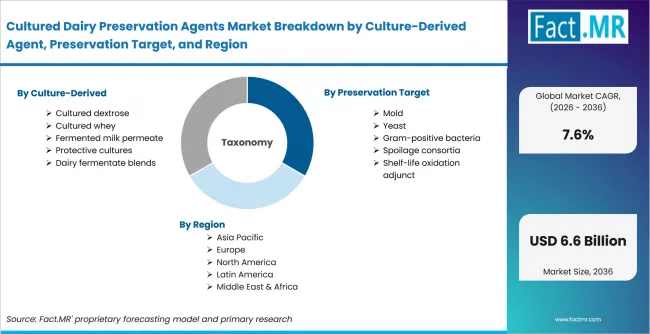
Cultured Dairy Preservation Agents Market Breakdown By Culture Derived Agent, Preservation Target, And Region | Source: Fact.MR
| Attribute | Details |
|---|---|
| Quantitative Units | USD Billion |
| Market Definition | Fermentation-derived ingredients and protective cultures used to control spoilage and support shelf life in dairy products. |
| Culture-Derived Agent | Cultured dextrose; Cultured whey; Fermented milk permeate; Protective cultures; Dairy fermentate blends |
| Preservation Target | Mold; Yeast; Gram-positive bacteria; Spoilage consortia; Shelf-life oxidation adjunct |
| Dairy Application | Cheese; Yogurt; Cultured dairy; Dairy desserts; Processed dairy |
| Delivery Format | Liquid fermentate; Dry powder; Concentrate; Direct-vat culture; Blended preservation system |
| Regions Covered | North America; Latin America; Western Europe; Eastern Europe; East Asia; South Asia & Pacific; Middle East & Africa |
| Countries Covered | United Kingdom; United States; Germany; France; Japan |
| Key Companies Profiled | Corbion; Kerry Group; Kemin Industries; IFF; Lallemand; dsm-firmenich |
| Forecast Period | 2026 to 2036 |
| Approach | Hybrid top-down and bottom-up assessment using dairy output, application fit, segment shares, country growth, provider portfolios, and preservation-system use. |
Source: Fact.MR analysis. Updated Oct 6, 2026
How is the market segmented?
-
By Culture-Derived Agent:
- Cultured dextrose
- Cultured whey
- Fermented milk permeate
- Protective cultures
- Dairy fermentate blends
-
By Preservation Target:
- Mold
- Yeast
- Gram-positive bacteria
- Spoilage consortia
- Shelf-life oxidation adjunct
-
By Dairy Application:
- Cheese
- Yogurt
- Cultured dairy
- Dairy desserts
- Processed dairy
-
By Delivery Format:
- Liquid fermentate
- Dry powder
- Concentrate
- Direct-vat culture
- Blended preservation system
-
By Region:
- North America
- Latin America
- Western Europe
- Eastern Europe
- East Asia
- South Asia & Pacific
- Middle East & Africa
Frequently Asked Questions
How big is the Cultured Dairy Preservation Agents Market in 2026?
What is the CAGR of the Cultured Dairy Preservation Agents Market from 2026 to 2036?
Which culture-derived agent leads the Cultured Dairy Preservation Agents Market?
Which preservation target leads the Cultured Dairy Preservation Agents Market?
Who are the leading companies in the Cultured Dairy Preservation Agents Market?
Who worked on this report


Preview the report firsthand - request a free sample
Free SampleGet the brochure for pricing and purchase details
Download PDF