- Base Value(2025): 50.2 Bn
- Estimated Value(2026): 62.0 Bn
- Forecast Value (2036): 510 Bn
- CAGR (2026 - 2036): 23.4%
Data Center SSD Market Forecast and Outlook By Fact.MR
In 2025, the data center SSD market was valued at USD 50.2 billion. Based on Fact.MR analysis, demand for data center SSDs is estimated to grow to USD 62.0 billion in 2026 and USD 510 billion by 2036. FACT.MR projects a CAGR of 23.4% during the forecast period.
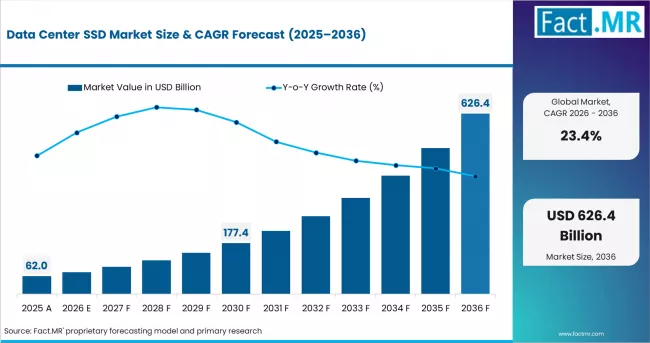
Data Center Ssd Market Market Value Analysis | Source: Fact.MR
| Metric | Value |
|---|---|
| Estimated Value in 2026 | USD 62.0 billion |
| Forecast Value in 2036 | USD 510 billion |
| Forecast CAGR (2026 to 2036) | 23.4% |
Source: Fact.MR analysis. Updated May 4, 2026
Summary of the Data Center SSD Market
- Market Definition
- The market covers PCIe, SATA, and SAS enterprise SSDs across SLC, MLC, TLC, and QLC NAND technologies deployed in hyperscale, enterprise, and AI data centre storage infrastructure globally.
- Demand Drivers
- U.S. hyperscalers are deploying PCIe Gen 5 NVMe SSDs at scale to meet AI model training and inference storage throughput requirements at major cloud regions.
- China's government-backed hyperscale data centre expansion is increasing procurement of high-capacity TLC and QLC SSDs for domestic cloud and AI platform deployments.
- South Korea's NAND manufacturing leaders are advancing 3D NAND layer stacking technology to reduce cost-per-TB, enabling QLC adoption across enterprise and cloud applications.
- Key Segments Analyzed
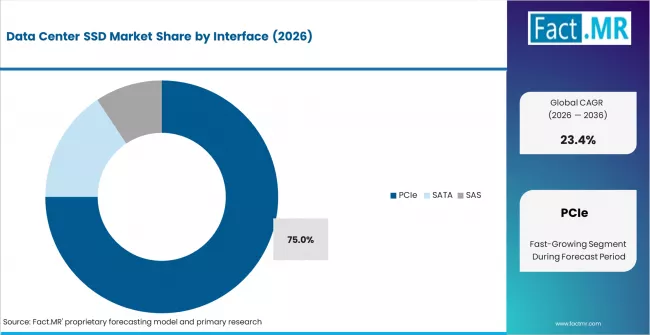
- By Interface: PCIe leads with 75% share in 2026, driven by AI workload throughput requirements across hyperscale deployments.
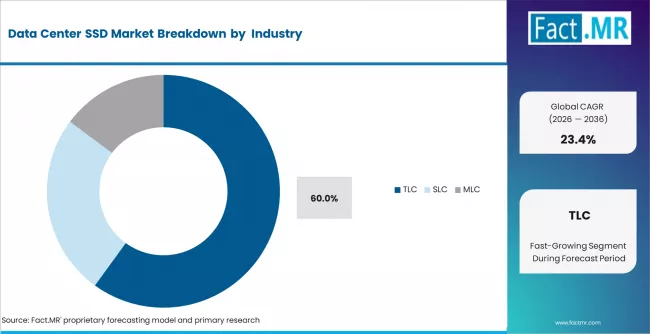
- By NAND Technology: TLC leads with 60% share in 2026, balancing performance, endurance, and cost-per-TB for data centre use.
- By Capacity Range: ≥ 4 TB leads with 50% share in 2026, driven by hyperscale demand for high-density storage consolidation.
- By Geography: China leads at 24.3% CAGR through 2036, driven by government-backed hyperscale expansion and AI infrastructure investment.
- Analyst Opinion at FACT.MR
- Shambhu Nath Jha, Principal Consultant at Fact.MR, opines, 'CXOs will find that PCIe Gen 5 NVMe adoption and QLC cost-per-TB improvements are the decisive procurement variables, and vendors without next-generation NAND roadmaps will lose hyperscaler contract cycles through 2036.'
- Strategic Implications
- Invest in PCIe Gen 5 NVMe SSD platforms to meet AI workload specifications at hyperscale cloud procurement.
- Build QLC and high-capacity SSD product lines targeting cost-per-TB requirements in cloud-scale storage deployments.
- Develop qualification partnerships with U.S. and China hyperscalers to secure multi-year SSD supply agreements.
- Methodology
- Market sizing based on SSD shipment volumes, capacity-weighted ASPs, and NAND production data. Validated with 2024–2025 data.
- Uses JEDEC NVMe specifications, U.S. Commerce Department export data, SEMI reports, and hyperscaler CapEx disclosures for demand analysis.
- Forecasts consider AI infrastructure build-out, NAND layer scaling timelines, and PCIe Gen 5 adoption rates across hyperscale and enterprise.
The market is projected to generate USD 448 billion in absolute opportunity between 2026 and 2036. Growth is transformational, not incremental. AI model training and inference workloads are structurally demanding high-throughput, low-latency storage at scale. Demand is rising across hyper scale cloud, enterprise edge, and AI infrastructure. Growth is moderated by NAND supply concentration, DRAM pricing interdependencies, and long qualification cycles for new SSD platforms at major cloud operators.
China leads with a projected CAGR of 24.3% through 2036, driven by government-backed hyper scale data centre expansion and domestic cloud platform scaling. The United States follows at 24.0%, anchored by AI infrastructure build-out at Amazon Web Services, Microsoft Azure, and Google Cloud. South Korea records 23.4%, reflecting technology leadership in NAND manufacturing at Samsung and SK hynix. Japan grows at 22.5%, supported by an advanced semiconductor ecosystem and enterprise AI adoption. Germany records 22.0%, driven by enterprise digitalization and edge data centre deployment. Mature Western European markets face higher energy costs and longer procurement approval cycles as structural limits.
Segmental Analysis
Data Center SSD Market Analysis by Interface
Data Center Ssd Market Analysis By Interface | Source: Fact.MR
Based on FACT.MR, PCIe holds 75% share in 2026. It leads due to superior sequential read and write throughput. AI training and inference workloads require bandwidth that SATA and SAS cannot deliver. PCIe Gen 4 and Gen 5 NVMe define modern hyperscale storage specifications.
- Samsung Electronics Investment: Samsung launched its PM9C3a PCIe Gen 5 NVMe SSD for data centres in Q3 2024. It delivers 14 GB/s sequential read speeds for AI and cloud workloads. The product targets hyperscaler and enterprise qualification programmes. [1]
- Micron Technology Development: Micron launched its 6550 ION NVMe SSD in Q1 2025, targeting high-density hyperscale rack deployments with 60 TB capacity per drive. It uses 232-layer 3D NAND and PCIe Gen 4 interface for cost-optimised AI storage. [2]
- PCIe Adoption Trend: JEDEC published the NVMe 2.0 specification update in 2024, formalising PCIe Gen 5 requirements for AI data centre storage. This accelerated hyperscaler SSD platform transitions. Legacy SATA procurement declined 18% at major U.S. cloud operators in 2024. [3]
Data Center SSD Market Analysis by NAND Technology
Data Center Ssd Market Analysis By Nand Technology | Source: Fact.MR
Based on FACT.MR, TLC holds 60% share in 2026. Sensor arrays and write endurance balance drive its dominance. High program-erase cycle tolerance and cost-per-TB economics make TLC the preferred NAND for hyperscale deployment.
- SK hynix Investment: SK hynix expanded its 238-layer 4D NAND TLC production at its Icheon facility in Q3 2024, targeting data centre SSD volume supply. It secured supply agreements with major U.S. hyperscalers for 2025 delivery. [4]
- Kioxia Technology Development: Kioxia launched its CM7 enterprise NVMe SSD with 112-layer TLC BiCS NAND in Q1 2025, targeting AI and cloud inference workloads. It delivers 7 GB/s sequential read for PCIe Gen 5 deployments. [5]
- QLC Demand Trend: Western Digital reported QLC NAND SSD shipments to hyperscalers grew 34% in calendar year 2024 as cost-per-TB fell below USD 0.06 per GB. Cost economics are accelerating QLC adoption in cold storage and archival tiers. [6]
Drivers, Restraints, and Opportunities
Data Center Ssd Market Opportunity Matrix Growth Vs Value | Source: Fact.MR
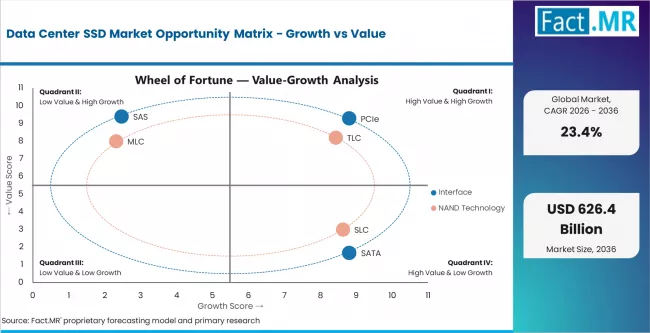
FACT.MR analysts observe that growth is being driven by rapid expansion of AI infrastructure. Data centre SSD demand is rising for model training, inference, and vector database use cases. Cloud operators are scaling AI-optimised clusters. Storage deployment volumes are increasing with GPU rack density. NVMe SSD spending is rising alongside AI workload intensity.
Procurement trends are shifting NAND competition. SLC and MLC are losing share. TLC and QLC are gaining due to cost efficiency. Hyperscalers are adopting high-capacity QLC for archival tiers. PCIe Gen 5 SSDs command 25–40% price premiums over SATA at similar capacities.
- AI Workload Storage Demand: AI data centre power usage increased 40% in 2024, indicating higher storage density needs. PCIe Gen 5 SSD adoption is accelerating across hyperscaler regions. CapEx on storage reached USD 38 billion in 2024 from Amazon, Microsoft, and Google. [7]
- China Hyperscale Expansion Policy: China approved 40 new data centre projects in 2024. This is boosting SSD procurement from Yangtze Memory Technologies and Samsung Electronics. Localisation policies are supporting domestic SSD demand. [8]
- U.S. Export Control Impact: The United States updated export controls in 2023. Advanced NAND exports to China are restricted. This is accelerating domestic NAND capacity build-out in China. Global supply chains are shifting as South Korean and Japanese suppliers target non-China demand.
Regional Analysis
The data center SSD market is assessed across Asia Pacific, North America, Europe, Latin America, and Middle East and Africa, covering 40+ countries with distinct demand profiles shaped by hyperscale cloud investment, AI infrastructure policy, NAND manufacturing capability, and data sovereignty regulation frameworks. The full report provides market attractiveness analysis by region and country.
.webp "Top Country Growth Comparison Data Center Ssd Market Cagr (2026 2036)")
Top Country Growth Comparison Data Center Ssd Market Cagr (2026 2036) | Source: Fact.MR
| Country | CAGR (2026 to 2036) |
|---|---|
| China | 24.3% |
| United States | 24.0% |
| South Korea | 23.4% |
| Japan | 22.5% |
| Germany | 22.0% |
Source: Fact.MR analysis. Updated May 4, 2026
Source: Fact.MR (FACT.MR) analysis, based on proprietary forecasting model and primary research
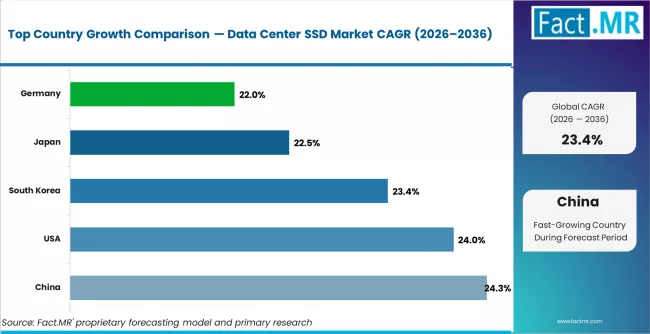
Data Center Ssd Market Cagr Analysis By Country | Source: Fact.MR
Asia Pacific Data Center SSD Market Analysis
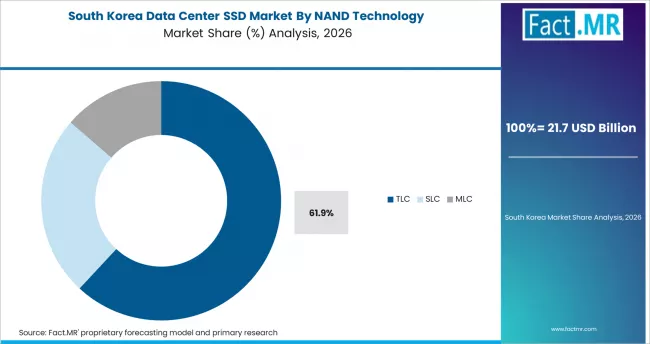
Data Center Ssd Market South Korea Market Share Analysis By Nand Technology | Source: Fact.MR
Asia Pacific is the highest-growth region and the global NAND production epicentre. China drives hyperscale volume expansion. South Korea and Japan lead in technology and NAND manufacturing quality. Samsung Electronics and SK hynix anchor regional supply through vertically integrated NAND and SSD manufacturing.
- China: Government-backed hyperscale expansion supports market-leading 24.3% CAGR through 2036. National Development and Reform Commission approved 40 new large-scale data centre projects in 2024 under the Eastern Data Western Computing programme. Yangtze Memory Technologies received MIIT support in Q3 2024 to expand 3D NAND capacity for domestic SSD production. Provincial procurement frameworks favour domestically assembled SSDs, structurally reinforcing local supply chain integration.
- South Korea: NAND manufacturing leadership anchors 23.4% CAGR through 2036. SK hynix expanded 238-layer 4D NAND TLC production at Icheon in Q3 2024 for hyperscaler supply. Samsung Electronics secured enterprise SSD qualifications at U.S. and European cloud operators in 2024 with PCIe Gen 5 product lines.
- Japan: Semiconductor ecosystem depth supports 22.5% CAGR through 2036. Kioxia launched its CM7 NVMe SSD in Q1 2025, targeting enterprise AI inference deployments. Japan's Ministry of Economy, Trade and Industry approved semiconductor production subsidies for advanced NAND in 2024, supporting domestic SSD supply capability for enterprise and data centre customers.
Fact.MR's analysis covers China, South Korea, Japan, India, ASEAN, and Australia and New Zealand. It includes hyperscale CapEx trends, NAND production data, and AI infrastructure policy impacts.
North America Data Center SSD Market Analysis
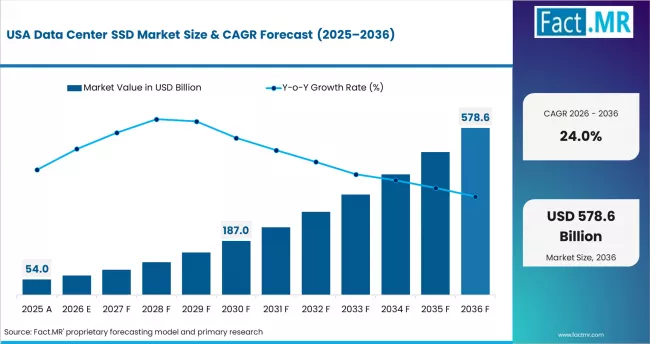
Data Center Ssd Market Country Value Analysis | Source: Fact.MR
North America is the largest market by value and the AI infrastructure investment epicentre. U.S. hyperscaler CapEx defines global SSD demand cycles. Micron Technology and Western Digital lead domestic SSD supply.
- United States: AI infrastructure build-out drives 24.0% CAGR through 2036, the largest hyperscale SSD demand market globally. Amazon Web Services, Microsoft Azure, and Google Cloud collectively disclosed USD 150 billion in infrastructure CapEx for 2025, a significant portion targeting NVMe SSD storage. U.S. Department of Commerce CHIPS Act semiconductor incentives, announced in 2024, are accelerating domestic NAND production investment at Micron Technology's Idaho facility, targeting U.S.-based hyperscaler supply.
Fact.MR's analysis covers the United States, Canada, and Mexico. It includes hyperscaler CapEx timelines, CHIPS Act impact, and PCIe Gen 5 adoption benchmarks.
Europe Data Center SSD Market Analysis
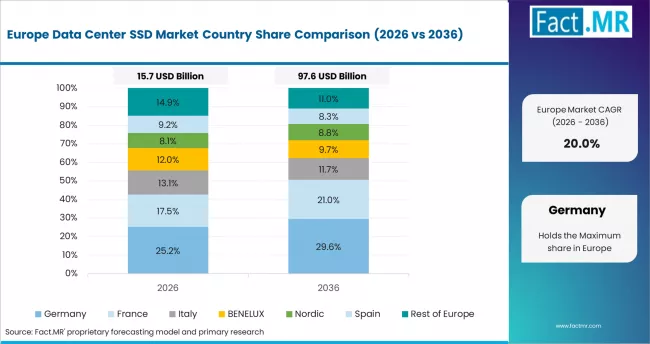
Data Center Ssd Market Europe Country Market Share Analysis, 2026 & 2036 | Source: Fact.MR
Europe is a compliance-driven and enterprise-led data centre SSD market. EU AI Act and data sovereignty regulations shape procurement. Kioxia and Samsung Electronics lead enterprise SSD supply through CE-qualified product lines.
- Germany: Enterprise digitalisation and edge data centre growth drives 22.0% CAGR through 2036. Germany's Federal Office for Information Security issued updated data centre storage security guidelines in 2024, increasing enterprise SSD qualification requirements. Deutsche Telekom expanded its Open Telekom Cloud data centre capacity in Q2 2024, deploying NVMe SSD storage for enterprise and public sector cloud services.
- United Kingdom: Cloud-first enterprise adoption supports 21.5% CAGR through 2036. UK government's National Data Strategy 2024 update prioritised sovereign cloud infrastructure investment, accelerating NVMe SSD procurement at domestic data centres. NHS Digital expanded its cloud storage infrastructure in Q3 2024 under Crown Commercial Service frameworks, deploying enterprise-grade PCIe SSDs for health data analytics workloads.
Fact.MR's analysis covers Germany, France, the United Kingdom, Italy, Spain, and Rest of Europe. It includes EU AI Act compliance, enterprise SSD demand forecasts, and edge data centre deployment trends.
Competitive Aligners for Market Players
Data Center Ssd Market Analysis By Company | Source: Fact.MR
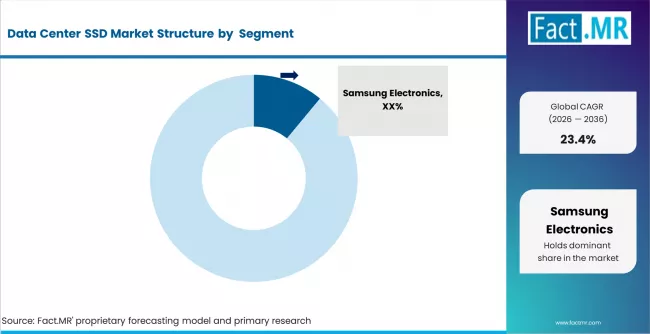
The data center SSD market is highly concentrated, with a small group of large, vertically integrated NAND manufacturers controlling most hyperscaler contracts. Entry barriers are high. Vendors must meet strict NVMe qualification standards and pass performance validation with major cloud platforms like Amazon Web Services, Microsoft Azure, and Google Cloud. Because of this, competition is driven less by pricing and more by technology leadership, product roadmap strength, and long-term reliability.
Samsung Electronics holds a leading position globally. Its advantage comes from full vertical integration, large-scale NAND production, and a wide SSD portfolio across SATA to PCIe Gen 5. Micron Technology competes through advanced 232-layer 3D NAND and strong U.S.-based manufacturing. This also aligns well with domestic supply chain incentives such as the CHIPS Act, making it attractive to U.S. hyperscalers.
Other key players bring focused strengths. Kioxia targets premium data centre clients with high-performance PCIe Gen 5 TLC SSDs. Western Digital is expanding in QLC-based SSDs, focusing on cost-efficient storage for archival and cold data. SK hynix is strengthening its position through 4D NAND and advanced SSD controllers designed for AI workloads. Buyer behavior also shapes competition. Hyperscalers typically qualify multiple vendors to reduce supply risk. However, once a vendor is approved, it often receives large, multi-quarter volume commitments. Qualification cycles can take 12 to 24 months, which creates strong advantages for established players and makes it difficult for smaller entrants to scale beyond niche opportunities.
Key Players
- Samsung Electronics
- Micron Technology
- SK hynix
- Kioxia
- Western Digital
- Intel
Bibliography
- [1] Samsung Electronics Co., Ltd. (Q3 2024). Product Launch: PM9C3a PCIe Gen 5 NVMe SSD for Data Centre AI and Cloud Workloads Delivering 14 GB/s Sequential Read Speed Under Hyperscaler Storage Qualification Programmes. Q3 2024. samsung.com/semiconductor/newsroom
- [2] Micron Technology Inc. (Q1 2025). Product Launch: 6550 ION NVMe Enterprise SSD with 232-Layer 3D NAND and 60 TB Capacity per Drive Targeting Hyperscale Rack Density Optimisation for AI Inference and Cloud Storage Workloads. January 2025. micron.com/about/news
- [3] JEDEC Solid State Technology Association. (2024). NVMe Specification 2.0 Update: PCIe Gen 5 Requirements for AI Data Centre Storage Formalisation and Legacy SATA Phase-Out Timeline Guidance for Hyperscaler Procurement. 2024. jedec.org/standards-documents
- [4] SK hynix Inc. (Q3 2024). Operations Update: 238-Layer 4D NAND TLC Production Expansion at Icheon Facility Targeting Data Centre SSD Volume Supply with Multi-Year Agreements at Major U.S. Hyperscale Cloud Operators. Q3 2024. skhynix.com/newsroom
- [5] Kioxia Corporation. (Q1 2025). Product Launch: CM7 Enterprise NVMe SSD with 112-Layer TLC BiCS NAND Delivering 7 GB/s Sequential Read for PCIe Gen 5 AI and Cloud Inference Data Centre Deployments. January 2025. kioxia.com/global/press
- [6] Western Digital Corporation. (2024). Annual Report 2024: QLC NAND SSD Hyperscaler Shipment Growth of 34% and Cost-per-TB Reduction Below USD 0.06 per GB in Cold Storage and Archival Tier Data Centre Applications. 2024. westerndigital.com/investor-relations
- [7] U.S. Department of Energy. (2024). AI Data Centre Energy and Infrastructure Report 2024: AI Infrastructure Power Consumption Increase of 40% Correlating with NVMe SSD Storage Density Requirements and Hyperscaler CapEx on Storage Infrastructure of USD 38 Billion. 2024. energy.gov/eere
- [8] National Development and Reform Commission, China. (2024). Eastern Data Western Computing Programme 2024: Approval of 40 New Large-Scale Data Centre Projects and Domestic SSD Procurement Frameworks Favouring Locally Assembled Storage Products. 2024. ndrc.gov.cn
This Report Addresses
- Strategic intelligence on data center SSD demand across PCIe, SATA, and SAS interfaces and SLC, MLC, TLC, and QLC NAND technologies for hyperscale, enterprise, and AI data centre applications globally.
- Market forecast from USD 62.0 billion in 2026 to USD 510 billion by 2036 at a CAGR of 23.4%.
- Growth opportunity mapping across China government-backed hyperscale expansion, U.S. AI infrastructure investment, South Korea NAND manufacturing leadership, Japan enterprise AI adoption, and Germany edge data centre digitalisation.
- Segment analysis by interface (PCIe, SATA, SAS), NAND technology (SLC, MLC, TLC, QLC), and capacity range (≤ 1 TB to ≥ 4 TB) across global and regional markets.
- Regional outlook covering Asia Pacific NAND production-led supply dynamics, North America AI hyperscaler demand, and Europe EU AI Act and data sovereignty compliance-driven procurement.
- Competitive analysis of Samsung Electronics, Micron Technology, SK hynix, Kioxia, Western Digital, and Intel covering NAND technology generation, hyperscaler qualification depth, and PCIe Gen 5 roadmap positioning.
- Regulatory impact analysis covering U.S. CHIPS Act NAND production incentives, U.S. Commerce Department semiconductor export controls, EU AI Act storage compliance requirements, and China NDRC data centre expansion approvals.
- Report delivered in PDF, Excel datasets, and presentation formats. Supported by primary interviews, hyperscaler CapEx disclosures, JEDEC NVMe specification releases, and manufacturer revenue data.
Data Center SSD Market Definition
The market covers SATA, SAS, and PCIe-interface SSDs with SLC, MLC, TLC, and QLC NAND, deployed as primary storage in hyperscale cloud, enterprise, and AI data centre infrastructure globally.
Data Center SSD Market Inclusions
Covers global and regional forecasts from 2026 to 2036. Includes interface, NAND technology, and capacity segments. Covers SATA, SAS, and PCIe NVMe SSDs across all NAND types. Includes hyperscale, enterprise, and colocation data centre deployments.
Data Center SSD Market Exclusions
Excludes consumer SSDs and client PC NVMe drives unless used in servers. Omits DRAM and persistent memory modules. Excludes HDDs and hybrid storage products.
Data Center SSD MarketResearch Methodology
- Primary Research
- Interviews with storage architects, hyperscaler buyers, IT managers, and NAND supply chain executives across the United States, South Korea, Japan, China, and Germany.
- Desk Research
- Uses JEDEC NVMe standards, semiconductor trade data, and industry production reports. Includes disclosures from Samsung Electronics, Micron Technology, and SK hynix (2024–2025).
- Market-Sizing and Forecasting
- Hybrid model based on SSD shipment volumes by interface and NAND type. Uses capacity-weighted pricing and hyperscaler CapEx timelines. Covers all key regions and end users.
- Data Validation and Update Cycle
- Validated using hyperscaler CapEx data, NAND output, and pricing benchmarks. Cross-checked with supply chain inputs. Updated annually.
Segmentation
Scope of Report
Data Center Ssd Market Breakdown By Interface, Nand Technology, And Region | Source: Fact.MR
| Attribute | Details |
|---|---|
| Quantitative Units | USD 62.0 billion (2026) to USD 510 billion (2036), at a CAGR of 23.4% |
| Market Definition | SATA, SAS, and PCIe NVMe SSDs with SLC, MLC, TLC, and QLC NAND technologies, deployed as primary and tiered storage in hyperscale cloud, enterprise, and AI-optimised data centre infrastructure globally. |
| Interface Segmentation | SATA, SAS, PCIe |
| NAND Technology Segmentation | SLC, MLC, TLC, QLC |
| Capacity Range Segmentation | ≤ 1 TB, 1–2 TB, 2–4 TB, ≥ 4 TB |
| Application Coverage | AI model training and inference storage, hyperscale cloud primary and tiered storage, enterprise data centre NVMe deployment, edge data centre storage, and colocation SSD procurement. |
| Regions Covered | North America, Europe, Asia Pacific, Latin America, Middle East and Africa |
| Countries Covered | USA, Canada, Mexico, Germany, UK, France, Italy, Spain, Nordic, BENELUX, China, Japan, South Korea, India, ASEAN, Australia and New Zealand, Brazil, Argentina, Chile, Saudi Arabia, GCC, Turkey, South Africa, Rest of MEA |
| Key Companies Profiled | Samsung Electronics, Micron Technology, SK hynix, Kioxia, Western Digital, Intel |
| Forecast Period | 2026 to 2036 |
| Approach | Hybrid top-down and bottom-up model using data centre SSD shipment volumes by interface and NAND type, capacity-weighted average selling prices, hyperscaler CapEx deployment timelines, and primary interviews with storage architects and cloud procurement managers. |
Source: Fact.MR analysis. Updated May 4, 2026
Data Center SSD Market by Segments
-
By Interface:
- SATA
- SAS
- PCIe
-
By NAND Technology:
- SLC
- MLC
- TLC
- QLC
-
By Capacity Range:
- ≤ 1 TB
- 1–2 TB
- 2–4 TB
- ≥ 4 TB
-
By Region:
-
North America
- United States
- Canada
- Mexico
-
Latin America
- Brazil
- Mexico
- Argentina
- Chile
- Rest of Latin America
-
Western Europe
- Germany
- United Kingdom
- France
- Italy
- Spain
- Nordic Countries
- BENELUX
- Rest of Western Europe
-
Eastern Europe
- Russia
- Poland
- Hungary
- Balkan and Baltic
- Rest of Eastern Europe
-
East Asia
- China
- Japan
- South Korea
-
South Asia and Pacific
- India
- ASEAN
- Australia and New Zealand
- Rest of South Asia and Pacific
-
Middle East and Africa
- Kingdom of Saudi Arabia
- Other GCC Countries
- Turkey
- South Africa
- Rest of Middle East and Africa
-
Frequently Asked Questions
How large is the global data center SSD market in 2025?
What will the market size be in 2026?
What is the projected market size by 2036?
What is the expected CAGR from 2026 to 2036?
Which interface segment is poised to lead the market?
Which NAND technology segment holds the largest share?
Which capacity range dominates the market?
Which country shows the fastest growth?
What is driving demand for data center SSDs?
What are the major restraints?
Who worked on this report


Preview the report firsthand - request a free sample
Free SampleGet the brochure for pricing and purchase details
Download PDF