- Market Value (2025):USD 91.9 Mn
- Estimated Value (2026):USD 115.0 Mn
- Forecast Value (2036):USD 1500 Mn
- CAGR (2026-2036):29.3%
What is the defect image generation market forecast to be worth by 2036?
USD 115.0 million in 2026 to USD 1,500 million by 2036, at 29.3% CAGR.
- The defect image generation market crossed a valuation of USD 91.9 million in 2025.
- Demand is expected to increase from USD 115.0 million in 2026 to USD 1,500 million by 2036.
- The market is forecast to record 29.3% CAGR from 2026 to 2036 because aviation inspection models need defect examples before live deployment approval.
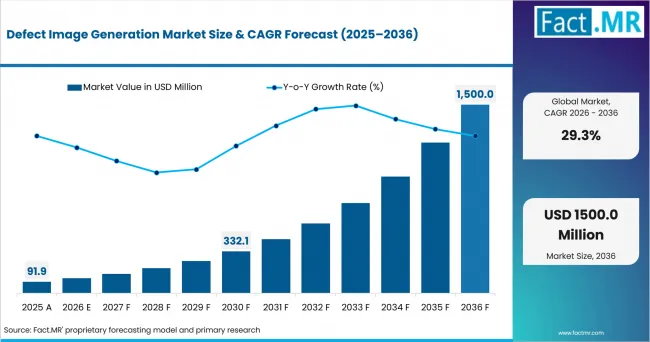
Defect Image Generation Market Market Value Analysis | Source: Fact.MR
What are the defining numbers behind defect image generation growth?
USD 1,400 million absolute opportunity by 2036, led by India and China.
- Demand Drivers in the Market
- Airport operators need more defect examples before camera inspection systems are approved for live ramp use.
- Airlines need model-ready image libraries to reduce manual review during turnaround and maintenance checks.
- Ground handlers need visual evidence for equipment damage before repair claims and asset downtime decisions.
- GSE suppliers need inspection-data services because equipment fleets are becoming more connected through gate systems.
- Key Segments Analyzed
- By Product Type: Software is projected to hold 43.0% share in 2026 since image creation and labeling are the first buying steps.
- By Defect Source: Synthetic Renderings are expected to account for 44.0% share in 2026 because rare damage cases need repeatable examples.
- By Application: Maintenance is anticipated to hold 34.0% share in 2026 because visible wear checks have direct operating value.
- By Customer Type: Airlines are predicted to account for 31.0% share in 2026 as fleet checks require common image standards.
- By Deployment: Retrofit is forecast to hold 39.0% share in 2026 since cameras can be added to existing gates and workshops.
- By Geography: India is expected to post 33.8% CAGR through 2036 with airport expansion creating new inspection-data needs.
- Analyst Opinion at Fact.MR
- Shambhu Nath Jha, Senior Analyst at Fact.MR, states, “I see this market as a data-readiness problem before it is a camera problem. Airports and airlines want visual inspection tools. The harder task is proving that those tools have seen enough defect examples. Suppliers that can create useful defect libraries and validate them against real ramp conditions get a better route into paid aviation inspection programs.”
- Strategic Implications
- Image-software vendors should build aviation-specific defect classes before selling broad inspection tools.
- GSE suppliers need asset-level image libraries that match installed fleets and service workflows.
- Airports should validate defect-image quality before linking automated alerts to repair or downtime decisions.
- Airlines need common label standards so generated images can support fleet-level inspection models.
Generated defect images for aviation assets form the core of this market. Airports Council International World projected 9.8 billion global passengers for 2025. This traffic level raises equipment-use intensity across aprons, gates and maintenance areas.
India is expected to post 33.8% CAGR through 2036 as airport network expansion creates fresh inspection-data needs. China is projected to record 32.7% CAGR because passenger and cargo throughput keep rising. The United Arab Emirates is forecast at 31.6% CAGR as Dubai remains a high-volume hub. The United States is expected to advance at 30.2% CAGR as large hubs test visual inspection at scale. The United Kingdom is expected to expand at 27.1% CAGR through retrofit-led airport programs.
How does the defect image generation market break down by segment?
Software leads at 43.0%; synthetic renderings lead at 44.0%.
Which product type dominates?
Software holds 43.0% share in 2026.
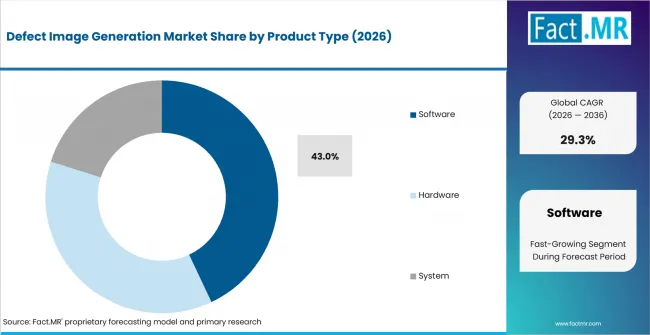
Defect Image Generation Market Analysis By Product Type | Source: Fact.MR
Software leads because aviation buyers need image creation and annotation before camera systems are scaled. The segment is projected to hold 43.0% share in 2026 as inspection teams build model-ready defect libraries. Adjacent synthetic data generation demand supports this logic because rare visual cases can be created before they appear in daily footage.
Which defect source dominates?
Synthetic Renderings lead with 44.0% share in 2026.
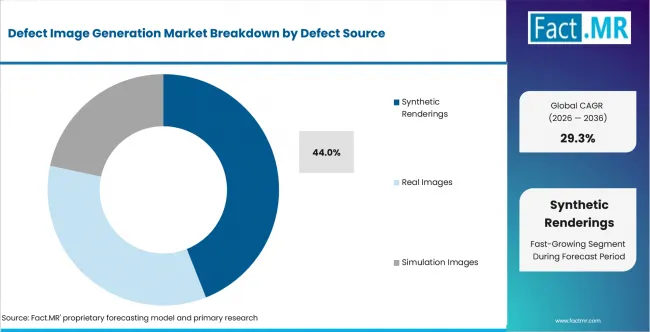
Defect Image Generation Market Analysis By Defect Source | Source: Fact.MR
Synthetic renderings lead because rare ramp defects cannot be captured quickly through live operations. These images help model teams test dents, scratches and component wear under controlled visual conditions. Inspection buyers also compare this output with 3D machine vision methods when depth and asset shape matter.
Which application dominates?
Maintenance holds 34.0% share in 2026.
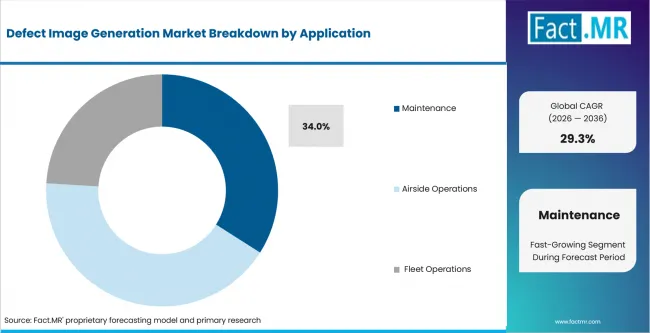
Defect Image Generation Market Analysis By Application | Source: Fact.MR
Maintenance leads because visible wear checks have clear value for equipment uptime. The segment is anticipated to hold 34.0% share in 2026 as operators test image libraries for tires, loaders and gate assets. Demand links naturally with robot vision systems because both require controlled visual evidence before automated decisions are trusted.
Which customer type dominates?
Airlines account for 31.0% share in 2026.
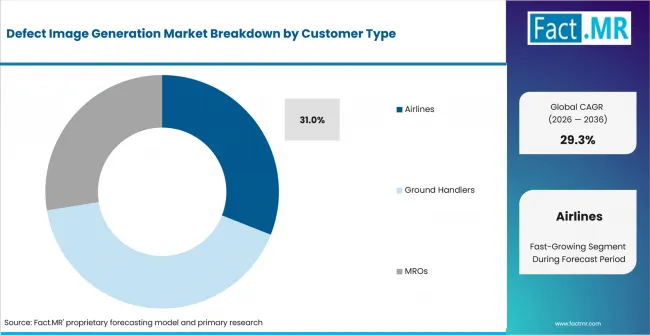
Defect Image Generation Market Analysis By Customer Type | Source: Fact.MR
Airlines lead because fleet checks need common image standards across stations. The segment is predicted to account for 31.0% share in 2026 as carriers link inspection evidence with maintenance and turnaround records. Ground handlers are close followers since they manage asset contact during daily operations.
Which deployment model dominates?
Retrofit holds 39.0% share in 2026.
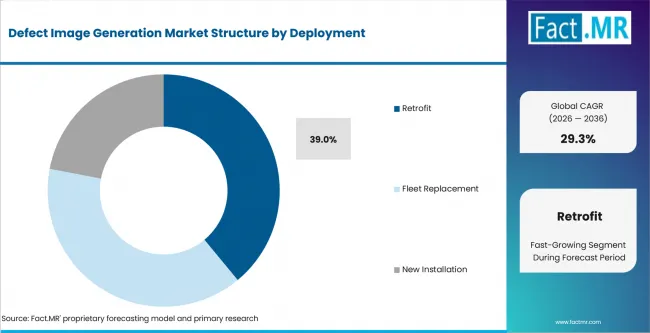
Defect Image Generation Market Analysis By Deployment | Source: Fact.MR
Retrofit leads because airports can add cameras and image workflows without replacing entire equipment fleets. The deployment route is forecast to hold 39.0% share in 2026. Buyers prefer this path when inspection tools must fit existing gate, ramp and workshop assets.
What is accelerating defect image generation adoption, and what is holding it back?
Rare defect coverage and airport ramp inspection needs drive it, while trust gaps in generated defects and limited aviation image benchmarks restrain it.
Drivers Impact Analysis
| DRIVER | (~) % IMPACT ON CAGR | GEOGRAPHIC RELEVANCE | IMPACT TIMELINE |
|---|---|---|---|
| Rare defect coverage for model training | +6.3% | Global, strongest in aviation hubs | Short term (≤ 2 years) |
| Airport traffic pressure on ramp assets | +5.8% | India, China, UAE, USA | Medium term (2–4 years) |
| Camera retrofits across gate operations | +5.1% | North America and Europe | Medium term (2–4 years) |
| Airline maintenance proof requirements | +4.8% | Global airline networks | Short term (≤ 2 years) |
| Connected GSE data workflows | +4.2% | Middle East, Europe, East Asia | Long term (≥ 4 years) |
Source: Fact.MR analysis. Updated Jul 2, 2026
- Rare defect coverage for training
- Inspection models need examples that live ramp footage cannot supply at useful speed. Generated libraries fill this gap by creating controlled images of damage before it appears often in operations. Ground support equipment tires are one of the clearest visual-inspection use cases because tire wear is easy to document through image libraries.
- Traffic pressure on ramp assets
- Airport traffic puts more cycles on tugs, loaders and gate equipment. International Air Transport Association reported 3.4% growth in cargo tonne-kilometers for 2025. Higher utilization makes image-based defect proof more useful for maintenance teams.
- Retrofit cameras at gates
- Gate operators can add cameras and image workflows to existing assets. That matters because full equipment replacement is slower than software-led retrofit. Visual data programs can start near airport catering trucks and other vehicles that already pass through controlled service points.
Opportunity Impact Analysis
| OPPORTUNITY | (~) % IMPACT ON CAGR | GEOGRAPHIC RELEVANCE | IMPACT TIMELINE |
|---|---|---|---|
| Aviation-specific defect libraries | +6.1% | India, China, UAE, USA | Medium term (2–4 years) |
| Service packages for model validation | +5.4% | North America and Europe | Short term (≤ 2 years) |
| Generated images for GSE wear checks | +4.9% | Global airport networks | Medium term (2–4 years) |
| Image review after workflow changes | +4.3% | Global | Long term (≥ 4 years) |
| Airside asset data partnerships | +3.8% | Europe and Middle East | Medium term (2–4 years) |
Source: Fact.MR analysis. Updated Jul 2, 2026
- Aviation-specific defect libraries
- The best opening is not a generic dataset. Buyers need defect classes that match airport assets and repair logic. Libraries tied to belt loaders can support use cases with clear damage patterns and repeat maintenance checks.
- Model validation services
- Generated images have more value when suppliers also test how models respond to them. Airports need assurance that synthetic defects resemble real damage. This creates service revenue beyond one-time library delivery.
- GSE wear-check expansion
- GSE wear checks can extend image-generation demand beyond cameras mounted at gates. Generated damage scenes can support training for aircraft tugs and high-contact support vehicles. Suppliers that know asset geometry can build stronger libraries.
Restraints Impact Analysis
| RESTRAINT | (~) % IMPACT ON CAGR | GEOGRAPHIC RELEVANCE | IMPACT TIMELINE |
|---|---|---|---|
| Trust gap in generated defects | -4.6% | Global | Short term (≤ 2 years) |
| Limited aviation image benchmarks | -3.8% | Global, strongest in early pilots | Medium term (2–4 years) |
| Buyer concern over false alerts | -3.2% | USA, Europe, Japan | Medium term (2–4 years) |
| Integration cost at older gates | -2.9% | Europe, India, South Asia | Medium term (2–4 years) |
| Data ownership across operators | -2.4% | Global airline networks | Long term (≥ 4 years) |
Source: Fact.MR analysis. Updated Jul 2, 2026
- Trust gap in generated defects
- Generated images can create useful examples but buyers still need proof that the defects match field damage. National Institute of Standards and Technology published its generative AI risk profile in July 2024. This makes validation documentation a sales requirement.
- Limited aviation image benchmarks
- Public defect-image benchmarks are thinner in aviation ground operations than in manufacturing inspection. This limits direct comparison between suppliers. Related industrial drone inspection shows the same issue because asset context changes how visual evidence is judged.
- Integration cost at older gates
- Older gates often have mixed equipment and uneven data access. Generated-image tools may need adapters, labeling work and validation runs before use. This slows adoption around air start units and other assets that differ by airport age and operating practice.
Which countries are scaling defect image generation fastest?
India leads at 33.8%. China follows at 32.7%. UAE reaches 31.6%. USA reaches 30.2%. UK reaches 27.1%.
Based on regional analysis, the market covers North America, Europe, Asia Pacific, Latin America, and the Middle East and Africa.
| Country | CAGR |
|---|---|
| India | 33.8% |
| China | 32.7% |
| United Arab Emirates | 31.6% |
| United States | 30.2% |
| United Kingdom | 27.1% |
Source: Fact.MR analysis. Updated Jul 2, 2026
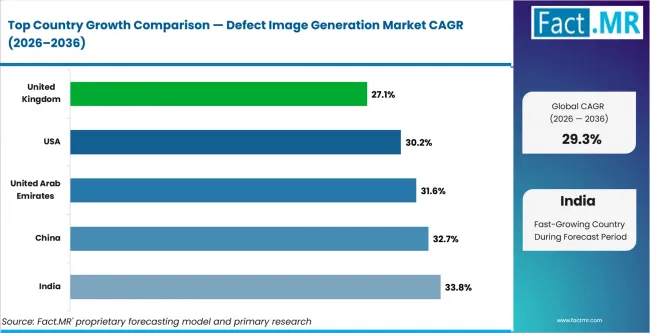
Defect Image Generation Market Cagr Analysis By Country | Source: Fact.MR
What is powering India’s lead?
33.8% CAGR, supported by airport expansion and inspection-data needs.
India is adding aviation capacity through new airports and regional routes. The Ministry of Civil Aviation reported that airlines carried 538.4 thousand domestic passengers on November 23, 2025. India is expected to post 33.8% CAGR through 2036 because more operating sites need low-cost inspection support. Suppliers that package image libraries with retrofit cameras can reach airports before full automation budgets are approved.
How is China scaling inspection-data demand?
32.7% CAGR, driven by commercial airport throughput and cargo activity.
China has a large airport base and heavy logistics activity. The Civil Aviation Administration of China reported 1.529 billion passenger trips through national commercial airports in 2025. China is projected to record 32.7% CAGR through 2036 because airlines and airports need faster visual checks across high-throughput assets. Local partners can help suppliers adapt libraries to domestic equipment models and operating rules.
Why is the United Arab Emirates important?
31.6% CAGR, supported by Dubai hub traffic and airside data programs.
The United Arab Emirates has a concentrated hub model that raises the value of operational evidence. Dubai Airports reported that Dubai International welcomed 95.2 million guests in 2025. The country is forecast at 31.6% CAGR through 2036 because inspection tools can be tested in high-volume airport workflows. Suppliers that connect defect images with apron systems can win earlier reference accounts.
What supports the USA outlook?
30.2% CAGR, backed by large hubs and retrofit-heavy inspection programs.
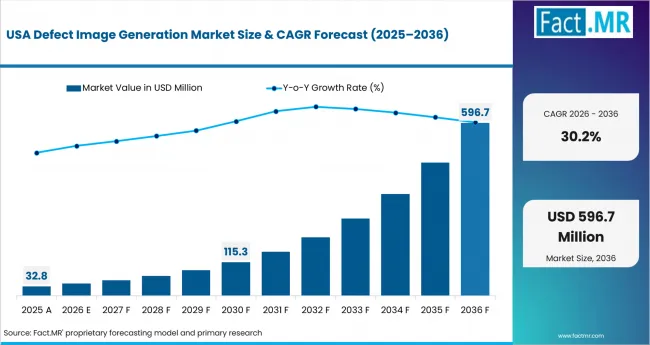
Defect Image Generation Market Country Value Analysis | Source: Fact.MR
The United States has several airports with scale suited to image-led inspection pilots. Airports Council International World listed Hartsfield-Jackson Atlanta International Airport at 106.3 million passengers in 2025. The United States is expected to advance at 30.2% CAGR through 2036 as operators test inspection workflows across baggage, gate and ramp assets. Buyers are likely to favor suppliers with field validation and service support.
How does the United Kingdom perform?
27.1% CAGR, supported by record airport passenger journeys and station-level retrofit demand.
United Kingdom buyers compare aviation tools by risk control and documentation. The United Kingdom Civil Aviation Authority reported 302 million airport passengers in 2025. The country is expected to expand at 27.1% CAGR through 2036 with demand centered on airline and airport retrofit programs. Procurement is likely to favor suppliers that prove station-level fit.
Who leads the defect image generation landscape?
Roboflow, Overview AI and NVIDIA lead through equipment access and airside account reach.
Defect image generation is used by aviation buyers that need trusted visual evidence before automated inspection decisions. GSE suppliers understand asset geometry and maintenance workflows. Vision-data vendors bring generated-image and model-testing capability. Buyers are expected to prefer partners that connect both sides into one working inspection path.
Roboflow is positioned through computer vision data tooling, model training workflows, and defect-image dataset support. Installed knowledge can support defect libraries tied to real equipment conditions.
Providers that combine asset access, label quality and field validation are expected to be better placed. Pure software vendors can win pilots but may need GSE partners for operating context. Equipment suppliers can defend accounts if they add image-library services to maintenance support.
Which companies are the key players?
Key players include NVIDIA and Roboflow. Overview AI, Siemens and ZetaMotion also compete. Rendered.ai and Anyverse are included in the supplier set.
- NVIDIA
- Roboflow
- Overview AI
- Siemens
- ZetaMotion
- Rendered.ai
- Anyverse
Bibliography
- Airports Council International World. (2025, September 30). Global air travel forecasted to reach 9.8 billion passengers in 2025, nearing the historic 10 billion milestone.
- International Air Transport Association. (2026, January 29). Global air cargo demand achieved record volume in 2025.
- Press Information Bureau, Ministry of Civil Aviation, Government of India. (2026, January 21). Year end review of Ministry of Civil Aviation.
- Civil Aviation Administration of China. (2026, April 22). CAAC releases statistical bulletin of civil aviation industry development in 2025.
- Dubai Airports. (2026, February 11). DXB sets global benchmark as record traffic become the norm.
- Airports Council International World. (2026, April 20). What are the busiest airports in the world in 2025?
- United Kingdom Civil Aviation Authority. (2026, February 24). UK aviation officially breaks records with over 300m passenger journeys in 2025.
- Airports Council International Europe. (2026, February 5). 2025 all about traffic resilience as Europe’s airports welcomed an additional 100 million passengers.
- National Institute of Standards and Technology. (2024, July 26). Artificial Intelligence Risk Management Framework: Generative Artificial Intelligence Profile.
- European Commission. (2024, August 1). AI Act enters into force.
This Report Addresses
- Strategic intelligence on defect image generation across product type and defect source.
- Segment analysis covering Software and Synthetic Renderings.
- Regional outlook covering India and China. It also covers UAE, USA and UK.
- Competitive analysis of NVIDIA and Roboflow. Overview AI and Siemens are also reviewed.
- Buyer assessment covering airlines and ground handlers that use image libraries for inspection proof.
- Service assessment covering synthetic libraries and annotation. Model validation and retrofit support are included.
- Primary interviews and official aviation sources support the forecast. Company checks and provider validation are included.
What does the defect image generation market cover?
Model-ready images and validation sets for aviation-ground-operation defect detection.
The defect image generation market covers paid tools and services that create image assets for inspection models. It includes synthetic renderings, curated real images and annotated libraries. The market differs from camera hardware because the service focus is training evidence and defect-class coverage.
What is included in the scope?
Synthetic defect libraries, annotated image sets and retrofit-linked image workflows.
The scope includes generated images for dents and scratches. It also covers tire wear and gate-equipment surface damage. It covers software used to create rare defect scenes and service packages that review label quality. Retrofit packages that connect cameras with defect-image workflows are also included.
What is excluded from the scope?
Airport vehicles, basic CCTV systems and public datasets without commercial workflow support.
The scope excludes GSE hardware sold without image-generation support. It excludes general photo storage and standard CCTV systems. It excludes public datasets that are not sold as part of a commercial aviation inspection workflow.
How was the analysis built?
100+ sources, 40+ company portfolios, 25+ countries, 20+ interviews.
- Primary Research: Primary research includes interviews with airport operations managers and airline maintenance teams. It includes input from GSE vendors and aviation software buyers.
- Desk Research: Desk research reviews aviation traffic data, AI governance sources and GSE supplier disclosures. It covers official airport traffic releases and company product pages.
- Market-Sizing and Forecasting: Forecasting uses aviation inspection account counts and likely image-library spending. Passenger traffic and cargo activity support the market assessment.
- Data Validation and Update Cycle: Forecasts are validated through source checks and company activity reviews. Post-2024 aviation evidence and supplier activity confirm market direction.
Segmentation
What is the report’s scope and coverage?
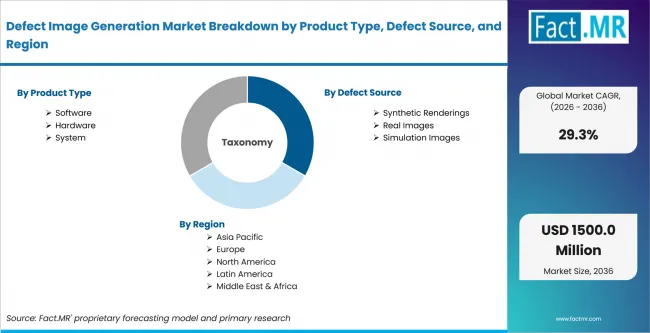
Defect Image Generation Market Breakdown By Product Type, Defect Source, And Region | Source: Fact.MR
| Attribute | Details |
|---|---|
| Quantitative Units | USD Million in 2026 to USD Million by 2036 at CAGR |
| Market Definition | Generated and curated defect images for aviation-ground-operation inspection models |
| Product Type | Hardware, Software, System, Retrofit, Service Package |
| Defect Source | Synthetic Renderings, Real Images, Simulation Images, GAN Images, Annotated Libraries |
| Application | Airside Operations, Gate Operations, Fleet Operations, Maintenance, Safety |
| Customer Type | Airport Operators, Airlines, Ground Handlers, MROs, Contractors |
| Deployment | New Installation, Retrofit, Fleet Replacement, Maintenance Contract |
| Regions Covered | North America, Europe, East Asia, Middle East, South Asia |
| Countries Covered | India, China, United Arab Emirates, United States, United Kingdom |
| Key Companies Profiled | NVIDIA, Roboflow, Overview AI, Siemens, ZetaMotion, Rendered.ai and Anyverse |
| Forecast Period | 2026 to 2036 |
| Approach | Hybrid top-down and bottom-up approach using airport traffic, GSE account access, image-library pricing and provider validation |
Source: Fact.MR analysis. Updated Jul 2, 2026
How is the market segmented?
-
By Product Type:
- Hardware
- Software
- System
- Retrofit
- Service Package
-
By Defect Source:
- Synthetic Renderings
- Real Images
- Simulation Images
- GAN Images
- Annotated Libraries
-
By Application:
- Airside Operations
- Gate Operations
- Fleet Operations
- Maintenance
- Safety
-
By Customer Type:
- Airport Operators
- Airlines
- Ground Handlers
- MROs
- Contractors
-
By Deployment:
- New Installation
- Retrofit
- Fleet Replacement
- Maintenance Contract
-
By Region:
- North America
- United States
- Canada
- Mexico
- Latin America
- Brazil
- Argentina
- Rest of Latin America
- Europe
- Germany
- United Kingdom
- France
- Italy
- Spain
- Rest of Europe
- Asia Pacific
- China
- India
- Japan
- South Korea
- ASEAN
- Middle East & Africa
- GCC Countries
- South Africa
- UAE
- Rest of Middle East & Africa
- North America
Frequently Asked Questions
Which product type leads the Defect Image Generation Market?
Which country expands fastest in the Defect Image Generation Market?
How does China perform in the Defect Image Generation Market?
How does the United Arab Emirates perform in the Defect Image Generation Market?
How does the United States perform in the Defect Image Generation Market?
How does the United Kingdom perform in the Defect Image Generation Market?
What is the primary driver in the Defect Image Generation Market?
What is the main restraint in the Defect Image Generation Market?
Why are synthetic renderings important in this market?
Who worked on this report


Preview the report firsthand - request a free sample
Free SampleGet the brochure for pricing and purchase details
Download PDF