- Base Value(2025): 511 Mn
- Estimated Value(2026): 530.2 Mn
- Forecast Value (2036): 739.8 Mn
- CAGR (2026 - 2036): 3.8%
Dehydrating Breather Market Forecast 2026 to 2036
In 2025, the dehydrating breather market was valued at USD 511 million. Based on Future Market Insights' analysis, demand for dehydrating breathers is estimated to grow to USD 530.2 million in 2026 and USD 739.8 million by 2036. FMI projects a CAGR of 3.8% during the forecast period.
The absolute dollar growth from 2026 to 2036 is USD 209.6 million. This growth is driven by the increasing demand for dehydrating breathers in industries such as manufacturing, energy, and automotive, where they are crucial for preventing moisture and contaminants from entering equipment, thus prolonging their lifespan and enhancing operational efficiency. However, the market faces challenges such as the need for regular maintenance and the relatively high cost of advanced breathers in certain applications.
As stated on the Maschinenfabrik Reinhausen website regarding the MESSKO® MTRAB® 2.5 dehydrating breather, ‘Ever longer operating times and ever higher current densities lead to continuously increasing demands on operating equipment. The maintenance-free MESSKO® MTRAB® 2.5 dehydrating breathers continuously dehumidify and monitor the breathing cycle of power transformers - in all climatic zones.’
South Korea leads with a CAGR of 5.6%, driven by a growing industrial sector and increased awareness of equipment protection needs. The United Kingdom follows with a 5.3% CAGR, supported by rising demand for moisture control solutions in manufacturing and energy sectors. China grows at 4.7%, fueled by the expansion of industrialization and demand for durable equipment. The United States shows 4.2% growth, reflecting steady demand for dehydrating breathers in industrial applications. Japan grows at 3.1%, with a mature market focused on long-term equipment reliability.
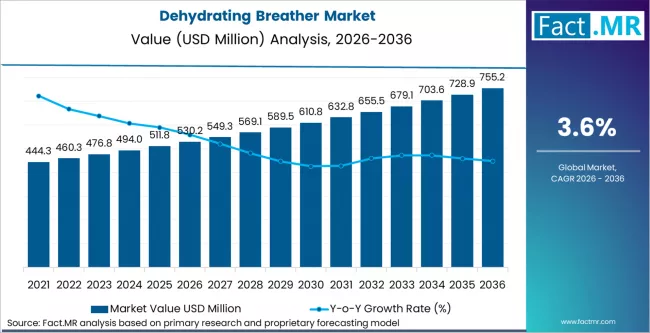
Dehydrating Breather Market Market Value Analysis | Source: Fact.MR
Dehydrating Breather Market Definition
The dehydrating breather market involves devices that remove moisture and contaminants from air entering enclosed systems, protecting internal components from corrosion and degradation.
Market Inclusions
This report covers global and regional market sizes for dehydrating breathers, including product types (desiccant, silica gel, activated alumina), and applications (gearboxes, hydraulic systems, compressors).
Market Exclusions
The scope excludes air filtration products without moisture control and desiccant systems used outside fluid reservoir protection.
Research Methodology
- Primary Research: Interviews were conducted with engineers, OEM specialists, and industrial end users.
- Desk Research: Data was sourced from industry reports and trade association publications.
- Market‑Sizing and Forecasting: A hybrid model combining top‑down demand forecasts with bottom‑up shipment data was used.
- Data Validation and Update Cycle: Findings were validated through expert review and aligned with recent production and trade figures.
Summary of the Dehydrating Breather Market
-
Market Definition
- The Dehydrating Breather Market involves devices that remove moisture and contaminants from air entering enclosed systems, such as transformers, oil storage tanks, and reactors. These breathers are essential for preventing internal corrosion, degradation, and contamination of equipment components, thereby enhancing their performance and lifespan.
-
Demand Drivers
- Growing industrial demand for equipment protection solutions to prevent moisture and particulate contamination, particularly in energy, manufacturing, and automotive sectors.
- Rising awareness about the importance of moisture control in maintaining equipment reliability, efficiency, and longevity.
- Expansion of the power generation, transmission, and distribution industries, increasing the need for transformers and oil storage tanks that benefit from effective moisture control.
- Increasing demand for high-performance industrial equipment in various climates, necessitating robust moisture control systems.
-
Key Segments Analyzed
- Type: Silica gel is expected to dominate, capturing 53.4% of the market share by 2026 due to its high moisture absorption capacity and widespread use in moisture-sensitive applications.
- Application: Transformers are projected to account for 57.7% of the market share by 2026, driven by the critical need for moisture control to protect transformer insulation and ensure operational longevity.
- End-Use Industry: The power generation and transmission sectors are expected to be the primary end-users, supported by strong demand for reliable, high-performance equipment.
- Region: South Korea is expected to lead in growth, with a projected CAGR of 5.6%, driven by industrial expansion and increasing need for moisture control solutions.
-
Analyst Opinion at FactMR
- "As industries continue to expand and modernize, the demand for effective moisture control systems like dehydrating breathers is on the rise. Silica gel-based breathers are expected to dominate due to their efficiency in protecting sensitive equipment, such as transformers, from environmental damage." - Shambhu Nath Jha, Principal Consultant at FactMR.
-
Strategic Implications/Executive Takeaways
- Focus on enhancing the moisture-absorbing capabilities of dehydrating breathers, particularly silica gel-based products, to improve equipment lifespan in critical industries.
- Develop advanced moisture control solutions for emerging markets where industrialization is driving demand for high-performance equipment.
- Leverage the growing importance of equipment reliability and efficiency to expand the use of dehydrating breathers in industries like power generation, manufacturing, and renewable energy.
-
Methodology
- Derived from primary research with engineers, OEM specialists, and industrial end-users.
- Benchmarked against data from industries relying on equipment protection, including power generation and manufacturing sectors.
- Hybrid top-down and bottom-up market modeling, validated through expert reviews and recent production data.
Segmental Analysis
Dehydrating Breather Market Analysis by Type
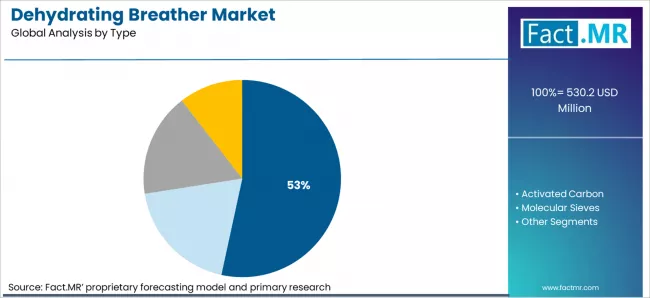
Dehydrating Breather Market Analysis By Type | Source: Fact.MR
- Market Overview: Silica gel is projected to hold 53.4% of the dehydrating breather market by 2026. Silica gel is commonly used in dehydrating breathers due to its high absorption capacity for moisture, which helps protect electrical equipment from damage caused by humidity and moisture. It is particularly used in applications where moisture control is critical to maintaining the functionality and longevity of equipment.
- Demand Drivers:
- Moisture Absorption Efficiency: Silica gel is highly effective at absorbing moisture, making it the material of choice for preventing corrosion and ensuring the optimal performance of electrical equipment. This property is essential in environments where humidity can cause damage to sensitive components.
- Widely Used in Electrical Equipment: Silica gel is commonly used in dehydrating breathers for transformers, oil storage tanks, and other electrical equipment, where maintaining a dry environment is critical for preventing electrical failures and ensuring reliability.
- Cost-Effectiveness and Availability: Silica gel is affordable, readily available, and easy to use, contributing to its dominance in the dehydrating breather market across a variety of industries.
Dehydrating Breather Market Analysis by Application
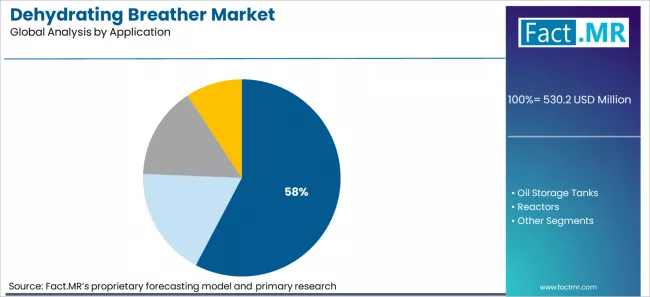
Dehydrating Breather Market Analysis By Application | Source: Fact.MR
- Market Overview: Transformers are expected to capture 57.7% of the market share by 2026. Dehydrating breathers are critical in transformers, where moisture control is necessary to prevent oil degradation, corrosion, and short circuits. Silica gel-based breathers are particularly effective in transformers as they help maintain the quality of insulating oil and extend the life of the transformer.
- Demand Drivers:
- Moisture Control in Transformers: In transformers, moisture can significantly reduce the lifespan and performance of the insulating oil, leading to equipment failures. Dehydrating breathers, especially those using silica gel, are essential for maintaining oil quality and preventing moisture-related damage.
- Regulatory and Safety Requirements: With the growing demand for reliable and efficient electrical infrastructure, regulations and industry standards are increasing the need for moisture control in transformers and other electrical equipment, further driving the adoption of dehydrating breathers.
- Increasing Demand for Electricity: As global electricity demand increases and electrical grids expand, the need for transformers and other equipment that maintain their integrity under various environmental conditions grows. Dehydrating breathers are essential in ensuring that these assets remain functional and reliable.
Dehydrating Breather Market Drivers, Restraints, and Opportunities
FMR analysts observe that the dehydrating breather market is a mature, performance‑driven segment tied to the need for moisture and particulate control in rotating equipment and fluid reservoirs. Historically, simple breathers offered basic filtration; rising concerns about water ingress and contamination in gearboxes and hydraulics drove demand for dehydrating breathers that combine desiccants with filtration. The 2026 valuation reflects steady demand from industrial and mobile equipment where fluid life and component protection are priorities.
While basic breathers remain common in cost‑sensitive applications, advanced dehydrating units with higher moisture capacity are gaining share. These higher‑value products support net market value growth as maintenance best practices and equipment uptime expectations rise.
- Contamination Control Demand: Users adopt dehydrating breathers to reduce moisture and particulate ingress versus basic filters that offer limited protection.
- Maintenance Standards Pressure: Reliability programs push certified breathers that meet defined performance criteria.
- Regional Industrial Trends: In Asia‑Pacific and North America, strong industrial activity drives higher uptake of advanced solutions.
Regional Analysis
The market analysis covers key global regions, including East Asia, Western Europe, North America, and South Korea. It is segmented geographically, with specific market dynamics for each region. The full report provides a detailed market attractiveness analysis.
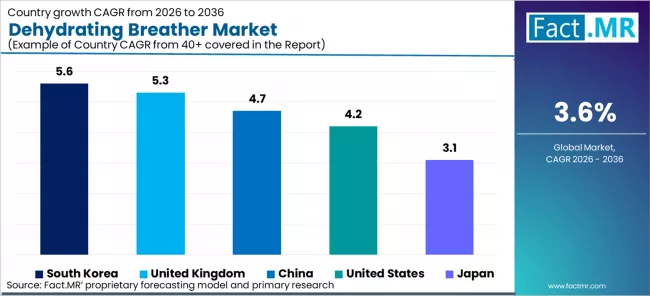
Dehydrating Breather Market Cagr Analysis By Country | Source: Fact.MR
| Country | CAGR (%) |
|---|---|
| South Korea | 5.6% |
| United Kingdom | 5.3% |
| China | 4.7% |
| United States | 4.2% |
| Japan | 3.1% |
Source: Fact.MR analysis. Updated Feb 24, 2026
Source: Fact MR (FMR) analysis, based on proprietary forecasting model and primary research.
East Asia:
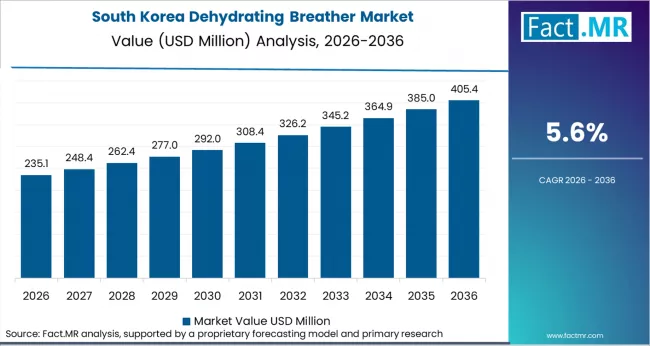
Dehydrating Breather Market Country Value Analysis | Source: Fact.MR
In East Asia, South Korea and China are the dominant markets for dehydrating breathers, driven by growing industrialization and the increasing need for efficient moisture control solutions.
- South Korea: Demand for dehydrating breathers in South Korea is projected to rise at 5.6% CAGR through 2036. South Korea’s industrial expansion and growing demand for moisture control in manufacturing continue to boost market growth.
- China: Demand for dehydrating breathers in China is projected to rise at 4.7% CAGR through 2036. China’s growing industrial base and need for reliable moisture management in equipment drive steady demand for dehydrating breathers.
Western Europe:
In Western Europe, the United Kingdom is a key market for dehydrating breathers, driven by the region’s strong industrial and manufacturing sectors.
- United Kingdom: Demand for dehydrating breathers in the UK is projected to rise at 5.3% CAGR through 2036. The UK’s expanding manufacturing sector and rising focus on equipment longevity and moisture control contribute to continued market growth.
North America:
In North America, the United States remains a key market for dehydrating breathers, supported by industrial applications across sectors such as energy, manufacturing, and transportation.
- United States: Demand for dehydrating breathers in the U.S. is projected to rise at 4.2% CAGR through 2036. The U.S. industrial sector’s expansion and increased demand for moisture control in heavy machinery continue to fuel market demand.
East Asia:
In Japan, demand for dehydrating breathers remains steady due to increasing automation and industrial growth across sectors such as energy and manufacturing.
- Japan: Demand for dehydrating breathers in Japan is projected to rise at 3.1% CAGR through 2036. Japan’s industrial development and focus on high-performance equipment support steady demand for moisture control products like dehydrating breathers.
Fact MR's analysis of the Dehydrating Breather Market in East Asia, Western Europe, North America, and South Korea consists of country-wise assessments that include South Korea, the United Kingdom, China, the United States, and Japan. Readers can find detailed trends, regulatory updates, and company-specific investments shaping the market’s growth in these countries.
How Are Key Players Competing in the Dehydrating Breather Market?
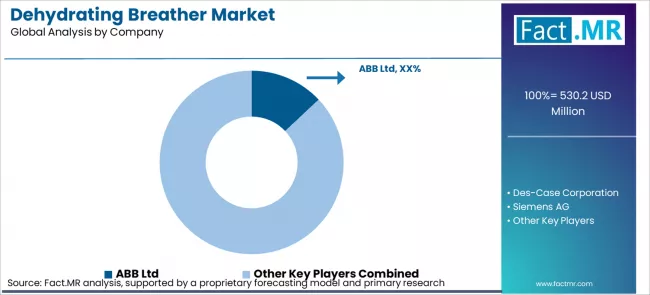
Dehydrating Breather Market Analysis By Company | Source: Fact.MR
In the dehydrating breather market, leading players such as ABB Ltd., Siemens AG, and Eaton Corporation plc differentiate themselves through advanced technology and high-performance products that enhance transformer longevity and reliability. These companies invest in developing breathers that efficiently remove moisture and particulate contaminants from electrical transformers, safeguarding sensitive equipment. Des-Case Corporation and Qualitrol Company LLC focus on specialized moisture control solutions for various industries, incorporating IoT and sensor technologies for real-time monitoring. Hubbell Incorporated and Maschinenfabrik Reinhausen GmbH maintain a strong market presence with breather designs aimed at energy efficiency and preventing transformer damage. Companies like DryKeep, Inc., Comem S.p.A., and Trench Group are expanding their offerings with high-quality, durable breathers for critical electrical infrastructure, providing tailored solutions that comply with industry standards.
Recent Industry Developments
- Hitachi Energy Massive Production Expansion (Corporate): In October 2025, Hitachi Energy announced a $9 billion global investment to expand its manufacturing and R&D for power grids, which follows a $1.5 billion commitment in April 2024 specifically to ramp up transformer production, directly increasing the primary demand for protective accessories like dehydrating breathers.
- Qualitrol Launch of Zero-Wire Smart Breathers (Corporate): In 2025, Qualitrol released the STB000 series, the first universal, maintenance-free smart breather featuring "zero exposed wires" and a pressure-sensor-driven pattern recognition algorithm that ensures the unit only regenerates desiccant during the transformer's "exhale" phase.
- IEEE Standards Board Maintenance & Commissioning Updates (Regulatory): In December 2025, the IEEE SA Standards Board approved an extension until December 31, 2026, for P841.2, the "Recommended Practice for On-Site Assembly, Commissioning, Operation and Maintenance of Prefabricated Transformer Zone Modules," which dictates the handling and maintenance standards for essential components like breathers in industrial facilities.
Key Players of the Dehydrating Breather Market
- ABB Ltd
- Des-Case Corporation
- Siemens AG
- Hubbell Incorporated
- Eaton Corporation plc
- Maschinenfabrik Reinhausen GmbH
- Qualitrol Company LLC
- DryKeep, Inc.
- Comem S.p.A. (Comem Group)
- Trench Group (Trench Ltd.)
Report Scope
| Metric | Value |
|---|---|
| Quantitative Units | USD 530.2 million (2026) to USD 739.8 million (2036), at a CAGR of 3.8% |
| Market Definition | The Dehydrating Breather Market includes devices used to remove moisture from electrical equipment like transformers, oil storage tanks, and reactors, ensuring protection from contamination and extending equipment life. |
| By Type | Silica Gel, Activated Carbon, Molecular Sieves, Other Materials |
| By Application | Transformers, Oil Storage Tanks, Reactors, Other Electrical Equipment |
| By End-Use Industry | Power Generation, Transmission and Distribution, Manufacturing and Processing, Renewable Energy, Oil and Gas, Other End-User Industries |
| Regions Covered | North America, Latin America, Europe, East Asia, South Asia, Oceania, Middle East and Africa |
| Countries Covered | United States, Canada, Mexico, Brazil, Argentina, Germany, France, United Kingdom, Italy, Spain, China, India, Japan, South Korea, Indonesia, Australia, and 40+ countries |
| Key Companies Profiled | ABB Ltd, Des-Case Corporation, Siemens AG, Hubbell Incorporated, Eaton Corporation plc, Maschinenfabrik Reinhausen GmbH, Qualitrol Company LLC, DryKeep, Inc., Comem S.p.A. (Comem Group), Trench Group (Trench Ltd.) |
| Forecast Period | 2026 to 2036 |
| Approach | Hybrid top-down and bottom-up market modeling validated through primary interviews with manufacturers and supported by trade data benchmarking and market research. |
Source: Fact.MR analysis. Updated Feb 24, 2026
Bibliographies
- Maschinenfabrik Reinhausen GmbH. (2025, November 1). MESSKO® MTRAB® 2.5 dehydrating breather: Maintenance-free transformer moisture control technology [Product announcement]. Maschinenfabrik Reinhausen GmbH.
- ABB Ltd. (2025). Moisture control and dehydrating breather solutions for transformer and industrial equipment applications. ABB Ltd.
- Hitachi Energy Ltd. (2025, October). Hitachi Energy announces global investment of up to $9 billion to expand power grid manufacturing and R&D capacity [Press release]. Hitachi Energy Ltd.
- Qualitrol Company LLC. (2025). Qualitrol introduces STB000 series maintenance-free smart breather technology [Product launch]. Qualitrol Company LLC.
- IEEE Standards Association. (2025, December 10). Approval of extension for IEEE P841.2: Transformer zone modules commissioning and maintenance guidance [Standards board action]. IEEE Standards Association.
This report addresses
- Market intelligence enabling comprehensive assessment of leading countries and product segments across the Dehydrating Breather Market globally.
- Market volume (sales units) estimates and 10-year revenue forecasts from 2026 to 2036, validated through manufacturer shipment data, channel partner surveys, and country-level demand modeling.
- Growth opportunity mapping across dehydrating breather types (Silica Gel, Activated Carbon, Molecular Sieves, and Other Materials), applications (Transformers, Oil Storage Tanks, Reactors, and Other Electrical Equipment), and end-user industries (Power Generation, Transmission and Distribution, Manufacturing and Processing, Renewable Energy, Oil and Gas, and Other End-User Industries).
- Segment and regional revenue forecasts by breather type, application, end-user industry, and geography across 40+ countries.
- Competition strategy analysis covering dealer network structure, recent developments, product portfolio, USPs, and market share analysis.
- Product and regulatory compliance tracking aligned with industry-specific moisture control standards and equipment longevity requirements.
- Regulatory impact analysis addressing contamination control mandates, environmental regulations, and industrial equipment protection standards across key markets.
- Report delivery in PDF, Excel, PowerPoint, and interactive dashboard formats for executive, procurement, and operational planning use.
Segmentation
Dehydrating Breather Market Key Segments
-
Type :
- Silica Gel
- Activated Carbon
- Molecular Sieves
- Other Materials
-
Application :
- Transformers
- Oil Storage Tanks
- Reactors
- Other Electrical Equipment
-
End-Use Industry :
- Power Generation
- Transmission and Distribution
- Manufacturing and Processing
- Renewable Energy
- Oil and Gas
- Other End-User Industries
-
Region :
- North America
- USA
- Canada
- Mexico
- Europe
- Germany
- UK
- France
- Italy
- Spain
- Nordic Countries
- BENELUX
- Rest of Europe
- Asia Pacific
- China
- Japan
- South Korea
- India
- Australia
- Rest of Asia Pacific
- Latin America
- Brazil
- Argentina
- Rest of Latin America
- Middle East and Africa
- Kingdom of Saudi Arabia
- United Arab Emirates
- South Africa
- Rest of Middle East and Africa
- Other Regions
- Oceania
- Central Asia
- Other Markets
- North America
Frequently Asked Questions
How large is the demand for Dehydrating Breathers in the global market in 2026?
What will be the market size of Dehydrating Breathers in the global market by 2036?
What is the expected demand growth for Dehydrating Breathers in the global market between 2026 and 2036?
Which type of dehydrating breather is expected to dominate the market?
Which region is expected to show the highest growth rate for Dehydrating Breathers?
How significant is the growth outlook for the United Kingdom in this market?
What is the growth outlook for China in this report?
What is the growth forecast for the United States in the Dehydrating Breathers market?
What is the growth forecast for Japan in the Dehydrating Breathers market?
Which company is identified as a leading player in the Dehydrating Breathers market?
What are Dehydrating Breathers used for?
What does the Dehydrating Breathers market include in this report?
How is the market forecast developed in this report?
What is meant by the Dehydrating Breathers market in this report?
Who worked on this report


Preview the report firsthand - request a free sample
Free SampleGet the brochure for pricing and purchase details
Download PDF