- Market Value (2025): USD 695.8 Mn
- Estimated Value (2026): USD 752.0 Mn
- Forecast Value (2036): USD 1634.0 Mn
- CAGR (2026-2036): 8.1%
What is the Dental Zirconium Materials Market forecast to be worth by 2036?
USD 752.0 million in 2026 to USD 1,634.0 million by 2036 at an 8.1% CAGR.
- Dental zirconium materials revenue totalled USD 695.8 million in 2025, with laboratory orders for milling blanks providing most of that base.
- Value will grow from USD 752.0 million in 2026 to USD 1,634.0 million by 2036 as monolithic zirconia crowns and bridges replace metal-ceramic work in more cases.
- An 8.1% CAGR reflects steady gains in restoration volume plus a shift toward premium multilayer and fast-sintering grades that carry higher prices per unit.
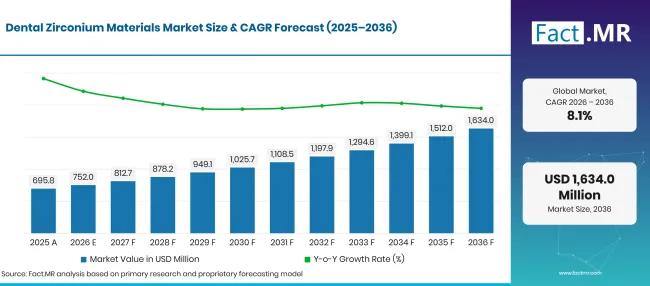
Dental Zirconium Materials Market Forecast Global | Source: Fact.MR
| Year | Basis | Market Value (USD million) |
|---|---|---|
| 2025 | Actual | 695.8 |
| 2026 | Estimate | 752.0 |
| 2036 | Forecast | 1,634.0 |
| CAGR 2026 to 2036 | Forecast period | 8.1% |
Source: Fact.MR analysis. Updated Nov 4, 2026
What are the defining numbers behind Dental Zirconium Materials Market growth?
The 2026 to 2036 period adds USD 882.0 million in new value, with crown production in digital laboratories accounting for most of the gain.
- Demand Drivers in the Market
- Tooth loss creates a large, ageing patient pool for fixed and removable restorations. The World Health Organization estimates that oral diseases affect nearly 3.7 billion people, and that complete tooth loss reaches 23% among people aged 60 or older [1]. Each lost or damaged tooth is a potential crown, bridge or implant case for a laboratory.
- Gradient zirconia is widening the range of cases a single blank can serve. The US Food and Drug Administration cleared VITA YZ Multi Translucent through a 510(k) decision dated 21 February 2025 [2]. Grades of this kind let technicians mill anterior and posterior crowns from the same disc, which simplifies stock and lowers waste.
- Faster sintering is bringing zirconia into single-visit dentistry. Ivoclar states that its IPS e.max ZirCAD Prime block can be sintered in 15 minutes under its test conditions, with a dentin flexural strength of 1,100 MPa [3]. Clinics can now offer a same-day zirconia crown, a service once limited to glass ceramics.
- Laboratory digitization keeps demand for milling blanks rising. Scanners, design software and five-axis mills have become standard equipment in mid-sized labs, and every new mill installed creates a recurring order for blocks and discs.
- Key Segments Analyzed
- By Product Type: Zirconium Blocks will hold 38.5% in 2026, as chairside mills and small lab units work from pre-shaped blocks sized for single crowns.
- By Application: Crowns will account for 54.2% of 2026 revenue, since single-tooth restorations form the bulk of everyday restorative work.
- By End-User: Dental Laboratories will capture 67.4% of 2026 value, given that design, milling, sintering and finishing are concentrated in lab workshops.
- Analyst Opinion at Fact.MR
- Shambhu Nath Jha, Principal Consultant at Fact.MR, states, “Zirconia has moved from a framework material hidden under porcelain to the visible surface of the restoration, and that shift will keep lifting the value of every blank sold. Laboratories will reward suppliers whose discs mill cleanly, sinter predictably and match shade guides without rework. Over the next ten years, the gap between commodity white zirconia and premium multilayer grades will widen, and pricing power will follow translucency and speed.”
- Strategic Implications
- Manufacturers should publish validated milling and sintering parameters for the leading CAD/CAM systems, because labs judge a new disc mainly by how little adjustment it needs.
- Distributors should bundle zirconia blanks with sintering furnaces, burs and stains for labs that are buying their first mill, since those labs lock in a supplier early.
- Dental laboratories should standardize on a small number of multilayer grades that cover both anterior and posterior cases, which cuts inventory and shade errors.
- Investors should look at producers with in-house powder processing, as control over powder purity and particle size sets the ceiling on translucency and batch consistency.
Japan will lead the comparison at 9.6%, helped by a public fee schedule that already pays for CAD/CAM crowns and keeps lab milling capacity busy. The United Kingdom follows at 8.9%, where a high volume of NHS treatment courses sustains crown and bridge work. The United States will grow at 7.9% as a shrinking technician workforce pushes labs toward automated milling. Germany, at 6.4%, starts from a mature prosthetics base with flat claim volumes, so growth comes from replacing older materials. Brazil closes the range at 5.8%, with public digital prosthesis programs still at an early stage of rollout.
How does the Dental Zirconium Materials Market break down by segment?
Zirconium Blocks will lead Product Type at 38.5%; Crowns will head Application at 54.2%; Dental Laboratories will hold End-User at 67.4% in 2026.
Which Product Type leads?
Zirconium Blocks take 38.5% of 2026 sales.
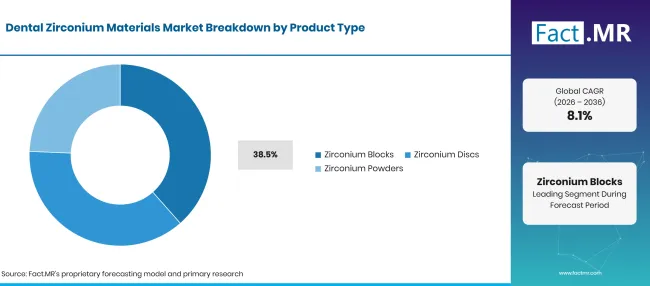
Dental Zirconium Materials Market Breakdown Product Type | Source: Fact.MR
| Product Type | Share (2026) |
|---|---|
| Zirconium Blocks (Leading segment) | 38.5% |
| Other segments combined | 61.5%* |
| Total | 100.0% |
Source: Fact.MR analysis. Updated Nov 4, 2026
Chairside mills and compact lab units are built around blocks, which arrive pre-sized and mounted for a single crown or short bridge. That format suits the same-day workflows now spreading through clinics with intraoral scanners and in-office milling units. Blocks also reduce the risk of wasted material when a lab cuts only one or two units per job. Discs serve high-volume labs that nest many crowns and bridges in one blank, and they carry the multilayer gradients used for long-span work. Powders feed blank producers, injection molding and research into printable zirconia, a field linked to the wider dental 3D printing segment.
What supports Crowns within Application?
Crowns represent 54.2% of 2026 revenue.
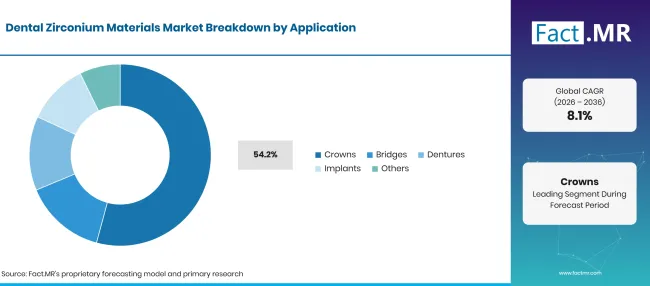
Dental Zirconium Materials Market Breakdown Application | Source: Fact.MR
| Application | Share (2026) |
|---|---|
| Crowns (Leading segment) | 54.2% |
| Other segments combined | 45.8%* |
| Total | 100.0% |
Source: Fact.MR analysis. Updated Nov 4, 2026
A crown is the most frequent indirect restoration in general practice, and monolithic zirconia now covers molars, premolars and many anterior cases. Its strength allows thin walls, which preserves more tooth structure than metal-ceramic designs. Patients asking for metal-free work, often as part of cosmetic dentistry plans, add further volume. Bridges use the same discs but in smaller numbers, while zirconia frameworks for dentures and implant bars are a growing niche in full-arch cases. Implant abutments and one-piece ceramic implants form the implant segment, which links to the dental implant abutment systems category.
How does End-User shape demand?
Dental Laboratories account for 67.4% of 2026 value.
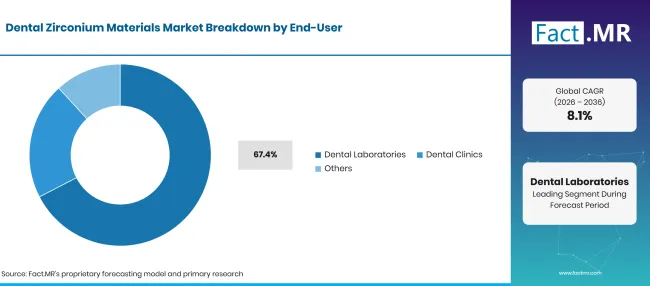
Dental Zirconium Materials Market Breakdown End User | Source: Fact.MR
| End-User | Share (2026) |
|---|---|
| Dental Laboratories (Leading segment) | 67.4% |
| Other segments combined | 32.6%* |
| Total | 100.0% |
Source: Fact.MR analysis. Updated Nov 4, 2026
Most restorations still pass through a lab where technicians design, nest, mill, sinter, stain and glaze the final piece. Labs choose zirconia on shrinkage accuracy, color stability after sintering and how cleanly a disc machines at fine margins. They also carry the widest product range, from high-strength frameworks to translucent anterior grades. Clinics with chairside equipment buy blocks directly and are the source of most new block demand. Other buyers include in-house milling centers at dental service organizations and contract producers of dental prosthetics, whose orders depend on production capacity and case mix.
What is accelerating Dental Zirconium Materials Market adoption, and what is holding it back?
Growth comes from more crowns and bridges being made digitally and from zirconia replacing metal-ceramic and some glass-ceramic work. Gradient grades and faster sintering open new indications each year. Against this, mills and furnaces cost a lot for small labs, lithium disilicate still wins many anterior cases on aesthetics, and poor sintering control can lead to fractures and remakes.
Drivers Impact Analysis
| DRIVER | (~) % IMPACT ON CAGR | GEOGRAPHIC RELEVANCE | IMPACT TIMELINE |
|---|---|---|---|
| DRIVER | (~) % IMPACT ON CAGR | GEOGRAPHIC RELEVANCE | IMPACT TIMELINE |
| Wider use of monolithic zirconia in crowns and fixed restorations | +1.6% | Global | Short term (<=2 years) |
| Spread of CAD/CAM milling across dental laboratories | +1.2% | Western Europe, North America, East Asia | Medium term (2-4 years) |
| Multilayer zirconia with improved translucency | +0.9% | Western Europe, East Asia, North America | Medium term (2-4 years) |
| Ageing populations and growing need for fixed restorations | +0.7% | Global | Long term (>=4 years) |
Source: Fact.MR analysis. Updated Nov 4, 2026
Opportunity Impact Analysis
| OPPORTUNITY | (~) % IMPACT ON CAGR | GEOGRAPHIC RELEVANCE | IMPACT TIMELINE |
|---|---|---|---|
| OPPORTUNITY | (~) % IMPACT ON CAGR | GEOGRAPHIC RELEVANCE | IMPACT TIMELINE |
| Fast-sintering blocks for same-day chairside crowns | +0.9% | North America, Western Europe, East Asia | Short term (<=2 years) |
| New digital milling facilities in mid-sized laboratories | +0.7% | South Asia & Pacific, Western Europe, North America | Medium term (2-4 years) |
| Zirconia for implant abutments and full-arch frameworks | +0.5% | Global | Medium term (2-4 years) |
| Public digital prosthesis programs in emerging markets | +0.4% | Latin America, South Asia & Pacific | Long term (>=4 years) |
Source: Fact.MR analysis. Updated Nov 4, 2026
Restraints Impact Analysis
| RESTRAINT | (~) % IMPACT ON CAGR | GEOGRAPHIC RELEVANCE | IMPACT TIMELINE |
|---|---|---|---|
| RESTRAINT | (~) % IMPACT ON CAGR | GEOGRAPHIC RELEVANCE | IMPACT TIMELINE |
| High cost of CAD/CAM mills and sintering furnaces | -0.6% | Global | Short term (<=2 years) |
| Competition from lithium disilicate and other glass ceramics | -0.4% | Global | Short term (<=2 years) |
| Technical demands of milling, sintering and shade control | -0.3% | Global | Medium term (2-4 years) |
| Uneven performance across zirconia grades and indications | -0.2% | Global | Long term (>=4 years) |
Source: Fact.MR analysis. Updated Nov 4, 2026
Which countries are scaling the Dental Zirconium Materials Market through 2036?
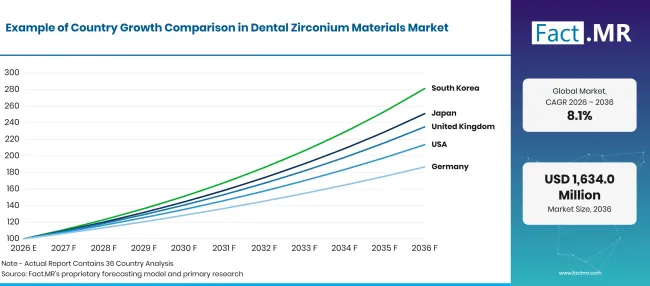
Dental Zirconium Materials Market Growth Index | Source: Fact.MR
| Country | CAGR (2026 to 2036) |
|---|---|
| Japan | 9.6% |
| United Kingdom | 8.9% |
| United States | 7.9% |
| Germany | 6.4% |
| Brazil | 5.8% |
Source: Fact.MR analysis. Updated Nov 4, 2026
What puts Japan at the front of the comparison?
9.6% CAGR, helped by insured CAD/CAM crowns and a deep base of domestic dental material makers.
Japan’s Ministry of Health, Labour and Welfare lists CAD/CAM crowns in its national dental fee schedule, at 388 points for an anterior tooth and up to 615 points for a molar, under a notice that took effect on 1 March 2026 [4]. An earlier notice of 28 November 2025 carried the same crown entries from 1 December 2025 [5]. Insured CAD/CAM work keeps scanners and mills in steady use in Japanese labs, and the same equipment produces self-pay zirconia crowns and bridges.
How is the United Kingdom developing demand?
8.9% CAGR, as NHS treatment volumes recover and private practices add digital crown work.
The NHS Business Services Authority reports 35 million courses of NHS dental treatment in England in 2024/25, 4% more than a year earlier, delivered by 24,655 dentists with NHS activity [6]. Labs serving both NHS and private work are moving to milled zirconia to control cost per unit.
What is supporting United States adoption?
7.9% CAGR, driven by labour shortages that push laboratories toward automated milling.
The US Bureau of Labor Statistics counts 34,400 dental laboratory technician jobs in 2025 and projects a 6% decline in that workforce from 2025 to 2035 [7]. With fewer technicians, labs rely more on nested milling of zirconia discs and on design software to keep output steady. Large dental service organizations are also bringing milling in-house, which adds block demand.
How is Germany developing demand?
6.4% CAGR, reflecting a mature prosthetics market where zirconia gains share from older materials.
Statutory insurers in Germany settled 7.67 million prosthetic treatment cases in 2024, 0.8% fewer than in 2023, according to the KZBV statistical yearbook [8]. Flat case numbers mean growth depends on material choice, and labs keep moving from metal-ceramic and cast work to monolithic and multilayer zirconia. A dense network of master technician labs supports early uptake of new grades.
How is Brazil scaling demand?
5.8% CAGR, as public digital prosthesis programs reach more municipalities.
Brazil’s Ministry of Health is delivering 500 digital prosthesis kits, each with an intraoral scanner and 3D printers, to 409 municipalities, and 316 municipalities had received equipment by September 2026 [9]. A 2026 technical note set new rules for recording production at specialised dental centers and regional prosthesis laboratories [10]. Most public work today is removable dentures, so zirconia gains first in the private crown segment.
Who leads the Dental Zirconium Materials Market?
Competition falls into three groups. Full-line dental companies, namely Dentsply Sirona, Ivoclar, Solventum and Straumann Group, sell zirconia alongside cements, scanners, implants or chairside systems, so they compete on workflow fit as much as on material. Ivoclar showed this in March 2025 with a block that sinters in 15 minutes in its own Programat furnace [3].
Material specialists, including Kuraray Noritake Dental, VITA Zahnfabrik and Zirkonzahn, compete on translucency, shade accuracy and processing guidance; Kuraray Noritake keeps publishing lab case reports on its KATANA Zirconia YML discs, the latest in September 2026 [11]. System suppliers such as Amann Girrbach tie their own zirconia to their mills and software, and in September 2026 the company highlighted a 10-year warranty on Zolid restorations made to its guidelines [12]. Over the forecast period, buyers will favour suppliers that can prove consistent batches, short sintering cycles and validated parameters for common mills.
Which companies are the key providers?
Key companies in the Dental Zirconium Materials Market include Dentsply Sirona, Ivoclar, Solventum, Kuraray Noritake Dental, Straumann Group, Zirkonzahn, Amann Girrbach and VITA Zahnfabrik.
- Dentsply Sirona
- Ivoclar
- Solventum
- Kuraray Noritake Dental
- Straumann Group
- Zirkonzahn
- Amann Girrbach
- VITA Zahnfabrik
Bibliography
- [1] World Health Organization. (2025, March 17). Oral health.
- [2] US Food and Drug Administration. (2025, February 21). 510(k) Premarket Notification K243940: VITA YZ Multi Translucent.
- [3] Ivoclar. (2025, March 24). Ivoclar presents the new IPS e.max ZirCAD Prime block: The next level of speed and strength.
- [4] Ministry of Health, Labour and Welfare. (2026, February 27)
- [5] Ministry of Health, Labour and Welfare. (2025, November 28)
- [6] NHS Business Services Authority. (2025, August 28). Dental statistics: England 2024/25.
- [7] US Bureau of Labor Statistics. (2026, August 27). Dental and Ophthalmic Laboratory Technicians and Medical Appliance Technicians.
- [8] Kassenzahnärztliche Bundesvereinigung. (2026, March 17). Statistisches Jahrbuch 2025: Abgerechnete Behandlungsfälle und BEMA-Punkte.
- [9] Ministério da Saúde. (2026, September 28). SUS prepara dentistas e técnicos para os novos equipamentos digitais que produzem próteses.
- [10] Ministério da Saúde. (2026, March 18). Nota Técnica nº 32/2026-CGSB/DESF/SAPS/MS.
- [11] Kuraray Noritake Dental. (2026, September 16). Partial veneering on zirconia: minimal layers, maximum aesthetics.
- [12] Amann Girrbach. (2026, September 9). Did you know? A 10-year warranty on Zolid restorations!.
This Report Answers
- How much revenue do zirconium blocks, discs and powders generate, and how will the mix change through 2036?
- Why do chairside clinics prefer blocks while high-volume labs buy discs?
- What share of zirconia demand comes from crowns, and how fast are bridges, dentures and implant work growing?
- How are dental laboratories changing their material choices as technician numbers fall?
- Which of Japan, the United Kingdom, the United States, Germany and Brazil offers the best growth, and what explains the gaps?
- Where do full-line dental groups, material specialists and system suppliers each hold an edge?
What does the Dental Zirconium Materials Market cover?
This report values yttria-stabilized zirconia sold for dental use in block, disc and powder form, at the price paid by laboratories, clinics and other buyers. It counts all translucency classes, from high-strength 3Y frameworks to 5Y and multilayer anterior grades.
Revenue is tracked by product form, by the restoration the material ends up in and by the buyer that processes it. Country estimates follow the same definitions.
What is included in the scope?
Pre-shaded and white zirconia blocks for chairside and lab mills.
Monolayer and multilayer zirconia discs for crowns, bridges, frameworks and full-arch work. Zirconia powders sold for blank pressing, molding and printable dental formulations. Zirconia blanks used to mill implant abutments and denture frameworks.
What is excluded from the scope?
Lithium disilicate, feldspathic ceramics, composites, PMMA and metal alloys, which compete with zirconia but are valued in other dental consumables reports.
Finished crowns, bridges and implants sold as complete devices, beyond the value of the zirconia inside them.
Mills, sintering furnaces, scanners and design software.
Clinical fees and laboratory service charges.
How Was the Analysis Built?
The analysis draws on 120+ sources, 35+ company portfolios, 25+ countries, and more than 20 industry interviews.
- Primary Research: Primary research includes discussions with manufacturers, service providers, technology developers, distributors, end users, and subject-matter experts. These conversations examine purchasing priorities, product adoption, operational challenges, approval requirements, competitive positioning, and the factors that influence wider market acceptance.
- Desk Research: Desk research covers government statistics, regulatory publications, company filings, trade data, technical studies, industry associations, standards, public policy, and other authoritative sources. Every source used in the analysis is documented in the bibliography.
- Market Sizing and Forecasting: Market estimates combine historical performance, demand indicators, pricing and volume trends, segment shares, company participation, country-level growth, adoption patterns, investment activity, and barriers to market expansion.
- Data Validation and Update Cycle: Findings are validated by comparing primary interviews with public data, company activity, regulatory changes, trade patterns, and industry developments. Regular updates review new product launches, capacity changes, partnerships, approvals, and shifts in commercial adoption.
Segmentation
What is the report’s scope and coverage?
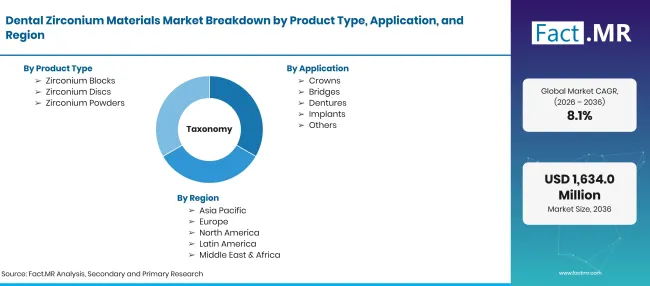
Dental Zirconium Materials Market Taxonomy | Source: Fact.MR
| Attribute | Details |
|---|---|
| Quantitative Units | USD million |
| Market Definition | Zirconia-based materials in block, disc and powder form used to produce crowns, bridges, dentures, implant components and other dental restorations. |
| Product Type | Zirconium Blocks; Zirconium Discs; Zirconium Powders |
| Application | Crowns; Bridges; Dentures; Implants; Others |
| End-User | Dental Laboratories; Dental Clinics; Others |
| Regions Covered | North America; Latin America; Western Europe; Eastern Europe; East Asia; South Asia & Pacific; Middle East & Africa |
| Countries Covered | Japan; United Kingdom; United States; Germany; Brazil |
| Companies Profiled | Dentsply Sirona; Ivoclar; Solventum; Kuraray Noritake Dental; Straumann Group; Zirkonzahn; Amann Girrbach; VITA Zahnfabrik |
| Forecast Period | 2026 to 2036 |
| Approach | Restoration volumes by application and country, combined with blank consumption per unit and prevailing material prices, checked against supplier portfolios. |
Source: Fact.MR analysis. Updated Nov 4, 2026
How is the market segmented?
-
By Product Type
- Zirconium Blocks
- Zirconium Discs
- Zirconium Powders
-
By Application
- Crowns
- Bridges
- Dentures
- Implants
- Others
-
By End-User
- Dental Laboratories
- Dental Clinics
- Others
-
By Region
- North America
- Latin America
- Western Europe
- Eastern Europe
- East Asia
- South Asia & Pacific
- Middle East & Africa
Frequently Asked Questions
How large is the dental zirconium materials market in 2026?
What growth rate will the dental zirconium materials market record?
Which product type leads?
Which application leads?
Which end-user leads?
Which country will grow quickest?
Who are the main companies?
What holds the market back?
Who worked on this report


Preview the report firsthand - request a free sample
Free SampleGet the brochure for pricing and purchase details
Download PDF