- Market Value (2025): USD 7.8 Bn
- Estimated Value (2026): USD 8.21 Bn
- Forecast Value (2036): USD 13.6 Bn
- CAGR (2026-2036): 5.2%
What is the Dermatophytosis Treatment Market forecast to be worth by 2036?
USD 8.2 billion in 2026 to USD 13.6 billion by 2036 at a 5.2% CAGR.
- The dermatophytosis treatment market was valued at USD 7.8 billion in 2025, with over-the-counter creams for athlete’s foot, jock itch and body ringworm carrying the bulk of unit volume.
- Revenue will expand from USD 8.21 billion in 2026 to USD 13.6 billion by 2036 as topical self-care stays routine and nail and scalp cases keep oral antifungals in steady prescription use.
- A 5.2% CAGR reflects a mature, off-patent drug class whose value grows through treated patient numbers and newer nail formulations, not through price.
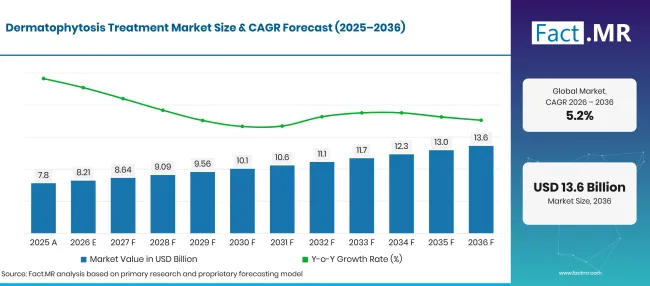
Dermatophytosis Treatment Market Forecast Global | Source: Fact.MR
| Year | Basis | Market Value (USD billion) |
|---|---|---|
| 2025 | Actual | 7.8 |
| 2026 | Estimate | 8.21 |
| 2036 | Forecast | 13.6 |
| CAGR 2026 to 2036 | Forecast period | 5.2% |
Source: Fact.MR analysis. Updated Nov 9, 2026
What are the defining numbers behind Dermatophytosis Treatment Market growth?
The 2026 to 2036 period adds USD 5.4 billion in new value, led by pharmacy-sold topical antifungals used at home.
- Demand Drivers in the Market
- Fungal skin infection is one of the most widespread conditions in primary care. WHO’s June 2025 fact sheet says fungal skin infections affect more than 650 million people at any time, and that in some countries more than 25% of children under 10 have scalp ringworm [1].
- Nail infection creates a long, repeat treatment need. CDC’s clinical overview, updated in April 2026, estimates that onychomycosis affects about 14% of the general population and is especially common in older adults [2].
- Treatment rules split demand cleanly between routes. CDC guidance updated in February 2026 states that skin ringworm usually clears with non-prescription creams, lotions or powders used for 2 to 4 weeks, while scalp ringworm needs a prescription oral antifungal for 1 to 3 months [3].
- Emerging strains are adding diagnostic and second-line demand. CDC reported in October 2026 that Trichophyton indotineae is one of three emerging ringworm types seen in the United States and may not respond to typical antifungal drugs [4]. Its clinician brief adds that terbinafine-resistant Trichophyton rubrum cases are increasingly reported [5].
- Key Segments Analyzed
- By Drug Type: Antifungal Creams will capture 38.5% of 2026 revenue, since a single tube treats most foot, groin and body infections without a prescription.
- By Route of Administration: Topical will account for 62.3% of 2026 value, given that guidance places creams, sprays and powders first for skin ringworm.
- By Distribution Channel: Retail Pharmacies will hold 41.2% of 2026 sales, as most patients buy their first treatment at a local counter.
- By End-User: Homecare Settings will represent 64.5% of 2026 demand, owing to the self-applied nature of most skin treatment.
- Analyst Opinion at Fact.MR
- Shambhu Nath Jha, Principal Consultant at Fact.MR, states, “Ringworm is common enough that most treatment will keep starting with a pharmacy cream and a few weeks of home use. The commercial change through 2036 will come at the harder end, where nail disease and terbinafine-resistant strains push patients toward testing, longer courses and newer topical solutions. Suppliers that combine trusted self-care brands with prescription nail and scalp options will be best placed as clinicians ask for proof of cure, not only symptom relief.”
- Strategic Implications
- Manufacturers should invest in nail and scalp formulations with simpler dosing, because these infections need months of therapy and poor adherence is the usual reason for relapse.
- Pharmacy chains should train counter staff to spot scalp, nail and widespread cases that need referral, since self-care products do not reach the scalp and steroid creams can worsen ringworm.
- Clinicians and health systems should widen access to culture and susceptibility testing, so that infections failing terbinafine are identified early and switched to suitable agents.
- Investors should look at companies holding both consumer antifungal brands and prescription nail products, where brand trust and regulatory approvals protect margins in an off-patent class.
Germany will lead the five-country view at 6.0%, where an older population and strong dermatology coverage bring more nail cases into treatment. Brazil follows at 5.5% as a hot, humid climate and expanding pharmacy access lift purchase of topical products. The United States will grow at 4.9%, a pace held back by deep generic and store-brand pricing even as resistant strains add specialist workups. The United Kingdom, at 4.4%, leans on community pharmacy self-care with growing laboratory referrals for hard cases. Japan closes the group at 3.9%, where a mature market for nail and foot products grows mainly with its ageing population.
How does the Dermatophytosis Treatment Market break down by segment?
Antifungal Creams will lead Drug Type at 38.5%; Topical will head Route of Administration at 62.3%; Retail Pharmacies will top Distribution Channel at 41.2%; Homecare Settings will hold End-User at 64.5% in 2026.
Which Drug Type leads?
Antifungal Creams hold 38.5% of 2026 sales.
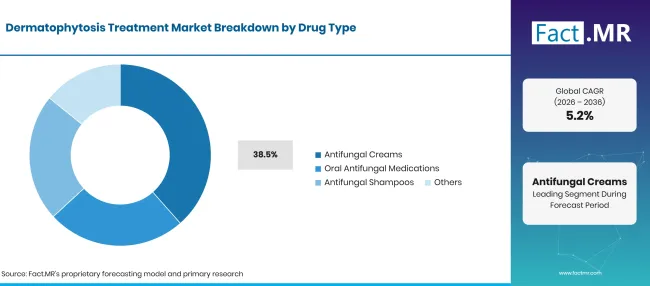
Dermatophytosis Treatment Market Breakdown Drug Type | Source: Fact.MR
| Drug Type | Share (2026) |
|---|---|
| Antifungal Creams (Leading segment) | 38.5% |
| Other segments combined | 61.5%* |
| Total | 100.0% |
Source: Fact.MR analysis. Updated Nov 9, 2026
Foot, groin and body ringworm are usually treated first with a terbinafine or azole cream. These products are cheap, widely stocked and familiar to patients, so they win the first purchase in most episodes. Branded lines share the shelf with store brands, which keeps unit prices low. Oral antifungal medications such as terbinafine and itraconazole tablets serve scalp, nail and extensive infections, and they carry higher value per course. Antifungal shampoos support scalp treatment and help limit spread within households. Other formats include nail lacquers, sprays and powders. Many of these overlap with the wider antifungal drugs category, which also covers invasive and vaginal infections.
What supports Topical within Route of Administration?
Topical takes 62.3% of 2026 revenue.
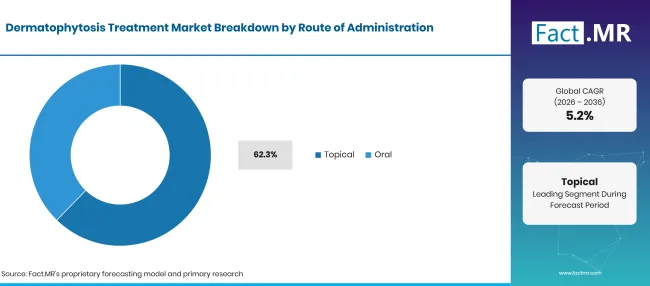
Dermatophytosis Treatment Market Breakdown Route Of Administration | Source: Fact.MR
| Route of Administration | Share (2026) |
|---|---|
| Topical (Leading segment) | 62.3% |
| Other segments combined | 37.7%* |
| Total | 100.0% |
Source: Fact.MR analysis. Updated Nov 9, 2026
Treatzent guidance places skin ringworm firmly in the topical group, and most patients finish therapy without seeing a doctor. Creams and sprays act where the infection is and avoid the liver monitoring that some tablets need. Nail solutions and lacquers extend the topical route into onychomycosis, where long application periods raise the value of each patient. The oral route covers infections that topical products cannot reach, including the scalp and thick or many affected nails. New options for hard cases remain few. WHO’s April 2025 review of antifungal agents in clinical and preclinical development analysed the pipeline and called for new treatments for drug-resistant fungal disease [6]. Until such agents arrive, oral terbinafine and itraconazole will keep their role in second-line care.
What leads the Distribution Channel segment?
Retail Pharmacies account for 41.2% of 2026 sales.
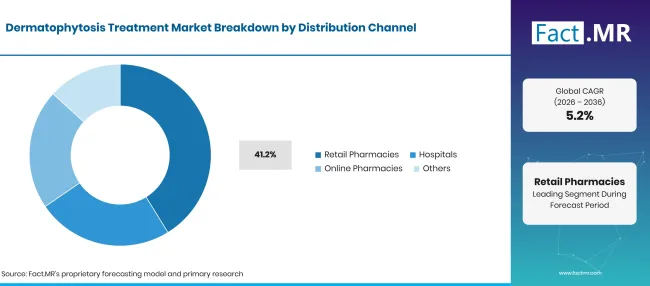
Dermatophytosis Treatment Market Breakdown Distribution Channel | Source: Fact.MR
| Distribution Channel | Share (2026) |
|---|---|
| Retail Pharmacies (Leading segment) | 41.2% |
| Other segments combined | 58.8%* |
| Total | 100.0% |
Source: Fact.MR analysis. Updated Nov 9, 2026
A typical patient notices an itchy, scaling patch, goes to a nearby pharmacy and leaves with a cream or powder the same day. Pharmacists guide product choice, explain the need to keep applying after symptoms fade and refer cases with scalp or nail involvement. This counter role gives community and chain pharmacies the first contact with most patients. Hospitals dispense oral therapy for complicated or resistant infections and for patients under specialist follow-up. Online pharmacies are growing through home delivery and repeat orders of self-care products, while prescription rules still apply to tablets. Other channels include supermarkets and drugstores that stock store-brand azole creams.
How does End-User shape demand?
Homecare Settings represent 64.5% of 2026 value.
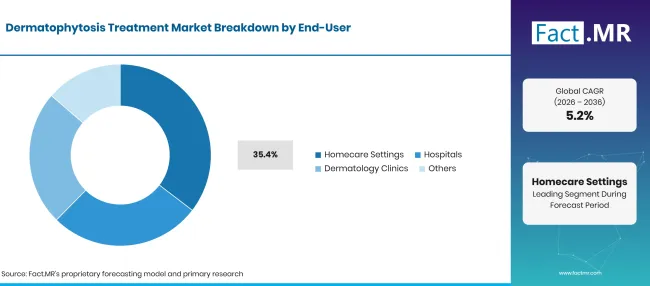
Dermatophytosis Treatment Market Breakdown End User | Source: Fact.MR
| End-User | Share (2026) |
|---|---|
| Homecare Settings (Leading segment) | 64.5% |
| Other segments combined | 35.5%* |
| Total | 100.0% |
Source: Fact.MR analysis. Updated Nov 9, 2026
Most ringworm is treated by patients themselves, who apply a cream or spray for several weeks and wash bedding and towels to stop reinfection. CDC advises continuing topical treatment even after symptoms improve [3], and that advice turns a single episode into several weeks of product use at home. Dermatology clinics take over when infections persist, recur or involve nails and scalp, and they order the tests needed to confirm the fungus. Hospitals manage extensive disease, immunocompromised patients and cases needing close monitoring of systemic therapy. Specialists also see overlap with inflammatory skin diseases treatment, as eczema and psoriasis are common misdiagnoses for tinea.
What is accelerating Dermatophytosis Treatment Market adoption, and what is holding it back?
High infection rates, easy pharmacy access and long nail treatment courses lift demand. Against that, patients often stop treatment early, generic pricing caps value and resistant strains make some cases slow to clear. WHO’s June 2026 blueprint on fungal disease and antifungal resistance points to gaps in diagnostics, treatment access and surveillance that countries still need to close [7].
Drivers Impact Analysis
| DRIVER | (~) % IMPACT ON CAGR | GEOGRAPHIC RELEVANCE | IMPACT TIMELINE |
|---|---|---|---|
| Steady flow of patients with athlete’s foot, jock itch and body ringworm | +1.5% | Global | Short term (<=2 years) |
| Long prescription and topical courses for fungal nail infection in older adults | +1.1% | North America, Western Europe, East Asia | Medium term (2-4 years) |
| Wide over-the-counter access to creams, sprays and powders | +0.8% | Global | Short term (<=2 years) |
| Second-line demand from terbinafine-resistant Trichophyton strains | +0.5% | South Asia & Pacific, Western Europe, North America | Medium term (2-4 years) |
Source: Fact.MR analysis. Updated Nov 9, 2026
Opportunity Impact Analysis
| OPPORTUNITY | (~) % IMPACT ON CAGR | GEOGRAPHIC RELEVANCE | IMPACT TIMELINE |
|---|---|---|---|
| Generic versions of newer topical nail solutions | +0.7% | North America | Medium term (2-4 years) |
| Online pharmacy reach for repeat self-care purchases | +0.5% | Global | Short term (<=2 years) |
| Shampoos and combined regimens for scalp ringworm in children | +0.3% | Middle East & Africa, South Asia & Pacific | Long term (>=4 years) |
| Wider pharmacy networks in emerging markets | +0.3% | Latin America, South Asia & Pacific | Long term (>=4 years) |
Source: Fact.MR analysis. Updated Nov 9, 2026
Restraints Impact Analysis
| RESTRAINT | (~) % IMPACT ON CAGR | GEOGRAPHIC RELEVANCE | IMPACT TIMELINE |
|---|---|---|---|
| Early treatment stops and reinfection within households | -0.6% | Global | Short term (<=2 years) |
| Low prices of off-patent azole and terbinafine products | -0.4% | Global | Medium term (2-4 years) |
| Liver and drug interaction concerns with systemic antifungals | -0.3% | Global | Medium term (2-4 years) |
| Limited access to fungal culture and susceptibility testing | -0.2% | Emerging markets | Long term (>=4 years) |
Source: Fact.MR analysis. Updated Nov 9, 2026
Which countries are scaling the Dermatophytosis Treatment Market through 2036?
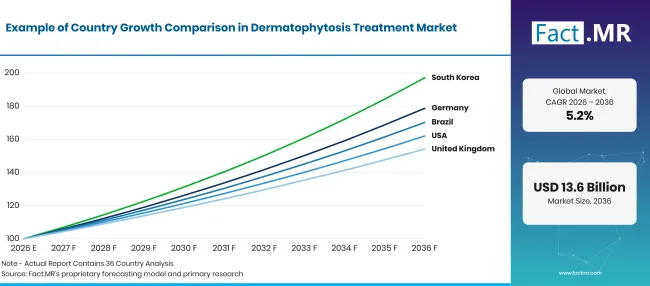
Dermatophytosis Treatment Market Growth Index | Source: Fact.MR
| Country | CAGR (2026 to 2036) |
|---|---|
| Germany | 6.0% |
| Brazil | 5.5% |
| United States | 4.9% |
| United Kingdom | 4.4% |
| Japan | 3.9% |
Source: Fact.MR analysis. Updated Nov 9, 2026
What supports Germany’s adoption?
6.0% CAGR, backed by an ageing population and close dermatology follow-up of nail infections.
Germany combines strong pharmacy self-care with easy access to office-based dermatologists, who treat a large share of nail and recurrent foot infections. Its population is getting older, which raises the number of people with thickened nails and slow-healing foot infections. Destatis reported in June 2026 that people aged 60 and over reached 31% of the population at the end of 2025, out of 83.5 million residents [8].
How is Brazil developing demand?
5.5% CAGR, as a humid climate and wider pharmacy access sustain topical purchases.
Heat and humidity favour foot and groin infections across much of Brazil, and most patients start treatment with a cream bought at a drugstore. Public access to pharmacies is broad. The Ministry of Health reported in February 2025 that its Farmácia Popular programme served more than 24 million people in 2024, a record for the programme since 2006 [9]. That pharmacy reach supports regular contact with self-care antifungal products sold alongside programme medicines.
What is supporting the United States’ adoption?
4.9% CAGR, helped by deep over-the-counter supply and specialist care for resistant cases.
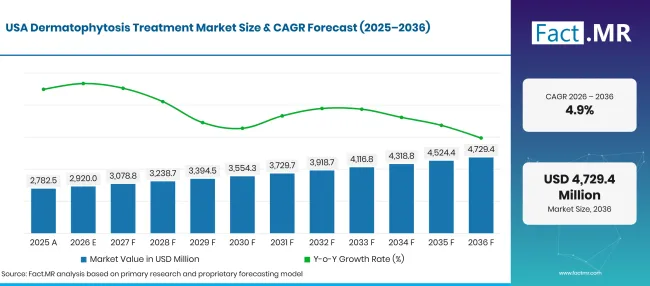
Dermatophytosis Treatment Market Forecast Usa | Source: Fact.MR
American patients can choose among many branded and store-brand antifungal creams and sprays. The Lamisil AT cream label published on DailyMed in November 2025 states that it cures most athlete’s foot, jock itch and ringworm [10]. Price competition among these products limits value growth. Specialist demand is rising, however, because CDC states that most clinical labs cannot tell emerging strains apart without genomic sequencing [5].
How is the United Kingdom scaling demand?
4.4% CAGR, reflecting pharmacy self-care and growing laboratory referral of resistant infections.
Community pharmacies handle most first episodes of athlete’s foot and body ringworm in the United Kingdom, with GP referral for scalp and nail disease. Laboratory data show a growing hard-to-treat group. A UKHSA briefing shared by NHS North East London in May 2025 found that Trichophyton indotineae accounted for 40% of dermatophyte isolates referred to the national Mycology Reference Laboratory in 2024 [11]. Those cases add testing and longer, second-line treatment courses.
How does Japan perform?
3.9% CAGR, owing to a mature self-care market that grows with its older population.
Japan has long-established pharmacy ranges for athlete’s foot and nail fungus, so growth comes from more patients, not new product classes. Age is the main factor. The Cabinet Office’s FY2025 ageing report put the population aged 65 and over at 36.24 million on October 1, 2024, equal to 29.3% of the total [12]. Older patients often need longer nail treatment and careful choice of oral drugs because of other medicines they take.
Who leads the Dermatophytosis Treatment Market?
Competition divides into three groups. Consumer health brand owners such as Bayer with Canesten and Karo Healthcare with Lamisil AT win the pharmacy shelf through brand recognition and pharmacist trust.
Prescription dermatology specialists form the second group: Bausch Health markets Jublia efinaconazole solution for toenail onychomycosis, and its DailyMed label was refreshed in August 2025 [13], while Galderma supplies Loceryl amorolfine nail lacquer. These firms compete on nail cure data and dermatologist relationships. A third group of generic makers, including Glenmark and Alembic Pharmaceuticals, presses on price and supply. Alembic received final USFDA approval in February 2026 for efinaconazole topical solution 10% [14], which opens the newer nail category to generic competition. Through 2036, success will depend on holding self-care brand loyalty while offering effective options for nail, scalp and resistant infections that send patients back to clinics.
Which companies are the key providers?
Key companies in the Dermatophytosis Treatment Market include Bayer, Karo Healthcare, Bausch Health, Galderma, Glenmark Pharmaceuticals and Alembic Pharmaceuticals.
- Bayer
- Karo Healthcare
- Bausch Health
- Galderma
- Glenmark Pharmaceuticals
- Alembic Pharmaceuticals
Bibliography
- [1] World Health Organization. (2025, June 19). Ringworm (tinea).
- [2] Centers for Disease Control and Prevention. (2026, April 29). Clinical Overview of Ringworm.
- [3] Centers for Disease Control and Prevention. (2026, February 9). Treatment of Ringworm.
- [4] Centers for Disease Control and Prevention. (2026, October 13). Emerging Types of Ringworm.
- [5] Centers for Disease Control and Prevention. (2026, October 13). Clinician Brief: Emerging Ringworm.
- [6] World Health Organization. (2025, April 1). Antifungal agents in clinical and preclinical development: overview and analysis.
- [7] World Health Organization. (2026, June 30). Blueprint for strengthening responses to fungal disease and antifungal resistance.
- [8] Statistisches Bundesamt (Destatis). (2026, June 16). Bevölkerung Deutschlands sinkt im Jahr 2025 um 0,1 %.
- [9] Agência Gov, Ministério da Saúde. (2025, February 14). Farmácia Popular beneficiou mais de 24 milhões de brasileiros em 2024, maior número da série histórica.
- [10] U.S. National Library of Medicine, DailyMed. (2025, November 17). LAMISIL AT CREAM (terbinafine hydrochloride) cream: Karo Healthcare Inc..
- [11] NHS North East London. (2025, May 28). UKHSA briefing: Increasing detection of antifungal resistant Trichophyton indotineae in England.
- [12] Cabinet Office, Government of Japan. (2025, June). Annual Report on the Ageing Society [Summary] FY2025.
- [13] U.S. National Library of Medicine, DailyMed. (2025, August 18). JUBLIA (efinaconazole) solution: Bausch Health US LLC.
- [14] Alembic Pharmaceuticals Limited. (2026, February 24). Alembic Pharmaceuticals Limited announces USFDA Final Approval for Efinaconazole Topical Solution, 10%.
This Report Answers
- How is revenue split between antifungal creams, oral antifungal medications and shampoos?
- Why do topical products carry most route of administration value, and where does oral therapy still win?
- What role do retail pharmacies, hospitals and online pharmacies play in getting patients treated?
- How much treatment happens at home, and when do dermatology clinics and hospitals take over?
- Which brand owners, prescription specialists and generic makers compete in this field?
- What explains the growth gap between Germany, Brazil, the United States, the United Kingdom and Japan?
What does the Dermatophytosis Treatment Market cover?
This study values antifungal medicines used against dermatophytes, the fungi that infect keratin in skin, hair and nails. Conditions covered include tinea pedis, tinea cruris, tinea corporis, tinea capitis and dermatophyte onychomycosis.
Value is measured at manufacturer selling prices in USD billion across four segment groups. Country estimates cover Germany, Brazil, the United States, the United Kingdom and Japan, with totals for seven world regions.
What is included in the scope?
Topical creams, gels, sprays, powders and lotions containing terbinafine, clotrimazole, miconazole, econazole, ketoconazole and related agents.
Oral terbinafine, itraconazole, griseofulvin and fluconazole when prescribed for dermatophyte infection.
Nail solutions and lacquers used in dermatophytic onychomycosis therapeutics, including efinaconazole and amorolfine.
Antifungal shampoos used with oral therapy for scalp ringworm.
What is excluded from the scope?
Medicines for vaginal yeast infection, covered under vulvovaginal candidiasis treatment.
Systemic antifungals used for invasive and hospital fungal infections, which belong to the broader anti-infective agents field.
Diagnostic tests, laboratory services and dermatology consultation fees.
Cosmetic foot care, deodorant powders and anti-dandruff shampoos without an antifungal drug indication.
How Was the Analysis Built?
The analysis draws on 120+ sources, 35+ company portfolios, 25+ countries, and more than 20 industry interviews.
- Primary Research: Primary research includes discussions with manufacturers, service providers, technology developers, distributors, end users, and subject-matter experts. These conversations examine purchasing priorities, product adoption, operational challenges, approval requirements, competitive positioning, and the factors that influence wider market acceptance.
- Desk Research: Desk research covers government statistics, regulatory publications, company filings, trade data, technical studies, industry associations, standards, public policy, and other authoritative sources. Every source used in the analysis is documented in the bibliography.
- Market Sizing and Forecasting: Market estimates combine historical performance, demand indicators, pricing and volume trends, segment shares, company participation, country-level growth, adoption patterns, investment activity, and barriers to market expansion.
- Data Validation and Update Cycle: Findings are validated by comparing primary interviews with public data, company activity, regulatory changes, trade patterns, and industry developments. Regular updates review new product launches, capacity changes, partnerships, approvals, and shifts in commercial adoption.
Segmentation
What is the report’s scope and coverage?
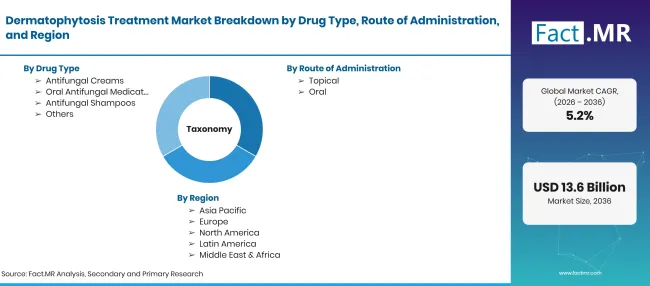
Dermatophytosis Treatment Market Taxonomy | Source: Fact.MR
| Attribute | Details |
|---|---|
| Quantitative Units | USD billion in 2026 |
| Market Definition | Prescription and over-the-counter antifungal medicines used to treat dermatophyte infections of the skin, scalp and nails, in topical and oral forms. |
| Drug Type | Antifungal Creams; Oral Antifungal Medications; Antifungal Shampoos; Others |
| Route of Administration | Topical; Oral |
| Distribution Channel | Retail Pharmacies; Hospitals; Online Pharmacies; Others |
| End-User | Homecare Settings; Hospitals; Dermatology Clinics; Others |
| Regions Covered | North America; Latin America; Western Europe; Eastern Europe; East Asia; South Asia & Pacific; Middle East & Africa |
| Countries Covered | Germany; Brazil; United States; United Kingdom; Japan |
| Companies Profiled | Bayer; Karo Healthcare; Bausch Health; Galderma; Glenmark Pharmaceuticals; Alembic Pharmaceuticals |
| Forecast Period | 2026 to 2036 |
| Approach | Hybrid top-down and bottom-up model built from treated tinea and onychomycosis cases, topical and oral product mix, pharmacy channel sales and country age profiles. |
Source: Fact.MR analysis. Updated Nov 9, 2026
How is the market segmented?
-
By Drug Type
- Antifungal Creams
- Oral Antifungal Medications
- Antifungal Shampoos
- Others
-
By Route of Administration
- Topical
- Oral
-
By Distribution Channel
- Retail Pharmacies
- Hospitals
- Online Pharmacies
- Others
-
By End-User
- Homecare Settings
- Hospitals
- Dermatology Clinics
- Others
-
By Region
- North America
- Latin America
- Western Europe
- Eastern Europe
- East Asia
- South Asia & Pacific
- Middle East & Africa
Frequently Asked Questions
How large is the dermatophytosis treatment market in 2026?
What growth rate will the dermatophytosis treatment market record?
Which drug type leads?
Which route of administration leads?
Which distribution channel leads?
Which end-user leads?
Which country will grow quickest?
Who are the main companies?
What holds the market back?
Who worked on this report


Preview the report firsthand - request a free sample
Free SampleGet the brochure for pricing and purchase details
Download PDF