- Market Value (2025): USD 15.7 Bn
- Estimated Value (2026): USD 16.3 Bn
- Forecast Value (2036): USD 24.6 Bn
- CAGR (2026-2036): 4.2%
What is the Antifungal Drugs Market forecast to be worth by 2036?
USD 16.3 billion in 2026 to USD 24.6 billion by 2036 at a 4.2% CAGR.
- As per Fact.MR analysis, the antifungal drugs market reached USD 15.7 billion in 2025.
- Demand will increase from USD 16.3 billion in 2026 to USD 24.6 billion by 2036.
- The antifungal drugs market will record 4.2% CAGR from 2026 to 2036.
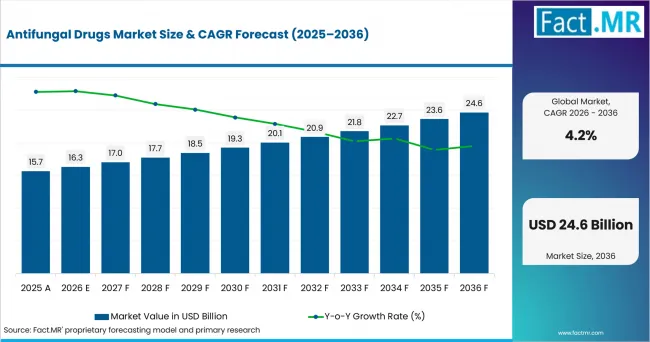
Antifungal Drugs Market Value Analysis | Source: Fact.MR
What are the defining numbers behind Antifungal Drugs Market growth?
An absolute opportunity of USD 8.3 billion will be created between 2026 and 2036.
- Demand Drivers in the Market
- Resistant ringworm is lengthening treatment courses for skin and nail infections. Longer oral regimens will lift tablet volumes in dermatology and primary care.
- A thin development pipeline keeps established drug classes in wide use. The World Health Organization reported in April 2025 that only four new antifungal drugs had been approved in the past decade, with nine candidates in clinical development and three in phase 3 [1]. Prescribers will therefore rely on current azole and echinocandin regimens for most of the forecast period.
- Fungal disease is gaining a higher place on health policy agendas. In June 2026, the World Health Organization released a blueprint stating that fungal diseases affect more than 300 million people each year [2]. National programs that adopt this guidance will widen testing, which turns missed infections into treated cases.
- Cancer and transplant care is expanding the pool of patients who receive antifungal prophylaxis. Posaconazole and isavuconazole courses often continue for weeks after chemotherapy or a stem cell transplant.
- Generic entry is widening access to hospital antifungals. Lower-cost micafungin and posaconazole let formulary committees treat more patients within fixed budgets.
- Key Segments Analyzed
- By Drug Class: Azoles will hold 42.3% share in 2026, supported by oral and intravenous options that cover yeast, mould and dermatophyte infections.
- By Indication: Dermatophytosis will account for 42.1% share in 2026 owing to frequent skin and nail infections that return after treatment.
- By Dosage Form: Tablets will capture 46.4% share in 2026 given that oral terbinafine and azoles cover most outpatient courses.
- Analyst Opinion at Fact.MR
- Shambhu Nath Jha, Principal Consultant at Fact.MR, states, “Demand for antifungal drugs will rise steadily through 2036 as resistance changes how clinicians treat both skin and hospital infections. Terbinafine-resistant ringworm is lengthening outpatient courses, while drug-resistant Candida keeps echinocandins in heavy use in intensive care. Cancer and transplant programs are widening prophylaxis, which adds weeks of therapy per patient. Generic entry is lowering the price per course in older classes. Suppliers that pair reliable azole and echinocandin supply with stewardship support and susceptibility data will benefit from this rise.”
- Strategic Implications
- Brand manufacturers should build clinical evidence in azole-resistant aspergillosis, since formulary committees ask for data in patients who cannot take azoles.
- Generic producers should prioritise injectable echinocandins and delayed-release posaconazole, where hospital tenders reward reliable supply and bioequivalence records.
- Hospital pharmacists should link antifungal stewardship to susceptibility testing so that high-cost agents are kept for confirmed resistant or invasive cases.
- Payers should review coverage limits for longer oral courses in resistant tinea, given that short reimbursed courses often end in relapse.
Mexico will lead at 5.3% CAGR, supported by a large diabetic population at higher risk of fungal infection. Ireland will follow at 4.8% as hospitals tighten screening for imported resistant Candida. Australia will record 4.4%, driven by antifungal prophylaxis in haematology and oncology care. The United States will reach 4.0% on the back of rising Candida auris case reporting. At 3.7%, the United Kingdom gains from rising bloodstream yeast infections, while Sweden will record 3.1% given few resistant cases.
How does the Antifungal Drugs Market break down by segment?
Azoles will lead Drug Class at 42.3%; Dermatophytosis will lead Indication at 42.1%.
Which Drug Class dominates?
Azoles will hold 42.3% share in 2026.
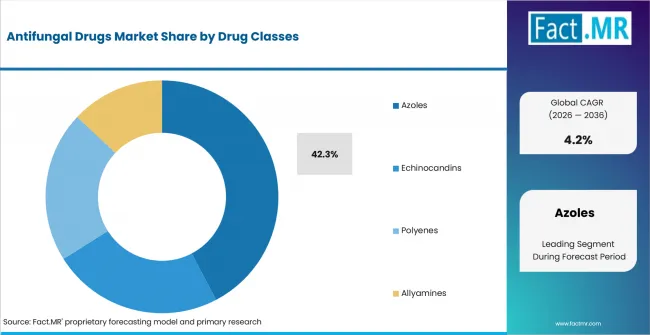
Antifungal Drugs Market Analysis By Drug Classes | Source: Fact.MR
Azoles will lead because the class spans topical creams, oral tablets and intravenous forms. Fluconazole remains a first choice for many Candida infections, while voriconazole and posaconazole cover invasive mould disease. Echinocandins are preferred for candidaemia in intensive care, and polyenes are held for severe cases.
Resistance is starting to shape azole use in hospitals. The UK Health Security Agency reported in May 2026 that fluconazole resistance was found in 14.5% of Nakaseomyces glabratus isolates and 1.9% of Candida albicans isolates in England [3]. Higher resistance in some species will steer more invasive cases toward echinocandins within wider hospital-acquired infection therapeutics budgets.
What leads the Indication segment?
Dermatophytosis will account for 42.1% share in 2026.
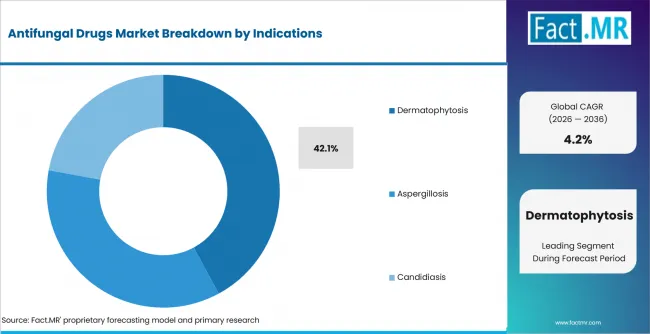
Antifungal Drugs Market Analysis By Indications | Source: Fact.MR
Dermatophytosis covers ringworm of the skin, scalp, groin and nails. These infections are common in the community and often return, so patients cycle through topical and oral courses several times. Nail disease ties demand to long onychomycosis treatment regimens.
Treating skin infections is becoming harder for clinicians. The CDC’s February 2026 clinician brief identified three emerging dermatophyte strains in the United States, including Trichophyton indotineae and terbinafine-resistant Trichophyton rubrum [4]. Some of these cases need itraconazole or antifungals usually reserved for invasive infections. Longer regimens will raise spending on dermatophytic onychomycosis therapeutics and related skin care.
How does Dosage Form shape demand?
Tablets will capture 46.4% share in 2026.
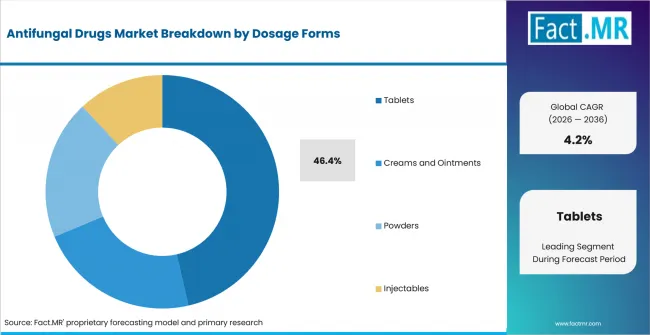
Antifungal Drugs Market Analysis By Dosage Forms | Source: Fact.MR
Tablets will lead since oral terbinafine, fluconazole and itraconazole cover most outpatient courses. Creams and ointments serve superficial infections and overlap with vulvovaginal candidiasis treatment products. Powders support foot and skin-fold care, while injectables stay tied to intensive care and cancer wards.
Systemic antifungal use is holding steady in England. The same UKHSA surveillance summary reported that systemic antifungal use in 2024 was 2% higher than in 2019 [3]. Stable systemic demand, combined with generic entry, will keep tablet and injectable volumes firm while prices per course ease.
What is accelerating Antifungal Drugs Market adoption, and what is holding it back?
Demand is supported by resistant ringworm and drug-resistant Candida, and by more immunocompromised patients who need prophylaxis. Growth is constrained by generic price erosion, limited fungal testing capacity and the slow arrival of new drug classes.
Drivers Impact Analysis
| DRIVER | (~) % IMPACT ON CAGR | GEOGRAPHIC RELEVANCE | IMPACT TIMELINE |
|---|---|---|---|
| Rising antifungal resistance in Candida and dermatophytes | +1.2% | Global | Short term (<= 2 years) |
| Growth in cancer and transplant patient pools | +1.0% | North America, Western Europe, Australia | Medium term (2-4 years) |
| Policy focus on fungal priority pathogens | +0.8% | Global | Medium term (2-4 years) |
| Wider access to lower-cost generic antifungals | +0.6% | Latin America, South Asia & Pacific | Short term (<= 2 years) |
| Diabetes-linked fungal infection risk | +0.4% | Latin America, Middle East & Africa | Long term (>= 4 years) |
Source: Fact.MR analysis. Updated Oct 1, 2026
Opportunity Impact Analysis
| OPPORTUNITY | (~) % IMPACT ON CAGR | GEOGRAPHIC RELEVANCE | IMPACT TIMELINE |
|---|---|---|---|
| Novel mechanisms for azole-resistant aspergillosis | +0.9% | North America, Western Europe | Medium term (2-4 years) |
| Once-weekly echinocandin dosing for prophylaxis | +0.7% | North America, Western Europe | Medium term (2-4 years) |
| Oral therapies for resistant tinea | +0.5% | South Asia & Pacific, Western Europe | Short term (<= 2 years) |
| Rapid fungal diagnostics linked to targeted therapy | +0.4% | Global | Long term (>= 4 years) |
Source: Fact.MR analysis. Updated Oct 1, 2026
Restraints Impact Analysis
| RESTRAINT | (~) % IMPACT ON CAGR | GEOGRAPHIC RELEVANCE | IMPACT TIMELINE |
|---|---|---|---|
| Generic price erosion in azoles and echinocandins | -0.7% | Global | Short term (<= 2 years) |
| Limited fungal testing in hospital laboratories | -0.5% | Latin America, Middle East & Africa | Medium term (2-4 years) |
| Drug interactions and liver toxicity with azoles | -0.4% | Global | Medium term (2-4 years) |
| Slow approval of new antifungal classes | -0.3% | Global | Long term (>= 4 years) |
Source: Fact.MR analysis. Updated Oct 1, 2026
Which countries are scaling the Antifungal Drugs Market through 2036?
- The country comparison spans 2.2 percentage points between Mexico at 5.3% and Sweden at 3.1%.
- Mexico will remain 0.5 percentage point above Ireland given that diabetes-related infection risk widens the treated patient base.
- Ireland will remain 0.4 percentage point above Australia through tighter hospital screening for imported resistant Candida.
- Australia will remain 0.4 percentage point above the United States as haematology and oncology wards expand antifungal prophylaxis.
- The United States will remain 0.3 percentage point above the United Kingdom through continued growth in Candida auris case reporting.
- Growth in the United Kingdom will remain 0.6 percentage point above Sweden, supported by bloodstream yeast infections that edged higher in 2024.
- Sweden will close the displayed range at 3.1%, reflecting few resistant cases and restrained prescribing habits.
Comparable CAGRs create different entry conditions, since resistance patterns and reimbursement rules vary by country. Full report coverage includes North America, Latin America, Western Europe, Eastern Europe, East Asia, South Asia & Pacific, Middle East & Africa.
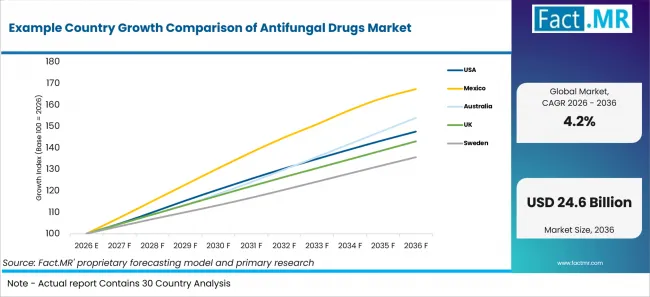
Example Country Growth Comparison Of Antifungal Drugs Market | Source: Fact.MR
| Country | CAGR (2026-2036) |
|---|---|
| Mexico | 5.3% |
| Ireland | 4.8% |
| Australia | 4.4% |
| United States | 4.0% |
| United Kingdom | 3.7% |
| Sweden | 3.1% |
Source: Fact.MR analysis. Updated Oct 1, 2026
What supports Mexico adoption?
5.3% CAGR, supported by diabetes-linked infection risk and wide use of generic azoles.
Mexico carries a heavy burden of diabetes, a condition that raises the risk of candidiasis, skin infections and invasive mould disease. INEGI reported in November 2025 that diabetes mellitus caused 112,577 deaths in 2024, the second cause of death nationally [5]. Broad use of low-cost generic azoles in primary care will keep tablet volumes rising.
How is Ireland scaling demand?
4.8% CAGR, driven by hospital screening for resistant Candida and national stewardship planning.
Irish hospitals treat drug-resistant Candida mainly as an imported risk linked to patients who received care abroad. The Department of Health published iNAP3 in November 2025, a One Health plan on antimicrobial resistance for 2026 to 2030 that names antifungals within its scope [6]. Stewardship work under the plan will support susceptibility-guided azole prescribing in acute hospitals.
What supports Australia’s growth?
4.4% CAGR, supported by prophylaxis demand in haematology and oncology care.
Cancer care drives much of Australia’s hospital antifungal demand. AIHW estimates that around 20,000 Australians were diagnosed with a blood cancer in 2025, a patient group that often receives mould-active prophylaxis [7]. Growth in this cohort will favour posaconazole and isavuconazole over older azoles.
How is the United States developing demand?
4.0% CAGR, supported by rising Candida auris reporting and hospital echinocandin use.
The CDC reported 6,304 clinical cases of Candida auris in 2024 and notes that case counts still rise each year, although the pace has slowed since 2022 [8]. Resistant isolates narrow azole options, so echinocandins carry much of the hospital treatment load. FDA approval of once-weekly rezafungin and new generic micafungin supply will widen echinocandin choice for American hospitals.
What is supporting the United Kingdom’s adoption?
3.7% CAGR, supported by rising bloodstream yeast infections and new C. auris notification rules.
Serious yeast infections are edging up in England. UKHSA reported 2,247 bloodstream yeast infections in 2024 and 178 Candidozyma auris cases in the same year [9]. Identification of C. auris in a human sample became legally notifiable in April 2025, which will increase screening across NHS trusts [3].
How does Sweden perform?
3.1% CAGR, supported by low resistant-case volumes and restrained antimicrobial prescribing.
Folkhälsomyndigheten reports that six C. auris cases were recorded in Sweden between 2020 and February 2024, all imported after care in hospitals abroad [10]. Laboratory reporting to the national Svebar system helps hospitals act early on imported strains. Conservative prescribing habits will keep volume growth modest.
How is the competition in the Antifungal Drugs Market?
Competition in the antifungal drugs market combines branded originators, pipeline developers and generic producers. Generic azoles and echinocandins keep price pressure high in hospital tenders, so branded players compete on resistance coverage and clinical evidence. New mechanisms such as olorofim and fosmanogepix will reshape positions in invasive mould infections.
Who leads the Antifungal Drugs Market?
Pfizer supplies Vfend and holds Cresemba rights in Europe outside the Nordic countries, China and 16 Asia Pacific markets. Astellas Pharma markets Cresemba in the United States. Merck & Co. provides Noxafil, and Gilead Sciences manufactures AmBisome for mould infections. Basilea started a phase 3 fosmanogepix study in July 2025 [11].
In June 2026, F2G and Shionogi reported positive phase 3 results for olorofim in invasive aspergillosis [12]. Mundipharma completed enrolment in its rezafungin prophylaxis trial in October 2025 [13]. Glenmark announced a US launch of generic micafungin in August 2025 [14], and Lupin supplies generic posaconazole. Competition centers on resistance coverage and injectable supply.
Which companies are the key providers?
Key companies include Pfizer Inc.; Merck & Co., Inc.; Astellas Pharma Inc.; Gilead Sciences, Inc.; Basilea Pharmaceutica Ltd.; F2G Limited; Mundipharma (including rezafungin rights acquired from Cidara Therapeutics); Lupin Limited; and Glenmark Pharmaceuticals Ltd.
- Pfizer Inc.
- Merck & Co., Inc.
- Astellas Pharma Inc.
- Gilead Sciences, Inc.
- Basilea Pharmaceutica Ltd.
- F2G Limited
- Mundipharma (including rezafungin rights acquired from Cidara Therapeutics)
- Lupin Limited
- Glenmark Pharmaceuticals Ltd.
Bibliography
- World Health Organization. (2025, April 1). WHO issues its first-ever reports on tests and treatments for fungal infections.
- World Health Organization. (2026, June 30). New WHO report outlines critical steps to confront fungal disease and antifungal resistance.
- UK Health Security Agency. (2026, May 13). ESPAUR report 2024 to 2025: extended summary.
- Centers for Disease Control and Prevention. (2026, February 6). Clinician Brief: Emerging Ringworm.
- Instituto Nacional de Estadística y Geografía. (2025, November 10). Comunicado de prensa 142/25: Estadísticas de defunciones registradas (EDR) [Press release 142/25: Registered death statistics].
- Department of Health. (2025, November 17). Minister for Health and Minister for Agriculture, Food and the Marine jointly publish Ireland’s third One Health National Action Plan on Antimicrobial Resistance 2026-2030 (iNAP3).
- Australian Institute of Health and Welfare. (2026, July 14). Cancer data in Australia, Overview of cancer in Australia, 2025.
- Centers for Disease Control and Prevention. (2026, March 3). Tracking C. auris.
- UK Health Security Agency. (2025, May 29). Small rise in serious yeast infections.
- Folkhälsomyndigheten. (2025, September 16). Sjukdomsinformation om Candidozyma auris-infektion [Disease information on Candidozyma auris infection].
- Basilea Pharmaceutica. (2025, July 29). Basilea initiates phase 3 study with antifungal fosmanogepix in invasive mold infections.
- F2G. (2026, June 18). F2G and Shionogi Announce Positive Topline Results from Global Phase 3 OASIS Study Evaluating Oral Olorofim Versus AmBisome® Followed by Standard of Care in Patients with Invasive Aspergillosis.
- Mundipharma. (2025, October 13). Mundipharma announces patient enrolment completion in Phase III ReSPECT clinical trial for REZZAYO® (rezafungin).
- Glenmark Pharmaceuticals. (2025, August 19). Glenmark Pharmaceuticals Inc., USA to launch Micafungin for Injection USP, 50 mg/vial and 100 mg/vial (Single-Dose Via
This Report Answers
- The report explains antifungal drug demand by drug class, indication and dosage form.
- Segment analysis identifies the subsegments that head each category in 2026 and the clinical reasons behind their shares.
- Country analysis compares the six profiled markets using resistance, disease burden and cancer-care indicators.
- Competitive analysis reviews branded azole and polyene suppliers, pipeline developers and generic producers.
- Indication analysis looks at how resistance in ringworm and Candida changes treatment choice.
What does the Antifungal Drugs Market cover?
The Antifungal Drugs Market covers medicines used to treat or prevent fungal infections of the skin, nails, mucosa and internal organs. It includes the four listed drug classes sold in oral, topical and injectable forms.
The assessment spans community treatment of dermatophytosis and hospital treatment of aspergillosis and candidiasis. Prophylaxis in cancer and transplant patients is counted within the relevant indication, since the same agents serve both prevention and treatment.
What is included in the scope?
The scope includes branded and generic antifungal drugs dispensed through hospital, retail and online pharmacies.
Systemic agents used in intensive care overlap with anti-infective agents, and only the antifungal share of that spending is counted. Azoles and polyenes used for endemic mycoses are included, with context drawn from coccidioidomycosis drugs.
What is excluded from the scope?
The scope excludes fungal diagnostics, antifungal coatings, agricultural fungicides and veterinary antifungals.
Products for inflammatory skin disease treatment fall outside the boundary unless they contain an antifungal active ingredient.
How Was the Analysis Built?
The analysis draws on 120+ sources, 35+ company portfolios, 25+ countries, and more than 20 industry interviews.
- Primary Research: Primary research includes discussions with manufacturers, service providers, technology developers, distributors, end users, and subject-matter experts. These conversations examine purchasing priorities, product adoption, operational challenges, approval requirements, competitive positioning, and the factors that influence wider market acceptance.
- Desk Research: Desk research covers government statistics, regulatory publications, company filings, trade data, technical studies, industry associations, standards, public policy, and other authoritative sources. Every source used in the analysis is documented in the bibliography.
- Market Sizing and Forecasting: Market estimates combine historical performance, demand indicators, pricing and volume trends, segment shares, company participation, country-level growth, adoption patterns, investment activity, and barriers to market expansion.
- Data Validation and Update Cycle: Findings are validated by comparing primary interviews with public data, company activity, regulatory changes, trade patterns, and industry developments. Regular updates review new product launches, capacity changes, partnerships, approvals, and shifts in commercial adoption.
Segmentation
What is the report’s scope and coverage?
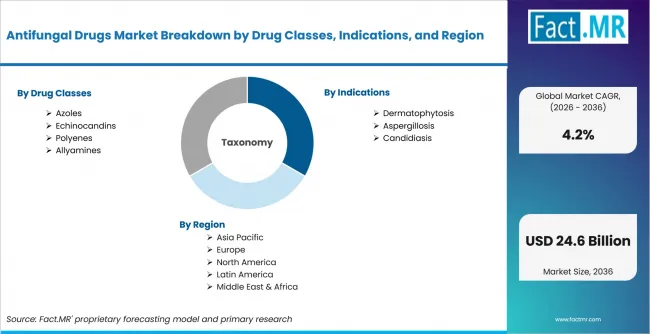
Antifungal Drugs Market Breakdown By Drug Classes, Indications, And Region | Source: Fact.MR
| Attribute | Details |
|---|---|
| Quantitative Units | USD billion |
| Market Definition | Prescription and over-the-counter medicines used to treat or prevent fungal infections in humans, including azoles, echinocandins, polyenes and allylamines. The scope covers oral, topical and injectable forms used for skin, nail, mucosal and invasive infections. |
| Drug Class | Azoles; Echinocandins; Polyenes; Allylamines |
| Indication | Dermatophytosis; Aspergillosis; Candidiasis |
| Dosage Form | Tablets; Creams and Ointments; Powders; Injectables |
| Regions Covered | North America; Latin America; Western Europe; Eastern Europe; East Asia; South Asia & Pacific; Middle East & Africa |
| Countries Covered | Mexico; Ireland; Australia; United States; United Kingdom; Sweden |
| Key Companies Profiled | Pfizer Inc.; Merck & Co., Inc.; Astellas Pharma Inc.; Gilead Sciences, Inc.; Basilea Pharmaceutica Ltd.; F2G Limited; Mundipharma; Lupin Limited; Glenmark Pharmaceuticals Ltd. |
| Forecast Period | 2026 to 2036 |
| Approach | Hybrid top-down and bottom-up approach using fungal infection burden, treatment course length, drug class mix, dosage form use, country resistance trends and provider portfolio review. |
Source: Fact.MR analysis. Updated Oct 1, 2026
How is the market segmented?
-
By Drug Class:
- Azoles
- Echinocandins
- Polyenes
- Allylamines
-
By Indication:
- Dermatophytosis
- Aspergillosis
- Candidiasis
-
By Dosage Form:
- Tablets
- Creams and Ointments
- Powders
- Injectables
-
By Region:
- North America
- Latin America
- Western Europe
- Eastern Europe
- East Asia
- South Asia & Pacific
- Middle East & Africa
Who worked on this report


Preview the report firsthand - request a free sample
Free SampleGet the brochure for pricing and purchase details
Download PDF