- Market Value (2025): USD 1.4 Mn
- Estimated Value (2026): USD 1.5 Mn
- Forecast Value (2036): USD 3.1 Mn
- CAGR (2026-2036): 7.4%
What is the Die-Lip Buildup Reducers Market forecast to be worth by 2036?
USD 1.5 billion in 2026 to USD 3.1 billion by 2036 at a 7.4% CAGR.
- The Die-Lip Buildup Reducers Market reached USD 1.4 billion in 2025.
- Demand is forecast to increase from USD 1.5 billion in 2026 to USD 3.1 billion by 2036.
- The market is forecast to record a 7.4% CAGR from 2026 to 2036 as film plants and compounders seek longer line runs with fewer die-cleaning interruptions.
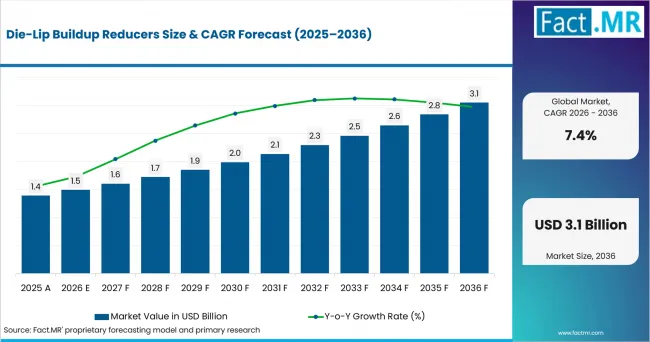
Die Lip Buildup Reducers Value Analysis | Source: Fact.MR
What are the defining numbers behind Die-Lip Buildup Reducers Market growth?
USD 1.6 billion absolute opportunity between 2026 and 2036, led by silicone masterbatch, polyethylene substrates, and blown-film processing.
- Demand Drivers in the Market
- Film plants need process aids that stop deposits at the die lip because buildup can break long runs. Cleaner die edges are forecast to cut surface marks and reduce manual cleaning between runs.
- Polyethylene plants need steady melt flow at high line speeds because die-exit faults can appear before a shutdown. Buildup reducers are forecast to support longer runs across blown film and stretch-film output.
- Compounders need aid systems that spread evenly through resin so low dose rates keep melt flow steady. A uniform masterbatch is forecast to help plants repeat the same line response across resin and output lots.
- Pack makers need fluoropolymer-free options as chemistry rules tighten. On August 11, 2026, the European Commission said that the PPWR applies from August 12, 2026 and that food-contact packaging containing PFAS at or above specified limits can no longer be placed on the EU market.
- Plants using recycled resin need wider process windows because melt flow can change across feedstock lots. Aids that steady die-exit flow are forecast to support longer runs as recycled content changes viscosity or deposit build.
- Key Segments Analyzed
- By Processing Aid Chemistry: Silicone masterbatch is forecast to hold 34.0% share in 2026 due to simple dosing and common use in polyolefin blending.
- By Processing Function: Melt-fracture reduction is forecast to account for 31.0% share in 2026 because unstable die-exit flow often appears alongside surface defects and deposit formation.
- By Polymer Substrate: Polyethylene is forecast to capture 36.0% share in 2026, supported by its use in blown and stretch film extrusion.
- By Application: Blown film is forecast to represent 29.0% share in 2026 owing to long runs and clear sensitivity to die-line contamination.
- Analyst Opinion at Fact.MR
- Shambhu Nath Jha, Principal Consultant at Fact.MR, states, “Die-lip buildup raises line cost. Demand is forecast to favor products that keep film surfaces clean and fit common resin recipes. Suppliers that pair steady dispersion with food-contact records have a clear path into approved lines.”
- Strategic Implications
- Film plants should compare buildup control with melt-fracture control because both faults can appear in the same high-shear process window. Trials should track die condition and film finish over a run period that matches normal line settings.
- Compounders should keep masterbatch dispersion even so treatment rates stay steady across large film and profile runs. Carrier fit and pellet form should be checked before the aid is approved for several customer resin systems.
- Pack makers should keep food-contact and chemical-rule records current. In January 2025, the U.S. Food and Drug Administration determined that 35 PFAS food-contact notifications had ceased to be effective after the related uses were abandoned. Rule review is forecast to remain part of aid approval for regulated packs.
China is forecast to record 8.6% CAGR through 2036 due to its large polyolefin base. Japan is forecast to advance at 7.5% as plants focus on stable film finish. The USA is forecast to post 7.1% alongside plastics plant investment. France is forecast at 7.1% as pack rules shape recipe choice. Germany is forecast to record 6.9% as recycling and line gains shape aid approval.
How does the Die-Lip Buildup Reducers Market break down by segment?
Silicone masterbatch leads Processing Aid Chemistry at 34.0%; polyethylene leads Polymer Substrate at 36.0%.
Which Processing Aid Chemistry leads?
Silicone masterbatch is expected to hold 34.0% share in 2026.
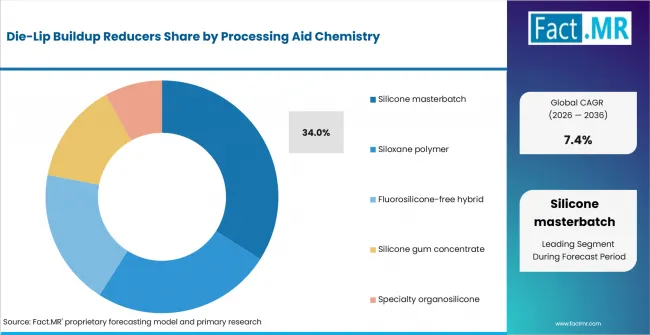
Die Lip Buildup Reducers Analysis By Processing Aid Chemistry | Source: Fact.MR
Silicone masterbatch is forecast to lead because plants can meter high-molecular-weight silicone through common blending equipment. Pellet form supports controlled dosing and easy handling in polyethylene lines. Siloxane polymers and silicone gum concentrates give plants other routes for flow and surface control. Fluorosilicone-free hybrids suit uses that favor a different process chemistry. Specialty organosilicones serve resin systems that need closer fit control. These choices let teams tune die flow while keeping familiar line equipment and masterbatch feed systems.
What leads the Processing Function segment?
Melt-fracture reduction is projected to account for 31.0% share in 2026.
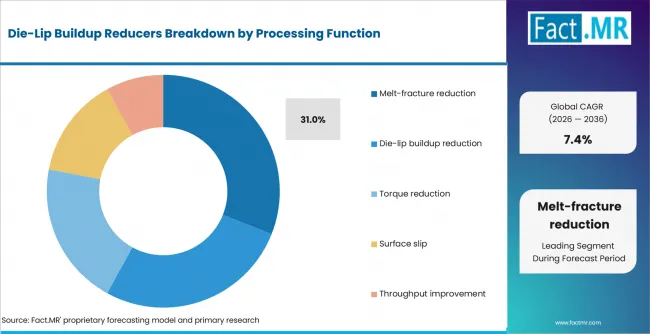
Die Lip Buildup Reducers Analysis By Processing Function | Source: Fact.MR
Melt-fracture reduction is forecast to lead because plants can see roughness or distortion on the film surface. Die-lip buildup reduction remains a separate line goal because deposits can force cleaning stops during stable runs. Torque reduction helps difficult mixes that place more load on the extruder. Surface slip helps downstream handling when film contact creates friction. Throughput improvement becomes more useful after plants stabilize film finish. The function mix starts with clear surface faults and then moves toward line gains.
How does Polymer Substrate shape demand?
Polyethylene is anticipated to capture 36.0% share in 2026.
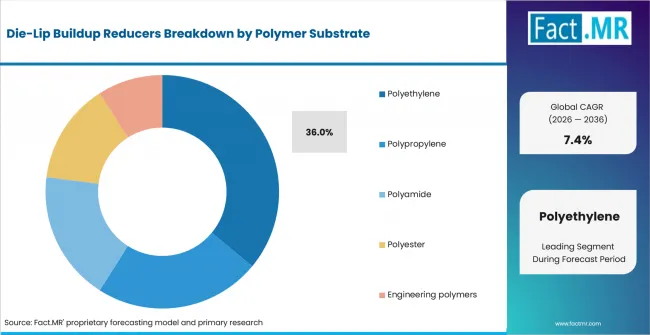
Die Lip Buildup Reducers Analysis By Polymer Substrate | Source: Fact.MR
Polyethylene is forecast to lead due to its wide use in flexible packs and film lines. Long runs make deposit control easier to compare with cleaning rate. Polypropylene follows across film and profile lines where silicone aids can support melt flow. Polyamide and polyester need different heat and resin-fit windows. Engineering polymers form a smaller group because higher process heat narrows aid choice. Teams are therefore forecast to match buildup reducers to the host resin before using one aid package across several polymer families.
What supports Blown Film within Application?
Blown film is estimated to represent 29.0% share in 2026.
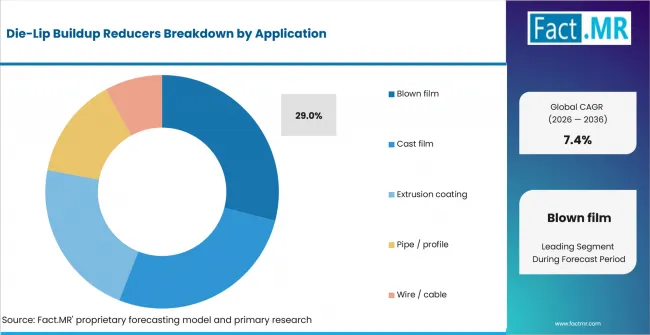
Die Lip Buildup Reducers Analysis By Application | Source: Fact.MR
Blown film is forecast to lead owing to long line runs where deposits can create marks and raise cleaning rate. Cast film also needs stable die conditions across flat-die lines. Extrusion coating places more weight on even polymer flow over the base sheet. Pipe and profile lines gain from long stable runs because shutdowns break output. Wire and cable mixes add filled compounds and demanding surfaces. The Federal Reserve reported in January 2026 that U.S. plastics and rubber products capacity utilization was 73.2% in December 2025. High use of installed lines keeps line gains relevant to aid choice.
What is accelerating Die-Lip Buildup Reducers Market adoption, and what is holding it back?
Extrusion uptime and fluoropolymer-free reformulation support adoption; qualification and resin-specific compatibility restrain it.
Drivers Impact Analysis
| Driver | (~) % Impact on CAGR | Geographic Relevance | Impact Timeline |
|---|---|---|---|
| Longer extrusion runs with fewer die-cleaning stops | +1.4% | Global | Short term (<= 2 years) |
| Fluoropolymer-free processing-aid reformulation | +1.1% | North America, Europe | Medium term (2-4 years) |
| Film surface-quality control at higher line speed | +0.9% | Global | Short term (<= 2 years) |
| Processing variability in recycled polyolefin streams | +0.7% | Europe, East Asia | Long term (>= 4 years) |
Opportunity Impact Analysis
| Opportunity | (~) % Impact on CAGR | Geographic Relevance | Impact Timeline |
|---|---|---|---|
| Silicone masterbatch substitution in polyolefin film | +0.9% | Global | Medium term (2-4 years) |
| Additive packages for recycled-content extrusion | +0.7% | Europe, North America | Long term (>= 4 years) |
| Low-dose solutions for profile, pipe, and cable lines | +0.5% | Asia, Europe | Medium term (2-4 years) |
Restraints Impact Analysis
| Restraint | (~) % Impact on CAGR | Geographic Relevance | Impact Timeline |
|---|---|---|---|
| Qualification time for resin and application combinations | -0.5% | Global | Short term (<= 2 years) |
| Food-contact and chemical-compliance documentation | -0.4% | North America, Europe | Medium term (2-4 years) |
| Performance variation across polymer grades and fillers | -0.3% | Global | Long term (>= 4 years) |
Which countries are scaling the Die-Lip Buildup Reducers Market through 2036?
- The country comparison spans 1.7 percentage points across the stated 2026 to 2036 outlook.
- China remains 1.1 percentage points above Japan as its large polyolefin base supports frequent process-aid use.
- Japan remains 0.4 percentage point above the USA as film finish and steady line control remain central to plant approval.
- The USA and France each record 7.1% CAGR through different drivers tied to plastics plants and pack rules.
- Germany closes the shown range at 6.9% as recycling work and plant-line needs shape aid choice.
Similar CAGRs can create different entry paths because resin mix and use rules vary by country. Full report coverage includes North America, Latin America, Western Europe, Eastern Europe, East Asia, South Asia & Pacific, and Middle East & Africa.
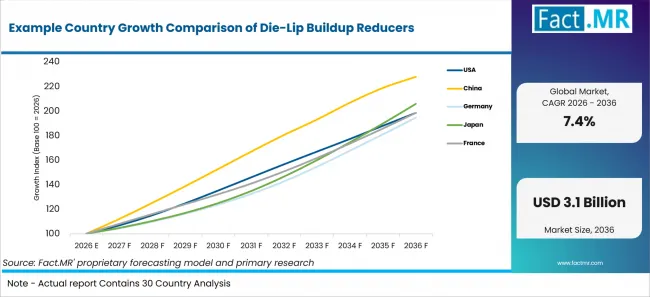
Example Country Growth Comparison Of Die Lip Buildup Reducers | Source: Fact.MR
| Country | CAGR (2026-2036) |
|---|---|
| China | 8.6% |
| Japan | 7.5% |
| USA | 7.1% |
| France | 7.1% |
| Germany | 6.9% |
What supports China's growth?
8.6% CAGR, supported by polyolefin production and large-scale extrusion activity.
China has a broad polyolefin base that supports repeat use of process aids. The National Bureau of Statistics reported in February 2026 that ethylene output reached 41.508 million tonnes in 2025 and increased 6.4% from 2024. China is forecast to record 8.6% CAGR through 2036 as film and profile plants seek steady die conditions during long runs.
How is Japan scaling demand?
7.5% CAGR, shaped by process stability and film-quality requirements.
Japanese plants place close attention on repeatable film finish during long runs. The Ministry of Economy, Trade and Industry reported in February 2026 that Japan's December 2025 production index was 101.8 on a seasonally adjusted basis. The original index was 106.8, up 2.6% from December 2024. Japan is forecast to advance at 7.5% CAGR through 2036 as plants approve aids for steady output across changing resin and use conditions.
What supports USA adoption?
7.1% CAGR, backed by plastics-manufacturing investment and extrusion efficiency.
U.S. film and profile plants operate across a large installed plastics plant base. The U.S. Bureau of Economic Analysis reported on June 10, 2026 that expenditures for new foreign direct investment in U.S. plastics and rubber products manufacturing totaled USD 19.0 billion in 2025. The USA is forecast to post 7.1% CAGR through 2036 as plants compare buildup control with cleaning rate and line stability.
What supports France demand?
7.1% CAGR, supported by packaging conversion and polymer-processing activity.
French plants compare buildup reducers with film finish and pack-mix needs. INSEE reported in July 2026 that the production index for rubber and plastics products and other non-metallic mineral products stood at 86.3 in May 2026, with output over the latest three-month period 1.5% above the same period a year earlier. France is forecast to record 7.1% CAGR through 2036 as flexible-packaging plants seek steadier die conditions across long runs.
What supports Germany's adoption?
6.9% CAGR, influenced by packaging recycling and extrusion efficiency.
German plants work within a pack system that puts sustained focus on resin recovery and steady process results. The German Environment Agency and the Central Agency Packaging Register reported on January 27, 2026 that around 5.5 million tonnes of packaging waste collected by Germany’s dual systems were recovered in 2024. Germany is forecast to record 6.9% CAGR through 2036 as film and profile plants balance die condition with resin fit and recycled-content variation.
Who leads the Die-Lip Buildup Reducers Market?
Dow, Wacker Chemie, Momentive, Evonik, and Mitsubishi Chemical Group are profiled across silicone and polymer-processing-aid portfolios.
Dow has a direct product link to die-lip buildup control through DOWSIL™ 5-1050 Polymer Processing Aid. In September 2025, Dow launched the polyethylene-based masterbatch for blown and stretch film applications and stated that it mitigates melt fracture and suppresses die-lip buildup in linear low-density polyethylene grades. Wacker Chemie participates through GENIOPLAST® silicone processing aids, including PE50S08, which supports polyethylene extrusion and reduces die deposits in profile-related applications.
Momentive supplies PEarlene™ silicone masterbatches for plastics processing, with improved flow characteristics that can reduce die drool under certain conditions. Evonik offers organo-modified siloxane polymer processing aids such as TEGO® PPA 51-1 and 51-7, which are designed to address die-drool buildup in film extrusion. Mitsubishi Chemical supplies METABLEN™ processing aids and modifiers for thermoplastics, including grades that reduce or prevent die deposits. Competition is expected to center on resin compatibility, additive dosage, extrusion performance, and regulatory requirements. Repeatable die-performance results and regulatory documentation are expected to influence supplier selection across film and profile extrusion applications.
Which companies are the key providers?
Dow and Wacker Chemie are profiled with Momentive, Evonik, and Mitsubishi Chemical Group.
- Dow
- Wacker Chemie
- Momentive
- Evonik
- Mitsubishi Chemical Group
Bibliography
- Directorate-General for Environment. (2026, August 11). New EU packaging rules start to apply, including restrictions on PFAS in food-contact packaging. European Commission.
- U.S. Food and Drug Administration. (2025, January 3). FDA determines authorization for 35 food contact notifications related to PFAS are no longer effective.
- Board of Governors of the Federal Reserve System. (2026, January 16). Industrial production and capacity utilization—G.17: Table 7. Capacity utilization.
- Dow. (2025, September 23). Dow unveils an alternative to fluoropolymer-based polymer processing aids for film packaging.
- National Bureau of Statistics of China. (2026, February 28). Statistical communiqué of the People’s Republic of China on the 2025 national economic and social development.
- Ministry of Economy, Trade and Industry. (2026, February 16). Indices of industrial production: Revised report for December 2025.
- U.S. Bureau of Economic Analysis. (2026, June 10). New foreign direct investment in the United States, 2025.
- Institut national de la statistique et des études économiques. (2026, July 3). In May 2026, manufacturing output fell back by 1.0%.
- German Environment Agency, & Central Agency Packaging Register. (2026, January 27). Facts against myths: Packaging waste recycling in Germany is working.
This Report Answers
- The report explains where die-lip buildup reducers are used across processing-aid chemistry and process function. It also covers polymer substrate and use. The coverage also places die buildup control within the wider halogen-free process aids context.
- Segment review identifies the stated lead subsegments and explains why plants choose them. The segment review also considers nearby PVC additives where extrusion behavior affects aid choice.
- Country review covers China, Japan, USA, France, and Germany using the stated 2026 to 2036 CAGR outlook.
- Competitive review covers Dow, Wacker Chemie, Momentive, Evonik, and Mitsubishi Chemical Group across relevant silicone and process-aid product lines.
What does the Die-Lip Buildup Reducers Market cover?
Silicone, siloxane, hybrid, and organosilicone processing aids used to limit die deposits and related extrusion defects.
The market covers aid concentrates designed to reduce material build at an extrusion die lip. It includes products used to steady flow and reduce melt fracture. It also covers products that cut surface faults or extend time between die-cleaning events when those functions link directly to deposit control. The broader polyolefin resin context helps frame the base polymers used on these lines. Related masterbatch systems show how low-dose aids are delivered into resin.
The boundary is narrower than the wider polymer-additives field. General lubricants and slip agents enter the scope only when their stated process role links to buildup control. Masterbatches and surface modifiers enter when they support die-exit stability or a linked extrusion fault. Recycled streams are reviewed alongside recycled polyolefin use where resin variation changes die behavior. Adjacent compatibilizer additives give context for mixed-resin flow while this scope stays centered on die buildup control.
What is included in the scope?
Die-lip buildup reducer formulations used in film, coating, profile, pipe, and wire or cable extrusion.
Coverage includes silicone masterbatch and siloxane polymer chemistry used in polyethylene and polypropylene processing. Related processing context includes extrusion aids and halogen-free extrusion aids where die cleanliness and surface stability overlap. The scope also covers fluorosilicone-free hybrids and silicone gum concentrates when their function directly addresses deposit control.
What is excluded from the scope?
Base polymers, extrusion machinery, finished plastic products, and unrelated additive functions fall beyond the defined market boundary.
The scope excludes base resins and finished converted products when they are sold apart from a die-buildup control function. Adjacent context includes melt fracture eliminators and bio polymer processing aids because both categories can involve die-exit stability. Products enter this market scope only when their stated use directly addresses die deposits or a linked extrusion defect.
How Was the Analysis Built?
The analysis draws on 120+ sources, 35+ company portfolios, 25+ countries, and more than 20 industry interviews.
- Primary Research: Primary research includes discussions with manufacturers, service providers, technology developers, distributors, end users, and subject-matter experts. These conversations examine purchasing priorities, product adoption, operational challenges, approval requirements, competitive positioning, and the factors that influence wider market acceptance.
- Desk Research: Desk research covers government statistics, regulatory publications, company filings, trade data, technical studies, industry associations, standards, public policy, and other authoritative sources. Every source used in the analysis is documented in the bibliography.
- Market Sizing and Forecasting: Market estimates combine historical performance, demand indicators, pricing and volume trends, segment shares, company participation, country-level growth, adoption patterns, investment activity, and barriers to market expansion.
- Data Validation and Update Cycle: Findings are validated by comparing primary interviews with public data, company activity, regulatory changes, trade patterns, and industry developments. Regular updates review new product launches, capacity changes, partnerships, approvals, and shifts in commercial adoption.
What is the report’s scope and coverage?
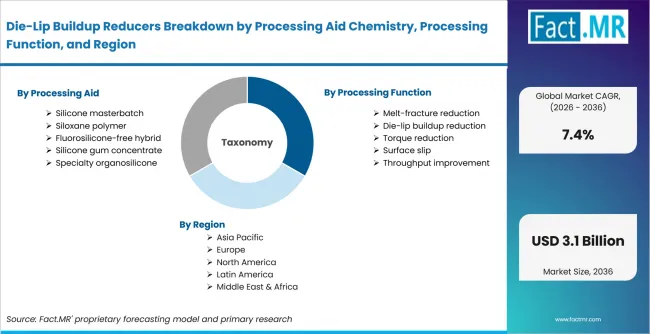
Die Lip Buildup Reducers Breakdown By Processing Aid Chemistry, Processing Function, And Region | Source: Fact.MR
| Attribute | Details |
|---|---|
| Quantitative Units | USD billion |
| Market Definition | Processing-aid systems used to reduce material accumulation at the extrusion die lip and to support cleaner die-exit behavior during polymer processing. |
| Processing Aid Chemistry | Silicone masterbatch; Siloxane polymer; Fluorosilicone-free hybrid; Silicone gum concentrate; Specialty organosilicone |
| Processing Function | Melt-fracture reduction; Die-lip buildup reduction; Torque reduction; Surface slip; Throughput improvement |
| Polymer Substrate | Polyethylene; Polypropylene; Polyamide; Polyester; Engineering polymers |
| Application | Blown film; Cast film; Extrusion coating; Pipe / profile; Wire / cable |
| Regions Covered | North America; Latin America; Western Europe; Eastern Europe; East Asia; South Asia & Pacific; Middle East & Africa |
| Countries Covered | China; Japan; USA; France; Germany |
| Key Companies Profiled | Dow; Wacker Chemie; Momentive; Evonik; Mitsubishi Chemical Group |
| Forecast Period | 2026 to 2036 |
| Approach | Hybrid top-down and bottom-up approach using extrusion-aid demand; polymer substrate mix; application exposure; country growth; and provider portfolio review. |
How is the market segmented?
-
By Processing Aid Chemistry:
- Silicone masterbatch
- Siloxane polymer
- Fluorosilicone-free hybrid
- Silicone gum concentrate
- Specialty organosilicone
-
By Processing Function:
- Melt-fracture reduction
- Die-lip buildup reduction
- Torque reduction
- Surface slip
- Throughput improvement
-
By Polymer Substrate:
- Polyethylene
- Polypropylene
- Polyamide
- Polyester
- Engineering polymers
-
By Application:
- Blown film
- Cast film
- Extrusion coating
- Pipe / profile
- Wire / cable
-
By Region:
- North America
- Latin America
- Western Europe
- Eastern Europe
- East Asia
- South Asia & Pacific
- Middle East & Africa