- Market Value (2025): USD 1.6 Bn
- Estimated Value (2026): USD 1.8 Bn
- Forecast Value (2036): USD 3.8 Bn
- CAGR (2026-2036): 8.1%
What is the Melt Fracture Eliminators Market forecast to be worth by 2036?
USD 1.8 billion in 2026 to USD 3.8 billion by 2036, at 8.1% CAGR.
- The Melt Fracture Eliminators Market crossed a valuation of USD 1.6 billion in 2025.
- Demand is projected to increase from USD 1.8 billion in 2026 to USD 3.8 billion by 2036.
- The market is forecast to record 8.1% CAGR from 2026 to 2036 as film converters and compounders qualify PPAs that remove sharkskin while protecting line speed.
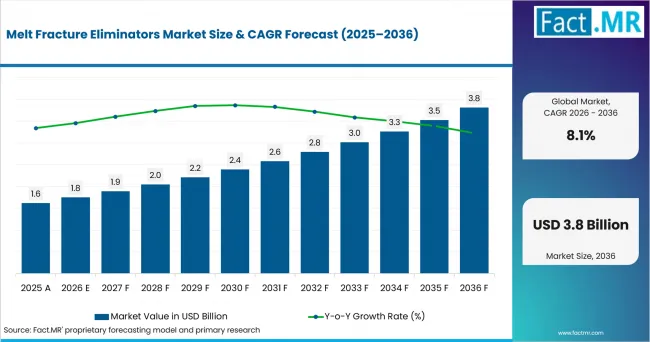
Melt Fracture Eliminators Market Value Analysis | Source: Fact.MR
What are the defining numbers behind Melt Fracture Eliminators Market growth?
USD 2.06 billion absolute opportunity by 2036, led by Fluoropolymer PPA, LLDPE and blown film.
- Demand Drivers in the Market
- Film converters need faster sharkskin cleanout supported by tighter visual-quality requirements in retail packaging and label-facing flexible films.
- Compounders need lower die pressure as higher recycled polyethylene loading narrows the processing window for film-grade formulations.
- Resin producers need additive packages that help LLDPE and mLLDPE run cleanly at higher shear rates while avoiding line stoppages.
- PFAS reporting increases documentation requirements. EPA stated in April 2026 that TSCA section 8(a)(7) requires reporting for PFAS manufactured, including imported, in any year from 2011 through 2022, while its April 2026 action moved the start of the reporting period from April 13, 2026 to 60 days after the effective date of EPA’s forthcoming revision to the rule.
- Key Segments Analyzed
- By Technology: Fluoropolymer PPA is expected to hold 46.00% share in 2026 due to its long use in polyolefin extrusion and proven sharkskin removal.
- By Polyethylene Grade: LLDPE is projected to account for 42.00% share in 2026 because narrow processing windows make surface defects more visible.
- By Extrusion Application: Blown film is anticipated to capture 49.00% share in 2026 owing to its high sensitivity to melt flow instability.
- By Primary KPI: Sharkskin elimination is estimated to represent 36.00% share in 2026, reinforced by its direct link with film appearance and scrap reduction.
- Analyst Opinion at Fact.MR
- Shambhu Nath Jha, Principal Consultant at Fact.MR, states, “Melt fracture eliminators are moving into line-risk decisions. Converters are expected to compare PPA systems by cleanout time and food-contact documentation. Suppliers need lab proof and plant-scale trials in one package.”
- Strategic Implications
- Additive suppliers should publish resin-grade guidance for LLDPE, mLLDPE and recycled PE so converters shorten trial cycles.
- Masterbatch producers should build carrier systems that disperse consistently at low dosage while avoiding haze or gel specks.
- Film converters should track sharkskin cleanout time, die-lip deposits and pressure change in the same plant trial.
- Resin and additive suppliers can align polymer processing-aid recommendations with the EU Packaging and Packaging Waste Regulation, which began applying on 12 August 2026 and includes recyclability requirements and mandatory recycled-content provisions for plastic packaging from 2030.
The USA is expected to record 8.7% CAGR through 2036 supported by active plastics output and PFAS reporting. Germany is projected to post 8.1% CAGR owing to its dense plastics base. South Korea is anticipated to advance at 7.3% CAGR due to manufacturing modernization. The UK is estimated to hold 6.6% CAGR shaped by packaging fees. France is forecast to reach 6.2% CAGR as recycling rules reshape flexible packaging choices.
How does the Melt Fracture Eliminators Market break down by segment?
Fluoropolymer PPA leads at 46.00%; blown film leads at 49.00%.
Which Technology dominates?
Fluoropolymer PPA holds 46.0% share in 2026.
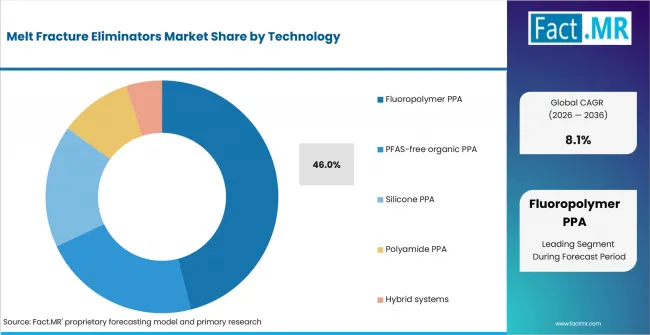
Melt Fracture Eliminators Market Analysis By Technology | Source: Fact.MR
Fluoropolymer PPA is expected to hold 46.00% share in 2026 due to its long record in polyethylene film. PFAS-free organic PPA systems are gaining qualification attention as regulations tighten. Silicone PPAs are moving into trials where converters need lower haze. Arkema S.A. states that Kynar PVDF and Orgasol Polyamide 12 processing aids help eliminate melt fracture in polyolefin extrusion.
What leads the Polyethylene Grade segment?
LLDPE accounts for 42.0% share in 2026.
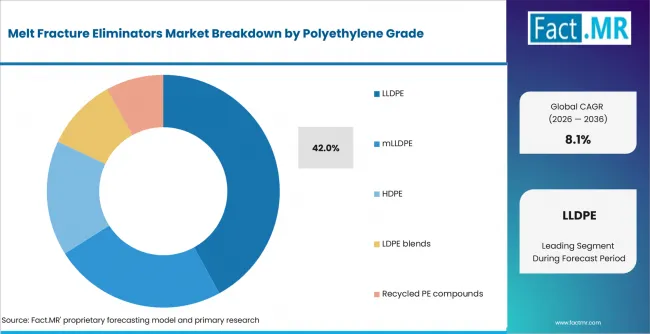
Melt Fracture Eliminators Market Analysis By Polyethylene Grade | Source: Fact.MR
LLDPE is projected to account for 42.00% share in 2026 because film-grade LLDPE often shows sharkskin at higher shear rates. mLLDPE follows as converters pursue toughness and seal performance. Dow identifies LLDPE film as a target application for DOWSIL™ 5-1050 PPA, highlighting reduced melt fracture and lower die pressure for smoother extrusion processing.
How does Extrusion Application shape demand?
Blown film leads with 49.0% share in 2026.
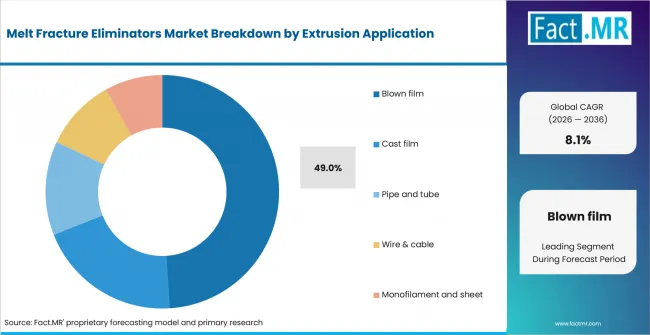
Melt Fracture Eliminators Market Analysis By Extrusion Application | Source: Fact.MR
Blown film is anticipated to capture 49.00% share in 2026 owing to its sensitivity to surface quality. Cast film uses PPAs where optical quality influences rejected rolls. Pipe and tube lines value pressure reduction because lower drag supports steadier output. Avient Corporation states that Cesa non-PFAS process aid supports film, sheet and pipe extrusion.
What supports Sharkskin elimination within Primary KPI?
Sharkskin elimination represents 36.0% share in 2026.
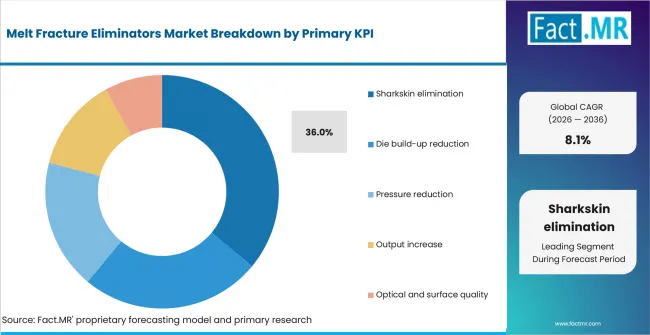
Melt Fracture Eliminators Market Analysis By Primary Kpi | Source: Fact.MR
Sharkskin elimination is estimated to represent 36.00% share in 2026 as it gives operators a visible pass-or-fail signal. Die build-up reduction follows because deposits create downtime. Pressure reduction supports higher output on difficult grades. Ingenia Polymers Corp. states that its non-PFAS PPAs reduce die-lip buildup and eliminate melt fracture in blown film.
What is accelerating Melt Fracture Eliminators Market adoption, and what is holding it back?
Surface-defect control drives it; formulation qualification restrains it.
Drivers Impact Analysis
| DRIVER | (~) % IMPACT ON CAGR | GEOGRAPHIC RELEVANCE | IMPACT TIMELINE |
|---|---|---|---|
| Sharkskin removal in LLDPE film | +1.8% | Global | Short term (<= 2 years) |
| PFAS-free PPA qualification | +1.5% | North America, Europe, East Asia | Medium term (2-4 years) |
| Recycled PE processing stability | +1.2% | Europe, North America | Medium term (2-4 years) |
| Lower die pressure and downtime | +0.9% | Global | Short term (<= 2 years) |
| Food-contact packaging documentation | +0.7% | USA, Europe | Long term (>= 4 years) |
Source: Fact.MR analysis. Updated Sep 3, 2026
- Sharkskin removal in LLDPE film: Film converters evaluate processing aids by how effectively they remove melt fracture and restore a smooth surface after dosing. Faster stabilization can reduce off-specification rolls and improve production consistency across retail and flexible packaging applications.
- PFAS-free PPA qualification: Regulatory and customer requirements are encouraging converters to evaluate PFAS-free processing aids that maintain extrusion performance. Alternatives that control melt fracture, support die cleanliness, and fit food-contact requirements can gain preference in film-production qualification programs.
- Recycled PE processing stability: Recycled polyethylene can introduce greater melt-flow variability and make surface defects more difficult to control. Melt-fracture eliminators can help processors stabilize extrusion behavior and incorporate recycled PE while continuing to use established production lines.
- Lower die pressure and downtime: Processing aids reduce friction between polymer melt and metal surfaces, helping control die pressure and processing instability. Improved melt flow can support difficult resin grades, reduce interruptions, and maintain higher throughput across polyolefin extrusion operations.
- Food-contact packaging documentation: Packaging customers require regulatory documentation alongside processing-performance data. Suppliers with clear food-contact compliance, dosage guidance, and compatibility information can simplify commercial screening and accelerate qualification of processing aids for food-contact film applications.
Opportunity Impact Analysis
| OPPORTUNITY | (~) % IMPACT ON CAGR | GEOGRAPHIC RELEVANCE | IMPACT TIMELINE |
|---|---|---|---|
| Non-fluorinated masterbatch systems | +1.3% | North America, Europe | Short term (<= 2 years) |
| Recycled PE film processing | +1.1% | Europe, USA, South Korea | Medium term (2-4 years) |
| Asia technical-service expansion | +0.8% | South Korea, China, Southeast Asia | Medium term (2-4 years) |
| Wire and cable extrusion trials | +0.5% | Global | Long term (>= 4 years) |
Source: Fact.MR analysis. Updated Sep 3, 2026
- Non-fluorinated masterbatch systems: Organic and silicone processing aids give masterbatch suppliers a route into converters reviewing PFAS exposure. Drop-in formats are particularly relevant for film producers, while clear dosage guidance by resin type and line speed can support faster qualification.
- Recycled PE film processing: Recycled polyethylene compounds create a strong use case for melt-fracture eliminators because feedstock variation can increase surface defects. Processing aids can help converters stabilize film quality and maintain smoother extrusion performance when recycled content is introduced.
- Asia technical-service expansion: South Korea and nearby conversion hubs create opportunities for suppliers that can translate laboratory performance into reliable plant operation. Regional demonstrations and technical support help customers compare non-fluorinated alternatives with established fluoropolymer processing aids under actual extrusion conditions.
- Wire and cable extrusion trials: Cable manufacturers require dependable surface quality and pressure control in polyethylene insulation and jacketing. Processing-aid suppliers can treat wire and cable as a longer qualification channel, where detailed customer testing creates stronger retention once a formulation is approved.
Restraints Impact Analysis
| RESTRAINT | (~) % IMPACT ON CAGR | GEOGRAPHIC RELEVANCE | IMPACT TIMELINE |
|---|---|---|---|
| PFAS regulatory uncertainty | -0.8% | USA, Europe | Short term (<= 2 years) |
| Grade-specific validation burden | -0.6% | Global | Medium term (2-4 years) |
| Haze and optics risk | -0.4% | Film packaging hubs | Short term (<= 2 years) |
| Small-converter trial cost | -0.3% | Emerging markets | Long term (>= 4 years) |
Source: Fact.MR analysis. Updated Sep 3, 2026
- PFAS regulatory uncertainty: Fluoropolymer processing aids remain widely used, but evolving reporting and restriction proposals are creating additional qualification checks. European film converters increasingly seek clearer additive documentation and stronger regulatory assurance before approving new processing-aid systems.
- Grade-specific validation burden: A processing aid that performs well in one LLDPE grade may behave differently in mLLDPE or recycled polyethylene. Resin architecture can change cleanout timing and dosage needs, requiring suppliers to support resin-specific trials and provide comparable equipment-performance evidence.
- Haze and optics risk: Film converters need surface improvement without compromising haze, clarity, or gel performance. Optical testing therefore forms an important part of processing-aid qualification, especially in retail film, stretch film, and label-facing packaging where visual quality directly influences customer acceptance.
- Small-converter trial cost: Smaller converters can delay additive changes because each test consumes resin, masterbatch, and production time. Failed trials can create off-specification rolls, making packaged technical guidance, low-dosage masterbatches, and practical trial support important for reducing qualification barriers.
Which countries are scaling the Melt Fracture Eliminators Market through 2036?
- The country comparison spans 2.48 percentage points and forms two practical growth bands across the forecast period.
- The USA remains 0.57 percentage point above Germany through PFAS documentation pressure and a broad plastics conversion base.
- Germany remains 0.81 percentage point above South Korea as European packaging rules deepen additive review in film projects.
- South Korea remains 0.65 percentage point above the UK as manufacturing activity supports film and compounder trials.
- The UK remains 0.45 percentage point above France as packaging fees sharpen material-efficiency and recycled-content reviews.
- France closes the displayed range through recycling policy and PFAS review in packaging applications.
Comparable CAGRs can create different entry conditions due to plastics output, packaging regulation, PFAS documentation and converter qualification speed. Full report coverage includes North America, Latin America, Western Europe, Eastern Europe, East Asia, South Asia & Pacific, Middle East & Africa.
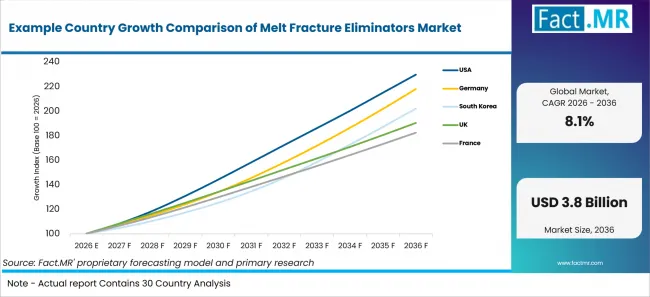
Example Country Growth Comparison Of Melt Fracture Eliminators Market | Source: Fact.MR
| Country | CAGR (2026-2036) |
|---|---|
| USA | 8.7% |
| Germany | 8.1% |
| South Korea | 7.3% |
| UK | 6.6% |
| France | 6.2% |
Source: Fact.MR analysis. Updated Sep 3, 2026
What supports USA adoption?
8.7% CAGR, supported by active plastics output and PFAS documentation.
U.S. converters evaluate PPAs through pressure change and visible surface quality in LLDPE film trials. The Federal Reserve’s seasonally adjusted plastics and rubber products index reached 95.2939 in July 2026. The USA is expected to record 8.7% CAGR through 2036 as additive trials link defect control with chemical documentation.
What underpins Germany’s growth?
8.1% CAGR, driven by plastics clusters and EU packaging rules.
Germany gives PPA suppliers a dense conversion base tied to film and pipe qualification work. Germany Trade & Invest states that the country accounts for more than 20% of European plastics production. Germany is projected to post 8.1% CAGR through 2036 as PPWR-linked packaging redesign supports additive review.
How is South Korea scaling demand?
7.3% CAGR, supported by manufacturing activity and packaging modernization.
South Korea’s extrusion base benefits from active manufacturing and regional film investment. The Ministry of Data and Statistics reported that the manufacturing production index increased 6.1% year on year in June 2026. South Korea is anticipated to advance at 7.3% CAGR through 2036 as processors test PPAs for stable output.
What supports the UK outlook?
6.6% CAGR, shaped by rubber and plastics sales and packaging fees.
UK packaging suppliers face material-efficiency checks while EPR and plastic tax rules affect converter decisions. ONS reported UK manufacture of rubber and plastic products at GBP 26,234.6 million in 2025. The UK is estimated to hold 6.6% CAGR through 2036 as recycled-content review increases extrusion-aid screening.
How does France perform?
6.2% CAGR, supported by recycling policy and packaging conversion needs.
France is moving packaging design toward stronger recycling outcomes while converters protect surface quality. Insee reported that the production value of France’s combined rubber and plastic products and other non-metallic mineral products sector reached EUR 54 billion in 2025, based on provisional national accounts data. France is forecast to reach 6.2% CAGR through 2036 as PPA review aligns with packaging compliance.
Who leads the Melt Fracture Eliminators Market?
Arkema S.A. and Dow Inc. lead direct PPA coverage, while Clariant AG and Avient Corporation strengthen non-PFAS extrusion options.
Arkema S.A. is active through Kynar® PVDF and Orgasol® Polyamide 12 polymer processing aids for polyolefin extrusion. Dow Inc. adds alternative PPA technology through DOWSIL™ 5-1050, a polyethylene masterbatch containing a silicone additive for film-packaging extrusion. Clariant AG’s April 2026 Chinaplas update highlighted AddWorks™ PPA 101 FG and AddWorks™ PPA 122 G as PFAS-free solutions for film extrusion applications.
Ampacet Corporation serves the market through PFAS-free PPA and masterbatch systems for film processing. Avient Corporation competes through Cesa non-PFAS process aid for polyolefins. Ingenia Polymers Corp. offers non-PFAS PPAs for blown film and other extrusion technologies. Competition is expected to center on resin-specific proof and technical-service depth.
Which companies are the key providers?
Key companies include Arkema S.A., Clariant AG, Dow Inc., Ampacet Corporation, Avient Corporation, and Ingenia Polymers Corp.
- Arkema S.A.
- Clariant AG
- Dow Inc.
- Ampacet Corporation
- Avient Corporation
- Ingenia Polymers Corp.
Bibliography
- Arkema. (2025, May). Arkema showcase Kynar® PVDF and Orgasol® Polyamide 12, Polymer Processing Aid (PPRA).
- Avient Corporation. (2024, July 29). Non-PFAS polymer process aids for extrusion in polyolefins.
- Board of Governors of the Federal Reserve System. (2026, August 18). Industrial production and capacity utilization – G.17 [Table 4, Industrial Production Indexes: Market and Industry Group Summary].
- Clariant. (2026, April 8). Clariant advances sustainable plastics innovation across the value chain at Chinaplas 2026.
- Dow. (2025, September 23). Dow unveils an alternative to fluoropolymer-based polymer processing aids for film packaging.
- European Chemicals Agency. (2025, August 20). ECHA publishes updated PFAS restriction proposal.
- Directorate-General for Environment. (2026, August 11). New EU packaging rules start to apply, including restrictions on PFAS in food-contact packaging. European Commission.
- Germany Trade & Invest. (2025). The plastics industry in Germany [Fact sheet, Issue 2025].
- Institut national de la statistique et des études économiques. (2026, July 21). Indicateurs macroéconomiques de l'industrie.
- Ministry of Data and Statistics. (2026, July 31). Monthly industrial statistics, June 2026.
- Office for National Statistics. (2026, August 13). UKProdTO: 22 - Manufacture of Rubber and Plastic Products TOTAL (£m) [Time series JQ7N].
- U.S. Environmental Protection Agency. (2026, April 9). Update on reporting deadline for TSCA PFAS reporting rule.
This Report Answers
- The report explains where melt fracture eliminators are used across technology, polyethylene grade, extrusion application, and primary KPI. It covers fluoropolymer, PFAS-free organic, silicone, polyamide, and hybrid PPA systems used across polyethylene extrusion.
- Segment analysis identifies the leading subsegments and the processing reasons converters prioritize them. It examines Fluoropolymer PPA, LLDPE, blown film, and sharkskin elimination together with their role in surface quality, pressure control, and extrusion stability.
- Country analysis examines the USA, Germany, South Korea, UK, and France and the manufacturing, packaging-policy, PFAS-documentation, and plastics-conversion factors influencing PPA qualification and adoption.
- Competitive analysis reviews providers including Arkema S.A., Clariant AG, Dow Inc., Ampacet Corporation, Avient Corporation, and Ingenia Polymers Corp. It also considers fluoropolymer and non-PFAS processing-aid portfolios, masterbatch formats, and technical-service depth.
- Application analysis assesses how sharkskin removal, die build-up, pressure reduction, output improvement, and optical quality influence purchasing decisions. It also considers resin-specific dosing, recycled PE processing, food-contact documentation, and qualification requirements across film, pipe, wire and cable, and sheet extrusion.
What does the Melt Fracture Eliminators Market cover?
Fluoropolymer PPA, organic PPA, silicone PPA and polyamide PPA used for extrusion surface control.
The Melt Fracture Eliminators Market covers additives used to reduce sharkskin, die build-up and pressure instability during polymer extrusion. The market includes fluoropolymer PPAs, PFAS-free organic PPAs, silicone PPAs, polyamide PPAs and hybrid systems used mainly in polyethylene conversion.
The scope differs from broader processing-aid categories because it focuses on melt-fracture control and related extrusion KPIs. Adjacent fluoropolymers are covered only when positioned as extrusion processing aids.
What is included in the scope?
Melt fracture eliminator systems used in polyethylene extrusion and recycled PE conversion.
The scope includes PPA masterbatches and additive concentrates used in LLDPE, mLLDPE, HDPE and recycled PE compounds. It covers blown film, cast film, pipe and tube, wire and cable, monofilament and sheet extrusion. Coverage includes systems used with circular polyolefins when extrusion surface control is the stated function.
What is excluded from the scope?
General lubricants and unrelated polymer additives are outside the scope.
The scope excludes polymer resins sold without a PPA function and general colorants outside melt-fracture control. Broader masterbatch systems fall outside the boundary unless positioned for extrusion processing enhancement. Equipment-only fixes and die redesign services are outside the market boundary.
How Was the Analysis Built?
The analysis draws on 120+ sources, 35+ company portfolios, 25+ countries, and more than 20 industry interviews.
- Primary Research: Primary research includes discussions with manufacturers, service providers, technology developers, distributors, end users, and subject-matter experts. These conversations examine purchasing priorities, product adoption, operational challenges, approval requirements, competitive positioning, and the factors that influence wider market acceptance.
- Desk Research: Desk research covers government statistics, regulatory publications, company filings, trade data, technical studies, industry associations, standards, public policy, and other authoritative sources. Every source used in the analysis is documented in the bibliography.
- Market Sizing and Forecasting: Market estimates combine historical performance, demand indicators, pricing and volume trends, segment shares, company participation, country-level growth, adoption patterns, investment activity, and barriers to market expansion.
- Data Validation and Update Cycle: Findings are validated by comparing primary interviews with public data, company activity, regulatory changes, trade patterns, and industry developments. Regular updates review new product launches, capacity changes, partnerships, approvals, and shifts in commercial adoption.
Segmentation
What is the report’s scope and coverage?
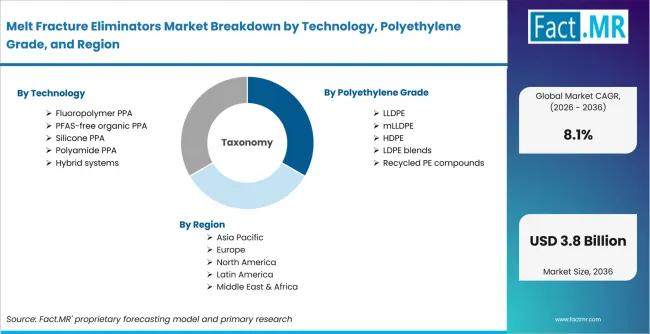
Melt Fracture Eliminators Market Breakdown By Technology, Polyethylene Grade, And Region | Source: Fact.MR
| Attribute | Details |
|---|---|
| Quantitative Units | USD billion |
| Market Definition | Additives used to reduce sharkskin, die build-up and pressure instability during polymer extrusion. |
| Technology | Fluoropolymer PPA; PFAS-free organic PPA; Silicone PPA; Polyamide PPA; Hybrid systems |
| Polyethylene Grade | LLDPE; mLLDPE; HDPE; LDPE blends; Recycled PE compounds |
| Extrusion Application | Blown film; Cast film; Pipe and tube; Wire and cable; Monofilament and sheet |
| Primary KPI | Sharkskin elimination; Die build-up reduction; Pressure reduction; Output increase; Optical and surface quality |
| Regions Covered | North America; Latin America; Western Europe; Eastern Europe; East Asia; South Asia & Pacific; Middle East & Africa |
| Countries Covered | USA; Germany; South Korea; UK; France |
| Companies Profiled | Arkema S.A.; Clariant AG; Dow Inc.; Ampacet Corporation; Avient Corporation; Ingenia Polymers Corp. |
| Forecast Period | 2026 to 2036 |
| Approach | Hybrid top-down and bottom-up approach using extrusion applications; polyethylene grade mix; technology adoption; country conversion activity; and provider portfolio review. |
Source: Fact.MR analysis. Updated Sep 3, 2026
How is the market segmented?
-
By Technology:
- Fluoropolymer PPA
- PFAS-free organic PPA
- Silicone PPA
- Polyamide PPA
- Hybrid systems
-
By Polyethylene Grade:
- LLDPE
- mLLDPE
- HDPE
- LDPE blends
- Recycled PE compounds
-
By Extrusion Application:
- Blown film
- Cast film
- Pipe and tube
- Wire and cable
- Monofilament and sheet
-
By Primary KPI:
- Sharkskin elimination
- Die build-up reduction
- Pressure reduction
- Output increase
- Optical and surface quality
-
By Region:
- North America
- Latin America
- Western Europe
- Eastern Europe
- East Asia
- South Asia & Pacific
- Middle East & Africa
Frequently Asked Questions
How big is the melt fracture eliminators market in 2026?
What is the CAGR of the melt fracture eliminators market from 2026 to 2036?
Which technology leads the melt fracture eliminators market?
Which polyethylene grade leads the melt fracture eliminators market?
Who are the leading companies in the melt fracture eliminators market?
Who worked on this report


Preview the report firsthand - request a free sample
Free SampleGet the brochure for pricing and purchase details
Download PDF