- Market Value (2025): USD 3.9 Bn
- Estimated Value (2026): USD 4.3 Bn
- Forecast Value (2036): USD 11.9 Bn
- CAGR (2026-2036): 10.7%
What is the Moisture-Control Hot Trays Market forecast to be worth by 2036?
USD 4.3 billion in 2026 to USD 11.9 billion by 2036 at a 10.7% CAGR.
- The Moisture-Control Hot Trays Market reached USD 3.9 billion in 2025.
- Demand is projected to increase from USD 4.3 billion in 2026 to USD 11.9 billion by 2036.
- The market is forecast to record a 10.7% CAGR from 2026 to 2036 as hot-meal users and food packers adopt fiber formats with better moisture and grease control.
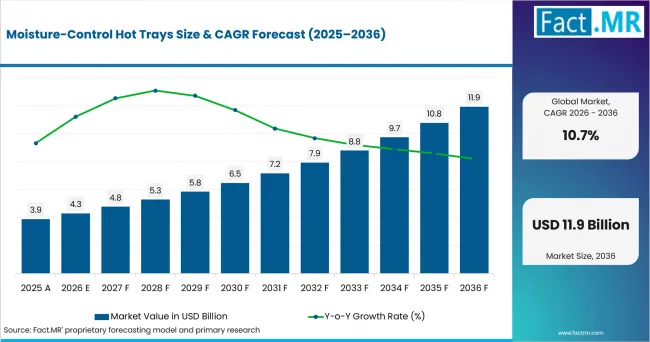
Moisture Control Hot Trays Value Analysis | Source: Fact.MR
What are the defining numbers behind Moisture-Control Hot Trays Market growth?
USD 7.6 billion absolute opportunity is expected between 2026 and 2036.
- Demand Drivers in the Market
- Quick-service and takeaway users need rigid trays that keep their shape after steam and sauces reach the fiber surface. This need links moisture-control trays with wider foodservice packaging.
- Foodservice distributors need formats that balance oil resistance with moisture control. USDA Economic Research Service reported USD 1.41 trillion in U.S. food-away-from-home spending in 2025, equal to 56.3% of total food spending.
- Prepared-food brands need fiber trays that can handle chilled or frozen storage before reheat. The same use case overlaps with ready meal trays, where shape stability affects pack choice.
- Packaging converters need materials that meet current food-contact rules and still provide barrier performance. The European Commission stated in August 2026 that the PPWR applies from 12 August 2026 and restricts PFAS above set limits in food-contact packaging.
- Key Segments Analyzed
- By Fiber Feedstock: Bagasse is expected to hold 34.0% share in 2026 because its short-fiber structure works well with molded forms used for food trays and divided serviceware.
- By Performance Treatment: Grease resistant treatment is projected to account for 37.0% share in 2026 as fried foods and sauced meals expose fiber to oil during holding and transport.
- By Format: Trays are expected to capture 33.0% share in 2026 owing to their broad use for plated meals, counter service, prepared foods and divided portions.
- By Application: Hot meals are expected to represent 36.0% share in 2026 because heat, steam and oil create a direct need for moisture control and stable molded structures.
- Analyst Opinion at Fact.MR
- Shambhu Nath Jha, Principal Consultant at Fact.MR, states, “The business test for these trays now extends beyond fiber substitution. Operators are examining how hot food behaves during holding and transport. Demand is projected to favor firms that combine forming strength with grease and moisture control while keeping the tray practical for the intended disposal route.”
- Strategic Implications
- Tray converters should test grease and moisture barriers against the actual hold time of hot meals. The design should align with compostable food service coatings when the finished tray has a compostability route.
- Food brands should match tray depth and compartment shape to menu moisture. Pooled liquid stresses corners and rims in a different way than surface grease.
- Fiber firms should document feedstock consistency so forming lines can hold wall thickness and rim stiffness. Good fiber preparation reduces variation between shallow and deep tray shapes.
- Large-kitchen users should test stacking and reheat together. Where home-compost claims are used, the product should match the conditions covered by home-compostable food serviceware.
China is forecast at 11.0% CAGR through 2036 as catering use supports high-volume meal packs. The USA is projected at 10.5% as food-away-from-home activity supports demand. Japan is also expected at 10.5% as convenience formats remain important in meal distribution. Germany is forecast at 10.3% as packaging rules support recyclable fiber formats. France is projected at 9.8% as prepared-meal channels support rigid single-use formats.
How does the Moisture-Control Hot Trays Market break down by segment?
Grease resistant treatment leads at 37.0%; hot meals lead at 36.0%.
Which Fiber Feedstock dominates?
Bagasse is expected to hold 34.0% share in 2026.
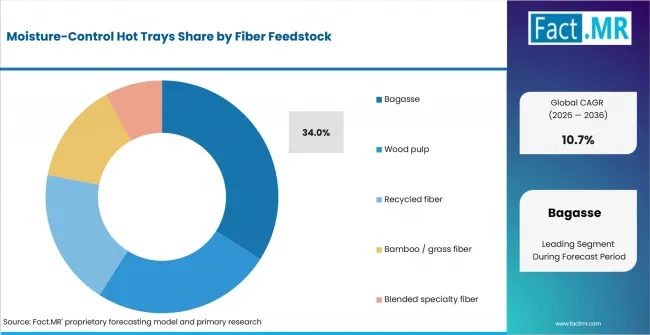
Moisture Control Hot Trays Analysis By Fiber Feedstock | Source: Fact.MR
Bagasse is expected to hold 34.0% share because it can be formed into rigid meal trays and divided formats. Wood pulp remains useful where smooth surfaces and steady strength matter. Recycled fiber fits uses that accept a rougher look and value recovered content. Bamboo and grass fiber add more sourcing options. Blended fibers let converters tune strength and forming behavior for complex shapes. This places bagasse within the wider high-performance molded fiber category.
What leads the Performance Treatment segment?
Grease resistant treatment is projected to account for 37.0% share in 2026.
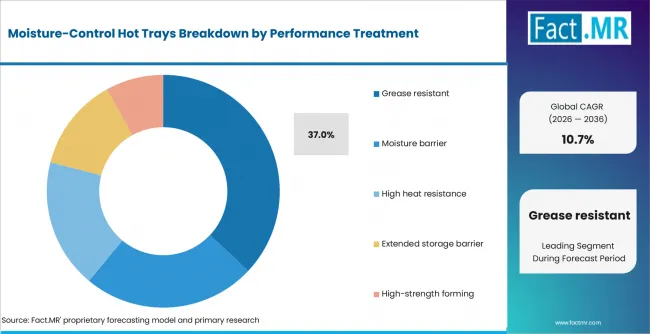
Moisture Control Hot Trays Analysis By Performance Treatment | Source: Fact.MR
Grease resistant treatment is projected to account for 37.0% share because oil can weaken fiber and mark outer surfaces. Moisture barriers limit steam and water uptake when food stays in the tray for longer. Heat resistance matters where reheat is part of the use case. Extended-storage barriers support chilled and frozen uses. High-strength forming supports filling and stacking loads.
How does Format shape demand?
Trays are expected to capture 33.0% share in 2026.
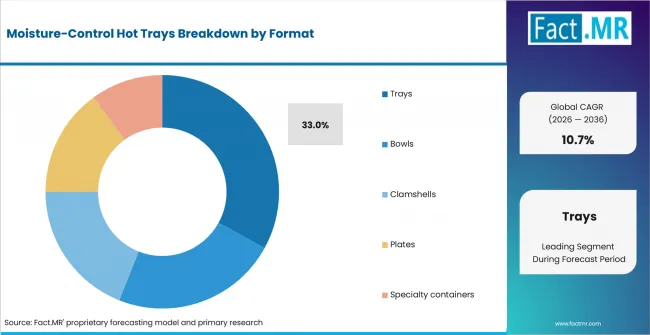
Moisture Control Hot Trays Analysis By Format | Source: Fact.MR
Trays are expected to capture 33.0% share because their open format supports counter service, lidding and divided meals. Bowls suit foods with more liquid. Clamshells combine a base and lid for takeaway use. Plates remain tied to immediate service. Special trays serve menu-specific sizes and handling needs. The format also overlaps with paper trays used for food containment and display.
What supports Hot meals within Application?
Hot meals are expected to represent 36.0% share in 2026.
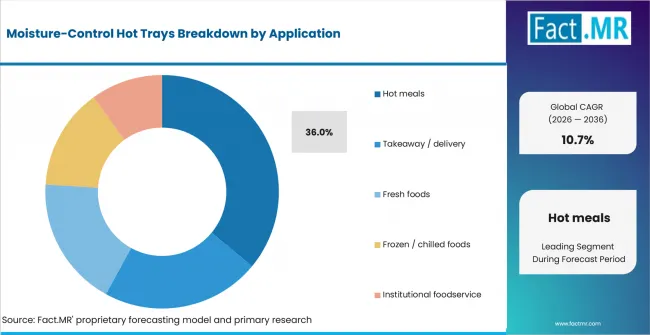
Moisture Control Hot Trays Analysis By Application | Source: Fact.MR
Hot meals are expected to represent 36.0% share because heat and steam can soften fiber when barrier control is weak. Takeaway adds travel time. Fresh foods place more weight on surface moisture and display. Frozen and chilled foods need stability before reheat. Large-kitchen foodservice also adds batch handling and stacking. These needs also overlap with fresh food packaging.
What is accelerating Moisture-Control Hot Trays Market adoption, and what is holding it back?
Hot-food moisture exposure drives use; barrier cost and end-of-life trade-offs restrain it.
Drivers Impact Analysis
| DRIVER | (~) % IMPACT ON CAGR | GEOGRAPHIC RELEVANCE | IMPACT TIMELINE |
|---|---|---|---|
| Hot meal and delivery exposure | +1.6% | Global | Short term (<= 2 years) |
| Fiber substitution in foodservice | +1.3% | North America, Europe, East Asia | Medium term (2-4 years) |
| Barrier-treatment improvement | +1.0% | Global | Medium term (2-4 years) |
| Institutional prepared-meal use | +0.7% | North America, Europe, East Asia | Long term (>= 4 years) |
Source: Fact.MR analysis. Updated Sep 23, 2026
Opportunity Impact Analysis
| OPPORTUNITY | (~) % IMPACT ON CAGR | GEOGRAPHIC RELEVANCE | IMPACT TIMELINE |
|---|---|---|---|
| Extended-storage fiber trays | +1.0% | North America, Europe | Medium term (2-4 years) |
| Cold-to-hot meal formats | +0.8% | Global | Medium term (2-4 years) |
| PFAS-free barrier systems | +0.7% | North America, Europe | Short term (<= 2 years) |
| High-strength specialty forming | +0.5% | East Asia, Europe | Long term (>= 4 years) |
Source: Fact.MR analysis. Updated Sep 23, 2026
Restraints Impact Analysis
| RESTRAINT | (~) % IMPACT ON CAGR | GEOGRAPHIC RELEVANCE | IMPACT TIMELINE |
|---|---|---|---|
| Barrier cost and coating complexity | -0.7% | Global | Short term (<= 2 years) |
| Moisture-related softening | -0.6% | Global | Short term (<= 2 years) |
| Recycling and composting compatibility | -0.5% | North America, Europe | Medium term (2-4 years) |
| Foodservice demand volatility | -0.3% | Global | Medium term (2-4 years) |
Source: Fact.MR analysis. Updated Sep 23, 2026
Which countries are scaling the Moisture-Control Hot Trays Market through 2036?
- The listed country range spans 1.2 points, from China at 11.0% CAGR to France at 9.8% over 2026 to 2036.
- China is 0.5 point above the USA and Japan as catering supports high-volume meal packaging.
- The USA and Japan both record 10.5% CAGR, but restaurant demand and convenience meals create different daily needs.
- Germany is 0.2 point below the USA and Japan as meal-service users balance fiber conversion with packaging cost.
- France closes the displayed range at 9.8% CAGR as food trade demand develops under the same EU packs framework that affects wider sustainable packaging choices.
Similar CAGRs can still create different entry conditions because tray shape, meal type and service channels vary by country. The full report covers North America, Latin America, Western Europe, Eastern Europe, East Asia, South Asia & Pacific, and the Middle East & Africa.
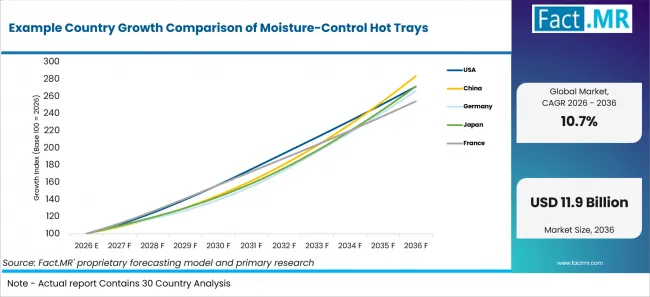
Example Country Growth Comparison Of Moisture Control Hot Trays | Source: Fact.MR
| Country | CAGR (2026-2036) |
|---|---|
| China | 11.0% |
| United States | 10.5% |
| Japan | 10.5% |
| Germany | 10.3% |
| France | 9.8% |
Source: Fact.MR analysis. Updated Sep 23, 2026
What supports China adoption?
11.0% CAGR, supported by catering use and high-volume meal service.
China has a large restaurant and catering base that creates repeat demand for single-use meal trays. The National Bureau of Statistics reported catering income of 5,798.2 billion yuan in 2025. The market is forecast at 11.0% CAGR as tray converters focus on moisture control during hot-food holding. High-volume service also requires steady wall thickness and rim strength.
What supports USA adoption?
10.5% CAGR, backed by a broad food trade daily base.
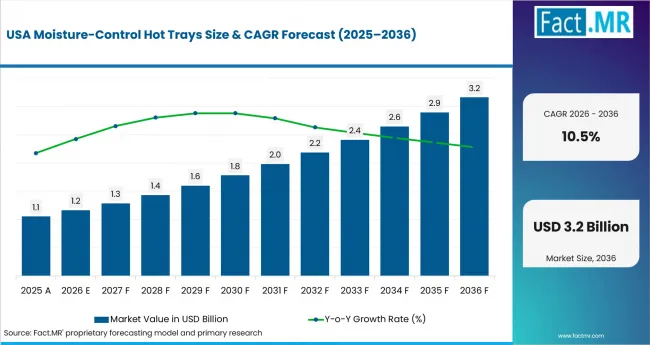
Moisture Control Hot Trays Country Value Analysis | Source: Fact.MR
Foodservice users in the USA need packaging that works across counter service, takeaway and large-kitchen meals. The U.S. Bureau of Labor Statistics reported that food services and drinking places added an average of 12,000 jobs per month in 2025. The market is projected at 10.5% CAGR as hot meals keep grease resistance and leak control central to tray approval. Suppliers also need steady performance across large multi-site networks.
How does Japan perform?
10.5% CAGR, led by convenience-oriented meal formats and precise tray fit.
Japan's prepared-meal market places close attention on portion display and pack uniformity. The Statistics Bureau reported average monthly consumption spending of 314,001 yen for two-or-more-person households in 2025. This is broad household-spending context rather than direct tray-demand evidence. The market is expected at 10.5% CAGR as meal formats continue to need reliable rigid packs. Clean forming and easy de-nesting remain useful on automated packing lines.
What is supporting Germany’s adoption?
10.3% CAGR, supported by fiber conversion under tight meal-service cost control.
Germany's meal-service market combines material-change pressure with close cost control. Destatis reported that gastronomy turnover rose 1.8% in nominal terms in 2025 but fell 2.2% in real terms from 2024. The market is expected at 10.3% CAGR as fiber trays are considered for hot meals and takeaway use. Barrier treatments need to protect stiffness while keeping cost premiums manageable.
What supports France growth?
9.8% CAGR, shaped by food trade use and EU packs needs.
France has a sizable food and beverage service base for prepared meals and restaurant packaging. INSEE reported an output index of 155.0 for food and beverage service activities in June 2026, with 2021 equal to 100. The market is forecast at 9.8% CAGR as firms balance moisture resistance with food-contact needs. Stable tray design remains important during holding and transport.
Who leads the Moisture-Control Hot Trays Market?
Huhtamaki announced in February 2025 that it would separate its Fiber Foodservice Europe-Asia-Oceania business into Fiber Packaging and Foodservice Europe-Asia-Oceania, with the change expected to take effect by April 1, 2025. Novolex completed its combination with Pactiv Evergreen on April 1, 2025, creating a broader food, beverage, and specialty packaging business. Sabert competes through molded-fiber and pulp food-packaging formats suitable for hot and cold foods. These portfolios connect with the wider next-generation paper and fiber packaging market.
Genpak supplies Harvest® molded-fiber trays and containers for foodservice applications. CKF provides molded-fiber foodservice formats including trays, plates, and cup carriers. These portfolios cover rigid fiber-based food packaging across foodservice, catering, takeout, and related applications and also overlap with the waste-fibre trays market.
Duni supplies Duniform Take-Away Fibre trays made from renewable bagasse. The trays use a thin high-barrier lamination and are designed for hot, cold, wet, greasy, and dry foods. The range is suitable for refrigeration, freezing, and microwave use, while its sealable design supports transport, storage, and reheating.
Supplier differentiation is expected to reflect tray rigidity, resistance to moisture and grease, sealing performance, temperature compatibility, storage requirements, and fit with the intended end-of-life route. Format range and clear technical specifications can also help suppliers address restaurant, prepared-food, catering, and institutional foodservice applications.
Which companies are the key providers?
Key companies include Huhtamaki, Novolex (Pactiv Evergreen legacy), Sabert, Genpak, CKF, and Duni.
- Huhtamaki
- Novolex (Pactiv Evergreen legacy)
- Sabert
- Genpak
- CKF
- Duni
Bibliography
- Zeballos, E., & Sinclair, W. (2026, June 11). Total U.S. food spending reached $2.51 trillion in 2025. U.S. Department of Agriculture, Economic Research Service.
- Directorate-General for Environment. (2026, August 11). New EU packaging rules start to apply, including restrictions on PFAS in food-contact packaging. European Commission.
- National Bureau of Statistics of China. (2026, January 19). National economy pushed forward with innovation-led and high-quality development and expected targets achieved successfully in 2025.
- U.S. Bureau of Labor Statistics. (2026, January 9). The employment situation-December 2025.
- Statistics Bureau of Japan. (2026, February 6). 2025 yearly average.
- Statistisches Bundesamt (Destatis). (2026, February 19). Gastgewerbeumsatz 2025 real 2,1 % niedriger als im Vorjahr [Hospitality turnover in 2025 down 2.1% in real terms year on year].
- Institut national de la statistique et des études économiques. (2026, August 21). In June 2026, output in services rebounded slightly (+0.2%).
- Sabert Corporation. (2025, November 19). Sabert Corporation’s Pulp Ultra® wins 2025 U.S. Plastics Pact Packaging Innovation Award for Compostability.
- Huhtamaki. (2025, February 14). Huhtamaki to separate Fiber Foodservice business segment into two distinct segments: Fiber Packaging and Foodservice Europe-Asia-Oceania.
- Novolex. (2025, April 1). Novolex and Pactiv Evergreen Inc. complete combination, creating a leading manufacturer in food, beverage and specialty packaging.
This Report Answers
- The report explains where moisture-control hot trays are used across fiber feedstock, fit treatment, format and use.
- Segment analysis identifies the leading subsegments and the daily reasons meal-service users select them.
- Country analysis examines the listed markets and the food trade conditions that shape tray use.
- Competitive analysis reviews current providers across molded fiber, formed fiber and food trade tray portfolios.
- Use analysis assesses how moisture, grease, heat and storage exposure influence tray choice.
What does the Moisture-Control Hot Trays Market cover?
The Moisture-Control Hot Trays Market covers rigid molded-fiber trays designed to manage moisture, grease or heat during filling, holding, transport, storage or reheat. The assessment includes bagasse, wood pulp, recycled fiber, bamboo or grass fiber and special fiber blends used in rigid meal-service formats.
The market boundary focuses on functional food-contact fit across hot meals, takeaway, fresh foods, chilled foods and large-kitchen service. Plain paperboard packs and plastic trays fall beyond the core boundary. Fiber-based tray systems enter scope when their treatment directly manages moisture or food-contact exposure.
What is included in the scope?
The scope includes molded-fiber food formats with grease-resistant, moisture-barrier, high-heat, extended-storage or high-strength forming features.
It covers restaurant, takeaway, prepared-food and large-kitchen uses. The assessment considers overlap with molded-pulp meal-service formats across the seven-region framework.
What is excluded from the scope?
Plastic-only trays, aluminum meal trays and rigid non-fiber formats fall beyond the scope. Paper wraps, cups and flexible pouches sit beyond the rigid-tray boundary.
Ready meal trays enter scope when the format is fiber based and meets the defined moisture-control boundary.
How Was the Analysis Built?
The analysis draws on 120+ sources, 35+ company portfolios, 25+ countries, and more than 20 industry interviews.
- Primary Research: Primary research includes discussions with manufacturers, service providers, technology developers, distributors, end users, and subject-matter experts. These conversations examine purchasing priorities, product adoption, operational challenges, approval requirements, competitive positioning, and the factors that influence wider market acceptance.
- Desk Research: Desk research covers government statistics, regulatory publications, company filings, trade data, technical studies, industry associations, standards, public policy, and other authoritative sources. Every source used in the analysis is documented in the bibliography.
- Market Sizing and Forecasting: Market estimates combine historical performance, demand indicators, pricing and volume trends, segment shares, company participation, country-level growth, adoption patterns, investment activity, and barriers to market expansion.
- Data Validation and Update Cycle: Findings are validated by comparing primary interviews with public data, company activity, regulatory changes, trade patterns, and industry developments. Regular updates review new product launches, capacity changes, partnerships, approvals, and shifts in commercial adoption.
Segmentation
What is the report’s scope and coverage?
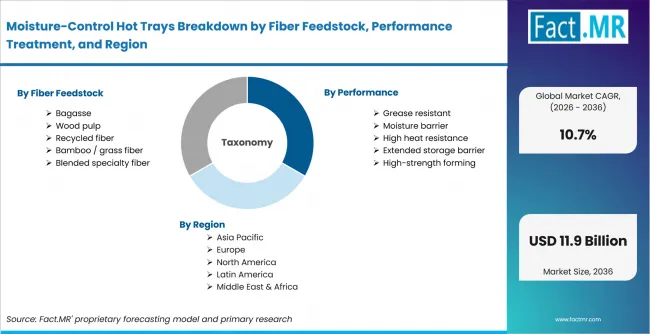
Moisture Control Hot Trays Breakdown By Fiber Feedstock, Performance Treatment, And Region | Source: Fact.MR
| Attribute | Details |
|---|---|
| Quantitative Units | USD billion |
| Market Definition | Molded-fiber trays and related rigid foodservice formats designed to manage moisture, grease, heat or storage exposure in hot and prepared-food applications. |
| Fiber Feedstock | Bagasse; Wood pulp; Recycled fiber; Bamboo / grass fiber; Blended specialty fiber |
| Performance Treatment | Grease resistant; Moisture barrier; High heat resistance; Extended storage barrier; High-strength forming |
| Format | Trays; Bowls; Clamshells; Plates; Specialty containers |
| Application | Hot meals; Takeaway / delivery; Fresh foods; Frozen / chilled foods; Institutional foodservice |
| Regions Covered | North America; Latin America; Western Europe; Eastern Europe; East Asia; South Asia & Pacific; Middle East & Africa |
| Countries Covered | China; United States; Japan; Germany; France |
| Key Companies Profiled | Huhtamaki; Novolex (Pactiv Evergreen legacy); Sabert; Genpak; CKF; Duni |
| Forecast Period | 2026 to 2036 |
| Approach | Hybrid top-down and bottom-up assessment using foodservice use cases, molded-fiber product coverage, barrier requirements, country demand indicators and provider portfolio review. |
Source: Fact.MR analysis. Updated Sep 23, 2026
How is the market segmented?
-
By Fiber Feedstock:
- Bagasse
- Wood pulp
- Recycled fiber
- Bamboo / grass fiber
- Blended specialty fiber
-
By Performance Treatment:
- Grease resistant
- Moisture barrier
- High heat resistance
- Extended storage barrier
- High-strength forming
-
By Format:
- Trays
- Bowls
- Clamshells
- Plates
- Specialty containers
-
By Application:
- Hot meals
- Takeaway / delivery
- Fresh foods
- Frozen / chilled foods
- Institutional foodservice
-
By Region:
- North America
- Latin America
- Western Europe
- Eastern Europe
- East Asia
- South Asia & Pacific
- Middle East & Africa
Frequently Asked Questions
How big is the moisture-control hot trays market in 2026?
What is the CAGR of the moisture-control hot trays market from 2026 to 2036?
Which performance treatment leads the moisture-control hot trays market?
Which application leads the moisture-control hot trays market?
Who are the leading companies in the moisture-control hot trays market?
Who worked on this report


Preview the report firsthand - request a free sample
Free SampleGet the brochure for pricing and purchase details
Download PDF