- Market Value (2025): USD 4.7 Bn
- Estimated Value (2026): USD 5.1 Bn
- Forecast Value (2036): USD 13.8 Bn
- CAGR (2026-2036): 10.4%
What is the Extended-Storage Molded Fiber Market forecast to be worth by 2036?
USD 5.1 billion in 2026 to USD 13.8 billion by 2036 at a 10.4% CAGR.
- The Extended-Storage Molded Fiber Market reached USD 4.7 billion in 2025.
- Demand is forecast to increase from USD 5.1 billion in 2026 to USD 13.8 billion by 2036.
- The market is forecast to grow at a 10.4% CAGR from 2026 to 2036. Demand comes from meal service and prepared food teams. These users need fiber packs that stay strong during longer storage and transit.
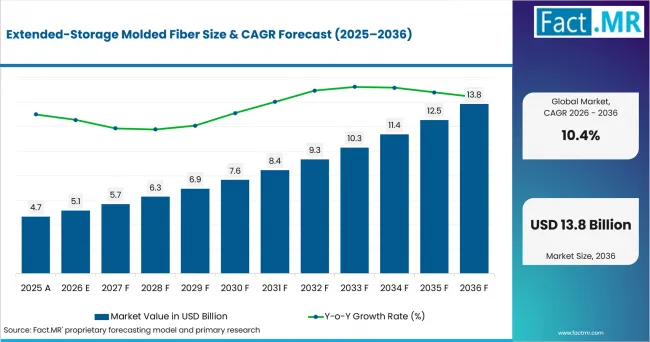
Extended Storage Molded Fiber Value Analysis | Source: Fact.MR
What are the defining numbers behind Extended-Storage Molded Fiber Market growth?
An absolute opportunity of USD 8.6982 billion is expected between 2026 and 2036.
- Demand Drivers in the Market
- Meal service teams need packs that stay firm during longer holding and transit. In June 2026, the USDA Economic Research Service reported that inflation-adjusted U.S. food-away-from-home spending reached USD 1.41 trillion in 2025, expressed in 2025 dollars. Food away from home accounted for 56.3% of total food expenditures in 2025 on a nominal basis.
- Prepared food brands need molded fiber for hot filling and reheating. The pack must keep its shape. Heat resistance matters when packs move from preparation to holding and delivery. The barrier must protect food and help the fiber wall stay rigid through that cycle.
- Converters need grease and moisture barriers that fit the food type and holding period. Clear test conditions help teams compare options before commercial runs. Even coating at corners and rims is important because these areas face more handling stress.
- Retail and transit channels need rigid fiber packs that protect food during stacking and movement. Food-to-go packs therefore need a secure fit and dependable closure. The pack must keep its form as it moves between kitchens, counters and transit bags.
- Key Segments Analyzed
- By Fiber Feedstock: Bagasse is forecast to hold 34.0% share in 2026. It can form rigid food packs and supports many sugarcane bagasse fiber applications.
- By Performance Treatment: Grease resistant is forecast to hold 37.0% share in 2026. Hot meals need barriers that control oil during holding and transit.
- By Format: Trays are forecast to capture 33.0% share in 2026. They are widely used for prepared meals, fresh foods and portioned meal service.
- By Application: Hot meals are estimated to hold 36.0% share in 2026. Heat and steam put direct stress on ready-meal trays during service and transit.
- Analyst Opinion at Fact.MR
- Shambhu Nath Jha, Principal Consultant at Fact.MR states: “Extended storage changes the use test for molded fiber. Packs are forecast to keep their shape after longer contact with moisture or grease. Suppliers should combine stable forming with food-safe coatings and clear use limits.”
- Strategic Implications
- Meal service teams should test filled packs after realistic hot-hold and chilled-storage cycles. Longer dwell time can reveal weak points that short bench tests miss. Full-pack tests help teams compare wall stiffness and lid fit before wider use.
- Fiber suppliers should document furnish consistency and forming behavior. Stable inputs help converters control wall thickness and stiffness. Uniform fiber preparation also supports repeatable pressure and drying conditions across shifts and lines.
- Brand owners should match pack design with local collection and paper-recovery systems. Clear disposal guidance can make fiber packs easier to sort. Material choices and surface treatments should be reviewed together. End-of-life instructions should stay simple.
China is forecast to record a 12.1% CAGR through 2036. France is forecast at 10.9%. The USA and Japan are each forecast at 9.7%. Germany is forecast at 9.5%. The growth drivers differ across catering, meal service, food trade and recovery systems.
How does the Extended-Storage Molded Fiber Market break down by segment?
Grease resistant is projected to lead Performance Treatment at 37.0% share in 2026. Hot meals are estimated to lead Application at 36.0% share.
Which Fiber Feedstock dominates?
Bagasse is expected to hold 34.0% share in 2026.
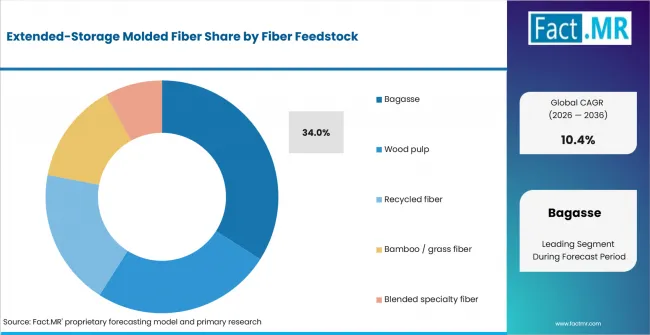
Extended Storage Molded Fiber Analysis By Fiber Feedstock | Source: Fact.MR
Bagasse is forecast to lead because it forms well into rigid food packs. Wood pulp is another common forming base. Recycled fiber can serve suitable food-contact uses. Bamboo and grass fiber add non-wood options. Blends can tune stiffness or surface quality.
What leads the Performance Treatment segment?
Grease resistant is projected to account for 37.0% share in 2026.
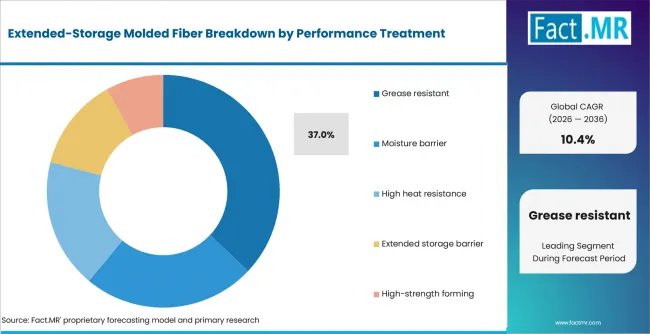
Extended Storage Molded Fiber Analysis By Performance Treatment | Source: Fact.MR
Grease resistance is forecast to lead. Hot meals place oil against the fiber wall during holding and transit. Moisture barriers serve chilled foods. High-heat systems support reheating. Extended-storage barriers address longer contact times. High-strength forming helps packs resist stacking and repeated handling.
How does Format shape demand?
Trays are anticipated to capture 33.0% share in 2026.
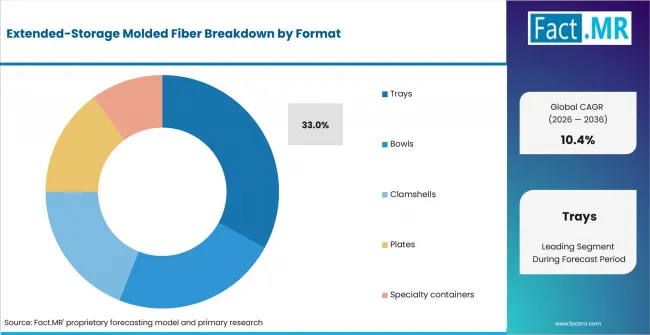
Extended Storage Molded Fiber Analysis By Format | Source: Fact.MR
Trays are forecast to lead because they suit prepared meals and fresh foods. They also help keep portions stable in transit. Bowls serve liquid-rich meals. Clamshells combine a base with an attached lid. Plates remain useful in catering. In September 2026, ADEME reported that 4,893 kt of household packaging and graphic papers were sorted for recycling in France in 2024.
What supports Hot meals within Application?
Hot meals are estimated to represent 36.0% share in 2026.
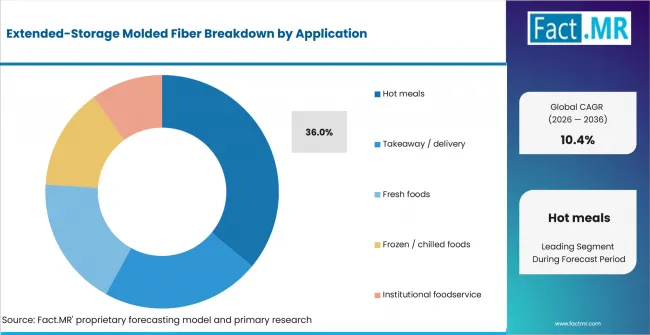
Extended Storage Molded Fiber Analysis By Application | Source: Fact.MR
Hot meals are estimated to lead. Heat and steam test fiber strength during service and transit. Takeaway packs need stackability. Fresh foods need moisture control. Frozen and chilled foods need resistance to condensation. Institutional meal service also values repeatable pack sizes.
What is accelerating Extended-Storage Molded Fiber Market adoption, and what is holding it back?
Meal service packaging needs support demand. Barrier cost and performance variation affect the pace of adoption.
Drivers Impact Analysis
| DRIVER | (~) % IMPACT ON CAGR | GEOGRAPHIC RELEVANCE | IMPACT TIMELINE |
|---|---|---|---|
| Food-away-from-home and prepared-meal volumes | +1.5% | North America, East Asia | Short term (<= 2 years) |
| PFAS-free grease and moisture barriers | +1.2% | North America, Europe | Medium term (2-4 years) |
| Fiber-packaging recycling infrastructure | +0.9% | Europe, Japan | Medium term (2-4 years) |
| Delivery and transport durability needs | +0.7% | East Asia, North America | Long term (>= 4 years) |
Source: Fact.MR analysis. Updated Sep 23, 2026
Opportunity Impact Analysis
| OPPORTUNITY | (~) % IMPACT ON CAGR | GEOGRAPHIC RELEVANCE | IMPACT TIMELINE |
|---|---|---|---|
| Barrier systems for longer hot-hold and chilled storage | +1.0% | Global | Medium term (2-4 years) |
| Formed-fiber replacement of selected plastic food packs | +0.8% | Europe, North America | Long term (>= 4 years) |
| Custom trays for retail and institutional meals | +0.6% | Global | Short term (<= 2 years) |
Source: Fact.MR analysis. Updated Sep 23, 2026
Restraints Impact Analysis
| RESTRAINT | (~) % IMPACT ON CAGR | GEOGRAPHIC RELEVANCE | IMPACT TIMELINE |
|---|---|---|---|
| Barrier treatment cost and qualification burden | -0.6% | Global | Short term (<= 2 years) |
| Strength loss under prolonged moisture exposure | -0.5% | Global | Medium term (2-4 years) |
| Uneven collection and composting routes | -0.4% | Europe, Asia | Long term (>= 4 years) |
Source: Fact.MR analysis. Updated Sep 23, 2026
Which countries are scaling the Extended-Storage Molded Fiber Market through 2036?
- The displayed country range spans 2.6 percentage points. China is forecast at 12.1% CAGR and Germany at 9.5%.
- China is 1.2 percentage points above France in the forecast. Its large catering market creates a broad base for transport-ready food packs.
- France is 1.2 percentage points above the USA in the forecast. Meal service channels are using more paper-based food formats.
- The USA and Japan are both forecast at 9.7% CAGR. Their demand patterns differ across restaurants and food trade.
- Germany is forecast at 9.5% CAGR. Its established paper-recovery system supports fiber-based packaging programs.
Similar CAGRs can still reflect different market conditions. Meal service scale and recovery systems vary by country. The report covers seven regions. These are North America, Latin America, Western Europe, Eastern Europe, East Asia, South Asia & Pacific, and Middle East & Africa.
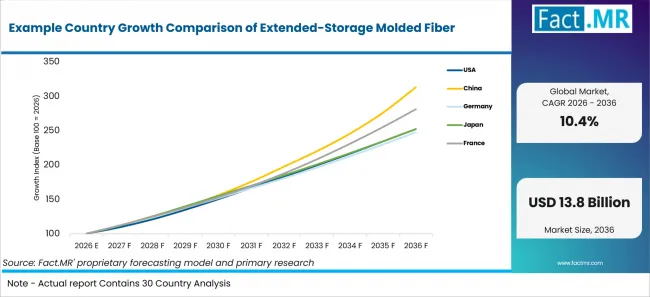
Example Country Growth Comparison Of Extended Storage Molded Fiber | Source: Fact.MR
| Country | CAGR (2026-2036) |
|---|---|
| China | 12.1% |
| France | 10.9% |
| USA | 9.7% |
| Japan | 9.7% |
| Germany | 9.5% |
Source: Fact.MR analysis. Updated Sep 23, 2026
What supports USA demand?
9.7% CAGR, supported by food-away-from-home spending and barrier needs.
U.S. meal service teams are forecast to favor firm molded fiber packs. These packs must perform during hot holding and transit. The 9.7% CAGR reflects restaurant use and a need for reliable grease barriers. In January 2026, the U.S. Bureau of Labor Statistics reported a 4.1% annual rise in food-away-from-home prices for December 2025.
What supports China demand?
12.1% CAGR, backed by catering scale and transport-ready food packaging.
China's large catering market gives converters a broad outlet for rigid fiber trays and bowls. The market is forecast to grow at 12.1% CAGR. In January 2026, the National Bureau of Statistics of China reported 2025 catering income of CNY 5,798.2 billion. This was up 3.2% from a year earlier.
What supports Germany demand?
9.5% CAGR, led by paper recovery systems and meal service packaging use.
Germany's paper recovery system supports a large packaging-recycling base. The market is forecast at 9.5% CAGR. Meal service use of recyclable trays and barrier treatments supports the forecast. In January 2026, the German Environment Agency and Central Agency Packaging Register reported on waste collected by the dual systems. Around 5.5 million tonnes of packaging waste were recovered in 2024.
What supports Japan demand?
9.7% CAGR, driven by food trade and compact meal-pack formats.
Japan's food trade and convenience-meal channels are forecast to support compact molded fiber packs. The market is forecast to grow at 9.7% CAGR. In February 2026, Japan's Ministry of Agriculture, Forestry and Fisheries reported its 2025 food-related export results. Agricultural, forestry and fishery products and food exports reached JPY 1.7005 trillion. This was up 12.8%.
What supports France demand?
10.9% CAGR, shaped by restaurant spending and paper-based meal packaging.
France's catering and prepared food channels are forecast to support strong fiber packs. Simple end-of-life guidance also matters. The market is forecast at 10.9% CAGR. In June 2026, Insee reported on 2025 spending for restaurants and accommodation. It was more than 20% above the 2019 level.
Who leads the Extended-Storage Molded Fiber Market?
Footprint, ThermoFibre, Sabert, Flatz, CKF and Cirkla are the profiled providers in the Extended-Storage Molded Fiber Market. Their relevance centers on molded-fiber food packaging designed for longer holding, delivery, chilled storage and prepared-food applications.
Competition centers on the ability to combine rigid fiber structures with grease resistance, moisture barriers, heat resistance and extended-storage performance. Suppliers also need forming consistency and structural strength so trays, bowls, clamshells and specialty containers maintain their shape during handling and transit.
Foodservice and prepared-meal applications place additional weight on stackability, barrier durability and compatibility with hot or chilled foods. Providers that support bagasse, wood pulp, recycled fiber and other specialty fiber systems can address different pack designs and end-use requirements.
Competitive differentiation therefore centers on forming quality, grease and moisture control, heat tolerance, structural retention and compatibility with longer food-holding cycles. Format breadth across trays, bowls, clamshells and specialty containers also influences supplier positioning.
Which companies are the key providers?
Companies profiled include Footprint; ThermoFibre; Sabert; Flatz; CKF; and Cirkla.
- Footprint
- ThermoFibre
- Sabert
- Flatz
- CKF
- Cirkla
Bibliography
- Zeballos, E., & Sinclair, W. (2026, June 11). Total U.S. food spending reached $2.51 trillion in 2025. U.S. Department of Agriculture, Economic Research Service.
- U.S. Food and Drug Administration. (2025, January 3). FDA determines authorization for 35 food contact notifications related to PFAS are no longer effective.
- Van de Voorde, J. (2026, March). Household packaging and graphic papers: Data 2024. ADEME.
- U.S. Bureau of Labor Statistics. (2026, January 13). Consumer Price Index – December 2025.
- National Bureau of Statistics of China. (2026, January 20). Total retail sales of consumer goods in December 2025.
- German Environment Agency, & Central Agency Packaging Register. (2026, January 27). Facts against myths: Packaging waste recycling in Germany is working.
- Beretti, P.-A., & Pereira, É. (2026, June 16). Household consumption in 2025: Household consumption slowed despite a sharp deceleration in prices. Insee Première, (2110).
This Report Answers
- The report explains where extended-storage molded fiber packaging is used across fiber feedstock and performance treatment. It also covers format and application requirements across longer-hold food packaging.
- Segment analysis identifies the leading subsegments and the operating reasons foodservice teams prioritize them, including grease resistance, structural strength, heat tolerance, and storage performance.
- Country analysis examines the listed markets and the foodservice, catering, recycling, and food-trade conditions supporting molded-fiber adoption.
- Competitive analysis reviews current providers across molded-fiber food packaging and formed-fiber technology. It also covers tray, bowl, clamshell, and related foodservice packaging capabilities.
- Application analysis assesses how heat, grease, moisture, and longer holding periods influence package selection. It also considers stackability, transit durability, barrier performance, and compatibility with hot, chilled, and prepared-food uses.
What does the Extended-Storage Molded Fiber Market cover?
The Extended-Storage Molded Fiber Market covers rigid fiber packs used beyond immediate food service. It includes molded-fiber trays made for food contact. Trays, bowls, clamshells and specialty packs are included when fiber forms the main rigid body. High-performance molded fiber also fits the scope. Its forming and coating must suit longer contact with hot or chilled foods.
The assessment covers trays, bowls and clamshells used for hot meals and transit. It also covers related paper-packaging uses. In these uses, rigid fiber protects food during storage, handling and transport. The market focuses on food-contact performance rather than industrial protective pulp packs.
What is included in the scope?
The scope includes molded fiber packs made from bagasse, wood pulp and recycled fiber. Bamboo, grass fiber and blended furnish are included when they form the rigid pack body. Food-to-go packs are also included. Molded fiber must provide the main structure during storage or delivery.
The scope includes fiber packs used in sustainable food packaging. Longer holding must be part of the use case. Home-compostable food serviceware is included when molded fiber forms the main rigid body. The pack must meet the same storage needs.
What is excluded from the scope?
The scope excludes loose paper wraps and flexible films. Industrial protective pulp packs are outside the boundary because their main role is product protection. Paperboard remains an adjacent category. It can compete with molded fiber in rigid meal-service uses.
Plastic-only packs and bioplastic formats are outside the core boundary. Fiber wraparound packs and transport cases are excluded in most cases. They are included only when they are the main molded food pack. The analysis stays focused on rigid formed-fiber packs used for longer food holding.
How Was the Analysis Built?
The analysis draws on 120+ sources, 35+ company portfolios, 25+ countries, and more than 20 industry interviews.
- Primary Research: Primary research includes discussions with manufacturers, service providers, technology developers, distributors, end users, and subject-matter experts. These conversations examine purchasing priorities, product adoption, operational challenges, approval requirements, competitive positioning, and the factors that influence wider market acceptance.
- Desk Research: Desk research covers government statistics, regulatory publications, company filings, trade data, technical studies, industry associations, standards, public policy, and other authoritative sources. Every source used in the analysis is documented in the bibliography.
- Market Sizing and Forecasting: Market estimates combine historical performance, demand indicators, pricing and volume trends, segment shares, company participation, country-level growth, adoption patterns, investment activity, and barriers to market expansion.
- Data Validation and Update Cycle: Findings are validated by comparing primary interviews with public data, company activity, regulatory changes, trade patterns, and industry developments. Regular updates review new product launches, capacity changes, partnerships, approvals, and shifts in commercial adoption.
Segmentation
What is the report’s scope and coverage?
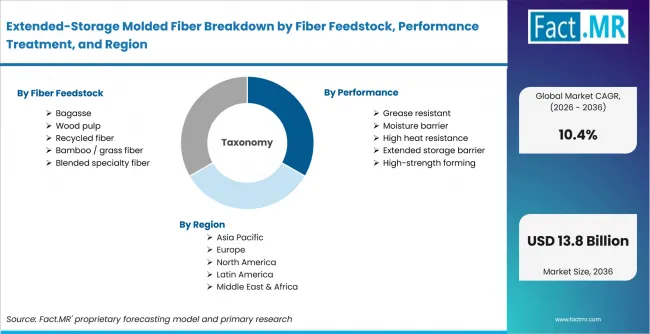
Extended Storage Molded Fiber Breakdown By Fiber Feedstock, Performance Treatment, And Region | Source: Fact.MR
| Attribute | Details |
|---|---|
| Quantitative Units | USD billion |
| Market Definition | Molded-fiber food packaging designed to retain structural and barrier performance during extended holding, delivery, chilled storage or prepared-food use. |
| Fiber Feedstock | Bagasse; Wood pulp; Recycled fiber; Bamboo / grass fiber; Blended specialty fiber |
| Performance Treatment | Grease resistant; Moisture barrier; High heat resistance; Extended storage barrier; High-strength forming |
| Format | Trays; Bowls; Clamshells; Plates; Specialty containers |
| Application | Hot meals; Takeaway / delivery; Fresh foods; Frozen / chilled foods; Institutional foodservice |
| Regions Covered | North America; Latin America; Western Europe; Eastern Europe; East Asia; South Asia & Pacific; Middle East & Africa |
| Countries Covered | USA; China; Germany; Japan; France |
| Key Companies Profiled | Footprint; ThermoFibre; Sabert; Flatz; CKF; Cirkla |
| Forecast Period | 2026 to 2036 |
| Approach | Hybrid top-down and bottom-up approach using foodservice activity, fiber-packaging demand, format mix, barrier requirements, country adoption and provider portfolio review. |
Source: Fact.MR analysis. Updated Sep 23, 2026
How is the market segmented?
-
By Fiber Feedstock
- Bagasse
- Wood pulp
- Recycled fiber
- Bamboo / grass fiber
- Blended specialty fiber
-
By Performance Treatment
- Grease resistant
- Moisture barrier
- High heat resistance
- Extended storage barrier
- High-strength forming
-
By Format
- Trays
- Bowls
- Clamshells
- Plates
- Specialty containers
-
By Application
- Hot meals
- Takeaway / delivery
- Fresh foods
- Frozen / chilled foods
- Institutional foodservice
-
By Region
- North America
- Latin America
- Western Europe
- Eastern Europe
- East Asia
- South Asia & Pacific
- Middle East & Africa
Frequently Asked Questions
How big is the extended-storage molded fiber market in 2026?
What is the CAGR of the extended-storage molded fiber market from 2026 to 2036?
Which performance treatment leads the extended-storage molded fiber market?
Which application leads the extended-storage molded fiber market?
Who are the leading companies in the extended-storage molded fiber market?
Who worked on this report


Preview the report firsthand - request a free sample
Free SampleGet the brochure for pricing and purchase details
Download PDF