- Market Value (2025): USD 547.6 Mn
- Estimated Value (2026): USD 571.9 Mn
- Forecast Value (2036): USD 882.2 Mn
- CAGR (2026-2036): 4.4%
What is the Diethylene Glycol Monomethyl Ether Market forecast to be worth by 2036?
USD 571.9 million in 2026 to USD 882.2 million by 2036, at 4.4% CAGR.
- The diethylene glycol monomethyl ether market was valued at USD 547.6 million in 2025, reflecting continued purchases of approved solvent grades by industrial formulators.
- Revenue is projected to increase from USD 571.9 million in 2026 to USD 882.2 million by 2036 as existing manufacturing applications continue to require qualified solvent supplies.
- The market is projected to grow at a 4.4% CAGR from 2026 to 2036.
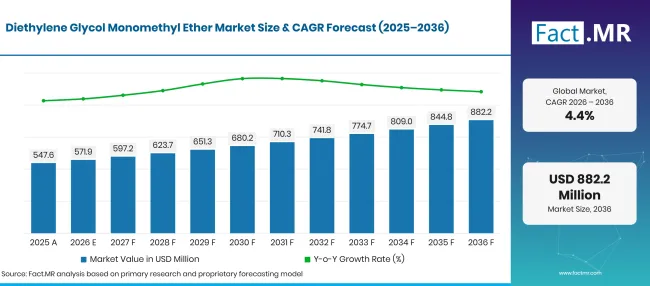
Diethylene Glycol Monomethyl Ether Market Forecast Global | Source: Fact.MR
| Year | Basis | Market Value (USD million) |
|---|---|---|
| 2025 | Calculated estimate | 547.6 |
| 2026 | Estimate | 571.9 |
| 2036 | Forecast | 882.2 |
| CAGR 2026 to 2036 | Forecast period | 4.4% |
Source: Fact.MR analysis. Updated Nov 2, 2026
What are the defining numbers behind Diethylene Glycol Monomethyl Ether Market growth?
The forecast represents USD 310.3 million in additional annual value by 2036, with industrial grades, solvent applications and paints and coatings forming the main demand categories.
- Demand Drivers in the Market
- Formulators value stable solvency. Methyl carbitol is water-compatible while also dissolving many organic ingredients.
- Coatings producers need workable drying time. The paints and coatings segment uses solvent systems selected for resin compatibility and final-film behavior.
- Chemical processing creates repeat purchasing. Plants using a qualified solvent commonly maintain stable specifications to avoid changes in batch behavior.
- Ingredient suppliers serving chemical plants are expected to benefit from clear batch specifications and dependable deliveries. Solvent purchasers review chemical identity and document quality before approving an ongoing supply relationship.
- Key Segments Analyzed
- By Product Type: Industrial Grade is projected to represent 58.4% of 2026 revenue as manufacturing formulations place weight on dependable technical specifications.
- By Application: Solvent use is estimated to account for 42.3% of 2026 sales due to the chemical’s use as a dissolving and blending ingredient.
- By End-User Industry: Paints and Coatings is projected to hold 35.2% of 2026 market value as formulators apply glycol ether properties in selected coating systems.
- Analyst Opinion at Fact.MR
- Shambhu Nath Jha, Principal Consultant at Fact.MR, states, “Methyl diglycol suppliers compete primarily on solvent fitness within the customer’s actual mixture and repeatability between deliveries. A formulator’s evaluation includes the solvent’s effect on drying time and blend stability. Once a material passes its internal checks, the manufacturer has a practical reason to maintain the qualified chemical specification.”
- Strategic Implications
- Manufacturers benefit from consistent technical specifications and safety documents across production lots. Coatings teams can then assess the material against their established formulation tests before considering changes to the ingredient source.
- Coating formulators should compare drying performance and resin compatibility inside the complete recipe before approving a new grade or supplier. Such checks support predictable finish quality across repeated batches.
- Chemical distributors should distinguish product identity from similar glycol ethers and maintain suitable storage and transport information. Suppliers can also compare adjacent glycol solvent demand in the triethylene glycol market while keeping the substances distinct.
- Industrial purchasers assess the total formulation cost alongside the time needed to qualify a solvent. A small difference in unit price has limited commercial appeal when additional testing introduces operating delays.
Brazil is projected to grow at 5.6% CAGR, followed by the USA at 5.0%, Germany at 4.6%, the UK at 3.6%, and Japan at 3.3% through 2036. Each market reflects a different mix of manufacturing customers and chemical distribution channels.
How does the Diethylene Glycol Monomethyl Ether Market break down by segment?
Industrial Grade 58.4%; Solvent 42.3%; Paints and Coatings 35.2% in 2026.
Which Product Type dominates?
Industrial Grade represents 58.4% of 2026 market value.
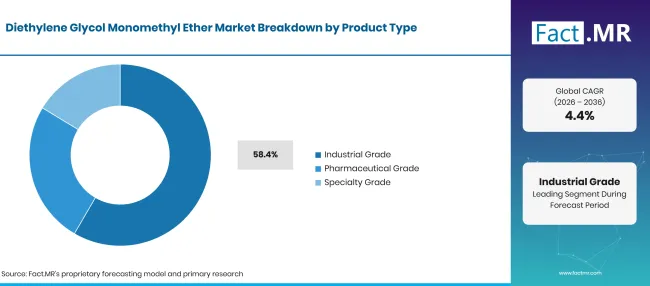
Diethylene Glycol Monomethyl Ether Market Breakdown Product Type | Source: Fact.MR
| Which Product Type dominates | Share (2026) |
|---|---|
| Industrial Grade (Leading segment) | 58.4% |
| Other segments combined | 41.6% |
| Total | 100.0% |
Source: Fact.MR analysis. Updated Nov 2, 2026
Industrial grade is projected to represent 58.4% of product-type revenue in 2026. This grade serves industrial blending operations where solvent quality has to remain consistent between deliveries. Formulators consider moisture content and product identity alongside their own process requirements. Pharmaceutical grade places greater weight on documented purity and controlled handling. Specialty grade addresses application-specific specifications that differ from routine industrial use. The grades describe purchasing and quality needs, not separate molecules with different chemical identities. Dow identifies Methyl CARBITOL as diethylene glycol methyl ether in its oxygenated-solvents guide [6]. Matching the exact chemical identity matters when customers compare similar-sounding glycol ether products.
How does Application shape demand?
Solvent captures 42.3% of 2026 market value.
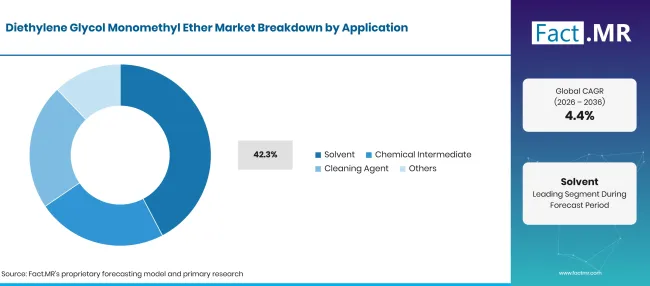
Diethylene Glycol Monomethyl Ether Market Breakdown Application | Source: Fact.MR
| How does Application shape demand | Share (2026) |
|---|---|
| Solvent (Leading segment) | 42.3% |
| Other segments combined | 57.7% |
| Total | 100.0% |
Source: Fact.MR analysis. Updated Nov 2, 2026
Solvent use is estimated to account for 42.3% of market value in 2026. Dissolving resins and improving the compatibility of mixed ingredients are relevant functions in this application. A chemical intermediate application involves use within a broader manufacturing route. Cleaning-agent formulations depend on the soil and materials being treated. Pharmaceutical applications carry their own purity and regulatory requirements and should not be assumed appropriate without application-specific qualification. Qualification against the complete formula is the basis for solvent selection because individual ingredient compatibility alone cannot establish final-product performance.
What leads End-User Industry demand?
Paints and Coatings lead with 35.2% of 2026 market value.
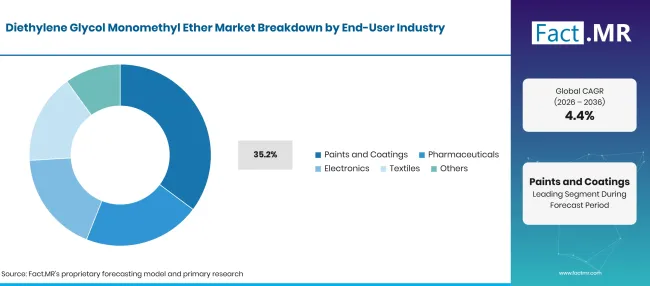
Diethylene Glycol Monomethyl Ether Market Breakdown End User Industry | Source: Fact.MR
| What leads End-User Industry demand | Share (2026) |
|---|---|
| Paints and Coatings (Leading segment) | 35.2% |
| Other segments combined | 64.8% |
| Total | 100.0% |
Source: Fact.MR analysis. Updated Nov 2, 2026
Paints and coatings is projected to account for 35.2% of revenue in 2026. Coatings makers choose solvents according to resin chemistry and the way the coating forms a film. Electronics users often apply stricter residue or cleanliness conditions. Textiles have separate requirements for dye penetration and process compatibility. Other industrial users depend on their own mixture specifications. Coatings makers weigh the consistency of solvent behavior against the time required to qualify a different grade. Eurostat reported in August 2026 that EU chemicals and chemical-products sold production decreased by 1.4% in constant prices during 2025 [2].
What is accelerating Diethylene Glycol Monomethyl Ether Market adoption, and what is holding it back?
Formulation compatibility supports buying; substitution tests and specification controls slow supplier changes.
Drivers Impact Analysis
| DRIVERS | (~) % IMPACT ON CAGR | GEOGRAPHIC RELEVANCE | IMPACT TIMELINE |
|---|---|---|---|
| Coating formulation needs | +1.1% | North America, Europe | Medium term |
| Solvent compatibility in chemical blends | +0.9% | Global | Short term |
| Textile dye-processing applications | +0.7% | East Asia | Medium term |
| Demand for documented supply quality | +0.5% | Global | Short term |
| Distribution access for smaller users | +0.3% | Latin America, Europe | Medium term |
Source: Fact.MR analysis. Updated Nov 2, 2026
Opportunity Impact Analysis
| OPPORTUNITY | (~) % IMPACT ON CAGR | GEOGRAPHIC RELEVANCE | IMPACT TIMELINE |
|---|---|---|---|
| Qualified alternative supply | +0.7% | Global | Medium term |
| Application testing for coatings | +0.5% | Europe, North America | Medium term |
| High-specification solvent offerings | +0.4% | Japan, USA | Long term |
| Better chemical-distributor service | +0.3% | Latin America | Short term |
Source: Fact.MR analysis. Updated Nov 2, 2026
Restraints Impact Analysis
| RESTRAINTS | (~) % IMPACT ON CAGR | GEOGRAPHIC RELEVANCE | IMPACT TIMELINE |
|---|---|---|---|
| Solvent substitution and reformulation | -0.8% | Global | Medium term |
| Safety and regulatory controls | -0.6% | Europe, North America | Long term |
| Variable chemical manufacturing output | -0.4% | Global | Short term |
| Specialty grade qualification costs | -0.3% | Global | Medium term |
Source: Fact.MR analysis. Updated Nov 2, 2026
Which countries are scaling the Diethylene Glycol Monomethyl Ether Market through 2036?
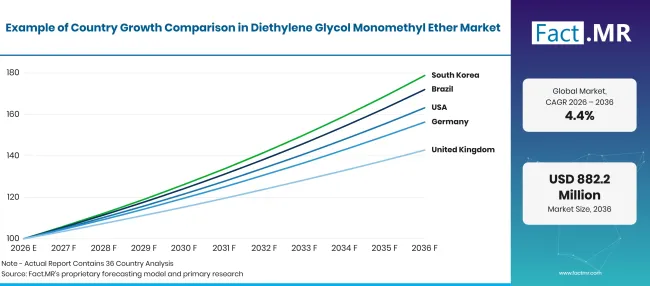
Diethylene Glycol Monomethyl Ether Market Growth Index | Source: Fact.MR
| Country | CAGR (2026 to 2036) |
|---|---|
| Brazil | 5.6% |
| USA | 5.0% |
| Germany | 4.6% |
| UK | 3.6% |
| Japan | 3.3% |
Source: Fact.MR analysis. Updated Nov 2, 2026
What supports Brazil market performance?
Brazil is projected to grow at 5.6% CAGR through 2036.
Brazilian chemical formulators work across domestic manufacturing networks and imported ingredient channels. The Brazilian Institute of Geography and Statistics (IBGE) reported in February 2026 that industrial production rose 0.6% during 2025 [3]. Distributors are expected to compete on grade consistency and delivery reliability. Periodic changes in plant output and the time required for formulation testing remain relevant commercial constraints.
What supports USA market performance?
USA is projected to grow at 5.0% CAGR through 2036.
U.S. manufacturers choosing methyl diglycol assess product identity and compatibility before approving a batch for regular use. Dow identifies Methyl CARBITOL as the chemical sold under CAS 111-77-3 [7]. Coating formulators and dye producers are expected to consider grades that fit their process requirements. Workplace handling also shapes purchasing decisions: OSHA lists a flash point of 200°F for the substance [8].
What supports Germany market performance?
Germany is projected to grow at 4.6% CAGR through 2036.
Germany’s chemical exporters serve an established network of industrial customers that purchase solvents for selected processing needs. Eurostat reported in October 2026 that German exports of chemicals and related products to non-EU countries reached €130 billion in 2025 [1]. Continued purchasing depends on matching solvent performance to coating recipes and on meeting applicable chemical documentation requirements.
What supports UK market performance?
UK is projected to grow at 3.6% CAGR through 2036.
British chemical processors often rely on specialty distributors for the solvent grades and documentation required by smaller production runs. The Office for National Statistics publishes an index for UK chemicals and chemical-products output [4]. Buyers of methyl diglycol are expected to consider delivery conditions and batch consistency alongside the time needed to approve changes in their existing formulations.
What supports Japan market performance?
Japan is projected to grow at 3.3% CAGR through 2036.
Japanese specialty-chemical users place value on consistent grade specifications for carefully controlled manufacturing processes. The Ministry of Economy, Trade and Industry published its 2025 production statistics in June 2026 [5]. Solvent use in dye and selected coating formulations depends on technical testing at plant level. Suppliers serving these users need clear chemical identification and dependable quality documentation.
Who leads the Diethylene Glycol Monomethyl Ether Market?
Competition centers on exact chemical identity and repeatable quality for industrial methyl diglycol applications. Dow offers the substance under the Methyl CARBITOL name and describes documented technical uses. Other listed groups operate in broader chemical supply or distribution and require product-level confirmation before being described as direct producers of this chemical.
Distributors can differentiate themselves through handling information and delivery options for customers ordering smaller volumes. Manufacturing suppliers are judged on chemical specifications and their ability to support repeated production runs. A broad glycol ether portfolio alone does not establish production of CAS 111-77-3.
Which companies are the key providers?
Key companies include BASF SE, Dow Inc., Eastman Chemical Company, INEOS Group Limited / INEOS Oxide, LyondellBasell Industries N.V., Monument Chemical, Jiangsu Dynamic Chemical Co., Ltd., Advance Petrochemicals Ltd., Solventis, and FBC Chemical Corp.
- BASF SE
- Dow Inc.
- Eastman Chemical Company
- INEOS Group Limited / INEOS Oxide
- LyondellBasell Industries N.V.
- Monument Chemical
- Jiangsu Dynamic Chemical Co., Ltd.
- Advance Petrochemicals Ltd.
- Solventis
- FBC Chemical Corp.
Bibliography
- [1] Eurostat. (2026, October 15). EU chemicals trade surplus at €257 billion in 2025
- [2] Eurostat. (2026, August 24). EU industrial production rebounds in 2025.
- [3] Instituto Brasileiro de Geografia e Estatística. (2026, February 3). Produção industrial recua 1,2% em dezembro
- [4] Office for National Statistics. (2026, October 15). IOP: CE: Manufacture of chemicals and chemical products: CVMNSA.
- [5] Ministry of Economy, Trade and Industry. (2026, June 30). Current Survey of Production: 2025 yearbook
- [6] Dow. (n.d.). Oxygenated solvents
- [7] Dow. (n.d.). Methyl CARBITOL™ solvent
- [8] Occupational Safety and Health Administration. (2024, January 24). Diethylene glycol monomethyl ether
This Report Answers
- How industrial, pharmaceutical and specialty grades differ in commercial specification and qualification requirements.
- Why solvent applications account for a substantial part of the market’s 2026 valuation.
- How paints and coatings uses relate to solvent behavior in selected formulations.
- Which operating conditions distinguish chemical users in Brazil, USA, Germany, UK and Japan.
- What suppliers and distributors must demonstrate to support repeat ordering and product substitution.
What does the Diethylene Glycol Monomethyl Ether Market cover?
The scope covers sales of diethylene glycol monomethyl ether under its recognized chemical identity. Relevant end uses include industrial solvent applications and qualified processing uses. Market values reflect the named substance, not the entire glycol-ether family or related products with other CAS numbers.
What is included in the scope?
Industrial and higher-specification grades fall within the market when sold as diethylene glycol monomethyl ether.
The use categories include solvent blending, chemical intermediate roles and eligible processing applications. End-user analysis covers paints and coatings, electronics, textiles and other industrial buyers.
What is excluded from the scope?
Diethylene glycol itself and chemically distinct glycol ethers are excluded.
Finished paints and cleaning products are outside the sales boundary because their revenue includes many other ingredients. The market does not count a supplier’s entire oxygenated-solvents portfolio as methyl diglycol revenue.
How Was the Analysis Built?
The analysis draws on 120+ sources, 35+ company portfolios, 25+ countries, and more than 20 industry interviews.
- Primary Research: Primary research includes discussions with manufacturers, service providers, technology developers, distributors, end users, and subject-matter experts. These conversations examine purchasing priorities, product adoption, operational challenges, approval requirements, competitive positioning, and the factors that influence wider market acceptance.
- Desk Research: Desk research covers government statistics, regulatory publications, company filings, trade data, technical studies, industry associations, standards, public policy, and other authoritative sources. Every source used in the analysis is documented in the bibliography.
- Market Sizing and Forecasting: Market estimates combine historical performance, demand indicators, pricing and volume trends, segment shares, company participation, country-level growth, adoption patterns, investment activity, and barriers to market expansion.
- Data Validation and Update Cycle: Findings are validated by comparing primary interviews with public data, company activity, regulatory changes, trade patterns, and industry developments. Regular updates review new product launches, capacity changes, partnerships, approvals, and shifts in commercial adoption.
Segmentation
What is the report’s scope and coverage?
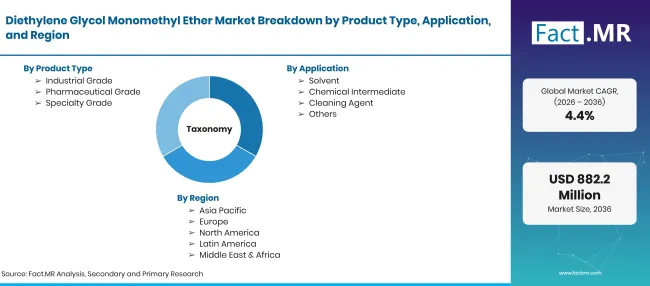
Diethylene Glycol Monomethyl Ether Market Taxonomy | Source: Fact.MR
| Attribute | Details |
|---|---|
| Quantitative Units | USD million |
| Market Definition | Diethylene glycol monomethyl ether (CAS 111-77-3), including methyl diglycol and methyl carbitol sold for industrial use |
| Product Type | Industrial Grade; Pharmaceutical Grade; Specialty Grade |
| Application | Solvent; Chemical Intermediate; Pharmaceuticals; Cleaning Agent; Others |
| End-User Industry | Paints and Coatings; Electronics; Textiles; Others |
| Regions Covered | North America; Latin America; Western Europe; Eastern Europe; East Asia; South Asia and Pacific; Middle East and Africa |
| Countries Covered | Brazil; USA; Germany; UK; Japan |
| Companies Profiled | BASF SE, Dow Inc., Eastman Chemical Company, INEOS Group Limited / INEOS Oxide, LyondellBasell Industries N.V., Monument Chemical, Jiangsu Dynamic Chemical Co., Ltd., Advance Petrochemicals Ltd., Solventis, and FBC Chemical Corp. |
| Forecast Period | 2026 to 2036 |
| Approach | Application-based demand assessment and supplier-product review |
Source: Fact.MR analysis. Updated Nov 2, 2026
How is the market segmented?
-
By Product Type
- Industrial Grade
- Pharmaceutical Grade
- Specialty Grade
-
By Application
- Solvent
- Chemical Intermediate
- Pharmaceuticals
- Cleaning Agent
- Others
-
By End-User Industry
- Paints and Coatings
- Electronics
- Textiles
- Others
-
By Region
- North America
- Latin America
- Western Europe
- Eastern Europe
- East Asia
- South Asia and Pacific
- Middle East and Africa
Frequently Asked Questions
How big is the Diethylene Glycol Monomethyl Ether Market in 2026?
What is the CAGR of the Diethylene Glycol Monomethyl Ether Market from 2026 to 2036?
Which product type leads the Diethylene Glycol Monomethyl Ether Market?
Which application leads the Diethylene Glycol Monomethyl Ether Market?
Who are the leading companies in the Diethylene Glycol Monomethyl Ether Market?
Who worked on this report


Preview the report firsthand - request a free sample
Free SampleGet the brochure for pricing and purchase details
Download PDF