- Base Value(2026): 283.7 Mn
- Estimated Value(2026): 283.7 Mn
- Forecast Value (2036): 452.1 Mn
- CAGR (2026 - 2036): 4.8%
Diethylene Glycol Monobutyl Ether Acetate Market Forecast 2026 to 2036
Valuation of the diethylene glycol monobutyl ether acetate market stood at USD 268.4 million in 2025. According to Fact MR, demand for diethylene glycol monobutyl ether acetate solvents is expected to reach USD 283.7 million in 2026 and USD 452.1 million by 2036. A CAGR of 4.8% is projected for the forecast timeline.
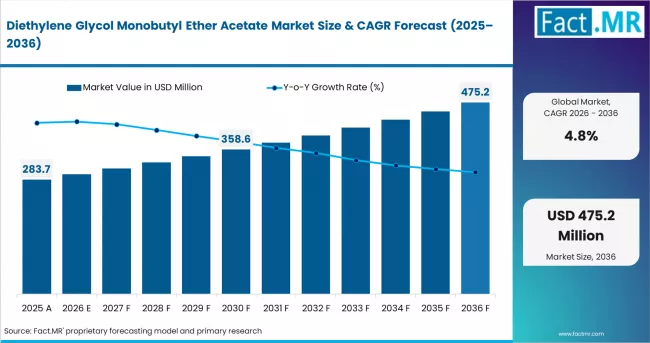
Diethylene Glycol Monobutyl Ether Acetate Market Market Value Analysis | Source: Fact.MR
Summary of the Diethylene Glycol Monobutyl Ether Acetate Market
- Market Definition
- The Diethylene Glycol Monobutyl Ether Acetate Market includes glycol ether acetate solvents used to dissolve resins, pigments, and additives in coatings, inks, cleaners, and adhesives requiring controlled evaporation rate, strong solvency power, and stable formulation compatibility across industrial chemical processing applications.
- Demand Drivers
- Stable utilization of glycol ether acetate solvents supporting controlled evaporation performance across coatings and printing ink formulations
- Increasing demand for coalescing solvents supporting film formation characteristics across waterborne and solvent borne coating systems
- Continued incorporation of specialty solvents supporting viscosity adjustment across industrial cleaning and chemical formulation workflows
- Consistent consumption of solvent intermediates supporting resin compatibility across paints, adhesives, and specialty chemical production environments
- Key Segments Analyzed
- Function: Solvent applications account for 52% share supported by strong solvency performance across coating formulations
- End Use Industry: Paints and coatings represent 46% share driven by requirement for controlled drying and film formation properties
- Application: Coatings and printing inks demonstrate stable demand across industrial surface finishing processes
- Geography: Europe and North America demonstrate steady consumption across specialty solvent manufacturing environments
- Analyst Opinion at Fact MR
- Shambhu Nath Jha, Principal Consultant, Fact MR, opines, "In this updated edition of the Diethylene Glycol Monobutyl Ether Acetate Market report, demand remains aligned with continued utilization of glycol ether acetate solvents supporting controlled evaporation performance, formulation stability, and compatibility across coatings, inks, and industrial chemical applications through 2036."
- Strategic Implications Executive Takeaways
- Maintain stable petrochemical feedstock sourcing supporting glycol ether acetate solvent production continuity
- Strengthen formulation optimization supporting compatibility with acrylic, polyurethane, and alkyd resin systems
- Monitor regulatory frameworks influencing solvent emission standards and formulation compliance requirements
- Optimize manufacturing consistency supporting stable evaporation profile and solvency strength across specialty solvent applications
- Methodology
- Primary interviews conducted with solvent manufacturers, coating formulators, ink producers, and specialty chemical distributors
- Desk research based on polymer chemistry literature, regulatory documentation, technical datasheets, and industry publications
- Hybrid top-down specialty solvent demand assessment combined with bottom-up glycol ether acetate consumption benchmarking
- Validation through supplier data triangulation, expert consultation, and monitoring of industrial solvent formulation trends
Diethylene Glycol Monobutyl Ether Acetate Market
| Metric | Details |
|---|---|
| Industry Size (2026E) | USD 283.7 million |
| Industry Value (2036F) | USD 452.1 million |
| CAGR (2026 to 2036) | 4.8% |
Source: Fact.MR analysis. Updated Apr 11, 2026
A CAGR of 4.8% indicates incremental expansion supported by continued use in coatings, inks, and industrial cleaning formulations requiring controlled evaporation profiles. Growth remains steady due to formulation compatibility advantages, while constraints persist from VOC regulatory pressure, petrochemical feedstock price sensitivity, and substitution by low-emission solvent alternatives.
The United Kingdom leads with a projected CAGR of 5.2%, supported by stable demand for coalescing solvents across industrial coating formulations. Germany follows with a CAGR of 5.0%, driven by consistent use of glycol ether acetates across paint and surface coating manufacturing processes. The United States records a CAGR of 4.8%, reflecting steady consumption of solvent components across protective coating applications. France shows a CAGR of 4.6%, supported by gradual procurement of specialty solvents across formulation chemistry operations. Japan records the slowest growth at 4.3%, reflecting a mature market where demand is largely tied to replacement procurement cycles within established industrial solvent supply chains. Mature markets generate a significant share of replacement demand as formulation requirements remain aligned with coating performance consistency and process compatibility across industrial finishing applications.
Segmental Analysis
Diethylene Glycol Monobutyl Ether Acetate Market Analysis by Function
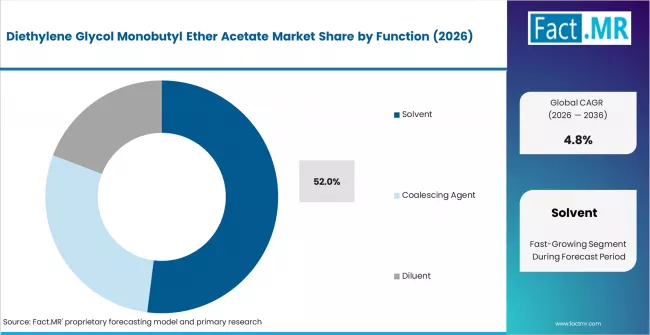
Diethylene Glycol Monobutyl Ether Acetate Market Analysis By Function | Source: Fact.MR
- Market Overview: Based on Fact MR assessment, solvent functionality is projected to account for 52% share of the diethylene glycol monobutyl ether acetate market in 2026. Glycol ether acetate structure enables controlled evaporation rate and polarity balance required for dissolution of resins, pigments, and additives across coating formulations. Solvent performance supports viscosity adjustment and film leveling characteristics during application processes including spray coating and roll coating operations. Chemical compatibility with acrylic, polyurethane, and alkyd resin systems supports formulation stability across liquid coating products requiring controlled drying behavior and uniform surface film formation.
- Demand Drivers:
- Solvency Performance Requirements: Diethylene glycol monobutyl ether acetate supports dissolution of polymer binders enabling uniform dispersion across coating formulation matrices.
- Evaporation Control Parameters: Moderate evaporation rate supports controlled film formation enabling smooth coating surface characteristics.
- Formulation Compatibility Needs: Solvent demonstrates interaction stability with pigments and additives incorporated across industrial coating preparation workflows.
Diethylene Glycol Monobutyl Ether Acetate Market Analysis by End Use Industry
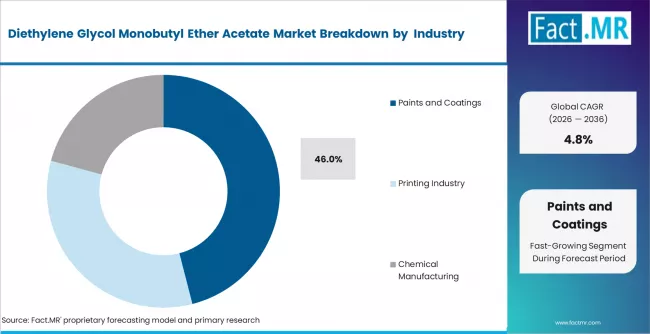
Diethylene Glycol Monobutyl Ether Acetate Market Analysis By End Use Industry | Source: Fact.MR
- Market Overview: Paints and coatings industry is estimated to hold 46% share of the diethylene glycol monobutyl ether acetate market in 2026, supported by utilization across industrial coatings, architectural paints, and protective surface treatments requiring controlled solvent evaporation behavior. Glycol ether acetate solvents support film coalescence and viscosity regulation across coating systems applied on metal, wood, and polymer substrates requiring uniform surface coverage performance. Coating formulation stability supports consistent application characteristics across decorative and protective paint systems requiring balanced drying kinetics.
- Demand Drivers:
- Film Formation Requirements: Solvent inclusion supports uniform distribution of resin components enabling continuous coating layer development across substrate surfaces.
- Application Performance Parameters: Controlled evaporation supports smooth surface finish characteristics across spray and brush applied coating systems.
- Resin Compatibility Needs: Glycol ether acetate demonstrates compatibility with polymer binder systems used across industrial and architectural coating formulations.
Key Dynamics
Diethylene Glycol Monobutyl Ether Acetate Market Drivers, Restraints, and Opportunities
Fact MR analysis indicates that the diethylene glycol monobutyl ether acetate market developed from glycol ether solvent chemistry used in coatings, inks, and industrial formulations requiring controlled evaporation and solvency balance. Historically, high-boiling glycol ether esters were adopted in paints and printing inks where controlled drying behavior improved film formation and coating uniformity. The current market valuation reflects sustained demand from industrial coatings, specialty inks, and cleaning formulations where solvency performance and compatibility with resins are required. Demand persists because the solvent supports pigment dispersion, viscosity control, and film coalescence in waterborne and solvent-based coating systems.
A structural shift is occurring as conventional high-VOC solvents gradually face substitution pressures from formulations designed to reduce emission levels in coatings and printing applications. Traditional hydrocarbon solvents remain widely used where cost efficiency and formulation familiarity remain priorities. Diethylene glycol monobutyl ether acetate functions as a coalescing solvent in low-VOC coatings and latex paints, requiring controlled synthesis and purity levels that increase production cost relative to commodity solvents. Even with moderate volume growth, higher-value specialty solvent formulations support gradual market value expansion in coatings and industrial chemical applications.
- Low VOC Coatings: Coating manufacturers use glycol ether acetate solvents to improve film formation and pigment dispersion in waterborne and industrial coating systems.
- Solvent Emission Regulation: Frameworks such as European Union REACH regulation and U.S. Environmental Protection Agency VOC guidelines influence solvent formulation selection.
- Asia Industrial Coatings Demand: China, Japan, and South Korea maintain large coatings and printing ink manufacturing sectors requiring controlled-evaporation solvent systems.
Regional Analysis
The Diethylene Glycol Monobutyl Ether Acetate Market is assessed across North America, Europe, Asia Pacific, Latin America, and Middle East & Africa, segmented by country-level demand in industrial coatings, cleaning formulations, printing inks, and specialty solvent processing. Regional demand reflects solvent performance requirements, formulation efficiency standards, and specialty chemical production capabilities. The full report offers market attractiveness analysis.
.webp "Top Country Growth Comparison Diethylene Glycol Monobutyl Ether Acetate Market Cagr (2026 2036)")
Top Country Growth Comparison Diethylene Glycol Monobutyl Ether Acetate Market Cagr (2026 2036) | Source: Fact.MR
| Country | CAGR (2026-2036) |
|---|---|
| United Kingdom | 5.2% |
| Germany | 5.0% |
| United States | 4.8% |
| France | 4.6% |
| Japan | 4.3% |
Source: Fact.MR analysis. Updated Apr 11, 2026
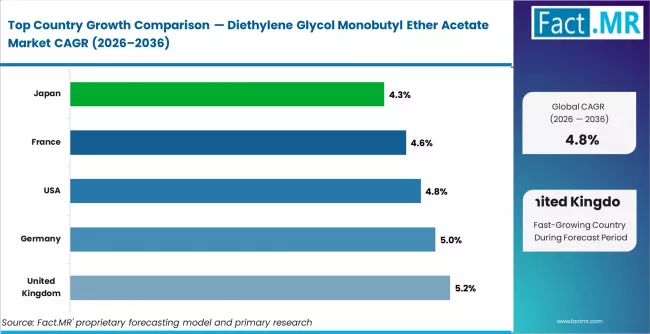
Diethylene Glycol Monobutyl Ether Acetate Market Cagr Analysis By Country | Source: Fact.MR
Source: Fact MR analysis, based on proprietary forecasting model and primary research
Europe
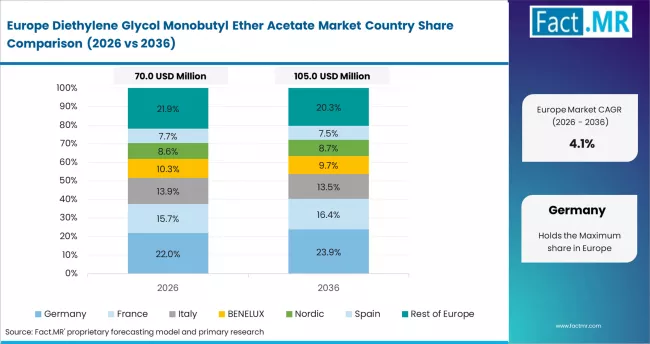
Diethylene Glycol Monobutyl Ether Acetate Market Europe Country Market Share Analysis, 2026 & 2036 | Source: Fact.MR
Europe functions as the specialty solvent regulatory laboratory for industrial coating and formulation applications, supported by structured chemical safety frameworks and advanced formulation innovation ecosystems. BASF SE strengthens glycol ether solvent production capabilities. Arkema S.A. expands specialty solvent formulation portfolio. Solvay S.A. supports industrial solvent innovation.
- United Kingdom: Demand for diethylene glycol monobutyl ether acetate in United Kingdom is projected to rise at 5.2% CAGR through 2036. The UK REACH regulatory framework (Health and Safety Executive, updated 2021) supports controlled solvent usage compliance. Arkema S.A. expanded specialty solvent product offerings (March 2023), supporting supply growth.
- Germany: Demand for diethylene glycol monobutyl ether acetate in Germany is projected to rise at 5.0% CAGR through 2036. EU REACH chemical safety framework (European Chemicals Agency, ongoing) supports formulation solvent compliance. BASF SE expanded glycol ether solvent manufacturing capacity (February 2023), supporting market adoption.
- France: Demand for diethylene glycol monobutyl ether acetate in France is projected to rise at 4.6% CAGR through 2036. The French Chemical Industry Strategic Plan update (Ministry of Economy, 2022) supports specialty solvent production expansion. Solvay S.A. expanded industrial solvent formulation initiatives (January 2023), supporting demand.
North America
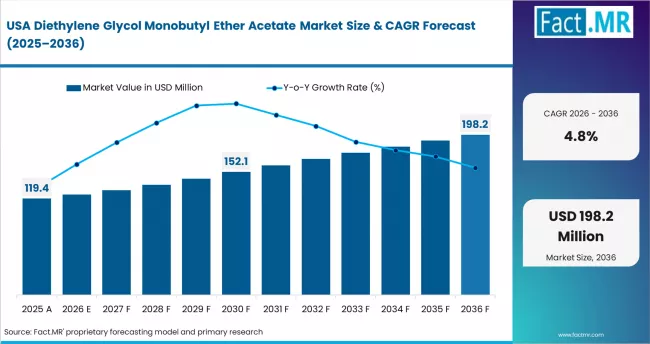
Diethylene Glycol Monobutyl Ether Acetate Market Country Value Analysis | Source: Fact.MR
North America functions as the industrial solvent commercialization and specialty formulation innovation hub, supported by strong demand in coatings, printing inks, and cleaning chemical applications. Dow Inc. strengthens glycol ether solvent formulation capabilities. Eastman Chemical Company expands specialty solvent product portfolio. Huntsman Corporation supports industrial solvent development.
- United States: Demand for diethylene glycol monobutyl ether acetate in United States is projected to rise at 4.8% CAGR through 2036. The Toxic Substances Control Act framework (U.S. Environmental Protection Agency, updated 2022) supports solvent formulation compliance standards. Dow Inc. expanded glycol ether solvent production capabilities (April 2023), supporting market expansion.
Asia Pacific
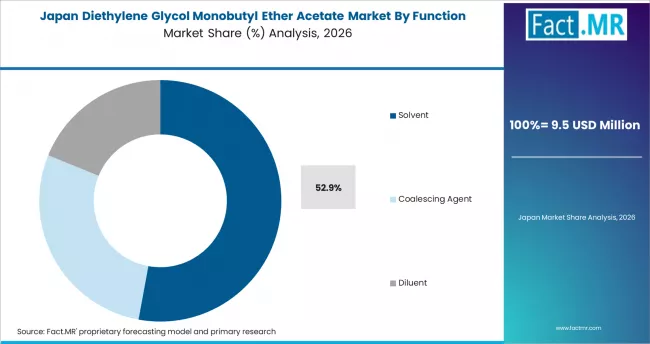
Diethylene Glycol Monobutyl Ether Acetate Market Japan Market Share Analysis By Function | Source: Fact.MR
Asia Pacific serves as the industrial solvent manufacturing and specialty formulation processing market, supported by expanding coatings production capacity and specialty chemical demand. Mitsubishi Chemical Group Corporation strengthens specialty solvent manufacturing capabilities. Kuraray Co., Ltd. expands formulation solvent product portfolio. Sumitomo Chemical Co., Ltd. supports specialty solvent innovation.
- Japan: Demand for diethylene glycol monobutyl ether acetate in Japan is projected to rise at 4.3% CAGR through 2036. The Chemical Substances Control Law framework (Ministry of Economy, Trade and Industry, 2021) supports regulated solvent production compliance. Kuraray Co., Ltd. expanded specialty solvent production capabilities (May 2023), supporting market demand.
Fact MR's analysis of diethylene glycol monobutyl ether acetate market in global regions consists of country-wise assessment that includes United Kingdom, Germany, United States, France, and Japan. Readers can find solvent demand trends, formulation developments, regulatory frameworks, and competitive positioning across key markets.
Competitive Landscape
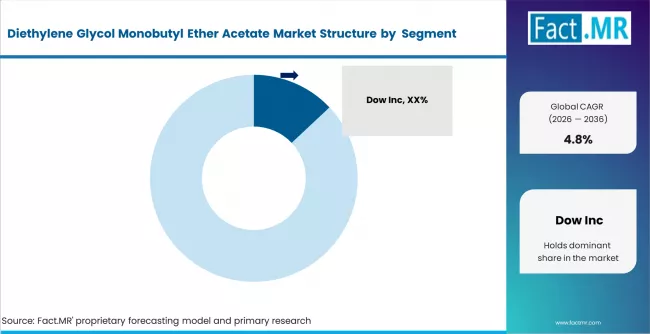
Diethylene Glycol Monobutyl Ether Acetate Market Analysis By Company | Source: Fact.MR
Competitive Structure and Buyer Dynamics in the Diethylene Glycol Monobutyl Ether Acetate Market
The competitive structure of the Diethylene Glycol Monobutyl Ether Acetate Market is moderately concentrated, with multinational chemical companies controlling a significant share of glycol ether solvent production. Companies such as Dow Inc., Eastman Chemical Company, BASF SE, Arkema SA, Solvay SA, Huntsman Corporation, and LyondellBasell Industries NV maintain strong positions through established petrochemical manufacturing infrastructure and global solvent distribution networks. Additional participants including Sasol Limited, Shell Chemicals, and KH Neochem Co. Ltd. contribute through specialty solvent production and regional supply capabilities. Competition is primarily influenced by solvent purity, evaporation characteristics, formulation compatibility, and cost efficiency across coatings, inks, and industrial cleaning applications.
Several companies maintain structural advantages through vertically integrated petrochemical production and access to feedstock required for glycol ether synthesis. Firms such as Dow Inc., BASF SE, and Eastman Chemical Company benefit from large scale chemical production infrastructure supporting stable raw material availability. Arkema SA and Solvay SA maintain advantages through specialty solvent formulation expertise and established relationships with coatings manufacturers. Industrial buyers typically adopt multi supplier sourcing strategies to reduce dependence on a single solvent supplier and ensure supply continuity. Procurement decisions evaluate suppliers based on product consistency, regulatory compliance, and long term availability, moderating supplier pricing leverage across the market.
Key Players of the Diethylene Glycol Monobutyl Ether Acetate Market
- Dow Inc.
- Eastman Chemical Company
- BASF SE
- Arkema SA
- Solvay SA
- LyondellBasell Industries NV
- Huntsman Corporation
- Sasol Limited
- Shell Chemicals
- KH Neochem Co. Ltd.
Bibliographies
- [1] Eastman Chemical Company. (2024). Eastman™ DB Acetate (diethylene glycol monobutyl ether acetate) – Technical product data sheet for printing inks, high-bake enamels, and latex-paint coalescing applications. Eastman.
- [2] Ataman Kimya A.Ş. (2009). Diethylene glycol monobutyl ether acetate – High-boiling glycol ether ester solvent for inks, industrial coatings, and waterborne latex paints. Ataman Chemicals.
- [3] Dow Chemical. (2025). DOWANOL™ PMA and DPMA glycol ether acetates – Formulation guides and technical data for coatings and industrial solvent systems. Dow specialty solvents.
- [4] HARRPA. (2012). Statement on volatile organic compounds (VOCs): Impact of the EU “Decopaint” Directive 2004/42/EC on glycol ethers and glycol ester solvents. HARRPA.
- [5] PubChem (National Library of Medicine). (2025). Diethylene glycol monobutyl ether acetate – Chemical and toxicological profile for industrial solvent and coalescing-agent applications. NIH PubChem.
This Report Addresses
- Market size estimation and revenue forecasts for the Diethylene Glycol Monobutyl Ether Acetate Market from 2026 to 2036, based on specialty solvent consumption benchmarks.
- Growth opportunity mapping across coatings, printing inks, industrial cleaners, adhesives, and chemical intermediate applications.
- Segment and regional revenue forecasts covering solvent, coalescing agent, diluent, and viscosity modifier functional roles used in formulation systems.
- Competition strategy assessment of Dow Inc., BASF SE, Eastman Chemical Company, Arkema SA, and Solvay SA.
- Regulatory impact analysis covering VOC emission regulations, REACH solvent safety compliance, and industrial chemical handling standards.
- Market report delivery in PDF, Excel, PPT, and interactive dashboard formats for specialty solvent demand benchmarking.
- Supply chain vulnerability assessments examining petrochemical feedstock cost exposure, solvent substitution risk, formulation compatibility requirements, and regulatory pressure on emission controlled solvent systems.
Diethylene Glycol Monobutyl Ether Acetate Market Definition
Diethylene Glycol Monobutyl Ether Acetate Market Definition Paragraph
The Diethylene Glycol Monobutyl Ether Acetate Market includes glycol ether acetate solvents used to dissolve, disperse, and stabilize resins, polymers, dyes, and additives in coatings, inks, cleaners, and specialty chemical formulations requiring controlled evaporation rate and strong solvency performance.
Diethylene Glycol Monobutyl Ether Acetate Market Inclusions
The report includes global and regional market size estimates, forecast analysis, and segmentation by purity grade, application area, formulation type, end use industry, pricing structure, and supply chain distribution patterns across solvent based formulation markets.
Diethylene Glycol Monobutyl Ether Acetate Market Exclusions
The scope excludes other glycol ether solvents without acetate functionality, finished coating or cleaning products, solvent blends where chemical composition cannot be isolated, and solvent manufacturing equipment.
Diethylene Glycol Monobutyl Ether Acetate Market Research Methodology
- Primary Research: Interviews were conducted with solvent manufacturers, coating formulators, ink producers, raw material suppliers, and specialty chemical distributors.
- Desk Research: Public sources included chemical technical literature, company datasheets, regulatory documentation, trade statistics, and publications related to glycol ether solvent chemistry.
- Market-Sizing and Forecasting: A hybrid model combining top-down specialty solvent demand evaluation and bottom-up analysis of diethylene glycol ether acetate consumption across formulation applications was applied.
- Data Validation and Update Cycle: Outputs were validated through cross comparison of supplier data, expert consultation, and periodic monitoring of solvent demand trends across coatings, inks, and cleaning formulations.
Segmentation
Report Scope
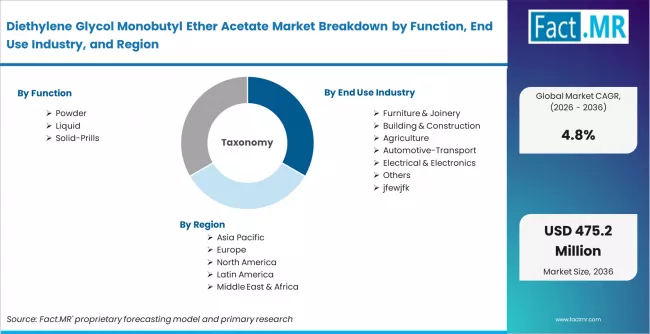
Diethylene Glycol Monobutyl Ether Acetate Market Breakdown By Function, End Use Industry, And Region | Source: Fact.MR
| Metric | Value |
|---|---|
| Quantitative Units | USD 283.7 million (2026) to USD 452.1 million (2036), at a CAGR of 4.8% |
| Market Definition | The diethylene glycol monobutyl ether acetate market includes production and commercialization of glycol ether ester solvents used to improve flow characteristics, film formation, solvency strength, and formulation stability in coatings, inks, and industrial cleaning applications. |
| Application Segmentation | Coatings, Printing inks, Industrial cleaners, Adhesives, Chemical intermediates |
| Function Segmentation | Solvent, Coalescing agent, Diluent, Viscosity modifier |
| End Use Industry Segmentation | Paints and coatings, Printing industry, Chemical manufacturing, Cleaning products, Adhesives industry |
| Regions Covered | North America, Latin America, Europe, East Asia, South Asia, Oceania, Middle East and Africa |
| Countries Covered | United States, Canada, Mexico, Brazil, Germany, France, United Kingdom, Italy, Spain, Netherlands, Belgium, China, Japan, South Korea, India, Thailand, Indonesia, Saudi Arabia, United Arab Emirates, and 40+ countries |
| Key Companies Profiled | Dow Inc., Eastman Chemical Company, BASF SE, Arkema SA, Solvay SA, LyondellBasell Industries NV, Huntsman Corporation, Sasol Limited, Shell Chemicals, KH Neochem Co. Ltd. |
| Forecast Period | 2026 to 2036 |
| Approach | Hybrid top-down and bottom-up market estimation based on solvent demand patterns in coatings and inks, formulation additive consumption ratios, industrial chemical production benchmarking, specialty solvent trade flow analysis, and validation through primary interviews with chemical manufacturers, formulators, and industrial distributors. |
Source: Fact.MR analysis. Updated Apr 11, 2026
Diethylene Glycol Monobutyl Ether Acetate Market Key Segments
-
Application :
- Coatings
- Printing Inks
- Industrial Cleaners
- Adhesives
- Chemical Intermediates
-
Function :
- Solvent
- Coalescing Agent
- Diluent
- Viscosity Modifier
-
End Use Industry :
- Paints and Coatings
- Printing Industry
- Chemical Manufacturing
- Cleaning Products
- Adhesives Industry
-
Region :
- North America
- USA
- Canada
- Mexico
- Europe
- Germany
- UK
- France
- Italy
- Spain
- Nordic Countries
- BENELUX
- Rest of Europe
- Asia Pacific
- China
- Japan
- South Korea
- India
- Australia
- Rest of Asia Pacific
- Latin America
- Brazil
- Argentina
- Rest of Latin America
- Middle East and Africa
- Kingdom of Saudi Arabia
- United Arab Emirates
- South Africa
- Rest of Middle East and Africa
- Other Regions
- Oceania
- Central Asia
- Other Markets
- North America
Frequently Asked Questions
How large is the demand for Diethylene Glycol Monobutyl Ether Acetate in the global market in 2026?
What will be the market size of Diethylene Glycol Monobutyl Ether Acetate in the global market by 2036?
What is the expected demand growth for Diethylene Glycol Monobutyl Ether Acetate in the global market between 2026 and 2036?
Which company is identified as a leading manufacturer in the Diethylene Glycol Monobutyl Ether Acetate market?
Which function segment is projected to dominate Diethylene Glycol Monobutyl Ether Acetate demand by 2026?
Why is Diethylene Glycol Monobutyl Ether Acetate widely used as a solvent?
What is driving demand for Diethylene Glycol Monobutyl Ether Acetate in the United Kingdom?
What is the growth outlook for the Diethylene Glycol Monobutyl Ether Acetate market in the United Kingdom?
Why is Germany an important market for glycol ether acetate solvent consumption?
What is the growth outlook for the Diethylene Glycol Monobutyl Ether Acetate market in Germany?
How is demand for Diethylene Glycol Monobutyl Ether Acetate evolving in the United States?
What is the growth outlook for the Diethylene Glycol Monobutyl Ether Acetate market in the United States?
What is the growth outlook for the Diethylene Glycol Monobutyl Ether Acetate market in France?
How is Japan positioned in the Diethylene Glycol Monobutyl Ether Acetate market?
What is the growth outlook for the Diethylene Glycol Monobutyl Ether Acetate market in Japan?
What is Diethylene Glycol Monobutyl Ether Acetate and what is it mainly used for?
What does the Diethylene Glycol Monobutyl Ether Acetate market include in this report?
What applications are included in the scope of the Diethylene Glycol Monobutyl Ether Acetate market?
What is excluded from the scope of the Diethylene Glycol Monobutyl Ether Acetate market report?
What does market forecast mean in the Diethylene Glycol Monobutyl Ether Acetate market report?
How is the Diethylene Glycol Monobutyl Ether Acetate market forecast developed in this report?
What does primary validation indicate in the Diethylene Glycol Monobutyl Ether Acetate market analysis?
Who worked on this report


Preview the report firsthand - request a free sample
Free SampleGet the brochure for pricing and purchase details
Download PDF