- Market Value (2025): USD 73.6 Mn
- Estimated Value (2026): USD 77.4 Mn
- Forecast Value (2036): USD 128.5 Mn
- CAGR (2026-2036): 5.2%
What is the 2,3-Pyridinedicarboxylic Acid Market forecast to be worth by 2036?
USD 77.4 million in 2026 to USD 128.5 million by 2036 at a 5.2% CAGR.
- The 2,3-pyridinedicarboxylic acid market reached USD 73.6 million in 2025.
- As per Fact.MR analysis, the market is forecast at USD 77.4 million in 2026 and USD 128.5 million in 2036.
- The market is forecast to grow at a 5.2% CAGR between 2026 and 2036 as pharmaceutical researchers and specialist chemical users continue purchasing specified grades.
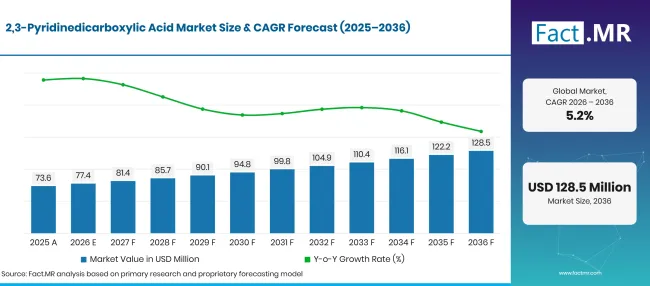
23 Pyridinedicarboxylic Acid Market Forecast Global | Source: Fact.MR
| Year | Basis | Market Value (USD Million) |
|---|---|---|
| 2025 | Actual | 73.6 |
| 2026 | Estimate | 77.4 |
| 2036 | Forecast | 128.5 |
| CAGR 2026 to 2036 | Forecast period | 5.2% |
Source: Fact.MR analysis. Updated Nov 2, 2026
What are the defining numbers behind 2,3-Pyridinedicarboxylic Acid Market growth?
The market is projected to add USD 51.1 million between 2026 and 2036, with high-purity grades and pharmaceutical applications accounting for the largest forecast shares.
- Demand Drivers in the Market
- Laboratory chemists need reliable structural identity before using 2,3-pyridinedicarboxylic acid in synthesis work.
- Pharmaceutical researchers examine a reagent’s assay and the reaction in which it will be used before placing an order. Eurostat reported on July 24, 2025, that the EU sold production value of basic pharmaceutical products and pharmaceutical preparations increased by 12.7% at current prices, from EUR 234 billion in 2023 to EUR 263 billion in 2024 [2].
- Analytical laboratories need grades with clear specifications and batch records so researchers can repeat work with confidence.
- Research teams often begin with small quantities of a chemical before considering larger trials.
- Handling requirements also influence supplier selection. Thermo Fisher Scientific updated its safety documentation for the powder in September 2025 and identifies the material for laboratory use [4].
- Key Segments Analyzed
- By Purity: High Purity accounts for 62.4% of 2026 market value, reflecting demand for controlled assay levels in laboratory and synthesis work.
- By Application: Pharmaceuticals represents 54.2% of the 2026 application mix, covering research and development work involving the material rather than approval for use in finished medicines.
- By End-User: Pharmaceutical Companies account for 48.6% of 2026 demand, while research institutes and chemical manufacturers form the other named customer groups.
- Analyst Opinion at Fact.MR
- Shambhu Nath Jha, Principal Consultant at Fact.MR, states, “A laboratory buying this compound generally needs dependable identity and lot documentation as well as a suitable price. Researchers can compare small packs during initial trials, but once they settle on a method, consistent assay results and a supplier’s ability to meet the same specification become more important for repeat orders.”
- Strategic Implications
- Chemical catalogue suppliers should make the CAS number, purity method and available pack sizes easy to compare so laboratories can qualify the correct grade. Related Fact.MR coverage examines chemical intermediates at the broader product-category level.
- Pharmaceutical research teams should distinguish a reagent that is suitable for laboratory work from an ingredient authorized for a finished medicine. Each use calls for its own technical and regulatory assessment.
- Specialist distributors should make batch documentation and delivery arrangements clear to laboratories working to fixed experiment schedules.
- Chemical manufacturers considering larger orders should establish the required grade and intended use before committing to a dedicated production arrangement.
Germany is forecast to record 6.0% CAGR through 2036. Brazil follows at 5.5%, the USA at 4.9%, the UK at 4.4% and Japan at 3.9%. Differences in the rates describe the market outlook by country, while chemical purchasing decisions still depend on whether a particular grade fits a specific experiment or manufacturing route.
How does the 2,3-Pyridinedicarboxylic Acid Market break down by segment?
High Purity represents 62.4%; Pharmaceuticals represents 54.2%; Pharmaceutical Companies account for 48.6% of forecast 2026 value in their respective classifications.
Which Purity segment shapes demand?
High Purity accounts for 62.4% share in 2026.
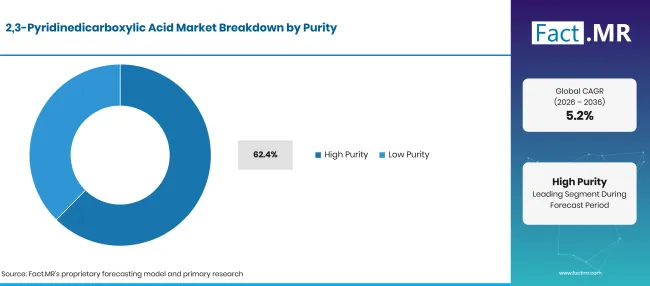
23 Pyridinedicarboxylic Acid Market Breakdown Purity | Source: Fact.MR
| Purity | Share (2026) |
|---|---|
| High Purity (Leading segment) | 62.4% |
| Other segments combined | 37.6% |
| Total | 100.0% |
Source: Fact.MR analysis. Updated Nov 2, 2026
High-purity acid is used when a researcher requires a narrow input specification and wants to limit uncertainty caused by impurities. The commercial distinction is the degree of documented assay control, not a separate chemical identity. Lower-purity material remains relevant when the intended work accepts a broader composition range.
Which Application segment shapes demand?
Pharmaceuticals lead with 54.2% share in 2026.
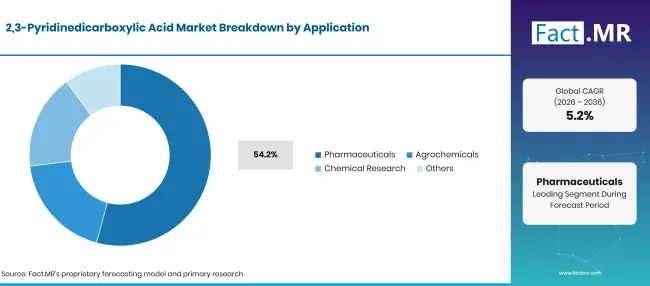
23 Pyridinedicarboxylic Acid Market Breakdown Application | Source: Fact.MR
| Application | Share (2026) |
|---|---|
| Pharmaceuticals (Leading segment) | 54.2% |
| Other segments combined | 45.8% |
| Total | 100.0% |
Source: Fact.MR analysis. Updated Nov 2, 2026
The pharmaceutical application category is centered on research use and possible intermediate chemistry. A reagent catalogue does not prove that an acid has regulatory approval for administration to patients. Agrochemical and general chemical research applications depend on individual reactions, so their use must be assessed case by case. The product is also studied as quinolinic acid in biological research, a different setting from commercial pharmaceutical manufacture [4].
Which End-User segment shapes demand?
Pharmaceutical Companies hold 48.6% share in 2026.
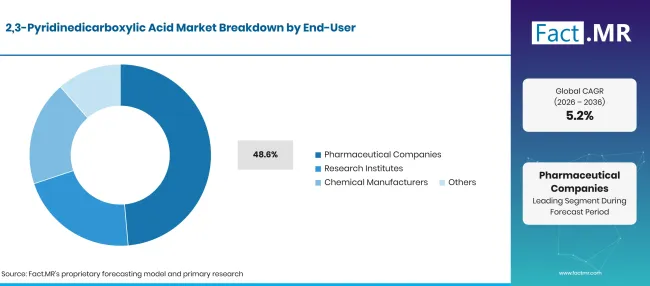
23 Pyridinedicarboxylic Acid Market Breakdown End User | Source: Fact.MR
| End-User | Share (2026) |
|---|---|
| Pharmaceutical Companies (Leading segment) | 48.6% |
| Other segments combined | 51.4% |
| Total | 100.0% |
Source: Fact.MR analysis. Updated Nov 2, 2026
Pharmaceutical companies account for the largest stated end-user share, although their work may span early discovery and process studies. Research institutes also buy small reagent quantities for controlled experiments and teaching-related projects. Chemical manufacturers may review the molecule for a defined synthesis step but normally require a specification before offering regular supply. A laboratory buyer can select from a public catalogue, while larger users often ask for a quote and an agreed technical package.
What is accelerating 2,3-Pyridinedicarboxylic Acid Market adoption, and what is holding it back?
Research access, accurate identification and documented purity support demand for this specialist acid. Buyers also need to evaluate the intended use and complete qualification work before increasing purchase volumes.
Driver Impact Analysis
| DRIVER | (~) % IMPACT ON CAGR | GEOGRAPHIC RELEVANCE | IMPACT TIMELINE |
|---|---|---|---|
| High-purity research grades | +1.1% | Global | Short term |
| Traceable catalogues | +0.8% | Global | Short term |
| Heterocyclic chemistry research | +0.6% | Europe, USA, Japan | Medium term |
| Custom supply enquiries | +0.3% | Global | Medium term |
Source: Fact.MR analysis. Updated Nov 2, 2026
Opportunity Impact Analysis
| OPPORTUNITY | (~) % IMPACT ON CAGR | GEOGRAPHIC RELEVANCE | IMPACT TIMELINE |
|---|---|---|---|
| Documented higher-assay grades | +0.6% | Global | Medium term |
| Batch-specific technical support | +0.4% | Global | Short term |
| Research-scale repeat ordering | +0.2% | USA, Europe, Japan | Medium term |
Source: Fact.MR analysis. Updated Nov 2, 2026
Restraints Impact Analysis
| RESTRAINT | (~) % IMPACT ON CAGR | GEOGRAPHIC RELEVANCE | IMPACT TIMELINE |
|---|---|---|---|
| Restrictions on intended use | -0.5% | USA, Europe | Short term |
| Detailed qualification needs | -0.4% | Global | Medium term |
| Limited project volumes | -0.2% | Global | Medium term |
Source: Fact.MR analysis. Updated Nov 2, 2026
Which countries are scaling the 2,3-Pyridinedicarboxylic Acid Market through 2036?
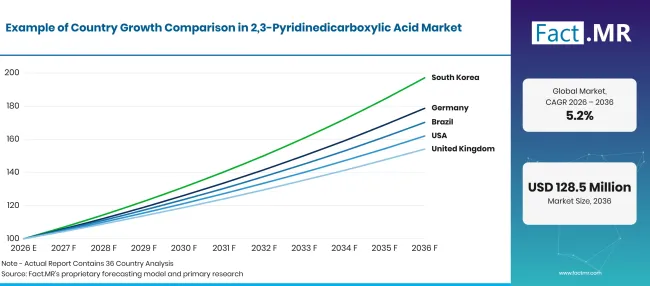
23 Pyridinedicarboxylic Acid Market Growth Index | Source: Fact.MR
| Country | CAGR (2026 to 2036) |
|---|---|
| Germany | 6.0% |
| Brazil | 5.5% |
| USA | 4.9% |
| UK | 4.4% |
| Japan | 3.9% |
Source: Fact.MR analysis. Updated Nov 2, 2026
What supports Germany market activity?
6.0% CAGR, supported by Germany’s chemical research base and specialist reagent access.
Germany’s chemical research base gives laboratories access to specialist reagents and documented supplier grades. Eurostat reported that Germany exported EUR 67.9 billion in medicinal and pharmaceutical products outside the EU in 2025 [5]. Destatis reported that German industrial production declined by 1.1% in 2025 on a calendar-adjusted basis [6].
What supports Brazil market activity?
5.5% CAGR, linked to Brazil’s pharmaceutical sector and laboratory testing demand.
Brazil’s medicine sector provides an established setting for laboratory testing and compound screening. Anvisa reported Brazilian pharmaceutical-market revenue of approximately BRL 160.7 billion for 2024 in its 2025 announcement [7]. This is a wider industry measure, not quinolinic acid sales. Researchers seeking CAS 89-00-9 still need a documented grade suitable for their individual method. Overseas supply can make delivery planning and batch paperwork especially relevant to research schedules.
What supports USA market activity?
4.9% CAGR, driven by established U.S. chemical suppliers and multiple catalogue-grade options.
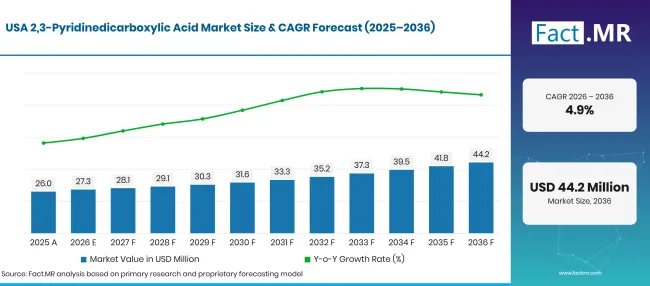
23 Pyridinedicarboxylic Acid Market Forecast Usa | Source: Fact.MR
US researchers can compare specific product listings from several established chemical suppliers. Sigma-Aldrich identifies quinolinic acid as 2,3-pyridinedicarboxylic acid and lists its P63204 product at 99% assay [1]. These are distinct catalogue options for the same CAS number and help laboratories choose suitable material for experiments.
What supports UK market activity?
4.4% CAGR, supported by the UK life sciences network and demand for documented research reagents.
The UK has a developed life sciences research network that purchases identified chemical reagents for specific experiments. The Office for Life Sciences reported 6,170 UK life sciences businesses across 7,320 companies in the 2023/24 reporting period [8]. UK laboratories working with heterocyclic compounds need to establish the correct 2,3-dicarboxylic isomer before ordering. Supplier documentation also helps compare purity and handling conditions when methods are transferred between teams.
What supports Japan market activity?
3.9% CAGR, tied to domestic supplier access and research-scale chemical use in Japan.
Japan’s laboratory chemical sector includes domestic access to the exact compound through Tokyo Chemical Industry. Its P0550 listing identifies CAS 89-00-9 and specifies purity above 98.0% [3]. Technical records matter because an incorrect pyridinedicarboxylic acid isomer can change the chemical structure under examination. The product’s smaller research pack sizes also suit experimental work where consumption follows individual project stages.
Who leads the 2,3-Pyridinedicarboxylic Acid Market?
Named suppliers span international laboratory distributors and specialist research-chemical companies.
Direct, publicly identifiable offerings are available from Merck KGaA through Sigma-Aldrich, Tokyo Chemical Industry, and Thermo Fisher Scientific [4]. Cayman Chemical also lists quinolinic acid as a defined research product. The competitive difference that a laboratory can evaluate publicly is the product specification and associated technical documentation.
An online catalogue shows that a research chemical is offered for sale, but it does not establish manufacturing ownership or global market share. Laboratories also need to distinguish synthesis work from studies involving quinolinic acid in biological pathways.
Which companies are the key providers?
Key companies include Merck KGaA (Sigma-Aldrich); Tokyo Chemical Industry Co., Ltd.; Thermo Fisher Scientific Inc.; Santa Cruz Biotechnology, Inc.; FUJIFILM Wako Pure Chemical Corporation; Central Drug House (P) Ltd.; Jubilant Ingrevia Limited; Cayman Chemical Company; Spectrum Chemical Manufacturing Corp.; LGC Standards (Toronto Research Chemicals).
- Merck KGaA (Sigma-Aldrich)
- Tokyo Chemical Industry Co., Ltd.
- Thermo Fisher Scientific Inc.
- Santa Cruz Biotechnology, Inc.
- FUJIFILM Wako Pure Chemical Corporation
- Central Drug House (P) Ltd.
- Jubilant Ingrevia Limited
- Cayman Chemical Company
- Spectrum Chemical Manufacturing Corp.
- LGC Standards (Toronto Research Chemicals)
Bibliography
- [1] Merck KGaA. (n.d.). 2,3-Pyridinedicarboxylic acid, 99% (Product No. P63204). Sigma-Aldrich. Retrieved October 29, 2026, from
- [2] Eurostat. (2025, July 24). Decrease in industrial production in 2024.
- [3] Tokyo Chemical Industry. (n.d.). 2,3-Pyridinedicarboxylic acid (Product No. P0550). Retrieved October 29, 2026, from
- [4] Thermo Fisher Scientific. (2025, September 10). Pyridine-2,3-dicarboxylic acid: Safety data sheet (Version 4; Cat. No. A11414).
- [5] Eurostat. (2026, April 13). Medicinal & pharma products: €221 billion trade surplus.
- [6] Statistisches Bundesamt (Destatis). (2026, February 6). Production in December 2025: -1.9% on the previous month.
- [7] Agência Nacional de Vigilância Sanitária. (2025, August 28). CMED divulga Anuário Estatístico do Mercado Farmacêutico.
- [8] Office for Life Sciences. (2025, October 2). Bioscience and health technology sector statistics 2023 to 2024.
This Report Answers
- How high-purity products differ from lower-purity grades in research purchasing and technical documentation.
- Why pharmaceutical research and chemical synthesis should be considered separately from approved finished-drug applications.
- How the five country forecasts compare and what publicly documented chemical supplier products are available.
- Which technical records support repeat ordering for laboratory and process-development customers.
What does the 2,3-Pyridinedicarboxylic Acid Market cover?
The market concerns the chemical compound identified as CAS 89-00-9, including specified grades supplied for research and relevant chemical work. The same compound is called quinolinic acid in some scientific and supplier literature. Revenue classification follows the stated purity, application and end-user dimensions.
What is included in the scope?
High- and low-purity grades are included when the substance is 2,3-pyridinedicarboxylic acid. Laboratory and chemical-development supply is in scope, together with other uses classified within the stated application categories where appropriate evidence exists. Customers are grouped as pharmaceutical companies, research institutes, chemical manufacturers and others.
What is excluded from the scope?
Other pyridinedicarboxylic acid positional isomers are outside the chemical boundary. Finished medicines, formulated pesticides and unrelated pyridine derivatives are excluded. Scientific interest in quinolinic acid does not by itself qualify unrelated products as part of this market.
How Was the Analysis Built?
The analysis draws on 120+ sources, 35+ company portfolios, 25+ countries, and more than 20 industry interviews.
- Primary Research: Primary research includes discussions with manufacturers, service providers, technology developers, distributors, end users, and subject-matter experts. These conversations examine purchasing priorities, product adoption, operational challenges, approval requirements, competitive positioning, and the factors that influence wider market acceptance.
- Desk Research: Desk research covers government statistics, regulatory publications, company filings, trade data, technical studies, industry associations, standards, public policy, and other authoritative sources. Every source used in the analysis is documented in the bibliography.
- Market Sizing and Forecasting: Market estimates combine historical performance, demand indicators, pricing and volume trends, segment shares, company participation, country-level growth, adoption patterns, investment activity, and barriers to market expansion.
- Data Validation and Update Cycle: Findings are validated by comparing primary interviews with public data, company activity, regulatory changes, trade patterns, and industry developments. Regular updates review new product launches, capacity changes, partnerships, approvals, and shifts in commercial adoption.
Segmentation
What is the report’s scope and coverage?
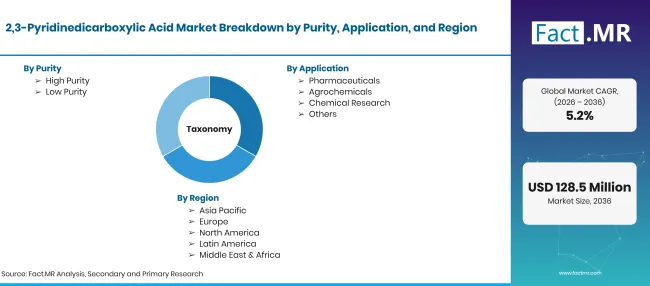
23 Pyridinedicarboxylic Acid Market Taxonomy | Source: Fact.MR
| Attribute | Details |
|---|---|
| Quantitative Units | USD million in 2026 to USD million by 2036 at CAGR |
| Market Definition | 2,3-pyridinedicarboxylic acid (quinolinic acid), CAS 89-00-9, sold as a specialty research and chemical input |
| Purity | High Purity; Low Purity |
| Application | Pharmaceuticals; Agrochemicals; Chemical Research; Others |
| End-User | Pharmaceutical Companies; Research Institutes; Chemical Manufacturers; Others |
| Regions Covered | North America; Latin America; Western Europe; Eastern Europe; East Asia; South Asia & Pacific; Middle East & Africa |
| Countries Covered | Germany; Brazil; USA; UK; Japan |
| Companies Profiled | Merck KGaA (Sigma-Aldrich); Tokyo Chemical Industry Co., Ltd.; Thermo Fisher Scientific Inc.; Santa Cruz Biotechnology, Inc.; FUJIFILM Wako Pure Chemical Corporation; Central Drug House (P) Ltd.; Jubilant Ingrevia Limited; Cayman Chemical Company; Spectrum Chemical Manufacturing Corp.; LGC Standards (Toronto Research Chemicals). |
| Forecast Period | 2026 to 2036 |
| Approach | Market value forecast and application mapping; product-level identity and supplier catalogue review |
Source: Fact.MR analysis. Updated Nov 2, 2026
How is the market segmented?
-
By Purity
- High Purity
- Low Purity
-
By Application
- Pharmaceuticals
- Agrochemicals
- Chemical Research
- Others
-
By End-User
- Pharmaceutical Companies
- Research Institutes
- Chemical Manufacturers
- Others
-
By Region
- North America
- Latin America
- Western Europe
- Eastern Europe
- East Asia
- South Asia & Pacific
- Middle East & Africa
Frequently Asked Questions
How big is the 2,3-Pyridinedicarboxylic Acid Market in 2026?
What is the CAGR of the 2,3-Pyridinedicarboxylic Acid Market from 2026 to 2036?
Which purity segment leads the 2,3-Pyridinedicarboxylic Acid Market?
Which application leads the 2,3-Pyridinedicarboxylic Acid Market?
Who are the leading companies in the 2,3-Pyridinedicarboxylic Acid Market?
Who worked on this report


Preview the report firsthand - request a free sample
Free SampleGet the brochure for pricing and purchase details
Download PDF