- Market Value (2025): USD 38.4 Mn
- Estimated Value (2026): USD 39.8 Mn
- Forecast Value (2036): USD 57.6 Mn
- CAGR (2026-2036): 3.8%
What is the Digital Battery Hydrometer Market forecast to be worth by 2036?
USD 39.8 million in 2026 to USD 57.6 million by 2036 at a 3.8% CAGR.
- The Digital Battery Hydrometers Market was valued at USD 38.4 million in 2025, according to the digital battery hydrometers market data.
- Revenue is projected to increase to USD 39.8 million in 2026 and USD 57.6 million by 2036, reflecting demand for digital electrolyte measurement in battery manufacturing, automotive servicing, and industrial maintenance.
- Growth is forecast at a 3.8% CAGR from 2026 to 2036. Digital electrolyte-density measurement, portable testing, and repeatable specific-gravity readings are potential contributors to market expansion in lead-acid battery applications.
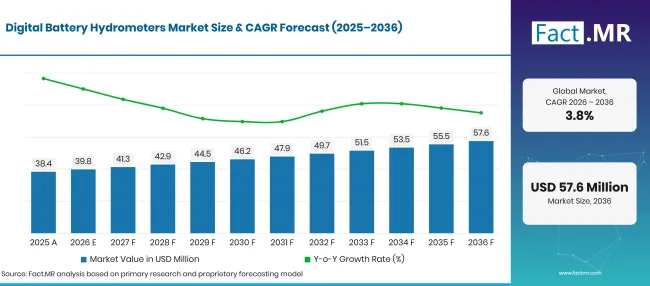
Factmr Digital Battery Hydrometers Market Forecast Global | Source: Fact.MR
| Year | Basis | Market Value (USD million) |
|---|---|---|
| 2025 | Actual | 38.3 |
| 2026 | Estimate | 39.8 |
| 2036 | Forecast | 57.6 |
| CAGR 2026 to 2036 | Forecast period | 3.8% |
Source: Fact.MR analysis. Updated Oct 21, 2026
What are the defining numbers behind Digital Battery Hydrometer Market growth?
The 2026 to 2036 period adds USD 17.8 million in new value, driven by demand for digital electrolyte measurement in battery manufacturing, automotive servicing, and industrial battery maintenance.
- Demand Drivers in the Market
- Battery testing standards are reinforcing maintenance requirements. On 14 July 2026, SAE International revised its J3012 recommended practice for 12-volt lead-acid batteries used in vehicle start-stop systems. The standard covers battery performance characteristics and testing recommendations [1]. This strengthens the relevance of battery diagnostic equipment, although the standard does not specifically mandate digital hydrometers.
- Battery manufacturing is increasing the need for traceable quality testing. On 31 August 2026, Agaram Technologies announced a collaboration with Waaree Energies to digitize quality assurance and quality control across multiple battery manufacturing sites using laboratory information and data-management systems [2]. The development highlights manufacturers’ focus on organized test data and traceability, creating an indirect opportunity for digital measurement instruments.
- Demand for preventive maintenance is supporting portable battery diagnostics. On 9 September 2026, HD Power Test Equipment published information about its lead-acid battery discharge tester for UPS systems, telecommunications, data centres, substations, and industrial facilities [3]. This reflects the continued need to assess battery condition and capacity. Digital hydrometers serve a complementary role where flooded lead-acid batteries permit electrolyte specific-gravity testing.
- Key Segments Analyzed
- By Product Type: Benchtop instruments will account for 58.0% of 2026 revenue.
- By Application: Automotive will represent 42.3% of 2026 sales, followed by Industrial at 31.7%.
- By Distribution Channel: Offline distribution will hold 64.3% share in 2026, with online accounting for 35.7%.
- By End-User: Automotive Service Centers will lead with 38.9% share in 2026, followed by Battery Manufacturers at 32.1%.
- Analyst Opinion at Fact.MR
- Shambhu Nath Jha, Principal Consultant at Fact.MR, states, “Digital battery hydrometer suppliers compete on measurement accuracy, temperature compensation, ease of operation, and the ability to retain or export results. Benchtop instruments can serve controlled testing environments, while portable equipment is suited to field inspections and recurring maintenance. Suppliers that combine dependable readings with calibration support, user training, and efficient distribution may be better positioned to retain customers.”
- Strategic Implications
- Instrument manufacturers need to differentiate their products through measurement accuracy, portability, data storage, and ease of cleaning.
- Battery manufacturers should prioritize repeatability, temperature compensation, and traceability when selecting instruments for production quality control.
- Automotive service equipment distributors can strengthen customer support through product demonstrations, technical guidance, and recommendations on suitable battery-testing methods.
- Online distributors improve the purchasing experience with clear technical specifications, compatibility details, and accessible calibration and after-sales services.
The United States is forecast to grow at a 4.9% CAGR from 2026 to 2036, the highest rate among the five countries. The United Kingdom follows at 4.4%, Germany at 3.9%, Brazil at 3.1%, and Japan at 2.8%.
How does the Digital Battery Hydrometers Market break down by segment?
Benchtop instruments will lead Product Type at 58%; Automotive will lead Application at 42.3%; Offline distribution will account for 64.3%; Automotive Service Centers will lead End-User at 38.9%.
Which Product Type leads?
Benchtop instruments account for 58% of 2026 sales.
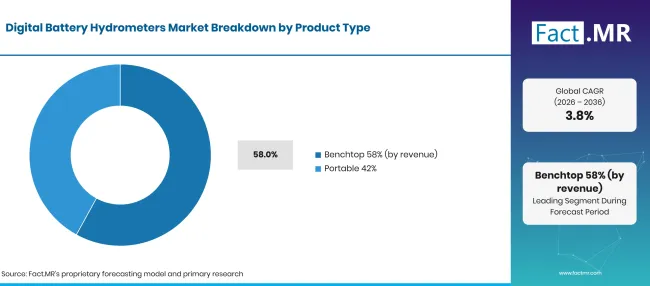
Factmr Digital Battery Hydrometers Market Breakdown Product Type | Source: Fact.MR
| Product Type | Share (2026) |
|---|---|
| Benchtop (Leading segment) | 58.0% |
| Other segments combined | 42.0%* |
| Total | 100.0% |
Source: Fact.MR analysis. Updated Oct 21, 2026
Benchtop instruments suit laboratories and battery production facilities where measurements are performed under controlled conditions. Portable equipment, by contrast, is designed for technicians who need to test batteries at installation sites or during service visits. Anton Paar's DMA 35 Ampere is designed for measuring the specific gravity of sulfuric acid in lead-acid batteries, including in battery production and uninterruptible power supply maintenance [4]. The Vertiv Albér DMA 35 similarly provides handheld density measurement, temperature readings, and stored measurement records [5].
What leads the Application segment?
Automotive accounts for 42.3% of 2026 sales.
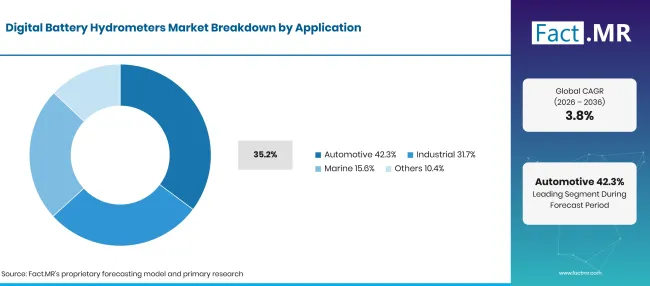
Factmr Digital Battery Hydrometers Market Breakdown Application | Source: Fact.MR
| Application | Share (2026) |
|---|---|
| Automotive (Leading segment) | 42.3% |
| Other segments combined | 57.7%* |
| Total | 100.0% |
Source: Fact.MR analysis. Updated Oct 21, 2026
Automotive applications include the inspection of serviceable lead-acid batteries during maintenance and fault diagnosis. Specific-gravity readings can help technicians compare electrolyte conditions across battery cells [6]. Industrial applications include maintenance of eligible stationary batteries used in backup-power and critical equipment systems. Marine applications can include lead-acid batteries used for starting and auxiliary electrical power. Other applications cover additional testing and maintenance environments in which electrolyte-density measurement is appropriate.
What supports Automotive Service Centers within End-User?
Automotive Service Centers account for 38.9% of 2026 sales.
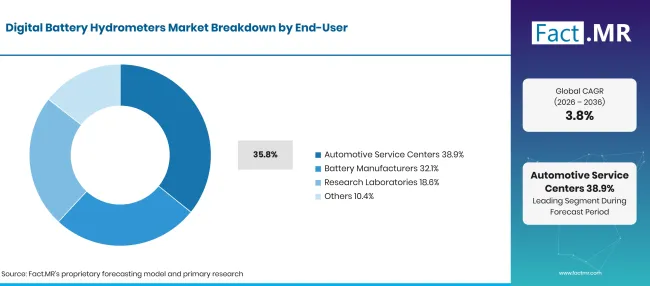
Factmr Digital Battery Hydrometers Market Breakdown End User | Source: Fact.MR
| End-User | Share (2026) |
|---|---|
| Automotive Service Centers (Leading segment) | 38.9% |
| Other segments combined | 61.1%* |
| Total | 100.0% |
Source: Fact.MR analysis. Updated Oct 21, 2026
Automotive service centers can use digital hydrometers to inspect eligible lead-acid batteries and compare electrolyte readings during maintenance. Battery manufacturers represent another important user group, where electrolyte concentration measurements can support production checks. Research laboratories use density measurement in testing and evaluation, while other end users include industrial maintenance teams and specialist service providers.
What is accelerating Digital Battery Hydrometers Market adoption, and what is holding it back?
Digital measurement, battery production quality control, and field-testing requirements support demand. Equipment cost, calibration needs, limited applicability to sealed batteries, and competition from broader battery diagnostic systems may constrain adoption.
Drivers Impact Analysis
| Driver | Indicative impact | Geographic relevance | Impact timeline |
|---|---|---|---|
| Replacement of manual readings with digital measurement | +1.2% | Global | Short term (≤ 2 years) |
| Battery manufacturing quality-control requirements | +1.0% | Global | Medium term (2–4 years) |
| Industrial battery maintenance and backup-power reliability | +0.8% | North America, Europe, Asia Pacific | Medium term (2–4 years) |
| Field testing and digital recordkeeping | +0.6% | Global | Long term (≥ 4 years) |
Source: Fact.MR analysis. Updated Oct 21, 2026
Opportunity Impact Analysis
| Opportunity | Indicative impact | Geographic relevance | Impact timeline |
|---|---|---|---|
| Portable instruments for field service teams | +0.7% | Global | Short term (≤ 2 years) |
| Digital measurement records for maintenance workflows | +0.5% | North America, Europe, East Asia | Medium term (2–4 years) |
| Supply to battery production and testing facilities | +0.4% | Europe, North America, East Asia | Medium term (2–4 years) |
| Distributor-led calibration and after-sales support | +0.3% | Global | Long term (≥ 4 years) |
Source: Fact.MR analysis. Updated Oct 21, 2026
Restraints Impact Analysis
| Restraint | Indicative impact | Geographic relevance | Impact timeline |
|---|---|---|---|
| Higher initial cost than basic manual hydrometers | -0.5% | Global | Short term (≤ 2 years) |
| Calibration, handling, and maintenance requirements | -0.4% | Global | Short term (≤ 2 years) |
| Limited applicability to sealed batteries without accessible electrolyte | -0.3% | Global | Medium term (2–4 years) |
| Competition from electronic battery diagnostic systems | -0.5% | North America, Europe, East Asia | Long term (≥ 4 years) |
Source: Fact.MR analysis. Updated Oct 21, 2026
Which countries are scaling the Digital Battery Hydrometer Market through 2036?
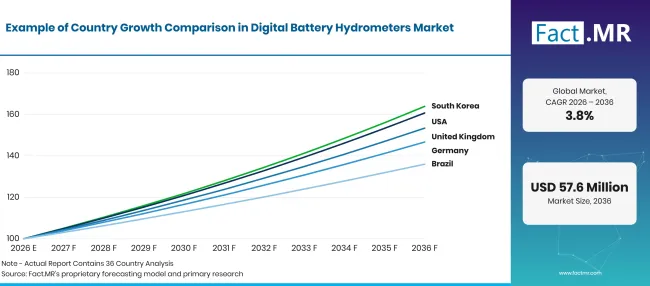
Factmr Digital Battery Hydrometers Market Growth Index | Source: Fact.MR
| Country | CAGR (2026–2036) |
|---|---|
| Germany | 3.9% |
| Brazil | 3.1% |
| United States | 4.9% |
| United Kingdom | 4.4% |
| Japan | 2.8% |
Source: Fact.MR analysis. Updated Oct 21, 2026
What supports Germany’s adoption?
3.9% CAGR, reflecting potential demand from automotive servicing and industrial battery maintenance.
On 8 September 2026, GS Yuasa Battery Europe launched SalesIQ at Automechanika Frankfurt 2026, introducing battery-market intelligence and forecasting tools for distributors and workshops. The launch demonstrates investment in automotive aftermarket support in Europe, although it does not specifically confirm increased digital hydrometer sales in Germany [7].
How is Brazil scaling demand?
3.1% CAGR, supported by potential demand from automotive servicing and industrial battery maintenance.
A 2026 country-specific launch or acquisition directly linked to digital battery hydrometers in Brazil could not be verified. The market opportunity remains associated with automotive workshops, battery distributors, and industrial facilities that service eligible lead-acid batteries. Brazil-specific sales or distribution announcements are needed to substantiate a more concrete growth driver.
What anchors U.S. adoption?
4.9% CAGR, the highest growth rate among the five countries in your estimates.
On 19 August 2026, LG Energy Solution announced the start of production at its new Lansing battery plant, highlighting continued investment in U.S. battery manufacturing. This is a broader battery-industry development rather than evidence of digital hydrometer adoption. Digital hydrometer applications are more directly associated with accessible lead-acid battery electrolyte, including appropriate industrial maintenance and battery-testing operations [8]. [8]
How is the United Kingdom developing demand?
4.4% CAGR, reflecting potential opportunities in automotive servicing and industrial maintenance.
A specific 2026 UK launch or acquisition directly related to digital battery hydrometers could not be verified. Demand may be supported by battery maintenance across backup-power installations and automotive service networks, but a dated UK-specific announcement or market-sales figure is needed to establish this connection.
How does Japan perform?
2.8% CAGR, indicating comparatively moderate growth during forecast period.
On 16 September 2026, Panasonic Energy announced the launch of Energy Innovation Square, a battery R&D facility in Osaka supporting development and production for automotive and data-centre applications. The investment demonstrates Japan’s continued battery-technology development, but it does not establish direct growth in digital battery hydrometer demand [9].
Who leads the Digital Battery Hydrometers Market?
Fact.MR finds that Anton Paar GmbH; Vertiv Group Corp. (Albér); ATAGO Co., Ltd.; Kyoto Electronics Manufacturing Co., Ltd. (KEM); Eagle Eye Power Solutions participate across the digital battery measurement and testing equipment value chain.
Anton Paar and ATAGO specialize in digital measurement instruments, including hydrometers designed to measure sulfuric acid specific gravity in lead-acid batteries. Vertiv, through its Albér product line, serves industrial battery monitoring and maintenance applications. Storage Battery Systems and Eagle Eye Power Solutions participate in the wider battery-testing equipment market. Product specifications should be checked for measurement range, temperature compensation, data logging, and compatibility with the intended battery type before treating instruments as directly comparable.
Commercial competition depends on measurement accuracy and practical service requirements. Battery manufacturers need repeatable readings for quality control. Maintenance technicians need portable instruments that simplify field inspections and recordkeeping. Industrial users need reliable equipment and technical support for preventive maintenance. Calibration, data-transfer capabilities, and suitability for flooded lead-acid batteries can differentiate suppliers.
Which companies are the key providers?
The companies specified for this report are:
- Anton Paar GmbH
- Vertiv Group Corp. (Albér)
- ATAGO Co., Ltd.
- Kyoto Electronics Manufacturing Co., Ltd. (KEM)
- Eagle Eye Power Solutions
Bibliography
- [1] SAE International. (2026, July 14). Storage batteries for start-stop operations (SAE Standard No. J3012_202607).
- [2] Agaram Technologies. (2026, August 31). Waaree Energies selects Agaram for Li-ion battery quality testing.
- [3] HD Power Test Equipment Co., Ltd. (2026, September 9). Lead acid battery discharge tester for reliable capacity testing.
- [4] Anton Paar. (n.d.). Digital battery hydrometer: DMA 35 Ampere.
- [5] Vertiv. (n.d.). Albér DMA35 series digital storage battery hydrometers
- [6] Victron Energy. (2026, September 15). Lead-acid battery monitoring: How it works.
- [7] GS Yuasa Battery Europe Ltd. (2026, September 8). GS Yuasa launches SalesIQ at Automechanika Frankfurt 2026.
- [8] LG Energy Solution. (2026, August 19). LG Energy Solution announces start of production at all-new Lansing battery plant.
- [9] Panasonic Energy Co., Ltd. (2026, September 16). Panasonic Energy launches new global battery R&D hub in Japan to accelerate development and production for automotive and data center applications.
- [10] ATAGO Co., Ltd. (n.d.). Digital hydrometer DH-10C.
- [11] ATAGO Co., Ltd. (n.d.). Digital hydrometer DH-10F.
- [12] Anton Paar. (n.d.). Portable density meter: DMA 35
This Report Answers
- How is market revenue distributed by product type, application, distribution channel, and end-user?
- Which categories lead the 2026 market, and what purchasing requirements support their positions?
- How do the five country-level growth forecasts compare through 2036?
- Which companies offer dedicated digital battery hydrometers or related battery diagnostic equipment?
- How do measurement accuracy, temperature compensation, data storage, and after-sales support influence equipment selection?
- What factors may support or constrain market adoption?
What does the Digital Battery Hydrometers Market cover?
The Digital Battery Hydrometers Market covers digital instruments used to measure electrolyte specific gravity or density, primarily in lead-acid batteries. Specific-gravity readings help assess electrolyte condition, while temperature measurement and compensation can support more consistent results. Depending on the model, instruments may also offer data logging, result export, or other digital reporting functions.
The assessment tracks instruments sold to automotive service centers, battery manufacturers, research laboratories, and other relevant end users. Market revenue is measured at the instrument stage, excluding the value of batteries tested and broader battery diagnostic systems that do not perform the covered electrolyte measurement.
What is included in the scope?
The scope includes benchtop and portable digital hydrometers designed for battery electrolyte measurement.
It covers equipment used for eligible lead-acid battery inspection, manufacturing checks, and maintenance, along with digital specific-gravity and density measurement and temperature compensation where supported. Integrated data storage, reporting, and export functions are also included, with sales considered across offline distributors, specialist instrument suppliers, and online channels.
What is excluded from the scope?
The scope excludes conventional glass or float-type hydrometers without digital measurement and general-purpose density meters used outside battery applications.
Battery monitoring equipment that measures voltage, internal resistance, or other parameters without electrolyte-density measurement is also outside the scope. Battery manufacturing machinery unrelated to electrolyte testing, batteries, chargers, battery management software, replacement services, and revenue from finished automotive, industrial, or marine batteries are excluded.
How Was the Analysis Built?
The analysis draws on market estimates, company information, public statistical publications, regulatory information, and industry evidence to assess market developments and forecasts.
- Primary Research: Primary research includes discussions with manufacturers, service providers, technology developers, distributors, end users, and subject-matter experts. These conversations examine purchasing priorities, product adoption, operational challenges, approval requirements, competitive positioning, and the factors that influence wider market acceptance.
- Desk Research: Desk research covers government statistics, regulatory publications, company filings, trade data, technical studies, industry associations, standards, public policy, and other authoritative sources. Every source used in the analysis is documented in the bibliography.
- Market Sizing and Forecasting: Market estimates combine historical performance, demand indicators, pricing and volume trends, segment shares, company participation, country-level growth, adoption patterns, investment activity, and barriers to market expansion.
- Data Validation and Update Cycle: Findings are validated by comparing primary interviews with public data, company activity, regulatory changes, trade patterns, and industry developments. Regular updates review new product launches, capacity changes, partnerships, approvals, and shifts in commercial adoption.
Segmentation
What is the report’s scope and coverage?
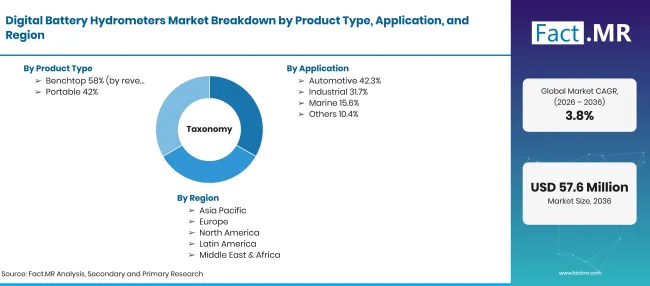
Factmr Digital Battery Hydrometers Market Taxonomy | Source: Fact.MR
| Attribute | Details |
|---|---|
| Quantitative Units | USD million in 2026 to USD million by 2036 at CAGR |
| Market Definition | Digital instruments used to measure battery electrolyte specific gravity or density, primarily for lead-acid batteries |
| Product Type | Benchtop; Portable |
| Application | Automotive; Industrial; Marine; Others |
| Distribution Channel | Offline; Online |
| End-User | Automotive Service Centers; Battery Manufacturers; Research Laboratories; Others |
| Regions Covered | North America; Latin America; Western Europe; Eastern Europe; East Asia; South Asia & Pacific; Middle East & Africa |
| Countries Covered | Germany; Brazil; United States; United Kingdom; Japan |
| Companies Profiled | Anton Paar GmbH; Vertiv Group Corp. (Albér); ATAGO Co., Ltd.; Kyoto Electronics Manufacturing Co., Ltd. (KEM); Eagle Eye Power Solutions |
| Forecast Period | 2026–2036 |
| Approach | Market estimates, segment shares, country growth rates, product portfolio analysis, and application review |
Source: Fact.MR analysis. Updated Oct 21, 2026
How is the market segmented?
-
By Product Type
- Benchtop
- Portable
-
By Application
- Automotive
- Industrial
- Marine
- Others
-
By Distribution Channel
- Offline
- Online
-
By End-User
- Automotive Service Centers
- Battery Manufacturers
- Research Laboratories
- Others
-
By Region
- North America
- Latin America
- Western Europe
- Eastern Europe
- East Asia
- South Asia & Pacific
- Middle East & Africa
Frequently Asked Questions
How big is the Digital Battery Hydrometers Market in 2026?
What is the CAGR of the Digital Battery Hydrometers Market from 2026 to 2036?
Which product type leads the Digital Battery Hydrometers Market?
Which application leads the Digital Battery Hydrometers Market?
Which distribution channel leads the market?
Which country will grow the fastest through 2036?
Who are the main companies in the Digital Battery Hydrometers Market?
Who worked on this report


Preview the report firsthand - request a free sample
Free SampleGet the brochure for pricing and purchase details
Download PDF