- Market Value (2025): USD 2.27 Bn
- Estimated Value (2026): USD 2.45 Bn
- Forecast Value (2036): USD 5.2 Bn
- CAGR (2026-2036): 7.8%
What is the Digital Thermostats Market forecast to be worth by 2036?
USD 2.5 billion in 2026 to USD 5.2 billion by 2036, at a 7.8% CAGR.
- As per Fact.MR analysis, the digital thermostats market reached USD 2.27 billion in 2025.
- Demand will increase from USD 2.45 billion in 2026 to USD 5.2 billion by 2036.
- The market is forecast to record a 7.8% CAGR from 2026 to 2036, covering connected and programmable thermostat purchases.
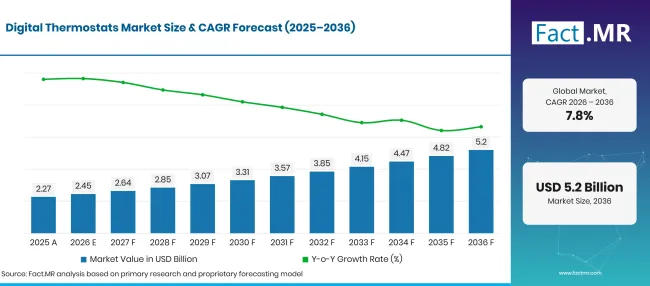
Factmr Digital Thermostats Market Forecast Global | Source: Fact.MR
| Year | Basis | Market Value (USD billion) |
|---|---|---|
| 2026 | Estimate | 2.45 |
| 2036 | Forecast | 5.2 |
| CAGR 2026 to 2036 | Forecast period | 7.8% |
Source: Fact.MR analysis. Updated Oct 15, 2026
What are the defining numbers behind Digital Thermostats Market growth?
USD 2.7 billion absolute opportunity between 2026 and 2036, supported by smart models and residential applications.
- Demand Drivers in the Market
- Homeowners look for thermostats that reduce unnecessary heating and cooling while preserving comfortable indoor temperatures. Energy-related settings have a clear economic role because the thermostat controls equipment that accounts for a substantial part of household spending.
- Homeowners replacing basic controls can choose schedules or remote adjustments without changing the heating system itself. Ecobee introduced Smart Thermostat Essential in January 2025 as a lower-priced model with a touchscreen [2].
- Commercial property teams need predictable temperature schedules across occupied and unoccupied hours. A control system that works with existing equipment can reduce daily manual adjustments and make routine maintenance easier.
- Key Segments Analyzed
- By Product Type: Smart Digital Thermostats hold 42.8% share in 2026, reflecting purchases of devices with connected comfort controls.
- By Application: Home installations account for 42.6% share in 2026 as homes upgrade room-temperature management.
- By Distribution Channel: Specialty Stores capture 31.2% share in 2026 because installation advice remains part of many thermostat purchases.
- Analyst Opinion at Fact.MR
- Shambhu Nath Jha, Principal Consultant at Fact.MR, states, “Thermostat selection is becoming an equipment-fit decision as much as a device purchase. Buyers compare wiring needs and the ability to control temperatures during daily absences. Suppliers offering clear fit guidance and dependable installer support are better placed to turn product interest into completed installations.”
- Strategic Implications
- Thermostat manufacturers should explain equipment compatibility in plain terms before purchase, including the need for a common wire or a supported alternative.
- Installers should check heating and cooling equipment type before recommending products and should account for homeowners who want only basic scheduling.
- Specialty retailers benefit from displaying practical setup information and explaining the differences between settable and app-connected models.
- Property managers should review control schedules by room use, while keeping manual overrides available for occupants and maintenance teams.
The United States is set to post 9.4% CAGR through 2036 as home comfort controls are upgraded. Germany follows at 8.6% amid heat-pump installations and home renovation. Brazil reaches 7.2% where cooling needs shape buying choices. The United Kingdom records 6.2% alongside connected-home upgrades. Japan advances at 5.7% as homes assess efficient room-by-room climate controls.
How does the Digital Thermostats Market break down by segment?
Smart Digital Thermostats 42.8%; Residential 42.6%; Specialty Stores 31.2% in 2026.
Which Product Type dominates?
Smart Digital Thermostats hold a 42.8% share in 2026.
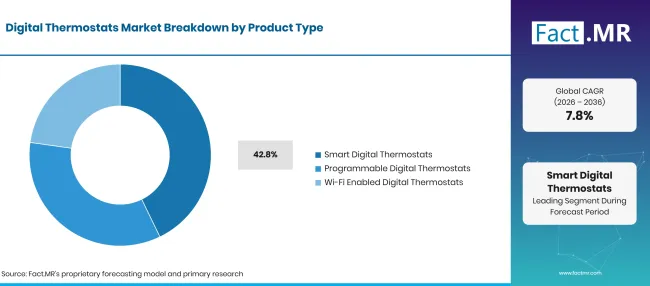
Factmr Digital Thermostats Market Breakdown Product Type | Source: Fact.MR
| Product Type | Share (2026) |
|---|---|
| Smart Digital Thermostats (Leading segment) | 42.8% |
| Other segments combined | 57.2%* |
| Total | 100.0% |
Source: Fact.MR analysis. Updated Oct 15, 2026
Smart models offer temperature changes from mobile apps and may provide automatic schedules or occupancy-based settings. Buyers tend to evaluate ease of use alongside heating-system compatibility. Programmable digital thermostats remain relevant where households prefer a fixed daily timetable without an internet connection.
What leads the Application segment?
Residential accounts for a 42.6% share in 2026.
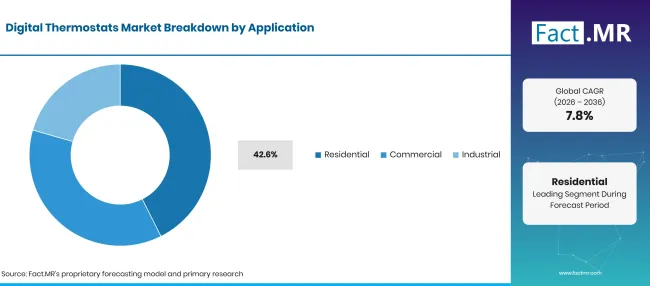
Factmr Digital Thermostats Market Breakdown Application | Source: Fact.MR
| Application | Share (2026) |
|---|---|
| Residential (Leading segment) | 42.6% |
| Other segments combined | 57.4%* |
| Total | 100.0% |
Source: Fact.MR analysis. Updated Oct 15, 2026
Residential use covers thermostats installed in houses and flats to manage everyday comfort. Households can adjust settings before leaving home and set recurring heating periods around occupancy. Commercial premises often require longer operating schedules and centralized building controls.
Which Distribution Channel serves the largest share?
Specialty Stores capture a 31.2% share in 2026.
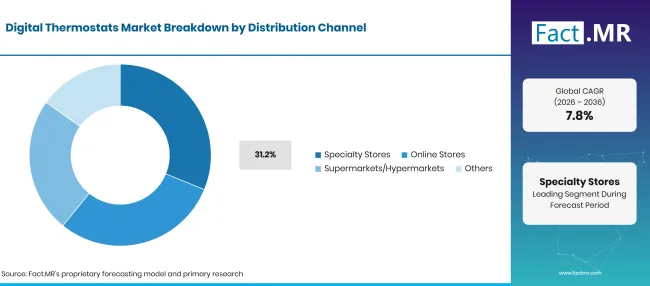
Factmr Digital Thermostats Market Breakdown Distribution Channel | Source: Fact.MR
| Distribution Channel | Share (2026) |
|---|---|
| Specialty Stores (Leading segment) | 31.2% |
| Other segments combined | 68.8%* |
| Total | 100.0% |
Source: Fact.MR analysis. Updated Oct 15, 2026
Specialty stores serve buyers who want help choosing an appropriate control for a particular heating or cooling system. Staff and affiliated installers can explain device wiring and the differences between heating-only and multi-stage equipment. Online stores suit repeat buyers who already know a product specification. Supermarkets and hypermarkets carry simpler consumer selections where available, while other channels include installer-led sales.
What is accelerating Digital Thermostats Market adoption, and what is holding it back?
Control convenience and HVAC replacement support purchases; compatibility and installation costs limit adoption.
Drivers Impact Analysis
| DRIVER | (~) % IMPACT ON CAGR | GEOGRAPHIC RELEVANCE | IMPACT TIMELINE |
|---|---|---|---|
| Household temperature scheduling | +1.1% | North America, Europe | Medium term (2–4 years) |
| HVAC replacement and retrofit work | +0.9% | Global | Medium term (2–4 years) |
| App-based remote access | +0.8% | United States, Europe | Short term (≤ 2 years) |
| Heat-pump control requirements | +0.6% | Germany, Japan | Long term (≥ 4 years) |
| Professional installation support | +0.4% | Global | Short term (≤ 2 years) |
Source: Fact.MR analysis. Updated Oct 15, 2026
Opportunity Impact Analysis
| OPPORTUNITY | (~) % IMPACT ON CAGR | GEOGRAPHIC RELEVANCE | IMPACT TIMELINE |
|---|---|---|---|
| Installer-friendly device setup | +0.7% | Global | Medium term (2–4 years) |
| Heat-pump compatible products | +0.6% | Europe, Japan | Medium term (2–4 years) |
| Retail product education | +0.5% | North America, Brazil | Short term (≤ 2 years) |
| Commercial schedule upgrades | +0.4% | Global | Long term (≥ 4 years) |
Source: Fact.MR analysis. Updated Oct 15, 2026
Restraints Impact Analysis
| RESTRAINT | (~) % IMPACT ON CAGR | GEOGRAPHIC RELEVANCE | IMPACT TIMELINE |
|---|---|---|---|
| Existing equipment mismatch | -0.8% | Global | Short term (≤ 2 years) |
| Installed system upgrade cost | -0.6% | Global | Medium term (2–4 years) |
| Consumer setup difficulties | -0.5% | Global | Short term (≤ 2 years) |
| Connected-device privacy concerns | -0.3% | North America, Europe | Long term (≥ 4 years) |
Source: Fact.MR analysis. Updated Oct 15, 2026
Which countries are scaling the Digital Thermostats Market through 2036?
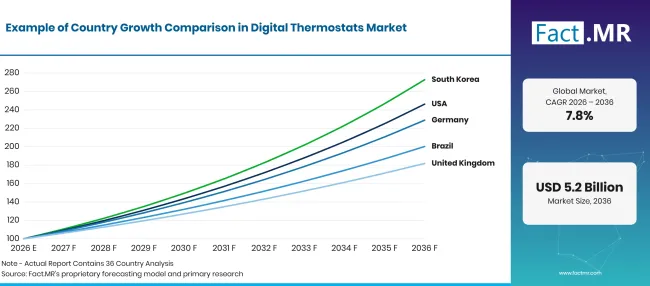
Factmr Digital Thermostats Market Growth Index | Source: Fact.MR
| Country | CAGR (2026–2036) |
|---|---|
| United States | 9.4% |
| Germany | 8.6% |
| Brazil | 7.2% |
| United Kingdom | 6.2% |
| Japan | 5.7% |
Source: Fact.MR analysis. Updated Oct 15, 2026
What supports digital thermostat sales in the United States?
9.4% CAGR, linked to residential cooling costs, new-home installations, and thermostat upgrades.
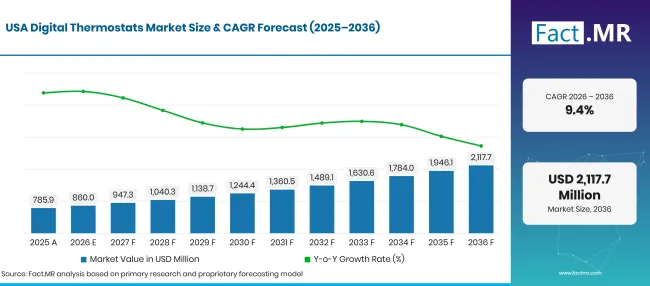
Factmr Digital Thermostats Market Forecast Usa | Source: Fact.MR
U.S. households continue to pay close attention to heating and cooling costs when making home energy decisions. The U.S. Energy Information Administration forecast average monthly residential electricity bills of USD 178 for June through September 2025 [3]. New housing construction creates demand for thermostat installations. Many homeowners also rely on professional technicians to choose digital thermostats that work well with their existing heating and cooling equipment.
Why is Germany expanding its digital thermostat base?
8.6% CAGR, influenced by heat-pump installations, new housing, and building renovation.
Germany's increasing use of heat pumps is creating more demand for digital temperature controls that work with modern heating systems. Destatis reported that heat pumps were used in 73.6% of residential buildings completed in 2025 [4]. Home renovation projects are also driving replacement of older thermostats and room controls. Many households work with heating specialists to choose between simple programmable models and connected thermostats that suit their existing systems.
How is Brazil developing digital thermostat demand?
7.2% CAGR, shaped by cooling equipment choices and specialist retail distribution.
Brazilian consumers are paying more attention to temperature-control options when choosing air-conditioning equipment. Inmetro published its 2025 air-conditioner efficiency tables in June 2026 [5]. These ratings help retailers explain differences in equipment performance. Digital thermostats are most commonly used in systems that allow separate temperature controls. Installation companies also check wiring and system requirements before recommending a suitable thermostat.
What is shaping digital thermostat sales in the United Kingdom?
6.2% CAGR, associated with connected-home upgrades and modern heating controls.
UK households are becoming more familiar with digital heating controls and other energy-saving technologies. The Department for Energy Security and Net Zero reported about 42 million smart and advanced meters in Great Britain in August 2026 [6]. Heating engineers continue to play an important role in thermostat selection because boilers and heat pumps use different control systems. Many households also prefer thermostats that offer simple scheduling while still providing connected features.
How is Japan maintaining digital thermostat sales?
5.7% CAGR, linked to room-level comfort control and equipment compatibility.
Japanese households often use air conditioners with built-in temperature controls, so demand for standalone thermostats depends on the type of equipment already installed. Japan’s Statistics Bureau reported average monthly expenditure of JPY 314,001 for households with at least two members in 2025 [7]. Commercial buildings and larger multi-room systems create additional demand for digital temperature controls. Installers help customers choose models that work well with their existing heating and cooling equipment.
Who leads the Digital Thermostats Market?
Honeywell Home, Google Nest and ecobee serve home thermostat needs; industrial and building-controls suppliers serve other applications.
Honeywell Home thermostats are offered by Resideo under license, an ownership difference that matters when checking current product introductions. Google Nest and ecobee market connected home controls through their buyer ecosystems. Resideo introduced the X2S in January 2025, while ecobee announced its Essential model in the same month [1].
Johnson Controls, Schneider Electric and Siemens serve building-control needs that can include programmable temperature control and integration with larger automation equipment. Carrier supplies thermostat products alongside its HVAC systems. These businesses have different target customers, so their offerings should be compared by installation type and supported heating or cooling equipment.
Which companies are the key providers?
Key companies include Resideo Technologies, Inc. (Honeywell Home); Johnson Controls International plc; Google LLC (Google Nest); Schneider Electric SE; Siemens AG; Ecobee Inc.; and Carrier Global Corporation.
- Resideo Technologies, Inc. (Honeywell Home)
- Johnson Controls International plc
- Google LLC (Google Nest)
- Schneider Electric SE
- Siemens AG
- Ecobee Inc.
- Carrier Global Corporation
Bibliography
- [1] Resideo Technologies, Inc. (2025, January 6). Resideo introduces Honeywell Home X2S Smart Thermostat at CES 2025.
- [2] ecobee. (2025, January 6). Introducing ecobee Smart Thermostat Essential: Designed for Savings, Control & Comfort.
- [3] U.S. Energy Information Administration. (2025, June 23). Residential electricity bills could increase slightly this summer.
- [4] Statistisches Bundesamt (Destatis). (2026, June 10). Rund drei Viertel der im Jahr 2025 errichteten Wohngebäude heizen mit Wärmepumpen.
- [5] Instituto Nacional de Metrologia, Qualidade e Tecnologia. (2026, June 2). Condicionadores de ar (2025).
- [6] Department for Energy Security and Net Zero. (2026, August 27). Smart meters in Great Britain, quarterly update June 2026: Statistical bulletin.
- [7] Statistics Bureau of Japan. (2026, February 6). Family Income and Expenditure Survey: 2025 yearly average.
This Report Answers
- The report examines why app-enabled thermostat functions influence residential purchasing decisions.
- Product analysis covers smart models and the role of fixed-schedule programmable thermostats.
- Application analysis compares household installations with commercial and industrial control requirements.
- Country analysis covers Germany, Brazil, the United States, the United Kingdom and Japan.
- The competitive review distinguishes residential thermostat brands from building-controls equipment providers.
- Distribution assessment explains specialty-store sales alongside online and general retail channels.
What does the Digital Thermostats Market cover?
The market covers electronic temperature-setting devices used with compatible heating and cooling equipment. Product scope includes smart digital thermostats and programmable devices alongside Wi-Fi enabled models. A device is included where thermostat temperature-control functions form part of the sold product.
What is included in the scope?
Primary research focuses on thermostat installers and building operators who assess device compatibility, purchase priorities and temperature-control requirements.
What is excluded from the scope?
The scope excludes unrelated household sensors and stand-alone energy meters that cannot control temperature.
General building-management software without a thermostat product is outside the core device boundary. Remote controls supplied only as accessories to room air conditioners are treated separately when they do not function as independent thermostats. The value of the entire heating or cooling appliance is not counted as thermostat revenue.
How Was the Analysis Built?
The analysis draws on 120+ sources, 35+ company portfolios, 25+ countries, and more than 20 industry interviews.
- Primary Research: Primary research includes discussions with manufacturers, service providers, technology developers, distributors, end users, and subject-matter experts. These conversations examine purchasing priorities, product adoption, operational challenges, approval requirements, competitive positioning, and the factors that influence wider market acceptance.
- Desk Research: Desk research covers government statistics, regulatory publications, company filings, trade data, technical studies, industry associations, standards, public policy, and other authoritative sources. Every source used in the analysis is documented in the bibliography.
- Market Sizing and Forecasting: Market estimates combine historical performance, demand indicators, pricing and volume trends, segment shares, company participation, country-level growth, adoption patterns, investment activity, and barriers to market expansion.
- Data Validation and Update Cycle: Findings are validated by comparing primary interviews with public data, company activity, regulatory changes, trade patterns, and industry developments. Regular updates review new product launches, capacity changes, partnerships, approvals, and shifts in commercial adoption.
Segmentation
What is the report’s scope and coverage?
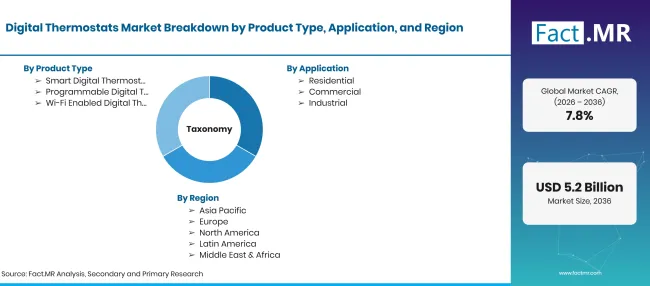
Factmr Digital Thermostats Market Taxonomy | Source: Fact.MR
| Attribute | Details |
|---|---|
| Quantitative Units | USD billion |
| Market Definition | Digital room-temperature controllers used with compatible heating or cooling equipment |
| Product Type | Smart Digital Thermostats; Programmable Digital Thermostats; Wi-Fi Enabled Digital Thermostats |
| Application | Residential; Commercial; Industrial |
| Distribution Channel | Specialty Stores; Online Stores; Supermarkets/Hypermarkets; Others |
| Regions Covered | North America; Latin America; Western Europe; Eastern Europe; East Asia; South Asia & Pacific; Middle East & Africa |
| Countries Covered | Germany; Brazil; United States; United Kingdom; Japan |
| Companies Profiled | Resideo Technologies, Inc. (Honeywell Home); Johnson Controls; Google Nest; Schneider Electric; Siemens; ecobee; Carrier |
| Forecast Period | 2026 to 2036 |
| Approach | Product fit, application requirements, official building and energy data, and manufacturer product records |
Source: Fact.MR analysis. Updated Oct 15, 2026
How is the market segmented?
-
By Product Type:
- Smart Digital Thermostats
- Programmable Digital Thermostats
- Wi-Fi Enabled Digital Thermostats
-
By Application:
- Residential
- Commercial
- Industrial
-
By Distribution Channel:
- Specialty Stores
- Online Stores
- Supermarkets/Hypermarkets
- Others
-
By Region:
- North America
- Latin America
- Western Europe
- Eastern Europe
- East Asia
- South Asia & Pacific
- Middle East & Africa
Frequently Asked Questions
How big is the digital thermostats market in 2026?
What CAGR is forecast from 2026 to 2036?
Which product type leads?
Which application leads?
Who are the main companies in the digital thermostats market?
Who worked on this report


Preview the report firsthand - request a free sample
Free SampleGet the brochure for pricing and purchase details
Download PDF