- Market Value (2025): USD 161.1 Mn
- Estimated Value (2026): USD 170.4 Mn
- Forecast Value (2036): USD 299.8 Mn
- CAGR (2026-2036): 5.8%
What is the Digital Polarimeters Market forecast to be worth by 2036?
USD 170.4 million in 2026 to USD 299.8 million by 2036 at a 5.8% CAGR.
- The digital polarimeters market was valued at USD 161.1 million in 2025, with benchtop instruments and pharmaceutical testing carrying most of that revenue.
- By 2036, revenue will reach USD 299.8 million, up from USD 170.4 million in 2026.
- A 5.8% CAGR will hold from 2026 to 2036, since continuing demand for optical-rotation measurement in quality control and research keeps laboratories upgrading from manual instruments.
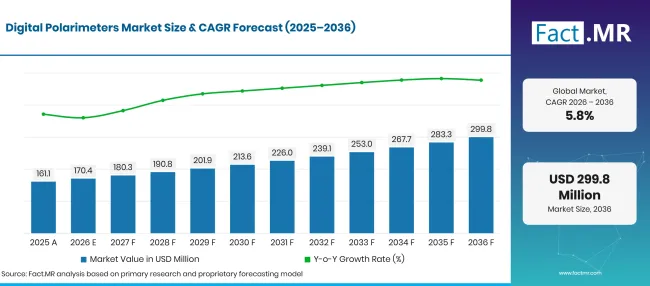
Digital Polarimeters Market Forecast Global | Source: Fact.MR
| Year | Basis | Market Value (USD million) |
|---|---|---|
| 2025 | Estimated | 161.1 |
| 2026 | Estimate | 170.4 |
| 2036 | Forecast | 299.8 |
| CAGR 2026 to 2036 | Forecast period | 5.8% |
Source: Fact.MR analysis. Updated Oct 27, 2026
What are the defining numbers behind Digital Polarimeters Market growth?
The 2026 to 2036 period adds USD 129.4 million in new value, led by pharmaceutical analysis, routine laboratory testing and industrial quality control.
- Demand Drivers in the Market
- The FDA Center for Drug Evaluation and Research approved 46 novel drugs in 2025 [1]. Independently, USP General Chapter <781> describes optical rotation as a criterion for identity and purity of certain optically active pharmaceutical materials [10].
- Chemical manufacturers use polarimetry to confirm optical activity and batch consistency, choosing instruments by sample type, range and precision.
- Food and beverage testing adds demand, as sugar-related analysis needs optical rotation readings in selected ingredients and products.
- Research laboratories need dependable measurement for chiral compounds and reactions, while 2025 sales across the ten largest pharmaceutical markets rose 10.0%, sustaining development testing.
- Digital displays and automated measurement reduce manual reading errors, simplifying routine workflows in busy 2026 laboratories.
- Key Segments Analyzed
- By Product Type: Benchtop Digital Polarimeters lead with a 62.4% share in 2026, since routine laboratory work and quality-control checks call for the steady accuracy and temperature control these instruments provide.
- By Application: Pharmaceuticals capture 38.2% of 2026 revenue, as drug makers rely on polarimetry to analyze and assess the quality of optically active materials.
- By End-User: Laboratories secure 45.0% of 2026 demand, because testing and analytical facilities put polarimeters to work across both routine and specialized measurement tasks.
- Analyst Opinion at Fact.MR
- Shambhu Nath Jha, Principal Consultant at Fact.MR, states, "Digital polarimeters fill an essential niche in analytical measurement. Buyers weigh accuracy, repeatability, operating ease, sample handling and data management against cost. Pharmaceutical quality control stays a core application, while chemical, food and beverage, and research laboratories extend the range of uses."
- Strategic Implications
- Instrument makers will win more trust by building their product story around measurement accuracy, repeatability, and ease of use.
- Sales teams serving drug makers need to show clearly how instrument performance fits documented laboratory procedures and the quality-control requirements that apply.
- Portable models suit users who test on the move or outside a fixed laboratory, while benchtop models fit routine, higher-throughput workflows.
- Manufacturers that pair every sale with clear application guidance, training and dependable after-sales service help laboratories keep their measurements consistent.
Germany sets the pace among the five countries at a 6.7% CAGR, helped by a deep pharmaceutical and chemical industry. Brazil is next at 6.1%, outrunning the 5.8% global rate as drug demand climbs quickly. The United States, at 5.5%, lags the global average slightly, since mature, compliance-minded laboratories mostly swap out old units. The United Kingdom registers 4.9%, sustained by steady pharmaceutical and university testing. Japan closes the group at 4.4%, where well-established laboratories and sluggish drug-market growth temper expansion.
How does the Digital Polarimeters Market break down by segment?
Benchtop Digital Polarimeters lead Product Type at 62.4%; Pharmaceuticals lead Application at 38.2%; and Laboratories lead End-User at 45.0%.
Which Product Type dominates?
Benchtop Digital Polarimeters hold 62.4% of the market.
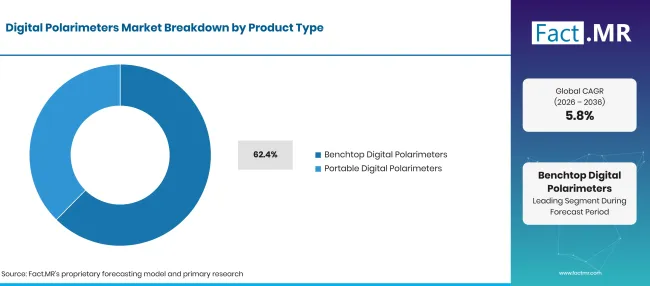
Digital Polarimeters Market Breakdown Product Type | Source: Fact.MR
| Product Type | Share (2026) |
|---|---|
| Benchtop Digital Polarimeters (Leading segment) | 62.4% |
| Other segments combined | 37.6% |
| Total | 100.0% |
Source: Fact.MR analysis. Updated Oct 27, 2026
Stable placement and repeatable measurement make Benchtop Digital Polarimeters the preferred choice for laboratories with established testing routines, which explains their 62.4% share in 2026. A fixed installation supports tighter temperature control, consistent sample handling and smooth integration with quality-control procedures across pharmaceutical, chemical, food and research settings. Portable instruments make up the remaining 37.6% and appeal mainly to users who need mobility or work where a fixed laboratory setup is impractical.
What supports Pharmaceuticals within Application?
Pharmaceuticals account for 38.2% of the market.
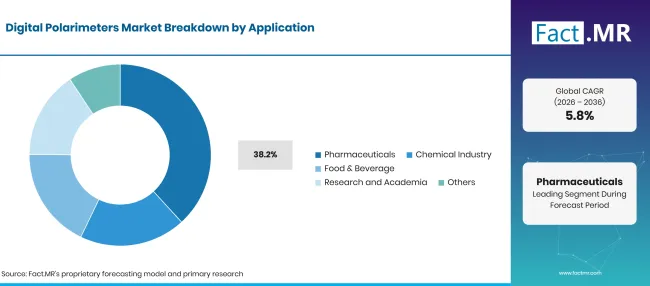
Digital Polarimeters Market Breakdown Application | Source: Fact.MR
| Application | Share (2026) |
|---|---|
| Pharmaceuticals (Leading segment) | 38.2% |
| Other segments combined | 61.8% |
| Total | 100.0% |
Source: Fact.MR analysis. Updated Oct 27, 2026
Certain optically active pharmaceutical substances are evaluated through optical-rotation measurements, as described by USP General Chapter <781> [10]. Fact.MR estimates that the Pharmaceuticals application accounts for 38.2% of digital polarimeter market revenue in 2026; this share is a market-model estimate. Every result must also fit the sample, measurement conditions and laboratory procedure. Chemical, food and beverage, and academic users add demand, but they generally work under fewer mandatory test requirements, so their shares trail.
What leads the End-User segment?
Laboratories account for 45.0% of the market.
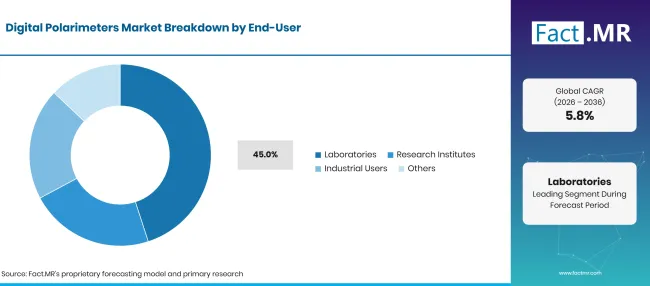
Digital Polarimeters Market Breakdown End User | Source: Fact.MR
| End-User | Share (2026) |
|---|---|
| Laboratories (Leading segment) | 45.0% |
| Other segments combined | 55.0% |
| Total | 100.0% |
Source: Fact.MR analysis. Updated Oct 27, 2026
Daily testing volume makes Laboratories the largest end-user group, with a 45.0% share in 2026. Quality-control, contract-testing and analytical laboratories use polarimeters for applicable optical-rotation measurements. Equipment selection and continued use depend on test requirements, performance, maintenance and laboratory qualification procedures. Research institutes use the instruments for studies of optical activity and chiral materials, but at lower volumes and with longer approval cycles. Industrial users build polarimetry into production checks, though usually with fewer instruments per site, so both groups trail laboratories.
What is accelerating Digital Polarimeters Market adoption, and what is holding it back?
Quality-control testing, pharmaceutical analysis and research work keep orders flowing for digital polarimeters. Automated measurement, clear digital readouts, and dependable calibration support make these instruments easier to adopt. Steady laboratory investment and wider use across pharmaceutical, chemical, food, and academic settings continue to open new purchase opportunities.
Drivers Impact Analysis
| DRIVER | (~) % IMPACT ON CAGR | GEOGRAPHIC RELEVANCE | IMPACT TIMELINE |
|---|---|---|---|
| Pharmaceutical quality-control testing keeps optically active substances moving through polarimeters | +2.0% | Global | Short to medium term (<= 4 years) |
| Chemical producers rely on optical rotation for process and batch consistency checks | +1.2% | Global | Short to medium term (<= 4 years) |
| Laboratory spending on digital measurement and data-handling features | +1.0% | Global | Medium term (2-4 years) |
| Food, beverage and academic testing broadens the buyer base | +0.8% | Global | Medium term (2-4 years) |
Source: Fact.MR analysis. Updated Oct 27, 2026
Opportunity Impact Analysis
| OPPORTUNITY | (~) % IMPACT ON CAGR | GEOGRAPHIC RELEVANCE | IMPACT TIMELINE |
|---|---|---|---|
| Instruments built around pharmaceutical laboratories and documented testing workflows | +0.6% | Global | Medium term (2-4 years) |
| Portable models for mobile or space-limited testing environments | +0.4% | Global | Medium term (2-4 years) |
| Stronger software, data handling and instrument connectivity | +0.3% | Global | Medium to long term (>= 2 years) |
| Training, calibration and after-sales support for laboratory users | +0.1% | Global | Long term (>= 4 years) |
Source: Fact.MR analysis. Updated Oct 27, 2026
Restraints Impact Analysis
| RESTRAINT | (~) % IMPACT ON CAGR | GEOGRAPHIC RELEVANCE | IMPACT TIMELINE |
|---|---|---|---|
| Upfront instrument cost and recurring calibration needs | -0.3% | Global | Short to medium term (<= 4 years) |
| Dependence on trained operators and method-specific sample preparation | -0.2% | Global | Short to medium term (<= 4 years) |
| Limited fit for samples where optical rotation adds little useful information | -0.1% | Global | Long term (>= 4 years) |
Source: Fact.MR analysis. Updated Oct 27, 2026
Which countries are scaling the Digital Polarimeters Market through 2036?
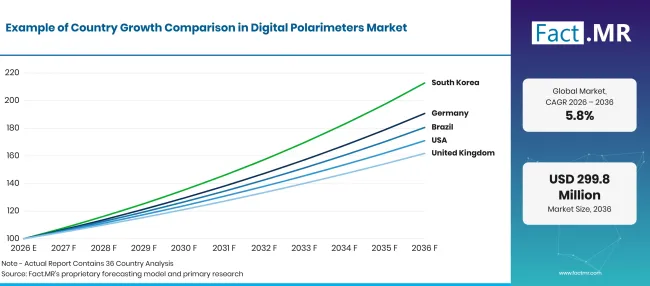
Digital Polarimeters Market Growth Index | Source: Fact.MR
| Country | CAGR (2026 to 2036) |
|---|---|
| Germany | 6.7% |
| Brazil | 6.1% |
| United States | 5.5% |
| United Kingdom | 4.9% |
| Japan | 4.4% |
Source: Fact.MR analysis. Updated Oct 27, 2026
What supports adoption in Germany?
6.7% CAGR, supported by Germany’s large pharmaceutical manufacturing base and local instrument expertise.
IQVIA ranked Germany third among the world's pharmaceutical markets in 2025, at USD 77.0 billion. Drug and chemical plants lean on routine optical rotation testing, and home-based companies A. Krüss Optronic GmbH and SCHMIDT + HAENSCH GmbH & Co. [6] give local laboratories close access to service and calibration.
How is Brazil developing demand?
6.1% CAGR, linked to expanding pharmaceutical production and growing quality-control capacity in Brazil.
IQVIA put Brazil's pharmacy market at USD 35.9 billion in 2025, up 13.2% in constant dollars. That growth pushes drug makers to add quality-control capacity, while most leading instrument vendors sit abroad, so distributors with local calibration and service win trust.
What is supporting the United States' adoption?
5.5% CAGR, driven by the scale of U.S. pharmaceutical manufacturing and routine instrument requalification.
U.S. pharmaceutical sales reached USD 906.5 billion in 2025, and the FDA approved 46 novel drugs [1]. This large and active pharmaceutical base supports regular quality-control testing, instrument replacement, calibration, and requalification across established laboratory and manufacturing environments.
How is the United Kingdom developing demand?
4.9% CAGR, supported by established pharmaceutical and university laboratories following validated testing cycles.
IQVIA ranked the United Kingdom seventh in 2025, with pharmaceutical sales of USD 46.9 billion, up 6.8% in constant dollars. Industrial and university laboratories follow pharmacopoeial rotation methods and renew instruments on validation cycles, though a mature installed base tempers growth.
How does Japan perform?
4.4% CAGR, shaped by Japan’s mature pharmaceutical sector and strong domestic instrument manufacturing base.
Japan ranked fourth in IQVIA's 2025 list at USD 63.7 billion, growing only 2.1% in constant dollars [9]. Japanese pharmaceutical laboratories follow applicable methods under the 19th edition of the Japanese Pharmacopoeia, effective April 10, 2026 [2], and domestic makers ATAGO CO., LTD. [8] and JASCO Corporation [5] supply local buyers, so new demand comes mainly from replacement.
Who leads the Digital Polarimeters Market?
Competition centers on instrument specialists that bundle polarimeters with calibration and compliance support. Anton Paar GmbH supplies the MCP 100 to 5500 range, with Peltier temperature control, pharma qualification documentation and 21 CFR Part 11 software [3].
Rudolph Research Analytical offers Autopol V Plus and VI models, quartz control plates and a standards laboratory [4]. JASCO Corporation's P-2000 series covers ultraviolet to near-infrared wavelengths and can be upgraded in the field [5]. SCHMIDT + HAENSCH GmbH & Co. markets the POL-53 high-speed series [6]. A. Krüss Optronic GmbH's P8000 family measures in about one second, with optional Peltier control. ATAGO CO., LTD. adds automatic polarimeters to a wider optical measurement line [8]. Buyers weigh accuracy, repeatability, software and service; company market shares were not provided.
Which companies are the key providers?
Key companies include Anton Paar GmbH; Rudolph Research Analytical; JASCO Corporation; SCHMIDT + HAENSCH GmbH & Co.; A. Krüss Optronic GmbH; and ATAGO CO., LTD..
- Anton Paar GmbH
- Rudolph Research Analytical
- JASCO Corporation
- SCHMIDT + HAENSCH GmbH & Co.
- Krüss Optronic GmbH
- ATAGO CO., LTD.
Bibliography
- [1] U.S. Food and Drug Administration, Center for Drug Evaluation and Research. (2026, January). Advancing health through innovation: New drug therapy approvals 2025. https://www.fda.gov/drugs/novel-drug-approvals-fda/novel-drug-approvals-2025FDA report
- [2] Ministry of Health, Labour and Welfare. (2026, April 10). The Japanese Pharmacopoeia (19th ed.). Government of Japan. https://www.mhlw.go.jp/stf/seisakunitsuite/bunya/0000066530.htmlMHLW Japanese Pharmacopoeia page
- [3] Anton Paar. (n.d.). Polarimeters. Anton Paar polarimeters Anton Paar
- [4] Rudolph Research Analytical. (n.d.). Polarimeters. Rudolph Research polarimeter information knowledge.rudolphresearch.com
- [5] JASCO. (n.d.). Digital polarimeters. JASCO digital polarimeters JASCO
- [6] SCHMIDT + HAENSCH. (n.d.). Polarimeter. SCHMIDT + HAENSCH polarimeters SCHMIDT + HAENSCH
- [8] ATAGO Co., Ltd. (n.d.). Polarimeter. ATAGO polarimeters atago.net
- [9] IQVIA. (2026, June). Top 10 pharmaceutical markets worldwide, 2025. IQVIA PDF
- [10] United States Pharmacopeia. (2022). General Chapter <781>: Optical Rotation. USP–NF. https://doi.usp.org/USPNF/USPNF_M99570_01_01.html
This Report Answers
- How the Digital Polarimeters Market is divided by product type, application and end-user.
- Which product type, application and end-user categories lead based on the provided shares.
- How the five listed countries compare by CAGR from 2026 to 2036.
- Which specialist instrument manufacturers are included in the competitive landscape.
- Which demand drivers, opportunities and restraints are relevant to digital polarimeter adoption.
What does the Digital Polarimeters Market cover?
This market spans digital instruments that gauge how optically active materials rotate polarized light, a measurement that pharmaceutical and chemical laboratories, food and beverage testers, and research groups trust every day. The study organizes the market by benchtop and portable formats, by application area, and by end-user group: laboratories, research institutes and industrial users.
Revenue is expressed in USD million, and the market is projected to grow steadily through the forecast period as quality-control and research demand keeps widening.
What is included in the scope?
Complete benchtop and portable digital polarimeters sold for optical-rotation measurement fall within the study.
Coverage extends across pharmaceutical analysis, chemical industry use, food and beverage testing, research and academia, and other applications, serving laboratories, research institutes, industrial users and others.
Onboard software and accessories count when bundled into the instrument sale, so the market value reflects the complete measurement solution that buyers receive.
What is excluded from the scope?
The study concentrates on the instrument itself. Standalone accessories, consumables and service contracts sold separately, along with laboratory instruments that do not measure optical rotation and non-digital measuring devices, fall outside the defined market.
How Was the Analysis Built?
The analysis draws on 120+ sources, 35+ company portfolios, 25+ countries, and more than 20 industry interviews.
- Primary Research: Primary research includes discussions with manufacturers, service providers, technology developers, distributors, end users, and subject-matter experts. These conversations examine purchasing priorities, product adoption, operational challenges, approval requirements, competitive positioning, and the factors that influence wider market acceptance.
- Desk Research: Desk research covers government statistics, regulatory publications, company filings, trade data, technical studies, industry associations, standards, public policy, and other authoritative sources. Every source used in the analysis is documented in the bibliography.
- Market Sizing and Forecasting: Market estimates combine historical performance, demand indicators, pricing and volume trends, segment shares, company participation, country-level growth, adoption patterns, investment activity, and barriers to market expansion.
- Data Validation and Update Cycle: Findings are validated by comparing primary interviews with public data, company activity, regulatory changes, trade patterns, and industry developments. Regular updates review new product launches, capacity changes, partnerships, approvals, and shifts in commercial adoption.
Segmentation
What is the report's scope and coverage?
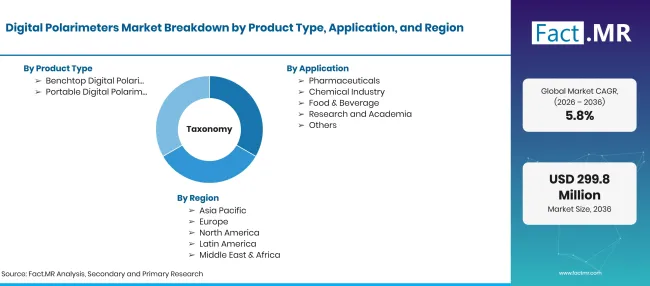
Digital Polarimeters Market Taxonomy | Source: Fact.MR
| Attribute | Details |
|---|---|
| Quantitative Units | USD million |
| Market Definition | Digital instruments that measure optical rotation in optically active samples, with results presented through a digital readout or electronic measurement interface. |
| Product Type | Benchtop Digital Polarimeters; Portable Digital Polarimeters |
| Application | Pharmaceuticals; Chemical Industry; Food & Beverage; Research and Academia; Others |
| End-User | Laboratories; Research Institutes; Industrial Users; Others |
| Regions Covered | North America; Latin America; Western Europe; Eastern Europe; East Asia; South Asia & Pacific; Middle East & Africa |
| Countries Covered | Germany; Brazil; United States; United Kingdom; Japan |
| Companies Profiled | Anton Paar GmbH; Rudolph Research Analytical; JASCO Corporation; SCHMIDT + HAENSCH GmbH & Co.; A. Krüss Optronic GmbH; ATAGO CO., LTD. |
| Forecast Period | 2026 to 2036 |
| Approach | Market values, segment shares and country CAGRs are based on the provided dataset. Qualitative discussion covers product formats, application areas, end-user groups and competitive positioning. |
Source: Fact.MR analysis. Updated Oct 27, 2026
How is the market segmented?
-
By Product Type
- Benchtop Digital Polarimeters
- Portable Digital Polarimeters
-
By Application
- Pharmaceuticals
- Chemical Industry
- Food & Beverage
- Research and Academia
- Others
-
By End-User
- Laboratories
- Research Institutes
- Industrial Users
- Others
-
By Region
- North America
- Latin America
- Western Europe
- Eastern Europe
- East Asia
- South Asia & Pacific
- Middle East & Africa
Frequently Asked Questions
How large is the digital polarimeters market in 2026?
What growth rate will the digital polarimeters market record from 2026 to 2036?
Which product type leads the digital polarimeters market?
Which application holds the greatest share of the digital polarimeters market?
Which end-user contributes the most to the digital polarimeters market?
Which country will record the strongest growth in the digital polarimeters market?
Who are the main companies in the digital polarimeters market?
Who worked on this report


Preview the report firsthand - request a free sample
Free SampleGet the brochure for pricing and purchase details
Download PDF