- Market Value (2025): USD 2.3 Bn
- Estimated Value (2026): USD 2.6 Bn
- Forecast Value (2036): USD 10.2 Bn
- CAGR (2026-2036): 14.7%
What is the Digital Employee Experience Managed Services Market forecast to be worth by 2036?
USD 2.6 billion in 2026 to USD 10.2 billion by 2036 at 14.7% CAGR.
- The Digital Employee Experience Managed Services Market at USD 2.3 billion in 2025.
- Demand is projected to increase from USD 2.6 billion in 2026 to USD 10.2 billion by 2036.
- The market is forecast to record a 14.7% CAGR from 2026 to 2036 as enterprise IT teams outsource monitoring, automation and support governance.
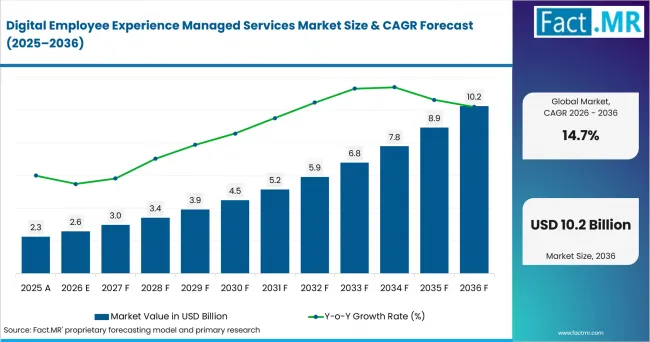
Digital Employee Experience Managed Services Market Value Analysis | Source: Fact.MR
What are the defining numbers behind Digital Employee Experience Managed Services Market growth?
USD 7.6 billion absolute opportunity by 2036, led by DEX monitoring & analytics and Cloud alongside BFSI and Large enterprises.
- Demand Drivers in the Market
- Enterprise IT teams need IT infrastructure monitoring that links device health with ticket volume and application response time.
- Workplace operations teams need managed support because hybrid users experience issues outside traditional office networks.
- Service desk leaders need self-heal routines that resolve common endpoint problems before employees open tickets.
- Security and compliance teams are expected to require clearer telemetry ownership when employee-experience tools collect endpoint data.
- Key Segments Analyzed
- By Service: DEX monitoring & analytics is expected to hold 31.0% share in 2026 due to demand for measurable employee-device and application signals.
- By Deployment: Cloud is projected to account for 64.0% share in 2026 supported by subscription delivery and links to cloud managed services.
- By End-Use: BFSI is anticipated to capture 26.0% share in 2026 because regulated firms need evidence around support quality and access control.
- By Organization Size: Large enterprises are estimated to represent 73.0% share in 2026 owing to larger endpoint estates and stricter service governance.
- Analyst Opinion at Fact.MR
- Shambhu Nath Jha, Principal Consultant at Fact.MR, states, “DEX managed services are moving employee support from ticket closure to measurable workplace performance. Procurement is expected to depend on analytics, automation and secure telemetry governance. Providers should prove faster resolution without weakening employee data controls.”
- Strategic Implications
- Enterprise CIOs should test DEX dashboards against actual ticket reduction before expanding contract scope.
- Service providers should connect automation playbooks with escalation rules so clients can see what changed after each intervention.
- Security teams should align DEX telemetry with managed security services controls before employee monitoring is widened.
- Investors should separate direct DEX managed service exposure from generic help desk outsourcing and workplace software resale.
Australia is forecast to post 16.2% CAGR through 2036. The United States is projected to record 15.9%, while Canada is anticipated to advance at 15.7%. The United Kingdom is estimated to reach 15.4%, Germany is forecast at 15.2%, and Japan is projected to post 14.1%.
How does the Digital Employee Experience Managed Services Market break down by segment?
DEX monitoring & analytics leads Service at 31.0%; Cloud leads Deployment at 64.0%.
Which service category dominates?
DEX monitoring & analytics holds 31.0% share in 2026.
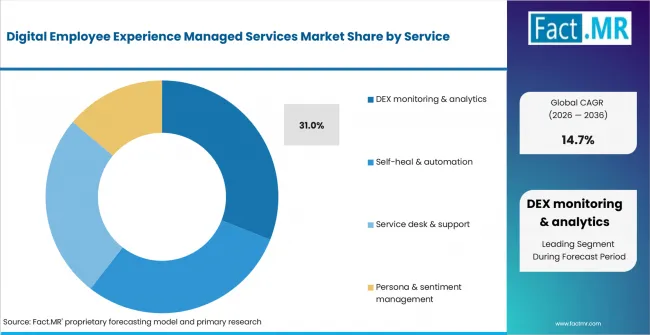
Digital Employee Experience Managed Services Market Analysis By Service | Source: Fact.MR
DEX monitoring & analytics is projected to lead Service Category with 31.0% share in 2026. Enterprise accounts favor this service when they need unified visibility into device health, application response and user sentiment across distributed digital workplace environments.
What leads the Deployment segment?
Cloud leads with 64.0% share in 2026.
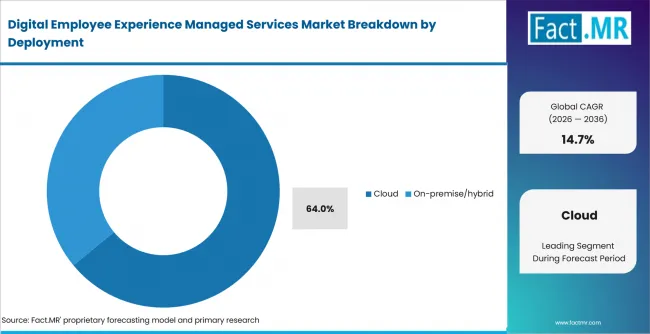
Digital Employee Experience Managed Services Market Analysis By Deployment | Source: Fact.MR
Cloud is expected to lead Deployment with 64.0% share in 2026 because DEX services require frequent updates and centralized visibility. The U.S. Census Bureau reported in September 2025 that 58.9% of businesses using specialized software considered it very important to their processes or methods.
How does End-Use shape demand?
BFSI leads End-Use with 26.0% share in 2026.
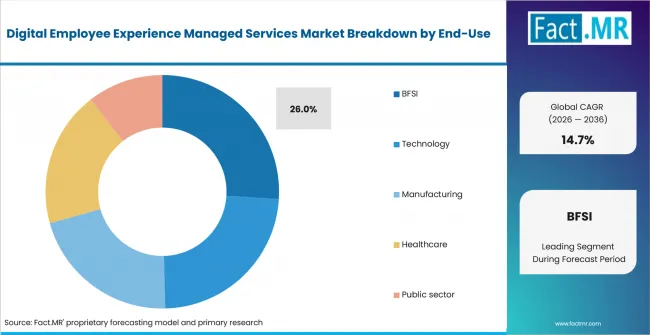
Digital Employee Experience Managed Services Market Analysis By End Use | Source: Fact.MR
BFSI is anticipated to lead End-Use with 26.0% share in 2026 because financial institutions require dependable support records, service-level evidence and controlled resolution processes. Large distributed workforces and regulated operating environments strengthen demand for DEX services that monitor endpoint performance and maintain consistent employee technology experiences.
What supports Large enterprises within Organization Size?
Large enterprises represent 73.0% share in 2026.
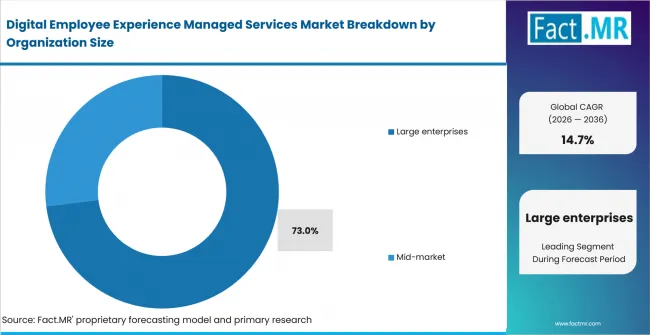
Digital Employee Experience Managed Services Market Analysis By Organization Size | Source: Fact.MR
Large enterprises are estimated to lead Organization Size with 73.0% share in 2026 owing to broad endpoint estates and multiple support tiers. The Office for National Statistics reported in June 2025 that 41% of workers in Great Britain with a degree or equivalent qualification hybrid worked, indicating substantial hybrid-work adoption among highly qualified workers.
What is accelerating Digital Employee Experience Managed Services Market adoption, and what is holding it back?
Hybrid work and cloud service estates drive it; cyber review and telemetry governance restrain it.
Drivers Impact Analysis
| DRIVER | (~) % IMPACT ON CAGR | GEOGRAPHIC RELEVANCE | IMPACT TIMELINE |
|---|---|---|---|
| Hybrid employee support complexity | +3.1% | United States, United Kingdom, Australia | Short term (<= 2 years) |
| Cloud workplace platform adoption | +2.6% | United States, Germany, Canada | Short term (<= 2 years) |
| Self-heal automation demand | +2.1% | Large enterprises and technology accounts | Medium term (2-4 years) |
| Experience analytics in service governance | +1.8% | BFSI and public sector accounts | Medium term (2-4 years) |
| AI-enabled service desk modernization | +1.2% | Australia, Canada, Germany, Japan | Long term (>= 4 years) |
- Hybrid employee support complexity: Hybrid incidents are expected to occur across home networks, office devices and cloud applications. The U.S. Census Bureau reported in September 2025 that 57.4% of businesses using specialized equipment rated it as very important to their processes or methods.
- Cloud workplace platform adoption: Cloud collaboration suites are anticipated to raise demand for uptime tracking and user-level performance data. Destatis reported in November 2025 that 86% of German large enterprises used paid cloud services in 2025.
- Self-heal automation demand: Self-heal automation is projected to reduce repetitive service desk work. HCLTech described DEX in April 2026 as employee interaction quality across workplace technology and digital services.
Opportunity Impact Analysis
| OPPORTUNITY | (~) % IMPACT ON CAGR | GEOGRAPHIC RELEVANCE | IMPACT TIMELINE |
|---|---|---|---|
| Integrated workplace telemetry | +1.5% | United States, United Kingdom, Germany | Medium term (2-4 years) |
| Persona-based experience services | +1.2% | BFSI, technology and healthcare accounts | Medium term (2-4 years) |
| Automation-led service desk redesign | +1.0% | Canada, Australia and Japan | Long term (>= 4 years) |
| Hybrid security support packaging | +0.8% | Regulated enterprise accounts | Long term (>= 4 years) |
- Integrated workplace telemetry: Integrated telemetry is projected to create opportunity where enterprises want one view across endpoint health and service outcomes. The U.K. Business Data Survey 2026 found that 79% of businesses with employees handled employee data in 2025-2026.
- Persona-based experience services: Persona-based services are anticipated to grow where employee roles face different application constraints. Providers can use sentiment and device signals to tune support policies by role.
- Automation-led service desk redesign: Automation-led redesign is expected to move common fixes into guided resolution paths. Wipro and Google Cloud expanded their partnership in December 2025 to advance enterprise productivity with Google Cloud technology.
Restraints Impact Analysis
| RESTRAINT | (~) % IMPACT ON CAGR | GEOGRAPHIC RELEVANCE | IMPACT TIMELINE |
|---|---|---|---|
| Employee telemetry privacy review | -1.3% | United Kingdom, Germany, Japan | Short term (<= 2 years) |
| Cyber risk in outsourced support | -1.1% | United States, Australia, Canada | Short term (<= 2 years) |
| Tool overlap with ITSM platforms | -0.9% | Large enterprises | Medium term (2-4 years) |
| Mid-market budget scrutiny | -0.7% | Canada, Australia, United Kingdom | Medium term (2-4 years) |
- Employee telemetry privacy review: Telemetry privacy review is expected to slow deployments when monitoring captures employee device behavior. Providers are expected to need clear consent, retention and access-control documentation.
- Cyber risk in outsourced support: Cyber risk is anticipated to constrain adoption where support partners need privileged access. ASD’s ACSC reported in October 2025 that it responded to more than 1,200 cyber security incidents in FY2024-25.
Which countries are scaling Digital Employee Experience Managed Services Market fastest?
- The country comparison spans 2.10 percentage points across the forecast period.
- Australia remains 0.4 percentage point above the United States due to hybrid work and business AI use.
- The United States remains 0.2 percentage point above Canada through cloud reliance and technology-workforce depth.
- Canada remains 0.3 percentage point above the United Kingdom as software services and AI workflow planning support managed operations.
- The United Kingdom remains 0.1 percentage point above Germany because hybrid work and digitised data handling support DEX programs.
- Germany remains 1.1 percentage points above Japan through cloud adoption and enterprise AI use.
- Japan closes the displayed range as telework and local language support create selective DEX demand.
Comparable CAGRs create different entry conditions because hybrid work, cloud deployment, cyber risk and procurement review vary by country. Coverage includes North America, Latin America, Europe, East Asia, South Asia and Pacific, Middle East and Africa.
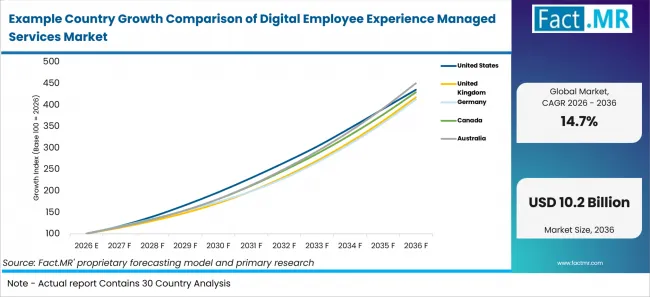
Example Country Growth Comparison Of Digital Employee Experience Managed Services Market | Source: Fact.MR
| Country | CAGR (2026-2036) |
|---|---|
| Australia | 16.2% |
| United States | 15.9% |
| Canada | 15.7% |
| United Kingdom | 15.4% |
| Germany | 15.2% |
| Japan | 14.1% |
What supports Australia adoption?
16.2% CAGR, backed by hybrid work, AI use and cyber reporting needs.
Australia’s growth is supported by hybrid work and rising business AI adoption. ABS reported 36% of employed people usually worked from home in August 2025, while 12% of businesses used AI in 2024-25. Cybercrime exposure, uneven endpoint estates and skills pressure may slow broader managed DEX deployment.
What is powering United States demand?
15.9% CAGR, supported by cloud reliance and technology-services depth.
United States growth reflects strong cloud reliance and deep technology-services capacity. The U.S. Census Bureau reported in September 2025 that 59.0% of businesses using cloud-based technology rated it as very important to their processes or methods, while BLS projected about 317,700 openings annually in computer and information technology occupations from 2024 to 2034. Cybercrime losses, mature ITSM overlap and staged approvals may restrain DEX expansion.
How is Canada developing demand?
15.7% CAGR, shaped by software-services scale and AI workflow planning.
Canada’s growth is supported by expanding software services and AI workflow planning. Statistics Canada reported in March 2026 that operating revenue in Canada’s software development and computer services industries increased 8.5% to CAD 161.9 billion in 2024. Cybersecurity actions, privacy reviews and proof requirements may extend procurement cycles.
What supports the United Kingdom outlook?
15.4% CAGR, driven by hybrid work and digitised business data.
United Kingdom growth reflects widespread hybrid work and extensive use of digitised business data. ONS reported in June 2025 that 28% of working adults in Great Britain hybrid worked between January and March 2025, while the UK Business Data Survey 2026 found that 86% of UK businesses handled some type of digitised data in 2025–2026. Cyber breaches, subscription scrutiny and telemetry reviews may slow managed DEX adoption.
How is Germany scaling managed DEX adoption?
15.2% CAGR, backed by enterprise cloud use and AI adoption.
Germany’s growth is supported by strong cloud and AI adoption. Destatis reported that 54% of German enterprises with at least 10 employees used paid cloud-computing services in 2025, while 26% used AI technologies. Large organizations are expected to connect endpoint support with service governance, although cost concerns, works-council reviews and overlapping tools may restrain deployment.
How does Japan perform?
14.1% CAGR, supported by telework adoption and information-services activity.
Japan’s growth is supported by established telework practices and a large technology-services base. MIC’s 2025 Communications Usage Trend Survey found that 50.1% of surveyed enterprises had introduced telework. Ransomware exposure, conservative rollouts and local handover requirements may extend provider selection.
Who leads the Digital Employee Experience Managed Services Market?
Accenture, Atos, Wipro and HCLTech show the direct relevance, while Unisys and DXC Technology strengthen the wider service field.
Accenture supports enterprise workplace transformation across technology operations and managed service programs. Atos contributes direct digital workplace experience services. Wipro adds digital workplace services through cloud and AI delivery. HCLTech supports DEX and workplace experience management through service desk and endpoint operations. Unisys and DXC Technology extend the provider set across support, infrastructure and managed infrastructure services.
Which companies are the key providers?
Key companies include Accenture, Atos, Wipro, HCLTech, Unisys, and DXC Technology.
- Accenture
- Atos
- Wipro
- HCLTech
- Unisys
- DXC Technology
Bibliography
- Australian Bureau of Statistics. (2025, December 12). Working arrangements, August 2025.
- Australian Bureau of Statistics. (2026, June 25). Characteristics of Australian Business, 2024–25 financial year.
- Australian Signals Directorate. (2025, October 14). Annual Cyber Threat Report 2024–2025.
- HCLTech. (2026, April 23). What is digital employee experience (DEX)?
- Atos. (2025, January 21). Atos Digital Workplace Experience Engagement platform enhances user support with Espressive's Barista Conversational AI solution.
- Department for Science, Innovation and Technology. (2026, April 30). Cyber security breaches survey 2025/2026.
- Department for Science, Innovation and Technology. (2026, June 18). UK Business Data Survey 2026.
- Federal Bureau of Investigation. (2026, April 6). 2025 Internet Crime Report.
- Statistisches Bundesamt (Destatis). (2025, November 24). Jedes zweite Unternehmen nutzt kostenpflichtige Cloud-Services [One in two enterprises uses paid cloud services].
- Statistisches Bundesamt (Destatis). (2025, November 24). Enterprises using artificial intelligence (AI) technologies, by employment size class, 2025.
- Office for National Statistics. (2025, June 11). Who has access to hybrid work in Great Britain?
- Statistics Canada. (2025, May 27). Business' or organization's plans to take any new or additional cybersecurity actions over the next 12 months, second quarter of 2025. (Table 33-10-1003-01).
- U.S. Bureau of Labor Statistics. (2025, August 28). Computer and information technology occupations. Occupational Outlook Handbook.
- International Trade Administration. (2025, November 20). Japan – Digital economy.
- Wipro. (2025, December 12). Wipro and Google Cloud expand their strategic partnership to advance enterprise productivity.
This Report Answers
- The report covers Service and Deployment choices shaping outsourced workplace support.
- Segment analysis covers DEX monitoring & analytics and Cloud as the 2026 share leaders.
- Country outlook evaluates Australia, the United States, Canada, the United Kingdom, Germany and Japan.
- Competitive analysis profiles Accenture, Atos, Wipro, HCLTech, Unisys and DXC Technology.
- Service assessment covers monitoring, automation and support operations. Scope extends to IT operations and services management where enterprise service governance overlaps with DEX outcomes.
What does the Digital Employee Experience Managed Services Market cover?
Digital employee experience managed services improve employee workplace-technology use across digital workplace support, endpoints, collaboration tools, applications and service desks.
Coverage includes DEX monitoring & analytics, self-heal & automation, service desk & support, and persona & sentiment management. End-use coverage spans BFSI, technology, manufacturing, healthcare and public sector accounts.
What is included in the scope?
The scope includes managed services that operate employee experience monitoring, support automation and service desk improvement programs.
Coverage includes endpoint performance, user sentiment, ticket analytics and resolution workflows. The market also includes services connected to mobile device management when those services are sold as part of employee experience operations.
Included work can overlap with IoT managed services where connected workplace devices create support events. The same inclusion rule applies when device data is used to improve employee experience outcomes rather than general asset monitoring.
What is excluded from the scope?
Standalone collaboration software licenses and generic help desk staffing remain outside the scope without managed DEX operations.
Customer experience platforms and cybersecurity-only contracts are excluded unless employee technology monitoring is included.
How Was the Analysis Built?
The analysis draws on 120+ sources, 35+ company portfolios, 25+ countries, and more than 20 industry interviews.
- Primary Research: Primary research includes discussions with manufacturers, service providers, technology developers, distributors, end users, procurement teams, and subject-matter experts. These conversations examine purchasing priorities, product adoption, operational challenges, approval requirements, competitive positioning, and the factors that influence wider market acceptance.
- Desk Research: Desk research covers government statistics, regulatory publications, company filings, trade data, technical studies, industry associations, standards, public policy, and other authoritative sources. Every source used in the analysis is documented in the bibliography.
- Market Sizing and Forecasting: Market estimates combine historical performance, demand indicators, pricing and volume trends, segment shares, company participation, country-level growth, adoption patterns, investment activity, and barriers to market expansion.
- Data Validation and Update Cycle: Findings are validated by comparing primary interviews with public data, company activity, regulatory changes, trade patterns, and industry developments. Regular updates review new product launches, capacity changes, partnerships, approvals, procurement trends, and shifts in commercial adoption.
What is the report’s scope and coverage?
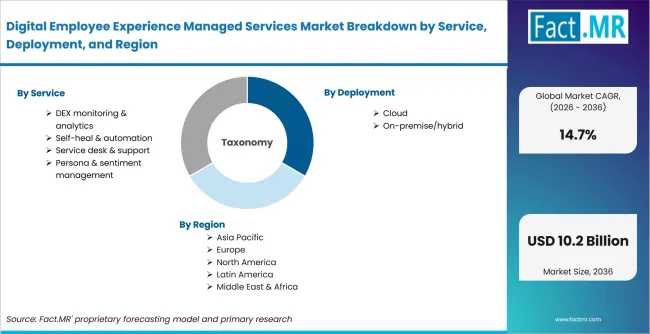
Digital Employee Experience Managed Services Market Breakdown By Service, Deployment, And Region | Source: Fact.MR
| Attribute | Details |
|---|---|
| Quantitative Units | USD billion in 2026 to USD billion by 2036 at CAGR |
| Market Definition | Outsourced services that monitor, improve and support employee technology experience across devices, applications, service desks and workplace platforms. |
| Service | DEX monitoring & analytics; Self-heal & automation; Service desk & support; Persona & sentiment management |
| Deployment | Cloud; On-premise/hybrid |
| End-Use | BFSI; Technology; Manufacturing; Healthcare; Public sector |
| Organization Size | Large enterprises; Mid-market |
| Regions Covered | North America; Latin America; Europe; East Asia; South Asia and Pacific; Middle East and Africa |
| Countries Covered | Australia; United States; Canada; United Kingdom; Germany; Japan |
| Key Companies Profiled | Accenture; Atos; Wipro; HCLTech; Unisys; DXC Technology |
| Forecast Period | 2026 to 2036 |
| Approach | Hybrid top-down and bottom-up approach using workplace IT spending, cloud adoption, hybrid work indicators, DEX analytics need, country patterns and company portfolio review |
How is the market segmented?
-
By Service:
- DEX monitoring & analytics
- Self-heal & automation
- Service desk & support
- Persona & sentiment management
-
By Deployment:
- Cloud
- On-premise/hybrid
-
By End-Use:
- BFSI
- Technology
- Manufacturing
- Healthcare
- Public sector
-
By Organization Size:
- Large enterprises
- Mid-market
-
By Region:
- North America
- Latin America
- Europe
- East Asia
- South Asia and Pacific
- Middle East and Africa