- Base Value(2025): 8.8 Bn
- Estimated Value(2026): 9.6 Bn
- Forecast Value (2036): 25.4 Bn
- CAGR (2026 - 2036): 10.2%
Managed Infrastructure Services Market Forecast and Outlook By Fact.MR
In 2025, the managed infrastructure services market was valued at USD 8.8 billion. Based on Fact.MR analysis, demand for managed infrastructure services is estimated to grow to USD 9.6 billion in 2026 and USD 25.4 billion by 2036. FACT.MR projects a CAGR of 10.2% during the forecast period.
The market is expected to generate USD 15.8 billion in incremental revenue during the forecast period. This reflects transformational growth. Growth is driven by rising enterprise adoption of multi-cloud environments. Regulatory compliance requirements are also increasing demand. Remote infrastructure monitoring is expanding across BFSI and healthcare sectors. However, growth faces some challenges. Pricing pressure from hyperscaler-native services is increasing. Budget constraints in public sector procurement are also limiting faster adoption.
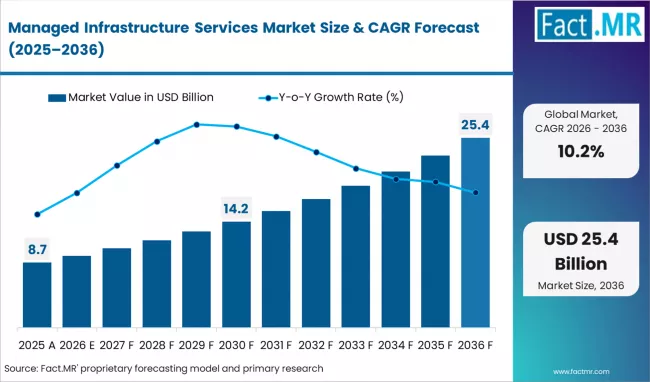
Managed Infrastructure Services Market Market Value Analysis | Source: Fact.MR
| Metric | Value |
|---|---|
| Estimated Value in 2026 | USD 9.6 billion |
| Forecast Value in 2036 | USD 25.4 billion |
| Forecast CAGR (2026 to 2036) | 10.2% |
Source: Fact.MR analysis. Updated Mar 25, 2026
South Korea leads country-level growth at 11.0% CAGR through 2036, supported by rapid enterprise cloud migration and government-mandated digital infrastructure modernisation under the Korea Digital New Deal. The United States follows at 10.8% CAGR, driven by large-enterprise multi-cloud contract renewals and rising AIOps-driven automation spend across financial services and healthcare.
Japan records 10.6% CAGR through enterprise IT outsourcing expansion and government-backed Society 5.0 digital infrastructure programmes. The United Kingdom posts 10.5% CAGR supported by post-Brexit public sector IT outsourcing re-tendering and FCA-driven cloud resilience compliance requirements. The European Union records 10.3% CAGR, shaped by DORA regulatory compliance mandates and cross-border managed service procurement across financial institutions in Germany, France, and the Netherlands.
Summary of Managed Infrastructure Services Market
- Market Definition
- The market includes outsourced infrastructure monitoring, disaster recovery, business continuity, and security audit services delivered to enterprises across multiple industries globally.
- Demand Drivers
- Multi-cloud adoption is pushing BFSI and healthcare firms to outsource infrastructure management to specialised providers.
- DORA regulations in the EU are driving demand for managed disaster recovery and compliance-focused services.
- Rising cybersecurity threats are increasing demand for managed security audit services, especially among mid-sized enterprises.
- Key Segments Analyzed
- By Service Type: Remote system monitoring leads with 38% share in 2026 due to demand for continuous infrastructure visibility.
- By Industry: Telecom and IT holds 30% share in 2026 due to high outsourcing across network operations.
- By Geography: North America leads in revenue, while South Korea shows fastest growth at 11.0% CAGR.
- Analyst Opinion at FACT.MR
- Shambhu Nath Jha, Senior Consultant at Fact.MR, opines that growth depends more on AIOps, zero-trust security, and DORA-aligned capabilities than contract volume.
- Strategic Implications
- Providers should integrate AIOps and multi-cloud management into core offerings to compete with hyperscaler-native services.
- Vendors must develop DORA-compliant disaster recovery frameworks with clear RTO and RPO commitments.
- Companies should expand managed security services for mid-market firms in the US and South Korea facing regulatory pressure.
- Methodology
- Market sizing uses contract volumes and values by service and geography, validated with provider data and IT spending surveys.
- Regulatory inputs include DORA, FCA standards, Korea Digital New Deal, and Japan Society 5.0 data.
- Forecasts include multi-cloud adoption, outsourcing trends, cybersecurity investment, and expert interviews.
Segmental Analysis
Managed Infrastructure Services Market Analysis by Service Type
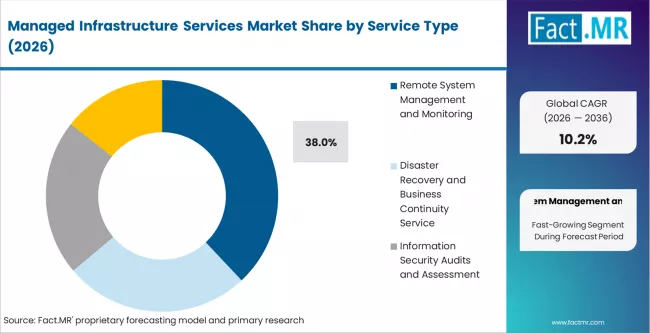
Managed Infrastructure Services Market Analysis By Service Type | Source: Fact.MR
Remote System Management and Monitoring is expected to hold 38% share in 2026. This is due to strong demand for 24x7 infrastructure visibility across hybrid and on-premise environments. It reduces the need for in-house network operations centres.
- IBM AIOps Investment: In October 2024, IBM expanded watsonx AIOps with enhanced observability and automation features for managed services. [1]
- HCL Technologies Monitoring Launch: In November 2024, HCL launched the Ivy platform with AI-driven root cause analysis and predictive maintenance capabilities. [4]
- Disaster Recovery Contract Growth: Gartner reported that 78% of enterprises faced disruptions in 2024, increasing demand for managed disaster recovery services. [5]
Managed Infrastructure Services Market Analysis by Industry
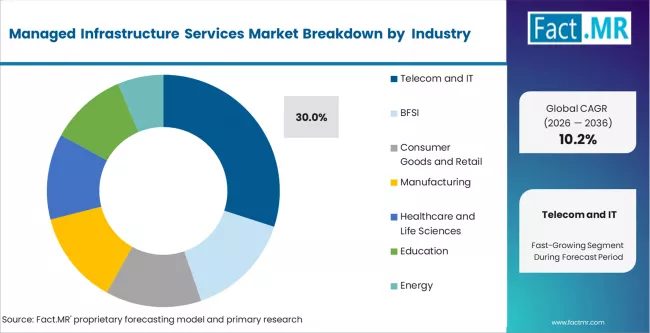
Managed Infrastructure Services Market Analysis By Industry | Source: Fact.MR
Telecom and IT is expected to hold 30% share in 2026. This reflects high outsourcing across network operations and multi-vendor infrastructure environments.
- TCS Telecom Engagement: In January 2025, TCS expanded its managed infrastructure contract with a European telecom operator across 12 markets. [6]
- BFSI DORA Outsourcing Surge: Accenture reported a 22% increase in EU financial services outsourcing in 2024 due to DORA compliance needs. [7]
- Healthcare IT Outsourcing Trend: NHS Shared Business Services expanded its managed infrastructure framework in 2024 to include cloud, disaster recovery, and security services. [8]
Drivers, Restraints, and Opportunities
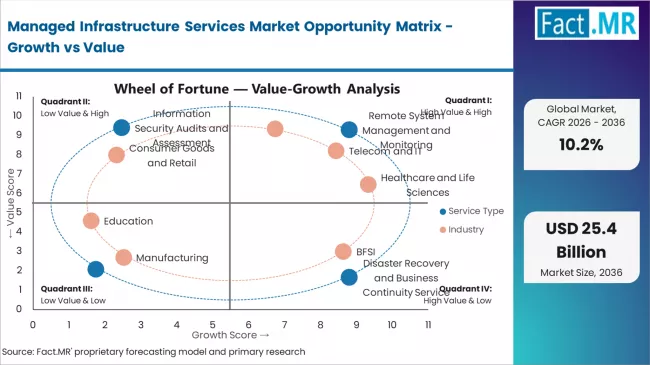
Managed Infrastructure Services Market Opportunity Matrix Growth Vs Value | Source: Fact.MR
FACT.MR identifies two key phases shaping the market. The first was the shift from break-fix to remote monitoring driven by virtualisation and early cloud adoption. The second is the move toward AI-driven multi-cloud management with AIOps and compliance frameworks.
The market is split between legacy contracts and premium AI-based services. Standard monitoring faces pricing pressure from hyperscalers. Bundled AIOps, disaster recovery, and security services command 30-50% higher pricing. This split supports overall revenue growth despite declining commodity pricing.
- DORA Compliance Mandate: The Digital Operational Resilience Act (DORA), effective January 2025, requires strict standards for disaster recovery and security audits. This is accelerating managed service demand in EU financial markets. [2]
- South Korea Digital New Deal: South Korea allocated KRW 2.3 trillion in 2024 for digital infrastructure. This supports enterprise cloud migration and IT outsourcing growth. [3]
- Enterprise AIOps Adoption: IBM reported 42% enterprise AI adoption in IT operations in 2024. AIOps is widely used for monitoring and incident management, driving provider adoption. [1]
Regional Analysis
The managed infrastructure services market is analysed across North America, Europe, Asia Pacific, Latin America, and Middle East and Africa, covering 40+ country-level demand profiles shaped by enterprise cloud adoption maturity, regulatory compliance requirements, public sector IT outsourcing models, and cybersecurity investment intensity. The full report offers market attractiveness analysis based on contract value benchmarks, AIOps adoption rates, and regulatory compliance programme penetration across regions.
.webp "Top Country Growth Comparison Managed Infrastructure Services Market Cagr (2026 2036)")
Top Country Growth Comparison Managed Infrastructure Services Market Cagr (2026 2036) | Source: Fact.MR
| Country | CAGR (2026 to 2036) |
|---|---|
| South Korea | 11.0% |
| United States | 10.8% |
| Japan | 10.6% |
| United Kingdom | 10.5% |
| European Union | 10.3% |
Source: Fact.MR analysis. Updated Mar 25, 2026
Source: Fact.MR (FACT.MR) analysis, based on proprietary forecasting model and primary research
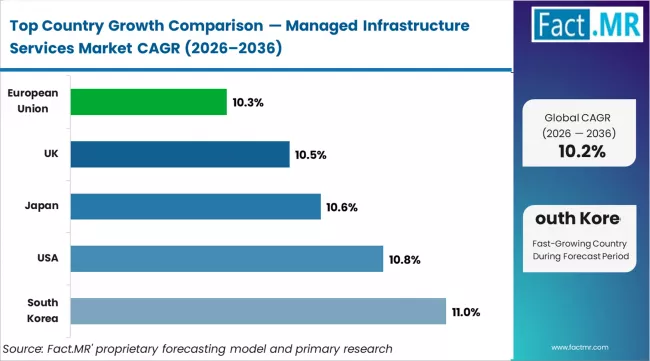
Managed Infrastructure Services Market Cagr Analysis By Country | Source: Fact.MR
Asia Pacific Managed Infrastructure Services Market
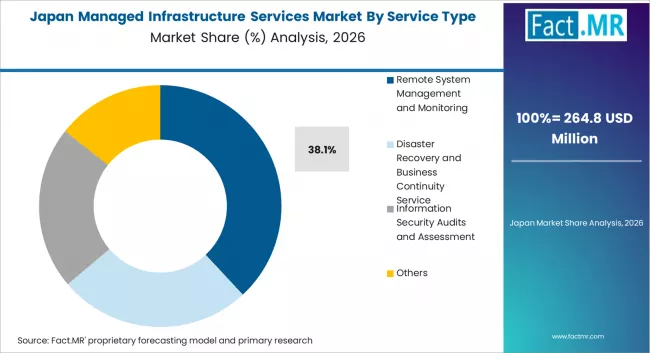
Managed Infrastructure Services Market Japan Market Share Analysis By Service Type | Source: Fact.MR
Asia Pacific is a high-growth region, driven by South Korea’s cloud programmes and Japan’s IT outsourcing expansion. NTT Data and Fujitsu lead in Japan. Samsung SDS and SK C&C lead in South Korea. Indian firms like TCS, Wipro, and HCL serve as regional delivery hubs.
- South Korea: South Korea is expected to record an 11.0% CAGR in managed infrastructure services through 2036. The government allocated KRW 2.3 trillion under Digital New Deal 2.0 in 2024. This supports cloud migration and IT outsourcing. KISA updated cloud security rules in October 2024. Government-linked entities must use certified managed security providers. This creates structured public sector demand, unlike the enterprise-led US market.
- Japan: Japan’s managed infrastructure services market is set to grow at a 10.6% CAGR through 2036. Society 5.0 programmes continue to fund IT modernisation. Enterprises are outsourcing monitoring and disaster recovery services. NTT Data expanded hybrid cloud services in July 2024. Domestic data residency rules drive local provider preference. This differs from South Korea’s cross-border cloud model.
FACT.MR's analysis of Asia Pacific includes South Korea, Japan, China, India, ASEAN, and Australia and New Zealand. It covers policy data, cloud adoption trends, and forecasts.
North America Managed Infrastructure Services Market
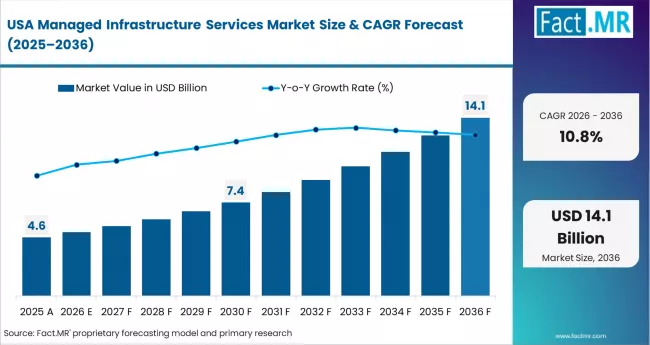
Managed Infrastructure Services Market Country Value Analysis | Source: Fact.MR
North America is the largest market, driven by BFSI and healthcare outsourcing. AIOps adoption is increasing rapidly. IBM, Accenture, and DXC lead enterprise services. Cognizant and Wipro serve mid-market clients.
- United States: The United States is projected to see a 10.8% CAGR in managed infrastructure services through 2036. Around 42% of enterprises use AI in IT operations. This drives AIOps-based monitoring adoption. Updated HIPAA rules in 2024 increased cybersecurity requirements. Hospitals are outsourcing security audits and compliance services. This differs from Europe’s DORA-driven demand.
FACT.MR's analysis of North America includes the US, Canada, and Mexico. It highlights AIOps trends, outsourcing benchmarks, and forecasts.
Europe Managed Infrastructure Services Market
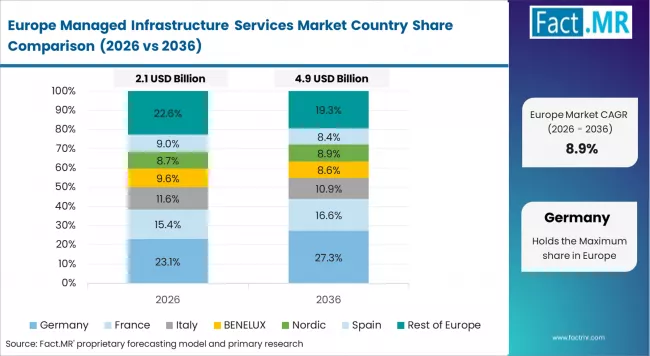
Managed Infrastructure Services Market Europe Country Market Share Analysis, 2026 & 2036 | Source: Fact.MR
Europe is driven by regulatory compliance. DORA is reshaping financial sector outsourcing. Capgemini, Atos, and DXC lead in Western Europe. NTT Data and Wipro are expanding in BFSI services.
- European Union: Across the EU, the market is likely to grow at a 10.3% CAGR through 2036. DORA enforcement began in January 2025. It requires managed ICT contracts with strict compliance. Financial institutions must outsource disaster recovery and audit services. Capgemini reported rising DORA-related contract wins in 2024 across major EU markets.
- United Kingdom: The UK market is expected to expand at a 10.5% CAGR through 2036. FCA operational resilience rules require full compliance by 2025. Financial firms must adopt managed infrastructure support. Atos renewed a government contract in August 2024. It covers monitoring, security, and continuity services. The UK follows a public sector-driven model, unlike EU financial outsourcing trends.
FACT.MR's analysis of Europe includes Germany, France, the UK, Italy, Spain, and Western Europe. It covers DORA data, FCA trends, and forecasts.
Competitive Aligners for Market Players
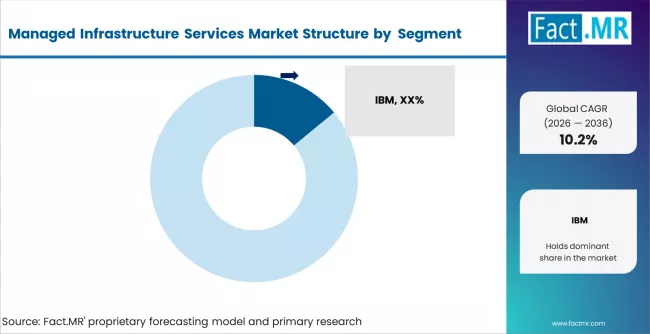
Managed Infrastructure Services Market Analysis By Company | Source: Fact.MR
The global managed infrastructure services market is moderately concentrated, with a few major players dominating large enterprise contracts. Companies like IBM, Accenture, TCS, HCL Technologies, and DXC Technology hold a significant share of the market. Competition happens on two levels. Large providers focus on advanced capabilities such as AIOps platforms, multi-cloud management, and regulatory compliance. Mid-sized providers compete more on pricing, industry expertise, and regional delivery strength.
IBM and Accenture have strong advantages due to long-standing enterprise relationships and well-developed compliance frameworks. Their proprietary AIOps platforms also make it harder for clients to switch vendors once systems are integrated. TCS and HCL Technologies benefit from large offshore delivery centers in India. This allows them to offer cost-effective services while gradually moving toward higher-value automation solutions. DXC Technology stands out in government and defense sectors, where its legacy and experience provide a competitive edge.
Large enterprise clients, including banks and telecom companies, avoid relying on a single vendor. They often use multiple providers and renegotiate contracts every few years. This keeps pricing competitive, especially for basic services. However, premium services that include AIOps and regulatory compliance are less price-sensitive, as buyers prioritize reliability, audit readiness, and long-term value over cost alone.
Key Players
- IBM
- Accenture
- HCL Technologies
- TCS
- DXC Technology
- Cognizant
- Wipro
- NTT Data
- Capgemini
- Atos
Bibliography
- [1] IBM Corporation. (2024). IBM Global AI Adoption Index 2024: Enterprise AI Deployment in IT Operations, Infrastructure Monitoring Automation, and AIOps Platform Investment Data. October 2024.
- [2] European Union. (2025). Regulation (EU) 2022/2554: Digital Operational Resilience Act (DORA) Full Enforcement Across EU Financial Institutions Covering ICT Third-Party Risk Management Requirements for Managed Infrastructure Service Contracts. January 2025.
- [3] Ministry of Science and ICT, Republic of Korea. (2024). Korea Digital New Deal 2.0: KRW 2.3 Trillion Digital Infrastructure Modernisation Investment Plan Including Government Agency Cloud Migration and IT Outsourcing Programme Expansion. March 2024.
- [4] HCL Technologies. (2024). Product Launch: HCL Ivy Smart Automation Platform for Managed Infrastructure Monitoring with AI-Powered Root Cause Analysis and Predictive Maintenance Capabilities for Enterprise BFSI and Manufacturing Clients. November 2024.
- [5] Gartner. (2024). IT Infrastructure Disruption and Disaster Recovery Activation Survey: 78% of Enterprises Experienced At Least One IT Infrastructure Disruption Requiring Disaster Recovery Activation in the Prior 12 Months. September 2024.
- [6] Tata Consultancy Services. (2025). Contract Announcement: TCS Renewal and Expansion of Managed Infrastructure Services Agreement with Major European Telecommunications Operator Covering Network Monitoring, Cloud Migration, and Security Operations Across 12 European Markets. January 2025.
- [7] Accenture plc. (2024). Q3 FY2024 Earnings Supplemental Data: EU Financial Services Managed IT Infrastructure Outsourcing Contract Value Growth of 22% Attributed to DORA Compliance Programme Expansion. September 2024.
- [8] NHS Shared Business Services. (2024). Framework Expansion Announcement: Managed Infrastructure Services Framework Addition of Cloud Hosting, Disaster Recovery, and Security Monitoring for NHS Trust Digital Health Infrastructure. September 2024.
This Report Addresses
- Strategic intelligence on DORA compliance outsourcing mandates across EU financial institutions, FCA operational resilience requirements for UK financial sector IT, Korea Digital New Deal government infrastructure programmes, U.S. HIPAA Security Rule updates, and AIOps adoption strategies shaping managed infrastructure service monetisation through 2036.
- Market forecast projecting growth from USD 9.6 billion in 2026 to USD 25.4 billion by 2036 at a 10.2% CAGR, segmented by service type, industry vertical, and region.
- Growth opportunity analysis across EU DORA-driven BFSI disaster recovery outsourcing, South Korea government digital infrastructure programme procurement, U.S. healthcare IT security audit expansion, and Japan enterprise hybrid cloud managed service adoption.
- Country CAGR outlook highlighting South Korea (11.0%), United States (10.8%), Japan (10.6%), United Kingdom (10.5%), and European Union (10.3%), supported by managed service provider revenue disclosures, enterprise IT spending surveys, and regulatory compliance programme data.
- Competitive landscape analysis covering IBM, Accenture, TCS, HCL Technologies, DXC Technology, Cognizant, Wipro, NTT Data, Capgemini, and Atos, focusing on AIOps platform differentiation, DORA compliance credential positioning, and multi-cloud management contract strategies.
- Technology tracking including AIOps-driven automated incident resolution, zero-trust security integration in managed monitoring contracts, multi-cloud observability platforms, and AI-powered predictive infrastructure maintenance capabilities.
- Regulatory coverage of DORA ICT third-party risk management requirements, FCA operational resilience standards, HIPAA Security Rule cybersecurity updates, Korea KISA cloud security compliance guidelines, and Japan Society 5.0 IT infrastructure procurement standards.
- Report deliverables include PDF report, Excel datasets, PowerPoint summary, and dashboards based on managed service provider financial filings, government digital programme statistics, regulatory authority publications, enterprise IT spending surveys, and primary research interviews.
Managed Infrastructure Services Market Definition
The managed infrastructure services market covers outsourced IT infrastructure management delivered by third-party providers for enterprise clients. Services include remote monitoring, disaster recovery, business continuity, and security audits across on-premise, hybrid, and cloud environments. It serves BFSI, telecom, healthcare, manufacturing, and public sector users.
Managed Infrastructure Services Market Inclusions
Includes global and regional forecasts from 2026 to 2036 by service type and industry. Covers remote management, disaster recovery, business continuity, and security audit services. Includes services across hybrid cloud, private cloud, and on-premise infrastructure across major regions.
Managed Infrastructure Services Market Exclusions
Excludes public cloud infrastructure managed directly by AWS, Microsoft Azure, and Google Cloud without third-party providers. Also excludes IT consulting, system integration, and standalone hardware maintenance contracts. Focus is on recurring managed service agreements.
Managed Infrastructure Services Market Research Methodology
- Primary Research: Interviews with IT procurement managers, infrastructure heads, service providers, and cloud architects across BFSI, healthcare, and telecom sectors in key regions.
- Desk Research: Analysis of DORA guidelines, FCA standards, Korea Digital New Deal data, Japan Society 5.0 statistics, and provider financial reports from 2024 to 2025.
- Market-Sizing and Forecasting: Hybrid model using contract volumes, average values, outsourcing penetration, and regulatory investment benchmarks.
- Data Validation and Update Cycle: Validated through provider revenues, IT spending surveys, regulatory data, and expert inputs with periodic updates.
Segmentation
Scope of Report
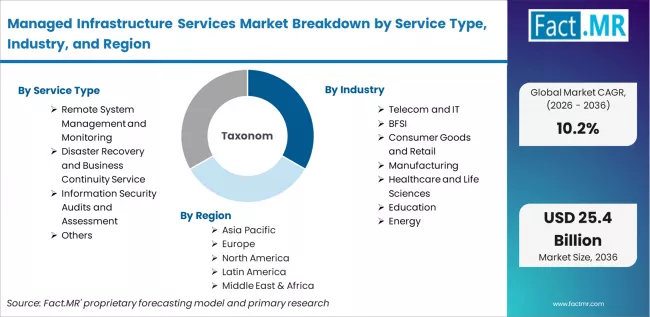
Managed Infrastructure Services Market Breakdown By Service Type, Industry, And Region | Source: Fact.MR
| Attribute | Details |
|---|---|
| Quantitative Units | USD 9.6 billion (2026) to USD 25.4 billion (2036), at a CAGR of 10.2% |
| Market Definition | Contracted outsourced IT infrastructure management services delivered by third-party providers covering remote monitoring, disaster recovery, business continuity, and security audit engagements across on-premise, hybrid, and cloud-hosted infrastructure for enterprise clients in BFSI, telecom, healthcare, manufacturing, and public sector verticals. |
| Service Type Segmentation | Remote System Management and Monitoring, Disaster Recovery and Business Continuity Service, Information Security Audits and Assessment, Others |
| Industry Segmentation | Telecom and IT, BFSI, Consumer Goods and Retail, Manufacturing, Healthcare and Life Sciences, Education, Energy |
| Application Coverage | Enterprise hybrid cloud infrastructure monitoring, financial sector DORA-compliant disaster recovery, healthcare IT security audit services, telecommunications network operations outsourcing, manufacturing plant infrastructure management, and public sector IT resilience programme delivery. |
| Regions Covered | North America, Europe, Asia Pacific, Latin America, Middle East and Africa |
| Countries Covered | USA, Canada, Mexico, Germany, UK, France, Italy, Spain, Nordic, BENELUX, China, Japan, South Korea, India, ASEAN, Australia and New Zealand, Brazil, Argentina, Chile, Saudi Arabia, GCC, Turkey, South Africa, Rest of MEA |
| Key Companies Profiled | IBM, Accenture, HCL Technologies, TCS, DXC Technology, Cognizant, Wipro, NTT Data, Capgemini, Atos |
| Forecast Period | 2026 to 2036 |
| Approach | Hybrid top-down and bottom-up model using managed infrastructure contract volumes by service type and industry vertical, average contract values, enterprise IT outsourcing penetration data, regulatory compliance investment benchmarks, and primary interviews with IT procurement managers, infrastructure operations heads, and managed service provider account executives. |
Source: Fact.MR analysis. Updated Mar 25, 2026
Managed Infrastructure Services Market by Segments
-
By Service Type :
- Remote System Management and Monitoring
- Disaster Recovery and Business Continuity Service
- Information Security Audits and Assessment
- Others
-
By Industry :
- Telecom and IT
- BFSI
- Consumer Goods and Retail
- Manufacturing
- Healthcare and Life Sciences
- Education
- Energy
-
By Region :
- North America
- United States
- Canada
- Mexico
- Latin America
- Brazil
- Mexico
- Argentina
- Chile
- Rest of Latin America
- Western Europe
- Germany
- United Kingdom
- France
- Italy
- Spain
- Nordic Countries
- BENELUX
- Rest of Western Europe
- Eastern Europe
- Russia
- Poland
- Hungary
- Balkan and Baltic
- Rest of Eastern Europe
- East Asia
- China
- Japan
- South Korea
- South Asia and Pacific
- India
- ASEAN
- Australia and New Zealand
- Rest of South Asia and Pacific
- Middle East and Africa
- Kingdom of Saudi Arabia
- Other GCC Countries
- Turkey
- South Africa
- Rest of Middle East and Africa
- North America
Frequently Asked Questions
How large is the managed infrastructure services market in 2025?
What will the market size be in 2026?
What is the projected market size by 2036?
What is the expected CAGR?
Which service type segment leads the managed infrastructure services market?
Which industry vertical dominates?
Which country shows the fastest growth?
Who worked on this report


Preview the report firsthand - request a free sample
Free SampleGet the brochure for pricing and purchase details
Download PDF