- Market Value (2025): USD 89.6 Bn
- Estimated Value (2026): USD 96.9 Bn
- Forecast Value (2036): USD 213.5 Bn
- CAGR (2026-2036): 8.2%
What is the Digital Payment Solutions Market forecast to be worth by 2036?
USD 96.9 billion in 2026 to USD 213.5 billion by 2036 at an 8.2% CAGR.
- According to Fact.MR estimates, the digital payment solutions market was valued at USD 89.6 billion in 2025.
- Market value is projected to rise from USD 96.9 billion in 2026 to USD 213.5 billion by 2036.
- The market is projected to grow at a 8.2% CAGR from 2026 to 2036 as merchants and consumers use electronic payment methods.
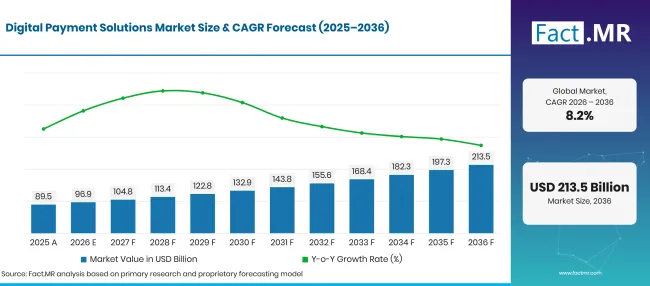
Digital Payment Solutions Market Forecast Global | Source: Fact.MR
| Year | Basis | Market Value (USD billion) |
|---|---|---|
| 2025 | Actual | 89.5 |
| 2026 | Estimate | 96.9 |
| 2036 | Forecast | 213.5 |
| CAGR 2026 to 2036 | Forecast period | 8.2% |
Source: Fact.MR analysis. Updated Nov 2, 2026
What are the defining numbers behind Digital Payment Solutions Market growth?
USD 116.6 billion absolute opportunity between 2026 and 2036.
- Demand Drivers in the Market
- Merchants are expanding cashless payment acceptance as consumers use cards and mobile payment methods. Deutsche Bundesbank reported on June 17, 2026, that cashless methods accounted for 55% of recorded purchases in Germany in 2025. Mobile payment methods represented 10% of purchases [1].
- Instant payment infrastructure is widening access to electronic transfers. The Central Bank of Brazil reported more than 170 million individual Pix users and over 7 billion transactions in January 2026. This creates opportunities for payment providers offering merchant acceptance and account-to-account payment services [2].
- Online and physical merchants need payment platforms that can process transactions across multiple channels. Payment providers are strengthening authorization, fraud monitoring and authentication capabilities to support these requirements.
- Businesses are also seeking scalable payment infrastructure that can connect checkout systems with billing, accounting and customer management applications. Cloud-based platforms can support centralized payment operations across multiple locations.[1][2]
- Key Segments Analyzed
- By Component, Software will account for 61.2% of the market in 2026, reflecting the role of payment gateways and transaction management platforms.
- By Payment Mode, Credit Card leads with 35.9% of the market in 2026, supported by established card acceptance across retail and online commerce.
- By End-User, Retail accounts for 31.7% of the market in 2026 as merchants integrate digital payment acceptance across physical and online stores.
- By Deployment Mode, Cloud accounts for a 58.2% share in 2026 due to its scalability and centralized management capabilities.
- By Enterprise Size, Large Enterprises hold 56.2% of the market in 2026, reflecting their transaction volumes and integration requirements.
- Analyst Opinion at Fact.MR
- Shambhu Nath Jha, Principal Consultant at Fact.MR, states, “Digital payment providers are competing on more than transaction processing. Merchants increasingly need payment platforms that connect online and in-store acceptance with secure authentication and efficient settlement. Providers that simplify integration while maintaining reliable transaction controls can strengthen their position as businesses expand digital commerce.”
- Strategic Implications
- Payment software providers should improve gateway integration and transaction management across card payments, digital wallets and bank transfers.
- Payment networks need to strengthen authentication and fraud prevention to protect transactions across online and physical channels.
- Merchant service providers can offer flexible pricing and simpler onboarding to support small and medium enterprises.
- Cloud payment providers must maintain strong security controls and reliable infrastructure for businesses managing transactions across multiple locations.
- Financial institutions need to improve interoperability between digital wallets, card networks and instant payment systems.
Germany is set to record a 10.0% CAGR through 2036. Brazil is set to post 9.1%, followed by the USA at 8.3%. The UK is estimated to advance at 7.4%, while Japan is forecast at 6.5%. National payment habits and the development of digital transaction infrastructure create different routes to market expansion.
How does the Digital Payment Solutions Market break down by segment?
In Fact.MR’s segmentation, Software leads Component at 61.2%; Credit Card leads Payment Mode at 35.9%; Retail leads End-User at 31.7%; Cloud leads Deployment Mode at 58.2%; and Large Enterprises lead Enterprise Size at 56.2%.
Which Component dominates?
Software is projected to account for 61.2% of the market in 2026.
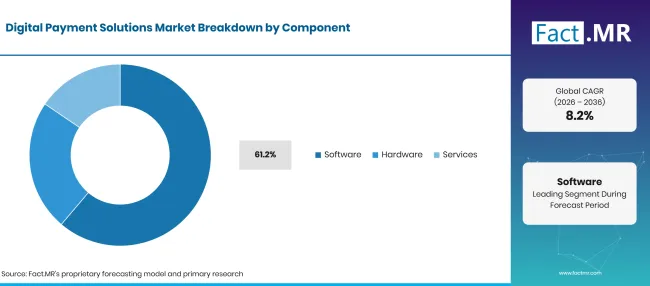
Digital Payment Solutions Market Breakdown Component | Source: Fact.MR
| Component | Share (2026) |
|---|---|
| Software (Leading segment) | 61.2% |
| Other segments combined | 38.8%* |
| Total | 100.0% |
Source: Fact.MR analysis. Updated Nov 2, 2026
Software accounts for the largest component share because payment platforms depend on applications that authorize transactions and connect merchants with payment networks. Payment gateways, merchant dashboards and transaction management systems help businesses accept and monitor electronic payments. Hardware and services remain important for physical payment acceptance and ongoing platform support.
What leads the Payment Mode segment?
Credit Card is projected to account for 35.9% of the market in 2026.
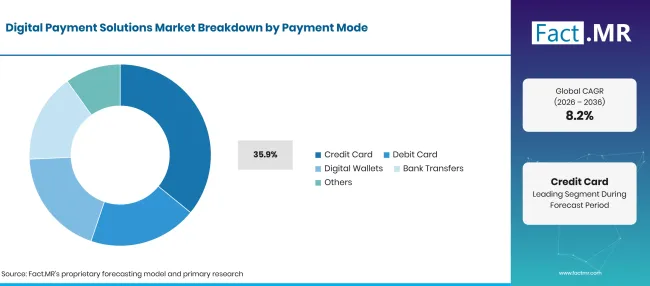
Digital Payment Solutions Market Breakdown Payment Mode | Source: Fact.MR
| Payment Mode | Share (2026) |
|---|---|
| Credit Card (Leading segment) | 35.9% |
| Other segments combined | 64.1%* |
| Total | 100.0% |
Source: Fact.MR analysis. Updated Nov 2, 2026
Credit cards account for the largest individual payment mode share in the segmentation. Their acceptance across online marketplaces and physical stores supports their continued use. Debit cards and digital wallets provide additional payment options, while bank transfers serve account-to-account transactions and business payments. Payment providers increasingly support multiple methods through a single checkout interface.
Which End-User category leads demand?
Retail is likely to account for a 31.7% share in 2026.
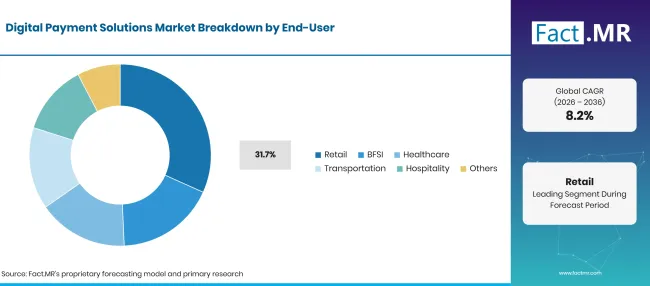
Digital Payment Solutions Market Breakdown End User | Source: Fact.MR
| End-User | Share (2026) |
|---|---|
| Retail (Leading segment) | 31.7% |
| Other segments combined | 68.3%* |
| Total | 100.0% |
Source: Fact.MR analysis. Updated Nov 2, 2026
Retailers require payment solutions for in-store purchases and online checkout. Integrated payment platforms can connect card terminals with e-commerce systems and transaction records. BFSI remains an important user because banks and financial service providers require digital transaction infrastructure. Healthcare, transportation and hospitality also use electronic payment systems to collect customer payments across different service environments.
Which Deployment Mode leads?
Cloud is projected to account for 58.2% of the market in 2026.
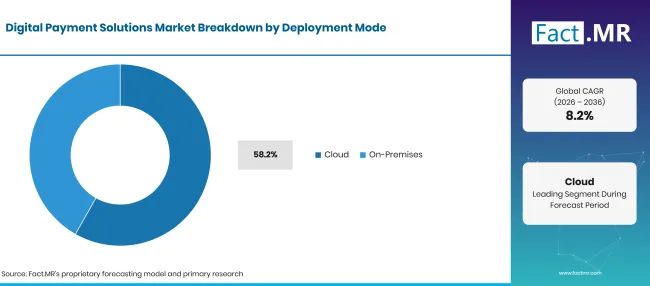
Digital Payment Solutions Market Breakdown Deployment Mode | Source: Fact.MR
| Deployment Mode | Share (2026) |
|---|---|
| Cloud (Leading segment) | 58.2% |
| On-Premises | 41.8%* |
| Total | 100.0% |
Source: Fact.MR analysis. Updated Nov 2, 2026
Cloud deployment leads as businesses seek payment platforms that can support multiple locations and sales channels. Cloud-based systems can simplify software updates and centralized transaction monitoring. On-premises deployment remains relevant for organizations that require greater control over internal infrastructure or need to maintain specific integration arrangements.
Which Enterprise Size category dominates?
Large Enterprises are projected to represent a 56.2% share in 2026.
| Enterprise Size | Share (2026) |
|---|---|
| Large Enterprises (Leading segment) | 56.2% |
| Small and Medium Enterprises | 43.8%* |
| Total | 100.0% |
Source: Fact.MR analysis. Updated Nov 2, 2026
Large enterprises account for the leading share because they often process high transaction volumes across multiple business units and geographical markets. These organizations require payment systems that can integrate with enterprise resource planning and financial management applications. SMEs also represent an important customer base as simplified payment gateways and point-of-sale solutions reduce the complexity of accepting digital payments.
What is accelerating Digital Payment Solutions Market adoption, and what is holding it back?
Growing cashless transactions and digital commerce support adoption, while fraud exposure and integration complexity create challenges.
Drivers Impact Analysis
| DRIVER | (~) % IMPACT ON CAGR | GEOGRAPHIC RELEVANCE | IMPACT TIMELINE |
|---|---|---|---|
| Expansion of e-commerce transactions | +1.0% | Global | Short term (≤ 2 years) |
| Greater use of digital wallets | +0.9% | Global | Short to medium term (2–4 years) |
| Growth of instant payment infrastructure | +0.8% | Brazil, Europe, Asia | Medium term (2–4 years) |
| Merchant adoption of cloud payment platforms | +0.6% | Global | Medium term (2–4 years) |
| Demand for secure transaction authentication | +0.5% | Global | Long term (≥ 4 years) |
Source: Fact.MR analysis. Updated Nov 2, 2026
Opportunity Impact Analysis
| OPPORTUNITY | (~) % IMPACT ON CAGR | GEOGRAPHIC RELEVANCE | IMPACT TIMELINE |
|---|---|---|---|
| Cross-border payment processing | +0.8% | Global | Medium term (2–4 years) |
| SME payment digitization | +0.7% | Emerging markets, Europe | Short to medium term (2–4 years) |
| Account-to-account payment integration | +0.6% | Europe, Brazil, Asia | Medium term (2–4 years) |
| Digital wallet interoperability | +0.5% | Global | Medium term (2–4 years) |
| Automated and agent-led payments | +0.4% | North America, Europe | Long term (≥ 4 years) |
Source: Fact.MR analysis. Updated Nov 2, 2026
Restraints Impact Analysis
| RESTRAINT | (~) % IMPACT ON CAGR | GEOGRAPHIC RELEVANCE | IMPACT TIMELINE |
|---|---|---|---|
| Payment fraud and cyberattacks | -0.8% | Global | Short term (≤ 2 years) |
| Regulatory and compliance requirements | -0.6% | Global | Short to medium term (2–4 years) |
| Integration with legacy systems | -0.5% | Global | Medium term (2–4 years) |
| Transaction processing costs | -0.4% | Global | Short term (≤ 2 years) |
| Uneven digital payment access | -0.3% | Emerging markets | Medium term (2–4 years) |
Source: Fact.MR analysis. Updated Nov 2, 2026
Which countries are scaling the Digital Payment Solutions Market through 2036?
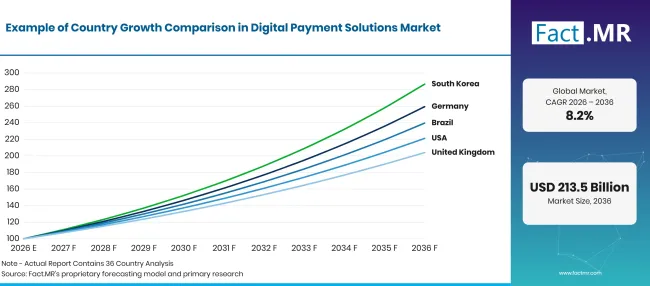
Digital Payment Solutions Market Growth Index | Source: Fact.MR
| Country | CAGR (2026–2036) |
|---|---|
| Germany | 10.0% |
| Brazil | 9.1% |
| USA | 8.3% |
| UK | 7.4% |
| Japan | 6.5% |
Source: Fact.MR analysis. Updated Nov 2, 2026
What supports Germany adoption?
10.0% CAGR, supported by the growing use of cashless payment methods and mobile transactions.
Germany’s payment landscape is undergoing a steady shift towards cashless transactions. According to the Deutsche Bundesbank, cashless methods accounted for 55% of recorded purchases in 2025, while debit cards represented 26% and mobile payment methods accounted for 10%. The number of card payments reached approximately 14.5 billion in 2025, registering 11% annual growth. SEPA instant credit transfers also recorded strong momentum, with transaction volumes increasing by 102% to approximately 680 million. [12]
How is Brazil developing digital payment adoption?
9.1% CAGR, driven by the extensive use of Pix and wider electronic payment access.
Brazil's digital payment ecosystem benefits from the rapid adoption of Pix. This widespread use of instant transfers supports demand for payment gateways and merchant solutions that can connect bank accounts with digital commerce. Providers can also address demand for reconciliation and payment management services among businesses.
What supports United States adoption?
8.3% CAGR, supported by high noncash transaction volumes and established card payment infrastructure.
The United States has a large electronic payment ecosystem across consumer and business transactions. The Federal Reserve reported that noncash payments reached 236.6 billion in 2024, with cards accounting for more than three-quarters of payments by number [3]. This creates a substantial operating environment for payment networks and processing providers. Demand for secure online checkout and integrated merchant payment services is also supporting platform development.
How is the United Kingdom building adoption?
7.4% CAGR, shaped by contactless card usage and growing mobile wallet adoption.
The UK has an established cashless payment environment. UK Finance reported that total payment volumes reached 49.7 billion in 2025, while card payments represented 64% of all payments. Nearly two-thirds of the population were registered for a mobile wallet [4]. These trends support demand for contactless payment terminals and integrated merchant payment platforms. Payment providers can also address demand for recurring payments and digital checkout services.
What supports Japan adoption?
6.5% CAGR, supported by rising cashless transaction values and government initiatives.
Japan's cashless payment ecosystem continues to expand through card payments and digital payment methods. The Ministry of Economy, Trade and Industry reported that the cashless payment ratio reached 58.0% in 2025, equivalent to JPY 162.7 trillion in transaction value [5]. Credit cards accounted for the largest share of cashless payment value. Continued progress toward the government's 2030 cashless payment target is expected to support payment infrastructure investment and merchant adoption.
Who leads the Digital Payment Solutions Market?
Fact.MR identifies Visa, Mastercard, PayPal, Block, Adyen and Stripe as key companies participating in the digital payment solutions market.
Visa and Mastercard operate global payment networks and provide transaction infrastructure for financial institutions and merchants. PayPal provides digital wallet and merchant checkout services. Block participates through its Square payment acceptance and commerce ecosystem. Adyen and Stripe provide integrated payment processing platforms for businesses operating across online and physical channels.
Visa Inc. operates a global payment network. Its fiscal 2025 disclosures reported USD 14.2 trillion in payments volume and 257.5 billion transactions processed on Visa's networks [6]. Mastercard Incorporated operates global card payment infrastructure and continues to develop digital transaction capabilities. Its June 2026 Agent Pay for Machines announcement addressed automated and programmatic payments [7]. PayPal Holdings, Inc. provides digital wallet and merchant payment services. Its 2025 filing reported USD 1.79 trillion in total payment volume and 439 million active accounts [8]. Block, Inc. provides payment acceptance and commerce services through Square. Its 2025 annual filing reported USD 259.6 billion in Square gross payment volume [9]. Adyen N.V. provides an integrated payments platform for online and in-store transactions. Its 2025 results reported processed volume of EUR 1,394.3 billion [10]. Stripe, Inc. provides payment processing and financial infrastructure for businesses. Its February 2026 annual update reported USD 1.9 trillion in payment volume generated by businesses using Stripe during 2025 [11].
Commercial competition depends on payment acceptance coverage, transaction security, processing reliability and integration capabilities. Payment networks compete through their reach and authentication services. Merchant payment platforms compete through checkout performance and software integration. Digital wallet providers seek to make electronic payments convenient across devices and sales channels.
Which companies are the key providers?
Key companies include Visa Inc.; Mastercard Incorporated; PayPal Holdings, Inc.; Block, Inc. (Square); Adyen N.V.; and Stripe, Inc.
- Visa Inc.
- Mastercard Incorporated
- PayPal Holdings, Inc.
- Block, Inc. (Square)
- Adyen N.V.
- Stripe, Inc.
Bibliography
- [1] Deutsche Bundesbank. (2026, June 17). Payment behaviour in Germany in 2025.
- [2] Banco Central do Brasil. (n.d.). Pix em números.
- [3] Board of Governors of the Federal Reserve System. (2026, July 1). Federal Reserve issues initial findings from its 2025 triennial payments study.
- [4] UK Finance. (2026, August 19). Digital payments continue to grow as mobile wallets become more popular across the UK.
- [5] Ministry of Economy, Trade and Industry. (2026, March 31). 2025 ratio of cashless payment among the total amount paid by consumers calculated
- [6] Visa Inc. (2025). Annual report 2025.
- [7] Mastercard. (2026, June 10). Mastercard launches Agent Pay for Machines to unlock super-fast, always-on payments
- [8] PayPal Holdings, Inc. (2026, February 3). Annual report for the fiscal year ended December 31, 2025 [Form 10-K]. U.S. Securities and Exchange Commission.
- [9] Block, Inc. (2026, February 26). Annual report for the fiscal year ended December 31, 2025 [Form 10-K]. U.S. Securities and Exchange Commission.
- [10] Adyen N.V. (2026, March 5). Adyen publishes 2025 Annual Report.
- [11] Stripe. (2026, February 24). Stripe publishes 2025 annual letter and announces tender offer to provide liquidity to current and former employees
- [12] Deutsche Bundesbank. (2026, July 22). Card payments remain on an upward trend.
This Report Answers
- The report describes how digital payment solutions support electronic transactions across consumer and business environments.
- Component analysis compares software, hardware and services.
- Payment mode analysis covers credit cards, debit cards, digital wallets and bank transfers.
- End-user analysis examines retail, BFSI, healthcare, transportation and hospitality.
- Deployment analysis compares cloud and on-premises payment infrastructure.
- Country analysis discusses Germany, Brazil, USA, UK and Japan alongside official payment statistics.
- The competitive overview profiles Visa, Mastercard, PayPal, Block, Adyen and Stripe.
What does the Digital Payment Solutions Market cover?
The market covers software, hardware and services used to facilitate electronic payments. It includes payment gateways, transaction processing platforms, card acceptance infrastructure, digital wallet services and related merchant payment capabilities. The analysis considers payment use across retail and other commercial sectors. It also examines cloud and on-premises deployment and adoption by large enterprises and SMEs.
What is included in the scope?
Included solutions support electronic payment acceptance, transaction authorization and payment processing.
The scope covers card-based payments, digital wallets and bank transfer methods. It also includes payment software and hardware used by merchants and financial institutions, along with services that support payment integration and transaction management.
What is excluded from the scope?
The analysis excludes cash transactions and financial services that do not directly facilitate digital payment acceptance or processing.
General banking products such as loans and deposits are outside the defined market boundary. Standalone enterprise software without payment processing functionality is also excluded. The total value of transactions processed by payment networks is not treated as market revenue.
How Was the Analysis Built?
The analysis draws on 120+ sources, 35+ company portfolios, 25+ countries, and more than 20 industry interviews.
- Primary Research: Primary research includes discussions with payment solution providers, payment processors, financial institutions, merchants, technology developers, end users and subject-matter experts. These conversations examine purchasing priorities, payment platform adoption, integration requirements, transaction security and competitive positioning.
- Desk Research: Desk research covers government payment statistics, regulatory publications, company filings, annual reports, payment network disclosures, industry associations and technical publications. Every source used in the analysis is documented in the bibliography.
- Market Sizing and Forecasting: Market estimates combine historical performance, transaction trends, payment infrastructure investment, pricing and volume trends, segment shares, company participation, country-level growth and barriers to market expansion.
- Data Validation and Update Cycle: Findings are validated by comparing primary interviews with public data, company activity, regulatory developments and payment adoption trends. Regular updates review new payment capabilities, product launches, partnerships, platform expansion and changes in commercial adoption.
Segmentation
What is the report's scope and coverage?
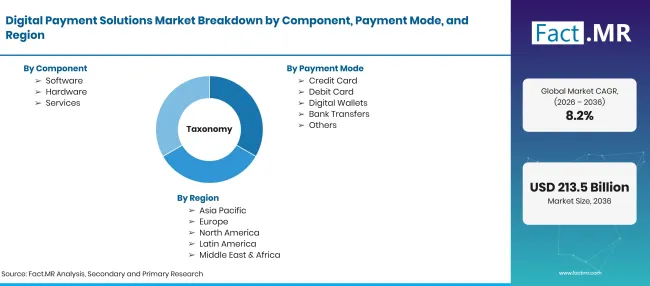
Digital Payment Solutions Market Taxonomy | Source: Fact.MR
| Attribute | Details |
|---|---|
| Quantitative Units | USD billion |
| Market Definition | The digital payment solutions market comprises software, hardware and services that enable the initiation, authorization, processing and settlement of electronic financial transactions between consumers, merchants and businesses. |
| Component | Software; Hardware; Services |
| Payment Mode | Credit Card; Debit Card; Digital Wallets; Bank Transfers; Others |
| End-User | Retail; BFSI; Healthcare; Transportation; Hospitality; Others |
| Deployment Mode | Cloud; On-Premises |
| Enterprise Size | Large Enterprises; Small and Medium Enterprises |
| Regions Covered | North America; Latin America; Western Europe; Eastern Europe; East Asia; South Asia & Pacific; Middle East & Africa |
| Countries Covered | Germany; Brazil; USA; UK; Japan |
| Companies Profiled | Visa; Mastercard; PayPal; Block (Square); Adyen; Stripe |
| Forecast Period | 2026 to 2036 |
| Approach | Market segmentation and scenario-based analysis supported by company disclosures and official payment statistics |
Source: Fact.MR analysis. Updated Nov 2, 2026
How is the market segmented?
-
By Component
- Software
- Hardware
- Services
-
By Payment Mode
- Credit Card
- Debit Card
- Digital Wallets
- Bank Transfers
- Others
-
By End-User
- Retail
- BFSI
- Healthcare
- Transportation
- Hospitality
- Others
-
By Deployment Mode
- Cloud
- On-Premises
-
By Enterprise Size
- Large Enterprises
- Small and Medium Enterprises
-
By Region
- North America
- Latin America
- Western Europe
- Eastern Europe
- East Asia
- South Asia & Pacific
- Middle East & Africa
Frequently Asked Questions
How big is the Digital Payment Solutions Market in 2026?
What is the CAGR from 2026 to 2036?
Which component has the largest share?
Which payment mode leads?
Which end-user category has the largest share?
Which deployment mode leads?
Which enterprise-size category has the largest share?
Which country is projected to grow fastest among the listed markets?
Which companies are covered?
Who worked on this report


Preview the report firsthand - request a free sample
Free SampleGet the brochure for pricing and purchase details
Download PDF