- Market Value (2025): USD 6.2 Bn
- Estimated Value (2026): USD 6.9 Bn
- Forecast Value (2036): USD 18.7 Bn
- CAGR (2026-2036): 10.5%
What is the Digital Pharmaceutical Supply Chain Management Market forecast to be worth by 2036?
USD 6.9 billion in 2026 to USD 18.7 billion by 2036 at 10.5% CAGR.
- The digital pharmaceutical supply chain management market reached USD 6.2 billion in 2025.
- Demand is projected to increase from USD 6.9 billion in 2026 to USD 18.7 billion by 2036.
- The market is forecast to record 10.5% CAGR from 2026 to 2036.
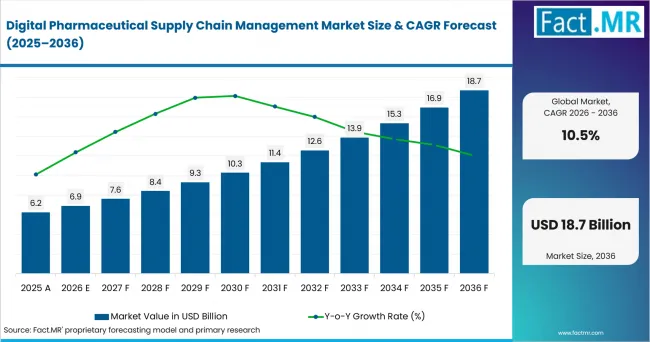
Digital Pharmaceutical Supply Chain Management Market Value Analysis | Source: Fact.MR
What are the defining numbers behind Digital Pharmaceutical Supply Chain Management Market growth?
USD 11.8 billion absolute opportunity is expected by 2036.
- Demand Drivers in the Market
- Pharmaceutical supply chains need product integrity from production to dispensing. Digital tools are used when products pass through several handoffs.
- Drug serialization and anti-counterfeiting rules are expected to make traceability a purchase condition for manufacturers and distributors.
- Cold chain monitoring is expected to support medicines that need controlled temperature during storage and transport.
- Key Segments Analyzed
- By Solution Type: Cloud-based SCM Software is expected to hold 38.0% share in 2026 because distributed users need shared access.
- By Supply Chain Function: Inventory Management is projected to account for 35.0% share in 2026 as availability and expiry control remain daily priorities.
- By End-use Sector: Pharmaceutical Manufacturers are anticipated to capture 41.0% share in 2026 since batch release depends on compliant product movement.
- By User Category: Life Sciences Companies are estimated to represent 39.0% share in 2026 due to their need for reliable documentation.
- By Technology Platform: Cloud-native Platform is forecast to hold 37.0% share in 2026 as buyers look for scalable access and easier updates.
- Analyst Opinion at Fact.MR
- Shambhu Nath Jha, Principal Consultant at Fact.MR, states, “Digital pharmaceutical supply chain management providers need to show how the platform fits regulated product movement. Repeat sales are expected to depend on data visibility and compliance documentation. Buyers are expected to reward suppliers that prove reliability across inventory, traceability and fulfillment workflows.”
- Strategic Implications
- Brand owners should map each platform message to a supply chain task. Clear use-case wording helps buyers see where the product reduces review time.
- Suppliers can improve retention by explaining integration steps in simple customer material. This reduces friction for manufacturers and distributors that manage regulated products.
- Channel teams may prioritize features that matter to pharmaceutical manufacturers and life sciences companies. Deployment support is likely to influence expansion decisions.
The USA leads at 11.4% CAGR through stronger pharmaceutical digitization and established technology buying. Germany follows at 10.9% as compliance discipline supports structured adoption. Japan reaches 10.3% through quality-focused procurement. China records 9.8% through distribution modernization. India posts 9.2% through expanding pharmaceutical production. The UK reaches 8.7% through mature healthcare procurement. Singapore records 8.1% through regulated logistics and regional distribution use.
How does the Digital Pharmaceutical Supply Chain Management Market break down by segment?
Cloud-based SCM Software is expected to lead Solution Type with 38.0% share in 2026. Inventory Management is projected to lead Supply Chain Function with 35.0% share in 2026.
Which Solution Type dominates?
Cloud-based SCM Software is projected to account for 38.0% share in 2026.
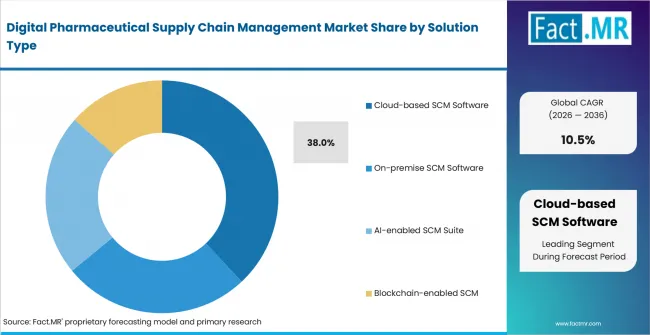
Digital Pharmaceutical Supply Chain Management Market Analysis By Solution Type | Source: Fact.MR
Cloud-based SCM Software leads this segment because teams need shared access across plants and partners. The format supports updates without heavy internal system work. AI-enabled SCM Suite and Blockchain-enabled SCM serve buyers that need deeper planning or traceability.
What leads the Supply Chain Function segment?
Inventory Management is expected to hold 35.0% share in 2026.
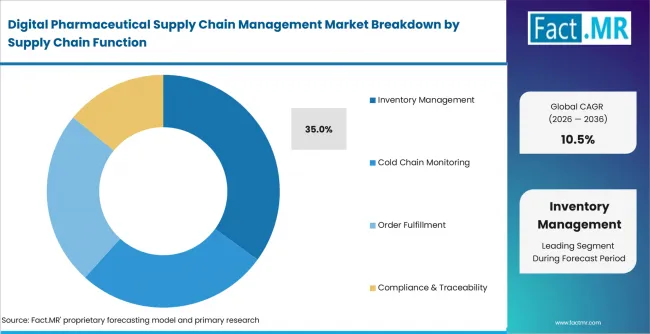
Digital Pharmaceutical Supply Chain Management Market Analysis By Supply Chain Function | Source: Fact.MR
Product availability gives Inventory Management its leading role. Expiry control and stock movement are everyday problems for pharmaceutical teams. Cold Chain Monitoring supports temperature-sensitive products. Order Fulfillment and Compliance & Traceability strengthen service and audit records.
What supports Pharmaceutical Manufacturers within End-use Sector?
Pharmaceutical Manufacturers are anticipated to capture 41.0% share in 2026.
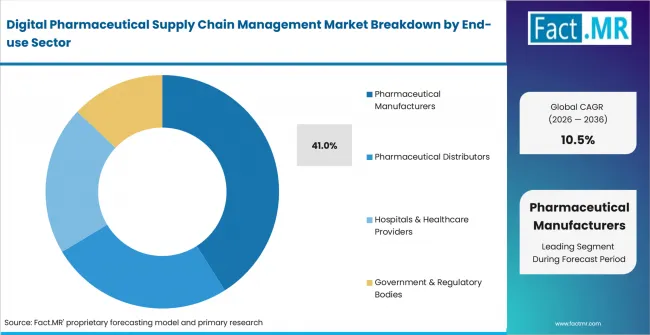
Digital Pharmaceutical Supply Chain Management Market Analysis By End Use Sector | Source: Fact.MR
Production control gives Pharmaceutical Manufacturers the leading position. Supply chain records begin before products leave the plant. Distributors and healthcare providers follow when product visibility becomes part of daily operations.
How do Life Sciences Companies shape demand?
Life Sciences Companies are estimated to represent 39.0% share in 2026.
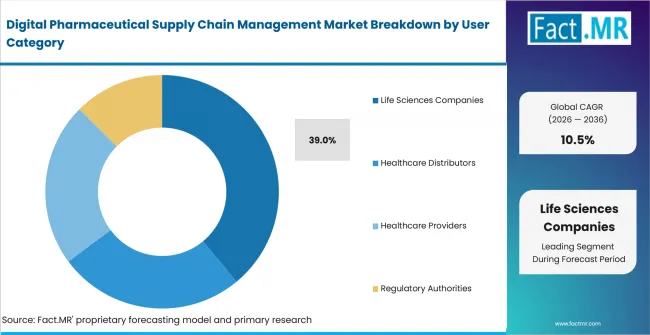
Digital Pharmaceutical Supply Chain Management Market Analysis By User Category | Source: Fact.MR
Life Sciences Companies work with regulated products and high documentation needs. Their buying route favors platforms that support planning and quality records together. Healthcare distributors and providers adopt later when daily order visibility becomes harder to manage manually.
What supports Cloud-native Platform adoption?
Cloud-native Platform is forecast to hold 37.0% share in 2026.
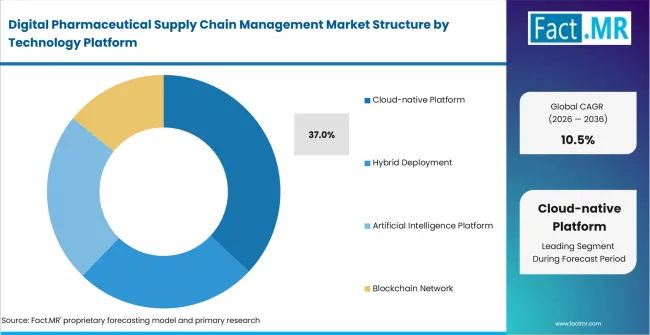
Digital Pharmaceutical Supply Chain Management Market Analysis By Technology Platform | Source: Fact.MR
Cloud-native Platform gains share because pharmaceutical supply chains involve many locations. The model supports updated workflows without heavy internal infrastructure. Hybrid Deployment and Artificial Intelligence Platform options need proof of planning accuracy before wider use.
What is accelerating Digital Pharmaceutical Supply Chain Management Market adoption, and what is holding it back?
Demand is expected to rise through regulated traceability and stronger inventory control. Growth may be limited by integration cost and validation work across healthcare IT systems.
Drivers Impact Analysis
| DRIVER | (~) % IMPACT ON CAGR | GEOGRAPHIC RELEVANCE | IMPACT TIMELINE |
|---|---|---|---|
| Adoption and integration | +1.6% | Global | Short term (<= 2 years) |
| Regulatory and compliance support | +1.4% | USA, Germany, UK | Short term (<= 2 years) |
| Channel and access expansion | +1.1% | Global | Medium term (2-4 years) |
| Clear specification and documentation | +0.9% | USA, UK, Canada | Medium term (2-4 years) |
| Cost and efficiency gains | +0.6% | Global | Long term (>= 4 years) |
Source: Fact.MR analysis. Updated Aug 7, 2026
- Adoption and integration: Cloud deployment is expected to reduce the effort needed to connect procurement and warehouse workflows.
- Regulatory and compliance support: Serialization rules are expected to make traceability evidence a normal software requirement.
- Channel and access expansion: Wider digital distribution coverage is expected to raise demand for shared inventory and fulfillment visibility.
Opportunity Impact Analysis
| OPPORTUNITY | (~) % IMPACT ON CAGR | GEOGRAPHIC RELEVANCE | IMPACT TIMELINE |
|---|---|---|---|
| Emerging application expansion | +1.0% | Global | Medium term (2-4 years) |
| Premium and specialist positioning | +0.8% | USA, UK, Germany | Medium term (2-4 years) |
| Channel and partner expansion | +0.7% | Global | Long term (>= 4 years) |
| Standards and compliance alignment | +0.5% | USA, Canada, Singapore | Long term (>= 4 years) |
Source: Fact.MR analysis. Updated Aug 7, 2026
- Emerging application expansion: Platforms that combine planning with transport data are expected to expand beyond single-function tools.
- Premium and specialist positioning: Providers can stand out when they explain cold chain monitoring and validation support in buyer-ready terms.
- Channel and partner expansion: Systems that bring manufacturers and distributors into one workflow are expected to improve account access.
Restraints Impact Analysis
| RESTRAINT | (~) % IMPACT ON CAGR | GEOGRAPHIC RELEVANCE | IMPACT TIMELINE |
|---|---|---|---|
| Cost and complexity | -1.1% | Global | Short term (<= 2 years) |
| Specification and compliance checks | -0.9% | USA, UK, Germany | Short term (<= 2 years) |
| Substitution by lower-cost alternatives | -0.7% | Import-dependent markets | Medium term (2-4 years) |
| Supply chain and pricing pressure | -0.5% | Global | Long term (>= 4 years) |
Source: Fact.MR analysis. Updated Aug 7, 2026
- Cost and complexity: Integration with enterprise systems can slow approvals when buyers cannot see the implementation path clearly.
- Specification and compliance checks: Validation demands may extend decision timelines because pharmaceutical users need audit-ready evidence before wider deployment.
- Supply chain and pricing pressure: Buyers may delay platform expansion when lower-cost digital tools look sufficient for basic visibility.
Which countries are scaling Digital Pharmaceutical Supply Chain Management Market fastest?
- The country comparison spans 3.3 percentage points and forms three practical growth bands across the forecast period.
- The USA remains 0.5 percentage point above Germany through technology purchasing depth and stronger pharmaceutical digitization.
- Germany remains 0.6 percentage point above Japan because compliance-led procurement supports structured platform adoption.
- Japan remains 0.5 percentage point above China through quality-focused supplier review and controlled implementation cycles.
- China remains 0.6 percentage point above India as distribution modernization increases demand for digital supply chain visibility.
- India remains 0.5 percentage point above the UK through expanding pharmaceutical production and wider workflow digitization.
- The UK remains 0.6 percentage point above Singapore through mature healthcare procurement and steady compliance-focused platform use.
Comparable CAGRs can create different entry conditions due to regulation and distribution depth. Full report coverage includes North America; Latin America; Europe; East Asia; South Asia and Pacific; Middle East and Africa.
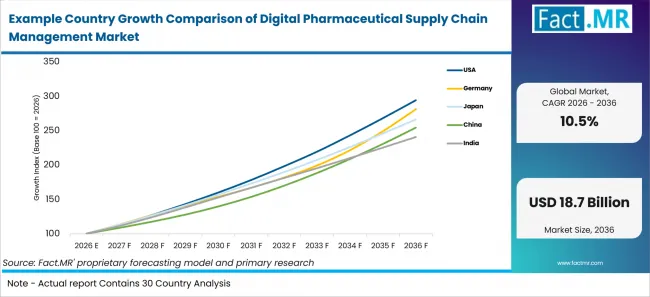
Example Country Growth Comparison Of Digital Pharmaceutical Supply Chain Management Market | Source: Fact.MR
Country CAGR (2026-2036)
| Country | CAGR (2026-2036) |
|---|---|
| USA | 11.4% |
| Germany | 10.9% |
| Japan | 10.3% |
| UK | 8.7% |
| Singapore | 8.1% |
Source: Fact.MR analysis. Updated Aug 7, 2026
What supports USA adoption?
11.4% CAGR, supported by technology purchasing depth and pharmaceutical digitization.
USA buyers often evaluate inventory visibility before expanding digital supply chain systems. Cloud-based SCM Software fits this environment because regulated product movement needs shared access across warehouses and partners.
How is Germany scaling demand?
10.9% CAGR, driven by compliance-led procurement and structured supplier review.
Germany uses a careful buying route for these platforms. Manufacturers are expected to ask for clear documentation before they widen use. This supports Inventory Management and Compliance & Traceability when product movement needs simple audit evidence.
What is driving Japan’s growth from 2026 to 2036?
10.3% CAGR, backed by quality-focused procurement and controlled implementation cycles.
Quality-focused platform review shapes Japan’s adoption path. Buyers are expected to test service continuity before wider rollout. Cloud-native Platform gains relevance where teams want steady access and controlled updates.
How does the UK perform?
8.7% CAGR, supported by mature healthcare procurement and compliance-focused platform use.
The UK favors suppliers that explain compliance fit in plain terms. Healthcare buyers are expected to compare data governance and service quality before broader use. This supports measured adoption across regulated logistics and provider-facing workflows.
What supports Singapore’s growth?
8.1% CAGR, backed by regulated healthcare logistics and regional distribution use.
Singapore’s compact logistics base creates selective demand for controlled product movement. Buyers are expected to value reliable documentation over broad platform scale. Regional distribution use may support adoption where pharmaceutical flows need clear inventory and traceability records.
Who leads the Digital Pharmaceutical Supply Chain Management Market?
SAP SE and Oracle Corporation show the broad enterprise relevance. IBM Corporation and Kinaxis Inc. strengthen planning and analytics coverage across regulated supply chains.
SAP SE supports enterprise planning for regulated supply chain workflows. Oracle Corporation adds cloud supply chain depth. IBM Corporation contributes analytics experience in AI in healthcare. Kinaxis Inc. strengthens concurrent planning exposure. Blue Yonder widens warehouse system coverage. Infor Inc. and Manhattan Associates, Inc. add enterprise software depth. Microsoft Corporation supports cloud infrastructure. TraceLink, Inc. and Körber AG – Körber Pharma and Körber Supply Chain strengthen traceability networks and logistics software coverage.
Which companies are the key providers?
Key companies include SAP SE; Oracle Corporation; IBM Corporation; Kinaxis Inc.; Blue Yonder; Infor Inc.; Manhattan Associates, Inc.; Microsoft Corporation; TraceLink, Inc.; Körber AG – Körber Pharma and Körber Supply Chain.
- SAP SE
- Oracle Corporation
- IBM Corporation
- Kinaxis Inc.
- Blue Yonder
- Infor Inc.
- Manhattan Associates, Inc.
- Microsoft Corporation
- TraceLink, Inc.
- Körber AG – Körber Pharma and Körber Supply Chain
Bibliography
- World Health Organization. (2025, February 21). Safe management of pharmaceutical waste from health care facilities: Global best practices.
- U.S. Food and Drug Administration. (2025). Progress toward the end of the DSCSA manufacturer and repackager exemption: FDA and PDG town hall.
- Blue Yonder Group, Inc. (2025, April 14). Faced with complex challenges, life sciences companies must embrace digitalization.
- Oracle Corporation. (2025, September 11). Oracle helps healthcare organizations streamline supply chain operations.
This Report Answers
- The report provides strategic intelligence on the Digital Pharmaceutical Supply Chain Management Market across Solution Type and Supply Chain Function choices that shape pharmaceutical product movement.
- Segment analysis covers Cloud-based SCM Software and inventory management software as the share leaders within the 2026 market.
- Country outlook evaluates the USA and Germany alongside Japan and China. India, the UK and Singapore complete the growth comparison across the profiled markets.
- Competitive analysis profiles SAP SE and Oracle Corporation alongside IBM Corporation and Kinaxis Inc. The remaining named companies complete the provider set.
- Technology assessment covers Cloud-native Platform and Hybrid Deployment. Artificial Intelligence Platform and blockchain in healthcare complete the platform view.
What does the Digital Pharmaceutical Supply Chain Management Market cover?
Digital pharmaceutical supply chain management covers platforms and services used to manage regulated product movement. Inventory visibility, traceability and compliance evidence determine adoption.
The market covers cloud-based SCM software, on-premise SCM software and AI-enabled SCM Suite. Coverage extends to pharmaceutical track and trace, cold chain logistics and Order Fulfillment. Compliance & Traceability is included when digital records support regulated product movement.
What is included in the scope?
Digital pharmaceutical supply chain management is assessed across the covered solution types and supply chain functions. End-use sectors and technology platforms follow the same product-flow rule.
The scope includes Cloud-based SCM Software and On-premise SCM Software alongside AI-enabled SCM Suite and Blockchain-enabled SCM. Platform coverage extends to cloud-native, hybrid and artificial intelligence models. Related context includes healthcare cloud computing and digital transformation alongside supply chain management software.
What is excluded from the scope?
General supply chain software without a pharmaceutical compliance use case remains outside the scope of this market.
The scope excludes platforms that do not address pharmaceutical product flow or traceability. General logistics tools are excluded unless they support regulated product movement. Pharmaceutical logistics is treated as adjacent context when it informs distribution workflow needs.
How Was the Analysis Built?
The analysis draws on 120+ sources, 35+ company portfolios, 25+ countries, and more than 20 industry interviews.
- Primary Research: Primary research includes discussions with manufacturers, service providers, technology developers, distributors, end users, procurement teams, and subject-matter experts. These conversations examine purchasing priorities, product adoption, operational challenges, approval requirements, competitive positioning, and the factors that influence wider market acceptance.
- Desk Research: Desk research covers government statistics, regulatory publications, company filings, trade data, technical studies, industry associations, standards, public policy, and other authoritative sources. Every source used in the analysis is documented in the bibliography.
- Market Sizing and Forecasting: Market estimates combine historical performance, demand indicators, pricing and volume trends, segment shares, company participation, country-level growth, adoption patterns, investment activity, and barriers to market expansion.
- Data Validation and Update Cycle: Findings are validated by comparing primary interviews with public data, company activity, regulatory changes, trade patterns, and industry developments. Regular updates review new product launches, capacity changes, partnerships, approvals, procurement trends, and shifts in commercial adoption.
Segmentation
What is the report’s scope and coverage?
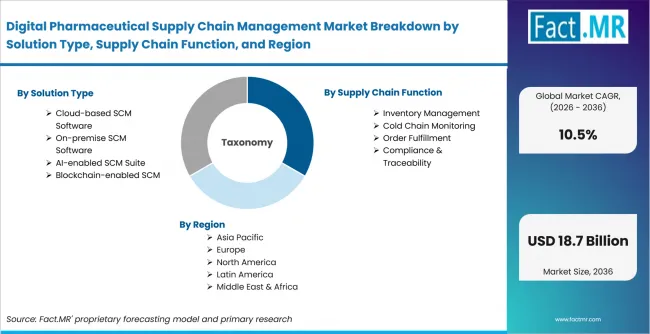
Digital Pharmaceutical Supply Chain Management Market Breakdown By Solution Type, Supply Chain Function, And Region | Source: Fact.MR
| Attribute | Details |
|---|---|
| Quantitative Units | USD billion |
| Market Definition | Digital pharmaceutical supply chain management platforms and services used to coordinate product movement, inventory visibility, traceability, fulfillment and compliance across regulated pharmaceutical supply chains |
| Solution Type | Cloud-based SCM Software; On-premise SCM Software; AI-enabled SCM Suite; Blockchain-enabled SCM |
| Supply Chain Function | Inventory Management; Cold Chain Monitoring; Order Fulfillment; Compliance & Traceability |
| End-use Sector | Pharmaceutical Manufacturers; Pharmaceutical Distributors; Hospitals & Healthcare Providers; Government & Regulatory Bodies |
| User Category | Life Sciences Companies; Healthcare Distributors; Healthcare Providers; Regulatory Authorities |
| Technology Platform | Cloud-native Platform; Hybrid Deployment; Artificial Intelligence Platform; Blockchain Network |
| Regions Covered | North America; Latin America; Europe; East Asia; South Asia and Pacific; Middle East and Africa |
| Countries Covered | USA; Germany; Japan; China; India; UK; Singapore |
| Key Companies Profiled | SAP SE; Oracle Corporation; IBM Corporation; Kinaxis Inc.; Blue Yonder; Infor Inc.; Manhattan Associates, Inc.; Microsoft Corporation; TraceLink, Inc.; Körber AG – Körber Pharma and Körber Supply Chain |
| Forecast Period | 2026 to 2036 |
| Approach | Hybrid top-down and bottom-up approach using segment demand; share; country growth; channel visibility; pricing; compliance needs; integration requirements; buyer adoption patterns and company portfolio review |
Source: Fact.MR analysis. Updated Aug 7, 2026
How is the market segmented?
-
By Solution Type:
- Cloud-based SCM Software
- Public Cloud Platform
- Private Cloud Platform
- On-premise SCM Software
- Local Enterprise Platform
- Edge-enabled Platform
- AI-enabled SCM Suite
- Demand Forecasting
- Predictive Planning
- Blockchain-enabled SCM
- Drug Serialization
- End-to-end Traceability
- Cloud-based SCM Software
-
By Supply Chain Function:
- Inventory Management
- Drug Inventory Optimization
- Stock Replenishment
- Cold Chain Monitoring
- Temperature Monitoring
- Vaccine Logistics
- Order Fulfillment
- Prescription Fulfillment
- Last-mile Delivery
- Compliance & Traceability
- Regulatory Reporting
- Recall Management
- Inventory Management
-
By End-use Sector:
- Pharmaceutical Manufacturers
- Brand Drug Manufacturers
- Generic Drug Manufacturers
- Pharmaceutical Distributors
- Medical Wholesalers
- Biopharmaceutical Companies
- Hospitals & Healthcare Providers
- Hospitals
- Healthcare Systems
- Government & Regulatory Bodies
- Public Health Agencies
- National Healthcare Programs
- Pharmaceutical Manufacturers
-
By User Category:
- Life Sciences Companies
- Global Pharma Companies
- Mid-sized Pharma Companies
- Healthcare Distributors
- Hospital Networks
- Contract Manufacturing Organizations
- Healthcare Providers
- Hospital Pharmacies
- Retail Pharmacy Chains
- Regulatory Authorities
- Drug Regulators
- Public Procurement Agencies
- Life Sciences Companies
-
By Technology Platform:
- Cloud-native Platform
- Multi-tenant SaaS
- API-driven Architecture
- Hybrid Deployment
- Private Cloud Infrastructure
- On-premise Integration
- Artificial Intelligence Platform
- Machine Learning Engine
- Predictive Analytics Platform
- Blockchain Network
- Distributed Ledger Technology
- Smart Contract Framework
- Cloud-native Platform
-
By Region:
- North America
- Latin America
- Europe
- East Asia
- South Asia and Oceania
- Middle East and Africa
Frequently Asked Questions
How big is the digital pharmaceutical supply chain management market in 2026?
What is the CAGR of the digital pharmaceutical supply chain management market from 2026 to 2036?
Which solution type leads the digital pharmaceutical supply chain management market?
Which end-use sector leads the digital pharmaceutical supply chain management market?
Who are the leading companies in the digital pharmaceutical supply chain management market?
Who worked on this report


Preview the report firsthand - request a free sample
Free SampleGet the brochure for pricing and purchase details
Download PDF