- Market Value (2025): USD 323.6 Mn
- Estimated Value (2026): USD 374.1 Mn
- Forecast Value (2036): USD 1600.0 Mn
- CAGR (2026-2036): 15.6%
What is the Digital Metabolic Care Platforms Market forecast to be worth by 2036?
USD 374.1 million in 2026 to USD 1,600.0 million by 2036 at 15.6% CAGR.
- The digital metabolic care platforms market crossed a valuation of USD 323.6 million in 2025.
- Demand is projected to increase from USD 374.1 million in 2026 to USD 1,600.0 million by 2036.
- The market is forecast to record 15.6% CAGR from 2026 to 2036 as sponsors consolidate diabetes and obesity support into one workflow.
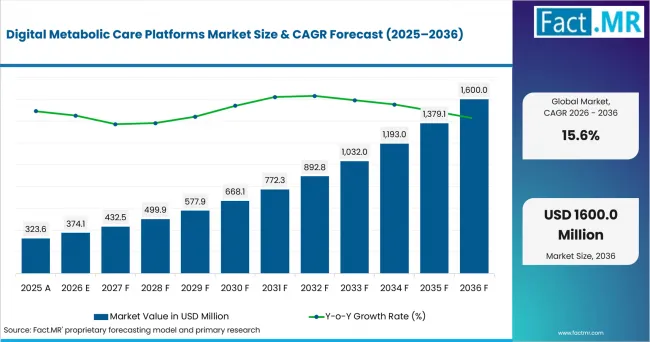
Digital Metabolic Care Platforms Market Value Analysis | Source: Fact.MR
What are the defining numbers behind Digital Metabolic Care Platforms Market growth?
USD 1,225.9 million absolute opportunity is expected by 2036. Type 2 diabetes and Coach-led programs lead the forecast base. Lifestyle & behavior change and Health plans complete the main share picture.
- Demand Drivers in the Market
- Multi-condition metabolic risk is expected to push health plans toward one program for diabetes, prediabetes and obesity.
- Care delivery is expected to depend on coaching and clinical escalation instead of a stand-alone wellness app.
- Enterprise sponsors are projected to favor consolidated platforms that reduce repeated member outreach across pharmacy and weight-care programs.
- Broader digital transformation in healthcare is expected to raise expectations for data exchange between metabolic platforms and plan systems.
- Key Segments Analyzed
- By Condition Focus: Type 2 diabetes is expected to hold 31.1% share in 2026 as diagnosed populations create recurring demand for monitoring and medication support.
- By Care Model: Coach-led programs are projected to account for 45.2% share in 2026 with frequent behavior support offering more scale than clinician-only delivery.
- By Intervention Type: Lifestyle & behavior change is anticipated to capture 34.5% share in 2026 since daily routines influence diabetes and obesity care.
- By Contracting Model: Per-member-per-month is estimated to represent 40.4% share in 2026 due to its fit with population-based care.
- By End User: Health plans are forecast to hold 47.8% share in 2026 as they connect digital care with claims and provider networks.
- Analyst Opinion at Fact.MR
- Shambhu Nath Jha, Sr. Consultant at Fact.MR, states, “Digital metabolic care platforms must prove that coaching, nutrition support and clinical escalation work inside dependable metabolic-care pathways. Purchasers are expected to value durable engagement, clear responsibility and measurable care transitions more than app activity alone.”
- Strategic Implications
- Health plans benefit from defined rules for condition transitions. Diabetes management software supports traceability across A1c history and outreach records.
- Program sponsors should keep weight-care services separate from prescription access. GLP-1 aftercare becomes important when members require nutrition guidance following medication decisions.
- Data integration must be tested before implementation begins. Remote patient monitoring devices create value when biomarker feeds lead to a clearly assigned human review.
The World Health Organization reported in November 2024 that the number of people living with diabetes rose to 830.0 million in 2022. This burden supports payer interest in platforms that combine long-term engagement, coaching, escalation rules and accountable metabolic-care workflows rather than app activity alone.
Country growth is led by markets where metabolic programs can fit into reimbursed, employer-funded or health-plan purchasing routes. France is projected to record the fastest growth among the profiled countries at 16.7% CAGR from 2026 to 2036, supported by digital-health reimbursement review and governance requirements. Italy follows at 16.3% as regional health systems require adaptable implementation models. The USA is expected to grow at 15.9% through employer and health-plan purchasing, while the UK is forecast at 14.4% as pathway fit guides procurement. Germany is estimated at 13.9% as evidence review, interoperability and data-protection expectations shape adoption timing.
How does the Digital Metabolic Care Platforms Market break down by segment?
Type 2 diabetes is expected to lead Condition Focus at 31.1% share in 2026. Coach-led programs are projected to lead Care Model at 45.2% share in 2026.
Why does Type 2 diabetes lead Condition Focus?
Type 2 diabetes is projected to account for 31.1% share in 2026.
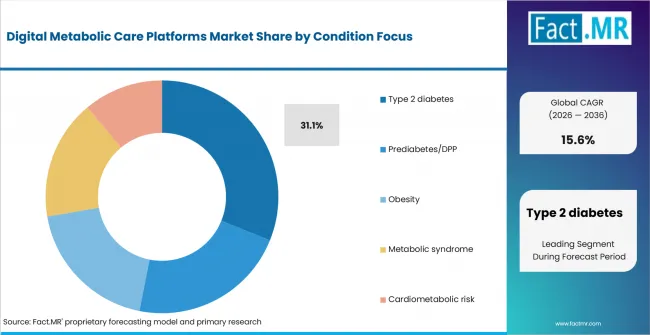
Digital Metabolic Care Platforms Market Analysis By Condition Focus | Source: Fact.MR
Type 2 diabetes gives platforms the largest recurring use case. Members need lifestyle guidance and medication support over long periods. Prediabetes/DPP and Obesity remain entry points for prevention and weight-care services. Metabolic syndrome and Cardiometabolic risk expand the pathway when sponsors want one program to follow members as risk changes.
Why do Coach-led programs lead Care Model?
Coach-led programs are expected to hold 45.2% share in 2026.
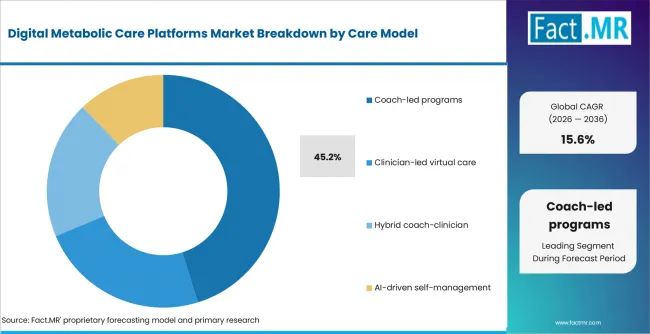
Digital Metabolic Care Platforms Market Analysis By Care Model | Source: Fact.MR
Coach-led delivery gives sponsors frequent behavior support without relying only on clinician time. Clinician-led virtual care remains needed when medication safety review is required. Hybrid coach-clinician programs and AI-driven self-management are expected to gain attention when escalation rules are clear.
How does Lifestyle & behavior change shape demand?
Lifestyle & behavior change is anticipated to lead with 34.5% share in 2026.
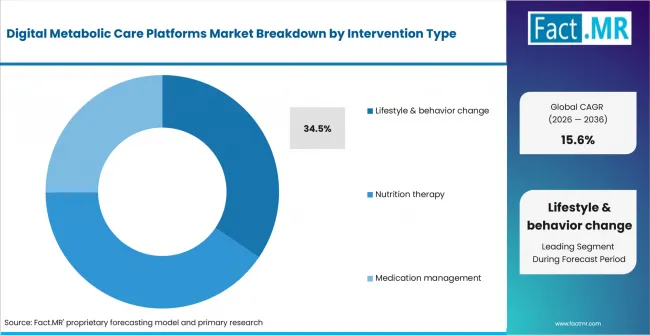
Digital Metabolic Care Platforms Market Analysis By Intervention Type | Source: Fact.MR
Daily routines remain central to metabolic care because food patterns and activity affect several conditions. Nutrition therapy is expected to support members who need tailored guidance. Medication management becomes more valuable when platforms coordinate GLP-1 use and diabetes drugs.
What supports Per-member-per-month contracting?
Per-member-per-month is estimated to represent 40.4% share in 2026.
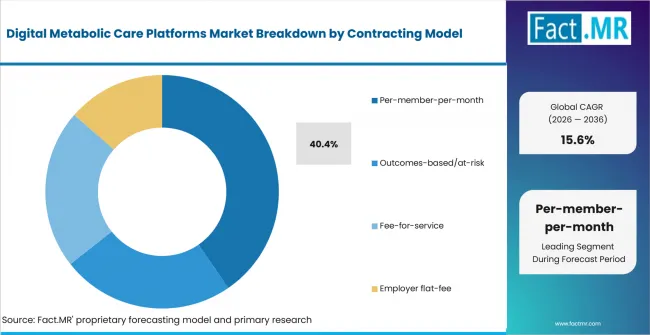
Digital Metabolic Care Platforms Market Analysis By Contracting Model | Source: Fact.MR
Recurring population-based fees match how employers and plans purchase ongoing care programs. Outcomes-based contracts remain useful when sponsors agree on attribution rules. Fee-for-service and employer flat-fee models fit narrower deployments or pilots.
What supports Health plans within End User?
Health plans are forecast to hold 47.8% share in 2026.
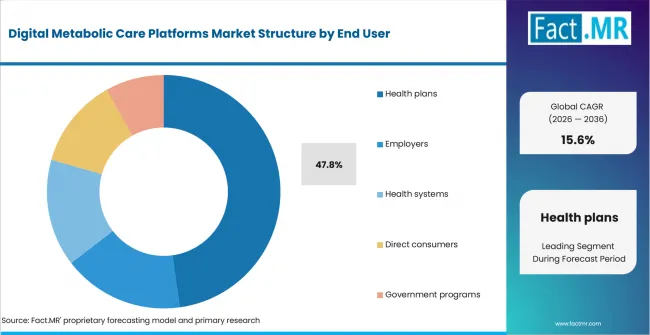
Digital Metabolic Care Platforms Market Analysis By End User | Source: Fact.MR
Health plans can contract across large member populations and connect programs with claims and provider networks. Employers remain active when benefit design targets workforce health and cost control. Health systems and government programs create additional demand when pathway ownership is clear. Direct consumers remain smaller because coverage and clinical integration are less consistent.
What is accelerating Digital Metabolic Care Platforms Market adoption, and what is holding it back?
Demand is expected to be driven by metabolic disease burden and lifestyle-change evidence. Adoption is expected to be held back by attribution problems and long-term engagement risk.
Drivers Impact Analysis
| DRIVER | QUALITATIVE IMPACT | GEOGRAPHIC RELEVANCE | IMPACT TIMELINE |
|---|---|---|---|
| High metabolic disease burden | High | Global | Short term (<=2 years) |
| Evidence for lifestyle change | High | Global | Short term (<=2 years) |
| Payer demand for consolidation | Medium | Global | Medium term (2-4 years) |
| Remote clinical capacity | Medium | France and enterprise markets | Medium term (2-4 years) |
Source: Fact.MR analysis. Updated Jul 27, 2026
- High metabolic disease burden: Diabetes and obesity are expected to create sustained demand for long-term metabolic support. Platforms gain relevance when health plans and employers require one service that can support members across several related conditions over long treatment periods.
- Evidence for lifestyle change: Structured coaching and nutrition support are expected to reduce progression risk when members stay engaged. Stronger evidence linking behavioral support with weight, glucose, and adherence outcomes can improve payer confidence and strengthen the case for broader program enrollment.
- Payer demand for consolidation: One platform is expected to simplify procurement across related metabolic conditions. Consolidation also reduces the need to maintain separate digital tools, although sponsors still require clear condition pathways, escalation rules, and outcome measures before replacing existing services.
Opportunity Impact Analysis
| OPPORTUNITY | QUALITATIVE IMPACT | GEOGRAPHIC RELEVANCE | IMPACT TIMELINE |
|---|---|---|---|
| Risk-based personalization | High | Global | Short term (<=2 years) |
| Outcomes-based contracts | Medium | France and Italy | Medium term (2-4 years) |
| Health-system integration | Medium | Global | Medium term (2-4 years) |
Source: Fact.MR analysis. Updated Jul 27, 2026
- Risk-based personalization: Programs are expected to adjust service intensity when biomarkers and engagement patterns change. Better personalization may direct intensive support toward high-risk members while allowing stable participants to continue through lower-cost digital pathways.
- Outcomes-based contracts: Shared measures are expected to align vendor payment with agreed clinical and utilization goals. Wider adoption will depend on reliable baselines, sufficient follow-up periods, and agreement over which outcomes the platform can reasonably influence.
- Health-system integration: Referral and data exchange are expected to connect digital programs with primary care and specialty care. Platforms that return progress data to clinicians may gain stronger acceptance than standalone tools that operate outside existing care workflows.
Restraints Impact Analysis
| RESTRAINT | QUALITATIVE IMPACT | GEOGRAPHIC RELEVANCE | IMPACT TIMELINE |
|---|---|---|---|
| Attribution in multi-condition care | High | Global | Short term (<=2 years) |
| Member overlap | High | Regulated and payer-funded markets | Medium term (2-4 years) |
| Long-term engagement | Medium | Global | Medium term (2-4 years) |
Source: Fact.MR analysis. Updated Jul 27, 2026
- Attribution in multi-condition care: Clinical change may reflect medication use or in-person care as well as the platform. This makes it difficult to assign savings or outcomes to one intervention, particularly when members participate in several programs at the same time.
- Member overlap: Members may receive duplicative outreach from disease management and pharmacy programs. Sponsors therefore require eligibility rules and shared care records that prevent several programs from contacting the same member for similar needs.
- Long-term engagement: Yearlong behavior change requires participation after the first sign-up period. Platforms must refresh coaching content, simplify tracking, and provide timely human support to prevent early enrollment from turning into low sustained use.
Which countries are scaling Digital Metabolic Care Platforms Market fastest?
The country comparison is led by France at 16.7% CAGR, followed by Italy at 16.3% and the USA at 15.9%. The UK is projected at 14.4%, while Germany records 13.9% as evidence review and interoperability requirements slow deployment. Growth reflects different purchasing paths across the five markets.
- France leads through digital-health reimbursement review and data-hosting expectations that favor providers with clear clinical governance.
- Italy remains close to France because regional care pathways require adaptable referral, coaching and implementation models.
- The USA records an upper-mid position as employers and health plans compare digital metabolic care with existing chronic care programs.
- The UK shows a measured path where NHS access and evidence expectations favor services that fit a defined care pathway.
- Germany records the lowest listed CAGR among the five countries as evidence review, interoperability and data-protection expectations lengthen entry work.
Comparable CAGRs can therefore produce different market entry conditions. Deployment timing depends on payer evidence, local clinical responsibility and the ability to integrate metabolic care with existing pathways.
The full report provides country-level CAGR analysis across North America and Latin America. It also covers Europe and East Asia. South Asia, Oceania and the Middle East and Africa complete the regional view.
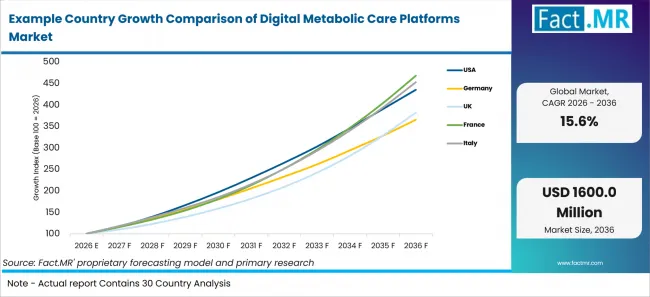
Example Country Growth Comparison Of Digital Metabolic Care Platforms Market | Source: Fact.MR
| Country | CAGR (2026-2036) |
|---|---|
| France | 16.7% |
| Italy | 16.3% |
| USA | 15.9% |
| UK | 14.4% |
| Germany | 13.9% |
Source: Fact.MR analysis. Updated Jul 27, 2026
Why does France’s reimbursement pathway favor clinically govern platforms?
16.7% CAGR, supported by reimbursement review and digital-health governance.
France gives digital metabolic care platforms a route into routine care through its national digital-health framework. Providers must align with health-data hosting, consent and clinical-evidence requirements before connecting coaching, nutrition and medication support with reimbursed pathways. This favors platforms that can document professional oversight and exchange information securely with established health services.
How does Italy’s regional healthcare structure shape platform adoption?
16.3% CAGR, backed by regional care pathways and local partnerships.
Italy’s market is shaped by regional responsibility for healthcare delivery. A platform may therefore need different referral, clinical-support and implementation arrangements across local health systems rather than relying on one national deployment model. Providers that work with regional authorities, hospitals and diabetes-care networks can adapt coaching and nutrition services to local pathways, supporting growth through 2036.
Why do employer benefit contracts define the USA opportunity?
15.9% CAGR, led by employer and health-plan purchasing.
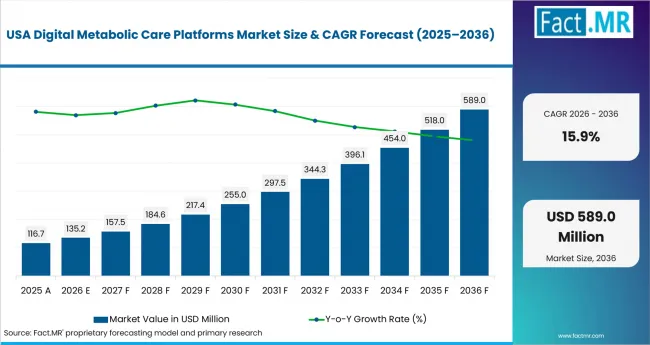
Digital Metabolic Care Platforms Market Country Value Analysis | Source: Fact.MR
USA adoption is developing through benefit contracts rather than a single public reimbursement route. Employers and health plans can place diabetes prevention, obesity support and medication-related coaching within existing chronic-care programs. Vendors gain a stronger position when they can connect engagement records with claims, demonstrate measurable outcomes and prevent overlapping outreach from separate pharmacy, wellness and disease-management services.
What makes NHS pathway integration central to UK adoption?
14.4% CAGR, driven by NHS pathway fit and evidence expectations.
UK adoption depends on whether a platform can operate inside an established NHS care pathway rather than functioning as a separate wellness application. Services must clarify referral responsibility, clinical escalation and the return of patient information to healthcare professionals. Platforms that support diabetes prevention, weight management and ongoing metabolic monitoring with transparent evidence are better positioned for procurement through 2036.
Why does Germany place interoperability ahead of rapid deployment?
13.9% CAGR, supported by evidence review and interoperability requirements.
Germany provides a structured digital-health environment, but market entry depends on evidence, data protection and integration with regulated care systems. Digital metabolic care platforms must distinguish accountable clinical support from general fitness or diet applications. Providers that document patient benefit, define professional responsibility and exchange information through compatible health-data systems are more likely to progress beyond limited deployments.
Who leads the Digital Metabolic Care Platforms Market?
Omada Health and Virta Health show the clearest direct relevance. Livongo by Teladoc Health strengthens the connected diabetes management field through an established chronic care channel.
Omada Health supports prevention and diabetes programs with coaching and connected devices. Virta Health focuses on metabolic health programs that combine nutrition with clinical care. Livongo by Teladoc Health is relevant through diabetes condition management and connected monitoring. Vida Health extends the field through employer and health-plan metabolic care. Lark Health contributes AI-enabled diabetes prevention and care pathways. Twin Health adds digital twin services for metabolic health.
Competition is expected to depend on measurable outcomes and qualified human support from 2026 to 2036. Sponsor integration and attribution rules are expected to decide renewal confidence. Providers are expected to compare themselves against adjacent blood glucose monitoring devices when selling to health plans. Employer contracts are expected to overlap with corporate wellness programs when sponsors bundle metabolic risk support with workforce benefits.
Which companies are the key providers?
Key companies include Omada Health, Virta Health and Livongo by Teladoc Health. Vida Health, Lark Health and Twin Health complete the provider set.
- Omada Health
- Virta Health
- Livongo by Teladoc Health
- Vida Health
- Lark Health
- Twin Health
Bibliography
- World Health Organization. (2024, November 14). Diabetes.
- Centers for Disease Control and Prevention. (2026, January 21). National diabetes statistics report.
- Twin Health. (2025, August 20). New peer-reviewed study finds Twin Health’s AI precision treatment significantly improves outcomes in patients with type 2 diabetes and reduces reliance on costly medications, including GLP-1s.
- World Health Organization. (2025, December 8). Obesity and overweight.
- Virta Health. (2025, April 4). Virta Health cuts GLP-1 use for weight loss over 50% while driving significant and sustained outcomes, delivering major cost savings for payers.
- Omada Health. (n.d.). Diabetes Program.
- Teladoc Health. (n.d.). Livongo by Teladoc Health.
- Vida Health. (n.d.). Enterprise obesity and metabolic care.
- Lark Health. (n.d.). Diabetes Prevention Program.
This Report Answers
- The report provides strategic intelligence on the Digital Metabolic Care Platforms Market across Condition Focus and Care Model choices that shape metabolic care programs.
- Segment analysis covers Type 2 diabetes and Coach-led programs as the share leaders within the 2026 market.
- Country outlook evaluates France and Italy alongside the USA and the UK. Germany completes the growth comparison across the profiled markets.
- Competitive analysis profiles Omada Health and Virta Health alongside Livongo by Teladoc Health and Vida Health. Lark Health and Twin Health complete the provider set.
- Intervention assessment covers Lifestyle & behavior change and Nutrition therapy. Medication management completes the care view across higher-risk metabolic users.
What does the Digital Metabolic Care Platforms Market cover?
Digital metabolic care platforms coordinate lifestyle support and coaching for metabolic conditions. They support clinical escalation and nutrition guidance inside the same pathway.
The Digital Metabolic Care Platforms Market covers programs used for type 2 diabetes and prediabetes. Coverage extends to obesity and cardiometabolic risk. Coach-led and clinician-led virtual care are included. Hybrid coach-clinician services and AI-driven self-management remain in scope when human responsibility is clear. The market includes lifestyle behavior support and medication management. Contracting coverage includes health plans and employers. Health systems and government programs remain covered.
The market differs from general wellness applications. Commercial value comes from accountable metabolic care workflows. Broad telemedicine solutions remain outside the boundary unless the service manages metabolic outcomes. General fitness content is excluded. Stand-alone diet tracking is excluded unless it connects to a defined metabolic care program.
What is included in the scope?
Digital metabolic care platforms are used across health plans and employers. Health systems and government programs remain included.
The scope includes Condition Focus and Care Model alongside Intervention Type and Contracting Model. Coverage spans Type 2 diabetes and Prediabetes/DPP. Obesity and Cardiometabolic risk complete the condition scope. It includes coach-led programs and clinician-led virtual care. Hybrid coach-clinician models and AI-driven self-management follow the same responsibility rule. The scope includes mHealth monitoring services when they form part of an accountable metabolic care pathway.
What is excluded from the scope?
General wellness apps and unrelated virtual care services remain outside the scope of this market.
The scope excludes programs that do not manage metabolic risk or related cardiometabolic conditions. General fitness apps and food diaries are excluded when they do not connect to coaching or clinical review. Stand-alone pharmacy services are excluded unless they support a defined metabolic care program. Broad home healthcare services remain outside the boundary unless demand depends on digital metabolic care integration. Company revenue without a clear connection to digital metabolic care remains excluded.
How Was the Analysis Built?
The analysis draws on 120+ sources, 35+ company portfolios, 25+ countries, and more than 20 industry interviews.
- Primary Research: Primary research includes discussions with manufacturers, service providers, technology developers, distributors, end users, procurement teams, and subject-matter experts. These conversations examine purchasing priorities, product adoption, operational challenges, approval requirements, competitive positioning, and the factors that influence wider market acceptance.
- Desk Research: Desk research covers government statistics, regulatory publications, company filings, trade data, technical studies, industry associations, standards, public policy, and other authoritative sources. Every source used in the analysis is documented in the bibliography.
- Market Sizing and Forecasting: Market estimates combine historical performance, demand indicators, pricing and volume trends, segment shares, company participation, country-level growth, adoption patterns, investment activity, and barriers to market expansion.
- Data Validation and Update Cycle: Findings are validated by comparing primary interviews with public data, company activity, regulatory changes, trade patterns, and industry developments. Regular updates review new product launches, capacity changes, partnerships, approvals, procurement trends, and shifts in commercial adoption.
Segmentation
What is the report’s scope and coverage?
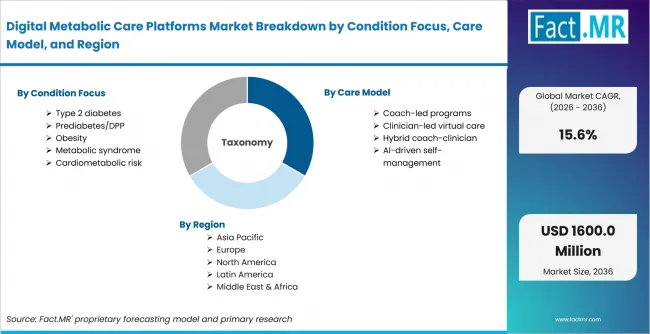
Digital Metabolic Care Platforms Market Breakdown By Condition Focus, Care Model, And Region | Source: Fact.MR
| Attribute | Details |
|---|---|
| Quantitative Units | USD 374.1 million in 2026 to USD 1,600.0 million by 2036 at 15.6% CAGR |
| Market Definition | Digital programs that manage diabetes, prediabetes, obesity, metabolic syndrome and related cardiometabolic risk through coaching, clinical care, behavior change, nutrition and medication support. The scope includes coach-led, clinician-led, hybrid and AI-assisted models. |
| Condition Focus | Type 2 diabetes; Prediabetes/DPP; Obesity; Metabolic syndrome; Cardiometabolic risk |
| Care Model | Coach-led programs; Clinician-led virtual care; Hybrid coach-clinician; AI-driven self-management |
| Intervention Type | Lifestyle & behavior change; Nutrition therapy; Medication management |
| Contracting Model | Per-member-per-month; Outcomes-based/at-risk; Fee-for-service; Employer flat-fee |
| End User | Health plans; Employers; Health systems; Direct consumers; Government programs |
| Regions Covered | North America; Latin America; Europe; East Asia; South Asia and Pacific; Middle East and Africa |
| Countries Covered | USA; Germany; UK; France; Italy |
| Key Companies Profiled | Omada Health; Virta Health; Livongo by Teladoc Health; Vida Health; Lark Health; Twin Health |
| Forecast Period | 2026 to 2036 |
| Approach | Hybrid top-down and bottom-up approach using health-plan demand; metabolic condition pathways; virtual coaching capacity; intervention type mix; contracting models; end-user purchasing patterns; country adoption patterns and company portfolio review |
Source: Fact.MR analysis. Updated Jul 27, 2026
How is the market segmented?
-
By Condition Focus:
- Type 2 diabetes
- Prediabetes/DPP
- Obesity
- Metabolic syndrome
- Cardiometabolic risk
-
By Care Model:
- Coach-led programs
- Clinician-led virtual care
- Hybrid coach-clinician
- AI-driven self-management
-
By Intervention Type:
- Lifestyle & behavior change
- Nutrition therapy
- Medication management
-
By Contracting Model:
- Per-member-per-month
- Outcomes-based/at-risk
- Fee-for-service
- Employer flat-fee
-
By End User:
- Health plans
- Employers
- Health systems
- Direct consumers
- Government programs
-
By Region:
- North America
- Latin America
- East Asia
- South Asia and Pacific
- Middle East and Africa
Frequently Asked Questions
Which Condition Focus leads the market?
Which Care Model leads the market?
Which Intervention Type leads the market?
Which Contracting Model leads the market?
Which End User leads the market?
Which country records the highest listed CAGR?
What is the primary driver in this market?
What is the main restraint?
Why do health plans lead demand?
Who worked on this report


Preview the report firsthand - request a free sample
Free SampleGet the brochure for pricing and purchase details
Download PDF