Digital Detox & Attention Wellness Services Market Size, Share, Growth and Forecast (2026 - 2036)

The Digital Detox & Attention Wellness Services Market is segmented by Service Type, by Customer Type, by Delivery Model, by Use Case, by Sales Channel, by Age Group and Region. Forecast for 2026 to 2036.

What is the digital detox and attention wellness services market forecast to be worth by 2036?

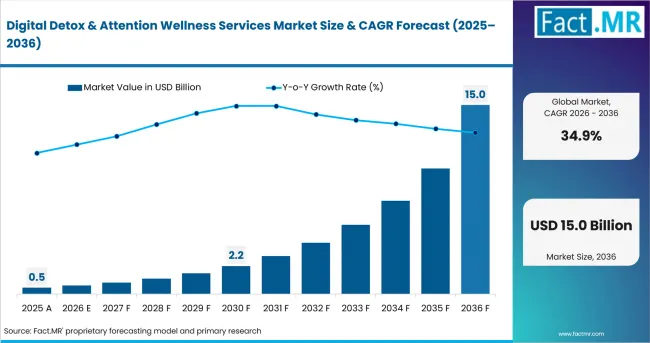
USD 0.75 billion in 2026 to USD 15.0 billion by 2036, at 34.9% CAGR.

  • The digital detox and attention wellness services market crossed a valuation of USD 0.56 billion in 2025.
  • The market is estimated at USD 0.75 billion in 2026 and is projected to reach USD 15.0 billion by 2036.
  • Growth is supported by employer well-being budgets, classroom phone rules and consumer willingness to pay for help with compulsive screen routines.
Digital Detox & Attention Wellness Services Market Value Analysis

What are the defining numbers behind digital detox and attention wellness services growth?

USD 14.25 billion absolute opportunity by 2036, led by India and the United States.

  • Demand Drivers in the Market
    • Employers are buying attention wellness programs because screen fatigue now affects meeting load, sleep quality and task completion.
    • Schools are adopting phone-free routines because teachers need fewer classroom interruptions and clearer behavior rules.
    • Parents are paying for app blockers and coaching because ordinary parental controls do not create lasting screen habits.
    • Retreat operators are adding phone-free stays because travelers want rest programs with a visible break from constant notifications.
  • Key Segments Analyzed
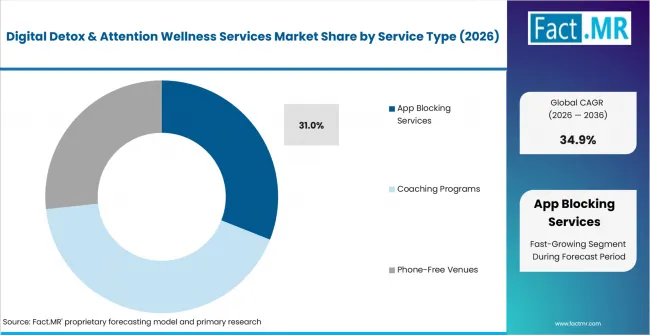
    • By Service Type: App Blocking Services are expected to hold 31.0% share in 2026 because users first pay for direct limits on apps and websites.
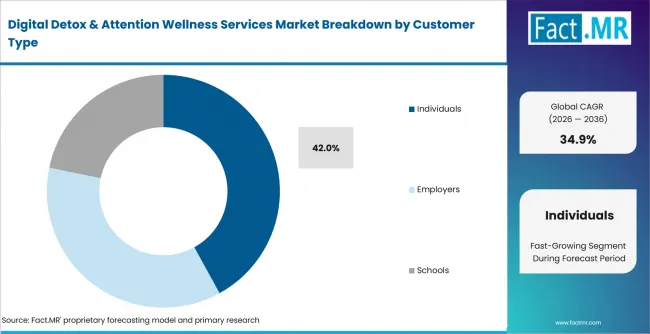
    • By Customer Type: Individuals lead with 42.0% share in 2026 because personal subscriptions remain the lowest-friction purchase route.
    • By Delivery Model: App Subscriptions are projected to hold 45.0% share in 2026 because recurring self-service plans fit low-ticket wellness budgets.
    • By Use Case: Focus Recovery is estimated to hold 34.0% share in 2026 because buyers connect screen reduction with work and study outcomes.
    • By Sales Channel: Direct Apps are likely to account for 38.0% share in 2026 because discovery happens through app stores and creator-led referrals.
    • By Age Group: Adults are expected to hold 40.0% share in 2026 because work stress creates a repeat buyer base for subscriptions and coaching.
    • By Geography: India is projected to record 36.6% compound annual growth rate through 2036 as low-cost services meet a large youth market.
  • Analyst Opinion at Fact.MR
    • Shambhu Nath Jha, Principal Consultant at Fact.MR, states, "Digital detox is about more than deleting apps. We see clients paying for proof that a service can make attention easier to protect at home, at work and in classrooms. Providers that combine simple blocking tools with coaching and phone-free routines are better placed than brands selling generic wellness content."
  • Strategic Implications
    • App providers should show how blocked time changes sleep, study or work routines.
    • Employers need privacy-safe dashboards that do not expose employee-level behavior.
    • School vendors should offer parent communication templates and staff training along with storage tools.
    • Retreat operators can improve repeat booking by connecting offline stays with post-trip habit coaching.

The core of this market is paid support that reduces non-essential screen use and rebuilds attention habits. Centers for Disease Control and Prevention data published in October 2024 found that 50.4% of United States teenagers had four or more hours of daily non-school screen time. That evidence gives schools and parents a reason to buy structured programs rather than rely only on device settings.

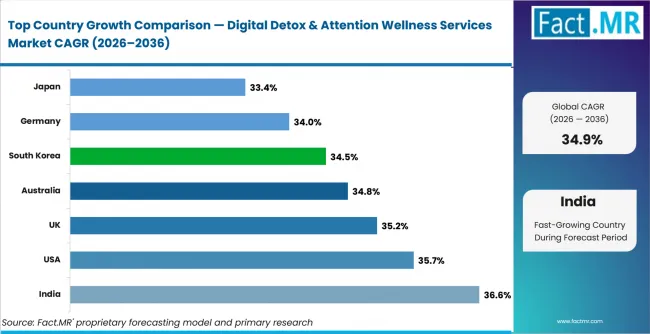
India is projected to record 36.6% compound annual growth rate through 2036 because youth connectivity and low-cost subscriptions expand the buyer base. The United States is expected to expand at 35.7% through 2036 as employers and schools pay for structured attention programs. The United Kingdom is forecast to grow at 35.2% through 2036 because school phone guidance supports service demand. Australia is expected to advance at 34.8% through 2036 as under-16 social media rules shift responsibility toward platforms and families. South Korea is projected to rise at 34.5% through 2036 as smartphone overdependence prevention remains part of public language. Germany is forecast at 34.0% through 2036 because privacy-safe workplace programs shape buying. Japan is expected to post 33.4% through 2036 because cautious school and family buying keeps the service base narrower.

How does the Digital Detox & Attention Wellness Services Market Break Down by Segment?

App Blocking Services lead at 31.0% share in 2026. Individuals lead at 42.0% share. App Subscriptions hold 45.0% share because the lowest-friction purchase remains a recurring mobile plan.

Screen reset programs often borrow behavior cues from mindfulness meditation apps because users need breathing, reflection and sleep routines after app limits are set. The difference is that attention wellness starts from phone behavior and then moves into well-being support.

Institutional buyers prefer tools that fit inside benefits platforms, learning systems and employee portals. This requirement connects the category with on-demand wellness software because HR teams need deployment, eligibility and usage workflows.

Which service type dominates?

App Blocking Services hold 31.0% share in 2026.
Digital Detox & Attention Wellness Services Market Analysis By Service Type

App Blocking Services lead because users first need a clear barrier between intention and automatic phone use. Paid blockers create value when they make bypass harder and when sessions sync across phone, desktop and browser. Freedom and Opal show this user logic through cross-device blocking and focus-session design. The segment keeps its lead because it gives users a visible result within the first week.

Which customer type dominates?

Individuals hold 42.0% share in 2026.
Digital Detox & Attention Wellness Services Market Analysis By Customer Type

Individuals account for the largest share because most buyers start with a personal problem before an employer or school gets involved. The user journey often begins with fatigue, poor sleep or missed study time. Services that also point users toward mental health software workflows can support referrals when screen behavior is linked with stress or anxiety.

Which delivery model dominates?

App Subscriptions hold 45.0% share in 2026.
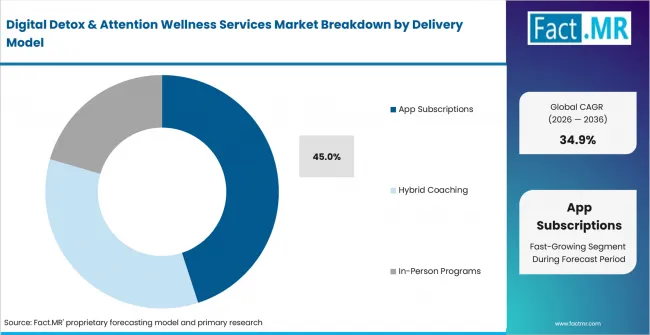
Digital Detox & Attention Wellness Services Market Analysis By Delivery Model

App Subscriptions lead because buyers can test a service without a long contract. The subscription model works when users receive clear rules, reports and reminders that make screen reduction easier to repeat. Hardware-assisted tools such as Brick and Unpluq sit beside this model when users want a physical barrier before app access.

Which use case dominates?

Focus Recovery holds 34.0% share in 2026.

Focus Recovery leads because users can connect screen limits with a practical outcome. The buyer is often trying to protect study blocks, deep work or a bedtime routine. This use case overlaps with medical wellness when service providers frame attention management as part of a broader preventive routine.
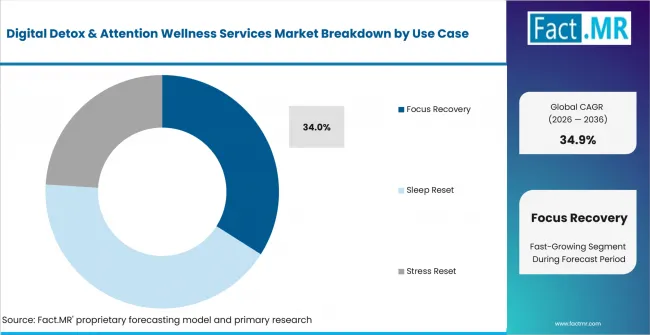
Digital Detox & Attention Wellness Services Market Analysis By Use Case

Which sales channel dominates?

Direct Apps hold 38.0% share in 2026.
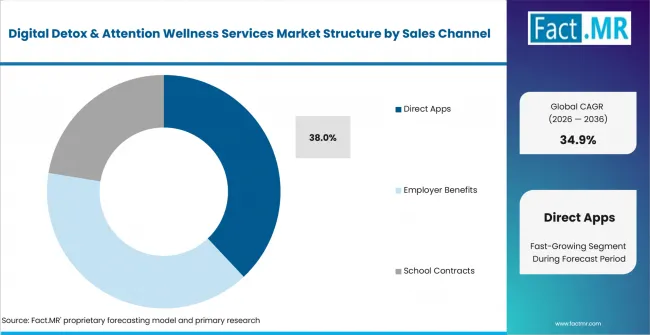
Digital Detox & Attention Wellness Services Market Analysis By Sales Channel

Direct Apps lead because users search for help at the moment of frustration. App stores and social referrals convert faster than employer procurement. The channel also supports fast experimentation with pricing, reminders and session formats. Institutional channels expand later when employers and schools ask for controls, reporting and training.

Which age group dominates?

Adults hold 40.0% share in 2026.
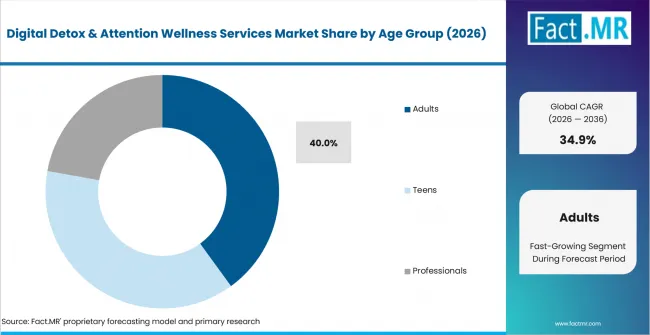
Digital Detox & Attention Wellness Services Market Analysis By Age Group

Adults lead because work-related attention loss creates a direct spending reason. Professionals buy blockers and reset coaching to protect meetings, writing time and sleep. Teens influence family purchases, but adult payment control keeps the revenue base centered on users with their own subscription budgets.

What is accelerating digital detox and attention wellness service demand, and what is holding it back?
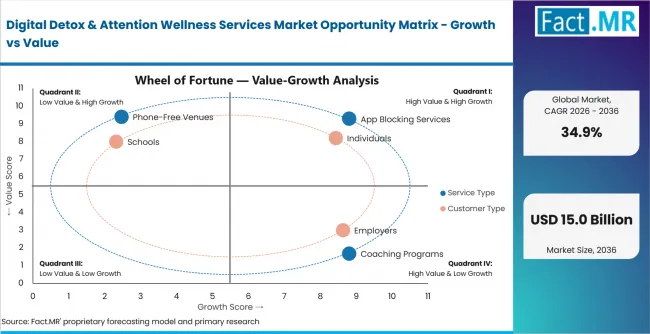
Digital Detox & Attention Wellness Services Market Opportunity Matrix Growth Vs Value

Screen Fatigue Enters Benefit Budgets

Employers are treating attention loss as a work design problem because meetings, messages and after-hours phone use affect rest and output. This gives corporate wellness services a natural route to include focus blocks, screen boundaries and manager training.

The Organisation for Economic Co-operation and Development reported in December 2025 that people using screens for 3 to 5 hours daily had 22.0% higher odds of low mental well-being. This supports employer interest in prevention programs that reduce screen load before it turns into absence or low engagement.

School Phone Rules Create Budgets

School phone rules are turning classroom attention into a procurement category. Phone pouches, storage systems and behavior policies need staff training and parent communication. Vendors that can reduce teacher workload are better placed than vendors that sell only storage products.

The United Kingdom Department for Education published guidance in February 2024 that asks schools to prohibit mobile phones during the school day. This gives phone-free service vendors a policy reason to speak with schools and academy groups.

Proof of Outcome Remains Uneven

The restraint is that clients can see blocked time but may not see lasting behavior change. App dashboards often show minutes saved, while employers and schools need evidence tied to sleep, study, retention or classroom behavior. Vendors need clearer program designs before large buyers standardize these services.

Centers for Disease Control and Prevention research published in 2025 found that high-screen teenagers were more likely to be infrequently well-rested at 59.9% compared with 40.1% for other teenagers. Service providers can use sleep improvement as an outcome marker only if measurement is privacy-safe and easy to explain.

From Wellness Content to Managed Attention

The main opportunity is managed attention rather than more content. Buyers want friction, coaching and repeat routines that fit into work, school and family life. Adjacent mHealth platforms show how wellness services can move into managed programs when screening, onboarding and follow-up are clear.

Which countries are scaling digital detox and attention wellness services fastest?

India leads at 36.6%, followed by the United States at 35.7% and the United Kingdom at 35.2%.
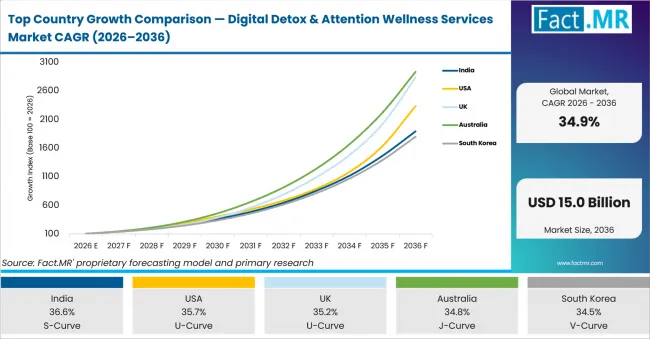
Digital Detox & Attention Wellness Services Market

Country CAGR
India 36.6%
United States 35.7%
United Kingdom 35.2%
Australia 34.8%
South Korea 34.5%
Germany 34.0%
Japan 33.4%

Digital Detox & Attention Wellness Services Market1

What is powering India's outlook?

36.6% CAGR, supported by high youth connectivity and low-ticket subscriptions.

India is projected to expand at 36.6% compound annual growth rate through 2036 as low-ticket subscriptions meet a large connected youth base. The Press Information Bureau reported in May 2025 that 85.5% of Indian households possessed at least one smartphone and 86.3% had internet access at home. This gives app blockers and family coaching providers a broad entry point. Suppliers still need local pricing because many buyers compare screen-control tools with free device settings.

What is powering the United States' outlook?

35.7% CAGR, supported by employer benefits and school district programs.
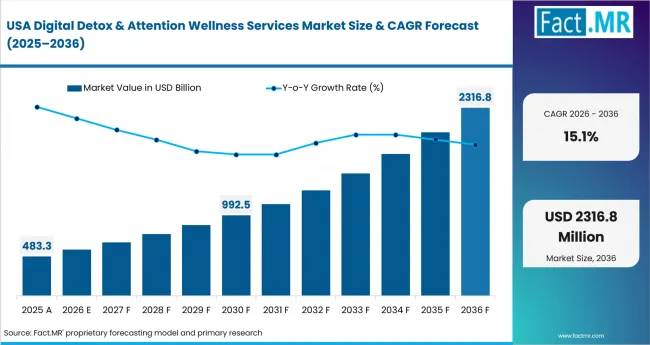
Digital Detox & Attention Wellness Services Market Country Value Analysis

The United States is expected to expand at 35.7% compound annual growth rate through 2036 as employer benefits and school district programs create the clearest institutional route. The Centers for Disease Control and Prevention reported in October 2024 that 50.4% of United States teenagers had four or more hours of daily screen time. Employers can connect attention services with sleep and task completion. School buyers still need simple implementation models because district-level rules differ by state.

What is powering the United Kingdom's outlook?

35.2% CAGR, supported by school phone guidance and parental concern.

The United Kingdom is forecast to grow at 35.2% compound annual growth rate through 2036 as school phone guidance turns attention management into a classroom operations issue. The House of Commons Education Committee reported in May 2024 that children's screen time rose 52.0% between 2020 and 2022. School trusts can assess phone-free pouches and policy support as behavior tools. Vendors need careful wording because wellness claims face closer review when services move into education settings.

What is powering Australia's outlook?

34.8% CAGR, supported by under-16 social media rules and family safety spending.

Australia is expected to advance at 34.8% compound annual growth rate through 2036 as child online safety rules make family responsibility more visible. The eSafety Commissioner reported in September 2024 that 84.0% of Australian children aged 8 to 12 had used a social media or messaging service. Parents are more likely to pay for tools that turn policy concern into daily routines. Providers need plain guidance because platform compliance and household behavior now overlap.

What is powering South Korea's outlook?

34.5% CAGR, supported by smartphone overdependence prevention programs.
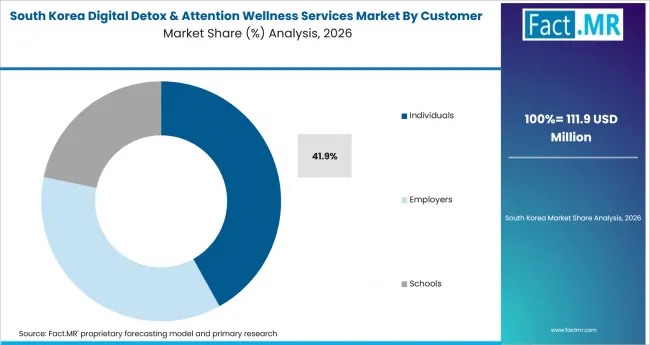
Digital Detox & Attention Wellness Services Market South Korea Market Share Analysis By Customer Type

South Korea is projected to rise at 34.5% compound annual growth rate through 2036 as smartphone overdependence remains a familiar policy and family concern. The Organisation for Economic Co-operation and Development reported in May 2025 that more than 80.0% of teenagers in Korea used digital devices for leisure for over two hours on a typical school day. Schools and families already understand prevention language. Providers need Korean-language coaching and privacy controls to scale beyond short digital fasting programs.

What is powering Germany's outlook?

34.0% CAGR, supported by privacy-safe workplace wellness programs.

Germany is forecast at 34.0% compound annual growth rate through 2036 because workplace programs must fit strict privacy expectations. The Organisation for Economic Co-operation and Development reported in May 2025 that more than 80.0% of teenagers in Germany used digital devices for leisure for over two hours on a typical school day. Employers and schools therefore have a practical reason to review attention support. Service providers need German-language onboarding and clear data storage controls before national rollout.

What is powering Japan's outlook?

33.4% CAGR, supported by cautious school and family service demand.
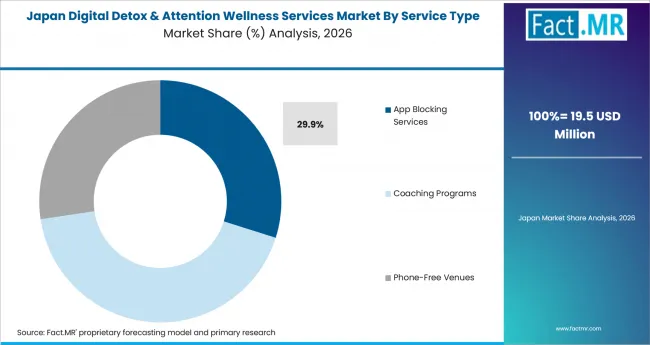
Digital Detox & Attention Wellness Services Market Japan Market Share Analysis By Service Type

Japan is expected to post 33.4% compound annual growth rate through 2036 because family and school buyers use a more cautious purchase route. The Organisation for Economic Co-operation and Development reported in May 2025 that Japanese 15-year-olds spent less leisure time on digital tools than peers in most surveyed countries. This narrows the mass-market subscription base. Suppliers need local-language guidance and school-friendly positioning rather than a broad screen-alarm message.

Who Leads the Digital Detox and Attention Wellness Services Landscape?
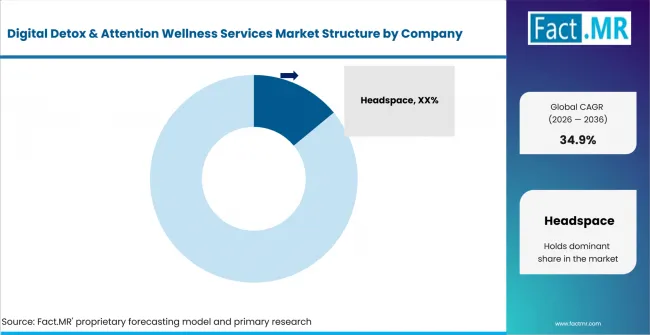
Digital Detox & Attention Wellness Services Market Analysis By Company

Digital detox and attention wellness services are used by people and institutions that need a practical way to reduce non-essential screen time. Headspace and Calm compete from a mental well-being base, while Freedom, Opal, Unpluq and Brick compete through blocking and friction. This creates overlap with mental fitness apps when buyers want daily practice and focus support in the same product.

Yondr and Unplugged Rest are different because they sell a physical or place-based break from phones. Yondr focuses on schools, events and workplaces that need a visible phone-free rule. Unplugged Rest sells cabin stays where the reset experience is the product. These offers help institutional and travel buyers see detox as a service rather than a feature.

Competitive advantage depends on proof, privacy and ease of use. Consumer apps need low-friction setup and clear reports. Institutional vendors need contracts, training and policy support. Adjacent wellness tourism providers can compete when they add phone-free stays and guided reset routines to lodging.

Providers that combine blocking with coaching and privacy-safe reporting are better placed through 2036. Standalone content libraries face pressure because buyers can already access meditation and sleep content in many apps. The winning offer explains what happens after the phone is put away.

Which Companies are the Key Players?

Headspace, Calm, Freedom, Opal, Yondr, Unplugged Rest, and Unpluq.

  • Headspace
  • Calm
  • Freedom
  • Opal
  • Yondr
  • Unplugged Rest
  • Unpluq

Research Sources and Bibliography

  • Zablotsky, B., Arockiaraj, B., Haile, G., & Ng, A. E. (2024, October). Daily screen time among teenagers: United States, July 2021–December 2023 (NCHS Data Brief No. 513). National Center for Health Statistics.
  • Zablotsky, B., Ng, A. E., Black, L. I., Haile, G., Bose, J., Jones, J. R., & Blumberg, S. J. (2025, July 10). Associations between screen time use and health outcomes among US teenagers. Preventing Chronic Disease, 22, 240537.
  • World Health Organization Regional Office for Europe. (2024, September 25). Teens, screens and mental health.
  • Organisation for Economic Co-operation and Development. (2025, December 4). Screen time and subjective well-being: Insights from a few countries worldwide (OECD Policy Insights on Well-being, Inclusion and Equal Opportunity No. 24). OECD Publishing.
  • Organisation for Economic Co-operation and Development. (2025, May 15). How’s life for children in the digital age? OECD Publishing.
  • Faverio, M., Anderson, M., & Park, E. (2025, April 22). Teens, social media and mental health. Pew Research Center.
  • House of Commons Education Committee. (2024, May 25). Screen time: Impacts on education and wellbeing (HC 118).
  • Department for Education. (2024, February 19). Government launches crackdown on mobile phones in schools. GOV.UK.
  • Office of Communications. (2026, May 21). Children and parents: Media use and attitudes report 2025-6.
  • eSafety Commissioner. (2026, March). Social Media Minimum Age: Compliance update.
  • Australian Government Department of Health, Disability and Ageing. (2026, March 13). Recommendations for children and young people.
  • Press Information Bureau. (2025, May 29). Results of Comprehensive Modular Survey: Telecom, 2025. Ministry of Statistics & Programme Implementation, Government of India.
  • Organisation for Economic Co-operation and Development. (2025, May 15). How children use digital media. In How’s life for children in the digital age? OECD Publishing.
  • Organisation for Economic Co-operation and Development. (2025, May 15). How children use digital media. In How’s life for children in the digital age? OECD Publishing.
  • Headspace. (2025, April 3). Headspace brings empathetic AI companion, Ebb, to UK members.
  • Calm. (2024, August 28). You asked, we listened: Introducing Calmpilation summer 2024.
  • Calm Health. (2026, January 21). Calm Health becomes newest benefit in the Solera Network, expanding support to millions.

This Report Answers

  • What is the global value of digital detox and attention wellness services in 2026 and 2036?
  • Which service types, buyers and use cases account for the highest 2026 shares?
  • Why are schools and employers becoming paid channels for attention wellness services?
  • Which countries offer the fastest 2026 to 2036 growth path?
  • How do app blockers, phone-free systems and retreat operators compete?
  • Which companies are most visible in app-based, hardware-assisted and offline reset services?
  • What restraints limit large institutional contracts for screen-time reduction services?
  • Which public sources support screen-time pressure and buyer need?

What is the digital detox and attention wellness services market forecast to be worth by 2036?

Digital detox and attention wellness services cover paid tools and programs that help people reduce non-essential screen use. The scope includes app blocking, attention coaching, phone-free workplace programs, classroom phone management and guided reset stays. The market differs from general meditation because the service outcome is screen control and attention recovery.

What is included in the scope?

The scope includes app blockers, website blockers, focus sessions, family coaching, school phone-free services, employer attention wellness programs and digital detox retreats. It also includes hardware-assisted services when the hardware is tied to a recurring program or managed routine.

What is excluded from the scope?

The scope excludes smartphone hardware sales, general meditation content without screen-use goals and clinical addiction treatment that is not sold as attention wellness. It also excludes ordinary parental-control software when the offer does not include coaching, behavior design or phone-free service support.

How was the analysis built?

100+ public sources, 35+ supplier portfolios, 25+ countries and 20+ interview-informed assumptions.

  • Primary Research:
    • Primary research includes interviews with digital wellness providers, educational administrators, workplace wellbeing managers, healthcare professionals, and app users. Insights were also gathered from corporate benefits teams, wellness consultants, and specialists evaluating attention-management and screen-time reduction programs.
  • Desk Research:
    • Desk research reviews public health studies, mental wellness publications, education and workplace wellbeing policies, screen-time usage statistics, online safety regulations, company annual reports, service portfolios, and digital wellness platform information. Research also covers government initiatives and academic research related to attention health and technology use.
  • Market Sizing and Forecasting:
    • Market estimates are derived using digital wellness app subscription volumes, institutional contract values, retreat and coaching program pricing, user adoption rates, and enterprise wellness spending. Forecasting incorporates trends in screen-time awareness, mental wellbeing initiatives, educational adoption, and corporate demand for attention-management solutions.
  • Data Validation and Update Cycle:
    • Forecasts are validated through expert consultations, company revenue assessments, pricing verification, user adoption indicators, and country-level screen-time and wellbeing data. Market assumptions are further tested against new service launches, partnership activity, regulatory developments, and company announcements.

What is the Report Scope and Coverage?
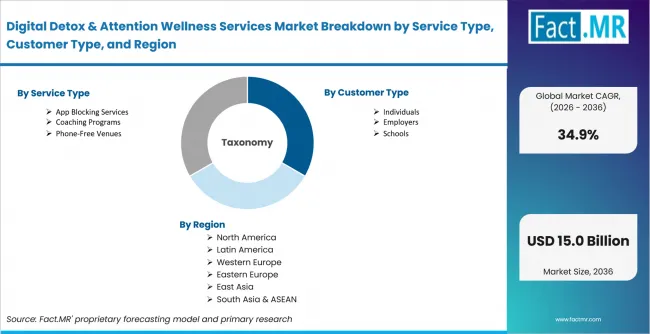
Digital Detox & Attention Wellness Services Market Breakdown By Service Type, Customer Type, And Region

Attribute Details
Quantitative Units USD Billion in 2026 to USD Billion by 2036 at CAGR
Market Definition Paid tools and programs that reduce non-essential screen use and support attention routines
Service Type App Blocking Services, Coaching Programs, Phone-Free Venues, Retreats, Family Programs
Customer Type Individuals, Employers, Schools, Travelers, Healthcare Buyers
Delivery Model App Subscriptions, Hybrid Coaching, In-Person Programs, Hardware-Assisted, Institution Contracts
Use Case Focus Recovery, Sleep Reset, Stress Reset, Family Boundaries, Classroom Attention
Sales Channel Direct Apps, Employer Benefits, School Contracts, Retreat Booking, Healthcare Referral
Age Group Adults, Teens, Professionals, Families, Students
Regions Covered North America, Latin America, Europe, Asia Pacific, Middle East and Africa
Countries Covered India, United States, United Kingdom, Australia, South Korea, Germany, Japan
Companies Profiled Headspace, Calm, Freedom, Opal, Yondr, Unplugged Rest, Unpluq
Forecast Period 2026 to 2036
Approach Hybrid bottom-up and top-down approach using public health data, supplier pricing, app activity and institutional buying logic

How is the Market Segmented?

  • By Service Type

    • App Blocking Services
    • Coaching Programs
    • Phone-Free Venues
    • Retreats
    • Family Programs
  • By Customer Type

    • Individuals
    • Employers
    • Schools
    • Travelers
    • Healthcare Buyers
  • By Delivery Model

    • App Subscriptions
    • Hybrid Coaching
    • In-Person Programs
    • Hardware-Assisted
    • Institution Contracts
  • By Use Case

    • Focus Recovery
    • Sleep Reset
    • Stress Reset
    • Family Boundaries
    • Classroom Attention
  • By Sales Channel

    • Direct Apps
    • Employer Benefits
    • School Contracts
    • Retreat Booking
    • Healthcare Referral
  • By Age Group

    • Adults
    • Teens
    • Professionals
    • Families
    • Students
  • By Region

    • North America
    • Latin America
    • Europe
    • Asia Pacific
    • Middle East and Africa

- Frequently Asked Questions -

Which service type leads in 2026?

App Blocking Services lead with 31.0% share in 2026.

Which customer type accounts for the largest share?

Individuals account for 42.0% share because subscriptions are easy to buy and test.

Which delivery model leads the market?

App Subscriptions lead with 45.0% share because monthly plans fit routine behavior support.

Which country grows fastest through 2036?

India is projected to record 36.6% compound annual growth rate through 2036.

Which companies are profiled?

The report profiles Headspace, Calm, Freedom, Opal, Yondr, Unplugged and Unpluq.

What is excluded from the market scope?

The scope excludes smartphone hardware, general meditation content and clinical addiction treatment outside attention wellness services.

Why is outcome proof important?

Outcome proof matters because buyers want sleep, focus or classroom behavior evidence rather than blocked-time claims alone.

Table of Content

  1. Executive Summary
    • Global Market Outlook
    • Demand to side Trends
    • Supply to side Trends
    • Technology Roadmap Analysis
    • Analysis and Recommendations
  2. Market Overview
    • Market Coverage / Taxonomy
    • Market Definition / Scope / Limitations
  3. Research Methodology
    • Chapter Orientation
    • Analytical Lens and Working Hypotheses
      • Market Structure, Signals, and Trend Drivers
      • Benchmarking and Cross-market Comparability
      • Market Sizing, Forecasting, and Opportunity Mapping
    • Research Design and Evidence Framework
      • Desk Research Programme (Secondary Evidence)
        • Company Annual and Sustainability Reports
        • Peer-reviewed Journals and Academic Literature
        • Corporate Websites, Product Literature, and Technical Notes
        • Earnings Decks and Investor Briefings
        • Statutory Filings and Regulatory Disclosures
        • Technical White Papers and Standards Notes
        • Trade Journals, Industry Magazines, and Analyst Briefs
        • Conference Proceedings, Webinars, and Seminar Materials
        • Government Statistics Portals and Public Data Releases
        • Press Releases and Reputable Media Coverage
        • Specialist Newsletters and Curated Briefings
        • Sector Databases and Reference Repositories
        • Fact.MR Internal Proprietary Databases and Historical Market Datasets
        • Subscription Datasets and Paid Sources
        • Social Channels, Communities, and Digital Listening Inputs
        • Additional Desk Sources
      • Expert Input and Fieldwork (Primary Evidence)
        • Primary Modes
          • Qualitative Interviews and Expert Elicitation
          • Quantitative Surveys and Structured Data Capture
          • Blended Approach
        • Why Primary Evidence is Used
        • Field Techniques
          • Interviews
          • Surveys
          • Focus Groups
          • Observational and In-context Research
          • Social and Community Interactions
        • Stakeholder Universe Engaged
          • C-suite Leaders
          • Board Members
          • Presidents and Vice Presidents
          • R&D and Innovation Heads
          • Technical Specialists
          • Domain Subject-matter Experts
          • Scientists
          • Physicians and Other Healthcare Professionals
        • Governance, Ethics, and Data Stewardship
          • Research Ethics
          • Data Integrity and Handling
      • Tooling, Models, and Reference Databases
    • Data Engineering and Model Build
      • Data Acquisition and Ingestion
      • Cleaning, Normalisation, and Verification
      • Synthesis, Triangulation, and Analysis
    • Quality Assurance and Audit Trail
  4. Market Background
    • Market Dynamics
      • Drivers
      • Restraints
      • Opportunity
      • Trends
    • Scenario Forecast
      • Demand in Optimistic Scenario
      • Demand in Likely Scenario
      • Demand in Conservative Scenario
    • Opportunity Map Analysis
    • Product Life Cycle Analysis
    • Supply Chain Analysis
    • Investment Feasibility Matrix
    • Value Chain Analysis
    • PESTLE and Porter’s Analysis
    • Regulatory Landscape
    • Regional Parent Market Outlook
    • Production and Consumption Statistics
    • Import and Export Statistics
  5. Global Market Analysis 2021 to 2025 and Forecast, 2026 to 2036
    • Historical Market Size Value (USD Million) Analysis, 2021 to 2025
    • Current and Future Market Size Value (USD Million) Projections, 2026 to 2036
      • Y to o to Y Growth Trend Analysis
      • Absolute $ Opportunity Analysis
  6. Global Market Pricing Analysis 2021 to 2025 and Forecast 2026 to 2036
  7. Global Market Analysis 2021 to 2025 and Forecast 2026 to 2036, By Service Type
    • Introduction / Key Findings
    • Historical Market Size Value (USD Million) Analysis By Service Type , 2021 to 2025
    • Current and Future Market Size Value (USD Million) Analysis and Forecast By Service Type , 2026 to 2036
      • App Blocking Services
      • Coaching Programs
      • Phone-Free Venues
    • Y to o to Y Growth Trend Analysis By Service Type , 2021 to 2025
    • Absolute $ Opportunity Analysis By Service Type , 2026 to 2036
  8. Global Market Analysis 2021 to 2025 and Forecast 2026 to 2036, By Customer Type
    • Introduction / Key Findings
    • Historical Market Size Value (USD Million) Analysis By Customer Type, 2021 to 2025
    • Current and Future Market Size Value (USD Million) Analysis and Forecast By Customer Type, 2026 to 2036
      • Individuals
      • Employers
      • Schools
    • Y to o to Y Growth Trend Analysis By Customer Type, 2021 to 2025
    • Absolute $ Opportunity Analysis By Customer Type, 2026 to 2036
  9. Global Market Analysis 2021 to 2025 and Forecast 2026 to 2036, By Delivery Model
    • Introduction / Key Findings
    • Historical Market Size Value (USD Million) Analysis By Delivery Model, 2021 to 2025
    • Current and Future Market Size Value (USD Million) Analysis and Forecast By Delivery Model, 2026 to 2036
      • App Subscriptions
      • Hybrid Coaching
      • In-Person Programs
    • Y to o to Y Growth Trend Analysis By Delivery Model, 2021 to 2025
    • Absolute $ Opportunity Analysis By Delivery Model, 2026 to 2036
  10. Global Market Analysis 2021 to 2025 and Forecast 2026 to 2036, By Use Case
    • Introduction / Key Findings
    • Historical Market Size Value (USD Million) Analysis By Use Case, 2021 to 2025
    • Current and Future Market Size Value (USD Million) Analysis and Forecast By Use Case, 2026 to 2036
      • Focus Recovery
      • Sleep Reset
      • Stress Reset
    • Y to o to Y Growth Trend Analysis By Use Case, 2021 to 2025
    • Absolute $ Opportunity Analysis By Use Case, 2026 to 2036
  11. Global Market Analysis 2021 to 2025 and Forecast 2026 to 2036, By Sales Channel
    • Introduction / Key Findings
    • Historical Market Size Value (USD Million) Analysis By Sales Channel, 2021 to 2025
    • Current and Future Market Size Value (USD Million) Analysis and Forecast By Sales Channel, 2026 to 2036
      • Direct Apps
      • Employer Benefits
      • School Contracts
    • Y to o to Y Growth Trend Analysis By Sales Channel, 2021 to 2025
    • Absolute $ Opportunity Analysis By Sales Channel, 2026 to 2036
  12. Global Market Analysis 2021 to 2025 and Forecast 2026 to 2036, By Age Group
    • Introduction / Key Findings
    • Historical Market Size Value (USD Million) Analysis By Age Group, 2021 to 2025
    • Current and Future Market Size Value (USD Million) Analysis and Forecast By Age Group, 2026 to 2036
      • Adults
      • Teens
      • Professionals
    • Y to o to Y Growth Trend Analysis By Age Group, 2021 to 2025
    • Absolute $ Opportunity Analysis By Age Group, 2026 to 2036
  13. Global Market Analysis 2021 to 2025 and Forecast 2026 to 2036, By Region
    • Introduction
    • Historical Market Size Value (USD Million) Analysis By Region, 2021 to 2025
    • Current Market Size Value (USD Million) Analysis and Forecast By Region, 2026 to 2036
      • North America
      • Latin America
      • Western Europe
      • Eastern Europe
      • East Asia
      • South Asia and Pacific
      • Middle East & Africa
    • Market Attractiveness Analysis By Region
  14. North America Market Analysis 2021 to 2025 and Forecast 2026 to 2036, By Country
    • Historical Market Size Value (USD Million) Trend Analysis By Market Taxonomy, 2021 to 2025
    • Market Size Value (USD Million) Forecast By Market Taxonomy, 2026 to 2036
      • By Country
        • USA
        • Canada
        • Mexico
      • By Service Type
      • By Customer Type
      • By Delivery Model
      • By Use Case
      • By Sales Channel
      • By Age Group
    • Market Attractiveness Analysis
      • By Country
      • By Service Type
      • By Customer Type
      • By Delivery Model
      • By Use Case
      • By Sales Channel
      • By Age Group
    • Key Takeaways
  15. Latin America Market Analysis 2021 to 2025 and Forecast 2026 to 2036, By Country
    • Historical Market Size Value (USD Million) Trend Analysis By Market Taxonomy, 2021 to 2025
    • Market Size Value (USD Million) Forecast By Market Taxonomy, 2026 to 2036
      • By Country
        • Brazil
        • Chile
        • Rest of Latin America
      • By Service Type
      • By Customer Type
      • By Delivery Model
      • By Use Case
      • By Sales Channel
      • By Age Group
    • Market Attractiveness Analysis
      • By Country
      • By Service Type
      • By Customer Type
      • By Delivery Model
      • By Use Case
      • By Sales Channel
      • By Age Group
    • Key Takeaways
  16. Western Europe Market Analysis 2021 to 2025 and Forecast 2026 to 2036, By Country
    • Historical Market Size Value (USD Million) Trend Analysis By Market Taxonomy, 2021 to 2025
    • Market Size Value (USD Million) Forecast By Market Taxonomy, 2026 to 2036
      • By Country
        • Germany
        • UK
        • Italy
        • Spain
        • France
        • Nordic
        • BENELUX
        • Rest of Western Europe
      • By Service Type
      • By Customer Type
      • By Delivery Model
      • By Use Case
      • By Sales Channel
      • By Age Group
    • Market Attractiveness Analysis
      • By Country
      • By Service Type
      • By Customer Type
      • By Delivery Model
      • By Use Case
      • By Sales Channel
      • By Age Group
    • Key Takeaways
  17. Eastern Europe Market Analysis 2021 to 2025 and Forecast 2026 to 2036, By Country
    • Historical Market Size Value (USD Million) Trend Analysis By Market Taxonomy, 2021 to 2025
    • Market Size Value (USD Million) Forecast By Market Taxonomy, 2026 to 2036
      • By Country
        • Russia
        • Poland
        • Hungary
        • Balkan & Baltic
        • Rest of Eastern Europe
      • By Service Type
      • By Customer Type
      • By Delivery Model
      • By Use Case
      • By Sales Channel
      • By Age Group
    • Market Attractiveness Analysis
      • By Country
      • By Service Type
      • By Customer Type
      • By Delivery Model
      • By Use Case
      • By Sales Channel
      • By Age Group
    • Key Takeaways
  18. East Asia Market Analysis 2021 to 2025 and Forecast 2026 to 2036, By Country
    • Historical Market Size Value (USD Million) Trend Analysis By Market Taxonomy, 2021 to 2025
    • Market Size Value (USD Million) Forecast By Market Taxonomy, 2026 to 2036
      • By Country
        • China
        • Japan
        • South Korea
      • By Service Type
      • By Customer Type
      • By Delivery Model
      • By Use Case
      • By Sales Channel
      • By Age Group
    • Market Attractiveness Analysis
      • By Country
      • By Service Type
      • By Customer Type
      • By Delivery Model
      • By Use Case
      • By Sales Channel
      • By Age Group
    • Key Takeaways
  19. South Asia and Pacific Market Analysis 2021 to 2025 and Forecast 2026 to 2036, By Country
    • Historical Market Size Value (USD Million) Trend Analysis By Market Taxonomy, 2021 to 2025
    • Market Size Value (USD Million) Forecast By Market Taxonomy, 2026 to 2036
      • By Country
        • India
        • ASEAN
        • Australia & New Zealand
        • Rest of South Asia and Pacific
      • By Service Type
      • By Customer Type
      • By Delivery Model
      • By Use Case
      • By Sales Channel
      • By Age Group
    • Market Attractiveness Analysis
      • By Country
      • By Service Type
      • By Customer Type
      • By Delivery Model
      • By Use Case
      • By Sales Channel
      • By Age Group
    • Key Takeaways
  20. Middle East & Africa Market Analysis 2021 to 2025 and Forecast 2026 to 2036, By Country
    • Historical Market Size Value (USD Million) Trend Analysis By Market Taxonomy, 2021 to 2025
    • Market Size Value (USD Million) Forecast By Market Taxonomy, 2026 to 2036
      • By Country
        • Kingdom of Saudi Arabia
        • Other GCC Countries
        • Turkiye
        • South Africa
        • Other African Union
        • Rest of Middle East & Africa
      • By Service Type
      • By Customer Type
      • By Delivery Model
      • By Use Case
      • By Sales Channel
      • By Age Group
    • Market Attractiveness Analysis
      • By Country
      • By Service Type
      • By Customer Type
      • By Delivery Model
      • By Use Case
      • By Sales Channel
      • By Age Group
    • Key Takeaways
  21. Key Countries Market Analysis
    • USA
      • Pricing Analysis
      • Market Share Analysis, 2025
        • By Service Type
        • By Customer Type
        • By Delivery Model
        • By Use Case
        • By Sales Channel
        • By Age Group
    • Canada
      • Pricing Analysis
      • Market Share Analysis, 2025
        • By Service Type
        • By Customer Type
        • By Delivery Model
        • By Use Case
        • By Sales Channel
        • By Age Group
    • Mexico
      • Pricing Analysis
      • Market Share Analysis, 2025
        • By Service Type
        • By Customer Type
        • By Delivery Model
        • By Use Case
        • By Sales Channel
        • By Age Group
    • Brazil
      • Pricing Analysis
      • Market Share Analysis, 2025
        • By Service Type
        • By Customer Type
        • By Delivery Model
        • By Use Case
        • By Sales Channel
        • By Age Group
    • Chile
      • Pricing Analysis
      • Market Share Analysis, 2025
        • By Service Type
        • By Customer Type
        • By Delivery Model
        • By Use Case
        • By Sales Channel
        • By Age Group
    • Germany
      • Pricing Analysis
      • Market Share Analysis, 2025
        • By Service Type
        • By Customer Type
        • By Delivery Model
        • By Use Case
        • By Sales Channel
        • By Age Group
    • UK
      • Pricing Analysis
      • Market Share Analysis, 2025
        • By Service Type
        • By Customer Type
        • By Delivery Model
        • By Use Case
        • By Sales Channel
        • By Age Group
    • Italy
      • Pricing Analysis
      • Market Share Analysis, 2025
        • By Service Type
        • By Customer Type
        • By Delivery Model
        • By Use Case
        • By Sales Channel
        • By Age Group
    • Spain
      • Pricing Analysis
      • Market Share Analysis, 2025
        • By Service Type
        • By Customer Type
        • By Delivery Model
        • By Use Case
        • By Sales Channel
        • By Age Group
    • France
      • Pricing Analysis
      • Market Share Analysis, 2025
        • By Service Type
        • By Customer Type
        • By Delivery Model
        • By Use Case
        • By Sales Channel
        • By Age Group
    • India
      • Pricing Analysis
      • Market Share Analysis, 2025
        • By Service Type
        • By Customer Type
        • By Delivery Model
        • By Use Case
        • By Sales Channel
        • By Age Group
    • ASEAN
      • Pricing Analysis
      • Market Share Analysis, 2025
        • By Service Type
        • By Customer Type
        • By Delivery Model
        • By Use Case
        • By Sales Channel
        • By Age Group
    • Australia & New Zealand
      • Pricing Analysis
      • Market Share Analysis, 2025
        • By Service Type
        • By Customer Type
        • By Delivery Model
        • By Use Case
        • By Sales Channel
        • By Age Group
    • China
      • Pricing Analysis
      • Market Share Analysis, 2025
        • By Service Type
        • By Customer Type
        • By Delivery Model
        • By Use Case
        • By Sales Channel
        • By Age Group
    • Japan
      • Pricing Analysis
      • Market Share Analysis, 2025
        • By Service Type
        • By Customer Type
        • By Delivery Model
        • By Use Case
        • By Sales Channel
        • By Age Group
    • South Korea
      • Pricing Analysis
      • Market Share Analysis, 2025
        • By Service Type
        • By Customer Type
        • By Delivery Model
        • By Use Case
        • By Sales Channel
        • By Age Group
    • Russia
      • Pricing Analysis
      • Market Share Analysis, 2025
        • By Service Type
        • By Customer Type
        • By Delivery Model
        • By Use Case
        • By Sales Channel
        • By Age Group
    • Poland
      • Pricing Analysis
      • Market Share Analysis, 2025
        • By Service Type
        • By Customer Type
        • By Delivery Model
        • By Use Case
        • By Sales Channel
        • By Age Group
    • Hungary
      • Pricing Analysis
      • Market Share Analysis, 2025
        • By Service Type
        • By Customer Type
        • By Delivery Model
        • By Use Case
        • By Sales Channel
        • By Age Group
    • Kingdom of Saudi Arabia
      • Pricing Analysis
      • Market Share Analysis, 2025
        • By Service Type
        • By Customer Type
        • By Delivery Model
        • By Use Case
        • By Sales Channel
        • By Age Group
    • Turkiye
      • Pricing Analysis
      • Market Share Analysis, 2025
        • By Service Type
        • By Customer Type
        • By Delivery Model
        • By Use Case
        • By Sales Channel
        • By Age Group
    • South Africa
      • Pricing Analysis
      • Market Share Analysis, 2025
        • By Service Type
        • By Customer Type
        • By Delivery Model
        • By Use Case
        • By Sales Channel
        • By Age Group
  22. Market Structure Analysis
    • Competition Dashboard
    • Competition Benchmarking
    • Market Share Analysis of Top Players
      • By Regional
      • By Service Type
      • By Customer Type
      • By Delivery Model
      • By Use Case
      • By Sales Channel
      • By Age Group
  23. Competition Analysis
    • Competition Deep Dive
      • Headspace
        • Overview
        • Product Portfolio
        • Profitability by Market Segments (Product/Age /Sales Channel/Region)
        • Sales Footprint
        • Strategy Overview
          • Marketing Strategy
          • Product Strategy
          • Channel Strategy
      • Calm
      • Freedom
      • Opal
      • Yondr
      • Unplugged Rest
      • Unpluq
  24. Assumptions & Acronyms Used

List Of Table

  • Table 1: Global Market Value (USD Million) Forecast by Region, 2021 to 2036
  • Table 2: Global Market Value (USD Million) Forecast by Service Type , 2021 to 2036
  • Table 3: Global Market Value (USD Million) Forecast by Customer Type, 2021 to 2036
  • Table 4: Global Market Value (USD Million) Forecast by Delivery Model, 2021 to 2036
  • Table 5: Global Market Value (USD Million) Forecast by Use Case, 2021 to 2036
  • Table 6: Global Market Value (USD Million) Forecast by Sales Channel, 2021 to 2036
  • Table 7: Global Market Value (USD Million) Forecast by Age Group, 2021 to 2036
  • Table 8: North America Market Value (USD Million) Forecast by Country, 2021 to 2036
  • Table 9: North America Market Value (USD Million) Forecast by Service Type , 2021 to 2036
  • Table 10: North America Market Value (USD Million) Forecast by Customer Type, 2021 to 2036
  • Table 11: North America Market Value (USD Million) Forecast by Delivery Model, 2021 to 2036
  • Table 12: North America Market Value (USD Million) Forecast by Use Case, 2021 to 2036
  • Table 13: North America Market Value (USD Million) Forecast by Sales Channel, 2021 to 2036
  • Table 14: North America Market Value (USD Million) Forecast by Age Group, 2021 to 2036
  • Table 15: Latin America Market Value (USD Million) Forecast by Country, 2021 to 2036
  • Table 16: Latin America Market Value (USD Million) Forecast by Service Type , 2021 to 2036
  • Table 17: Latin America Market Value (USD Million) Forecast by Customer Type, 2021 to 2036
  • Table 18: Latin America Market Value (USD Million) Forecast by Delivery Model, 2021 to 2036
  • Table 19: Latin America Market Value (USD Million) Forecast by Use Case, 2021 to 2036
  • Table 20: Latin America Market Value (USD Million) Forecast by Sales Channel, 2021 to 2036
  • Table 21: Latin America Market Value (USD Million) Forecast by Age Group, 2021 to 2036
  • Table 22: Western Europe Market Value (USD Million) Forecast by Country, 2021 to 2036
  • Table 23: Western Europe Market Value (USD Million) Forecast by Service Type , 2021 to 2036
  • Table 24: Western Europe Market Value (USD Million) Forecast by Customer Type, 2021 to 2036
  • Table 25: Western Europe Market Value (USD Million) Forecast by Delivery Model, 2021 to 2036
  • Table 26: Western Europe Market Value (USD Million) Forecast by Use Case, 2021 to 2036
  • Table 27: Western Europe Market Value (USD Million) Forecast by Sales Channel, 2021 to 2036
  • Table 28: Western Europe Market Value (USD Million) Forecast by Age Group, 2021 to 2036
  • Table 29: Eastern Europe Market Value (USD Million) Forecast by Country, 2021 to 2036
  • Table 30: Eastern Europe Market Value (USD Million) Forecast by Service Type , 2021 to 2036
  • Table 31: Eastern Europe Market Value (USD Million) Forecast by Customer Type, 2021 to 2036
  • Table 32: Eastern Europe Market Value (USD Million) Forecast by Delivery Model, 2021 to 2036
  • Table 33: Eastern Europe Market Value (USD Million) Forecast by Use Case, 2021 to 2036
  • Table 34: Eastern Europe Market Value (USD Million) Forecast by Sales Channel, 2021 to 2036
  • Table 35: Eastern Europe Market Value (USD Million) Forecast by Age Group, 2021 to 2036
  • Table 36: East Asia Market Value (USD Million) Forecast by Country, 2021 to 2036
  • Table 37: East Asia Market Value (USD Million) Forecast by Service Type , 2021 to 2036
  • Table 38: East Asia Market Value (USD Million) Forecast by Customer Type, 2021 to 2036
  • Table 39: East Asia Market Value (USD Million) Forecast by Delivery Model, 2021 to 2036
  • Table 40: East Asia Market Value (USD Million) Forecast by Use Case, 2021 to 2036
  • Table 41: East Asia Market Value (USD Million) Forecast by Sales Channel, 2021 to 2036
  • Table 42: East Asia Market Value (USD Million) Forecast by Age Group, 2021 to 2036
  • Table 43: South Asia and Pacific Market Value (USD Million) Forecast by Country, 2021 to 2036
  • Table 44: South Asia and Pacific Market Value (USD Million) Forecast by Service Type , 2021 to 2036
  • Table 45: South Asia and Pacific Market Value (USD Million) Forecast by Customer Type, 2021 to 2036
  • Table 46: South Asia and Pacific Market Value (USD Million) Forecast by Delivery Model, 2021 to 2036
  • Table 47: South Asia and Pacific Market Value (USD Million) Forecast by Use Case, 2021 to 2036
  • Table 48: South Asia and Pacific Market Value (USD Million) Forecast by Sales Channel, 2021 to 2036
  • Table 49: South Asia and Pacific Market Value (USD Million) Forecast by Age Group, 2021 to 2036
  • Table 50: Middle East & Africa Market Value (USD Million) Forecast by Country, 2021 to 2036
  • Table 51: Middle East & Africa Market Value (USD Million) Forecast by Service Type , 2021 to 2036
  • Table 52: Middle East & Africa Market Value (USD Million) Forecast by Customer Type, 2021 to 2036
  • Table 53: Middle East & Africa Market Value (USD Million) Forecast by Delivery Model, 2021 to 2036
  • Table 54: Middle East & Africa Market Value (USD Million) Forecast by Use Case, 2021 to 2036
  • Table 55: Middle East & Africa Market Value (USD Million) Forecast by Sales Channel, 2021 to 2036
  • Table 56: Middle East & Africa Market Value (USD Million) Forecast by Age Group, 2021 to 2036

List Of Figures

  • Figure 1: Global Market Pricing Analysis
  • Figure 2: Global Market Value (USD Million) Forecast 2021-2036
  • Figure 3: Global Market Value Share and BPS Analysis by Service Type , 2026 and 2036
  • Figure 4: Global Market Y-o-Y Growth Comparison by Service Type , 2026-2036
  • Figure 5: Global Market Attractiveness Analysis by Service Type
  • Figure 6: Global Market Value Share and BPS Analysis by Customer Type, 2026 and 2036
  • Figure 7: Global Market Y-o-Y Growth Comparison by Customer Type, 2026-2036
  • Figure 8: Global Market Attractiveness Analysis by Customer Type
  • Figure 9: Global Market Value Share and BPS Analysis by Delivery Model, 2026 and 2036
  • Figure 10: Global Market Y-o-Y Growth Comparison by Delivery Model, 2026-2036
  • Figure 11: Global Market Attractiveness Analysis by Delivery Model
  • Figure 12: Global Market Value Share and BPS Analysis by Use Case, 2026 and 2036
  • Figure 13: Global Market Y-o-Y Growth Comparison by Use Case, 2026-2036
  • Figure 14: Global Market Attractiveness Analysis by Use Case
  • Figure 15: Global Market Value Share and BPS Analysis by Sales Channel, 2026 and 2036
  • Figure 16: Global Market Y-o-Y Growth Comparison by Sales Channel, 2026-2036
  • Figure 17: Global Market Attractiveness Analysis by Sales Channel
  • Figure 18: Global Market Value Share and BPS Analysis by Age Group, 2026 and 2036
  • Figure 19: Global Market Y-o-Y Growth Comparison by Age Group, 2026-2036
  • Figure 20: Global Market Attractiveness Analysis by Age Group
  • Figure 21: Global Market Value (USD Million) Share and BPS Analysis by Region, 2026 and 2036
  • Figure 22: Global Market Y-o-Y Growth Comparison by Region, 2026-2036
  • Figure 23: Global Market Attractiveness Analysis by Region
  • Figure 24: North America Market Incremental Dollar Opportunity, 2026-2036
  • Figure 25: Latin America Market Incremental Dollar Opportunity, 2026-2036
  • Figure 26: Western Europe Market Incremental Dollar Opportunity, 2026-2036
  • Figure 27: Eastern Europe Market Incremental Dollar Opportunity, 2026-2036
  • Figure 28: East Asia Market Incremental Dollar Opportunity, 2026-2036
  • Figure 29: South Asia and Pacific Market Incremental Dollar Opportunity, 2026-2036
  • Figure 30: Middle East & Africa Market Incremental Dollar Opportunity, 2026-2036
  • Figure 31: North America Market Value Share and BPS Analysis by Country, 2026 and 2036
  • Figure 32: North America Market Value Share and BPS Analysis by Service Type , 2026 and 2036
  • Figure 33: North America Market Y-o-Y Growth Comparison by Service Type , 2026-2036
  • Figure 34: North America Market Attractiveness Analysis by Service Type
  • Figure 35: North America Market Value Share and BPS Analysis by Customer Type, 2026 and 2036
  • Figure 36: North America Market Y-o-Y Growth Comparison by Customer Type, 2026-2036
  • Figure 37: North America Market Attractiveness Analysis by Customer Type
  • Figure 38: North America Market Value Share and BPS Analysis by Delivery Model, 2026 and 2036
  • Figure 39: North America Market Y-o-Y Growth Comparison by Delivery Model, 2026-2036
  • Figure 40: North America Market Attractiveness Analysis by Delivery Model
  • Figure 41: North America Market Value Share and BPS Analysis by Use Case, 2026 and 2036
  • Figure 42: North America Market Y-o-Y Growth Comparison by Use Case, 2026-2036
  • Figure 43: North America Market Attractiveness Analysis by Use Case
  • Figure 44: North America Market Value Share and BPS Analysis by Sales Channel, 2026 and 2036
  • Figure 45: North America Market Y-o-Y Growth Comparison by Sales Channel, 2026-2036
  • Figure 46: North America Market Attractiveness Analysis by Sales Channel
  • Figure 47: North America Market Value Share and BPS Analysis by Age Group, 2026 and 2036
  • Figure 48: North America Market Y-o-Y Growth Comparison by Age Group, 2026-2036
  • Figure 49: North America Market Attractiveness Analysis by Age Group
  • Figure 50: Latin America Market Value Share and BPS Analysis by Country, 2026 and 2036
  • Figure 51: Latin America Market Value Share and BPS Analysis by Service Type , 2026 and 2036
  • Figure 52: Latin America Market Y-o-Y Growth Comparison by Service Type , 2026-2036
  • Figure 53: Latin America Market Attractiveness Analysis by Service Type
  • Figure 54: Latin America Market Value Share and BPS Analysis by Customer Type, 2026 and 2036
  • Figure 55: Latin America Market Y-o-Y Growth Comparison by Customer Type, 2026-2036
  • Figure 56: Latin America Market Attractiveness Analysis by Customer Type
  • Figure 57: Latin America Market Value Share and BPS Analysis by Delivery Model, 2026 and 2036
  • Figure 58: Latin America Market Y-o-Y Growth Comparison by Delivery Model, 2026-2036
  • Figure 59: Latin America Market Attractiveness Analysis by Delivery Model
  • Figure 60: Latin America Market Value Share and BPS Analysis by Use Case, 2026 and 2036
  • Figure 61: Latin America Market Y-o-Y Growth Comparison by Use Case, 2026-2036
  • Figure 62: Latin America Market Attractiveness Analysis by Use Case
  • Figure 63: Latin America Market Value Share and BPS Analysis by Sales Channel, 2026 and 2036
  • Figure 64: Latin America Market Y-o-Y Growth Comparison by Sales Channel, 2026-2036
  • Figure 65: Latin America Market Attractiveness Analysis by Sales Channel
  • Figure 66: Latin America Market Value Share and BPS Analysis by Age Group, 2026 and 2036
  • Figure 67: Latin America Market Y-o-Y Growth Comparison by Age Group, 2026-2036
  • Figure 68: Latin America Market Attractiveness Analysis by Age Group
  • Figure 69: Western Europe Market Value Share and BPS Analysis by Country, 2026 and 2036
  • Figure 70: Western Europe Market Value Share and BPS Analysis by Service Type , 2026 and 2036
  • Figure 71: Western Europe Market Y-o-Y Growth Comparison by Service Type , 2026-2036
  • Figure 72: Western Europe Market Attractiveness Analysis by Service Type
  • Figure 73: Western Europe Market Value Share and BPS Analysis by Customer Type, 2026 and 2036
  • Figure 74: Western Europe Market Y-o-Y Growth Comparison by Customer Type, 2026-2036
  • Figure 75: Western Europe Market Attractiveness Analysis by Customer Type
  • Figure 76: Western Europe Market Value Share and BPS Analysis by Delivery Model, 2026 and 2036
  • Figure 77: Western Europe Market Y-o-Y Growth Comparison by Delivery Model, 2026-2036
  • Figure 78: Western Europe Market Attractiveness Analysis by Delivery Model
  • Figure 79: Western Europe Market Value Share and BPS Analysis by Use Case, 2026 and 2036
  • Figure 80: Western Europe Market Y-o-Y Growth Comparison by Use Case, 2026-2036
  • Figure 81: Western Europe Market Attractiveness Analysis by Use Case
  • Figure 82: Western Europe Market Value Share and BPS Analysis by Sales Channel, 2026 and 2036
  • Figure 83: Western Europe Market Y-o-Y Growth Comparison by Sales Channel, 2026-2036
  • Figure 84: Western Europe Market Attractiveness Analysis by Sales Channel
  • Figure 85: Western Europe Market Value Share and BPS Analysis by Age Group, 2026 and 2036
  • Figure 86: Western Europe Market Y-o-Y Growth Comparison by Age Group, 2026-2036
  • Figure 87: Western Europe Market Attractiveness Analysis by Age Group
  • Figure 88: Eastern Europe Market Value Share and BPS Analysis by Country, 2026 and 2036
  • Figure 89: Eastern Europe Market Value Share and BPS Analysis by Service Type , 2026 and 2036
  • Figure 90: Eastern Europe Market Y-o-Y Growth Comparison by Service Type , 2026-2036
  • Figure 91: Eastern Europe Market Attractiveness Analysis by Service Type
  • Figure 92: Eastern Europe Market Value Share and BPS Analysis by Customer Type, 2026 and 2036
  • Figure 93: Eastern Europe Market Y-o-Y Growth Comparison by Customer Type, 2026-2036
  • Figure 94: Eastern Europe Market Attractiveness Analysis by Customer Type
  • Figure 95: Eastern Europe Market Value Share and BPS Analysis by Delivery Model, 2026 and 2036
  • Figure 96: Eastern Europe Market Y-o-Y Growth Comparison by Delivery Model, 2026-2036
  • Figure 97: Eastern Europe Market Attractiveness Analysis by Delivery Model
  • Figure 98: Eastern Europe Market Value Share and BPS Analysis by Use Case, 2026 and 2036
  • Figure 99: Eastern Europe Market Y-o-Y Growth Comparison by Use Case, 2026-2036
  • Figure 100: Eastern Europe Market Attractiveness Analysis by Use Case
  • Figure 101: Eastern Europe Market Value Share and BPS Analysis by Sales Channel, 2026 and 2036
  • Figure 102: Eastern Europe Market Y-o-Y Growth Comparison by Sales Channel, 2026-2036
  • Figure 103: Eastern Europe Market Attractiveness Analysis by Sales Channel
  • Figure 104: Eastern Europe Market Value Share and BPS Analysis by Age Group, 2026 and 2036
  • Figure 105: Eastern Europe Market Y-o-Y Growth Comparison by Age Group, 2026-2036
  • Figure 106: Eastern Europe Market Attractiveness Analysis by Age Group
  • Figure 107: East Asia Market Value Share and BPS Analysis by Country, 2026 and 2036
  • Figure 108: East Asia Market Value Share and BPS Analysis by Service Type , 2026 and 2036
  • Figure 109: East Asia Market Y-o-Y Growth Comparison by Service Type , 2026-2036
  • Figure 110: East Asia Market Attractiveness Analysis by Service Type
  • Figure 111: East Asia Market Value Share and BPS Analysis by Customer Type, 2026 and 2036
  • Figure 112: East Asia Market Y-o-Y Growth Comparison by Customer Type, 2026-2036
  • Figure 113: East Asia Market Attractiveness Analysis by Customer Type
  • Figure 114: East Asia Market Value Share and BPS Analysis by Delivery Model, 2026 and 2036
  • Figure 115: East Asia Market Y-o-Y Growth Comparison by Delivery Model, 2026-2036
  • Figure 116: East Asia Market Attractiveness Analysis by Delivery Model
  • Figure 117: East Asia Market Value Share and BPS Analysis by Use Case, 2026 and 2036
  • Figure 118: East Asia Market Y-o-Y Growth Comparison by Use Case, 2026-2036
  • Figure 119: East Asia Market Attractiveness Analysis by Use Case
  • Figure 120: East Asia Market Value Share and BPS Analysis by Sales Channel, 2026 and 2036
  • Figure 121: East Asia Market Y-o-Y Growth Comparison by Sales Channel, 2026-2036
  • Figure 122: East Asia Market Attractiveness Analysis by Sales Channel
  • Figure 123: East Asia Market Value Share and BPS Analysis by Age Group, 2026 and 2036
  • Figure 124: East Asia Market Y-o-Y Growth Comparison by Age Group, 2026-2036
  • Figure 125: East Asia Market Attractiveness Analysis by Age Group
  • Figure 126: South Asia and Pacific Market Value Share and BPS Analysis by Country, 2026 and 2036
  • Figure 127: South Asia and Pacific Market Value Share and BPS Analysis by Service Type , 2026 and 2036
  • Figure 128: South Asia and Pacific Market Y-o-Y Growth Comparison by Service Type , 2026-2036
  • Figure 129: South Asia and Pacific Market Attractiveness Analysis by Service Type
  • Figure 130: South Asia and Pacific Market Value Share and BPS Analysis by Customer Type, 2026 and 2036
  • Figure 131: South Asia and Pacific Market Y-o-Y Growth Comparison by Customer Type, 2026-2036
  • Figure 132: South Asia and Pacific Market Attractiveness Analysis by Customer Type
  • Figure 133: South Asia and Pacific Market Value Share and BPS Analysis by Delivery Model, 2026 and 2036
  • Figure 134: South Asia and Pacific Market Y-o-Y Growth Comparison by Delivery Model, 2026-2036
  • Figure 135: South Asia and Pacific Market Attractiveness Analysis by Delivery Model
  • Figure 136: South Asia and Pacific Market Value Share and BPS Analysis by Use Case, 2026 and 2036
  • Figure 137: South Asia and Pacific Market Y-o-Y Growth Comparison by Use Case, 2026-2036
  • Figure 138: South Asia and Pacific Market Attractiveness Analysis by Use Case
  • Figure 139: South Asia and Pacific Market Value Share and BPS Analysis by Sales Channel, 2026 and 2036
  • Figure 140: South Asia and Pacific Market Y-o-Y Growth Comparison by Sales Channel, 2026-2036
  • Figure 141: South Asia and Pacific Market Attractiveness Analysis by Sales Channel
  • Figure 142: South Asia and Pacific Market Value Share and BPS Analysis by Age Group, 2026 and 2036
  • Figure 143: South Asia and Pacific Market Y-o-Y Growth Comparison by Age Group, 2026-2036
  • Figure 144: South Asia and Pacific Market Attractiveness Analysis by Age Group
  • Figure 145: Middle East & Africa Market Value Share and BPS Analysis by Country, 2026 and 2036
  • Figure 146: Middle East & Africa Market Value Share and BPS Analysis by Service Type , 2026 and 2036
  • Figure 147: Middle East & Africa Market Y-o-Y Growth Comparison by Service Type , 2026-2036
  • Figure 148: Middle East & Africa Market Attractiveness Analysis by Service Type
  • Figure 149: Middle East & Africa Market Value Share and BPS Analysis by Customer Type, 2026 and 2036
  • Figure 150: Middle East & Africa Market Y-o-Y Growth Comparison by Customer Type, 2026-2036
  • Figure 151: Middle East & Africa Market Attractiveness Analysis by Customer Type
  • Figure 152: Middle East & Africa Market Value Share and BPS Analysis by Delivery Model, 2026 and 2036
  • Figure 153: Middle East & Africa Market Y-o-Y Growth Comparison by Delivery Model, 2026-2036
  • Figure 154: Middle East & Africa Market Attractiveness Analysis by Delivery Model
  • Figure 155: Middle East & Africa Market Value Share and BPS Analysis by Use Case, 2026 and 2036
  • Figure 156: Middle East & Africa Market Y-o-Y Growth Comparison by Use Case, 2026-2036
  • Figure 157: Middle East & Africa Market Attractiveness Analysis by Use Case
  • Figure 158: Middle East & Africa Market Value Share and BPS Analysis by Sales Channel, 2026 and 2036
  • Figure 159: Middle East & Africa Market Y-o-Y Growth Comparison by Sales Channel, 2026-2036
  • Figure 160: Middle East & Africa Market Attractiveness Analysis by Sales Channel
  • Figure 161: Middle East & Africa Market Value Share and BPS Analysis by Age Group, 2026 and 2036
  • Figure 162: Middle East & Africa Market Y-o-Y Growth Comparison by Age Group, 2026-2036
  • Figure 163: Middle East & Africa Market Attractiveness Analysis by Age Group
  • Figure 164: Global Market - Tier Structure Analysis
  • Figure 165: Global Market - Company Share Analysis

Digital Detox & Attention Wellness Services Market

Buy Report Now