- Market Value (2025): USD 547.5 Mn
- Estimated Value (2026): USD 640.0 Mn
- Forecast Value (2036): USD 3050.0 Mn
- CAGR (2026-2036): 16.9%
What is the Digital Caregiver Platforms Market forecast to be worth by 2036?
USD 640.0 million in 2026 to USD 3,050.0 million by 2036 at 16.9% CAGR.
- The digital caregiver platforms market reached USD 547.5 million in 2025.
- Demand is projected to increase from USD 640.0 million in 2026 to USD 3,050.0 million by 2036.
- The market is forecast to record 16.9% CAGR from 2026 to 2036 as sponsors fund care coordination and service navigation.
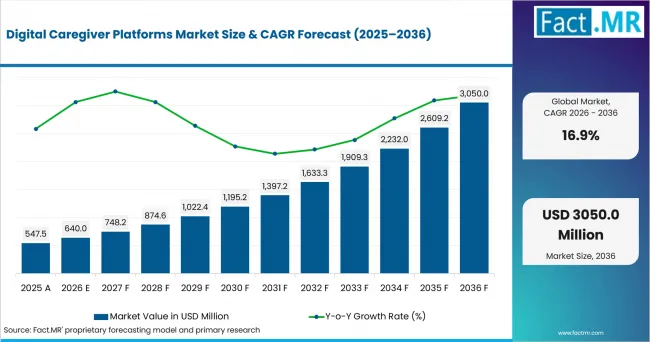
Digital Caregiver Platforms Market Value Analysis | Source: Fact.MR
What are the defining numbers behind Digital Caregiver Platforms Market growth?
USD 2,410.0 million absolute opportunity by 2036. Growth is led by Care coordination & scheduling and Older adults/dementia alongside Employer benefit and Employers.
- Demand Drivers in the Market
- Caregiving work is expected to move toward shared task records because relatives and service teams need the same daily view.
- Sponsors are expected to value platforms that reduce missed steps and help families reach support before care needs escalate.
- Service fragmentation is anticipated to raise demand for directories that place respite, aides and guidance inside one workflow.
- Employers are projected to review caregiver support beside absence and retention programs for working family caregivers.
- Key Segments Analyzed
- By Platform Function: Care coordination & scheduling is expected to hold 38.1% share in 2026 because shared calendars and tasks solve the first coordination problem families face.
- By Care Recipient: Older adults/dementia is projected to account for 37.4% share in 2026 since long-term dependency creates steady education and respite needs.
- By Sponsor Channel: Employer benefit is anticipated to capture 49.5% share in 2026 as workplace programs lower the first cost for users.
- By End User: Employers are estimated to represent 45.0% share in 2026 due to their ability to fund access for a defined workforce.
- Analyst Opinion at Fact.MR
- Shambhu Nath Jha states as Senior Analyst at Fact.MR, “Digital caregiver platforms have to reduce coordination work without creating another task for families. Enterprise adoption is expected to depend on verified service directories, clear consent workflows and human support when an app does not resolve the issue.”
- Strategic Implications
- Platform providers are expected to make benefits and financial navigation practical. This requirement fits aging-in-place orchestration services because families compare platforms by whether help is actually reached.
- Employers need clear measures before contracting. Sponsors are expected to use healthcare business intelligence to test whether claims and absence signals justify continued funding.
- Project leads need to protect directory accuracy and escalation handoffs. This point is relevant to digital transformation in healthcare because care-navigation tools lose trust when local service availability is outdated.
France is expected to record a 18.6% CAGR from 2026 to 2036, supported by public-program pathways and care-navigation demand. The USA is projected to record a 16.2% CAGR as employer and payer channels build larger funded access pools. Japan is anticipated to grow at 15.9% through aged-care coordination and family-support workflows. Germany is estimated to post a 14.7% CAGR where evidence review and data-protection expectations shape adoption. The UK is forecast at 14.4%, supported by service navigation needs and non-app support requirements.
How does the Digital Caregiver Platforms Market break down by segment?
Care coordination & scheduling is expected to lead Platform Function at 38.1% share in 2026. Older adults/dementia are projected to lead Care Recipient at 37.4% share in 2026.
Which platform function dominates?
Care coordination & scheduling is projected to account for 38.1% share in 2026.
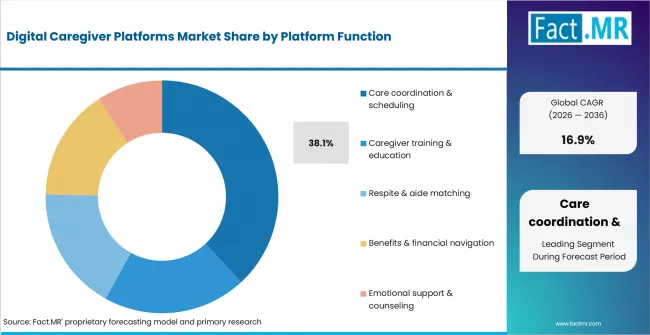
Digital Caregiver Platforms Market Analysis By Platform Function | Source: Fact.MR
Caregiving often starts with calendars and medicine reminders. Appointments and shared family tasks add to the same coordination load. A coordination layer is therefore expected to become the first daily-use function. Training and respite matching remain relevant because users need different help as care intensity changes. Benefit guidance and emotional support become more useful as care becomes harder to manage.
Which care recipient group leads?
Older adults/dementia is expected to hold 37.4% share in 2026.
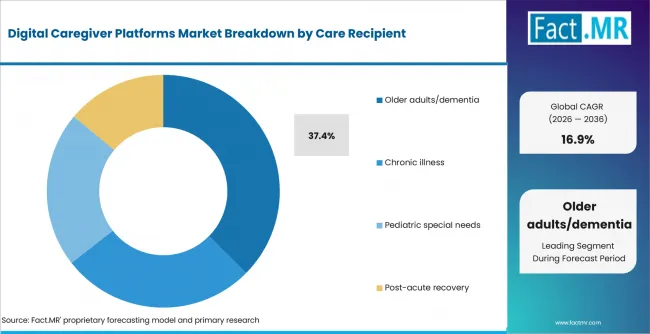
Digital Caregiver Platforms Market Analysis By Care Recipient | Source: Fact.MR
Older adults and dementia care create recurring needs across relatives and community services. This makes the segment the clearest starting point for platform adoption. Chronic illness, pediatric special needs and post-acute recovery remain addressable where families need structured handoffs and practical care education.
What leads the Sponsor Channel segment?
Employer benefit is anticipated to capture 49.5% share in 2026.
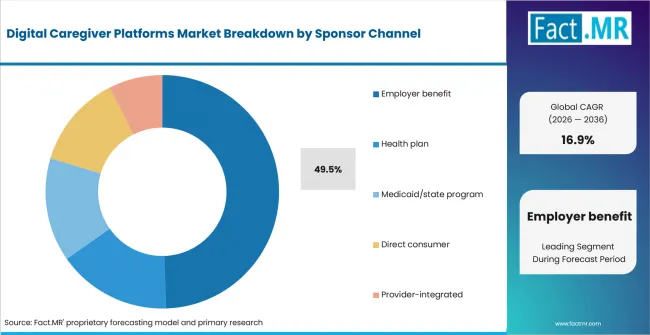
Digital Caregiver Platforms Market Analysis By Sponsor Channel | Source: Fact.MR
Employer sponsorship reduces upfront cost for workers and gives sponsors a defined population for rollout. Health plans and Medicaid or state programs are expected to expand where funding workflows are clear. Direct consumer channels and provider-integrated approaches are expected to follow referral readiness.
What supports Employers within End User?
Employers are forecast to hold 45.0% share in 2026.
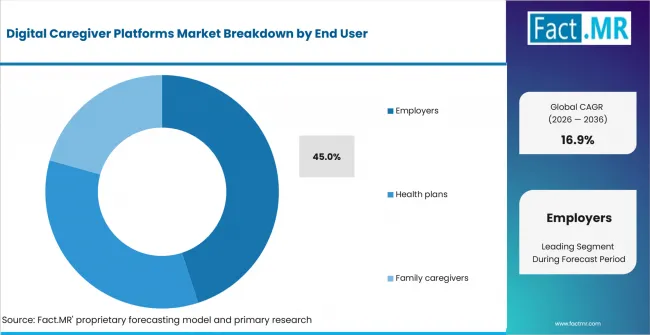
Digital Caregiver Platforms Market Analysis By End User | Source: Fact.MR
Employers lead because they purchase access for a known workforce and connect caregiver support with absence and retention programs. Health plans and family caregivers remain important users. Employer-led deployment is expected to give platforms faster scale in the base year.
What is accelerating Digital Caregiver Platforms Market adoption, and what is holding it back?
Demand is expected to be driven by population aging and caregiver strain. Adoption is expected to be held back by directory accuracy, digital exclusion and complex consent.
Drivers Impact Analysis
| DRIVER | (~) % IMPACT ON CAGR | GEOGRAPHIC RELEVANCE | IMPACT TIMELINE |
|---|---|---|---|
| Population aging | +3.1% | Global | Short term (<= 2 years) |
| Caregiver strain | +2.7% | Global | Short term (<= 2 years) |
| Fragmented services | +2.2% | Global | Medium term (2-4 years) |
| Employer productivity concerns | +1.8% | France and enterprise markets | Medium term (2-4 years) |
| Care navigation funding | +1.1% | Payer-funded markets | Long term (>= 4 years) |
Source: Fact.MR analysis. Updated Jul 25, 2026
- Population aging: More households are expected to coordinate care for older adults who need medical and daily-living support.
- Caregiver strain: Family careers often manage emotional pressure and service decisions without one place to organize them.
- Fragmented services: Families are expected to favor platforms that connect benefits, aides and respite without separate searches.
- Employer productivity concerns: Workplace sponsors are expected to compare caregiver support with absence and retention outcomes.
- Care navigation funding: Funded navigation programs are expected to improve platform access where payers want proof of closed-loop support.
Opportunity Impact Analysis
| OPPORTUNITY | (~) % IMPACT ON CAGR | GEOGRAPHIC RELEVANCE | IMPACT TIMELINE |
|---|---|---|---|
| Benefits and financial navigation | +1.5% | Global | Short term (<= 2 years) |
| Closed-loop referrals | +1.2% | France and USA | Medium term (2-4 years) |
| Accessible caregiver education | +0.9% | Global | Medium term (2-4 years) |
| Human-assisted service triage | +0.6% | Enterprise and payer markets | Long term (>= 4 years) |
Source: Fact.MR analysis. Updated Jul 25, 2026
- Benefits and financial navigation: Programs are expected to help families identify public and employer support before costs rise.
- Closed-loop referrals: Platforms are expected to gain value when they confirm whether referred services were actually reached.
- Accessible caregiver education: Short learning modules are expected to support families unable to attend formal training sessions.
- Human-assisted service triage: Coaching support is expected to separate platforms when a directory or app workflow does not solve the issue.
Restraints Impact Analysis
| RESTRAINT | (~) % IMPACT ON CAGR | GEOGRAPHIC RELEVANCE | IMPACT TIMELINE |
|---|---|---|---|
| Directory accuracy | -1.3% | Global | Short term (<= 2 years) |
| Digital exclusion | -1.0% | Regulated and payer-funded markets | Short term (<= 2 years) |
| Complex consent | -0.8% | Global | Medium term (2-4 years) |
| Proof of sustained value | -0.5% | Employer and payer channels | Long term (>= 4 years) |
Source: Fact.MR analysis. Updated Jul 25, 2026
- Directory accuracy: Outdated service availability is expected to weaken user trust and reduce follow-through after referral.
- Digital exclusion: Older users and low-connectivity households often need phone support or assisted navigation.
- Complex consent: Shared care information is expected to require clear authority and role-based access for each user.
- Proof of sustained value: Employers and payers are expected to request evidence that use continues after onboarding.
Which countries are scaling Digital Caregiver Platforms Market fastest?
The country comparison is defined less by the total CAGR range and more by the spacing between the markets. The difference between France and the UK is 4.22 percentage points. France occupies a separate upper position while the USA and Japan form a closely aligned pair. Germany and the UK create another compact cluster after a moderate step-down from Japan. This pattern reflects differences in sponsor access and care-service localization rather than a simple divide between mature and developing markets.
- France shows a notable position because public-program pathways can support structured care navigation and verified referrals. Its separation from the USA suggests that public funding routes may accelerate platform rollout beyond employer-led adoption.
- The USA remains close to Japan in CAGR terms but follows a different commercial route. Employer benefits and health-plan contracts create funded access pools that require evidence of service use and renewal value.
- Japan is positioned within the middle cluster through aged-care coordination and family-support workflows. Its rate resembles the USA although adoption depends more on local language design and assisted service channels.
- Germany records a measured position where privacy review and documented workflow value shape procurement. The moderate gap from Japan reflects a more cautious approval model rather than weaker caregiver demand.
- The UK stays closely aligned with Germany while relying more on care navigation and non-app support. Digital guidance must often be combined with human follow-up and accessible service information.
Comparable CAGRs can therefore create different market entry conditions. Deployment timing will depend on sponsor readiness and local service integration. Privacy requirements and assisted-navigation needs will also shape commercial preparation.
The full report provides country-level CAGR analysis across North America, Latin America, Europe, East Asia, South Asia, Oceania and the Middle East and Africa.
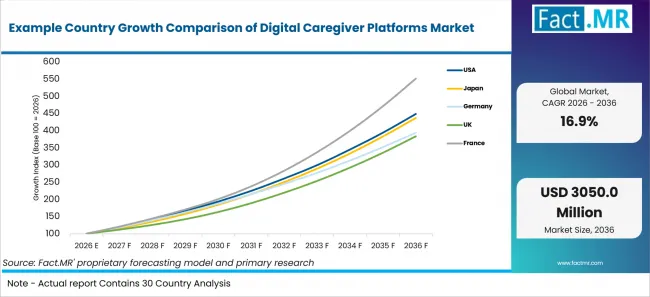
Example Country Growth Comparison Of Digital Caregiver Platforms Market | Source: Fact.MR
| Country | CAGR (2026-2036) |
|---|---|
| France | 18.6% |
| USA | 16.2% |
| Japan | 15.9% |
| Germany | 14.7% |
| UK | 14.4% |
Source: Fact.MR analysis. Updated Jul 25, 2026
What is driving France growth through 2036?
18.6% CAGR, supported by public-program pathways and digital care-navigation demand.
France is expected to lead the listed countries as funded care navigation becomes more useful for families managing older adults. Platform providers are expected to compete on directory accuracy and handoffs into local services. Adoption is projected to move fastest where care coordinators use one verified workflow.
Why does the USA remain a major market?
16.2% CAGR, shaped by employer benefit channels and payer-funded care support.
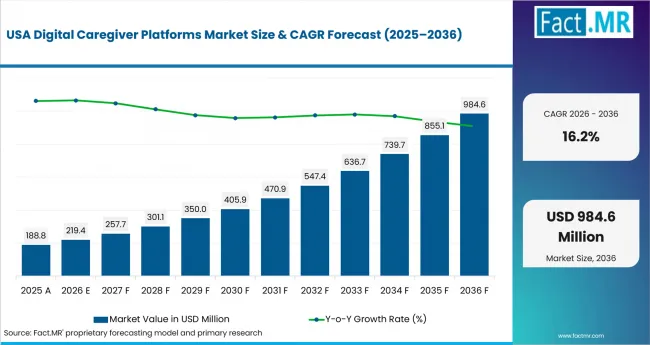
Digital Caregiver Platforms Market Country Value Analysis | Source: Fact.MR
The USA is projected to remain a high-value market because employers and health plans purchase caregiver support for large covered populations. These sponsors are expected to favor platforms that combine coaching and resource navigation. Vendors that prove service follow-through are expected to hold stronger renewal prospects.
What supports Japan demand?
15.9% CAGR, backed by aged-care coordination and family support workflows.
Japan is anticipated to expand through older-adult care needs that require practical family coordination. Platforms are expected to gain acceptance when they simplify appointments and care education. Local language design and assisted service channels are expected to matter because many caregivers share duties across generations.
What supports Germany?
14.7% CAGR, led by structured adoption and strict data-handling expectations.
Germany is estimated to grow through careful procurement where data protection and service evidence are reviewed before platform expansion. Employers and care organizations are expected to test whether tools improve coordination without adding administrative work. Stronger adoption is expected where platforms document clear roles for relatives and professionals.
What shapes UK growth?
14.4% CAGR, supported by care-navigation needs and access support for families.
The UK is forecast to grow as families look for clearer routes to care information and respite options. Platform adoption is expected to depend on simple interfaces and assisted navigation for users who do not rely only on apps. Providers that pair digital guidance with human follow-up are expected to stand out.
Who leads the Digital Caregiver Platforms Market?
Wellthy is among the prominent providers in this market. Cariloop and Papa also hold established positions, while Homethrive, ianacare and Careforth complete the listed provider group.
Competition is expected to center on verified service directories, human care guidance and payer-ready reporting. Wellthy’s employer and partner approach supports funded caregiver navigation. Cariloop and Homethrive compete more directly in employee-benefit channels. Papa and Careforth extend the market toward companion support and caregiver enablement.
Product differences are expected to depend on how effectively platforms connect family tasks with service outcomes. Links with senior technology services and elder-care products are relevant when platforms support older adults at home. Adjacent demand from adult day care and telemedicine also matters when care plans move between households and community services.
Providers are expected to face closer review of privacy, permission controls and escalation support as contracts move beyond pilot use. Platforms connected with digital therapeutics or predictive telehealth tools are also expected to clarify their limitations when families require licensed care or emergency assistance.
Which companies are the key providers?
Key companies include Wellthy; Cariloop; Papa; Homethrive; ianacare; and Careforth.
- Wellthy
- Cariloop
- Papa
- Homethrive
- ianacare
- Careforth
Bibliography
- Board of Governors of the Federal Reserve System. (2026, May). Living arrangements and care work. In Report on the economic well-being of U.S. households in 2025.
- Department for Business and Trade. (2026, January). Survey of employees and self-employed workers, 2024 to 2025.
- Department for Work and Pensions. (2026). Family Resources Survey: Financial year 2024 to 2025.
- Department of Health and Social Care. (2025, August 5). Survey of adult carers in England 2025 to 2026.
- Department of Health and Social Care, Department for Business and Trade, Department for Education, & Department for Work and Pensions. (2026, July 14). Unpaid carers action plan: Recognise, refer, reach.
This Report Answers
- The report provides strategic intelligence on the Digital Caregiver Platforms Market across Platform Function and Care Recipient choices that shape family support workflows.
- Segment analysis covers Care coordination & scheduling and Older adults/dementia as the share leaders within the 2026 market.
- Country outlook evaluates France and the USA alongside Japan and Germany. The UK completes the growth comparison across the profiled markets.
- Competitive analysis profiles Wellthy and Cariloop alongside Papa and Homethrive. ianacare and Careforth complete the provider set.
- Sponsor-channel assessment covers Employer benefit and Health plan programs. Medicaid or state programs and direct consumer access complete the channel view alongside provider-integrated routes.
What does the Digital Caregiver Platforms Market cover?
Digital caregiver platforms help family and unpaid caregivers organize care tasks, access support resources and find service help.
The Digital Caregiver Platforms Market covers software and guided support used for family-care coordination. Coverage extends to employer benefit and health-plan channels. Medicaid or state programs and provider-integrated routes are included where the platform supports non-clinical care coordination. The market does not count direct caregiver wages or facility-care services sold without a coordination layer.
The market differs from general healthcare apps because commercial value comes from reducing care coordination work for families. Generic directories remain outside the boundary. Standalone clinical devices are excluded. Unrelated wellness apps are excluded unless they directly support caregiver tasks and service follow-through.
What is included in the scope?
Digital caregiver platforms are used across employers and health plans. Public-program channels and family caregivers are included in the same scope.
The scope includes Platform Function and Care Recipient alongside Sponsor Channel and End User. Coverage spans care coordination and caregiver education. Respite matching and benefits navigation complete the function scope. It includes older adults and dementia. Chronic illness, pediatric special needs and post-acute recovery follow the same care-use rule.
What is excluded from the scope?
Standalone home-care labor and unrelated healthcare services remain outside the scope of this market.
The scope excludes senior housing and medical devices. Hospital care and claims administration are excluded. Generic directories are excluded when they do not manage caregiver workflows or service follow-through. Company revenue without a clear connection to caregiver coordination is excluded.
How Was the Analysis Built?
The analysis draws on 120+ sources, 35+ company portfolios, 25+ countries, and more than 20 industry interviews.
- Primary Research: Primary research includes discussions with manufacturers, service providers, technology developers, distributors, end users, procurement teams, and subject-matter experts. These conversations examine purchasing priorities, product adoption, operational challenges, approval requirements, competitive positioning, and the factors that influence wider market acceptance.
- Desk Research: Desk research covers government statistics, regulatory publications, company filings, trade data, technical studies, industry associations, standards, public policy, and other authoritative sources. Every source used in the analysis is documented in the bibliography.
- Market Sizing and Forecasting: Market estimates combine historical performance, demand indicators, pricing and volume trends, segment shares, company participation, country-level growth, adoption patterns, investment activity, and barriers to market expansion.
- Data Validation and Update Cycle: Findings are validated by comparing primary interviews with public data, company activity, regulatory changes, trade patterns, and industry developments. Regular updates review new product launches, capacity changes, partnerships, approvals, procurement trends, and shifts in commercial adoption.
Segmentation
What is the report’s scope and coverage?
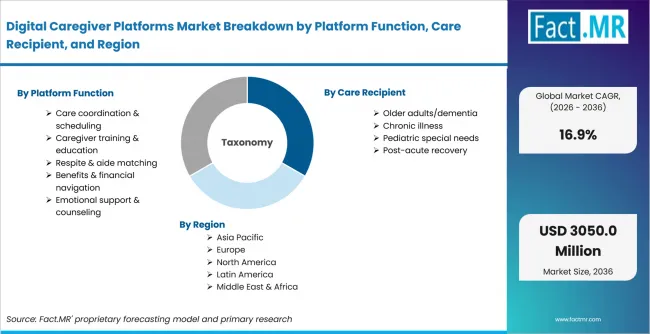
Digital Caregiver Platforms Market Breakdown By Platform Function, Care Recipient, And Region | Source: Fact.MR
| Attribute | Details |
|---|---|
| Quantitative Units | USD million in 2026 to USD million by 2036 at a CAGR |
| Market Definition | Digital platforms that help unpaid and family caregivers coordinate schedules and learn care tasks. They help users find respite or paid support and navigate benefits. Emotional support is included. |
| Platform Function | Care coordination & scheduling; Caregiver training & education; Respite & aide matching; Benefits & financial navigation; Emotional support & counseling |
| Care Recipient | Older adults/dementia; Chronic illness; Pediatric special needs; Post-acute recovery |
| Sponsor Channel | Employer benefit; Health plan; Medicaid/state program; Direct consumer; Provider-integrated |
| End User | Employers; Health plans; Family caregivers |
| Regions Covered | North America; Latin America; Europe; East Asia; South Asia and Pacific; Middle East and Africa |
| Countries Covered | France; USA; Japan; Germany; UK |
| Key Companies Profiled | Wellthy; Cariloop; Papa; Homethrive; ianacare; Careforth |
| Forecast Period | 2026 to 2036 |
| Approach | Hybrid top-down and bottom-up approach using caregiver support spending; employer benefit design; payer and public-program access; care coordination functions; service directory needs; consent requirements; family caregiver workflows; country adoption patterns and company portfolio review |
Source: Fact.MR analysis. Updated Jul 25, 2026
How is the market segmented?
-
By Platform Function:
- Care coordination & scheduling
- Caregiver training & education
- Respite & aide matching
- Benefits & financial navigation
- Emotional support & counseling
-
By Care Recipient:
- Older adults/dementia
- Chronic illness
- Pediatric special needs
- Post-acute recovery
-
By Sponsor Channel:
- Employer benefit
- Health plan
- Medicaid/state program
- Direct consumer
- Provider-integrated
-
By End User:
- Employers
- Health plans
- Family caregivers
-
By Region:
- North America
- Latin America
- Europe
- East Asia
- South Asia and Pacific
- Middle East and Africa
Frequently Asked Questions
Which Platform Function leads the market?
Which Care Recipient category leads the market?
Which Sponsor Channel leads the market?
Which End User leads the market?
Which country records the highest listed CAGR?
What is the primary driver in this market?
What is the main restraint?
Why do employers lead demand?
Who worked on this report


Preview the report firsthand - request a free sample
Free SampleGet the brochure for pricing and purchase details
Download PDF