- Market Value (2025): USD 259.8 Mn
- Estimated Value (2026): USD 305.0 Mn
- Forecast Value (2036): USD 1520.0 Mn
- CAGR (2026-2036): 17.4%
What is the Digital Fertility Coaching Market forecast to be worth by 2036?
USD 305.0 million in 2026 to USD 1,520.0 million by 2036 at 17.4% CAGR.
- The digital fertility coaching market reached USD 259.8 million in 2025.
- Demand is projected to increase from USD 305.0 million in 2026 to USD 1,520.0 million by 2036.
- The market is forecast to record 17.4% CAGR from 2026 to 2036 through clearer fertility guidance and employer-funded access.
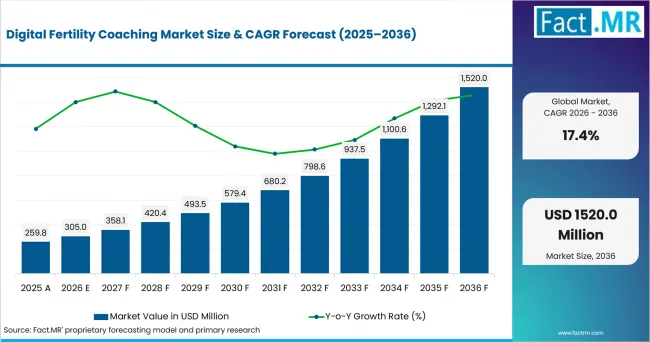
Digital Fertility Coaching Market Value Analysis | Source: Fact.MR
What are the defining numbers behind Digital Fertility Coaching Market growth?
USD 1,215.0 million absolute opportunity is expected by 2036. Preconception planning and 1:1 coach sessions lead the forecast with Employer benefit and Employers.
- Demand Drivers in the Market
- Users enter fertility care with uneven knowledge about testing and treatment. Coaching is expected to make early decisions easier before users meet a clinician.
- Fertility care often involves IVF and IUI. Medication and donor options add more decision steps. Digital guidance is expected to help users understand the order of care steps.
- Employer-sponsored access is expected to make coaching easier to fund. Sponsors still need programs that keep education separate from medical advice.
- Emotional support remains part of the care pathway. Digital programs are expected to help users manage waiting periods and next-step decisions without replacing clinicians.
- Key Segments Analyzed
- By Coaching Focus: Preconception planning is expected to hold 43.9% share in 2026 when users seek guidance before formal treatment begins.
- By Delivery Model: 1:1 coach sessions are projected to account for 38.6% share in 2026 when personal history and benefit rules need direct guidance.
- By Sponsor: Employer benefit is anticipated to capture 54.5% share in 2026 since employers fund access and connect coaching with fertility benefits.
- By End User: Employers are forecast to hold 34.7% share in 2026 through organized sponsorship for defined working populations.
- Analyst Opinion at Fact.MR
- Shambhu Nath Jha, Sr. Consultant at Fact.MR, states, “Digital fertility coaching providers must make the boundary between education and clinical advice visible. Employer and clinic adoption is expected to depend on qualified human support and clear referral practice.”
- Strategic Implications
- Practical male fertility support strengthens the service design. Inclusive coaching is expected to support evaluation and behavior change for both partners.
- Sponsors can assess clear performance measures before contracting. Service reviews can cover coach qualifications, referral quality, privacy practices and benefits-navigation accuracy.
- Implementation teams can establish explicit controls for coaching claims. Programs may overpromise outcomes when coaching cannot address every clinical cause of infertility.
The Human Fertilisation and Embryology Authority reported in June 2026 that NHS-funded IVF cycles accounted for 28% of UK IVF cycles in 2024. Funding variation reinforces the need for benefit navigation and care-pathway guidance, especially when users must compare public, private and employer-supported routes before treatment decisions.
Country growth remains strongest in employer-funded and benefit-navigation markets. The USA leads the profiled country set at 16.9% CAGR from 2026 to 2036, followed by the UK at 16.2% as fertility pathways and evidence expectations shape service design. Canada is forecast at 15.9% where provincial coverage differences make local guidance important. Germany is expected to record 15.4% as employers and care partners emphasize evidence review and information-security discipline, while Japan is projected at 14.9% through clinically cautious adoption and localized coaching design.
How does the Digital Fertility Coaching Market break down by segment?
Preconception planning is expected to lead Coaching Focus at 43.9% share in 2026. 1:1 coach sessions are projected to lead Delivery Model at 38.6% share in 2026.
Which coaching focus dominates?
Preconception planning is projected to account for 43.9% share in 2026.
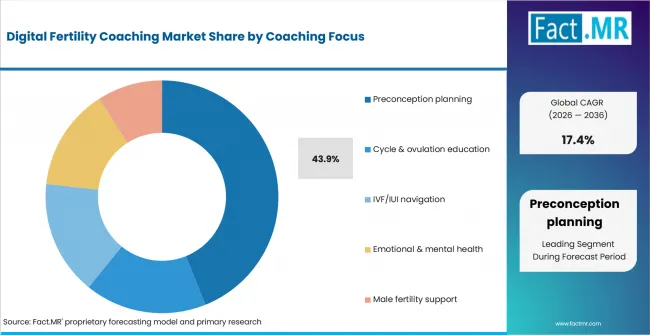
Digital Fertility Coaching Market Analysis By Coaching Focus | Source: Fact.MR
Preconception planning leads the category when users need education before treatment starts. Cycle and ovulation education supports timing decisions. IVF/IUI navigation supports higher-intensity care. Emotional and mental health coaching helps users manage stress during waiting periods. Male fertility support expands the path when programs are designed for both partners.
What leads the Delivery Model segment?
1:1 coach sessions are expected to hold 38.6% share in 2026.
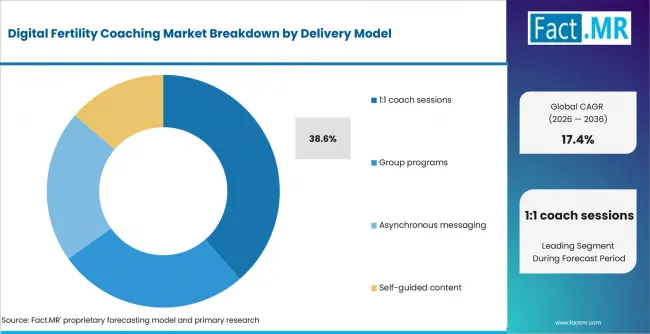
Digital Fertility Coaching Market Analysis By Delivery Model | Source: Fact.MR
Individual sessions are valuable when fertility history and benefit rules vary by user. Personal decisions often need a private discussion. Group programs help scale education when users share similar questions. Asynchronous messaging supports quick questions between appointments. Self-guided content remains useful when users need simple explanations before speaking with a coach.
How does Sponsor shape demand?
Employer benefit is anticipated to lead with 54.5% share in 2026.
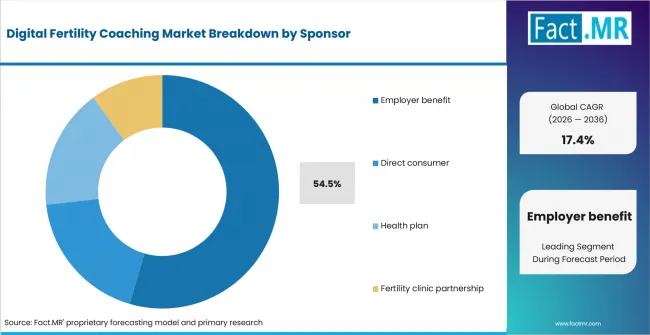
Digital Fertility Coaching Market Analysis By Sponsor | Source: Fact.MR
Sponsorship lowers the immediate cost of access and joins coaching with funded fertility services. Direct consumer demand remains relevant for users outside employer plans. Health plans are expected to add coaching when navigation lowers confusion. Fertility clinic partnerships support continuity when education prepares users for appointments.
What supports Employers within End User?
Employers are forecast to hold 34.7% share in 2026.
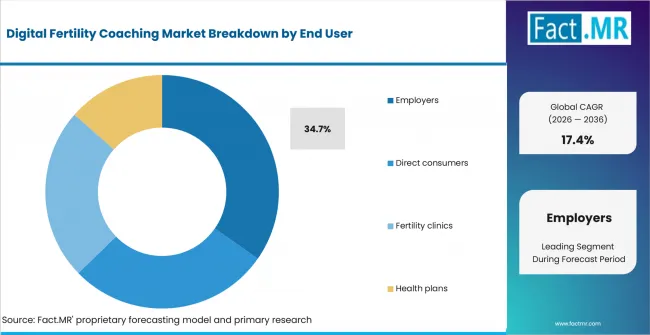
Digital Fertility Coaching Market Analysis By End User | Source: Fact.MR
Employers lead demand through access funded for a defined population. Coaching can work beside wider wellbeing programs. Direct consumers create demand when users pay for guidance themselves. Fertility clinics use coaching to prepare patients for treatment decisions. Health plans are expected to use navigation when reproductive benefits need clearer use pathways.
What is accelerating Digital Fertility Coaching Market adoption, and what is holding it back?
Demand is expected to be driven by high infertility burden and complex treatment navigation. Adoption is expected to be held back by unregulated coaching claims and benefit inequity.
Drivers Impact Analysis
| DRIVER | (~) % IMPACT ON CAGR | GEOGRAPHIC RELEVANCE | IMPACT TIMELINE |
|---|---|---|---|
| High infertility burden | +4.0% | Global | Short term (<= 2 years) |
| Complex treatment navigation | +3.7% | Global | Short term (<= 2 years) |
| Employer fertility benefits | +2.5% | USA and enterprise markets | Medium term (2-4 years) |
| Emotional support need | +1.8% | Global | Medium term (2-4 years) |
Source: Fact.MR analysis. Updated Jul 27, 2026
- High infertility burden: Fertility challenges are expected to keep navigation needs high when users need education before testing or treatment.
- Complex treatment navigation: Testing and treatment choices often become difficult to coordinate. Coaching is expected to make the sequence easier to understand.
- Employer fertility benefits: Sponsors use coaching and navigation to make funded services easier to access. Contracting is expected to favor clear escalation rules.
- Emotional support need: Trying to conceive and undergoing treatment is expected to create stress that brief visits do not fully address.
Opportunity Impact Analysis
| OPPORTUNITY | (~) % IMPACT ON CAGR | GEOGRAPHIC RELEVANCE | IMPACT TIMELINE |
|---|---|---|---|
| Male fertility support | +1.5% | Global | Short term (<= 2 years) |
| Clinic-connected navigation | +1.1% | USA and UK | Medium term (2-4 years) |
| Post-treatment transitions | +0.8% | Global | Medium term (2-4 years) |
Source: Fact.MR analysis. Updated Jul 27, 2026
- Male fertility support: Inclusive programs are expected to address evaluation and behavior for both partners without placing the full care burden on women.
- Clinic-connected navigation: Shared education and appointment preparation are expected to improve continuity. The coach still needs to stay outside diagnosis and prescribing.
- Post-treatment transitions: Programs support pregnancy and donor pathways. They support adoption decisions or treatment cessation when users need guidance after a cycle ends.
Restraints Impact Analysis
| RESTRAINT | (~) % IMPACT ON CAGR | GEOGRAPHIC RELEVANCE | IMPACT TIMELINE |
|---|---|---|---|
| Unregulated coaching claims | -1.3% | Global | Short term (<= 2 years) |
| Benefit inequity | -0.9% | Employer-funded markets | Medium term (2-4 years) |
| Sensitive personal information | -0.7% | Global | Medium term (2-4 years) |
Source: Fact.MR analysis. Updated Jul 27, 2026
- Unregulated coaching claims: Programs risk overpromising outcomes when coaching cannot change every clinical cause of infertility.
- Benefit inequity: Employer-funded access is expected to leave out contractors, smaller firms and people outside formal employment.
- Sensitive personal information: Reproductive plans and relationship details require strict privacy controls. Poor handling is expected to slow sponsor approval.
Which countries are scaling Digital Fertility Coaching Market fastest?
The country comparison is defined by how fertility support is paid for and how digital services fit local care pathways. The spread between the USA and Japan is 2.00 percentage points. The USA and UK form the upper pair because employer sponsorship and digital access expectations support earlier commercialization. Canada follows through localized referral and privacy requirements. Germany and Japan create a more measured cluster where evidence review and clinical oversight shape provider selection.
- The USA shows a notable position through employer-sponsored fertility benefits that support earlier access.
- The UK remains close to the USA in CAGR terms but depends more on fit with regulated fertility pathways.
- Canada’s position reflects provincial delivery differences that reward localized referrals and coverage explanations.
- Germany holds a measured position where procurement is expected to require clearer evidence and information-security discipline.
- Japan stands outside the upper cluster where structured clinical oversight is expected to guide adoption timing.
Comparable CAGRs are expected to create different market entry conditions across these countries. Deployment timing depends on sponsor readiness, coach qualification and referral boundaries. Commercial readiness reflects local privacy and clinical-supervision expectations.
The full report provides country-level CAGR analysis across North America, Latin America, Europe, East Asia, South Asia, Oceania and the Middle East and Africa.
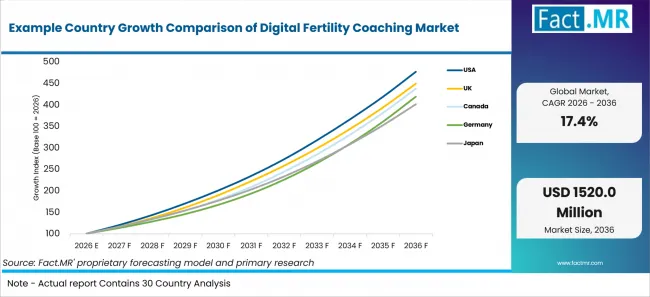
Example Country Growth Comparison Of Digital Fertility Coaching Market | Source: Fact.MR
| Country | CAGR (2026-2036) |
|---|---|
| USA | 16.9% |
| UK | 16.2% |
| Canada | 15.9% |
| Germany | 15.4% |
| Japan | 14.9% |
Source: Fact.MR analysis. Updated Jul 27, 2026
Why does employer-sponsored fertility access shape demand in the USA?
16.9% CAGR, supported by employer sponsorship and benefit-navigation demand.
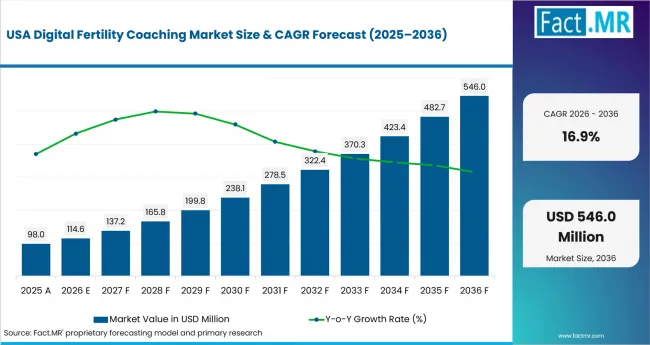
Digital Fertility Coaching Market Country Value Analysis | Source: Fact.MR
The USA’s digital fertility coaching market is developing around employer-funded fertility and family-building benefits. Coaching becomes valuable when employees need help understanding eligibility, treatment coverage and the steps required before contacting a fertility clinic. This gives providers a defined route into the market through workplace benefit programs rather than depending only on direct consumer subscriptions.
How do regulated fertility pathways shape demand in the UK?
16.2% CAGR, supported by digital access and pathway-fit requirements.
The UK market is shaped by fertility pathways in which treatment access, funding eligibility and clinical decisions can vary across local care systems. Digital coaching can help users prepare for consultations, understand treatment stages and identify the questions they need to raise before entering formal fertility care. Providers must still fit within the country’s regulated fertility environment rather than operating as independent treatment advisers.
Why does provincial variation influence fertility coaching demand in Canada?
15.9% CAGR, backed by provincial variation and privacy-led localization.
Canada’s fertility coaching demand is tied to differences in coverage, referral routes and treatment access across provinces. Users may face different funding rules and clinic pathways depending on where they live, creating a practical need for localized guidance before they begin testing or assisted reproductive treatment.
What makes evidence and information security central to Germany’s market?
15.4% CAGR, driven by evidence review and information-security expectations.
Germany’s market is developing around formal evaluation of digital health services and careful treatment of sensitive reproductive information. Employers and healthcare organizations are likely to examine whether coaching programs have qualified staff, documented escalation procedures and a clearly defined educational role.
Why does clinical oversight shape digital fertility coaching in Japan?
14.9% CAGR, led by clinical oversight and careful localization.
Japan’s market is shaped by a healthcare environment in which fertility decisions remain closely connected to licensed medical professionals. Digital coaching can support users by explaining treatment steps, preparing them for consultations and helping them manage the emotional pressure associated with fertility care.
Who leads the Digital Fertility Coaching Market?
Maven Clinic, Progyny, Carrot Fertility and Kindbody are among the main providers in the Digital Fertility Coaching Market. Their services cover employer fertility benefits, care guidance, diagnostics, clinic access and family-building support.
Maven Clinic offers early fertility support through diagnostics and guided care pathways. Progyny provides fertility and family-building benefit services. Carrot Fertility supports employers and members through fertility navigation and global care access. Kindbody combines digital support with fertility clinic services. Fertility Out Loud, sponsored by Ferring Pharmaceuticals Inc., offers free fertility coaching in partnership with Frame.
Competition is likely to focus on coach experience, privacy protection, referral quality and benefit-plan support. Providers that keep coaching separate from medical advice and clearly guide users toward clinical care are expected to build stronger trust with employers, health plans and fertility clinics.
Which companies are the key providers?
Key companies include Maven Clinic and Progyny. Carrot Fertility and Kindbody are included. Ferring Pharmaceuticals Inc. completes the provider set.
- Maven Clinic
- Progyny
- Carrot Fertility
- Kindbody
- Ferring Pharmaceuticals Inc.
How is the market segmented?
-
By Coaching Focus:
- Preconception planning
- Cycle & ovulation education
- IVF/IUI navigation
- Emotional & mental health
- Male fertility support
-
By Delivery Model:
- 1:1 coach sessions
- Group programs
- Asynchronous messaging
- Self-guided content
-
By Sponsor:
- Employer benefit
- Direct consumer
- Health plan
- Fertility clinic partnership
-
By End User:
- Employers
- Direct consumers
- Fertility clinics
- Health plans
-
By Region:
- North America
- Latin America
- Europe
- East Asia
- South Asia and Pacific
- Middle East and Africa
Bibliography
- Human Fertilisation and Embryology Authority. (2026, June 16).
- Maven Clinic. (2026, April 13).
- Progyny, Inc. (2026, February 27). U.S. Securities and Exchange Commission.
- The Cigna Group. (2025, March 13).
- Kindbody. (2026, February 12).
- Fertility Out Loud. (n.d.). Free fertility coaching in partnership with Frame; sponsored by Ferring Pharmaceuticals Inc.
This Report Answers
- The report provides strategic intelligence on the Digital Fertility Coaching Market across Coaching Focus and Delivery Model choices that shape user guidance programs.
- Segment analysis covers Preconception planning and 1:1 coach sessions as the share leaders within the 2026 market.
- Country outlook evaluates the USA and UK alongside Canada and Germany. Japan completes the growth comparison across the profiled markets.
- Competitive analysis profiles Maven Clinic and Progyny alongside Carrot Fertility and Kindbody. Ferring Pharmaceuticals Inc. completes the provider set.
- Service assessment covers employer benefit sponsorship and direct consumer access. Health plan and fertility clinic partnership models complete the sponsor view.
What does the Digital Fertility Coaching Market cover?
Digital fertility coaching services are used before and during fertility care.
The market covers services used for preconception planning, ovulation education, IVF/IUI navigation, emotional support and male fertility support. Coverage extends to 1:1 sessions, group programs, messaging and self-guided content. Employer benefit, direct consumer, health plan and fertility clinic partnership models are included when coaching supports education, navigation and referral readiness.
What is included in the scope?
The scope includes services that help users understand fertility care and prepare for next steps.
Included services support benefits navigation, appointment preparation, emotional support, education and referral readiness. Coverage spans employer-funded, consumer-paid, health plan and clinic partnership models. Coaching content is included when it supports structured guidance and clear escalation to licensed care.
What is excluded from the scope?
The scope excludes medical diagnosis, prescribing and clinical treatment delivery.
Coaching does not replace physician evaluation, lab testing, procedure delivery or embryo laboratory work. Technology platforms that only track cycles without human or structured coaching support are outside the main scope. General wellness content is excluded unless it directly supports fertility-care preparation.
How Was the Analysis Built?
The analysis draws on 120+ sources, 35+ company portfolios, 25+ countries, and more than 20 industry interviews.
- Primary Research: Primary research includes discussions with manufacturers, service providers, technology developers, distributors, end users, procurement teams, and subject-matter experts. These conversations examine purchasing priorities, product adoption, operational challenges, approval requirements, competitive positioning, and the factors that influence wider market acceptance.
- Desk Research: Desk research covers government statistics, regulatory publications, company filings, trade data, technical studies, industry associations, standards, public policy, and other authoritative sources. Every source used in the analysis is documented in the bibliography.
- Market Sizing and Forecasting: Market estimates combine historical performance, demand indicators, pricing and volume trends, segment shares, company participation, country-level growth, adoption patterns, investment activity, and barriers to market expansion.
- Data Validation and Update Cycle: Findings are validated by comparing primary interviews with public data, company activity, regulatory changes, trade patterns, and industry developments. Regular updates review new product launches, capacity changes, partnerships, approvals, procurement trends, and shifts in commercial adoption.
Segmentation
What is the report’s scope and coverage?
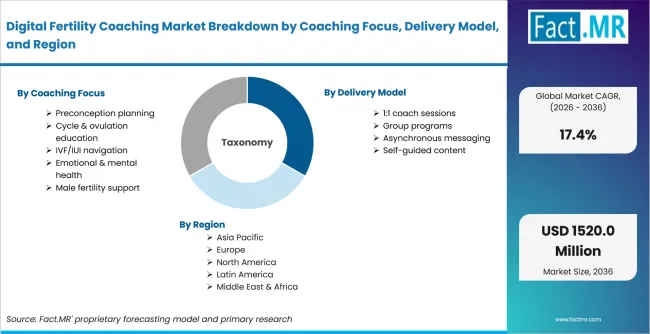
Digital Fertility Coaching Market Breakdown By Coaching Focus, Delivery Model, And Region | Source: Fact.MR
| Attribute | Details |
|---|---|
| Quantitative Units | USD 305.0 million in 2026 to USD 1,520.0 million by 2036 at 17.4% CAGR |
| Market Definition | Digital coaching services that help individuals and couples understand fertility, prepare for conception, navigate testing and assisted reproduction, and manage treatment-related decisions. |
| Coaching Focus | Preconception planning; Cycle & ovulation education; IVF/IUI navigation; Emotional & mental health; Male fertility support |
| Delivery Model | 1:1 coach sessions; Group programs; Asynchronous messaging; Self-guided content |
| Sponsor | Employer benefit; Direct consumer; Health plan; Fertility clinic partnership |
| End User | Employers; Direct consumers; Fertility clinics; Health plans |
| Regions Covered | North America; Latin America; Europe; East Asia; South Asia and Pacific; Middle East and Africa |
| Countries Covered | USA; UK; Canada; Germany; Japan |
| Key Companies Profiled | Maven Clinic; Progyny; Carrot Fertility; Kindbody; Ferring Pharmaceuticals Inc. |
| Forecast Period | 2026 to 2036 |
| Approach | Hybrid top-down and bottom-up approach using fertility-care pathway mapping; employer benefit channels; clinic referral patterns; digital coaching delivery models; privacy expectations; country adoption patterns and company portfolio review |
Source: Fact.MR analysis. Updated Jul 27, 2026
Frequently Asked Questions
Which Coaching Focus leads the market?
Which Delivery Model leads the market?
Which Sponsor category leads the market?
Which End User leads the market?
Which country records the highest listed CAGR?
What is the primary driver in this market?
What is the main restraint?
Why do employers lead demand?
Who worked on this report


Preview the report firsthand - request a free sample
Free SampleGet the brochure for pricing and purchase details
Download PDF