- Base Value(2025): 86.8 Bn
- Estimated Value(2026): 99.4 Bn
- Forecast Value (2036): 385.0 Bn
- CAGR (2026 - 2036): 14.5%
Digital Transformation in Healthcare Market Forecast and Outlook By Fact.MR
In 2025, the digital transformation in healthcare market was valued at USD 86.8 billion. Based on Fact.MR analysis, demand for digital transformation in healthcare solutions is estimated to grow to USD 99.4 billion in 2026 and USD 385.0 billion by 2036. FACT.MR projects a CAGR of 14.5% during the forecast period.
Between 2026 and 2036, the market is projected to create an absolute dollar opportunity of USD 285.6 billion. This transformational expansion reflects accelerating AI diagnostics deployment, cloud-based EHR adoption in emerging markets, and mandatory electronic health record and interoperability regulation across developed economies. Growth is moderated by healthcare IT integration complexity with legacy clinical systems, patient data privacy compliance costs under HIPAA, GDPR, and national health data laws, and cybersecurity investment requirements driven by rising ransomware targeting of hospital infrastructure. The digital transformation in healthcare market is expanding rapidly as hospital systems accelerate AI and cloud adoption to improve clinical outcomes and operational efficiency.
Country growth reflects national health digitisation programmes, AI regulatory frameworks, and hospital IT investment. China leads at 15.4% CAGR driven by national health informatisation programme investment and AI diagnostics deployment. The United States follows at 15.0% supported by federal interoperability mandates and AI-powered clinical tool adoption. South Korea records 14.6% through digital health national programme investment. Japan grows at 14.0% driven by digital health promotion strategy implementation. Germany advances at 13.6% through the Hospital Future Act digital investment programme. The United Kingdom posts 13.0%, with NHS digital transformation investment constrained by capital budget competition and legacy system complexity.
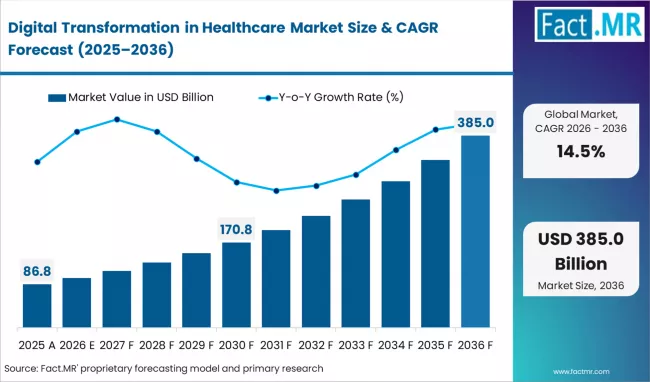
Digital Transformation In Healthcare Market Market Value Analysis | Source: Fact.MR
| Metric | Value |
|---|---|
| Estimated Value in 2026 | USD 99.4 billion |
| Forecast Value in 2036 | USD 385.0 billion |
| Forecast CAGR (2026 to 2036) | 14.5% |
Source: Fact.MR analysis. Updated Mar 16, 2026
Market Definition of Digital Transformation in Healthcare
The digital transformation in healthcare market includes technologies that modernise healthcare operations such as electronic health records, AI diagnostics, cloud data systems, IoT monitoring, big data analytics, and cybersecurity platforms used by hospitals, pharma companies, and insurers.
Market Inclusions
Includes global and regional forecasts from 2026-2036 by solution, organisation size, technology, and end user covering healthcare software, AI diagnostics, cloud EHR, IoT monitoring, analytics, and cybersecurity solutions.
Market Exclusions
Excludes standalone medical devices without digital software, pharmaceutical manufacturing technologies not linked to health IT, and general enterprise software not designed for healthcare workflows.
Research Methodology
- Primary Research: Interviews with hospital CIOs, clinical informatics leaders, pharma digital health managers, healthcare IT procurement teams, and insurance technology executives.
- Desk Research: Sources include CMS healthcare IT regulations, NHS digital transformation programmes, national health IT strategies, FDA AI software guidance, and company financial reports.
- Market Sizing and Forecasting: Hybrid model using healthcare IT spending, hospital EHR deployment data, AI medical device market statistics, and government digital health investment by country.
- Data Validation and Update Cycle: Forecasts validated using company revenue reports, CMS healthcare adoption statistics, NHS digital spending records, and expert interviews.
Summary of Digital Transformation in Healthcare Market
- Market Definition
- The digital transformation in healthcare market includes AI diagnostics, cloud EHR systems, IoT patient monitoring, data analytics, and cybersecurity platforms used across healthcare organizations.
- Demand Drivers
- US interoperability mandates under the 21st Century Cures Act require hospitals and insurers to deploy FHIR-compliant digital health platforms.
- Rapid FDA approvals for AI-powered diagnostic and clinical decision support tools are enabling hospitals to implement automated clinical workflows.
- Increasing ransomware attacks on healthcare systems are driving stronger cybersecurity investment to protect patient data infrastructure.
- Key Segments Analyzed
- By Solution: Software holds about 75% share in 2026 due to strong demand for SaaS EHR systems, AI diagnostics platforms, and analytics software.
- By End User: Hospitals and clinics account for about 45% share in 2026 as they are the largest healthcare IT buyers.
- By Technology: Artificial intelligence is the fastest-growing segment due to rapid adoption in diagnostics, clinical decision support, and drug discovery.
- Analyst Opinion at FACT.MR
- Shambhu Nath Jha, Senior Research Analyst at Fact.MR, states that the highest investment opportunities lie in FDA-approved AI clinical tools, FHIR-compliant cloud EHR infrastructure, and healthcare cybersecurity platforms meeting global compliance standards.
- Strategic Implications
- Healthcare IT companies should pursue FDA clearance and UK NICE validation to qualify for hospital procurement and reimbursement programmes.
- Vendors should develop FHIR-compliant APIs to support interoperability requirements across US and European healthcare systems.
- Cybersecurity providers should obtain ISO 27001 and HITRUST certifications to meet hospital infrastructure security standards.
- Methodology
- Market sizing used healthcare IT spending and EHR adoption data validated with company financial reports and CMS statistics.
- National digital health programmes, FDA AI device approvals, and NHS funding data supported demand analysis.
- Forecasts incorporated AI adoption trends, cloud EHR migration timelines, government digital health investment, and interviews with healthcare IT leaders.
Segmental Analysis
Digital Transformation in Healthcare Market Analysis by Solution
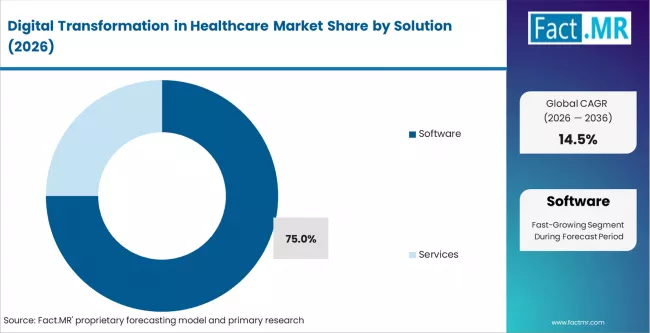
Digital Transformation In Healthcare Market Analysis By Solution | Source: Fact.MR
According to FACT.MR, software is projected to hold about 75% share in 2026 because SaaS EHR systems, AI diagnostics platforms, analytics software, and cybersecurity tools generate recurring subscription revenue.
- Oracle Health Cloud Investment: Oracle reported in December 2024 that Oracle Health cloud revenue grew 17% year-over-year due to hospital EHR cloud migration projects across North America and the Middle East. [5]
- Epic AI Integration Technology: In November 2024, Epic introduced Epic Cosmos AI features including automated clinical documentation and AI-assisted prior authorisation within its EHR platform. [6]
- Healthcare Software Adoption Trend: The US ONC Health IT Dashboard reported that 96% of US hospitals have adopted certified EHR technology and 64% use AI-enabled clinical decision support tools. [7]
Digital Transformation in Healthcare Market Analysis by End User
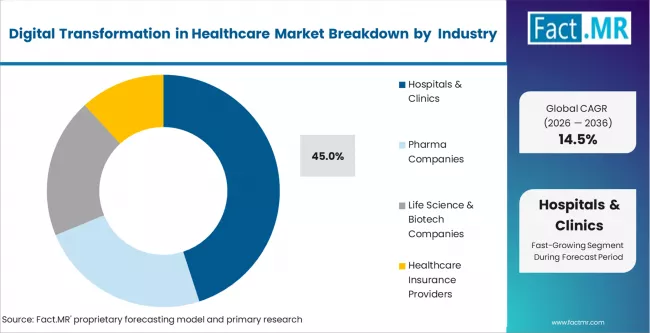
Digital Transformation In Healthcare Market Analysis By End Use | Source: Fact.MR
Based on FACT.MR's digital transformation in healthcare market report, Hospitals & Clinics are estimated to hold 45% share in 2026.
- Cerner (Oracle Health) Hospital Investment: In November 2024, Oracle Health completed the first phase of the NHS England national EHR rollout, deploying Oracle Health Millennium across Humber Teaching NHS Foundation Trust, a landmark programme serving as a reference deployment for subsequent NHS trust EHR contracts in the UK's national digital transformation programme. [8]
- Teladoc Health Telehealth Technology: In August 2024, Teladoc Health launched Primary360 integrated primary care with AI-assisted chronic condition management, targeting healthcare insurers and employer health plans seeking digital care alternatives that reduce hospital visit frequency while maintaining clinical quality for chronic disease management. [9]
- Pharma Digital Health Trend: Medtronic's fiscal Q2 2025 earnings supplement published in November 2024 disclosed that its connected device and remote monitoring platform revenue grew 14% year-over-year, driven by pharma and life science company adoption of integrated device-and-data digital health platforms for clinical trial monitoring and real-world evidence collection. [10]
Drivers, Restraints, and Opportunities
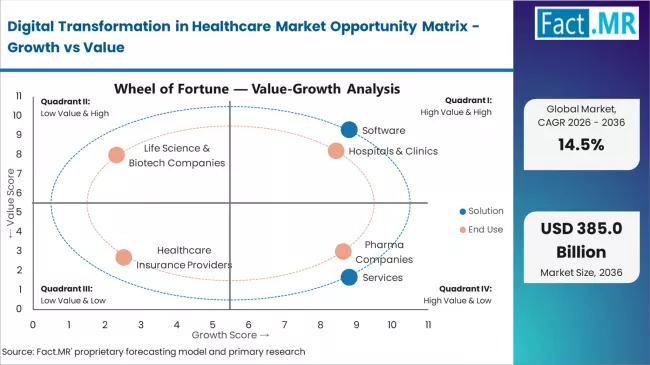
Digital Transformation In Healthcare Market Opportunity Matrix Growth Vs Value | Source: Fact.MR
FACT.MR analysts observe that the digital transformation in healthcare market is driven by long-term EHR adoption and rapid growth of AI and cloud platforms across global healthcare systems.
Government mandates and public funding programmes such as the US Meaningful Use initiative and Germany’s Hospital Future Act have created sustained demand for healthcare IT infrastructure. The market is shifting from basic digitization like EHR deployment toward advanced technologies including AI diagnostics, predictive analytics, and automated patient monitoring.
- US 21st Century Cures Act: The information blocking rule requires healthcare providers and EHR vendors to provide FHIR-based API access to patient data. This regulation is increasing hospital investment in interoperability platforms from vendors such as Epic and Oracle Health. [2]
- Germany Hospital Future Act: Germany’s KHZG programme allocated EUR 4.3 billion for hospital digital upgrades between 2021 and 2025. Hospitals are now entering long-term software maintenance and AI upgrade cycles after completing funded digital infrastructure deployments. [3]
- China National Health Informatisation: China’s National Health Commission reported that 95% of tertiary hospitals now use electronic medical records and is expanding AI diagnostics deployment to 10,000 county hospitals under the Healthy China 2030 programme. [4]
Regional Analysis
The digital transformation in healthcare market is analysed across Asia Pacific, Europe, North America, Latin America, and Middle East and Africa, covering 40+ countries with distinct demand profiles shaped by national health digitization programme maturity, AI regulatory frameworks, hospital IT infrastructure readiness, and healthcare insurance digitization investment. The full report offers market attractiveness analysis based on government digital health programme investment timelines and AI clinical tool regulatory clearance benchmarks.
.webp "Top Country Growth Comparison Digital Transformation In Healthcare Market Cagr (2026 2036)")
Top Country Growth Comparison Digital Transformation In Healthcare Market Cagr (2026 2036) | Source: Fact.MR
| Country | CAGR (2026-2036) |
|---|---|
| China | 15.4% |
| United States | 15.0% |
| South Korea | 14.6% |
| Germany | 13.6% |
| Japan | 14.0% |
| United Kingdom | 13.0% |
Source: Fact.MR analysis. Updated Mar 16, 2026
Source: Fact.MR (FACT.MR) analysis, based on proprietary forecasting model and primary research
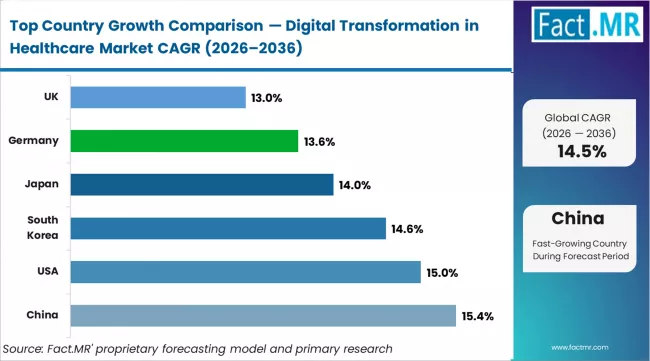
Digital Transformation In Healthcare Market Cagr Analysis By Country | Source: Fact.MR
Asia Pacific Digital Transformation in Healthcare Market Analysis
East Asia is one of the fastest-growing regions for healthcare digital transformation due to large government investment programmes and advanced hospital IT modernisation. Global technology providers and domestic vendors compete across AI diagnostics, hospital information systems, and remote monitoring technologies.
- China: China’s digital healthcare transformation market is projected to expand at 15.4% CAGR through 2036. The National Health Commission’s Healthy China 2030 initiative targets AI diagnostic deployment in 10,000 county hospital imaging centres. Siemens Healthineers reported strong growth in China AI imaging contracts across oncology and cardiology departments. Alibaba Cloud’s ET Medical Brain platform has supported over 200 million AI-assisted diagnoses across more than 1,400 hospitals.
- South Korea: Demand for South Korea’s digital healthcare sector is expected to record 14.6% CAGR through 2036. The Ministry of Health and Welfare expanded its Digital Healthcare Innovation Strategy with additional funding for AI and cloud health IT systems. National K-FHIR interoperability standards require public hospitals to adopt compatible EHR systems. Private investment is also growing, highlighted by Kakao Healthcare securing major funding for integrated digital health platforms.
- Japan: Japan’s digital healthcare transformation market is forecast to grow at 14.0% CAGR through 2036. The government’s Medical Digital Transformation Programme has accelerated nationwide electronic health record sharing through the My Health Record digital ID system. NEC reported strong growth in healthcare AI contracts for hospital diagnostic systems. Fujitsu also introduced AI clinical documentation solutions in leading hospital networks.
FACT.MR’s analysis of the digital transformation in healthcare market in Asia Pacific consists of country-wise assessment that includes China, Japan, South Korea, India, ASEAN, Australia and New Zealand, and Rest of South Asia and Pacific. Readers can find country CAGR forecasts, national health digitisation investment data, AI diagnostics regulatory benchmarks, and technology adoption trends by end-user segment.
Europe Digital Transformation in Healthcare Market Analysis
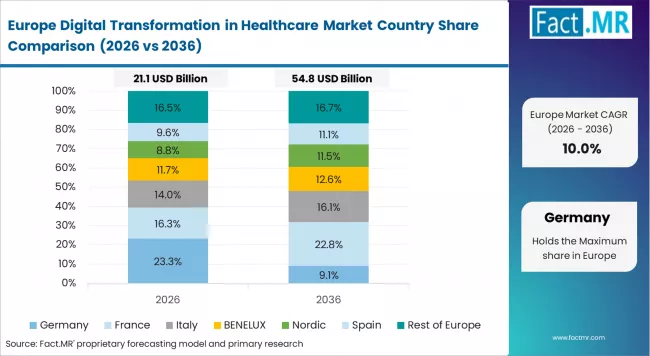
Digital Transformation In Healthcare Market Europe Country Market Share Analysis, 2026 & 2036 | Source: Fact.MR
Europe’s healthcare digital transformation market is shaped by strict regulatory frameworks including GDPR data protection, the EU AI Act for medical software, and national digital health investment programmes. Large healthcare technology vendors maintain strong positions through regulatory-certified platforms and hospital partnerships.
- Germany: Germany’s digital healthcare transformation demand is anticipated to grow at 13.6% CAGR through 2036. The KHZG hospital digital funding programme allocated EUR 4.3 billion for healthcare IT upgrades across nearly 1,900 hospitals. Hospitals are now entering new procurement cycles for AI clinical tools and EHR upgrades. Germany’s Digital Health Act has also expanded reimbursement pathways for AI-enabled medical software.
- United Kingdom: The United Kingdom digital healthcare transformation market is estimated to increase at 13.0% CAGR through 2036. NHS England’s national EHR programme selected Oracle Health as the primary vendor for system-wide deployment across NHS trusts. Updated MHRA guidelines have accelerated regulatory approval for AI diagnostic software. Genomics England programmes are also expanding digital health analytics investment for precision medicine research.
FACT.MR’s analysis of the digital transformation in healthcare market in Europe consists of country-wise assessment that includes Germany, France, the United Kingdom, Italy, Spain, Nordic countries, BENELUX, and Rest of Western Europe. Readers can find KHZG investment tracking, EU AI Act medical device classification benchmarks, NHS procurement data, and country-level forecasts by solution and technology.
North America Digital Transformation in Healthcare Market Analysis
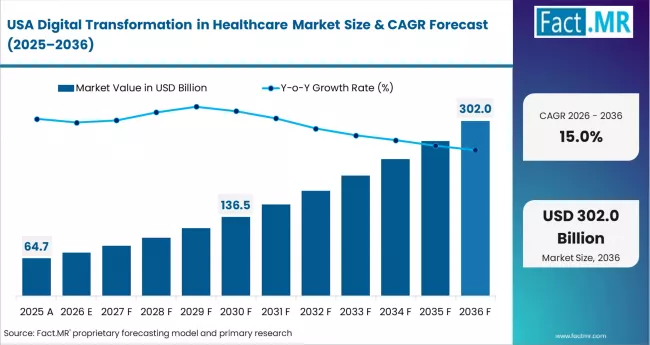
Digital Transformation In Healthcare Market Country Value Analysis | Source: Fact.MR
North America represents the largest investment region for healthcare digital transformation due to strong government interoperability mandates, value-based care reimbursement models, and widespread EHR adoption. Major technology vendors provide integrated clinical, cloud, and analytics platforms for healthcare organisations.
- United States: The digital transformation in healthcare market in the United States is expected to grow at 15.0% CAGR through 2036. The ONC HTI-1 Final Rule requires EHR systems to support predictive clinical decision support technologies including AI tools. Epic reported rapid adoption of its Cosmos AI documentation system across major hospital networks. Population health analytics platforms are also expanding through CMS value-based care programmes such as the ACO REACH model.
FACT.MR’s analysis of the digital transformation in healthcare market in North America consists of country-wise assessment that includes the United States, Canada, and Mexico. Readers can find interoperability mandate compliance data, CMS digital health investment benchmarks, FDA AI medical device approval statistics, and country-level forecasts by solution and end user.
Competitive Aligners for Market Players
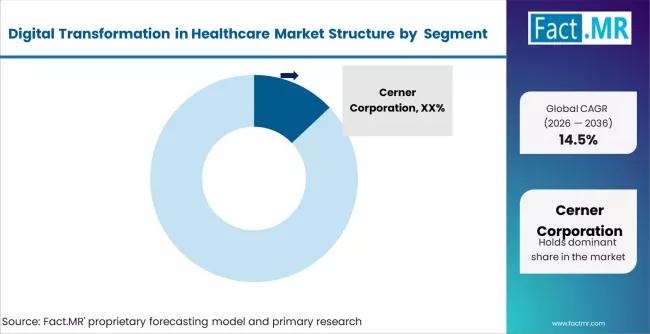
Digital Transformation In Healthcare Market Analysis By Company | Source: Fact.MR
The global digital transformation in healthcare market is led by a few major enterprise platform providers, particularly in the electronic health record (EHR) segment. Epic Systems and Oracle Health (formerly Cerner) dominate the hospital EHR market in the United States and maintain strong positions internationally. In contrast, the AI diagnostics and specialty healthcare software segment is more fragmented, with companies such as Siemens Healthineers, GE HealthCare, and Philips Healthcare competing alongside numerous AI medical technology startups.
Increasingly, competition is determined not just by software features but by proven clinical outcomes, regulatory approvals, and peer-reviewed research. Hospitals now expect technologies to have clear FDA clearance, NICE evaluation, or comparable regulatory validation before adoption.
Epic Systems has a strong competitive advantage because its platform integrates multiple hospital functions, including clinical records, billing, pharmacy management, and patient engagement. This deep integration makes switching systems complex and time-consuming for hospitals. Oracle Health benefits from combining EHR solutions with Oracle’s cloud infrastructure and enterprise management tools. Meanwhile, companies like Siemens Healthineers integrate AI analytics directly into imaging systems, embedding digital tools into everyday clinical workflows and strengthening their role in modern healthcare technology ecosystems.
Key Players
- Cerner Corporation
- Epic Systems Corporation
- GE Healthcare
- Siemens Healthineers
- Philips Healthcare
- IBM Watson Health
- Medtronic
- Oracle Health
- Teladoc Health
- Amazon Web Services
Bibliography
- [1] Office of the National Coordinator for Health Information Technology. (2024). 21st Century Cures Act Information Blocking Rule Enforcement Update: CMS Audit Programme and FHIR API Compliance Requirements for EHR Developers and Healthcare Providers. October 2024.
- [2] Federal Ministry of Health, Germany. (2024). Krankenhauszukunftsgesetz (KHZG) Programme Status Report: Hospital Digital Investment Disbursement Completion, Eligible Hospital Participation, and Post-Programme Procurement Cycle Outlook. November 2024.
- [3] National Health Commission, People's Republic of China. (2025). 2025 Digital Health Priorities and Healthy China 2030 AI Diagnostics Deployment Target: County Hospital AI Imaging Centre Programme and NHC Informatisation Roadmap. January 2025.
- [4] Oracle Corporation. (2024). Q2 Fiscal Year 2025 Earnings Supplement: Oracle Health Segment Cloud Revenue Growth Detail, NHS England Deployment Phase Completion, and Middle East EHR Contract Performance. December 2024.
- [5] Epic Systems Corporation. (2024). Customer Conference Materials: Epic Cosmos AI Ambient Documentation Feature Deployment Status, Health System Client Adoption Rate, and AI-Assisted Prior Authorisation Launch. November 2024.
- [6] Office of the National Coordinator for Health Information Technology. (2024). Health IT Dashboard 2024: Certified EHR Adoption Rate Among US Non-Federal Acute Care Hospitals, AI Clinical Decision Support Deployment Statistics, and Interoperability Performance Data. December 2024.
- [7] Oracle Health. (2024). Press Release: NHS England National EHR Programme Phase One Completion at Humber Teaching NHS Foundation Trust Oracle Health Millennium Deployment Milestone Update. November 2024.
- [8] Teladoc Health Inc. (2024). Product Launch: Primary360 AI-Assisted Chronic Condition Management for Healthcare Insurers and Employer Health Plans Integrated Virtual Primary Care and Digital Care Navigation. August 2024.
- [9] Medtronic plc. (2024). Q2 Fiscal Year 2025 Earnings Supplement: Connected Device and Remote Monitoring Platform Revenue Growth, Pharma and Life Science Digital Health Contract Expansion. November 2024. investorrelations.
This Report Addresses
- Strategic insights on US interoperability mandates, Germany KHZG hospital digital funding, China AI diagnostics deployment plans, NHS national EHR procurement, and EU AI Act regulations shaping healthcare digital transformation.
- Market forecast from USD 99.4 billion in 2026 to USD 385.0 billion by 2036 at 14.5% CAGR across solution, organisation size, technology, and end-user segments.
- Growth opportunities across China’s AI imaging hospital programme, US value-based care IT mandates, Germany AI reimbursement pathways, NHS EHR rollout, and Japan’s My Health Record digital ID system.
- Country CAGR outlook including China 15.4%, United States 15.0%, South Korea 14.6%, Japan 14.0%, Germany 13.6%, and United Kingdom 13.0%, supported by national health IT investment and AI regulations.
- Competitive analysis of Cerner (Oracle Health), Epic Systems, GE HealthCare, Siemens Healthineers, Philips Healthcare, IBM Watson Health, Medtronic, Teladoc Health, and Amazon Web Services.
- Technology tracking covering FDA-cleared AI diagnostics, ambient clinical documentation tools, FHIR R4 interoperability platforms, healthcare cybersecurity systems, IoT patient monitoring, and cloud EHR migration.
- Regulatory analysis of US ONC HTI-1 certification rules, EU AI Act medical AI standards, MHRA AI device pathways, Germany DiGA and DigiG reimbursement systems, and China health IT standards.
- Report delivered in PDF, Excel datasets, PowerPoint summary, and dashboard formats supported by healthcare IT adoption data, company reports, government programmes, and primary industry interviews.
Segmentation
Scope of Report
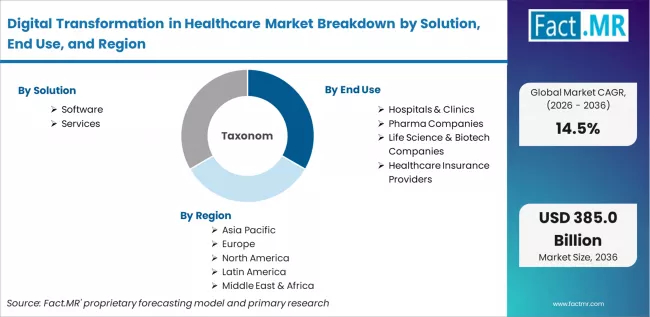
Digital Transformation In Healthcare Market Breakdown By Solution, End Use, And Region | Source: Fact.MR
| Attribute | Details |
|---|---|
| Quantitative Units | USD 99.4 billion (2026) to USD 385.0 billion (2036), at a CAGR of 14.5% |
| Market Definition | Adoption of digital technologies including AI, cloud computing, IoT, big data analytics, and cybersecurity to modernise clinical workflows, patient care, and healthcare operations. |
| Solution Segmentation | Software, Services |
| Organization Size Segmentation | Small and Medium-Sized Enterprises, Large Enterprises |
| Technology Segmentation | Artificial Intelligence, Cloud Computing, Big Data & Analytics, Internet of Things, Cybersecurity |
| End User Segmentation | Hospitals & Clinics, Pharma Companies, Life Science & Biotech Companies, Healthcare Insurance Providers |
| Application Coverage | Electronic health records, AI diagnostics, remote patient monitoring, clinical decision support, drug discovery analytics, population health management, and healthcare cybersecurity. |
| Regions Covered | Asia Pacific, Europe, North America, Latin America, Middle East and Africa |
| Countries Covered | China, Japan, South Korea, India, Australia and New Zealand, ASEAN, Rest of South Asia and Pacific, Germany, UK, France, Italy, Spain, Nordic, BENELUX, Rest of Western Europe, Russia, Poland, Hungary, USA, Canada, Mexico, Brazil, Chile, Ecuador, Rest of Latin America, Saudi Arabia, GCC, Turkey, South Africa, Rest of MEA |
| Key Companies Profiled | Cerner Corporation, Epic Systems Corporation, GE Healthcare, Siemens Healthineers, Philips Healthcare, IBM Watson Health, Medtronic, Oracle Health, Teladoc Health, Amazon Web Services |
| Forecast Period | 2026 to 2036 |
| Approach | Hybrid top-down and bottom-up model using healthcare IT spending data, hospital EHR deployment volumes, AI diagnostics contract values, and primary interviews with hospital CIOs and healthcare technology procurement leads. |
Source: Fact.MR analysis. Updated Mar 16, 2026
Digital Transformation in Healthcare Market by Segments
-
By Solution:
- Software
- Services
-
By Organization Size:
- Small and Medium-Sized Enterprises
- Large Enterprises
-
By Technology:
- Artificial Intelligence
- Cloud Computing
- Big Data & Analytics
- Internet of Things
- Cybersecurity
-
By End User:
- Hospitals & Clinics
- Pharma Companies
- Life Science & Biotech Companies
- Healthcare Insurance Providers
-
By Region:
- North America
- United States
- Canada
- Mexico
- Latin America
- Brazil
- Chile
- Ecuador
- Rest of Latin America
- Western Europe
- Germany
- United Kingdom
- France
- Italy
- Spain
- Nordic
- BENELUX
- Rest of Western Europe
- Eastern Europe
- Russia
- Poland
- Hungary
- Balkan and Baltic
- Rest of Eastern Europe
- East Asia
- China
- Japan
- South Korea
- South Asia and Pacific
- India
- ASEAN
- Australia and New Zealand
- Rest of South Asia and Pacific
- Middle East and Africa
- Kingdom of Saudi Arabia
- Other GCC Countries
- Turkey
- South Africa
- Other African Union
- Rest of Middle East and Africa
- North America
Frequently Asked Questions
How large is the digital transformation in healthcare market in 2025?
What will the market size be in 2026?
What is the projected market size by 2036?
What is the expected CAGR?
Which solution segment leads the market?
Which end-user segment holds the largest share?
Which technology is the fastest growing?
Which country shows the fastest growth?
What is the projected growth rate of the digital transformation in healthcare market in the United States?
How fast is the digital transformation in healthcare market growing in South Korea?
What CAGR is forecast for the digital healthcare transformation market in Germany?
What is the expected CAGR for digital transformation in healthcare in Japan?
What growth rate is projected for the United Kingdom’s digital healthcare transformation market?
Who worked on this report


Preview the report firsthand - request a free sample
Free SampleGet the brochure for pricing and purchase details
Download PDF